Mutant Fixation for a Stochastic Evolutionary Model in Fragmented Populations
Pith reviewed 2026-06-26 05:38 UTC · model grok-4.3
The pith
Rare migration reduces high-dimensional stochastic evolution in fragmented populations to a lower-dimensional Markov chain on fully mutant and wild-type demes.
A machine-rendered reading of the paper's core claim, the machinery that carries it, and where it could break.
Core claim
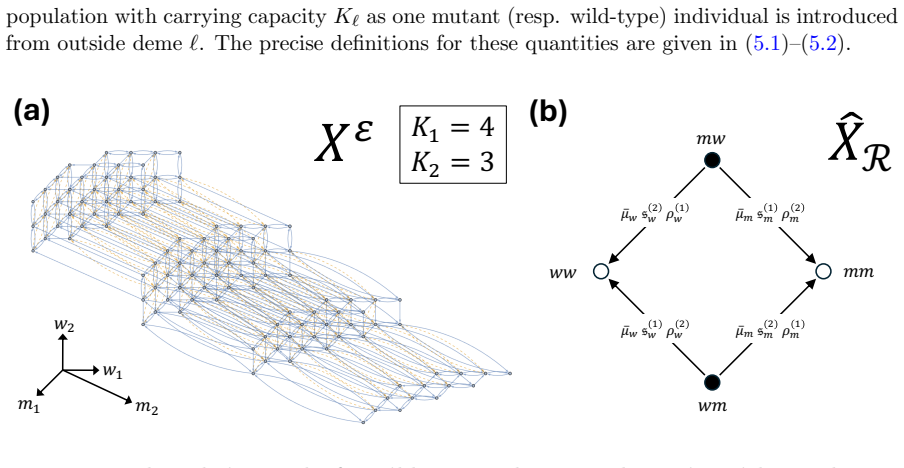
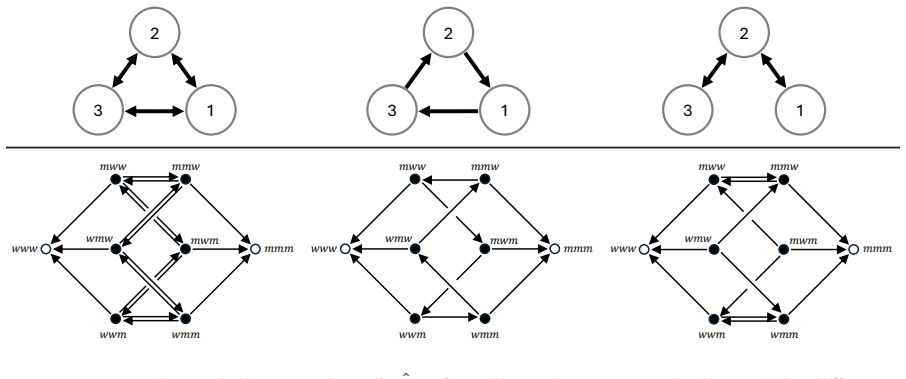
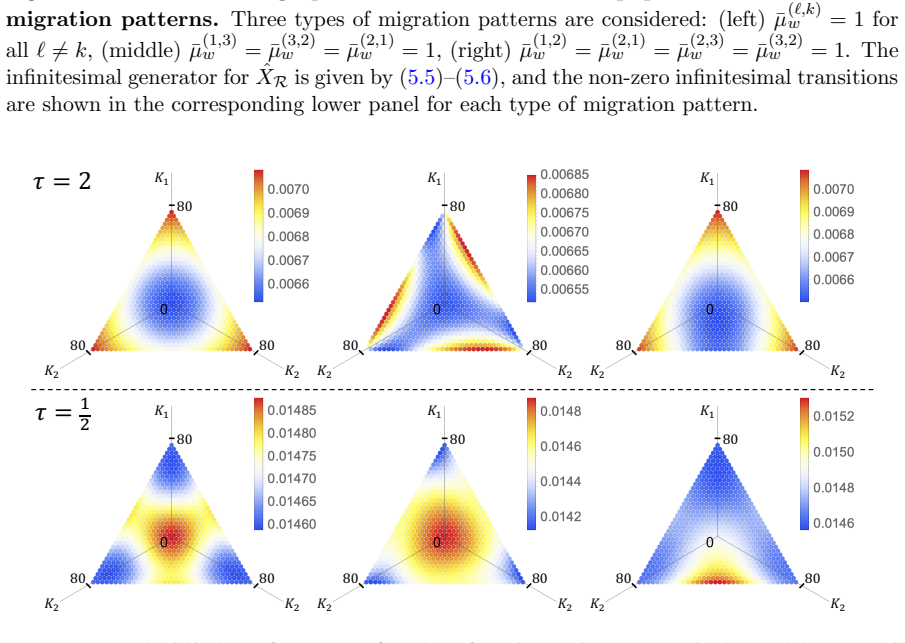
In the limit where migration occurs on a much slower timescale than within-deme dynamics, the full stochastic process can be reduced to a lower-dimensional Markov chain whose states correspond to configurations of fully mutant and fully wild-type demes. The reduction theorem establishes that fixation probabilities and absorption times of the original process are asymptotically determined by the corresponding quantities of the reduced chain. The framework accommodates heterogeneous deme sizes, deme-dependent birth and death processes, and migration on arbitrary strongly connected directed networks with asymmetric rates.
What carries the argument
The reduced Markov chain on configurations of fully mutant and fully wild-type demes, obtained by timescale separation from the original high-dimensional process.
If this is right
- Fixation probabilities for any initial configuration can be read off from the reduced chain rather than the original high-dimensional process.
- Absorption times likewise follow from the reduced chain.
- Explicit closed-form expressions become available for single-mutant fixation on arbitrary migration networks.
- The same reduction applies to directed asymmetric migration graphs and to demes of unequal sizes.
Where Pith is reading between the lines
- The method supplies a systematic way to compare fixation outcomes across different network topologies without simulating the full process.
- It opens the possibility of analyzing how changes in network connectivity or deme-size distribution alter long-term evolutionary outcomes.
- The reduction may serve as a building block for models that include occasional deme extinction or recolonization events.
Load-bearing premise
Migration occurs on a much slower timescale than within-deme birth and death dynamics.
What would settle it
For a small number of demes, compute fixation probabilities both from direct simulation of the full birth-death-migration process at very small migration rate and from the reduced chain; the two should agree in the limit.
Figures
read the original abstract
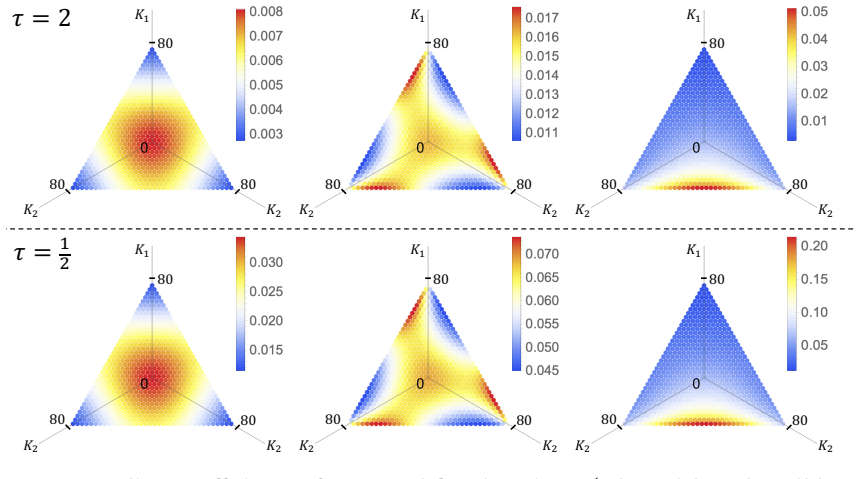
Population fragmentation is a common feature of many biological systems. Understanding mutant fixation in such systems is challenging because the underlying stochastic dynamics are high-dimensional. In this work, we develop a general mathematical framework for analyzing stochastic evolution in fragmented populations connected by rare migration. The framework is sufficiently general to accommodate heterogeneous deme sizes, deme-dependent birth and death processes, and migration on arbitrary strongly connected directed networks with asymmetric migration rates. We show that, in the limit where migration occurs on a much slower timescale than within-deme dynamics, the full stochastic process can be reduced to a lower-dimensional Markov chain whose states correspond to configurations of fully mutant and fully wild-type demes. The reduction theorem establishes that fixation probabilities and absorption times of the original process are asymptotically determined by the corresponding quantities of a reduced chain. As an application, we derive explicit formulas for mutant fixation probabilities and fixation times in fragmented populations initiated by the introduction of a single mutant. The results provide a general and tractable approach for studying evolutionary dynamics in complex fragmented populations.
Editorial analysis
A structured set of objections, weighed in public.
Referee Report
Summary. The manuscript develops a general framework for stochastic evolutionary dynamics in fragmented populations connected by rare migration on arbitrary strongly connected directed networks, allowing heterogeneous deme sizes and deme-dependent birth-death processes. It establishes a reduction theorem showing that in the slow-migration limit (migration timescale much slower than within-deme absorption), the high-dimensional continuous-time Markov chain reduces to a lower-dimensional chain whose states are the 2^K configurations of fully mutant or fully wild-type demes; fixation probabilities and mean absorption times of the original process converge to those of the reduced chain. Explicit formulas are derived for the single-mutant initiation case.
Significance. If the reduction holds with the stated generality, the work supplies a mathematically rigorous and computationally tractable method for computing fixation quantities in complex metapopulations that would otherwise require simulation of high-dimensional processes. The approach leverages standard singular-perturbation techniques for Markov chains on product spaces and yields explicit results without fitted parameters, which is a clear strength for applications in population genetics.
major comments (2)
- [Abstract / main reduction theorem] The reduction theorem is the central claim, but the abstract (and presumably the theorem statement) does not specify the precise mode of convergence or error bounds for absorption times; without these, it is difficult to confirm that the asymptotic equivalence holds uniformly for all initial conditions and network structures.
- [Reduction theorem statement and proof] The proof of the reduction relies on the migration graph being strongly connected to ensure the reduced chain is irreducible; this hypothesis must be shown to be necessary and sufficient for the occupation measure to concentrate on mono-type states, with a concrete counter-example if the graph is only weakly connected.
minor comments (2)
- [Application section] Clarify whether the explicit formulas for single-mutant fixation require solving a linear system on the reduced chain or admit a fully closed form independent of network size.
- [Model definition] Notation for the migration rates and birth-death parameters should be introduced with a single consistent table or list to avoid ambiguity when demes are heterogeneous.
Simulated Author's Rebuttal
We thank the referee for their careful reading, positive assessment of the work, and constructive suggestions. We address each major comment below and will incorporate clarifications via minor revisions.
read point-by-point responses
-
Referee: [Abstract / main reduction theorem] The reduction theorem is the central claim, but the abstract (and presumably the theorem statement) does not specify the precise mode of convergence or error bounds for absorption times; without these, it is difficult to confirm that the asymptotic equivalence holds uniformly for all initial conditions and network structures.
Authors: The reduction theorem establishes that, as the migration rate ε → 0, the fixation probabilities converge to those of the reduced chain and the scaled mean absorption times (multiplied by ε) converge to the corresponding reduced-chain quantities. This follows from standard singular-perturbation analysis on the product-space Markov chain and holds uniformly over initial conditions that share the same mono-type deme configuration. To address the request for explicitness, we will revise the abstract and Theorem 3.1 to state the mode of convergence (convergence of probabilities and of scaled expectations) and add a remark on the O(ε) error bounds that are uniform under the maintained strong-connectivity hypothesis. revision: yes
-
Referee: [Reduction theorem statement and proof] The proof of the reduction relies on the migration graph being strongly connected to ensure the reduced chain is irreducible; this hypothesis must be shown to be necessary and sufficient for the occupation measure to concentrate on mono-type states, with a concrete counter-example if the graph is only weakly connected.
Authors: Strong connectivity is used to guarantee that the reduced chain on the 2^K mono-type configurations is irreducible on its transient states, which is required for the occupation measure to concentrate on the two global absorbing states. The assumption is both necessary and sufficient: without it the network decomposes into strongly connected components whose fixation events are independent. We will add a short discussion of necessity together with the following concrete counter-example: two demes with a single directed migration A → B but no return path. The reduced chain then admits additional absorbing states in which A is mutant and B is wild-type (or vice versa), so the occupation measure fails to concentrate on global mono-type configurations. revision: yes
Circularity Check
No significant circularity
full rationale
The paper derives a reduction theorem for a continuous-time Markov chain on a product space of demes by invoking a standard singular-perturbation argument under an explicit separation-of-timescales hypothesis (migration rate ε→0 while intra-deme absorption rates remain O(1)). The resulting convergence of fixation probabilities and mean absorption times to those of the embedded jump chain on mono-type configurations follows directly from the model assumptions, the strong connectivity of the migration graph, and finite deme sizes; no parameter is fitted to data and then re-used as a prediction, no self-citation supplies a load-bearing uniqueness theorem, and the central claim is not equivalent to its inputs by definition. The derivation is therefore self-contained against external mathematical benchmarks for averaging principles on Markov processes.
Axiom & Free-Parameter Ledger
axioms (1)
- domain assumption Migration occurs on a much slower timescale than within-deme dynamics
Reference graph
Works this paper leans on
-
[1]
and Fu, Yi and Del Vecchio, Domitilla and Williams,Ruth J
Bruno, Simone and Campos, Felipe A. and Fu, Yi and Del Vecchio, Domitilla and Williams,Ruth J. , title=. SIAM Journal on Applied Dynamical Systems , year=
-
[2]
and Filar, Jerzy A
Avrachenkov, Konstantin E. and Filar, Jerzy A. and Howlett, Phil G. , year =. Analytic Perturbation Theory and Its Applications , ISBN =
-
[3]
and Helton, J
Hughes, Jared A. and Helton, J. William and Schlosser, Peter , keywords =. The discrete Laplace asymptotic method and its application to the 3XOR satisfiability problem , publisher =. 2025 , copyright =
2025
-
[4]
1997 , publisher=
Principles of population genetics , author=. 1997 , publisher=
1997
-
[5]
2004 , publisher=
Mathematical population genetics: theoretical introduction , author=. 2004 , publisher=
2004
-
[6]
and Wodarz, Dominik , title=
Komarova, Natalia L. and Wodarz, Dominik , title=. Nature Communications , year=
-
[7]
, title=
Lieberman, Erez and Hauert, Christoph and Nowak, Martin A. , title=. Nature , year=
-
[8]
Reviews of nonlinear dynamics and complexity , volume=
Stochastic evolutionary game dynamics , author=. Reviews of nonlinear dynamics and complexity , volume=. 2009 , publisher=
2009
-
[9]
Nature , volume=
Evolutionary dynamics on any population structure , author=. Nature , volume=. 2017 , publisher=
2017
-
[10]
Genetics Research , volume=
On the fixation probability of mutant genes in a subdivided population , author=. Genetics Research , volume=. 1970 , publisher=
1970
-
[11]
Evolution , pages=
Fixation probabilities and fixation times in a subdivided population , author=. Evolution , pages=. 1981 , publisher=
1981
-
[12]
Journal of The Royal Society Interface , volume=
Counterintuitive properties of the fixation time in network-structured populations , author=. Journal of The Royal Society Interface , volume=. 2014 , publisher=
2014
-
[13]
Scientific Reports , volume=
Fixation probabilities in network structured meta-populations , author=. Scientific Reports , volume=. 2021 , publisher=
2021
-
[14]
and Quince, Christopher , title=
Parsons, Todd L. and Quince, Christopher , title=. Theoretical Population Biology , year =
-
[15]
and Quince, Christopher , title=
Parsons, Todd L. and Quince, Christopher , title=. Theoretical Population Biology 72 , year=
-
[16]
and Quince, Christopher and Plotkin, Joshua B
Parsons, Todd L. and Quince, Christopher and Plotkin, Joshua B. , title=. Genetics , year=
-
[17]
Toward a universal model for spatially structured populations , journal=
Marrec, Lo\". Toward a universal model for spatially structured populations , journal=. 2021 , volume=
2021
-
[18]
Ecology and Evolution , doi=
Marrec, Loïc and Bank, Claudia and Bertrand, Thibault , title=. Ecology and Evolution , doi=. 2023 , volume=
2023
-
[19]
and Kurtz, Thomas G
Anderson, David F. and Kurtz, Thomas G. , TITLE =. 2015 , PAGES =
2015
-
[20]
2006 , PAGES =
Wilkinson, Darren James , TITLE =. 2006 , PAGES =
2006
-
[21]
Mathematical proceedings of the Cambridge philosophical society , volume=
A mathematical theory of natural and artificial selection, part V: selection and mutation , author=. Mathematical proceedings of the Cambridge philosophical society , volume=. 1927 , organization=
1927
-
[22]
Mathematical proceedings of the cambridge philosophical society , volume=
Random processes in genetics , author=. Mathematical proceedings of the cambridge philosophical society , volume=. 1958 , organization=
1958
-
[23]
Genetics , volume=
On the probability of fixation of mutant genes in a population , author=. Genetics , volume=
-
[24]
Genetics , volume=
The stepping stone model of population structure and the decrease of genetic correlation with distance , author=. Genetics , volume=
-
[25]
2008 , publisher=
Probability models for DNA sequence evolution , author=. 2008 , publisher=
2008
discussion (0)
Sign in with ORCID, Apple, or X to comment. Anyone can read and Pith papers without signing in.