REVIEW 4 major objections 5 minor 5 cited by
Simultaneous Multi-Robot Motion Planning with Projected Diffusion Models
T0 review · 4 major / 5 minor · reviewed 2026-08-09 · deepseek-v4-flash
Pith's one-line read SMD projects diffusion sampling into feasible multi-robot trajectories.
desk verdict Real empirical gains, but the feasibility guarantee in the text doesn't hold up because Algorithm 2's stopping condition is inverted and the multipliers never update. read the letter →
The pith
A machine-rendered reading of the paper's core claim, the machinery that carries it, and where it could break.
The reading
What carries the argument
The central object is the projected diffusion sampler (Algorithm 1) combined with an augmented-Lagrangian dual-ascent projection (Algorithm 2). The projection maps a noisy trajectory to the nearest point in the convex set $\Omega_c$ (start, goal, and velocity limits) while iteratively raising Lagrangian multipliers on the nonconvex inter-robot and obstacle-avoidance residuals $H_a$ and $H_o$, with tolerances $\delta_a$ and $\delta_o$ as stopping criteria. The relaxation replaces inequality constraints by equalities using nonnegative auxiliary variables $d$, which the paper never updates; the theoretical guarantee (Proposition 4.2) covers distance to $\Omega_c$, while Remark 4.3 extends the guarantee to the collision residuals only through the user-defined stopping criterion.
What would settle it
Run SMD on the corridor swap task with tight tolerances ($\delta_a=\delta_o=10^{-4}$), then compute the true collision inequalities $(\pi_i^h-\pi_j^h)^2 \ge (R_a)^2$ and $(\pi_i^h-o_j)^2 \ge (R_o)^2$ directly; if any pair of robots or a robot and an obstacle violates these while the residual check reports success, the stopping criterion is not a certificate of collision-freeness.
Extended reading notes
Core claim
The paper introduces SMD, a diffusion-based multi-robot motion planner that alternates score-based denoising with a projection operator; each projection solves a Lagrangian relaxation of the MRMP constraints over a convex set of start, goal, and velocity-feasible trajectories, then updates dual variables on the nonconvex collision residuals. The central claim is that this produces trajectories satisfying $\|H_a(\Pi)\| \le \delta_a$ and $\|H_o(\Pi)\| \le \delta_o$ for user-defined tolerances, and empirically yields collision-free, kinematically feasible plans at success rates no other tested learning-based method reaches, including 100% success on corridor swaps, 96% success with 9 robots in dense maps, and a 3.6x success-rate improvement over the prior best in the hardest setting.
Load-bearing premise
The load-bearing premise is that the augmented-Lagrangian dual-ascent loop, which only minimizes over the convex set $\Omega_c$, actually drives the original nonconvex collision inequalities to zero, so that a small residual means a genuinely collision-free trajectory.
Editorial extensions
If this is right
- In dense maps with 20 obstacles and 9 robots, SMD reports 96% success, a 3.6x improvement over the best prior method, with a near-zero collision ratio.
- In corridor maps, SMD is the only tested method with any successful plans, achieving 100% success on the two-robot swap.
- The projection guarantees output within user-set tolerances $\delta_a$ and $\delta_o$ for nonconvex collision residuals, and arbitrarily small distance to the convex constraint set $\Omega_c$.
- The introduced benchmark gives 4,000 standardized instances across empty, basic, dense, corridor, shelf, and room maps, with success rate, path length, acceleration, and collision ratio metrics.
- Because no rejection sampling or post-hoc repair is needed, SMD's per-sample pipeline is a single forward pass with interleaved projections.
Reading between the lines
- If the residual bounds are genuine certificates, the same projection wrapper could be dropped onto any generative trajectory model, not only score-based diffusion, turning them into constrained planners without retraining.
- The auxiliary variables $d$ in Eq. (8) are never updated in Algorithm 2; whether the stopping criterion can be fooled by stale $d$ is an open stress test the paper does not run.
- The runtime growth (from about 30 seconds for 3 robots to about 550 seconds for 9 robots in dense maps) suggests the dual-ascent projection, not the diffusion sampling, is the bottleneck; warm-started multipliers or learned initialization could be a natural next step.
- The 4,000-instance benchmark, with corridor, shelf, and room maps, looks usable as a shared evaluation suite for future MRMP planners, including classical anytime planners compared on the same metrics.
Editorial analysis
A structured set of objections, weighed in public.
Referee Report
Summary. The paper proposes Simultaneous MRMP Diffusion (SMD), a diffusion-based multi-robot motion planner that alternates denoising steps with a projection operator designed to enforce collision avoidance and kinematic feasibility. The projection is cast as a Lagrangian relaxation over convex constraints (start/goal, velocity) and nonconvex constraints (inter-robot and obstacle avoidance), solved by a dual-ascent procedure (Algorithm 2). The authors claim a feasibility guarantee: the projection output satisfies ||Ha(Π)|| ≤ δa and ||Ho(Π)|| ≤ δo for user-specified tolerances (Remark 4.3). They also introduce a new MRMP benchmark with empty, basic, dense, corridor, shelf, and room maps, and report extensive experiments showing that SMD outperforms standard diffusion (DM), Motion Planning Diffusion (MPD), and Multi-robot Motion Planning Diffusion (MMD), with high success rates and near-zero collision ratios across most settings. Classical baselines (EECBS) are also compared in the appendix.
Significance. If the feasibility guarantee and the experimental results hold, SMD would be an important advance: it would be the first diffusion-based planner to produce collision-free, kinematically feasible multi-robot trajectories in cluttered environments without rejection sampling or post-hoc filtering. The paper ships code, provides a standardized benchmark with 4,000 test instances, and reports consistent, monotonic improvements across all six map types and all robot counts, including a 3.6x success-rate improvement over the prior state of the art in dense 9-robot maps (96% vs. 27%). The sensitivity analysis of the projection scaling factor is a useful addition. However, the theoretical justification is not yet sound: the stated algorithm and proof do not establish the advertised nonconvex feasibility guarantee, and the relaxation with auxiliary variables is not fully specified. The empirical claim is credible on its own, but the paper's central formal contribution—the tolerance-bounded feasibility guarantee—is not supported by the current writeup.
major comments (4)
- [§4.3, Algorithm 2] The stopping criterion in Algorithm 2 checks the wrong quantity. The while condition is '∇ν_a < δa and ∇ν_o < δo', but lines 3 and 5 set ∇ν_a and ∇ν_o to H_a(Π̂) and H_o(Π̂), i.e., primal constraint residuals, not the dual gradients. This conflates the dual residual with the primal violation. Moreover, the loop never updates ν_a or ν_o, and line 4 uses ν*_a, ν*_o, which are never defined in the algorithm. As written, the loop terminates immediately if the initial residuals are below tolerance, and it does not implement the dual ascent described in Eq. (12). Consequently, Remark 4.3's claim that the output satisfies ||H_a(Π)|| ≤ δa and ||H_o(Π)|| ≤ δo is not established by the stated procedure.
- [§4.3, Eq. (8)-(12)] The auxiliary variables d_a and d_o introduced in Eq. (8) to convert inequalities into equalities are never optimized. The Lagrangian in Eq. (9) and the primal update in Eq. (12a) minimize over Π ∈ Ω_c only, with no minimization or update over d_a, d_o. Thus the equality constraints H_a(Π) = 0 and H_o(Π) = 0 as defined in Eq. (8) are not enforced; the residuals computed in Algorithm 2 are not equality residuals of the relaxed system. Without an update rule for d, the relaxation does not correspond to the original nonconvex inequalities, and a trajectory with small H_a(Π) (interpreted as the inequality violation f(Π) − R_a²) may still violate the original constraints, or the equalities may be infeasible for any Π. The paper should either explicitly minimize over d, or justify why the inequality-violation form is sufficient for the claimed guarantee.
- [§4.4 and Appendix B, Proposition 4.2] The proof of Proposition 4.2 is incomplete and does not support Remark 4.3. Eq. (15) asserts the existence of an iteration index Ī and a bound involving ‖F_t‖ without proof, and the conditions of Theorem 5.2 of Christopher et al. (2024) are not verified in the present setting. More importantly, Proposition 4.2 only bounds dist(Π, Ω_c), the distance to the convex set; it says nothing about the nonconvex constraints H_a(Π) and H_o(Π). Remark 4.3's guarantee on nonconvex residuals therefore does not follow from Proposition 4.2. The paper needs either a complete proof that the dual-ascent procedure drives the nonconvex residuals below δ, or a revised claim that clearly separates the convex guarantee from the empirical/heuristic treatment of nonconvex constraints.
- [§6.1 and §5, Baseline comparison] The claim in Section 6.1 that 'SMD is the only known method that provides feasible solutions for the largest number of robots in complex environments' is an overclaim relative to the evidence. The paper compares SMD only with DM, MPD, MMD, and (in the appendix) EECBS; other learning-based MRMP or optimization-based planners are not included. Similarly, the contribution stating 'the first benchmark for MRMP evaluation' is contradicted by Section C, which evaluates on maps introduced by Shaoul et al. (2025). These statements should be scaled back to 'among the methods compared' and 'a new benchmark,' respectively.
minor comments (5)
- [§2, Related Work] Typo: 'especifically' should be 'especially'.
- [Table 4, Shelf Maps, 9 robots] In the Shelf Maps 9-robot rows, the 'C ↓' and 'A ↓' entries appear swapped: the collision-ratio row contains acceleration values and the acceleration row contains collision-ratio values. This makes Table 4 hard to read and should be corrected.
- [Figures 9 and 10, Appendix C] The y-axis of the sensitivity analysis plots is labeled 'Gradient,' but the text refers to 'gradient convergence.' Please clarify whether the plotted quantity is the constraint residual, the multiplier gradient, or the norm of the augmented-Lagrangian gradient, since the distinction matters for interpreting the convergence behavior.
- [§4.3, Eq. (12c)] Eq. (12c) contains a typo: the update for ν_o is written as 'ν_o^{k+1} = ν_a^k + ρ_o^k H_o(Π^k)', which reuses the subscript 'a' instead of 'o'. The intended update should be ν_o^{k+1} = ν_o^k + ρ_o^k H_o(Π^k).
- [§4.2, Eq. (6)-(7)] The nonconvex constraints are written as squared-distance inequalities, but they are not qualified by whether the trajectories are continuous or discretized in time. Please state explicitly whether (6) and (7) are required at every discrete time step h only, or over continuous time, and how the benchmark evaluates collisions between time steps.
Circularity Check
The nonconvex feasibility 'guarantee' in Remark 4.3 is exactly Algorithm 2's stopping condition, and the convex guarantee's proof leans on the authors' prior theorem; the measured benchmark results are independent.
-
self definitional
[Section 4.4, Remark 4.3; Section 4.3, Algorithm 2 (lines 2 and 5)]
"Specifically, SMD ensures the output of the projection operator Π: ||Ha(Π)|| ≤δa, ||Ho(Π)|| ≤δo, for some tolerances δa, δo > 0. (Remark 4.3) ... while ∇ν a < δa and ∇ν o < δo do ... ∇ν a ← Ha( ˆΠ), ∇ν o ← Ho( ˆΠ) (Algorithm 2)."
The claimed guarantee is exactly the loop's exit condition: Algorithm 2 loops while ∇νa < δa and ∇νo < δo, and lines 3 and 5 set those variables to Ha(Π̂) and Ho(Π̂). Therefore any output of the loop satisfies the 'guarantee' by construction; the Lagrangian/dual-ascent derivation in Eqs. (9)-(12) plays no role in establishing it. The residual Ha/Ho is defined in Eq. (8) in terms of auxiliary variables da, do that never appear in Algorithm 2, so the link between this stopping test and the original collision constraints (6)-(7) is asserted, not derived. The theoretical claim is thus a restatement of the termination test rather than a first-principles guarantee.
-
self citation load bearing
[Appendix B.1, proof of Proposition 4.2, Eq. (16)]
"Using Theorem 5.2 in (Christopher et al., 2024), for any i ≥ I, we have: E[Error(U(PΩc(Π^i_t)), Ωc)] ≤ ξ ≤ E[Error(U(Π^i_t), Ωc)]."
Proposition 4.2 is the paper's convex-feasibility guarantee, but its proof is not self-contained: it invokes Theorem 5.2 from the authors' own prior NeurIPS 2024 paper (Christopher, Baek, and Fioretto; the first and last authors overlap with the present paper). The proof also relies on an unproved assertion, Eq. (15), before applying that theorem. Thus the convex guarantee is carried by a self-citation chain rather than derived here; if Theorem 5.2's hypotheses are not met, the guarantee has no independent support in this paper.
full rationale
The empirical evaluation is not circular: SMD's success rates, collision ratios, and path lengths are measured on held-out test instances (Section 5 and Appendix A.3) and compared against external baselines; no parameter is fitted to those test outcomes. The diffusion model is trained on MMD-generated trajectories, but that is data generation, not fitting the target result, and the test instances are separate. Circularity appears in the theoretical support. Remark 4.3 asserts ||Ha(Π)|| ≤ δa and ||Ho(Π)|| ≤ δo as a 'theoretical guarantee,' but Algorithm 2's while condition is exactly '∇νa < δa and ∇νo < δo', with ∇νa and ∇νo assigned Ha(Π) and Ho(Π) inside the loop. Hence the guarantee is the loop's exit test by construction; it does not by itself establish the original nonconvex constraints (6)-(7), especially because the auxiliary variables da and do from Eq. (8) are never updated in Algorithm 2. Additionally, Proposition 4.2's proof relies on Theorem 5.2 from the authors' prior paper (Christopher et al. 2024) without verifying Eq. (15) or the theorem's conditions, making the convex guarantee load-bearing on a self-citation. These issues affect the formal guarantee, not the measured benchmark results, so the circularity is partial rather than total.
Assumptions & free parameters
free parameters (4)
- Projection tolerances δa, δo =
Not reported.
- Penalty scaling factor ζ =
1.05 (recommended).
- Initial penalty weight ρ =
Not reported.
- Diffusion sampling steps =
25.
assumptions (3)
- domain assumption Assumption 4.1: the relaxed MRMP cost L(Π, νa, νo) is continuously differentiable and convex over Ωc.
- ad hoc to paper Dual ascent on the nonconvex MRMP constraints converges to a point with residuals below the user-specified tolerances.
- standard math Theorem 5.2 of Christopher et al. (2024) about projected diffusion convergence.
Cite this review
Pith. "Pith review of Simultaneous Multi-Robot Motion Planning with Projected Diffusion Models." pith.science (2026). https://pith.science/paper/ULMV4MAM
@misc{pith2026250203607,
  author       = {Pith},
  title        = {Pith review of: Simultaneous Multi-Robot Motion Planning with Projected Diffusion Models},
  year         = {2026},
  howpublished = {\url{https://pith.science/paper/ULMV4MAM}},
  note         = {Machine review of arXiv:2502.03607}
}
read the original abstract
Recent advances in diffusion models hold significant potential in robotics, enabling the generation of diverse and smooth trajectories directly from raw representations of the environment. Despite this promise, applying diffusion models to motion planning remains challenging due to their difficulty in enforcing critical constraints, such as collision avoidance and kinematic feasibility. These limitations become even more pronounced in Multi-Robot Motion Planning (MRMP), where multiple robots must coordinate in shared spaces. To address these challenges, this work proposes Simultaneous MRMP Diffusion (SMD), a novel approach integrating constrained optimization into the diffusion sampling process to produce collision-free, kinematically feasible trajectories. Additionally, the paper introduces a comprehensive MRMP benchmark to evaluate trajectory planning algorithms across scenarios with varying robot densities, obstacle complexities, and motion constraints. Experimental results show SMD consistently outperforms classical and other learning-based motion planners, achieving higher success rates and efficiency in complex multi-robot environments.
Figures


Figures from the paper (5 more)



Forward citations
Cited by 5 Pith papers
-
Motion Planning with Model-Based Diffusion via Constraint Optimization and Adaptive Scheduling
MD-COAS unifies inexact augmented-Lagrangian soft constraints with convex-feasible-set hard projection and adaptively schedules them during model-based diffusion, improving safe and successful planning in non-convex e...
-
Every Sample Counts: Supervised Fine-Tuning of Language Models with Pointwise Constraints
Pointwise constrained fine-tuning via sample-wise augmented Lagrangians and learned relaxations reduces tail constraint violations across safety, tool-calling, and re-ranking while preserving average task performance.
-
Flow-Opt: Scalable Centralized Multi-Robot Trajectory Optimization with Flow Matching and Differentiable Optimization
Flow-Opt combines a flow-matching DiT model with a custom differentiable safety filter and learned initialization to enable fast centralized trajectory optimization for tens of robots.
-
Discrete-Guided Diffusion for Scalable and Safe Multi-Robot Motion Planning
DGD uses MAPF plans to guide diffusion sampling inside convex regions and claims scalable multi-robot motion planning, but the cross-region collision assumption is not supported.
-
Integration Matters: Rollout-Based Training for Constrained Diffusion Models
Rollout-based fine-tuning with a learned adaptive guidance scaling yields near-zero constraint violations while preserving sample fidelity in constrained diffusion models.
Reference graph
Works this paper leans on
-
[1]
Augugliaro, F., Schoellig, A. P., and D’Andrea, R. Gen- eration of collision-free trajectories for a quadrocopter fleet: A sequential convex programming approach. In 2012 IEEE/RSJ International Conference on Intelligent Robots and Systems, pp. 1917–1922,
work page 2012
-
[2]
For collision-free cases, we analyze path length and acceleration
Summary of MRMP Benchmark Instances Map Type Obstacle Variations Number of Robots Variations Start & Goal Variations Number of Instances Empty Maps 25 3 10 750 Basic Maps 25 3 10 750 Dense Maps 25 3 10 750 Corridor Maps 25 1 10 250 Shelf Maps 25 3 10 750 Room Maps 25 3 10 750 Total 4000 For each generated path, we first check for collisions and compute th...
work page 2024
-
[3]
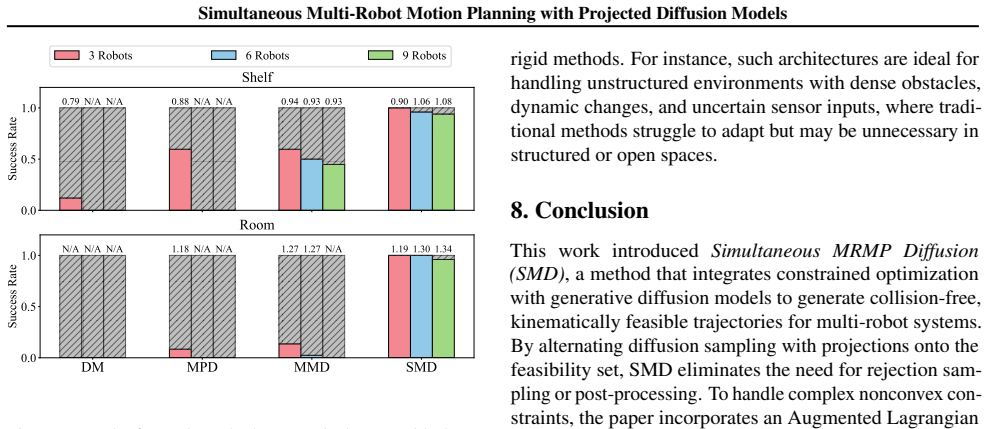
Additional results for classical algorithms and learning-based algorithms in random maps. S is the success rate, L denotes the average path length per robot, A is the average acceleration, and C is the collision ratio (see Section 5). We omit acceleration and collision information for multi-agent path finding methods, as they assume constant velocities an...
work page 1945
-
[4]
Additional results for classical algorithms and learning-based algorithms in practical maps. Map Robots Metric EECBS DM MPD MMD Ours Corridor Maps 2 S ↑ 1 0 0 0 1 L ↓ 1.4208 – – – 1.6619 A ↓ – – – – 0.0012 C ↓ – 1 1 1 0 Shelf Maps 3 S ↑ 1 0.1200 0.5960 0.5960 1 L ↓ 1.1697 0.7884 0.8825 0.9371 0.9017 A ↓ – 0.0030 0.0081 0.0030 0.0060 C ↓ – 0.5027 0.2493 0....
work page 1917
-
[5]
In addition, Table 6 shows evaluation results on practical maps introduced by (Shaoul et al., 2025)
Notably, more challenging tasks typically take longer to solve, thus increasing the average running time. In addition, Table 6 shows evaluation results on practical maps introduced by (Shaoul et al., 2025). SMD still maintains a zero collision rate. These results further confirm the practical applicability and reliability of our approach. In Figures 9 and...
work page 2025
-
[6]
Additional results for MMD and SMD in maps used in (Shaoul et al., 2025). Map Robots Metric MMD Ours Highways Maps 3 S ↑ 1 1 L ↓ 1.1638 1.1391 A ↓ 0.0026 0.0030 C ↓ 0 0 6 S ↑ 1 1 L ↓ 1.1669 1.1775 A ↓ 0.0028 0.0022 C ↓ 0 0 9 S ↑ 1 1 L ↓ 1.1792 1.1802 A ↓ 0.0028 0.0031 C ↓ 0 0 Conveyor Maps 3 S ↑ 1 1 L ↓ 1.1529 1.1499 A ↓ 0.0030 0.0029 C ↓ 0 0 6 S ↑ 1 1 L ...
work page 2025
-
[13]
Shaoul, Y ., Mishani, I., Vats, S., Li, J., and Likhachev, M
doi: 10.1109/ICRA57147.2024.10610519. Shaoul, Y ., Mishani, I., Vats, S., Li, J., and Likhachev, M. Multi-robot motion planning with diffusion models. In The Thirteenth International Conference on Learning Representations,
-
[15]
Ubukata, T., Li, J., and Tei, K
doi: 10.1109/TIV .2023.3274536. Ubukata, T., Li, J., and Tei, K. Diffusion model for plan- ning: A systematic literature review. arXiv preprint arXiv:2408.10266,
Show all 21 references
-
[16]
Implementation Details Software: The software used for experiments is Rocky Linux release 8.9, Python 3.8, Cuda 11.8, and PyTorch 2.0.0
11 Simultaneous Multi-Robot Motion Planning with Projected Diffusion Models A. Implementation Details Software: The software used for experiments is Rocky Linux release 8.9, Python 3.8, Cuda 11.8, and PyTorch 2.0.0. Hardware: For each of our experiments, we used 1 AMD EPYC 735...
2023
-
[1996]
Kotary, J
doi: 10.1109/70.508439. Kotary, J. and Fioretto, F. Learning constrained optimization with deep augmented lagrangian methods. arXiv preprint arXiv:2403.03454,
-
[2006]
Improved heuristics for multi-agent path finding with conflict-based search
Li, J., Felner, A., Boyarski, E., Ma, H., and Koenig, S. Improved heuristics for multi-agent path finding with conflict-based search. In IJCAI, volume 2019, pp. 442– 449,
2019
-
[2009]
Edmp: Ensemble-of-costs-guided diffusion for motion planning
10 Simultaneous Multi-Robot Motion Planning with Projected Diffusion Models Saha, K., Mandadi, V ., Reddy, J., Srikanth, A., Agar- wal, A., Sen, B., Singh, A., and Krishna, M. Edmp: Ensemble-of-costs-guided diffusion for motion planning. In 2024 IEEE International Conference o...
2024
-
[2011]
T., Baierl, M., Koert, D., and Peters, J
Carvalho, J., Le, A. T., Baierl, M., Koert, D., and Peters, J. Motion planning diffusion: Learning and planning of robot motions with diffusion models. In 2023 IEEE/RSJ International Conference on Intelligent Robots and Sys- tems (IROS), pp. 1916–1923. IEEE,
2023
-
[2012]
Boyd, S., Parikh, N., Chu, E., Peleato, B., Eckstein, J., et al
doi: 10.1109/ IROS.2012.6385823. Boyd, S., Parikh, N., Chu, E., Peleato, B., Eckstein, J., et al. Distributed optimization and statistical learning via the alternating direction method of multipliers. Foundations and Trends® in Machine learning, 3(1):1–122,
2012
-
[2015]
Christopher, J
doi: 10.1109/ICRA.2015.7140034. Christopher, J. K., Baek, S., and Fioretto, F. Constrained synthesis with projected diffusion models. In The Thirty- eighth Annual Conference on Neural Information Pro- cessing Systems,
2015
-
[2018]
doi: 10.1109/ICRA.2018. 8460730. Janner, M., Du, Y ., Tenenbaum, J. B., and Levine, S. Plan- ning with diffusion for flexible behavior synthesis. In International Conference on Machine Learning,
2018 doi
-
[2019]
P., Kumar, A., Er- mon, S., and Poole, B
Song, Y ., Sohl-Dickstein, J., Kingma, D. P., Kumar, A., Er- mon, S., and Poole, B. Score-based generative modeling through stochastic differential equations. arXiv preprint arXiv:2011.13456,
2011 arXiv
-
[2020]
Learning sampling distributions for robot motion planning
Ichter, B., Harrison, J., and Pavone, M. Learning sampling distributions for robot motion planning. In 2018 IEEE International Conference on Robotics and Automation (ICRA), pp. 7087–7094,
2018
-
[2021]
Priority inheritance with backtracking for iterative multi- agent path finding
Okumura, K., Machida, M., D ´efago, X., and Tamura, Y . Priority inheritance with backtracking for iterative multi- agent path finding. Artificial Intelligence, 310:103752, 2022a. Okumura, K., Yonetani, R., Nishimura, M., and Kanezaki, A. Ctrms: Learning to construct cooperati...
2009
-
[2023]
Motion planning diffusion: Learning and adapting robot motion planning with diffusion models
Carvalho, J., Le, A., Kicki, P., Koert, D., and Peters, J. Motion planning diffusion: Learning and adapting robot motion planning with diffusion models. arXiv preprint arXiv:2412.19948,
-
[2024]
Chen, Y ., Cutler, M., and How, J. P. Decoupled multi- agent path planning via incremental sequential convex programming. In 2015 IEEE International Conference on Robotics and Automation (ICRA), pp. 5954–5961,
2015
Reviewed August 9, 2026 · model on record in the stance chip above.
Discussion (0). Continue with ORCID to comment.