REVIEW 4 major objections 5 minor 2 cited by
Numerical evolution of self-gravitating halos of self-interacting dark matter
T0 review · 4 major / 5 minor · reviewed 2026-08-07 · deepseek-v4-flash
Pith's one-line read A laptop-scale simulation method for self-interacting dark matter reproduces the expected flattening of an NFW cusp and its later gravothermal collapse into a dense core.
desk verdict A promising reduced-phase-space method for SIDM halo evolution with public code; the physics is plausible but the paper under-delivers on quantitative validation against N-body benchmarks. read the letter →
The pith
A machine-rendered reading of the paper's core claim, the machinery that carries it, and where it could break.
The reading
What carries the argument
The load-bearing object is the coarse-grained collision probability $P_1(r_1, v_1, c_{\theta_1}) = (\Delta t / 2)\, (m_p / 4\pi r_1^2 \Delta r) \sum_i \sigma_{\mathrm{tot}}(v_{\mathrm{rel},i})\, v_{\mathrm{rel},i} / m$, where the sum runs over particles in a one-sided radial top-hat shell of width $\Delta r$ equal to the distance from particle 1 to the $j$-th particle outward, with $j = 10$ by default. This expression discretizes the Boltzmann collision integral into a Monte Carlo scattering probability over nearby simulation particles, avoids double counting by using a one-sided interval, and is followed by exact two-body elastic kinematics in the center-of-mass frame.
What would settle it
Run identical NFW halos with shell sizes $j = 2$, $10$, and $20$ and with timesteps spanning a factor of 10, and demand that the gravothermal collapse time and the late-time central density profile converge; the paper's own runs show $j=2$ already departs significantly and a tenfold timestep increase shifts collapse from 16.5 to about 18 Gyr, so these convergence tests decide the claim.
Extended reading notes
Core claim
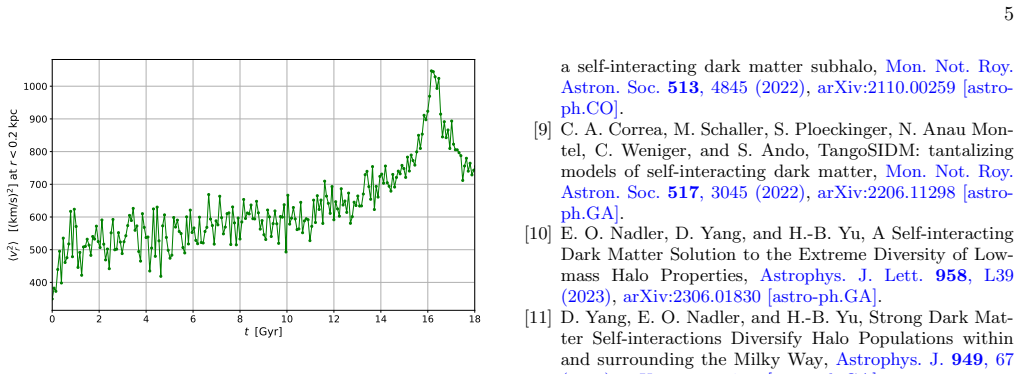
The central claim is that a spherically symmetric self-gravitating system, reduced from six-dimensional to three-dimensional phase space (radius, speed, and the angle of the velocity with the radial direction), can carry self-interactions as naturally as it carries gravity. The scattering step replaces the discretized phase-space density with a coarse-grained version averaged over a one-sided radial shell whose width is the distance from the particle in question to the tenth particle outward, and the collision probability is computed from that shell. Running the scheme on a $10^5$-particle NFW halo with $\sigma/m = 50\, \mathrm{cm^2\, g^{-1}}$ yields a density profile that flattens from $r^{-1}$ to a core by 1 Gyr, then slowly builds central density and velocity dispersion until a rapid gravothermal collapse near 16.5 Gyr produces a steep inner core, while the particle count in the inner region rises sharply. The paper also reports convergence checks showing that a tenfold larger timestep shifts the collapse to roughly 18 Gyr, that a shell with $j=2$ changes results significantly, and that $j=20$ behaves much like $j=10$.
Load-bearing premise
The load-bearing premise is that the coarse-grained scattering probability of Eq. (5), which averages the phase-space density over a one-sided radial shell of ten particles and carries a factor of 1/2, equals the true local collision rate in all regimes, including the short-mean-free-path core.
Editorial extensions
If this is right
- SIDM halo evolution can be simulated on a personal computer in hours, making parameter scans over cross-section magnitude, velocity dependence, angular dependence, and halo mass practical without supercomputers.
- The method reproduces both the early core flattening and the late gravothermal collapse of an NFW halo in a single run, so it captures the two regimes that matter for interpreting small-scale structure observations.
- Changing the scattering model (velocity dependence or angular distribution) requires only minor code changes, allowing realistic SIDM microphysics to be tested directly.
- With extensions for multiple particle masses and treatment of gravitational hard scattering as a self-interaction, the approach could be adapted to globular-cluster dynamics.
- Incorporating an adaptive timestep, which the authors identify as a natural next step, should extend the calculation to higher central densities and improve accuracy at late times.
Reading between the lines
- If the method converges as argued, the same shell-coarse-graining trick could be applied to anisotropic velocity distributions and tidal stripping, producing cheap mock SIDM halos for interpreting dwarf-galaxy rotation curves.
- The paper's own sensitivity to the coarse-graining shell size ($j=2$ differs significantly from $j=10$) implies that a convergence threshold in the shell width should be established before late-time collapse times are trusted; the physical content of the factor $1/2$ in Eq. (5) deserves a dedicated test.
- Because the code avoids force softening and several energy-conservation pitfalls of parallel N-body codes, it may serve as a fast benchmark for calibrating fluid or analytic gravothermal models, though that use goes beyond what is demonstrated here.
- A testable extension would be to run identical halos with velocity-dependent cross sections and compare the collapse-time scaling with universal gravothermal relations from existing N-body studies; the code makes such a scan cheap enough to perform systematically.
Editorial analysis
A structured set of objections, weighed in public.
Referee Report
Summary. The manuscript extends the NSphere scheme of Ref. [29], which evolves spherically symmetric self-gravitating systems in a reduced phase space, to include elastic self-interactions of dark matter. The scattering probability is implemented by coarse-graining the discretized phase-space density over a one-sided radial shell containing j particles (Eq. 5). As a proof of principle, the authors simulate a 1.15e9 Msun NFW halo with sigma/m = 50 cm^2/g and report that the central cusp flattens by 1 Gyr and that gravothermal collapse occurs at about 16.5 Gyr. They also report sensitivity tests varying the timestep, the particle number, and the shell parameter j, and they release the code publicly.
Significance. If the method is validated, it is a potentially valuable tool: it runs on a laptop in a few hours, removes the need for force softening, reduces stochastic noise relative to six-dimensional phase-space methods, and makes velocity- and angle-dependent cross sections essentially trivial to implement. The paper is a forward calculation with no fitted collapse parameters, and the authors are honest about the limitations of the fixed timestep. However, the central demonstration is currently only qualitative: no quantitative comparison is made to established N-body SIDM results, and the collision-rate prescription shows non-negligible sensitivity to numerical parameters. These gaps limit the paper's significance as a methods paper until they are addressed.
major comments (4)
- [Implementation and illustrative results] The simulation is initialized with parameters taken from Ref. [27], and that reference is cited for the timestep criterion, but no quantitative comparison to the N-body results of Ref. [27] (or to any other established SIDM simulation) is presented. Without such a benchmark, the statements that Fig. 1 is 'consistent with what is expected' and that gravothermal collapse is reproduced remain qualitative. A direct comparison of the central density versus time, the core radius evolution, or the collapse time against Ref. [27] is needed to support the central claim.
- [Eq. (5) and Implementation] The collision rate relies on an ad-hoc coarse-graining parameter j, with a default of j = 10. The text reports that j = 20 gives similar results but that j = 2 gives 'significantly different' results, yet no quantitative measure of this sensitivity is provided and no systematic study over j and particle number is shown. Since Eq. (5) is the only new physics introduced here, the paper should demonstrate that the chosen shell size yields a converged collision rate in all regimes relevant to core collapse, for example by comparing against the analytic collision rate in a uniform Maxwellian test or by showing the j-dependence of the central density evolution and collapse time.
- [Implementation and illustrative results] The fixed timestep is stated to be accurate to O(10%) only at densities below about 1e8 Msun/kpc^3, while the collapsing core reaches densities above 1e10 Msun/kpc^3, and the post-16.5 Gyr decrease in central density is labeled a numerical artifact in the Fig. 2 caption. A factor-of-10 increase in timestep moves the collapse time from 16.5 Gyr to about 18 Gyr. This is a load-bearing convergence issue for the claimed collapse time and late-time core density; the authors should either implement an adaptive timestep or provide a systematic timestep study demonstrating convergence of the collapse time and the late-time density profile.
- [Eq. (3) through Eq. (5)] The coarse-graining width Delta r is defined as the distance to the j-th outward neighbor, so it is not an independent physical scale: in the low-density outskirts it can average over a large radial interval, while in the dense core it may contain only a few particles with noisy velocity sampling. Because the short-mean-free-path core is precisely the regime that sets the collapse dynamics, the manuscript should verify that Eq. (5) faithfully reproduces the local collision rate there, rather than only reporting the final density profiles.
minor comments (5)
- [Dynamics] The sentence following Eq. (2) contains a typo: 'respsect' should be 'respect'.
- [Fig. 1 caption] The caption gives the scale density as 2.73e7 Msun cm^-3; the text and SI units require kpc^-3.
- [Fig. 2 caption] The caption says 'the simulation shown in Fig. 2'; this should likely refer to Fig. 1.
- [References] References [6], [22], and [27] lack publication years; please complete them.
- [Concluding remarks] The statement that 'similar results are obtained for j = 20' is not accompanied by any plot or quantitative measure; a supplementary figure or table would make this claim checkable.
Circularity Check
No circularity: core flattening and gravothermal collapse emerge from a forward simulation with fixed inputs; Eq. (5) is a discretized collision rate, not a fitted response, and the self-citations are legitimate code reuse and benchmark setup.
full rationale
The paper's central claim is that augmenting the NSphere scheme with Eq. (5) reproduces the known SIDM behaviors of core flattening and gravothermal collapse. The collision probability in Eq. (5) is directly discretized from the local Boltzmann collision rate, P1 = (Delta-t/2) times the integral of f sigma_tot v_rel over velocity, using a coarse-grained phase-space density; no parameter in this expression is fitted to the collapse time or density evolution being predicted. The initial halo parameters (NFW rho_s = 2.73e7 M_sun kpc^-3, r_s = 1.18 kpc, c = 19, N = 1e5) and cross section (sigma/m = 50 cm^2/g) are fixed inputs taken from earlier work, and the resulting collapse time near 16.5 Gyr is an output, not a matching target. The self-citation to Ref. [29] supplies the base phase-space evolution scheme, but that scheme is independently supported by the paper's statement that in the absence of self-interactions the code preserves the density profile for hundreds of dynamical times and preserves particle energies; the SIDM results are not used to justify the base method. The reported sensitivities (a factor-10 timestep moves collapse from 16.5 to about 18 Gyr, j = 2 gives significantly different results, and the late-time central-density decrease is labeled a numerical artifact) are numerical convergence and validation limitations, not cases where a prediction equals an input by construction. No equation reduces to a fitted value, and no uniqueness theorem is imported from same-author work, so there is no circular step.
Assumptions & free parameters
free parameters (2)
- j (coarse-graining shell size) =
10 (default)
- Fixed timestep dt =
0.00178 Myr
assumptions (5)
- domain assumption Spherical symmetry of the halo is assumed and imposed throughout; the code evolves only radial coordinate and angular momentum per particle.
- domain assumption The initial velocity distribution is isotropic, depending only on energy E, with cos(theta) uniformly distributed.
- domain assumption Scattering is elastic and between identical particles; generalizations to inelastic or different particles are not implemented.
- ad hoc to paper The local phase-space density is estimated by coarse-graining over a radial shell with a top-hat kernel of width Delta r containing j particles.
- domain assumption The halo is isolated, with no external tidal field or accretion, so the total mass and angular momentum are conserved up to numerical effects.
Cite this review
Pith. "Pith review of Numerical evolution of self-gravitating halos of self-interacting dark matter." pith.science (2026). https://pith.science/paper/UPUDEI5Z
@misc{pith2026250604334,
  author       = {Pith},
  title        = {Pith review of: Numerical evolution of self-gravitating halos of self-interacting dark matter},
  year         = {2026},
  howpublished = {\url{https://pith.science/paper/UPUDEI5Z}},
  note         = {Machine review of arXiv:2506.04334}
}
read the original abstract
We discuss a modification of a recently developed numerical scheme for evolving spherically symmetric self-gravitating systems to include the effects of self-interacting dark matter. The approach is far more efficient than traditional N-body simulations and cross sections with different dependencies on velocity and scattering-angle are easily accommodated. To demonstrate, we provide results of a simulation, which runs quickly on a personal computer, that shows the expected initial flattening of the inner region of an NFW halo as well as the later gravothermal collapse instability that leads to a dense core at the galactic center. We note that this approach can also be used, with some augmentation, to simulate the dynamics in globular clusters by modeling gravitational hard scattering as a self-interaction.
Figures


Forward citations
Cited by 2 Pith papers
-
A Novel Implementation of Self-Interacting Dark Matter in AREPO
A dedicated-tree Monte-Carlo SIDM module in AREPO-2 conserves energy/momentum under multiple scatters, supports velocity-dependent and inelastic models, and runs with only modest overhead versus CDM except in late cor...
-
The dark fate of ultra-faint dwarfs: Gravothermal collapse in action
Using high-resolution SIDM N-body simulations with tidal stripping, the authors find that the diverse dark-matter densities of Milky Way ultra-faint dwarfs can be explained if most are in the gravothermal collapse pha...
Reference graph
Works this paper leans on
-
[27]
I. Palubski, O. Slone, M. Kaplinghat, M. Lisanti, and F. Jiang, Numerical challenges in modeling gravothermal collapse in Self-Interacting Dark Matter halos, JCAP 09, 074, arXiv:2402.12452 [astro-ph.CO]
-
[29]
Evolution of self-gravitating spherical dark-matter halos with and without new physics
M. Kamionkowski and K. Sigurdson, Evolution of self- gravitating spherical dark-matter halos with and without new physics, (2025), arXiv:2504.13996 [astro-ph.GA]
work page Pith review arXiv 2025
-
[1]
D. N. Spergel and P. J. Steinhardt, Observational ev- idence for selfinteracting cold dark matter, Phys. Rev. Lett. 84, 3760 (2000), arXiv:astro-ph/9909386
arXiv 2000
-
[2]
S. Tulin and H.-B. Yu, Dark Matter Self-interactions and Small Scale Structure, Phys. Rept. 730, 1 (2018), arXiv:1705.02358 [hep-ph]
arXiv 2018
-
[3]
M. R. Buckley and A. H. G. Peter, Gravitational probes of dark matter physics, Phys. Rept. 761, 1 (2018), arXiv:1712.06615 [astro-ph.CO]
arXiv 2018
-
[4]
M. Kaplinghat, S. Tulin, and H.-B. Yu, Dark Matter Halos as Particle Colliders: Unified Solution to Small- Scale Structure Puzzles from Dwarfs to Clusters, Phys. Rev. Lett. 116, 041302 (2016), arXiv:1508.03339 [astro- ph.CO]
arXiv 2016
- [5]
-
[6]
A. Zentner, S. Dandavate, O. Slone, and M. Lisanti, A critical assessment of solutions to the galaxy diversity problem, JCAP 07 (07), 031, arXiv:2202.00012 [astro- ph.GA]
Show all 37 references
-
[7]
C. A. Correa, Constraining velocity-dependent self- interacting dark matter with the Milky Way’s dwarf spheroidal galaxies, Mon. Not. Roy. Astron. Soc. 503, 920 (2021), arXiv:2007.02958 [astro-ph.GA]
2021 arXiv
-
[8]
Z. C. Zeng, A. H. G. Peter, X. Du, A. Benson, S. Kim, F. Jiang, F.-Y. Cyr-Racine, and M. Vogelsberger, Core- collapse, evaporation, and tidal effects: the life story of a self-interacting dark matter subhalo, Mon. Not. Roy. Astron. Soc. 513, 4845 (2022), arXiv:2110.00259 [astr...
2022 arXiv
-
[9]
C. A. Correa, M. Schaller, S. Ploeckinger, N. Anau Mon- tel, C. Weniger, and S. Ando, TangoSIDM: tantalizing models of self-interacting dark matter, Mon. Not. Roy. Astron. Soc. 517, 3045 (2022), arXiv:2206.11298 [astro- ph.GA]
2022 arXiv
-
[10]
E. O. Nadler, D. Yang, and H.-B. Yu, A Self-interacting Dark Matter Solution to the Extreme Diversity of Low- mass Halo Properties, Astrophys. J. Lett. 958, L39 (2023), arXiv:2306.01830 [astro-ph.GA]
2023 arXiv
-
[11]
D. Yang, E. O. Nadler, and H.-B. Yu, Strong Dark Mat- ter Self-interactions Diversify Halo Populations within and surrounding the Milky Way, Astrophys. J. 949, 67 (2023), arXiv:2211.13768 [astro-ph.GA]
2023 arXiv
-
[12]
Colin, V
P. Colin, V. Avila-Reese, O. Valenzuela, and C. Firmani, Structure and subhalo population of halos in a selfinter- acting dark matter cosmology, Astrophys. J. 581, 777 (2002), arXiv:astro-ph/0205322
2002 arXiv
-
[13]
C. S. Kochanek and M. J. White, A Quantitative study of interacting dark matter in halos, Astrophys. J. 543, 514 (2000), arXiv:astro-ph/0003483
2000 arXiv
-
[14]
Balberg and S
S. Balberg and S. L. Shapiro, Gravothermal collapse of selfinteracting dark matter halos and the origin of mas- sive black holes, Phys. Rev. Lett. 88, 101301 (2002), arXiv:astro-ph/0111176
2002 arXiv
-
[15]
R. Dave, D. N. Spergel, P. J. Steinhardt, and B. D. Wandelt, Halo properties in cosmological simulations of selfinteracting cold dark matter, Astrophys. J. 547, 574 (2001), arXiv:astro-ph/0006218
2001 arXiv
-
[16]
Koda and P
J. Koda and P. R. Shapiro, Gravothermal collapse of iso- lated self-interacting dark matter haloes: N-body simula- tion versus the fluid model, Mon. Not. Roy. Astron. Soc. 415, 1125 (2011), arXiv:1101.3097 [astro-ph.CO]
2011 arXiv
-
[17]
Essig, S
R. Essig, S. D. Mcdermott, H.-B. Yu, and Y.-M. Zhong, Constraining Dissipative Dark Matter Self-Interactions, Phys. Rev. Lett. 123, 121102 (2019), arXiv:1809.01144 [hep-ph]
2019 arXiv
-
[18]
Nishikawa, K
H. Nishikawa, K. K. Boddy, and M. Kaplinghat, Accel- erated core collapse in tidally stripped self-interacting dark matter halos, Phys. Rev. D 101, 063009 (2020), arXiv:1901.00499 [astro-ph.GA]
2020 arXiv
-
[19]
Slone, F
O. Slone, F. Jiang, M. Lisanti, and M. Kaplinghat, Orbital evolution of satellite galaxies in self-interacting dark matter models, Phys. Rev. D 107, 043014 (2023), arXiv:2108.03243 [astro-ph.CO]
2023 arXiv
-
[20]
N. J. Outmezguine, K. K. Boddy, S. Gad-Nasr, M. Kaplinghat, and L. Sagunski, Universal gravother- mal evolution of isolated self-interacting dark matter ha- los for velocity-dependent cross-sections, Mon. Not. Roy. Astron. Soc. 523, 4786 (2023), arXiv:2204.06568 [astro- ph.GA]
2023 arXiv
-
[21]
S. Yang, X. Du, Z. C. Zeng, A. Benson, F. Jiang, E. O. Nadler, and A. H. G. Peter, Gravothermal Solutions of SIDM Halos: Mapping from Constant to Velocity- dependent Cross Section, Astrophys. J. 946, 47 (2023), arXiv:2205.02957 [astro-ph.CO]
2023 arXiv
-
[22]
Gad-Nasr, K
S. Gad-Nasr, K. K. Boddy, M. Kaplinghat, N. J. Out- mezguine, and L. Sagunski, On the late-time evolution of velocity-dependent self-interacting dark matter halos, JCAP 05, 131, arXiv:2312.09296 [astro-ph.GA]
-
[23]
Kummer, M
J. Kummer, M. Br¨ uggen, K. Dolag, F. Kahlhoefer, and K. Schmidt-Hoberg, Simulations of core formation for 6 frequent dark matter self-interactions, Mon. Not. Roy. Astron. Soc. 487, 354 (2019), arXiv:1902.02330 [astro- ph.CO]
2019 arXiv
-
[24]
M. S. Fischer, M. Br¨ uggen, K. Schmidt-Hoberg, K. Dolag, F. Kahlhoefer, A. Ragagnin, and A. Robert- son, N-body simulations of dark matter with frequent self-interactions, Mon. Not. Roy. Astron. Soc. 505, 851 (2021), arXiv:2012.10277 [astro-ph.CO]
2021 arXiv
-
[25]
M. S. Fischer, K. Dolag, and H.-B. Yu, Numerical chal- lenges for energy conservation in N-body simulations of collapsing self-interacting dark matter halos, Astron. Astrophys. 689, A300 (2024), arXiv:2403.00739 [astro- ph.CO]
2024 arXiv
-
[26]
C. Mace, Z. C. Zeng, A. H. G. Peter, X. Du, S. Yang, A. Benson, and M. Vogelsberger, Convergence tests of self-interacting dark matter simulations, Phys. Rev. D 110, 123024 (2024), arXiv:2402.01604 [astro-ph.GA]
2024 arXiv
-
[28]
C. Mace, S. Yang, Z. C. Zeng, A. H. G. Peter, X. Du, and A. Benson, Calibrating the SIDM Gravother- mal Catastrophe with N-body Simulations, (2025), arXiv:2504.13004 [astro-ph.GA]
2025 arXiv
-
[30]
Gurian and S
J. Gurian and S. May, Core Collapse Beyond the Fluid Approximation: The Late Evolution of Self-Interacting Dark Matter Halos, (2025), arXiv:2505.15903 [astro- ph.CO]
2025
-
[31]
Tucker-Smith and N
D. Tucker-Smith and N. Weiner, Inelastic dark matter, Phys. Rev. D 64, 043502 (2001), arXiv:hep-ph/0101138
2001 arXiv
-
[32]
Krnjaic and K
G. Krnjaic and K. Sigurdson, Big Bang Darkleosynthesis, Phys. Lett. B 751, 464 (2015), arXiv:1406.1171 [hep-ph]
2015 arXiv
-
[33]
Vogelsberger, J
M. Vogelsberger, J. Zavala, K. Schutz, and T. R. Slatyer, Evaporating the Milky Way halo and its satellites with inelastic self-interacting dark matter, Mon. Not. Roy. Astron. Soc. 484, 5437 (2019), arXiv:1805.03203 [astro- ph.GA]
2019 arXiv
-
[34]
K. T. E. Chua, K. Dibert, M. Vogelsberger, and J. Zavala, The impact of inelastic self-interacting dark matter on the dark matter structure of a Milky Way halo, Mon. Not. Roy. Astron. Soc. 500, 1531 (2020), arXiv:2010.08562 [astro-ph.GA]
2020 arXiv
-
[35]
O’Neil, M
S. O’Neil, M. Vogelsberger, S. Heeba, K. Schutz, J. C. Rose, P. Torrey, J. Borrow, R. Low, R. Adhikari, M. V. Medvedev, T. R. Slatyer, and J. Zavala, Endothermic self-interacting dark matter in Milky Way-like dark mat- ter haloes, Mon. Not. Roy. Astron. Soc. 524, 288 (2023), a...
2023 arXiv
-
[36]
S. Roy, X. Shen, M. Lisanti, D. Curtin, N. Murray, and P. F. Hopkins, Simulating Atomic Dark Matter in Milky Way Analogs, Astrophys. J. Lett.954, L40 (2023), arXiv:2304.09878 [astro-ph.GA]
2023 arXiv
-
[37]
V. M. Sabarish, M. Br¨ uggen, K. Schmidt-Hoberg, and M. S. Fischer, Accretion of self-interacting dark matter onto supermassive black holes, (2025), arXiv:2505.14779 [astro-ph.CO]
2025
Reviewed August 7, 2026 · model on record in the stance chip above.
Discussion (0). Continue with ORCID to comment.