REVIEW 3 major objections 3 minor 4 cited by
POINTS1.5: Building a Vision-Language Model towards Real World Applications
T0 review · 3 major / 3 minor · reviewed 2026-08-11 · deepseek-v4-flash
Pith's one-line read POINTS1.5-7B, trained on under 4 billion tokens, claims first place among sub-10B vision-language models on the OpenCompass leaderboard.
desk verdict Useful training recipe and released weights, but the abstract's token count doesn't match the paper's own table, and the leaderboard claim is thinner than it looks. read the letter →
The pith
A machine-rendered reading of the paper's core claim, the machinery that carries it, and where it could break.
The reading
What carries the argument
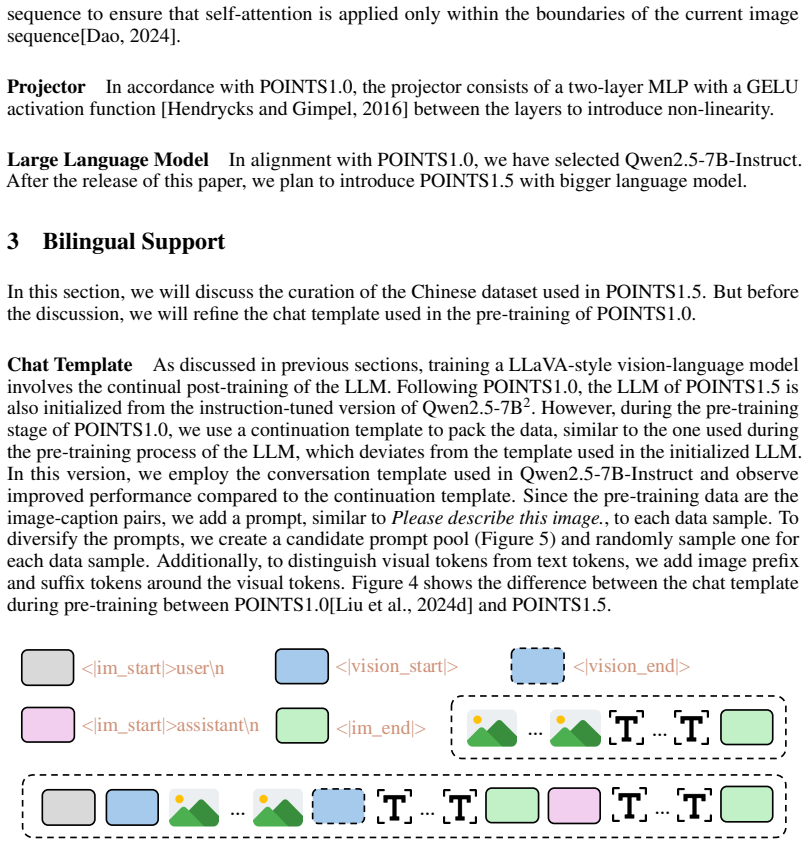
The architecture is the conventional LLaVA-style pipeline: a NaViT-style vision encoder (a Vision Transformer that patchifies images of any resolution and aspect ratio into a single patch sequence), a two-layer MLP projector with GELU, and Qwen2.5-7B-Instruct as the language backbone. The carrying mechanism is native dynamic resolution: instead of tiling a large image into fixed-size crops, the encoder processes the whole image and packs multiple image sequences into one long forward pass, recording start and end indices so self-attention stays within each image (via FlashAttention-2). On the data side, CapFusion merges original and VLM-generated captions, perplexity filtering selects the lowest-perplexity portion of the Chinese captions, and instruction data is filtered by LLM-based grammar detection and by discarding answers that are answerable without the image. Model soup averages the best checkpoints to produce the final weights.
What would settle it
Run the released POINTS1.5 checkpoint through the public VLMEvalKit evaluation on the eight leaderboard benchmarks with the same generation settings used by the leaderboard, and compare the reproduced average with the top competing sub-10B models; if another sub-10B model scores higher, or if the reproduced POINTS1.5 score falls below 67.4, the ranking claim is false. Separately, checking whether the token counts in the training logs match the abstract's 'fewer than 4 billion' figure would settle the token-budget sub-claim.
Extended reading notes
Core claim
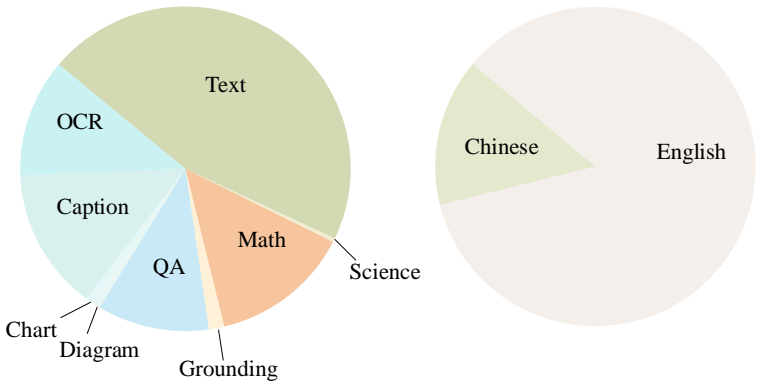
The paper claims that POINTS1.5-7B—a LLaVA-style model with a frozen NaViT vision encoder, an MLP projector, and Qwen2.5-7B-Instruct as its language model—achieves the highest OpenCompass average among models with fewer than 10 billion parameters as of December 8, 2024. The claimed result comes from a training budget of about 2.1 billion pretraining tokens plus 2.3 billion instruction-tuning tokens, built from two million captions (roughly half English, half Chinese) and a filtered visual instruction set. The authors report that model soup raises the best single checkpoint from 66.5 to 67.4 on the leaderboard average, and that the model's mathematical performance on MathVista, MATH-Vision, and MathVerse is particularly strong. They also state that filtering out samples whose questions can be answered without the image slightly degraded performance, so those samples were retained.
Load-bearing premise
The ranking claim assumes that all scores quoted from the public leaderboard were produced under identical, fair evaluation settings for every model; if some sub-10B entries were evaluated under different protocols, being first may be an artifact of protocol differences rather than model quality.
Editorial extensions
If this is right
- Other groups can reproduce the recipe on a 7B language model—NaViT-style encoder, about two million pretraining captions, filtered instruction data, and model soup—without needing tens of billions of tokens.
- Native dynamic resolution removes the tile-splitting step, so documents, screenshots, and charts of arbitrary sizes can be served in a single packed forward pass, simplifying deployment.
- The Chinese data pipeline, built by translating existing sets, generating answers with a strong VLM, and verifying by human labelers, offers a path to bilingual capability when open Chinese instruction data is scarce.
- The slightly negative effect of removing image-free questions suggests that some text-only samples belong in visual instruction tuning, making data filtering a question of balance rather than simple elimination.
- A 7B model beating several-times-larger models on the leaderboard would lower the compute bar for real-world multimodal applications.
Reading between the lines
- The abstract says fewer than 4 billion tokens while the training section says less than 5 billion and the table sums to about 4.4 billion; reconciling this figure would sharpen the headline claim.
- The paper's observation that dropping no-image questions slightly hurt performance is a clue that pure-text data acts as a regularizer, which a controlled study could test by adding a small text-only set to a VLM training run.
- The leaderboard claim is a snapshot from December 8, 2024, so it is necessarily time-limited; re-checking after later sub-10B models are submitted would confirm whether the ranking is durable.
- An ablation isolating the NaViT encoder from the data filtering would show how much of the gain comes from resolution handling versus data curation.
Editorial analysis
A structured set of objections, weighed in public.
Referee Report
Summary. POINTS1.5 is a 7B-parameter vision-language model built on the authors' earlier POINTS1.0. The paper replaces a fixed-resolution CLIP encoder with a NaViT-style dynamic-resolution encoder, adds Chinese pre-training and instruction-tuning data, and applies LLM-based filtering to visual instruction datasets. The headline claims are that the model is trained on fewer than 4 billion tokens and ranks first on the OpenCompass leaderboard among sub-10B models. The paper reports architecture details, dataset construction, training configurations in Table 3, and evaluation against open-source and proprietary models in Tables 4-5.
Significance. If the headline results held, the contribution would be practically significant: a competitive sub-10B open VLM with a very small training-token budget, bilingual support, and native arbitrary-resolution image processing. The paper also releases model weights and code links, which supports reproducibility. However, the efficiency claim is internally inconsistent with the paper's own token counts, and the ranking claim is weakened by model selection on the evaluation benchmark itself. These issues need to be resolved before the headline claims can be taken at face value.
major comments (3)
- [Abstract; Section 5; Table 3] The abstract states that POINTS1.5-7B is 'trained on fewer than 4 billion tokens,' but Section 5 states the total is 'less than 5 billion tokens,' and Table 3 reports about 2.1B pre-training tokens plus about 2.3B visual instruction tuning tokens, which sums to about 4.4B. Under the paper's own accounting the '<4B' claim is false; the authors should either correct the abstract or explain which tokens are excluded from the count.
- [Section 5, 'Model Soup over Best Performing Model'; Section 6, Tables 4-5] The final model is selected by averaging models with the best OpenCompass scores, and the same OpenCompass benchmark suite is then used in Table 4 to support the ranking claim. Because the model soup composition is chosen from these very scores, the reported margin over Qwen2-VL-7B (about 0.3 average points) is not an unbiased estimate. The authors should report robustness, e.g., multiple soup seeds, or evaluation on a held-out benchmark not used in selection.
- [Section 4, 'Visual Instruction Tuning Set Filtering'] The abstract claims that the filtering methods were 'comprehensively evaluate[d]' and the best ones selected, but Section 4 provides no ablation table or quantitative comparison. In particular, the image-free-answer filtering is reported to slightly degrade performance, yet the paper does not state whether the degraded variant was used in the final model. Adding ablations or removing the 'comprehensive evaluation' claim is required to support the contribution.
minor comments (3)
- [Figure 3 caption] The caption contains a typo: 'converntional' should be 'conventional.'
- [Table 5] The table lists two-number entries (e.g., 20.4/18.4 for InternVL2-8B) without defining what the two values represent; a footnote or legend is needed.
- [Section 2, batch forwarding] The phrase 'image sequence[Dao, 2024]' should have a space before the citation bracket.
Circularity Check
No significant circularity: the headline claims are external-benchmark results, and self-citations to POINTS1.0 are non-load-bearing engineering references; the abstract's token-count discrepancy is a factual inconsistency, not a circular step.
full rationale
POINTS1.5 is an empirical systems report rather than a derivation, so its claims are not generated by a formal chain of equations. The two headline assertions, namely the token budget and the OpenCompass rank, come from training logs and an external leaderboard, not from the model's own definitions. The only mathematical expressions in the paper, Eq. (1) for CapFusion and Eq. (2) for perplexity, are data-curation tools and are never used to derive the performance numbers. Self-citations to POINTS1.0 for dataset construction, the two-stage training recipe, and model soup are references to prior engineering choices; none of them is a uniqueness theorem, a smuggled ansatz, or a fitted parameter that forces the reported result. The model-soup procedure and the filtering-method selection do use OpenCompass scores as the selection criterion, which is benchmark fitting rather than circular reasoning: the reported score is a measured value on an external benchmark, not a quantity that is equal to the selection criterion by construction. A genuine internal inconsistency exists, because the abstract says 'fewer than 4 billion tokens,' while Table 3 lists about 2.1B pre-training tokens plus about 2.3B instruction-tuning tokens, summing to roughly 4.4B, and Section 5 says 'less than 5 billion tokens'; however, this is an arithmetic or reporting error, not a circularity. Under the required standard that circularity be exhibited by a specific reduction or a fitted parameter renamed as a prediction, no circular step can be identified.
Assumptions & free parameters
free parameters (7)
- Perplexity filtering percentile =
20% (approximately 1 million Chinese captions)
- Pre-training learning rate =
2e-4
- Instruction tuning learning rate =
2e-5
- Batch size =
32
- Context length =
4096
- Training tokens count =
~2.1B pre-training + ~2.3B instruction tuning
- Model soup composition =
not specified
assumptions (3)
- domain assumption The LLaVA-style architecture (vision encoder, MLP projector, LLM) is an effective base for vision-language post-training.
- domain assumption The pre-trained Qwen2.5-7B-Instruct LLM and the NaViT-style vision encoder are high-quality starting points.
- domain assumption The OpenCompass benchmark suite provides a fair and reliable measure of real-world VLM capability.
Cite this review
Pith. "Pith review of POINTS1.5: Building a Vision-Language Model towards Real World Applications." pith.science (2026). https://pith.science/paper/URGVIDG4
@misc{pith2026241208443,
  author       = {Pith},
  title        = {Pith review of: POINTS1.5: Building a Vision-Language Model towards Real World Applications},
  year         = {2026},
  howpublished = {\url{https://pith.science/paper/URGVIDG4}},
  note         = {Machine review of arXiv:2412.08443}
}
read the original abstract
Vision-language models have made significant strides recently, demonstrating superior performance across a range of tasks, e.g. optical character recognition and complex diagram analysis. Building on this trend, we introduce a new vision-language model, POINTS1.5, designed to excel in various real-world applications. POINTS1.5 is an enhancement of POINTS1.0 and incorporates several key innovations: i) We replace the original CLIP vision encoder, which had a fixed image resolution, with a NaViT-style vision encoder that supports native dynamic high resolution. This allows POINTS1.5 to process images of any resolution without needing to split them into tiles. ii) We add bilingual support to POINTS1.5, significantly enhancing its capability in Chinese. Due to the scarcity of open-source Chinese datasets for vision-language models, we collect numerous images from the Internet and annotate them using a combination of manual and automatic methods. iii) We propose a set of rigorous filtering methods for visual instruction tuning datasets. We comprehensively evaluate all these filtering methods, and choose the most effective ones to obtain the final visual instruction tuning set. Thanks to these innovations, POINTS1.5 significantly outperforms POINTS1.0 and demonstrates strong performance across a range of real-world applications. Notably, POINTS1.5-7B is trained on fewer than 4 billion tokens and ranks first on the OpenCompass leaderboard among models with fewer than 10 billion parameters
Figures


Figures from the paper (18 more)




Forward citations
Cited by 4 Pith papers
-
POINTS-Seeker: An Open Recipe for Multimodal Search Agents with Visual Memory Management
POINTS-Seeker-8B is an 8B multimodal model trained from scratch for agentic search that uses seeding and visual-space history folding to outperform prior models on six visual reasoning benchmarks.
-
InternLM-XComposer2.5-Reward: A Simple Yet Effective Multi-Modal Reward Model
IXC-2.5-Reward is an open-source multimodal reward model that achieves 70.0% macro accuracy on VL-RewardBench and improves LVLM chat via PPO.
-
Ocean-OCR: Towards General OCR Application via a Vision-Language Model
A 3B vision-language model trained with a large OCR-heavy data mix reports top scores on OCR benchmarks and beats the TextIn and PaddleOCR engines on custom document, scene-text, and handwriting evaluations.
-
Valley2: Exploring Multimodal Models with Scalable Vision-Language Design
Valley2, a 7B-scale open-source multimodal model, reports second-best OpenCompass average (67.4) among sub-10B models and the highest score (79.66) on its own in-house Ecom-VQA benchmark.
Reference graph
Works this paper leans on
-
[1]
Qwen-vl: A frontier large vision-language model with versatile abilities
Jinze Bai, Shuai Bai, Shusheng Yang, Shijie Wang, Sinan Tan, Peng Wang, Junyang Lin, Chang Zhou, and Jingren Zhou. Qwen-vl: A frontier large vision-language model with versatile abilities. arXiv preprint arXiv:2308.12966, 2023
arXiv 2023
-
[2]
Zheng Cai, Maosong Cao, Haojiong Chen, Kai Chen, Keyu Chen, Xin Chen, Xun Chen, Zehui Chen, Zhi Chen, Pei Chu, et al. Internlm2 technical report. arXiv preprint arXiv:2403.17297, 2024
arXiv 2024
-
[3]
Mega-bench: Scaling multimodal evaluation to over 500 real-world tasks
Jiacheng Chen, Tianhao Liang, Sherman Siu, Zhengqing Wang, Kai Wang, Yubo Wang, Yuansheng Ni, Wang Zhu, Ziyan Jiang, Bohan Lyu, et al. Mega-bench: Scaling multimodal evaluation to over 500 real-world tasks. arXiv preprint arXiv:2410.10563, 2024 a
-
[4]
Lin Chen, Jinsong Li, Xiaoyi Dong, Pan Zhang, Yuhang Zang, Zehui Chen, Haodong Duan, Jiaqi Wang, Yu Qiao, Dahua Lin, et al. Are we on the right way for evaluating large vision-language models? arXiv preprint arXiv:2403.20330, 2024 b
arXiv 2024
-
[5]
How far are we to gpt-4v? closing the gap to commercial multimodal models with open-source suites
Zhe Chen, Weiyun Wang, Hao Tian, Shenglong Ye, Zhangwei Gao, Erfei Cui, Wenwen Tong, Kongzhi Hu, Jiapeng Luo, Zheng Ma, et al. How far are we to gpt-4v? closing the gap to commercial multimodal models with open-source suites. arXiv preprint arXiv:2404.16821, 2024 c
arXiv 2024
-
[6]
Opencompass: A universal evaluation platform for foundation models
OpenCompass Contributors. Opencompass: A universal evaluation platform for foundation models. https://github.com/open-compass/opencompass, 2023
2023
-
[7]
Nvlm: Open frontier-class multimodal llms
Wenliang Dai, Nayeon Lee, Boxin Wang, Zhuolin Yang, Zihan Liu, Jon Barker, Tuomas Rintamaki, Mohammad Shoeybi, Bryan Catanzaro, and Wei Ping. Nvlm: Open frontier-class multimodal llms. arXiv preprint arXiv:2409.11402, 2024
arXiv 2024
-
[8]
Flash A ttention-2: Faster attention with better parallelism and work partitioning
Tri Dao. Flash A ttention-2: Faster attention with better parallelism and work partitioning. In International Conference on Learning Representations (ICLR), 2024
2024
Show all 55 references
-
[9]
Patch n’pack: Navit, a vision transformer for any aspect ratio and resolution
Mostafa Dehghani, Basil Mustafa, Josip Djolonga, Jonathan Heek, Matthias Minderer, Mathilde Caron, Andreas Steiner, Joan Puigcerver, Robert Geirhos, Ibrahim M Alabdulmohsin, et al. Patch n’pack: Navit, a vision transformer for any aspect ratio and resolution. Advances in Neura...
2024
-
[10]
Internlm-xcomposer2: Mastering free-form text-image composition and comprehension in vision-language large model
Xiaoyi Dong, Pan Zhang, Yuhang Zang, Yuhang Cao, Bin Wang, Linke Ouyang, Xilin Wei, Songyang Zhang, Haodong Duan, Maosong Cao, Wenwei Zhang, Yining Li, Hang Yan, Yang Gao, Xinyue Zhang, Wei Li, Jingwen Li, Kai Chen, Conghui He, Xingcheng Zhang, Yu Qiao, Dahua Lin, and Jiaqi Wa...
2024 arXiv
-
[11]
Internlm-xcomposer2-4khd: A pioneering large vision-language model handling resolutions from 336 pixels to 4k hd
Xiaoyi Dong, Pan Zhang, Yuhang Zang, Yuhang Cao, Bin Wang, Linke Ouyang, Songyang Zhang, Haodong Duan, Wenwei Zhang, Yining Li, Hang Yan, Yang Gao, Zhe Chen, Xinyue Zhang, Wei Li, Jingwen Li, Wenhai Wang, Kai Chen, Conghui He, Xingcheng Zhang, Jifeng Dai, Yu Qiao, Dahua Lin, a...
2024 arXiv
-
[12]
An image is worth 16x16 words: Transformers for image recognition at scale
Alexey Dosovitskiy. An image is worth 16x16 words: Transformers for image recognition at scale. arXiv preprint arXiv:2010.11929, 2020
2010 arXiv
-
[13]
Vlmevalkit: An open-source toolkit for evaluating large multi-modality models
Haodong Duan, Junming Yang, Yuxuan Qiao, Xinyu Fang, Lin Chen, Yuan Liu, Xiaoyi Dong, Yuhang Zang, Pan Zhang, Jiaqi Wang, et al. Vlmevalkit: An open-source toolkit for evaluating large multi-modality models. arXiv preprint arXiv:2407.11691, 2024
2024 arXiv
-
[14]
Making the v in vqa matter: Elevating the role of image understanding in visual question answering
Yash Goyal, Tejas Khot, Douglas Summers-Stay, Dhruv Batra, and Devi Parikh. Making the v in vqa matter: Elevating the role of image understanding in visual question answering. In Proceedings of the IEEE conference on computer vision and pattern recognition, pages 6904--6913, 2017
2017
-
[15]
Gaussian error linear units (gelus)
Dan Hendrycks and Kevin Gimpel. Gaussian error linear units (gelus). arXiv preprint arXiv:1606.08415, 2016
2016 arXiv
-
[16]
Gqa: A new dataset for real-world visual reasoning and compositional question answering
Drew A Hudson and Christopher D Manning. Gqa: A new dataset for real-world visual reasoning and compositional question answering. In Proceedings of the IEEE/CVF conference on computer vision and pattern recognition, pages 6700--6709, 2019
2019
-
[17]
A diagram is worth a dozen images
Aniruddha Kembhavi, Michael Salvato, Eric Kolve, Minjoon Seo, Hannaneh Hajishirzi, and Ali Farhadi. A diagram is worth a dozen images. ArXiv, abs/1603.07396, 2016. URL https://api.semanticscholar.org/CorpusID:2682274
2016 arXiv
-
[18]
Visual information extraction in the wild: practical dataset and end-to-end solution
Jianfeng Kuang, Wei Hua, Dingkang Liang, Mingkun Yang, Deqiang Jiang, Bo Ren, and Xiang Bai. Visual information extraction in the wild: practical dataset and end-to-end solution. In International Conference on Document Analysis and Recognition, pages 36--53. Springer, 2023
2023
-
[19]
What matters when building vision-language models? arXiv preprint arXiv:2405.02246, 2024
Hugo Lauren c on, L \'e o Tronchon, Matthieu Cord, and Victor Sanh. What matters when building vision-language models? arXiv preprint arXiv:2405.02246, 2024
2024 arXiv
-
[20]
Llava-onevision: Easy visual task transfer
Bo Li, Yuanhan Zhang, Dong Guo, Renrui Zhang, Feng Li, Hao Zhang, Kaichen Zhang, Yanwei Li, Ziwei Liu, and Chunyuan Li. Llava-onevision: Easy visual task transfer. arXiv preprint arXiv:2408.03326, 2024
2024 arXiv
-
[21]
Seed-bench: Benchmarking multimodal llms with generative comprehension
Bohao Li, Rui Wang, Guangzhi Wang, Yuying Ge, Yixiao Ge, and Ying Shan. Seed-bench: Benchmarking multimodal llms with generative comprehension. arXiv preprint arXiv:2307.16125, 2023 a
2023 arXiv
-
[22]
Blip-2: Bootstrapping language-image pre-training with frozen image encoders and large language models
Junnan Li, Dongxu Li, Silvio Savarese, and Steven Hoi. Blip-2: Bootstrapping language-image pre-training with frozen image encoders and large language models. In International conference on machine learning, pages 19730--19742. PMLR, 2023 b
2023
-
[23]
Hallusionbench: You see what you think? or you think what you see? an image-context reasoning benchmark challenging for gpt-4v (ision), llava-1.5, and other multi-modality models
Fuxiao Liu, Tianrui Guan, Zongxia Li, Lichang Chen, Yaser Yacoob, Dinesh Manocha, and Tianyi Zhou. Hallusionbench: You see what you think? or you think what you see? an image-context reasoning benchmark challenging for gpt-4v (ision), llava-1.5, and other multi-modality models...
-
[24]
Improved baselines with visual instruction tuning, 2023 b
Haotian Liu, Chunyuan Li, Yuheng Li, and Yong Jae Lee. Improved baselines with visual instruction tuning, 2023 b
2023
-
[25]
Llava-next: Improved reasoning, ocr, and world knowledge, January 2024 a
Haotian Liu, Chunyuan Li, Yuheng Li, Bo Li, Yuanhan Zhang, Sheng Shen, and Yong Jae Lee. Llava-next: Improved reasoning, ocr, and world knowledge, January 2024 a . URL https://llava-vl.github.io/blog/2024-01-30-llava-next/
2024
-
[26]
Visual instruction tuning
Haotian Liu, Chunyuan Li, Qingyang Wu, and Yong Jae Lee. Visual instruction tuning. Advances in neural information processing systems, 36, 2024 b
2024
-
[27]
Mmbench: Is your multi-modal model an all-around player? arXiv preprint arXiv:2307.06281, 2023 c
Yuan Liu, Haodong Duan, Yuanhan Zhang, Bo Li, Songyang Zhang, Wangbo Zhao, Yike Yuan, Jiaqi Wang, Conghui He, Ziwei Liu, et al. Mmbench: Is your multi-modal model an all-around player? arXiv preprint arXiv:2307.06281, 2023 c
2023 arXiv
-
[28]
Rethinking overlooked aspects in vision-language models
Yuan Liu, Le Tian, Xiao Zhou, and Jie Zhou. Rethinking overlooked aspects in vision-language models. arXiv preprint arXiv:2405.11850, 2024 c
2024 arXiv
-
[29]
Points: Improving your vision-language model with affordable strategies
Yuan Liu, Zhongyin Zhao, Ziyuan Zhuang, Le Tian, Xiao Zhou, and Jie Zhou. Points: Improving your vision-language model with affordable strategies. arXiv preprint arXiv:2409.04828, 2024 d
2024 arXiv
-
[30]
On the hidden mystery of ocr in large multimodal models
Yuliang Liu, Zhang Li, Biao Yang, Chunyuan Li, Xucheng Yin, Cheng-lin Liu, Lianwen Jin, and Xiang Bai. On the hidden mystery of ocr in large multimodal models. arXiv preprint arXiv:2305.07895, 2023 d
2023 arXiv
-
[31]
A convnet for the 2020s
Zhuang Liu, Hanzi Mao, Chao-Yuan Wu, Christoph Feichtenhofer, Trevor Darrell, and Saining Xie. A convnet for the 2020s. In Proceedings of the IEEE/CVF conference on computer vision and pattern recognition, pages 11976--11986, 2022
2022
-
[32]
Deepseek-vl: towards real-world vision-language understanding
Haoyu Lu, Wen Liu, Bo Zhang, Bingxuan Wang, Kai Dong, Bo Liu, Jingxiang Sun, Tongzheng Ren, Zhuoshu Li, Yaofeng Sun, et al. Deepseek-vl: towards real-world vision-language understanding. arXiv preprint arXiv:2403.05525, 2024 a
2024 arXiv
-
[33]
Learn to explain: Multimodal reasoning via thought chains for science question answering
Pan Lu, Swaroop Mishra, Tanglin Xia, Liang Qiu, Kai-Wei Chang, Song-Chun Zhu, Oyvind Tafjord, Peter Clark, and Ashwin Kalyan. Learn to explain: Multimodal reasoning via thought chains for science question answering. Advances in Neural Information Processing Systems, 35: 0 2507...
2022
-
[34]
Mathvista: Evaluating mathematical reasoning of foundation models in visual contexts
Pan Lu, Hritik Bansal, Tony Xia, Jiacheng Liu, Chunyuan Li, Hannaneh Hajishirzi, Hao Cheng, Kai-Wei Chang, Michel Galley, and Jianfeng Gao. Mathvista: Evaluating mathematical reasoning of foundation models in visual contexts. arXiv preprint arXiv:2310.02255, 2023
-
[35]
Ovis: Structural embedding alignment for multimodal large language model
Shiyin Lu, Yang Li, Qing-Guo Chen, Zhao Xu, Weihua Luo, Kaifu Zhang, and Han-Jia Ye. Ovis: Structural embedding alignment for multimodal large language model. arXiv preprint arXiv:2405.20797, 2024 b
2024 arXiv
-
[36]
Ok-vqa: A visual question answering benchmark requiring external knowledge
Kenneth Marino, Mohammad Rastegari, Ali Farhadi, and Roozbeh Mottaghi. Ok-vqa: A visual question answering benchmark requiring external knowledge. In Proceedings of the IEEE/cvf conference on computer vision and pattern recognition, pages 3195--3204, 2019
2019
-
[37]
Chartqa: A benchmark for question answering about charts with visual and logical reasoning
Ahmed Masry, Do Xuan Long, Jia Qing Tan, Shafiq Joty, and Enamul Hoque. Chartqa: A benchmark for question answering about charts with visual and logical reasoning. arXiv preprint arXiv:2203.10244, 2022
2022 arXiv
-
[38]
Gpt-4 technical report
OpenAI. Gpt-4 technical report. Technical Report 1, 2, 9, 10, OpenAI, 2023. URL https://example.com/gpt4-technical-report
2023
-
[39]
Laion-5b: An open large-scale dataset for training next generation image-text models
Christoph Schuhmann, Romain Beaumont, Richard Vencu, Cade Gordon, Ross Wightman, Mehdi Cherti, Theo Coombes, Aarush Katta, Clayton Mullis, Mitchell Wortsman, et al. Laion-5b: An open large-scale dataset for training next generation image-text models. Advances in Neural Informa...
2022
-
[40]
Neural machine translation of rare words with subword units
Rico Sennrich. Neural machine translation of rare words with subword units. arXiv preprint arXiv:1508.07909, 2015
2015 arXiv
-
[41]
Fast wordpiece tokenization
Xinying Song, Alex Salcianu, Yang Song, Dave Dopson, and Denny Zhou. Fast wordpiece tokenization. arXiv preprint arXiv:2012.15524, 2020
2012 arXiv
-
[42]
Attention is all you need
A Vaswani. Attention is all you need. Advances in Neural Information Processing Systems, 2017
2017
-
[43]
To see is to believe: Prompting gpt-4v for better visual instruction tuning
Junke Wang, Lingchen Meng, Zejia Weng, Bo He, Zuxuan Wu, and Yu-Gang Jiang. To see is to believe: Prompting gpt-4v for better visual instruction tuning. arXiv preprint arXiv:2311.07574, 2023
2023 arXiv
-
[44]
Measuring multimodal mathematical reasoning with math-vision dataset
Ke Wang, Junting Pan, Weikang Shi, Zimu Lu, Mingjie Zhan, and Hongsheng Li. Measuring multimodal mathematical reasoning with math-vision dataset. arXiv preprint arXiv:2402.14804, 2024 a
2024 arXiv
-
[45]
Qwen2-vl: Enhancing vision-language model's perception of the world at any resolution
Peng Wang, Shuai Bai, Sinan Tan, Shijie Wang, Zhihao Fan, Jinze Bai, Keqin Chen, Xuejing Liu, Jialin Wang, Wenbin Ge, et al. Qwen2-vl: Enhancing vision-language model's perception of the world at any resolution. arXiv preprint arXiv:2409.12191, 2024 b
2024 arXiv
-
[46]
Emu3: Next-token prediction is all you need
Xinlong Wang, Xiaosong Zhang, Zhengxiong Luo, Quan Sun, Yufeng Cui, Jinsheng Wang, Fan Zhang, Yueze Wang, Zhen Li, Qiying Yu, et al. Emu3: Next-token prediction is all you need. arXiv preprint arXiv:2409.18869, 2024 c
2024 arXiv
-
[47]
Morcos, Hongseok Namkoong, Ali Farhadi, Yair Carmon, Simon Kornblith, and Ludwig Schmidt
Mitchell Wortsman, Gabriel Ilharco, Samir Yitzhak Gadre, Rebecca Roelofs, Raphael Gontijo-Lopes, Ari S. Morcos, Hongseok Namkoong, Ali Farhadi, Yair Carmon, Simon Kornblith, and Ludwig Schmidt. Model soups: averaging weights of multiple fine-tuned models improves accuracy with...
2022 arXiv
-
[48]
Qwen2 technical report
An Yang, Baosong Yang, Binyuan Hui, Bo Zheng, Bowen Yu, Chang Zhou, Chengpeng Li, Chengyuan Li, Dayiheng Liu, Fei Huang, et al. Qwen2 technical report. arXiv preprint arXiv:2407.10671, 2024
2024 arXiv
-
[49]
Minicpm-v: A gpt-4v level mllm on your phone
Yuan Yao, Tianyu Yu, Ao Zhang, Chongyi Wang, Junbo Cui, Hongji Zhu, Tianchi Cai, Haoyu Li, Weilin Zhao, Zhihui He, et al. Minicpm-v: A gpt-4v level mllm on your phone. arXiv preprint arXiv:2408.01800, 2024
2024 arXiv
-
[50]
A survey on multimodal large language models
Shukang Yin, Chaoyou Fu, Sirui Zhao, Ke Li, Xing Sun, Tong Xu, and Enhong Chen. A survey on multimodal large language models. arXiv preprint arXiv:2306.13549, 2023
2023 arXiv
-
[51]
Capsfusion: Rethinking image-text data at scale
Qiying Yu, Quan Sun, Xiaosong Zhang, Yufeng Cui, Fan Zhang, Yue Cao, Xinlong Wang, and Jingjing Liu. Capsfusion: Rethinking image-text data at scale. In Proceedings of the IEEE/CVF Conference on Computer Vision and Pattern Recognition, pages 14022--14032, 2024
2024
-
[52]
Mm-vet: Evaluating large multimodal models for integrated capabilities
Weihao Yu, Zhengyuan Yang, Linjie Li, Jianfeng Wang, Kevin Lin, Zicheng Liu, Xinchao Wang, and Lijuan Wang. Mm-vet: Evaluating large multimodal models for integrated capabilities. arXiv preprint arXiv:2308.02490, 2023
2023 arXiv
-
[53]
Mmmu: A massive multi-discipline multimodal understanding and reasoning benchmark for expert agi
Xiang Yue, Yuansheng Ni, Kai Zhang, Tianyu Zheng, Ruoqi Liu, Ge Zhang, Samuel Stevens, Dongfu Jiang, Weiming Ren, Yuxuan Sun, et al. Mmmu: A massive multi-discipline multimodal understanding and reasoning benchmark for expert agi. In Proceedings of the IEEE/CVF Conference on C...
2024
-
[54]
Haotian Zhang, Mingfei Gao, Zhe Gan, Philipp Dufter, Nina Wenzel, Forrest Huang, Dhruti Shah, Xianzhi Du, Bowen Zhang, Yanghao Li, et al. Mm1. 5: Methods, analysis & insights from multimodal llm fine-tuning. arXiv preprint arXiv:2409.20566, 2024
2024 arXiv
-
[55]
Mathverse: Does your multi-modal llm truly see the diagrams in visual math problems? In European Conference on Computer Vision, pages 169--186
Renrui Zhang, Dongzhi Jiang, Yichi Zhang, Haokun Lin, Ziyu Guo, Pengshuo Qiu, Aojun Zhou, Pan Lu, Kai-Wei Chang, Yu Qiao, et al. Mathverse: Does your multi-modal llm truly see the diagrams in visual math problems? In European Conference on Computer Vision, pages 169--186. Spri...
2025
Reviewed August 11, 2026 · model on record in the stance chip above.
Discussion (0). Continue with ORCID to comment.