AutoPilot: Learning to Steer High Speed Robust BFT
Pith reviewed 2026-06-27 15:00 UTC · model grok-4.3
The pith
A decentralized reinforcement learning framework dynamically tunes parameters in high-speed BFT protocols to optimize performance under changing conditions.
A machine-rendered reading of the paper's core claim, the machinery that carries it, and where it could break.
Core claim
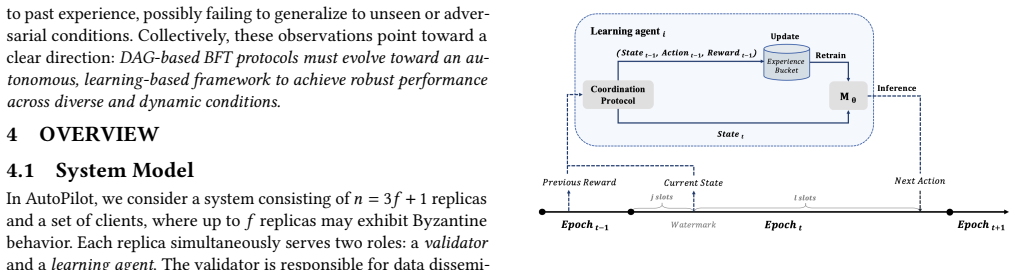
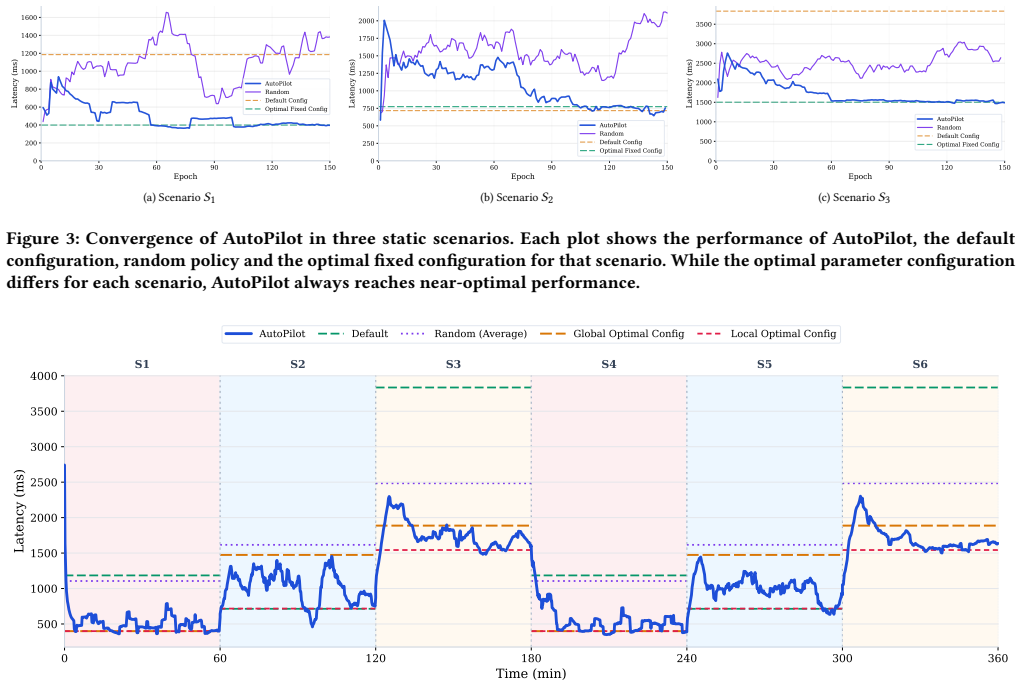
AutoPilot is a reinforcement learning-based framework that continuously monitors runtime conditions and dynamically adjusts protocol parameters online to optimize consensus performance. Coordinated in a decentralized manner to provide resilience against adversarial data pollution, when implemented on the Autobahn protocol it quickly converges to optimal configurations under changing environments, reduces end-to-end latency by 49.8 percent compared to the default protocol configuration, and outperforms random configuration exploration by 73.3 percent.
What carries the argument
Decentralized reinforcement learning framework that coordinates parameter tuning across nodes while resisting adversarial data pollution.
Load-bearing premise
Decentralized reinforcement learning can reliably converge to optimal parameters while remaining robust to adversarial data pollution and that the tested dynamic environments represent real deployment conditions.
What would settle it
Deploying the system on a live network with actual adversaries and measuring whether latency reductions and convergence hold or break would directly test the central claim.
Figures


read the original abstract
Recent Byzantine Fault Tolerant (BFT) protocols achieve strong performance by combining the low-latency advantages of leader-based BFT protocols with the high-throughput benefits of DAG-based data dissemination. Despite exposing a wide spectrum of internal tunable parameters, these protocols typically rely on static and heuristic configurations, which leads to performance degradation under dynamic workloads, heterogeneous network conditions, and evolving adversarial behaviors. In this paper, we present AutoPilot, a reinforcement learning-based framework that continuously monitors runtime conditions and dynamically adjusts protocol parameters online to optimize consensus performance. To ensure robustness, AutoPilot coordinates learning in a decentralized manner, providing resilience against adversarial data pollution. We implement AutoPilot on top of Autobahn, a state-of-the-art, highspeed, robust BFT protocol, and evaluate it across diverse dynamic environments. Experimental results demonstrate that AutoPilot quickly converges to the optimal configuration under changing environments, reduces end-to-end latency by 49.8% compared to the default protocol configuration, and outperforms random configuration exploration by 73.3%.
Editorial analysis
A structured set of objections, weighed in public.
Referee Report
Summary. The paper introduces AutoPilot, a reinforcement learning framework for online, dynamic adjustment of internal parameters in high-speed robust BFT protocols (implemented on Autobahn). It claims decentralized coordination enables resilience to adversarial data pollution, with experiments across dynamic environments showing quick convergence to optimal configurations, a 49.8% end-to-end latency reduction versus the default static configuration, and 73.3% better performance than random configuration exploration.
Significance. If the empirical results and robustness properties hold under scrutiny, the work would offer a practical advance for maintaining high performance in BFT systems facing heterogeneous networks, evolving workloads, and adversaries, reducing reliance on manual or heuristic tuning. The decentralized RL approach directly targets a key distributed-systems challenge.
major comments (3)
- [Abstract] Abstract: the headline empirical claims (49.8% latency reduction vs. default; 73.3% improvement over random) are presented without any description of experimental methodology, baselines, number of runs, statistical tests, or workload/adversary models, rendering it impossible to evaluate whether the data support the claims.
- [Abstract] Abstract: the central robustness claim—that decentralized coordination prevents adversarial data pollution—lacks any description of the state representation, reward function, update aggregation rule, or Byzantine-resilient mechanism (e.g., outlier filtering or resilient averaging); without these, the attribution of performance gains to the claimed property cannot be assessed.
- [Abstract] Abstract: no ablation isolating the decentralized learner from a centralized counterpart, and no experiments injecting targeted false gradients or polluted state reports, are referenced; these are load-bearing for the claim that coordination provides resilience.
Simulated Author's Rebuttal
We thank the referee for the comments on the abstract. We agree that the abstract would benefit from additional context on methodology and mechanisms to support the claims, and we will revise it in the next version while preserving conciseness. Full details remain in the body of the paper.
read point-by-point responses
-
Referee: [Abstract] Abstract: the headline empirical claims (49.8% latency reduction vs. default; 73.3% improvement over random) are presented without any description of experimental methodology, baselines, number of runs, statistical tests, or workload/adversary models, rendering it impossible to evaluate whether the data support the claims.
Authors: We agree the abstract is too terse on these points. In revision we will add a brief clause summarizing the experimental methodology, baselines (static defaults and random exploration), workloads, and evaluation approach from Section 5 so that the headline numbers can be assessed at a glance. revision: yes
-
Referee: [Abstract] Abstract: the central robustness claim—that decentralized coordination prevents adversarial data pollution—lacks any description of the state representation, reward function, update aggregation rule, or Byzantine-resilient mechanism (e.g., outlier filtering or resilient averaging); without these, the attribution of performance gains to the claimed property cannot be assessed.
Authors: The abstract currently gives only a high-level summary. We will expand it with one sentence outlining the decentralized RL components (state, reward, resilient aggregation) and the Byzantine-resilient mechanism, cross-referencing Sections 3 and 4 for the technical description. revision: yes
-
Referee: [Abstract] Abstract: no ablation isolating the decentralized learner from a centralized counterpart, and no experiments injecting targeted false gradients or polluted state reports, are referenced; these are load-bearing for the claim that coordination provides resilience.
Authors: We will add a short reference in the abstract to the ablation studies and adversarial-injection experiments that appear in Section 5, thereby linking the resilience claim to the supporting evidence already present in the manuscript. revision: yes
Circularity Check
No circularity; purely empirical claims with no derivations
full rationale
The paper presents an empirical RL-based framework for online BFT parameter tuning, with performance claims (latency reductions, convergence) resting on implementation and experiments across environments. No equations, first-principles derivations, fitted parameters renamed as predictions, or self-citation chains appear in the provided text. The abstract and description contain no load-bearing mathematical steps that could reduce to inputs by construction. This is the expected outcome for an applied systems paper whose central results are experimental rather than deductive.
Axiom & Free-Parameter Ledger
Reference graph
Works this paper leans on
-
[1]
[n. d.]. Aptos. https://aptosnetwork.com/
-
[2]
[n. d.]. Autobahn Codebase. https://github.com/neilgiri/autobahn-artifact
-
[3]
[n. d.]. Avalanche. https://www.avax.network/
-
[4]
[n. d.]. Dalek elliptic curve cryptography. https://github.com/dalek- cryptography/curve25519-dalek/tree/main/ed25519-dalek
-
[5]
[n. d.]. Fantom. https://fantom.foundation/
-
[6]
[n. d.]. MicrosoftCCF. https://github.com/microsoft/CCF
-
[7]
[n. d.]. RocksDB, version 0.16.0. https://rocksdb.org/
-
[8]
[n. d.]. Sei Giga. https://docs.sei.io/learn/sei-giga
-
[9]
[n. d.]. Somnia. https://docs.somnia.network
-
[10]
[n. d.]. Stable. https://docs.stable.xyz/
-
[11]
[n. d.]. Sui. https://sui.io/
-
[12]
[n. d.]. Tokio, version 1.5.0. https://tokio.rs/
-
[13]
Atul Adya, William J Bolosky, Miguel Castro, Gerald Cermak, Ronnie Chaiken, John R Douceur, Jon Howell, Jacob R Lorch, Marvin Theimer, and Roger P Wattenhofer. 2002. 𝐹 𝐴𝑅𝑆𝐼𝑇 𝐸: Federated, Available, and Reliable Storage for an Incompletely Trusted Environment. InSymposium on Operating Systems Design and Implementation (OSDI). USENIX Association
2002
-
[14]
Shipra Agrawal and Navin Goyal. 2013. Further Optimal Regret Bounds for Thompson Sampling. InThe International Conference on Artificial Intelligence and Statistics(2013)(AISTATS ’13)
2013
-
[15]
Youssef Allouah, Rachid Guerraoui, Nirupam Gupta, Rafael Pinot, and Geovani Rizk. 2023. Robust Distributed Learning: Tight Error Bounds and Breakdown Point under Data Heterogeneity. InConf. on Neural Information Processing Sys- tems (NeurIPS)
2023
-
[16]
Yair Amir, Brian Coan, Jonathan Kirsch, and John Lane. 2011. Prime: Byzantine replication under attack.Transactions on Dependable and Secure Computing8, 4 (2011), 564–577
2011
-
[17]
Mohammad Javad Amiri, Divyakant Agrawal, and Amr El Abbadi. 2019. CAPER: a cross-application permissioned blockchain.Proc. of the VLDB Endowment12, 11 (2019), 1385–1398
2019
-
[18]
Mohammad Javad Amiri, Divyakant Agrawal, and Amr El Abbadi. 2021. SharPer: Sharding Permissioned Blockchains Over Network Clusters. InSIGMOD Int. Conf. on Management of Data. ACM, 76–88
2021
-
[19]
Min An, Xuan Zhang, Jishu Wang, Qiyuan Fan, Chen Gao, Linyu Li, Cuizhen Lu, Nan Li, and Yingchen Liu. 2024. Rlchain: A drl approach for blockchain performance optimization toward iiot.IEEE Transactions on Network and Service Management22, 2 (2024), 1629–1645
2024
-
[20]
Balaji Arun, Zekun Li, Florian Suri-Payer, Sourav Das, and Alexander Spiegel- man. 2025. Shoal++: High Throughput DAG BFT Can Be Fast and Robust!. In Symposium on Networked Systems Design and Implementation (NSDI). USENIX Association
2025
-
[21]
Amy Babay, John Schultz, Thomas Tantillo, Samuel Beckley, Eamon Jordan, Kevin Ruddell, Kevin Jordan, and Yair Amir. 2019. Deploying intrusion-tolerant SCADA for the power grid. InInt. Conf. on Dependable Systems and Networks (DSN). IEEE, 328–335
2019
-
[22]
Jean-Paul Bahsoun, Rachid Guerraoui, and Ali Shoker. 2015. Making BFT proto- cols really adaptive. InInt. Parallel and Distributed Processing Symposium. IEEE, 904–913
2015
-
[23]
Gilad Baruch, Moran Baruch, and Yoav Goldberg. 2019. A little is enough: Circumventing defenses for distributed learning.Advances in Neural Information Processing Systems32 (2019)
2019
-
[24]
Alysson Bessani, Miguel Correia, Bruno Quaresma, Fernando André, and Paulo Sousa. 2013. DepSky: dependable and secure storage in a cloud-of-clouds.Trans- actions on Storage (TOS)9, 4 (2013), 12
2013
-
[25]
Leo Breiman. 1996. Bagging Predictors. InMachine Learning(1996)(Maching Learning ’96)
1996
-
[26]
Leo Breiman. 2001. Random forests.Machine learning45 (2001), 5–32
2001
-
[27]
Richard Gendal Brown, James Carlyle, Ian Grigg, and Mike Hearn. 2016. Corda: an introduction.R3 CEV, August1, 15 (2016), 14
2016
-
[28]
Yehonatan Buchnik and Roy Friedman. 2020. FireLedger: a high throughput blockchain consensus protocol.Proceedings of the VLDB Endowment13, 9 (2020), 1525–1539
2020
-
[29]
Miguel Castro and Barbara Liskov. 1999. Practical Byzantine fault tolerance. In Symposium on Operating Systems Design and Implementation (OSDI). USENIX Association, 173–186
1999
-
[30]
Miguel Castro and Barbara Liskov. 2002. Practical Byzantine fault tolerance and proactive recovery.Transactions on Computer Systems (TOCS)20, 4 (2002), 398–461
2002
-
[31]
Jeeta Ann Chacko, Ruben Mayer, and Hans-Arno Jacobsen. 2023. How to optimize my blockchain? a multi-level recommendation approach. 1, 1 (2023), 1–27
2023
-
[32]
Olivier Chapelle and Lihong Li. 2011. An empirical evaluation of Thompson sampling. InAdvances in neural information processing systems(2011)(NIPS’11)
2011
-
[33]
Feng Cheng, Jiang Xiao, Cunyang Liu, Shijie Zhang, Yifan Zhou, Bo Li, Baochun Li, and Hai Jin. 2024. Shardag: Scaling dag-based blockchains via adaptive sharding. InInt. Conf. on Data Engineering (ICDE). IEEE, 2068–2081
2024
-
[34]
Allen Clement, Manos Kapritsos, Sangmin Lee, Yang Wang, Lorenzo Alvisi, Mike Dahlin, and Taylor Riche. 2009. Upright cluster services. InSymposium on Operating Systems Principles (SOSP). ACM, 277–290
2009
-
[35]
Allen Clement, Edmund L Wong, Lorenzo Alvisi, Michael Dahlin, and Mirco Marchetti. 2009. Making Byzantine Fault Tolerant Systems Tolerate Byzantine Faults.. InSymposium on Networked Systems Design and Implementation (NSDI), Vol. 9. USENIX Association, 153–168
2009
-
[36]
Xiaohai Dai, Wei Li, Guanxiong Wang, Jiang Xiao, Haoyang Chen, Shufei Li, Albert Y Zomaya, and Hai Jin. 2024. Remora: A low-latency dag-based bft through optimistic paths.Transactions on Computers(2024)
2024
-
[37]
Xiaohai Dai, Guanxiong Wang, Jiang Xiao, Zhengxuan Guo, Rui Hao, Xia Xie, and Hai Jin. 2024. LightDAG: A low-latency DAG-based BFT consensus through lightweight broadcast. InInt. Parallel and Distributed Processing Symposium (IPDPS). IEEE, 998–1008
2024
-
[38]
Xiaohai Dai, Zhaonan Zhang, Zhengxuan Guo, Chaozheng Ding, Jiang Xiao, Xia Xie, Rui Hao, and Hai Jin. 2024. Wahoo: A dag-based bft consensus with low latency and low communication overhead.Transactions on Information Forensics and Security(2024)
2024
-
[39]
Xiaohai Dai, Zhaonan Zhang, Jiang Xiao, Jingtao Yue, Xia Xie, and Hai Jin. 2023. GradedDAG: An asynchronous DAG-based BFT consensus with lower latency. InInt. Symposium on Reliable Distributed Systems (SRDS). IEEE, 107–117
2023
-
[40]
George Danezis, Lefteris Kokoris-Kogias, Alberto Sonnino, and Alexander Spiegelman. 2022. Narwhal and Tusk: a DAG-based mempool and efficient BFT consensus. InEuropean Conf. on Computer Systems (EuroSys). 34–50
2022
-
[41]
Qiuyu Ding, Rongkai Zhang, Qinnan Zhang, Zhen Xiao, Jieyi Long, Mingchao Wan, Sen Liu, and Jin Dong. 2026. Alzo: Auto-Tuning with Reinforcement Learning for DAG-based Blockchains. InProceedings of the ACM Web Conference
2026
-
[42]
Dan Dobre, Ghassan Karame, Wenting Li, Matthias Majuntke, Neeraj Suri, and Marko Vukolić. 2013. PoWerStore: Proofs of writing for efficient and robust storage. InConf. on Computer and communications security (CCS). ACM, 285–298
2013
-
[43]
Cynthia Dwork, Nancy Lynch, and Larry Stockmeyer. 1988. Consensus in the presence of partial synchrony.Journal of the ACM (JACM)35, 2 (1988), 288–323
1988
-
[44]
facebookresearch. 2026. Narwhal. https://github.com/facebookresearch/narwhal. Public code repository for Narwhal and Tusk
2026
-
[45]
Sadegh Farhadkhani, Rachid Guerraoui, Nirupam Gupta, Rafael Pinot, and John Stephan. 2022. Byzantine machine learning made easy by resilient averaging of momentums. InInt. Conf. on Machine Learning (ICML). PMLR, 6246–6283
2022
-
[46]
Miguel Garcia, Nuno Neves, and Alysson Bessani. 2016. SieveQ: A layered bft protection system for critical services.IEEE Transactions on Dependable and Secure Computing15, 3 (2016), 511–525
2016
-
[47]
Neil Giridharan, Florian Suri-Payer, Ittai Abraham, Lorenzo Alvisi, and Natacha Crooks. 2024. Autobahn: Seamless high speed BFT. InSymposium on Operating Systems Principles (SOSP). ACM SIGOPS, 1–23
2024
-
[48]
Garth R Goodson, Jay J Wylie, Gregory R Ganger, and Michael K Reiter. 2004. Efficient Byzantine-tolerant erasure-coded storage. InInt. Conf. on Dependable Systems and Networks (DSN). IEEE, 135–144
2004
-
[49]
Christian Gorenflo, Stephen Lee, Lukasz Golab, and Srinivasan Keshav. 2019. Fastfabric: Scaling hyperledger fabric to 20,000 transactions per second. InInt. Conf. on Blockchain and Cryptocurrency (ICBC). IEEE, 455–463
2019
-
[50]
Justin Gottschlich, Armando Solar-Lezama, Nesime Tatbul, Michael Carbin, Mar- tin Rinard, Regina Barzilay, Saman Amarasinghe, Joshua B. Tenenbaum, and Tim Mattson. 2018. The three pillars of machine programming. InProceedings of the 2nd ACM SIGPLAN International Workshop on Machine Learning and Program- ming Languages(Philadelphia, PA, USA, 2018-06-18)(MA...
-
[51]
Rachid Guerraoui, Sébastien Rouault, et al. 2018. The hidden vulnerability of distributed learning in byzantium. InInt. Conf. on Machine Learning (ICML). PMLR, 3521–3530
2018
-
[52]
Guy Golan Gueta, Ittai Abraham, Shelly Grossman, Dahlia Malkhi, Benny Pinkas, Michael K Reiter, Dragos-Adrian Seredinschi, Orr Tamir, and Alin Tomescu. 2019. SBFT: a Scalable Decentralized Trust Infrastructure for Blockchains. InInt. Conf. on Dependable Systems and Networks (DSN). IEEE/IFIP, 568–580
2019
-
[53]
Niranjan Hasabnis and Justin Gottschlich. 2021. ControlFlag: a self-supervised idiosyncratic pattern detection system for software control structures. InProceed- ings of the 5th ACM SIGPLAN International Symposium on Machine Programming (New York, NY, USA, 2021-06-20)(MAPS ’21). Association for Computing Ma- chinery, 32–42. doi:10.1145/3460945.3464954
-
[54]
HyperLedger. 2019. https://github.com/hyperledger/ursa
2019
-
[55]
Dakai Kang, Junchao Chen, Tien Tuan Anh Dinh, and Mohammad Sadoghi. 2025. FairDAG: consensus fairness over multi-proposer causal design.Proceedings of the VLDB Endowment19, 2 (2025), 265–278
2025
-
[56]
Dakai Kang, Suyash Gupta, Dahlia Malkhi, and Mohammad Sadoghi. 2025. Hotstuff-1: Linear consensus with one-phase speculation.Proceedings of the ACM on Management of Data3, 3 (2025), 1–29
2025
-
[57]
Sai Praneeth Karimireddy, Lie He, and Martin Jaggi. 2021. Learning from history for byzantine robust optimization. InInt. Conf. on Machine Learning (ICML). PMLR, 5311–5319
2021
-
[58]
Idit Keidar, Eleftherios Kokoris-Kogias, Oded Naor, and Alexander Spiegelman
-
[59]
InSymposium on Principles of Distributed Computing (PODC)
All you need is dag. InSymposium on Principles of Distributed Computing (PODC). ACM, 165–175
-
[60]
Kieckhafer and Mohammad H
Roger M. Kieckhafer and Mohammad H. Azadmanesh. 1994. Reaching approxi- mate agreement with mixed-mode faults.Transactions on Parallel and Distributed Systems5, 1 (1994), 53–63
1994
-
[61]
Eleftherios Kokoris Kogias, Philipp Jovanovic, Nicolas Gailly, Ismail Khoffi, Linus Gasser, and Bryan Ford. 2016. Enhancing bitcoin security and performance with strong consistency via collective signing. InSecurity Symposium. USENIX Association, 279–296
2016
-
[62]
Eleftherios Kokoris-Kogias, Philipp Jovanovic, Linus Gasser, Nicolas Gailly, Ewa Syta, and Bryan Ford. 2018. Omniledger: A secure, scale-out, decentralized ledger via sharding. InSymposium on Security and Privacy (SP). IEEE, 583–598
2018
-
[63]
Ramakrishna Kotla, Lorenzo Alvisi, Mike Dahlin, Allen Clement, and Edmund Wong. 2007. Zyzzyva: speculative byzantine fault tolerance.Operating Systems Review (OSR)41, 6 (2007), 45–58
2007
-
[64]
Chi, Jeffrey Dean, and Neoklis Polyzotis
Tim Kraska, Alex Beutel, Ed H. Chi, Jeffrey Dean, and Neoklis Polyzotis. 2018. The Case for Learned Index Structures. InProceedings of the 2018 International Conference on Management of Data(New York, NY, USA, 2018)(SIGMOD ’18). ACM. doi:10.1145/3183713.3196909
-
[65]
Binhong Li, Licheng Lin, Shijie Zhang, Jianliang Xu, Jiang Xiao, Bo Li, and Hai Jin. 2025. FlexIM: efficient and verifiable index management in Blockchain.IEEE Transactions on Knowledge and Data Engineering(2025)
2025
-
[66]
Mingxuan Li, Yazhe Wang, Shuai Ma, Chao Liu, Dongdong Huo, Yu Wang, and Zhen Xu. 2023. Auto-tuning with reinforcement learning for permissioned blockchain systems.Proceedings of the VLDB Endowment16, 5 (2023), 1000–1012
2023
-
[67]
Loi Luu, Viswesh Narayanan, Chaodong Zheng, Kunal Baweja, Seth Gilbert, and Prateek Saxena. 2016. A secure sharding protocol for open blockchains. In SIGSAC Conf. on Computer and Communications Security (CCS). ACM, 17–30
2016
-
[68]
Dahlia Malkhi and Michael K Reiter. 1998. Secure and scalable replication in Phalanx. InSymposium on Reliable Distributed Systems (SRDS). IEEE, 51–58
1998
-
[69]
Dahlia Malkhi, Chrysoula Stathakopoulou, and Maofan Yin. 2024. BBCA-CHAIN: Low latency, high throughput BFT consensus on a DAG. InInt. Conf. on Financial Cryptography and Data Security (FC). Springer, 51–73
2024
-
[70]
Hongzi Mao, Malte Schwarzkopf, Shaileshh Bojja Venkatakrishnan, Zili Meng, and Mohammad Alizadeh. 2018. Learning Scheduling Algorithms for Data Processing Clusters. (2018). arXiv:1810.01963 http://arxiv.org/abs/1810.01963
arXiv 2018
-
[71]
Ryan Marcus, Parimarjan Negi, Hongzi Mao, Nesime Tatbul, Mohammad Al- izadeh, and Tim Kraska. 2021. Bao: Making Learned Query Optimization Practical. InProceedings of the 2021 International Conference on Management of Data(China, 2021-06)(SIGMOD ’21). doi:10.1145/3448016.3452838 Award: ’best paper award’
-
[72]
Heena Nagda, Sidharth Sankhe, Sakshi Sinha, Keon Attarha, Mohammad Javad Amiri, and Boon Thau Loo. 2026. DAG of DAGs: Order-Fairness Made Practical. InSIGMOD Int. Conf. on Management of Data. ACM
2026
-
[73]
Ian Osband and Benjamin Van Roy. 2015. Bootstrapped Thompson Sampling and Deep Exploration. (2015). http://arxiv.org/abs/1507.00300
Pith/arXiv arXiv 2015
-
[74]
Apache ResilientDB. [n. d.]. Global-Scale Sustainable Blockchain Fabric. https://resilientdb.incubator.apache.org/. ([n. d.])
-
[75]
Tom Roeder and Fred B Schneider. 2010. Proactive obfuscation.ACM Transactions on Computer Systems (TOCS)28, 2 (2010), 1–54
2010
-
[76]
Nibesh Shrestha, Rohan Shrothrium, Aniket Kate, and Kartik Nayak. 2024. Sail- fish: Towards Improving the Latency of DAG-based BFT. InSymposium on Secu- rity and Privacy (SP). IEEE, 21–21
2024
-
[77]
Paulo Sousa, Alysson Neves Bessani, Miguel Correia, Nuno Ferreira Neves, and Paulo Verissimo. 2009. Highly available intrusion-tolerant services with proactive-reactive recovery.IEEE Transactions on Parallel and Distributed Systems 21, 4 (2009), 452–465
2009
-
[78]
Alexander Spiegelman, Balaji Arun, Rati Gelashvili, and Zekun Li. 2024. Shoal: Improving dag-bft latency and robustness. InInt. Conf. on Financial Cryptography and Data Security (FC). Springer, 92–109
2024
-
[79]
Alexander Spiegelman, Neil Giridharan, Alberto Sonnino, and Lefteris Kokoris- Kogias. 2022. Bullshark: Dag bft protocols made practical. InACM SIGSAC Conf. on Computer and Communications Security (CCS). 2705–2718
2022
-
[80]
Dana Van Aken, Andrew Pavlo, Geoffrey J. Gordon, and Bohan Zhang. 2017. Automatic Database Management System Tuning Through Large-scale Machine Learning. InProceedings of the 2017 ACM International Conference on Management of Data(New York, NY, USA, 2017)(SIGMOD ’17). ACM, 1009–1024. doi:10.1145/ 3035918.3064029
arXiv 2017
discussion (0)
Sign in with ORCID, Apple, or X to comment. Anyone can read and Pith papers without signing in.