Pseudorandom Dynamics in the SYK Model and Cryptographic Censorship in JT Gravity
Pith reviewed 2026-06-29 23:41 UTC · model grok-4.3
The pith
Typical SYK states in the microcanonical window dual to JT gravity have event horizons, with the horizonless fraction doubly exponentially small, conditional on the planted-SYK hardness conjecture.
A machine-rendered reading of the paper's core claim, the machinery that carries it, and where it could break.
Core claim
Under the planted-SYK hardness conjecture, the SYK model supplies a conditional realization of cryptographic censorship in JT gravity: typical microcanonical states must have event horizons in their bulk duals, and the horizonless fraction is doubly exponentially small.
What carries the argument
The planted-SYK hardness conjecture, which converts the approximate k-design into a gravitationally pseudorandom unitary that cannot be efficiently distinguished from Haar-random by low-complexity observers.
If this is right
- Typical states in the SYK microcanonical window have event horizons in their JT gravity bulk duals.
- The horizonless fraction of such states is doubly exponentially small.
- The regularized geodesic length of the maximal interior slice distinguishes horizonful from horizonless geometries.
- This length gap grows linearly with time due to stretching of the black hole interior.
Where Pith is reading between the lines
- If the conjecture holds, the interior geodesic length provides a direct link between cryptographic censorship and the complexity-equals-volume conjecture.
- Analogous hardness assumptions in other holographic models could similarly enforce the rarity of horizonless geometries.
- A counterexample to the conjecture would permit efficient boundary reconstruction of horizonless bulk states.
Load-bearing premise
The planted-SYK hardness conjecture holds so that the approximate design can be treated as a gravitationally pseudorandom unitary.
What would settle it
An efficient algorithm that distinguishes a typical SYK unitary from a random one without knowledge of the disorder, or an explicit typical SYK state whose JT gravity dual lacks an event horizon.
Figures
read the original abstract
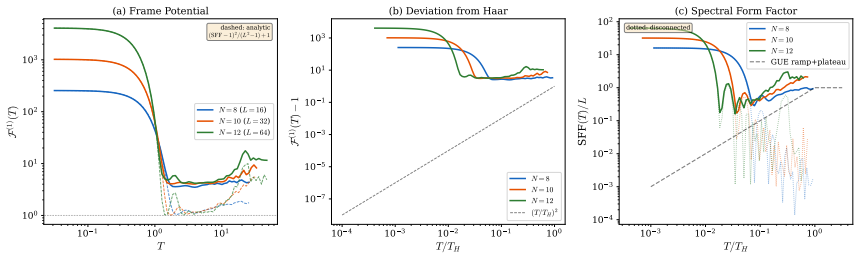
We argue that the SYK model provides a conditional realization of Cryptographic Censorship in JT gravity. By using the Weingarten calculus and random matrix universality, we prove that the SYK disorder ensemble is an approximate unitary $k$-design for all $k=\poly(N)$, with deviation controlled by the spectral form factor. We then formulate the planted-SYK hardness conjecture and provide evidence from spectral universality and the low-degree polynomial framework. Under this conjecture, the approximate design becomes a gravitationally pseudorandom unitary. Together with the efficient causal wedge reconstruction in JT gravity, this leads to the conclusion that typical states in the SYK microcanonical window must have event horizons in their bulk duals, with the horizonless fraction doubly exponentially small. We further identify the regularized geodesic length of the maximal interior slice as the explicit distinguishing operator. Its prediction gap grows linearly with time due to the stretching of the black hole interior, linking Cryptographic Censorship to the complexity equals volume conjecture.
Editorial analysis
A structured set of objections, weighed in public.
Referee Report
Summary. The manuscript claims that the SYK model provides a conditional realization of Cryptographic Censorship in JT gravity. Using Weingarten calculus and random-matrix universality, it proves that the SYK disorder ensemble is an approximate unitary k-design for all k = poly(N), with deviation controlled by the spectral form factor. It formulates the planted-SYK hardness conjecture and supplies supporting evidence from spectral universality and the low-degree polynomial framework. Under this conjecture the approximate design is upgraded to a gravitationally pseudorandom unitary; combined with efficient causal-wedge reconstruction in JT gravity, this implies that typical states in the SYK microcanonical window have event horizons in their bulk duals, with the horizonless fraction doubly exponentially small. The regularized geodesic length of the maximal interior slice is identified as the explicit distinguishing operator whose prediction gap grows linearly with time, linking the result to the complexity-equals-volume conjecture.
Significance. If the planted-SYK hardness conjecture holds, the result would be significant in connecting quantum chaos, pseudorandomness, and holographic gravity by exhibiting a concrete microscopic model in which cryptographic hardness enforces horizon formation for typical states. The independent technical contribution of proving the approximate k-design property via Weingarten calculus and the spectral form factor stands on its own, as does the explicit identification of a bulk operator whose linear growth distinguishes horizonless configurations. The work supplies a falsifiable prediction in the form of doubly exponential suppression of horizonless states.
major comments (2)
- [Section formulating the planted-SYK hardness conjecture] The section formulating the planted-SYK hardness conjecture: the central claim that typical microcanonical states must have event horizons (with horizonless fraction doubly exponentially small) follows only after invoking this unproven conjecture to promote the approximate design to a gravitationally pseudorandom unitary. The supplied evidence from spectral universality and low-degree polynomials is suggestive but does not constitute a proof, so the censorship conclusion remains conditional on an assumption that is also used to define the pseudorandomness property.
- [Abstract and design-proof paragraphs] Abstract and the design-proof paragraphs: the claim that the spectral form factor controls the deviation for all k = poly(N) is presented as a proof via Weingarten calculus, yet only a sketch of the route is given; without the explicit derivation it is impossible to confirm whether the stated bounds are strong enough to support the subsequent upgrade step even under the conjecture.
minor comments (1)
- The definition of 'gravitationally pseudorandom unitary' is introduced only after the conjecture; a self-contained definition placed earlier would improve readability.
Simulated Author's Rebuttal
We thank the referee for the careful and constructive report. We address each major comment below. The manuscript already frames the censorship result as conditional on the planted-SYK hardness conjecture and presents supporting evidence rather than a proof of the conjecture. For the design property we clarify the location of the full derivation and agree to minor clarifications in the abstract.
read point-by-point responses
-
Referee: [Section formulating the planted-SYK hardness conjecture] The section formulating the planted-SYK hardness conjecture: the central claim that typical microcanonical states must have event horizons (with horizonless fraction doubly exponentially small) follows only after invoking this unproven conjecture to promote the approximate design to a gravitationally pseudorandom unitary. The supplied evidence from spectral universality and low-degree polynomials is suggestive but does not constitute a proof, so the censorship conclusion remains conditional on an assumption that is also used to define the pseudorandomness property.
Authors: We agree that the central censorship claim is conditional on the planted-SYK hardness conjecture. This conditional status is stated explicitly in the abstract, the introduction, and the dedicated section that formulates the conjecture. The spectral-universality and low-degree-polynomial arguments are supplied only as supporting evidence for the plausibility of the conjecture, not as a proof. Because the manuscript never claims an unconditional proof, no revision is required on this point. revision: no
-
Referee: [Abstract and design-proof paragraphs] Abstract and the design-proof paragraphs: the claim that the spectral form factor controls the deviation for all k = poly(N) is presented as a proof via Weingarten calculus, yet only a sketch of the route is given; without the explicit derivation it is impossible to confirm whether the stated bounds are strong enough to support the subsequent upgrade step even under the conjecture.
Authors: The explicit derivation of the approximate k-design property, including the Weingarten-calculus steps and the precise bounds controlled by the spectral form factor, appears in Sections 3 and 4 of the main text. The abstract summarizes the result. To make the strength of the bounds immediately visible to readers who consult only the abstract, we will add a short parenthetical reference to the key steps and the resulting exponential suppression. This is a minor clarification; the technical bounds themselves remain unchanged. revision: yes
Circularity Check
No significant circularity; result is explicitly conditional
full rationale
The paper first establishes that the SYK disorder ensemble forms an approximate unitary k-design (k=poly(N)) via Weingarten calculus and random-matrix universality, with the deviation bounded by the spectral form factor; this step is self-contained and uses standard external techniques. It then separately formulates the planted-SYK hardness conjecture, supplies supporting evidence from spectral universality and low-degree polynomials, and states that only under this conjecture does the design become a gravitationally pseudorandom unitary, which combined with causal-wedge reconstruction yields the horizon conclusion. Because the central claim is presented as conditional on an additional unproven assumption rather than derived unconditionally or by re-labeling the design property itself, no step reduces the output to the inputs by construction. This is a standard conditional argument, not circularity.
Axiom & Free-Parameter Ledger
axioms (2)
- ad hoc to paper planted-SYK hardness conjecture
- domain assumption random matrix universality of SYK spectral form factor
invented entities (1)
-
gravitationally pseudorandom unitary
no independent evidence
Reference graph
Works this paper leans on
-
[1]
N. Engelhardt, Å. Folkestad, A. Levine, E. Verheijden and L. Yang,Cryptographic Censorship, JHEP01(2025) 122 [2402.03425]
-
[2]
Maldacena,The large-n limit of superconformal field theories and supergravity,International Journal of Theoretical Physics38(1999) 1113–1133
J. Maldacena,The large-n limit of superconformal field theories and supergravity,International Journal of Theoretical Physics38(1999) 1113–1133. – 24 –
1999
-
[3]
Bulk Locality and Quantum Error Correction in AdS/CFT
A. Almheiri, X. Dong and D. Harlow,Bulk Locality and Quantum Error Correction in AdS/CFT,JHEP04(2015) 163 [1411.7041]
work page internal anchor Pith review Pith/arXiv arXiv 2015
-
[4]
Black holes as mirrors: quantum information in random subsystems
P. Hayden and J. Preskill,Black holes as mirrors: quantum information in random subsystems, JHEP09(2007) 120 [0708.4025]
work page internal anchor Pith review Pith/arXiv arXiv 2007
-
[5]
Y. Sekino and L. Susskind,Fast Scramblers,JHEP10(2008) 065 [0808.2096]
work page internal anchor Pith review Pith/arXiv arXiv 2008
-
[6]
Black holes and the butterfly effect
S.H. Shenker and D. Stanford,Black holes and the butterfly effect,JHEP03(2014) 067 [1306.0622]
work page internal anchor Pith review Pith/arXiv arXiv 2014
-
[7]
J. Maldacena, S.H. Shenker and D. Stanford,A bound on chaos,JHEP08(2016) 106 [1503.01409]
work page internal anchor Pith review Pith/arXiv arXiv 2016
-
[8]
Black Holes and Random Matrices
J.S. Cotler, G. Gur-Ari, M. Hanada, J. Polchinski, P. Saad, S.H. Shenker et al.,Black Holes and Random Matrices,JHEP05(2017) 118 [1611.04650]
work page internal anchor Pith review Pith/arXiv arXiv 2017
-
[9]
The Second Law of Quantum Complexity
A.R. Brown and L. Susskind,Second law of quantum complexity,Phys. Rev. D97(2018) 086015 [1701.01107]
work page internal anchor Pith review Pith/arXiv arXiv 2018
-
[10]
A. Bouland, B. Fefferman and U. Vazirani,Computational pseudorandomness, the wormhole growth paradox, and constraints on the AdS/CFT duality,1910.14646
-
[11]
Pseudo-randomness and Learning in Quantum Computation
R.A. Low,Pseudo-randomness and Learning in Quantum Computation,1006.5227
work page internal anchor Pith review Pith/arXiv arXiv
-
[12]
Y.-Z. You, A.W.W. Ludwig and C. Xu,Sachdev-Ye-Kitaev Model and Thermalization on the Boundary of Many-Body Localized Fermionic Symmetry Protected Topological States,Phys. Rev. B95(2017) 115150 [1602.06964]
work page internal anchor Pith review Pith/arXiv arXiv 2017
-
[13]
Hopkins and D
S.B. Hopkins and D. Steurer,Efficient Bayesian estimation from few samples: community detection and related problems, in58th Annual IEEE Symposium on Foundations of Computer Science (FOCS), pp. 379–390, 2017, DOI
2017
-
[14]
D. Kunisky, A.S. Wein and A.S. Bandeira,Notes on computational hardness of hypothesis testing: predictions using the low-degree likelihood ratio,1907.11636
work page internal anchor Pith review Pith/arXiv arXiv 1907
-
[15]
T. Faulkner and M. Li,Asymptotically isometric codes for holography,2211.12439
-
[16]
Conformal symmetry and its breaking in two dimensional Nearly Anti-de-Sitter space
J. Maldacena, D. Stanford and Z. Yang,Conformal symmetry and its breaking in two-dimensional nearly anti-de Sitter space,Prog. Theor. Exp. Phys.2016(2016) 12C104 [1606.01857]
work page internal anchor Pith review Pith/arXiv arXiv 2016
-
[17]
K. Jensen,Chaos in AdS2 Holography,Phys. Rev. Lett.117(2016) 111601 [1605.06098]
work page internal anchor Pith review Pith/arXiv arXiv 2016
-
[18]
Local bulk operators in AdS/CFT: a boundary view of horizons and locality
A. Hamilton, D.N. Kabat, G. Lifschytz and D.A. Lowe,Local bulk operators in AdS/CFT: A Boundary view of horizons and locality,Phys. Rev. D73(2006) 086003 [hep-th/0506118]
work page internal anchor Pith review Pith/arXiv arXiv 2006
-
[19]
Holographic representation of local bulk operators
A. Hamilton, D.N. Kabat, G. Lifschytz and D.A. Lowe,Holographic representation of local bulk operators,Phys. Rev. D74(2006) 066009 [hep-th/0606141]
work page internal anchor Pith review Pith/arXiv arXiv 2006
- [20]
-
[21]
L.V. Iliesiu, M. Mezei and G. Sárosi,The volume of the black hole interior at late times,JHEP 07(2022) 073 [2107.06286]
-
[22]
L. Yang and N. Engelhardt,The Complexity of Learning (Pseudo)random Dynamics of Black Holes and Other Chaotic Systems,2302.11013
-
[23]
Complexity and Shock Wave Geometries
D. Stanford and L. Susskind,Complexity and shock wave geometries,Phys. Rev. D90(2014) 126007 [1406.2678]. – 25 –
work page internal anchor Pith review Pith/arXiv arXiv 2014
-
[24]
Susskind,Addendum to computational complexity and black hole horizons, 2014
L. Susskind,Addendum to computational complexity and black hole horizons, 2014
2014
-
[25]
Gapless Spin-Fluid Ground State in a Random Quantum Heisenberg Magnet
S. Sachdev and J. Ye,Gapless spin-fluid ground state in a random quantum Heisenberg magnet,Phys. Rev. Lett.70(1993) 3339 [cond-mat/9212030]
work page internal anchor Pith review Pith/arXiv arXiv 1993
-
[26]
A simple model of quantum holography
A. Kitaev, “A simple model of quantum holography.” Talks at KITP, April 7, 2015 and May 27, 2015, 2015
2015
-
[27]
Comments on the Sachdev-Ye-Kitaev model
J. Maldacena and D. Stanford,Remarks on the Sachdev-Ye-Kitaev model,Phys. Rev. D94 (2016) 106002 [1604.07818]
work page internal anchor Pith review Pith/arXiv arXiv 2016
-
[28]
Altland and M.R
A. Altland and M.R. Zirnbauer,Nonstandard symmetry classes in mesoscopic normal-superconducting hybrid structures,Physical Review B55(1997) 1142–1161
1997
-
[29]
A semiclassical ramp in SYK and in gravity
P. Saad, S.H. Shenker and D. Stanford,A semiclassical ramp in SYK and in gravity, 1806.06840
work page internal anchor Pith review Pith/arXiv arXiv
-
[30]
JT gravity as a matrix integral
P. Saad, S.H. Shenker and D. Stanford,JT gravity as a matrix integral,1903.11115
work page internal anchor Pith review Pith/arXiv arXiv 1903
-
[31]
Eigenstate thermalization in the Sachdev-Ye-Kitaev model
J. Sonner and M. Vielma,Eigenstate thermalization in the Sachdev-Ye-Kitaev model,JHEP11 (2017) 149 [1707.08013]
work page internal anchor Pith review Pith/arXiv arXiv 2017
- [32]
-
[33]
Mehta,Random Matrices, Elsevier/Academic Press, 3rd ed
M.L. Mehta,Random Matrices, Elsevier/Academic Press, 3rd ed. (2004), 10.1016/C2009-0-22297-5
-
[34]
Cipolloni,Eigenvector Decorrelation for Random Matrices and Applications,2410.10718
G. Cipolloni,Eigenvector Decorrelation for Random Matrices and Applications,2410.10718
-
[35]
Chaos, Complexity, and Random Matrices
J. Cotler, N. Hunter-Jones, J. Liu and B. Yoshida,Chaos, Complexity, and Random Matrices, JHEP11(2017) 048 [1706.05400]
work page internal anchor Pith review Pith/arXiv arXiv 2017
-
[36]
Jackiw,Lower dimensional gravity,Nucl
R. Jackiw,Lower dimensional gravity,Nucl. Phys. B252(1985) 343
1985
-
[37]
Teitelboim,Gravitation and Hamiltonian structure in two spacetime dimensions,Phys
C. Teitelboim,Gravitation and Hamiltonian structure in two spacetime dimensions,Phys. Lett. B126(1983) 41
1983
-
[38]
The soft mode in the Sachdev-Ye-Kitaev model and its gravity dual
A. Kitaev and S.-J. Suh,The soft mode in the Sachdev-Ye-Kitaev model and its gravity dual, JHEP05(2018) 183 [1711.08467]
work page internal anchor Pith review Pith/arXiv arXiv 2018
-
[39]
Leutheusser and H
S. Leutheusser and H. Liu,Subregion-subalgebra duality: emergence of space and time in holography, 2024
2024
-
[40]
Pseudorandom quantum states
Z. Ji, Y.-K. Liu and F. Song, “Pseudorandom quantum states.” Cryptology ePrint Archive, Paper 2018/544, 2018
2018
-
[41]
Optimizing quantum process tomography with unitary 2-designs
A.J. Scott,Optimizing quantum process tomography with unitary 2-designs,J. Phys. A41 (2008) 055308 [0711.1017]
work page internal anchor Pith review Pith/arXiv arXiv 2008
-
[42]
Dankert, R
C. Dankert, R. Cleve, J. Emerson and E. Livine,Exact and approximate unitary 2-designs and their application to fidelity estimation,Phys. Rev. A80(2009) 012304
2009
-
[43]
Integration with respect to the Haar measure on unitary, orthogonal and symplectic group
B. Collins and P. Śniady,Integration with respect to the Haar measure on unitary, orthogonal and symplectic group,Commun. Math. Phys.264(2006) 773 [math-ph/0402073]
work page internal anchor Pith review Pith/arXiv arXiv 2006
-
[44]
B. Collins, S. Matsumoto and J. Novak,The Weingarten calculus,Notices Amer. Math. Soc. 69(2022) 734 [2109.14890]
-
[45]
The tenfold way and many-body zero modes in the Sachdev-Ye-Kitaev model
J. Behrends, J.H. Bardarson and B. Béri,Tenfold way and many-body zero modes in the Sachdev-Ye-Kitaev model,Phys. Rev. B99(2019) 195123 [1812.10853]. – 26 –
work page internal anchor Pith review Pith/arXiv arXiv 2019
-
[46]
Onset of Random Matrix Behavior in Scrambling Systems
H. Gharibyan, M. Hanada, S.H. Shenker and M. Tezuka,Onset of Random Matrix Behavior in Scrambling Systems,JHEP07(2018) 124 [1803.08050]
work page internal anchor Pith review Pith/arXiv arXiv 2018
-
[47]
J. Baik, G. Ben Arous and S. Péché,Phase transition of the largest eigenvalue for nonnull complex sample covariance matrices,Ann. Probab.33(2005) 1643 [math/0403022]
work page internal anchor Pith review Pith/arXiv arXiv 2005
-
[48]
Hayashi,Asymptotic estimation theory for a finite-dimensional pure state model,J
M. Hayashi,Asymptotic estimation theory for a finite-dimensional pure state model,J. Phys. A31(1998) 4633
1998
-
[49]
Optimal Cloning of Pure States, Judging Single Clones
M. Keyl and R.F. Werner,Optimal cloning of pure states, testing single clones,J. Math. Phys. 40(1999) 3283 [quant-ph/9807010]
work page internal anchor Pith review Pith/arXiv arXiv 1999
-
[50]
Massar and S
S. Massar and S. Popescu,Optimal Extraction of Information from Finite Quantum Ensembles,Phys. Rev. Lett.74(1995) 1259
1995
-
[51]
A. Acín, E. Jané and G. Vidal,Optimal Estimation of Quantum Dynamics,Phys. Rev. A64 (2001) 050302 [quant-ph/0012015]
work page internal anchor Pith review Pith/arXiv arXiv 2001
-
[52]
Optimal quantum learning of a unitary transformation
A. Bisio, G. Chiribella, G.M. D’Ariano, S. Facchini and P. Perinotti,Optimal Quantum Learning of a Unitary Transformation,Phys. Rev. A81(2010) 032324 [0903.0543]
work page internal anchor Pith review Pith/arXiv arXiv 2010
-
[53]
General teleportation channel, singlet fraction and quasi-distillation
M. Horodecki, P. Horodecki and R. Horodecki,General teleportation channel, singlet fraction, and fidelity,Phys. Rev. A60(1999) 1888 [quant-ph/9807091]
work page internal anchor Pith review Pith/arXiv arXiv 1999
- [54]
-
[55]
N. Engelhardt and Å. Folkestad,General bounds on holographic complexity,JHEP01(2022) 040 [2109.06883]
-
[56]
C.H. Bennett, E. Bernstein, G. Brassard and U. Vazirani,Strengths and Weaknesses of Quantum Computing, vol. 26, pp. 1510–1523, 1997, DOI [quant-ph/9701001]
-
[57]
Quantum lower bounds by quantum arguments
A. Ambainis,Quantum lower bounds by quantum arguments,J. Comput. Syst. Sci.64(2002) 750 [quant-ph/0002066]
work page internal anchor Pith review Pith/arXiv arXiv 2002
-
[58]
E.S. Meckes,The Random Matrix Theory of the Classical Compact Groups, Cambridge University Press, Cambridge (2019), 10.1017/9781108303453
-
[59]
Hawking and D.N
S.W. Hawking and D.N. Page,Thermodynamics of Black Holes in anti-De Sitter Space, Commun. Math. Phys.87(1983) 577
1983
-
[60]
Anti-de Sitter Space, Thermal Phase Transition, And Confinement In Gauge Theories
E. Witten,Anti-de Sitter Space, Thermal Phase Transition, and Confinement in Gauge Theories,Adv. Theor. Math. Phys.2(1998) 505 [hep-th/9803131]
work page internal anchor Pith review Pith/arXiv arXiv 1998
-
[61]
D. Harlow and D. Jafferis,The Factorization Problem in Jackiw-Teitelboim Gravity,JHEP02 (2020) 177 [1804.01081]
-
[62]
Lin,The bulk hilbert space of double scaled syk,Journal of High Energy Physics2022 (2022)
H.W. Lin,The bulk hilbert space of double scaled syk,Journal of High Energy Physics2022 (2022)
2022
-
[63]
Rabinovici, A
E. Rabinovici, A. Sánchez-Garrido, R. Shir and J. Sonner,Krylov complexity from integrability to chaos,Journal of High Energy Physics2022(2022)
2022
- [64]
-
[65]
Three Lectures on Complexity and Black Holes
L. Susskind,Three Lectures on Complexity and Black Holes,1810.11563
work page internal anchor Pith review Pith/arXiv arXiv
-
[66]
Operator growth in the SYK model
D.A. Roberts, D. Stanford and A. Streicher,Operator growth in the SYK model,JHEP06 (2018) 122 [1802.02633]. – 27 –
work page internal anchor Pith review Pith/arXiv arXiv 2018
- [67]
- [68]
- [69]
-
[70]
The Gravity Dual of a Density Matrix
B. Czech, J.L. Karczmarek, F. Nogueira and M. Van Raamsdonk,The Gravity Dual of a Density Matrix,Class. Quant. Grav.29(2012) 155009 [1204.1330]
work page internal anchor Pith review Pith/arXiv arXiv 2012
-
[71]
X. Dong, D. Harlow and A.C. Wall,Reconstruction of Bulk Operators within the Entanglement Wedge in Gauge-Gravity Duality,Phys. Rev. Lett.117(2016) 021601 [1601.05416]
work page internal anchor Pith review Pith/arXiv arXiv 2016
-
[72]
Pseudorandom isometries
P. Ananth, A. Gulati, F. Kaleoglu and Y.-T. Lin, “Pseudorandom isometries.” Cryptology ePrint Archive, Paper 2023/1741, 2023
2023
-
[73]
Whitfield, J
J.D. Whitfield, J. Biamonte and A. Aspuru-Guzik,Simulation of electronic structure hamiltonians using quantum computers,Molecular Physics109(2011) 735–750
2011
-
[74]
Efficient quantum algorithms for simulating sparse Hamiltonians
D.W. Berry, G. Ahokas, R. Cleve and B.C. Sanders,Efficient quantum algorithms for simulating sparse Hamiltonians,Commun. Math. Phys.270(2007) 359 [quant-ph/0508139]
work page internal anchor Pith review Pith/arXiv arXiv 2007
-
[75]
Suzuki,Fractal decomposition of exponential operators with applications to many-body theories and Monte Carlo simulations,Phys
M. Suzuki,Fractal decomposition of exponential operators with applications to many-body theories and Monte Carlo simulations,Phys. Lett. A146(2002) 319
2002
-
[76]
Suzuki,General theory of fractal path integrals with applications to many-body theories and statistical physics,J
M. Suzuki,General theory of fractal path integrals with applications to many-body theories and statistical physics,J. Math. Phys.32(1991) 400. – 28 –
1991
discussion (0)
Sign in with ORCID, Apple, or X to comment. Anyone can read and Pith papers without signing in.