Model-Free Control approach for pH Regulation in Thin-Layer Photobioreactors
Pith reviewed 2026-06-29 23:37 UTC · model grok-4.3
The pith
A model-free extremum seeking control strategy reduces CO2 consumption by 39% and pH tracking error by over 60% compared to on-off control in thin-layer photobioreactors.
A machine-rendered reading of the paper's core claim, the machinery that carries it, and where it could break.
Core claim
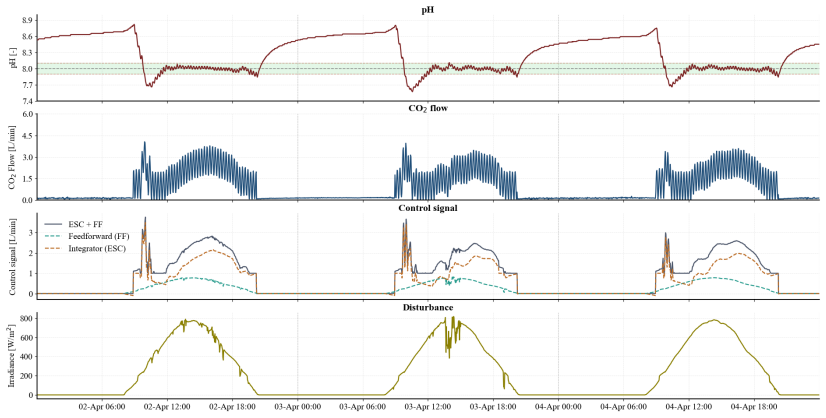
The proposed ESC strategy reduced cumulative CO2 consumption by approximately 39 % and decreased the accumulated pH tracking error by more than 60 % compared with conventional on-off control, while biomass- and irradiance-normalised indicators confirmed a more efficient use of injected carbon. These results demonstrate that high-frequency ESC can improve regulation performance and carbon utilisation efficiency in fast photobioreactor systems.
What carries the argument
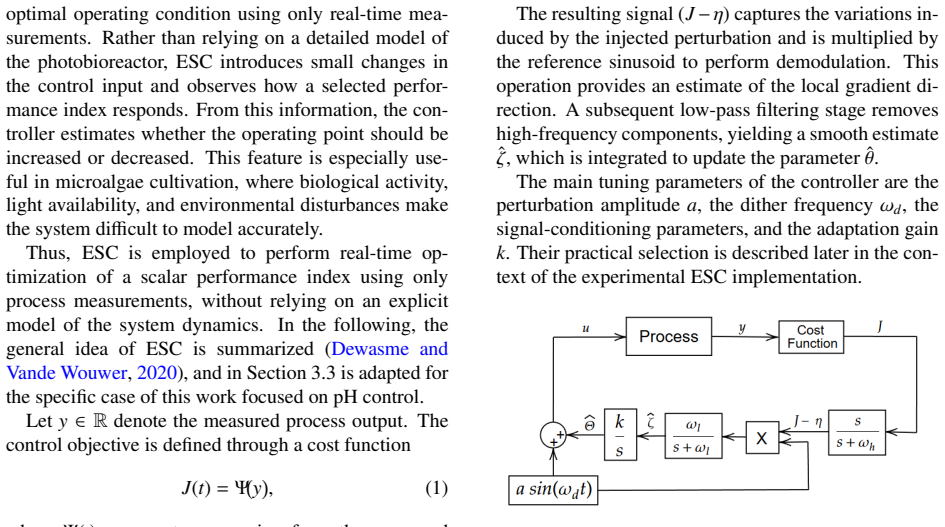
Extremum Seeking Control (ESC) with feedforward compensation of solar irradiance for real-time gradient-based optimization of pH without a system model.
If this is right
- More efficient use of injected carbon in variable outdoor conditions.
- Suitability of the approach for thin-layer cultivation systems.
- Improved process efficiency as measured by biomass and productivity indicators.
Where Pith is reading between the lines
- The method could be tested in other fast-response cultivation systems where models are unreliable.
- Scaling the high-frequency ESC might require attention to sensor noise levels.
- Efficiency gains may translate to lower operational costs for large-scale biomass production.
Load-bearing premise
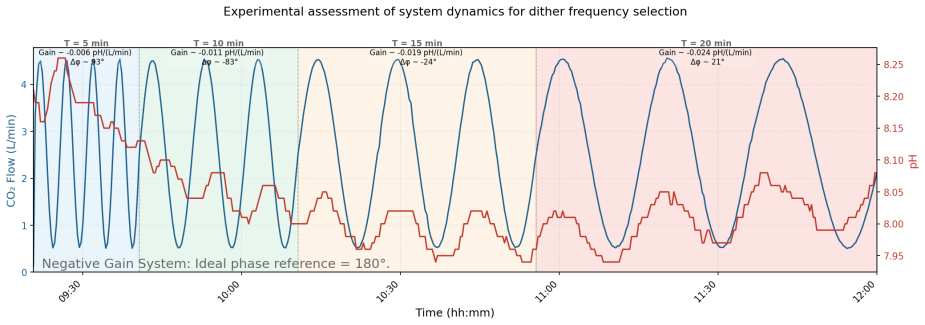
The reduced hydraulic inertia of TLR systems enables the adaptation of this control strategy to accelerate convergence while preserving gradient estimation accuracy.
What would settle it
An experiment showing that the ESC strategy does not achieve at least a 30% reduction in CO2 consumption or 50% in pH error compared to on-off control would challenge the reported performance gains.
Figures


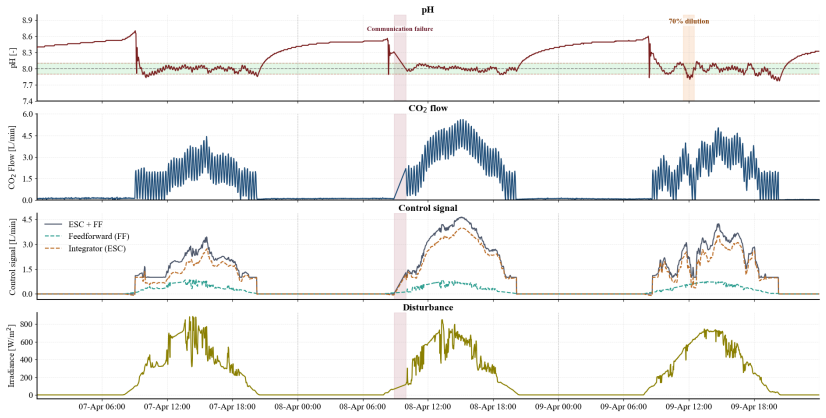

read the original abstract
Thin-layer photobioreactors (TLRs) exhibit fast hydrodynamic and thermal dynamics, strong nonlinear photosynthetic responses and significant time-variability due to irradiance fluctuations and biomass growth. These characteristics challenge conventional model-based control strategies, whose tuning degrades under rapidly changing operating conditions. This work presents the experimental implementation of a model-free control approach, Extremum Seeking Control (ESC), for performance optimization in a semi-industrial thin-layer photobioreactor. Unlike previous studies in raceway ponds, the reduced hydraulic inertia of TLR systems enables the adaptation of this control strategy to accelerate convergence while preserving gradient estimation accuracy. The proposed approach is experimentally compared against classical on-off control and ESC configurations with and without feedforward compensation of solar irradiance. Beyond control performance metrics, biological indicators such as biomass concentration and productivity are evaluated to assess the impact on process efficiency. Results show that the proposed ESC strategy reduced cumulative CO$_2$ consumption by approximately 39 % and decreased the accumulated pH tracking error by more than 60 % compared with conventional on-off control, while biomass- and irradiance-normalised indicators confirmed a more efficient use of injected carbon. These results demonstrate that high-frequency ESC can improve regulation performance and carbon utilisation efficiency in fast photobioreactor systems, highlighting its suitability for thin-layer cultivation under outdoor conditions.
Editorial analysis
A structured set of objections, weighed in public.
Referee Report
Summary. The manuscript presents the experimental implementation of Extremum Seeking Control (ESC) for pH regulation in a semi-industrial thin-layer photobioreactor (TLR). It compares the proposed high-frequency ESC (with and without feedforward solar irradiance compensation) to classical on-off control, reporting a ~39% reduction in cumulative CO2 consumption and >60% decrease in accumulated pH tracking error, along with improved biomass- and irradiance-normalized carbon utilization efficiency. The work attributes the feasibility of faster dithering to the reduced hydraulic inertia of TLRs relative to raceway ponds.
Significance. If the experimental results hold under the reported conditions, the paper demonstrates that model-free ESC can be adapted for fast-dynamics photobioreactors to improve regulation and resource efficiency without relying on detailed process models. This provides concrete evidence of practical gains (39% CO2 savings, 60% error reduction) in an outdoor-relevant setting and supports the broader applicability of high-frequency ESC to low-inertia cultivation systems.
minor comments (3)
- [Results] The abstract and results section report specific percentage improvements (39% CO2, >60% error) from direct experimental comparisons; the manuscript should include error bars, replicate counts, and statistical tests (e.g., t-tests or ANOVA) to substantiate these metrics and rule out variability due to irradiance fluctuations.
- [Methods] The description of the ESC adaptation for TLRs (accelerated convergence while preserving gradient accuracy) relies on the low-inertia property; a dedicated methods subsection should quantify the dither frequency, amplitude, and convergence time constants used, with explicit comparison to prior raceway implementations.
- [Discussion] Biological indicators (biomass concentration, productivity) are evaluated alongside control metrics; the manuscript should clarify how these were normalized and whether any confounding effects from pH regulation on growth kinetics were accounted for in the efficiency claims.
Simulated Author's Rebuttal
We thank the referee for the positive assessment of our work on Extremum Seeking Control for pH regulation in thin-layer photobioreactors and for recommending minor revision. The summary accurately captures the key experimental outcomes, including the 39% reduction in CO2 consumption and over 60% decrease in pH tracking error relative to on-off control.
Circularity Check
No significant circularity; purely experimental comparison
full rationale
The paper reports direct experimental results from implementing ESC on a thin-layer photobioreactor and comparing metrics (CO2 consumption, pH error) against on-off control. No derivation chain, fitted parameters renamed as predictions, or self-citation load-bearing steps appear in the abstract or described content. All performance claims rest on measured outcomes under stated conditions, with no reduction of outputs to inputs by construction.
Axiom & Free-Parameter Ledger
Reference graph
Works this paper leans on
-
[1]
Production cost of a real microalgae pro- duction plant and strategies to reduce it. Biotech- 11 nology Advances 30, 1344–1353. doi:10.1016/j. biotechadv.2012.02.005. special issue on ACB 2011. Acién, F.G., Molina, E., Reis, A., Torzillo, G., Zit- telli, G.C., Sepúlveda, C., Masojídek, J., 2017. Photobioreactors for the production of microal- gae, in: Gon...
work page doi:10.1016/j 2012
-
[2]
Biochemical Engineering Journal 222, 109833
A cheap real-time optimal control setup for microalgae cultures: Simulation and experimental re- sults. Biochemical Engineering Journal 222, 109833. doi:10.1016/j.bej.2025.109833. Nordio, R., Delgado, F., Sánchez-Zurano, A., González-Hernández, J., Rodríguez-Miranda, E., Guzmán, J.L., Lafarga, T., Acién, G., 2022. Long- term assessment of the nutrient rec...
discussion (0)
Sign in with ORCID, Apple, or X to comment. Anyone can read and Pith papers without signing in.