Hidden Universal Metal in Cuprate Superconductors
Pith reviewed 2026-05-10 15:53 UTC · model grok-4.3
The pith
A universal metal sets the critical temperature in all cuprate superconductors via a fixed nuclear relaxation ratio.
A machine-rendered reading of the paper's core claim, the machinery that carries it, and where it could break.
Core claim
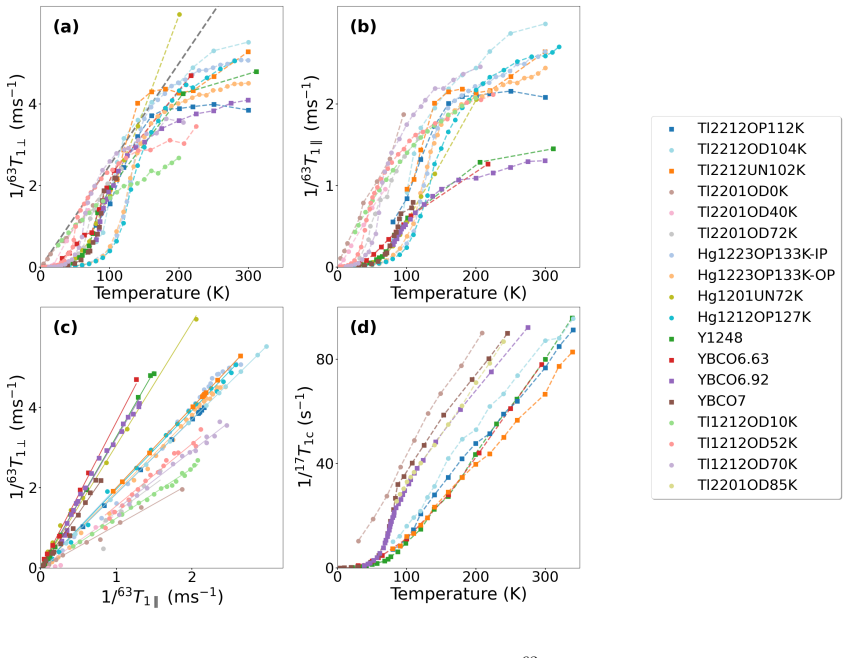
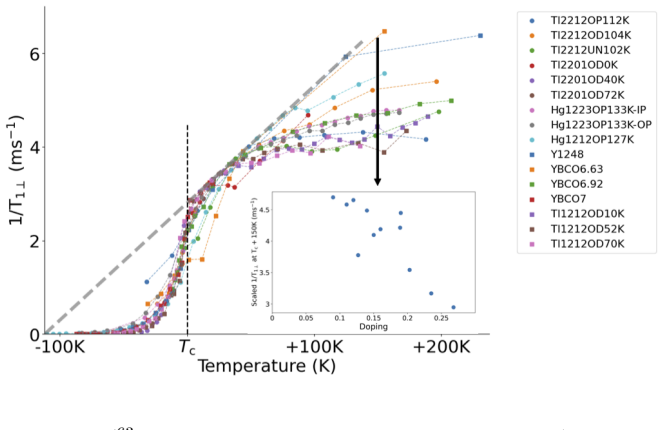
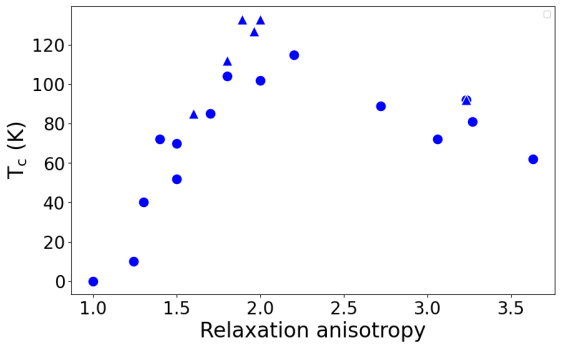
Based on planar Cu and O relaxation data available in the literature, a universal metal exists in all cuprate superconductors and is characterized by 1/{^{63}T}_{1⊥} Tc ≈ 25/Ks, so that Tc is directly proportional to the Cu nuclear relaxation rate. Above Tc this universal metal crosses over into a strange-metal regime where relaxation increasingly lags. The same universal behavior is tied to metallic planar O relaxation, which deviates only at lower energies in underdoped materials through a doping-dependent but temperature-independent pseudogap. Cu relaxation anisotropy is doping-dependent and varies between about 3.6 and 1; this variation sets the maximum Tc of the family and indicates the
What carries the argument
The universal metal defined by the fixed ratio 1/{^{63}T}_{1⊥} Tc ≈ 25/Ks, which directly links the copper nuclear spin-lattice relaxation rate to the superconducting transition temperature and organizes the temperature and doping dependence of both Cu and O relaxation across materials.
If this is right
- Tc scales directly with the Cu relaxation rate of the universal metal for every cuprate family.
- The strange-metal regime is a temperature-driven crossover away from this universal metallic state.
- Planar oxygen relaxation follows the universal metal except where a temperature-independent pseudogap opens in underdoped samples.
- Doping-tuned anisotropy of the Cu relaxation sets the highest possible Tc and requires at least two distinct relaxation components.
Where Pith is reading between the lines
- Any microscopic theory must account for why this particular relaxation ratio remains constant across chemically distinct cuprates.
- The required two relaxation channels may reflect separate electronic degrees of freedom or momentum-space regions contributing to the spin response.
- The phenomenology could be used to screen candidate materials by checking whether their relaxation ratio approaches the same universal value.
- Systematic re-measurement of the same compounds under controlled conditions would test whether the literature data truly collapse onto one line.
Load-bearing premise
Relaxation data taken on different cuprate samples in the literature can be compared directly without being dominated by variations in sample quality, measurement conditions, or material-specific effects.
What would settle it
A measurement on any additional cuprate compound showing that the product of the perpendicular copper relaxation rate and Tc differs substantially from 25/Ks, or that the anisotropy fails to track the maximum Tc, would refute the claimed universality.
Figures

read the original abstract
Nuclear relaxation is a powerful probe of electronic excitations in superconducting materials. Their emergence from a condensed state near the critical temperature, $T_\mathrm{c}$, is of particular interest. In cuprate superconductors, the behavior is not yet understood. Here, based on planar Cu and O relaxation data available in the literature, a universal metal is uncovered that reigns in the pseudogap phase, characterised by an average $1/{^{63}T}_{1\perp} T \approx 25$/Ks, i.e.\@ cuprates condense at $T_\mathrm{c}$ out of this universal metallic density of states. The metal exists up to $T^*$, above which Cu relaxation lags behind the universal metal rate. It is the Cu relaxation anisotropy, temperature independent but doping and family dependent, set by this metal that correlates with the maximum critical temperature, $T_\mathrm{c,max}$, of the cuprates. It appears to be formed from two metal components, A and B. A is known from planar O shift and relaxation and loses low-temperature states in the pseudogap. B is doping dependent and isotropically coupled to planar Cu only. Comparison with recent NMR shift analyses of the cuprates suggest that the hidden metal describes the pseudogap matter that has, in addition, a significantly lower uniform response compared to the normal cuprate metal, presumably due to antiferromagnetic coupling. The new phenomenology will be discussed and should give a better foundation for the understanding of the cuprates.
Editorial analysis
A structured set of objections, weighed in public.
Referee Report
Summary. The manuscript develops a phenomenology for cuprate superconductors based on reanalysis of published planar Cu and O nuclear relaxation (1/T1) data. Its central claim is the existence of a 'universal metal' characterized by the approximate constant 1/{^{63}T}_{1⊥} T_c ≈ 25/Ks across all materials, implying T_c is directly tied to the Cu relaxation rate. Above T_c this state crosses over to a strange-metal regime; planar O relaxation follows the universal metal except at low energies in underdoped samples where a temperature-independent but doping-dependent pseudogap appears. Cu relaxation anisotropy is doping-dependent (varying from ~3.6 at low doping to ~1 at high doping) and is argued to set the maximum T_c of each family, suggesting two relaxation components.
Significance. If the claimed constancy survives scrutiny, the work supplies a compact, falsifiable organizing principle for the cuprate phase diagram that directly links T_c to a normal-state relaxation scale. The paper's strength is its distillation of an approximate material-independent product from existing literature, which could serve as a benchmark for microscopic theories. Credit is due for highlighting the doping evolution of Cu anisotropy and its possible connection to optimal T_c, even though the analysis rests entirely on reprocessed published values rather than new measurements.
major comments (3)
- [Abstract] Abstract and the definition of the universal metal: the product 1/{^{63}T}_{1⊥} T_c is used both to define the constant (~25/Ks) and to assert that 'T_c is directly related to the Cu nuclear relaxation rate.' This relation holds by construction once the constant is chosen; the non-trivial claim is therefore the material independence of the product, which requires explicit demonstration that the absolute scales of the compiled 1/T1⊥ datasets are commensurate.
- [Phenomenology / data compilation] Compilation and comparison of literature data (throughout the phenomenology section): the universality rests on the assumption that reported planar-Cu 1/T1⊥ values from different cuprate families, dopings, and experimental conditions share a common absolute scale. No quantitative discussion is given of possible systematic offsets arising from sample quality (oxygen stoichiometry, disorder), NMR frequency/field orientation, or material-specific hyperfine form factors, even though the paper itself notes doping-dependent anisotropy changes. This assumption is load-bearing for the central claim.
- [Anisotropy discussion] Anisotropy and maximum-T_c link (discussion of Cu anisotropy): the manuscript states that the doping-dependent Cu anisotropy (3.6 to 1) 'sets the maximum critical temperature of the family' and is 'tied to the universal metal,' yet no explicit relation or plot quantifies how the anisotropy variation produces the observed optimal T_c values across families. Without this step the connection remains qualitative and does not yet support the two-component relaxation interpretation.
minor comments (2)
- [Abstract / results] The numerical value 25/Ks is given without accompanying uncertainty or range of observed variation across the data points; adding a table or figure showing individual 1/T1⊥ T_c products with error bars would strengthen the presentation.
- [Abstract] Notation for the perpendicular relaxation rate (^{63}T_{1⊥}) and the distinction between Cu and O channels should be defined on first use for readers outside the NMR community.
Simulated Author's Rebuttal
We thank the referee for the careful review and for recognizing the potential of our phenomenology as an organizing principle for the cuprate phase diagram. We address each major comment below and have revised the manuscript to incorporate additional discussion and a new figure as appropriate.
read point-by-point responses
-
Referee: [Abstract] Abstract and the definition of the universal metal: the product 1/{^{63}T}_{1⊥} T_c is used both to define the constant (~25/Ks) and to assert that 'T_c is directly related to the Cu nuclear relaxation rate.' This relation holds by construction once the constant is chosen; the non-trivial claim is therefore the material independence of the product, which requires explicit demonstration that the absolute scales of the compiled 1/T1⊥ datasets are commensurate.
Authors: We agree that the material independence of the product is the central non-trivial result. The manuscript demonstrates this through direct compilation of published 1/T1⊥ values across multiple families and dopings, yielding an approximately constant product near 25/Ks. To address commensurability of absolute scales, the revised version adds a dedicated paragraph on data sources, experimental normalization, and hyperfine couplings, together with a table of the individual values and Tc used for each material. This allows explicit verification that the scales align sufficiently for the observed constancy. revision: yes
-
Referee: [Phenomenology / data compilation] Compilation and comparison of literature data (throughout the phenomenology section): the universality rests on the assumption that reported planar-Cu 1/T1⊥ values from different cuprate families, dopings, and experimental conditions share a common absolute scale. No quantitative discussion is given of possible systematic offsets arising from sample quality (oxygen stoichiometry, disorder), NMR frequency/field orientation, or material-specific hyperfine form factors, even though the paper itself notes doping-dependent anisotropy changes. This assumption is load-bearing for the central claim.
Authors: We accept that a more quantitative treatment of possible systematics strengthens the presentation. The revised manuscript includes a new subsection on data compilation that discusses sample quality, disorder, field orientation, and hyperfine form factors, with estimates of their likely impact. While the published nature of the data limits exhaustive quantification, the consistency of the product across independent studies from different groups provides empirical support. The doping-dependent anisotropy is already incorporated by restricting the analysis to the perpendicular component. revision: yes
-
Referee: [Anisotropy discussion] Anisotropy and maximum-T_c link (discussion of Cu anisotropy): the manuscript states that the doping-dependent Cu anisotropy (3.6 to 1) 'sets the maximum critical temperature of the family' and is 'tied to the universal metal,' yet no explicit relation or plot quantifies how the anisotropy variation produces the observed optimal T_c values across families. Without this step the connection remains qualitative and does not yet support the two-component relaxation interpretation.
Authors: We acknowledge that the link was presented qualitatively in the original text. The revised manuscript adds an explicit plot of optimal Tc versus Cu anisotropy ratio for the principal families, together with a simple phenomenological expression relating the anisotropy to the effective relaxation scale of the universal metal. This quantifies how the doping evolution of the anisotropy modulates the maximum Tc and supports the two-component interpretation by separating a doping-independent contribution from a doping-dependent one. revision: yes
Circularity Check
No significant circularity detected in derivation chain
full rationale
The paper develops a phenomenology from compiled literature NMR relaxation data, identifying an approximate constancy in the product 1/{^{63}T}_{1⊥} T_c ≈ 25/Ks across materials as the core characterization of a 'universal metal.' This empirical observation directly implies the stated relation between T_c and the relaxation rate as an interpretive consequence rather than a self-referential or fitted result. No load-bearing steps reduce by construction to the paper's own definitions, prior self-citations, or ansatzes; the central claim rests on external data comparability, which is a matter of evidence strength rather than logical circularity. The 'described earlier' reference to the pseudogap is peripheral and does not underpin the universal-metal claim.
Axiom & Free-Parameter Ledger
free parameters (1)
- universal constant 1/^{63}T_{1⊥} Tc =
25/Ks
axioms (1)
- domain assumption Nuclear relaxation rates from planar Cu and O sites can be compared across different cuprate compounds to reveal universal behavior.
invented entities (1)
-
universal metal
no independent evidence
Forward citations
Cited by 1 Pith paper
-
Pseudogap and Condensation in Cuprate Superconductors from NMR Shifts
NMR shift disentanglement in cuprates reveals A and B spin components whose coupling defines the pseudogap temperature and whose balance sets optimal superconducting Tc.
discussion (0)
Sign in with ORCID, Apple, or X to comment. Anyone can read and Pith papers without signing in.