Through the Veil: Lyα Illuminates the Host Galaxies of Little Red Dots
Pith reviewed 2026-06-27 16:02 UTC · model grok-4.3
The pith
Lyα emission in Little Red Dots traces the extended host galaxy rather than the compact red core.
A machine-rendered reading of the paper's core claim, the machinery that carries it, and where it could break.
Core claim
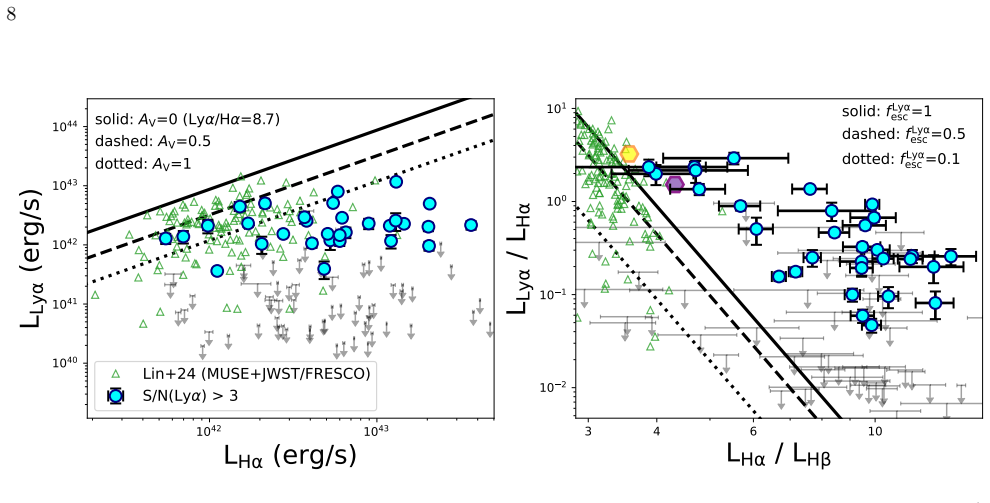
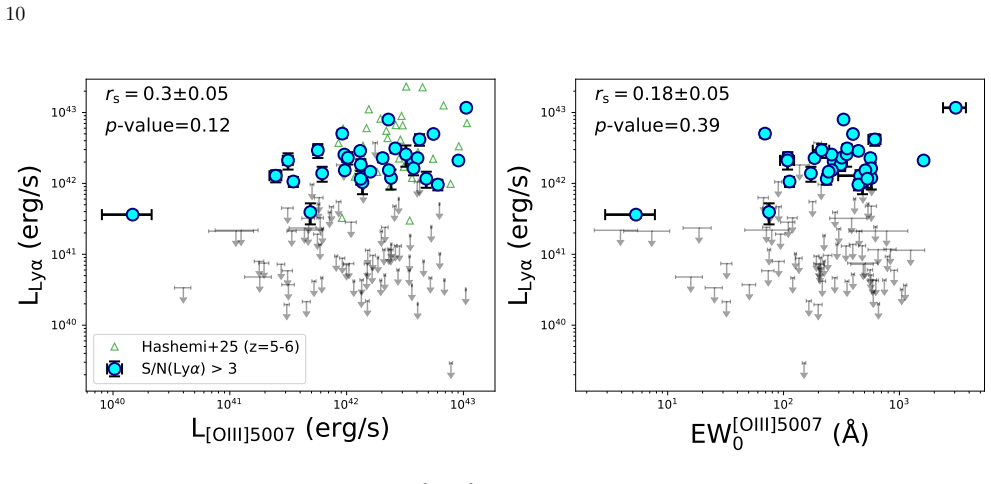
Lyα is primarily associated with the host-scale component rather than the compact component responsible for the broad Balmer lines and red continuum. This is inferred from lower Lyα/Hα ratios than in star-forming galaxies, closer tracking of Lyα luminosity with [O III] luminosity than equivalent width, and spatially extended, asymmetric Lyα maps that are offset from the rest-optical light, consistent with resonant scattering in clumpy gas.
What carries the argument
Lyα as a resonant tracer of neutral hydrogen that reveals the spatial distribution and kinematics of gas on host-galaxy scales.
If this is right
- Lyα provides a direct probe of the gaseous environment surrounding the compact red source in LRDs.
- The host galaxy's interstellar and circumgalactic gas shapes how Lyα escapes and is spatially redistributed.
- LRDs are embedded in more extended structures whose properties resemble those of normal high-redshift star-forming galaxies.
- The two-component picture separates the origin of the red continuum and broad lines from the origin of Lyα.
Where Pith is reading between the lines
- If the host-scale association holds, Lyα maps could be used to measure the size and clumpiness of gas around LRDs at z > 5.
- The offset and asymmetric Lyα emission suggests that orientation or gas geometry may influence which LRDs are detected in Lyα.
- This separation of components could help test whether the compact source is an AGN or a dust-obscured starburst by comparing gas kinematics traced by Lyα versus Balmer lines.
Load-bearing premise
Differences in Lyα/Hα ratios and the closer tracking of Lyα luminosity with [O III] luminosity reliably indicate that the emission comes from the extended host rather than the compact source.
What would settle it
Finding that Lyα emission in most LRDs is spatially coincident with the compact rest-optical core and shows Lyα/Hα ratios matching those expected from the broad-line region alone.
Figures








read the original abstract
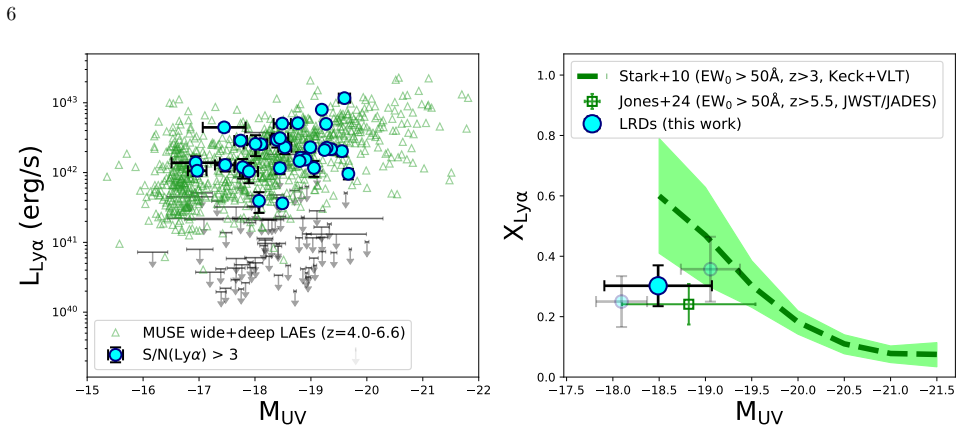
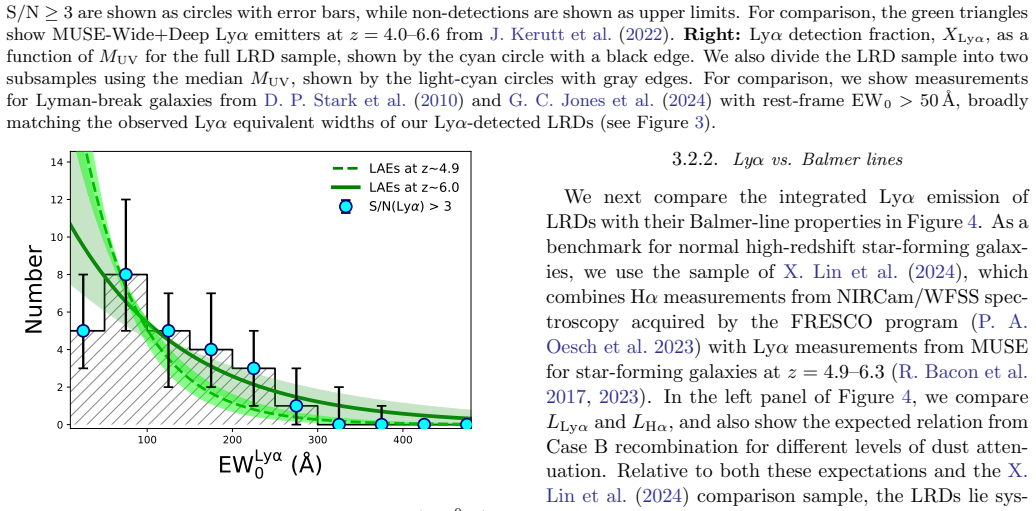
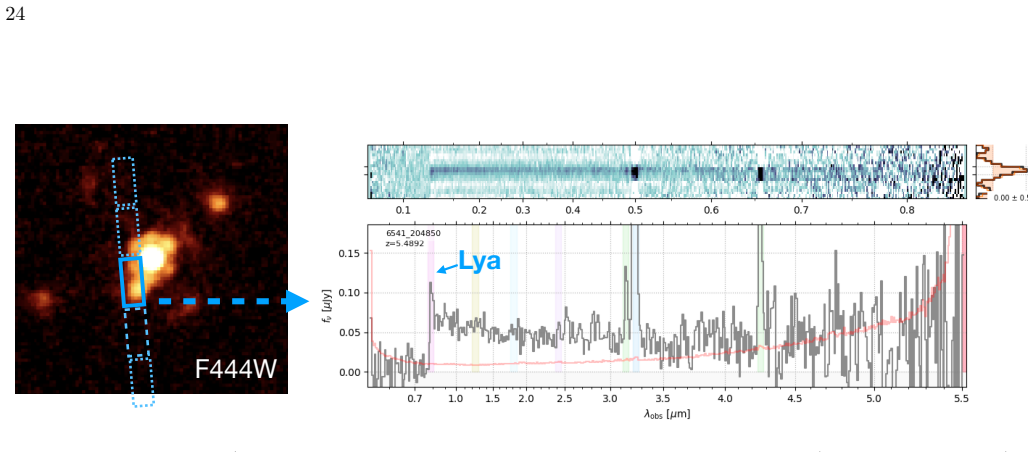
Little Red Dots (LRDs) are enigmatic, compact red sources ubiquitous in JWST deep fields whose physical nature remains elusive. As one of the most sensitive tracers of neutral hydrogen in galaxy environments, Ly$\alpha$ is uniquely positioned to probe the gaseous structures proposed to explain LRDs' unusual properties. We present a systematic study of Ly$\alpha$ emission in LRDs, using a sample of 110 spectroscopically confirmed LRDs at $z \geq 4$ from the A. de Graaff et al. (2025) catalog, all with NIRSpec/PRISM coverage of the Ly$\alpha$ line. We detect Ly$\alpha$ at signal-to-noise S/N $\geq$ 3 in 32 LRDs, finding Ly$\alpha$ luminosities and the distribution of rest-frame equivalent widths consistent with normal star-forming galaxies at comparable redshifts. Yet the Ly$\alpha$/H$\alpha$ ratios fall systematically below those of star-forming galaxies, and the Ly$\alpha$ luminosity tracks [O III] luminosity more closely than [O III] equivalent width, together suggesting that Ly$\alpha$ is primarily associated with the host-scale component rather than the compact component responsible for the broad Balmer lines and red continuum. For 13 LRDs at $z \gtrsim 5.5$, we construct continuum-subtracted Ly$\alpha$ maps using broadband imaging from HST/ACS or JWST/NIRCam, revealing spatially extended, asymmetric, and often offset emission relative to the rest-optical light, consistent with resonant scattering through clumpy, anisotropic gas commonly observed in high-redshift Ly$\alpha$ emitters. These results support a two-component picture in which the compact rest-optical source is embedded within a more extended host-galaxy environment whose interstellar and circumgalactic gas shapes Ly$\alpha$ escape and spatial redistribution. Ly$\alpha$ opens a new window into the relation between the compact red component, the host galaxy, and the surrounding gas in LRDs.
Editorial analysis
A structured set of objections, weighed in public.
Referee Report
Summary. The manuscript presents an observational study of Lyα emission in a sample of 110 spectroscopically confirmed Little Red Dots (LRDs) at z ≥ 4 using NIRSpec/PRISM data. Lyα is detected in 32 sources, with luminosities and rest-frame equivalent widths consistent with those of normal star-forming galaxies at similar redshifts. However, Lyα/Hα ratios are systematically lower, and Lyα luminosity correlates more strongly with [O III] luminosity than with [O III] equivalent width, leading the authors to conclude that Lyα originates primarily from the extended host galaxy component rather than the compact source responsible for broad Balmer lines and red continuum. For a subset of 13 sources at z ≳ 5.5, continuum-subtracted Lyα maps from HST/ACS or JWST/NIRCam reveal extended, asymmetric, and offset emission, consistent with resonant scattering in clumpy gas. The results support a two-component model for LRDs.
Significance. If the host-association interpretation holds, the work is significant for understanding the physical nature of LRDs by linking their Lyα properties to extended host environments and normal high-redshift star-forming galaxies. Strengths include the large sample of 110 sources with uniform NIRSpec coverage, direct S/N-based detections, and spatially resolved maps for 13 objects; the purely observational approach with comparisons to reference populations avoids circularity and provides falsifiable predictions for future modeling.
major comments (2)
- [Abstract and results on line ratios/correlations] Abstract (final paragraph) and the section discussing Lyα/Hα ratios and [O III] correlations: the claim that systematically lower Lyα/Hα ratios and tighter correlation of L_Lyα with L_[O III] (rather than EW_[O III]) establish primary association with the host-scale component is not uniquely supported, as no radiative transfer calculations or photoionization grids are presented to test whether a compact source with plausible variations in dust geometry, covering fraction, or escape paths could reproduce the same observables.
- [Lyα mapping results] Section on continuum-subtracted Lyα maps for the 13 sources at z ≳ 5.5: while the maps show spatially extended, asymmetric, and offset emission, the resonant-scattering possibility that photons originating from the central compact component could appear extended is not quantitatively ruled out via escape-fraction modeling or comparison to simulated surface-brightness profiles, weakening the conclusion that this confirms host-scale origin.
minor comments (1)
- [Throughout] Notation for luminosities and equivalent widths is used inconsistently in places (e.g., L_Lyα vs. L(Lyα)); a uniform convention would improve clarity.
Simulated Author's Rebuttal
We thank the referee for their constructive and detailed review, which has helped clarify the scope and limitations of our observational analysis. We respond to each major comment below and have revised the manuscript to address the points raised.
read point-by-point responses
-
Referee: [Abstract and results on line ratios/correlations] Abstract (final paragraph) and the section discussing Lyα/Hα ratios and [O III] correlations: the claim that systematically lower Lyα/Hα ratios and tighter correlation of L_Lyα with L_[O III] (rather than EW_[O III]) establish primary association with the host-scale component is not uniquely supported, as no radiative transfer calculations or photoionization grids are presented to test whether a compact source with plausible variations in dust geometry, covering fraction, or escape paths could reproduce the same observables.
Authors: We agree that the observational correlations and line ratios alone do not uniquely establish the host-scale association in the absence of radiative transfer or photoionization modeling. Our conclusions rest on empirical comparisons to star-forming galaxy populations and the relative strengths of the observed correlations. We have revised the abstract and the relevant discussion sections to use more cautious phrasing, describing the results as supporting rather than establishing the primary host-scale association, and we have added an explicit note that future modeling is required to test whether variations in the compact component could reproduce the same observables. revision: yes
-
Referee: [Lyα mapping results] Section on continuum-subtracted Lyα maps for the 13 sources at z ≳ 5.5: while the maps show spatially extended, asymmetric, and offset emission, the resonant-scattering possibility that photons originating from the central compact component could appear extended is not quantitatively ruled out via escape-fraction modeling or comparison to simulated surface-brightness profiles, weakening the conclusion that this confirms host-scale origin.
Authors: We acknowledge that the maps alone do not quantitatively exclude resonant scattering from a central origin. The asymmetries and spatial offsets are qualitatively consistent with host-scale gas, but without escape-fraction modeling or simulated profiles we cannot rule out alternatives. We have revised the mapping section to include a discussion of this limitation and to frame the results as consistent with (rather than confirming) a host-scale origin within the two-component framework. revision: yes
Circularity Check
No circularity: purely observational comparisons with no derivations or load-bearing self-citations
full rationale
The paper reports direct measurements of Lyα detection rates, luminosities, equivalent widths, Lyα/Hα ratios, and spatial maps in a sample of 110 LRDs drawn from an external catalog. Conclusions follow from empirical comparisons to star-forming galaxy populations at similar redshifts and from visual inspection of continuum-subtracted maps; no equations, fitted parameters, predictions, or ansatzes are present. The sole self-citation (de Graaff et al. 2025) supplies only the parent sample definition and is not invoked to justify any interpretive step. The analysis is therefore self-contained against external benchmarks and exhibits none of the enumerated circularity patterns.
Axiom & Free-Parameter Ledger
axioms (1)
- domain assumption Lyα serves as a tracer of neutral hydrogen gas in galaxy environments
Forward citations
Cited by 2 Pith papers
-
Compact Core, Extended Reach: A Bipolar kpc-Scale Elongation in a Little Red Dot at $z \approx 5.5$
LRD-204851 at z=5.482 shows a thin bipolar elongation several kpc long traced by UV and optical lines, with double-peaked Lyα and tentative N V supporting a biconical cavity from the central engine.
-
TBD LBD: The nature of `little blue dots'
LBDs are interpreted as lower-column analogues of LRDs in a gas-cocooned AGN sequence, with predicted spectral features including Balmer jumps and X-ray weakness.
Reference graph
Works this paper leans on
-
[1]
arXiv , author =:2404.19010 , journal =
Ananna, T. T., Bogd´ an,´A., Kov´ acs, O. E., Natarajan, P., & Hickox, R. C. 2024, ApJL, 969, L18, doi: 10.3847/2041-8213/ad5669
-
[2]
Anderson, J., & King, I. R. 2000, PASP, 112, 1360, doi: 10.1086/316632
-
[3]
Ando, M., Harikane, Y., Katz, H., Inayoshi, K., & Tanaka, T. S. 2026, arXiv e-prints, arXiv:2606.03522. https://arxiv.org/abs/2606.03522 23 Figure 16.Similar to Figure 8, but for the LRDs in COSMOS (first two rows) and UDS (remaining three rows). We note that the F090W imaging used here is from PRIMER and is relatively shallow, with a 5σdepth of 27.6 AB m...
Pith/arXiv arXiv 2026
-
[4]
Asada, Y., Inayoshi, K., Fei, Q., Fujimoto, S., & Willott, C. 2026, arXiv e-prints, arXiv:2601.10573, doi: 10.48550/arXiv.2601.10573
work page internal anchor Pith review Pith/arXiv arXiv doi:10.48550/arxiv.2601.10573 2026
-
[5]
Atek, H., Kunth, D., Hayes, M., ¨Ostlin, G., & Mas-Hesse, J. M. 2008, A&A, 488, 491, doi: 10.1051/0004-6361:200809527
-
[6]
2017, A&A, 608, A1, doi: 10.1051/0004-6361/201730833
Bacon, R., Conseil, S., Mary, D., et al. 2017, A&A, 608, A1, doi: 10.1051/0004-6361/201730833
-
[7]
2023, A&A, 670, A4, doi: 10.1051/0004-6361/202244187
Bacon, R., Brinchmann, J., Conseil, S., et al. 2023, A&A, 670, A4, doi: 10.1051/0004-6361/202244187
-
[8]
Becker, G. D., Bolton, J. S., Madau, P., et al. 2015, MNRAS, 447, 3402, doi: 10.1093/mnras/stu2646
-
[10]
Begelman, M. C., & Dexter, J. 2026b, ApJ, 996, 48, doi: 10.3847/1538-4357/ae274a
-
[11]
Begelman, M. C., Rossi, E. M., & Armitage, P. J. 2008, MNRAS, 387, 1649, doi: 10.1111/j.1365-2966.2008.13344.x
-
[12]
Bezanson, R., Labbe, I., Whitaker, K. E., et al. 2024, ApJ, 974, 92, doi: 10.3847/1538-4357/ad66cf
-
[13]
Bolton, J. S., & Haehnelt, M. G. 2007, MNRAS, 382, 325, doi: 10.1111/j.1365-2966.2007.12372.x
-
[14]
Bosman, S. E. I., Fan, X., Jiang, L., et al. 2018, MNRAS, 479, 1055, doi: 10.1093/mnras/sty1344
-
[15]
Bosman, S. E. I., Davies, F. B., Becker, G. D., et al. 2022, MNRAS, 514, 55, doi: 10.1093/mnras/stac1046
-
[16]
2016, A&A, 596, A63, doi: 10.1051/0004-6361/201629080
Boucaud, A., Bocchio, M., Abergel, A., et al. 2016, A&A, 596, A63, doi: 10.1051/0004-6361/201629080
-
[17]
Calzetti, D., Armus, L., Bohlin, R. C., et al. 2000, ApJ, 533, 682, doi: 10.1086/308692
work page internal anchor Pith review doi:10.1086/308692 2000
-
[18]
Calzetti, D., Kinney, A. L., & Storchi-Bergmann, T. 1994, ApJ, 429, 582, doi: 10.1086/174346
-
[19]
arXiv , author =:2505.18873 , journal =
Casey, C. M., Akins, H. B., Finkelstein, S. L., et al. 2025, ApJL, 990, L61, doi: 10.3847/2041-8213/adfa91
-
[20]
doi:10.1093/mnras/staf2131 , eprint =
Chang, S.-J., Gronke, M., Matthee, J., & Mason, C. 2026, MNRAS, 545, staf2131, doi: 10.1093/mnras/staf2131
-
[21]
Cloonan, A. P., Whitaker, K. E., Manning, S. M., et al. 2026, arXiv e-prints, arXiv:2603.24700, doi: 10.48550/arXiv.2603.24700 de Graaff, A., Hviding, R. E., Naidu, R. P., et al. 2025a, arXiv e-prints, arXiv:2511.21820, doi: 10.48550/arXiv.2511.21820 de Graaff, A., Rix, H.-W., Naidu, R. P., et al. 2025b, A&A, 701, A168, doi: 10.1051/0004-6361/202554681 de...
-
[22]
2024, The CANDELS-Area Prism Epoch of Reionization Survey (CAPERS),, JWST Proposal
Dickinson, M., Amorin, R., Arrabal Haro, P., et al. 2024, The CANDELS-Area Prism Epoch of Reionization Survey (CAPERS),, JWST Proposal. Cycle 3, ID. #6368
2024
-
[23]
2014, PASA, 31, e040, doi: 10.1017/pasa.2014.33
Dijkstra, M. 2014, PASA, 31, e040, doi: 10.1017/pasa.2014.33
-
[24]
Donnan, C. T., McLure, R. J., Dunlop, J. S., et al. 2024, MNRAS, 533, 3222, doi: 10.1093/mnras/stae2037
-
[25]
Eilers, A.-C., Davies, F. B., & Hennawi, J. F. 2018, ApJ, 864, 53, doi: 10.3847/1538-4357/aad4fd
-
[26]
J., Willott, C., Alberts, S., et al
Eisenstein, D. J., Willott, C., Alberts, S., et al. 2026, ApJS, 283, 6, doi: 10.3847/1538-4365/ae3163
-
[27]
1987, MNRAS, 225, 155, doi: 10.1093/mnras/225.1.155
Fasano, G., & Franceschini, A. 1987, MNRAS, 225, 155, doi: 10.1093/mnras/225.1.155
-
[28]
Finkelstein, S. L., Bagley, M. B., Arrabal Haro, P., et al. 2025, ApJL, 983, L4, doi: 10.3847/2041-8213/adbbd3
-
[29]
Foreman-Mackey, D., Hogg, D. W., Lang, D., & Goodman, J. 2013, PASP, 125, 306, doi: 10.1086/670067
-
[30]
arXiv , author =:2212.10531 , journal =
Furtak, L. J., Zitrin, A., Plat, A., et al. 2023a, ApJ, 952, 142, doi: 10.3847/1538-4357/acdc9d
-
[31]
Furtak, L. J., Zitrin, A., Weaver, J. R., et al. 2023b, MNRAS, 523, 4568, doi: 10.1093/mnras/stad1627 Gaia Collaboration, Brown, A. G. A., Vallenari, A., et al. 2021, A&A, 649, A1, doi: 10.1051/0004-6361/202039657
-
[32]
2025, A&A, 699, A343, doi: 10.1051/0004-6361/202555504
Genin, A., Shuntov, M., Brammer, G., et al. 2025, A&A, 699, A343, doi: 10.1051/0004-6361/202555504
-
[33]
Giavalisco, M., Ferguson, H. C., Koekemoer, A. M., et al. 2004, ApJL, 600, L93, doi: 10.1086/379232
work page internal anchor Pith review doi:10.1086/379232 2004
-
[34]
arXiv , author =:2309.05714 , journal =
Greene, J. E., Labbe, I., Goulding, A. D., et al. 2024, ApJ, 964, 39, doi: 10.3847/1538-4357/ad1e5f
-
[35]
Greene, J. E., Setton, D. J., Furtak, L. J., et al. 2026, ApJ, 996, 129, doi: 10.3847/1538-4357/ae1836
-
[36]
Grogin, N. A., Kocevski, D. D., Faber, S. M., et al. 2011, ApJS, 197, 35, doi: 10.1088/0067-0049/197/2/35
-
[37]
Gronke, M., Dijkstra, M., McCourt, M., & Oh, S. P. 2017, A&A, 607, A71, doi: 10.1051/0004-6361/201731013
-
[38]
Gunn, J. E., & Peterson, B. A. 1965, ApJ, 142, 1633, doi: 10.1086/148444
-
[39]
Hashemi, S., Becker, G. D., Zhu, Y., & Hong, H. 2025, MNRAS, 542, 104, doi: 10.1093/mnras/staf1225
-
[40]
2017, A&A, 608, A10, doi: 10.1051/0004-6361/201731579
Hashimoto, T., Garel, T., Guiderdoni, B., et al. 2017, A&A, 608, A10, doi: 10.1051/0004-6361/201731579
-
[41]
2015, PASA, 32, e027, doi: 10.1017/pasa.2015.25
Hayes, M. 2015, PASA, 32, e027, doi: 10.1017/pasa.2015.25
-
[42]
Hayes, M., ¨Ostlin, G., Mas-Hesse, J. M., et al. 2005, A&A, 438, 71, doi: 10.1051/0004-6361:20052702
-
[43]
2013, ApJL, 765, L27, doi: 10.1088/2041-8205/765/2/L27
Hayes, M., ¨Ostlin, G., Schaerer, D., et al. 2013, ApJL, 765, L27, doi: 10.1088/2041-8205/765/2/L27
-
[44]
Heintz, K. E., Brammer, G. B., Watson, D., et al. 2025, A&A, 693, A60, doi: 10.1051/0004-6361/202450243
-
[45]
C., Urrutia, T., Wisotzki, L., et al
Herenz, E. C., Urrutia, T., Wisotzki, L., et al. 2017, A&A, 606, A12, doi: 10.1051/0004-6361/201731055
-
[46]
1986, PASP, 98, 609, doi: 10.1086/131801
Horne, K. 1986, PASP, 98, 609, doi: 10.1086/131801
-
[47]
Huberty, M., Scarlata, C., Hayes, M. J., & Gazagnes, S. 2025, ApJ, 987, 82, doi: 10.3847/1538-4357/add5e7 26
-
[48]
arXiv , author =:2506.05459 , journal =
Hviding, R. E., de Graaff, A., Miller, T. B., et al. 2025, A&A, 702, A57, doi: 10.1051/0004-6361/202555816
-
[49]
Iani, E., Rinaldi, P., Caputi, K. I., et al. 2025, ApJ, 989, 160, doi: 10.3847/1538-4357/ade5a6
-
[50]
2017, A&A, 608, A2, doi: 10.1051/0004-6361/201731195
Inami, H., Bacon, R., Brinchmann, J., et al. 2017, A&A, 608, A2, doi: 10.1051/0004-6361/201731195
-
[51]
2024, ApJL, 973, L49, doi: 10.3847/2041-8213/ad74e2
Inayoshi, K., & Ichikawa, K. 2024, ApJL, 973, L49, doi: 10.3847/2041-8213/ad74e2
-
[52]
arXiv , author =:2409.07805 , journal =
Inayoshi, K., & Maiolino, R. 2025, ApJL, 980, L27, doi: 10.3847/2041-8213/adaebd
-
[53]
K., Shimizu, I., Iwata, I., & Tanaka, M
Inoue, A. K., Shimizu, I., Iwata, I., & Tanaka, M. 2014, MNRAS, 442, 1805, doi: 10.1093/mnras/stu936
-
[54]
2025, MNRAS, 544, 3900, doi: 10.1093/mnras/staf1867
Ji, X., Maiolino, R., ¨Ubler, H., et al. 2025, MNRAS, 544, 3900, doi: 10.1093/mnras/staf1867
-
[55]
Ji, X., Pezzulli, G., D’Eugenio, F., et al. 2026, arXiv e-prints, arXiv:2604.03370, doi: 10.48550/arXiv.2604.03370
work page internal anchor Pith review Pith/arXiv arXiv doi:10.48550/arxiv.2604.03370 2026
-
[56]
2025, ApJL, 988, L69, doi: 10.3847/2041-8213/adf194
Ji, Z., Alberts, S., Zhu, Y., et al. 2025, ApJL, 988, L69, doi: 10.3847/2041-8213/adf194
-
[57]
Jones, G. C., Bunker, A. J., Saxena, A., et al. 2024, A&A, 683, A238, doi: 10.1051/0004-6361/202347099
-
[58]
2022, A&A, 659, A183, doi: 10.1051/0004-6361/202141900
Kerutt, J., Wisotzki, L., Verhamme, A., et al. 2022, A&A, 659, A183, doi: 10.1051/0004-6361/202141900
-
[59]
Kido, D., Ioka, K., Hotokezaka, K., Inayoshi, K., & Irwin, C. M. 2025, MNRAS, 544, 3407, doi: 10.1093/mnras/staf1898
-
[60]
arXiv , author =:2312.03065 , journal =
Killi, M., Watson, D., Brammer, G., et al. 2024, A&A, 691, A52, doi: 10.1051/0004-6361/202348857
-
[61]
arXiv , author =:2404.03576 , journal =
Kocevski, D. D., Finkelstein, S. L., Barro, G., et al. 2025, ApJ, 986, 126, doi: 10.3847/1538-4357/adbc7d
-
[62]
Koekemoer, A. M., Faber, S. M., Ferguson, H. C., et al. 2011, ApJS, 197, 36, doi: 10.1088/0067-0049/197/2/36 Labb´ e, I., van Dokkum, P., Nelson, E., et al. 2023, Nature, 616, 266, doi: 10.1038/s41586-023-05786-2
-
[63]
Labbe, I., Greene, J. E., Bezanson, R., et al. 2025, ApJ, 978, 92, doi: 10.3847/1538-4357/ad3551
-
[64]
The case for super-Eddington accretion in JWST broad-line AGN during the first billion years
Lambrides, E., Larson, R., Garofali, K., et al. 2024, arXiv e-prints, arXiv:2409.13047, doi: 10.48550/arXiv.2409.13047
work page internal anchor Pith review Pith/arXiv arXiv doi:10.48550/arxiv.2409.13047 2024
-
[65]
Laursen, P., Sommer-Larsen, J., & Andersen, A. C. 2009, ApJ, 704, 1640, doi: 10.1088/0004-637X/704/2/1640
-
[66]
2017, A&A, 608, A8, doi: 10.1051/0004-6361/201731480
Leclercq, F., Bacon, R., Wisotzki, L., et al. 2017, A&A, 608, A8, doi: 10.1051/0004-6361/201731480
-
[67]
2024, ApJS, 272, 33, doi: 10.3847/1538-4365/ad3e7d
Lin, X., Cai, Z., Wu, Y., et al. 2024, ApJS, 272, 33, doi: 10.3847/1538-4365/ad3e7d
-
[68]
Liu, H., Jiang, Y.-F., Quataert, E., Greene, J. E., & Ma, Y. 2025, ApJ, 994, 113, doi: 10.3847/1538-4357/ae0c19
-
[69]
Ma, Y., Greene, J. E., Setton, D. J., et al. 2025, ApJ, 981, 191, doi: 10.3847/1538-4357/ada613
-
[70]
1995, ApJ, 441, 18, doi: 10.1086/175332
Madau, P. 1995, ApJ, 441, 18, doi: 10.1086/175332
-
[71]
2026, arXiv e-prints, arXiv:2602.22386, doi: 10.48550/arXiv.2602.22386
Madau, P., & Maiolino, R. 2026, arXiv e-prints, arXiv:2602.22386, doi: 10.48550/arXiv.2602.22386
-
[72]
V., de Graaff, A., Franx, M., et al
Maseda, M. V., de Graaff, A., Franx, M., et al. 2024, A&A, 689, A73, doi: 10.1051/0004-6361/202449914
-
[73]
2025, ApJ, 988, 57, doi: 10.3847/1538-4357/addf4e
Matsuoka, Y., Onoue, M., Iwasawa, K., et al. 2025, ApJ, 988, 57, doi: 10.3847/1538-4357/addf4e
-
[74]
arXiv , author =:2306.05448 , journal =
Matthee, J., Naidu, R. P., Brammer, G., et al. 2024, ApJ, 963, 129, doi: 10.3847/1538-4357/ad2345
-
[75]
A "Black Hole Star" Reveals the Remarkable Gas-Enshrouded Hearts of the Little Red Dots
Naidu, R. P., Matthee, J., Katz, H., et al. 2025, arXiv e-prints, arXiv:2503.16596, doi: 10.48550/arXiv.2503.16596
work page internal anchor Pith review Pith/arXiv arXiv doi:10.48550/arxiv.2503.16596 2025
-
[76]
Naidu, R. P., Oesch, P. A., Brammer, G., et al. 2026, The Open Journal of Astrophysics, 9, 56033, doi: 10.33232/001c.156033
-
[77]
Evidence of violation of Case B recombination in Little Red Dots
Nikopoulos, G. P., Watson, D., Sneppen, A., et al. 2025, arXiv e-prints, arXiv:2510.06362, doi: 10.48550/arXiv.2510.06362
work page internal anchor Pith review Pith/arXiv arXiv doi:10.48550/arxiv.2510.06362 2025
-
[78]
Oesch, P. A., Brammer, G., Naidu, R. P., et al. 2023, MNRAS, 525, 2864, doi: 10.1093/mnras/stad2411
-
[79]
2012, ApJ, 744, 83, doi: 10.1088/0004-637X/744/2/83
Ono, Y., Ouchi, M., Mobasher, B., et al. 2012, ApJ, 744, 83, doi: 10.1088/0004-637X/744/2/83
-
[80]
Osterbrock, D. E., & Ferland, G. J. 2006, Astrophysics of gaseous nebulae and active galactic nuclei ¨Ostlin, G., Hayes, M., Kunth, D., et al. 2009, AJ, 138, 923, doi: 10.1088/0004-6256/138/3/923
-
[81]
arXiv , author =:2407.15915 , journal =
Pacucci, F., & Narayan, R. 2024, ApJ, 976, 96, doi: 10.3847/1538-4357/ad84f7
discussion (0)
Sign in with ORCID, Apple, or X to comment. Anyone can read and Pith papers without signing in.