Systematic Derivation of Reliable Wake Functions for Complex Structures from Mesh-Based Wakefield Simulations
Pith reviewed 2026-06-26 02:33 UTC · model grok-4.3
The pith
A deconvolution procedure extracts reliable point-charge wake functions from finite-bunch wake potentials computed in mesh simulations.
A machine-rendered reading of the paper's core claim, the machinery that carries it, and where it could break.
Core claim
The central claim is that a deconvolution procedure using the prescribed drive-bunch distribution can reliably recover longitudinal and transverse wake functions from numerically computed wake potentials, even for complex geometries lacking analytical solutions.
What carries the argument
Deconvolution of mesh-computed wake potentials with a prescribed drive-bunch distribution.
If this is right
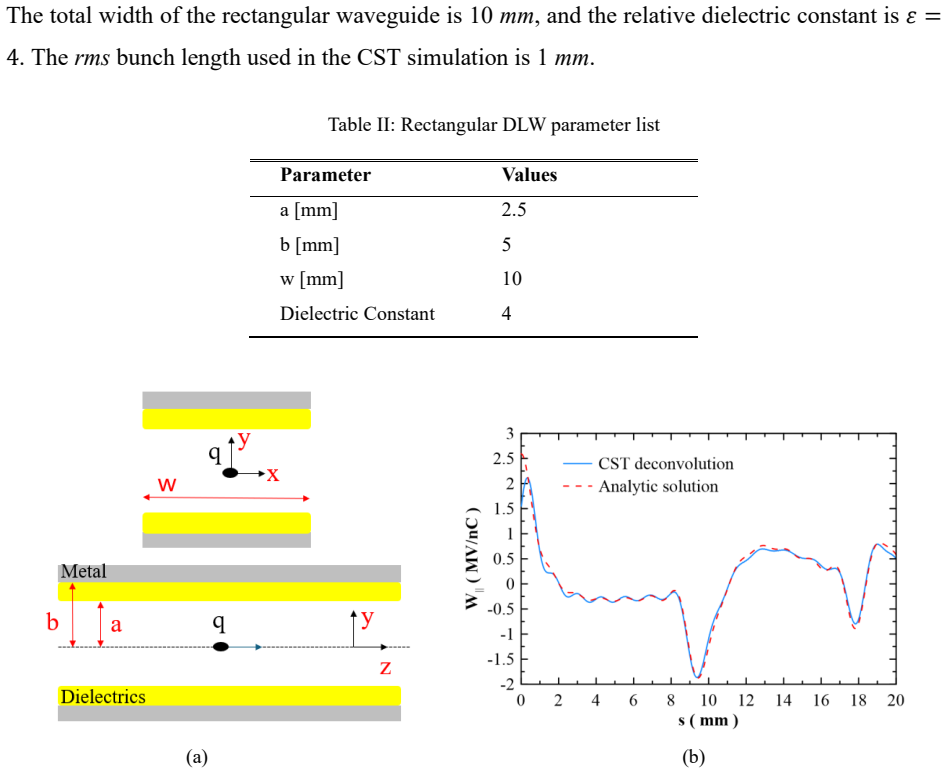
- Extracted longitudinal wake functions agree with analytical solutions in both short- and long-range regimes when the drive bunch is short.
- Particle-tracking simulations that use the extracted wake function produce phase-space distributions consistent with those obtained from an analytical wake model.
- For a modified rectangular dielectric-lined waveguide with non-uniform horizontal dielectric, the dominant deflecting wakefield is substantially reduced without significant degradation of the longitudinal wakefield.
- Corresponding beam impedances can be obtained directly from the extracted wake functions.
Where Pith is reading between the lines
- The same deconvolution step could be applied to wake potentials from other mesh solvers or time-domain codes without requiring new analytical derivations.
- Precise control of the drive-bunch length in simulation becomes a practical design variable for improving wake-function accuracy in complex geometries.
- Wake-function extraction for structures with multiple dielectric interfaces may allow systematic optimization of material placement to suppress specific instability modes.
Load-bearing premise
The drive-bunch distribution must be known precisely and must be sufficiently short for the deconvolution step to recover accurate wake functions.
What would settle it
A direct numerical comparison in which the extracted wake function deviates from the analytical solution for a short drive bunch in the rectangular dielectric-lined waveguide would falsify the method.
Figures


read the original abstract
Wakefield calculations are essential for analyzing beam-driven electromagnetic structures in accelerators. Although analytical wake functions are available for simple symmetric structures, complex geometries generally require mesh-based electromagnetic simulations, which provide finite-bunch wake potentials rather than point-charge wake functions directly. In this study, we present a systematic deconvolution-based method for extracting reliable wake functions from numerically calculated wake potentials using the prescribed drive-bunch distribution. The method is validated with a rectangular dielectric-lined waveguide (DLW), where the extracted longitudinal wake functions agree well with analytical solutions in both the short- and long-range regimes when the drive bunch is sufficiently short. The extracted wake function is further implemented in particle-tracking simulations, producing phase-space distributions consistent with those obtained using a built-in analytical wake-function model. The method is also applied to a modified rectangular DLW with a non-uniform horizontal dielectric distribution. The extracted longitudinal and transverse wake functions and corresponding beam impedances show that the dominant deflecting wakefield can be substantially reduced without significantly degrading the longitudinal wakefield. These results demonstrate the reliability and applicability of the proposed method for complex dielectric-loaded structures.
Editorial analysis
A structured set of objections, weighed in public.
Referee Report
Summary. The manuscript proposes a deconvolution-based procedure to extract point-charge wake functions from finite-bunch wake potentials computed by mesh-based electromagnetic solvers, using the known drive-bunch distribution as input. The method is validated on a rectangular dielectric-lined waveguide (DLW) by direct comparison of the extracted longitudinal wake to analytical solutions in both short- and long-range regimes (provided the drive bunch is short), the extracted wake is inserted into particle-tracking simulations and shown to reproduce phase-space distributions obtained with an analytic wake model, and the procedure is then applied to a modified rectangular DLW possessing a non-uniform horizontal dielectric distribution, yielding longitudinal and transverse wakes and impedances that indicate substantial suppression of the deflecting mode without major degradation of the accelerating wake.
Significance. If the central claim holds, the work supplies a practical, systematic route to obtain usable wake functions for accelerator structures whose geometry precludes analytic treatment, thereby improving the fidelity of beam-dynamics modeling. The explicit validation against independent analytic solutions and the consistency check in tracking simulations constitute clear strengths; the demonstration on an asymmetric geometry illustrates the intended use case.
major comments (2)
- [Abstract / validation] Abstract and validation section: quantitative agreement with analytic solutions is demonstrated only for the symmetric rectangular DLW; for the modified (asymmetric) DLW the extracted wakes and impedances are presented without any independent cross-check (second solver, refined mesh, or alternative extraction technique), so the transferability of the deconvolution reliability to complex structures rests on an untested assumption.
- [Application to modified DLW] The central claim that the method yields 'reliable' wake functions for complex dielectric-loaded structures is load-bearing; without a quantitative error budget or robustness test for the asymmetric geometry, the applicability statement cannot be assessed.
minor comments (1)
- [Method] The precise numerical implementation of the deconvolution (regularization, frequency cutoff, handling of discretization noise) is not described in sufficient detail to allow reproduction.
Simulated Author's Rebuttal
We thank the referee for the constructive comments and for recognizing the potential utility of the deconvolution approach. We address the major comments point by point below and indicate the revisions we will make.
read point-by-point responses
-
Referee: [Abstract / validation] Abstract and validation section: quantitative agreement with analytic solutions is demonstrated only for the symmetric rectangular DLW; for the modified (asymmetric) DLW the extracted wakes and impedances are presented without any independent cross-check (second solver, refined mesh, or alternative extraction technique), so the transferability of the deconvolution reliability to complex structures rests on an untested assumption.
Authors: We agree that quantitative validation against analytic solutions is shown only for the symmetric rectangular DLW. The deconvolution procedure itself is a general linear inverse problem that depends solely on the known drive-bunch distribution and the linearity of the wake response; it does not invoke symmetry. The same validated procedure is applied without modification to the asymmetric geometry. While an independent cross-check (e.g., second solver) for the asymmetric case would be desirable, the extracted wakes exhibit physically expected behavior, including substantial suppression of the deflecting mode. In revision we will add an explicit paragraph discussing the assumptions underlying transferability and the absence of an analytic reference for the asymmetric structure. revision: yes
-
Referee: [Application to modified DLW] The central claim that the method yields 'reliable' wake functions for complex dielectric-loaded structures is load-bearing; without a quantitative error budget or robustness test for the asymmetric geometry, the applicability statement cannot be assessed.
Authors: The claim of reliability rests on the benchmark validation where the extracted longitudinal wake reproduces the analytic solution to high accuracy for short bunches. Because no analytic reference exists for the asymmetric DLW, a quantitative error budget cannot be constructed from first principles; this is precisely the regime the method is intended to address. The results for the modified structure are presented as a demonstration of the method's use case rather than an independent validation. We will revise the abstract and conclusion to qualify the applicability statement, emphasizing that reliability is established on benchmark problems and that the asymmetric results illustrate practical utility while noting the lack of an independent error estimate. revision: yes
Circularity Check
No significant circularity; derivation uses standard deconvolution validated externally
full rationale
The paper derives wake functions via mathematical deconvolution of simulated wake potentials with a known drive-bunch distribution. This is a direct inversion step, not a fit or self-referential construction. Validation compares extracted functions to independent analytical solutions for the rectangular DLW case in both short- and long-range regimes. Application to the modified asymmetric structure presents results without claiming new predictions that reduce to the input data or prior self-citations. No load-bearing self-citations, ansatzes smuggled via citation, or renaming of known results appear in the provided text. The central claims rest on external benchmarks rather than internal equivalence.
Axiom & Free-Parameter Ledger
axioms (1)
- standard math Wake potential is the convolution of the point-charge wake function with the drive-bunch charge distribution.
Reference graph
Works this paper leans on
-
[1]
Physics of Collective Beam Instabilities in High Energy Accelerators
Chao, A. W., “Physics of Collective Beam Instabilities in High Energy Accelerators”, Wiley, New York (1993)
1993
-
[2]
Physics of Intensity Dependent Beam Instabilities
Ng, K. Y., “Physics of Intensity Dependent Beam Instabilities”, World Scientific, Singapore (2005). https://doi.org/10.1142/5835
-
[3]
TM0,1 Mode in Circular Wave Guides with Two Coaxial Dielectrics
Frankel, S., “TM0,1 Mode in Circular Wave Guides with Two Coaxial Dielectrics”, J. Appl. Phys. 18, 650 –655 (1947) . https://doi.org/10.1063/1.1697821
-
[4]
Cylindrical Dielectric Waveguide Modes
Snitzer, E., “Cylindrical Dielectric Waveguide Modes”, J. Opt. Soc. Am. 51, no. 5, pp. 491–498 (1961). https://doi.org/10.1364/JOSA.51.000491
-
[5]
A Proposed New Form of Dielectric-loaded Wave-Guide for Linear Electron Accelerators
R.-Shersby-Harvie, R.B., “A Proposed New Form of Dielectric-loaded Wave-Guide for Linear Electron Accelerators”, Nature 162, 890 (1948). https://doi.org/10.1038/162890a0
-
[6]
Mode Separation at the π-Mode in a Dielectric Loaded Waveguide Cavity
Walker, G.B. and West, N.D., “Mode Separation at the π-Mode in a Dielectric Loaded Waveguide Cavity”, Proc. IEE - Part C: Monographs 104, no.6, pp.381-387 (1957). https://doi.org/10.1049/pi- c.1957.0044
work page doi:10.1049/pi- 1957
-
[7]
R.-Shersby-Harvie, R.B., Mullett, L.B., Walkinshaw, W., Bell, J.S. and Loach, B.G. Loach., “A Theoretical and Experimental Investigation of Anisotropic-Dielectric-Loaded Linear Electron Accelerators”, Proc. IEE - Part B: Radio and Electronic Engineering 104, no.15, pp.273-290 (1957). https://doi.org/10.1049/pi-b-1.1957.0152
-
[8]
The Wake Field Acceleration Mechanism,
Voss, G.A. and Weiland, T., “The Wake Field Acceleration Mechanism,” Tech. Rep. DESY 82-074 (1982). https://lib-extopc.kek.jp/preprints/PDF/1982/8212/8212320.pdf
1982
-
[9]
Wake Fields and Wake Field Acceleration
Bane, K.L.F., Wilson, P.B. Wilson and Weiland, T., “Wake Fields and Wake Field Acceleration”, AIP Conference Proceedings 127, no. 1, pp. 875-928 (1985). https://doi.org/10.1063/1.35182
-
[10]
Fabrication and Testing of Corrugated Waveguides for a Collinear Wakefield Accelerator
Siy, A., Behdad, N., Booske, J. et al., “Fabrication and Testing of Corrugated Waveguides for a Collinear Wakefield Accelerator”, Phys. Rev. Accel. Beams 25, 021302 (2022). https://doi.org/10.1103/PhysRevAccelBeams.25.021302
-
[11]
O’Shea, B., Andonian, G., Barber, S. et al., “Observation of acceleration and deceleration in gigaelectron-volt-per-metre gradient dielectric wakefield accelerators”, Nat. Commun. 7, 12763 (2016). https://doi.org/10.1038/ncomms12763
-
[12]
Corrugated Pipe as a Beam Dechirper
Bane, K. L. F. and Stupakov, G., “Corrugated Pipe as a Beam Dechirper”, Nuclear Instruments and Methods in Physics Research Section A: Accelerators, Spectrometers, Detectors and Associated Equipment, Vol. 690, pp. 106-110 (2012). https://doi.org/10.1016/j.nima.2012.07.001
-
[13]
Zhang, Z., Bane, K., Ding, Y. et al., “Electron Beam Energy Chirp Control with a Rectangular Corrugated Structure at the Linac Coherent Light Source”, Phys. Rev. ST Accel. Beams 18 010702 (2015). https://doi.org/10.1103/PhysRevSTAB.18.010702
-
[14]
Analytical Formulas for Short Bunch Wakes in a Flat Dechirper
Bane, K., Stupakov, G. and Zagorodnov I., “Analytical Formulas for Short Bunch Wakes in a Flat Dechirper”, Phys. Rev. ST Accel. Beams 19 084401 (2016). https://doi.org/10.1103/PhysRevAccelBeams.19.084401
-
[15]
Antipov, S., Jing, C, Fedurin, M. et al., “Experimental Observation of Energy Modulation in Electron Beams Passing through Terahertz Dielectric Wakefield Structures”, Phys. Rev. Lett. 108 144801 (2012). https://doi.org/10.1103/PhysRevLett.108.144801
-
[16]
Removal of Residual Chirp in Compressed Beams Using a Passive Wakefield Technique
Harrison, M., Andonian, G., Hodgetts, T. et al., “ Removal of Residual Chirp in Compressed Beams Using a Passive Wakefield Technique”, Proc. IPAC2013 MOPHO25 (2013). https://epaper.kek.jp/PAC2013/papers/mopho25.pdf
2013
-
[17]
Fu, F., Wang, R., Zhu, P. et al., “Demonstration of Nonlinear-Energy-Spread Compensation in Relativistic Electron Bunches with Corrugated Structures”, Phys. Rev. Lett. 114 114801 (2015). https://doi.org/10.1103/PhysRevLett.114.114801
-
[18]
Emma, P., Venturini, M., Bane, K.L.F. et al., “Experimental Demonstration of Energy-Chirp Control in Relativistic Electron Bunches Using a Corrugated Pipe” Phys. Rev. Lett. 112 034801 (2014). https://doi.org/10.1103/PhysRevLett.112.034801
-
[19]
Deng, H., Zhang, M., Feng, C. et al., “Experimental Demonstration of Longitudinal Beam Phase- Space Linearizer in a Free-Electron Laser Facility by Corrugated Structures”, Phys. Rev. Lett. 113 254802 (2015). https://doi.org/10.1103/PhysRevLett.113.254802
-
[20]
Experimental Demonstration of Energy-Chirp Compensation by a Tunable Dielectric-Based Structure
Antipov, S., Baturin, S., Jing, C. et al., “Experimental Demonstration of Energy-Chirp Compensation by a Tunable Dielectric-Based Structure”, Phys. Rev. Lett. 112 114801 (2014). https://doi.org/10.1103/PhysRevLett.112.114801
-
[21]
Use of a Corrugated Beam Pipe as a Passive Deflector for Bunch Length Measurements
Seok, J., Chung, M., Kang, H., Min, C. and Na. D., “Use of a Corrugated Beam Pipe as a Passive Deflector for Bunch Length Measurements”, Phys. Rev. Accel. Beams 21 022801 (2018). https://doi.org/10.1103/PhysRevAccelBeams.21.022801
-
[22]
Temporal Profile Measurements of Relativistic Electron Bunch Based on Wakefield Generation
Bettoni, S., Craievich, P., Lutman, A. and Pedrozzi, M., “Temporal Profile Measurements of Relativistic Electron Bunch Based on Wakefield Generation”, Phys. Rev. Accel. Beams 19 021304 (2016). https://doi.org/10.1103/PhysRevAccelBeams.19.021304
-
[23]
W., and S
Zotter, B. W., and S. A. Kheifets. Impedances and Wakes in High-Energy Particle Accelerators,
-
[24]
https://doi.org/10.1142/3068
-
[25]
Elegant: A Flexible SDDS-Compliant Code for Accelerator Simulation
Borland, M., “Elegant: A Flexible SDDS-Compliant Code for Accelerator Simulation”, in Proc. ICAP2000 (2000). https://doi.org/10.2172/761286
-
[26]
Qiang, J., Ryne, R.D., Habib, S. and Decyk, V., “An Object-Oriented Parallel Particle-in-Cell Code for Beam Dynamics Simulation in Linear Accelerators”, Journal of Computational Physics, 163 pp. 434-451 (2000). https://doi.org/10.1006/jcph.2000.6570
-
[27]
https://www.3ds.com/products/simulia/cst-studio-suite
CST Studio Suite® . https://www.3ds.com/products/simulia/cst-studio-suite
-
[28]
Wakefield Computations for the CLIC PETS Using the Parallel Finite Element Time-Domain Code T3P
Candel, A., Kabel, A., Lee, L. et al., “Wakefield Computations for the CLIC PETS Using the Parallel Finite Element Time-Domain Code T3P”, SLAC-PUB-13669 (2009). https://www.slac.stanford.edu/pubs/slacpubs/13500/slac-pub-13669.pdf
2009
-
[29]
TE/TM Field Solver for Particle Beam Simulations without Numerical Cherenkov Radiation
Zagorodnov, I. and Weiland, T., “TE/TM Field Solver for Particle Beam Simulations without Numerical Cherenkov Radiation”, Phys. Rev. ST Accel. Beams 8 042001 (2005). https://doi.org/10.1103/PhysRevSTAB.8.042001
-
[30]
Large scale parallel wake field computations for 3d-accelerator structures with the PBCI code
E. Gjonaj et al., “Large scale parallel wake field computations for 3d-accelerator structures with the PBCI code”, Proc. of ICAP 2006 MOM2IS02 (2006). https://www.jacow.org/proceedings/icap06/PAPERS/MOM2IS02.PDF
2006
-
[31]
GdfidL: A FINITE DIFFERENCE PROGRAM WITH REDUCED MEMORY AND CPU USAGE
Bruns, W., “GdfidL: A FINITE DIFFERENCE PROGRAM WITH REDUCED MEMORY AND CPU USAGE”, Proc. PAC1997 pp. 2651-2653 (1997). https://accelconf.web.cern.ch/pac97/papers/pdf/9P118.PDF and http://www.gdfidl.de
1997
-
[32]
Simulations of an Energy Dechirper Based on Dielectric Lined Waveguides
Nie, Y., Xia, G. and Pacey, T., “Simulations of an Energy Dechirper Based on Dielectric Lined Waveguides”, Nuclear Instruments and Methods in Physics Research Section A: Accelerators, Spectrometers, Detectors and Associated Equipment 909 pp. 271–275 (2018). https://doi.org/10.1016/j.nima.2017.11.050
-
[33]
Simulation Studies for Dielectric Wakefield Programme at CLARA Facility
Pacey, T., Saveliev, Y., Xia, G. and Smith, J., “Simulation Studies for Dielectric Wakefield Programme at CLARA Facility”, Nuclear Instruments and Methods in Physics Research Section A: Accelerators, Spectrometers, Detectors and Associated Equipment 909 (2018): 261–65. https://doi.org/10.1016/j.nima.2017.12.038
-
[34]
VORPAL: A Versatile Plasma Simulation Code
Nieter, C., and Cary, J., “VORPAL: A Versatile Plasma Simulation Code”, Journal of Computational Physics 196 pp. 448–473 (2004). https://doi.org/10.1016/j.jcp.2003.11.004
-
[35]
Qiang, Ji, Steve Lidia, Robert Ryne, and C. Limborg. ‘Three-Dimensional Quasistatic Model for High Brightness Beam Dynamics Simulation’. Physical Review Special Topics - Accelerators and Beams 9 (04 2006). https://doi.org/10.1103/PhysRevSTAB.9.044204
-
[36]
‘Field Analysis of a Dielectric-Loaded Rectangular Waveguide Accelerating Structure’
Xiao, Lifing, Wei Gai, and Xiang Sun. ‘Field Analysis of a Dielectric-Loaded Rectangular Waveguide Accelerating Structure’. In PACS2001. Proceedings of the 2001 Particle Accelerator Conference (Cat. No.01CH37268), 5:3963–65 vol.5, 2001. https://doi.org/10.1109/PAC.2001.988312
-
[37]
Electromagnetic Wake Fields and Beam Stability in Slab-Symmetric Dielectric Structures
Tremaine, A., Rosenzweig, J. and Schoessow, P., “Electromagnetic Wake Fields and Beam Stability in Slab-Symmetric Dielectric Structures”, Phys. Rev. E 56 pp. 7204–7216 (1997). https://doi.org/10.1103/PhysRevE.56.7204
-
[38]
Mihalcea, D., Piot, . and Stoltz, P., “Three-Dimensional Analysis of Wakefields Generated by Flat Electron Beams in Planar Dielectric-Loaded Structures”, Phys. Rev. ST Accel. Beams 15 081304 (2012). https://doi.org/10.1103/PhysRevSTAB.15.081304
-
[39]
‘Collective Effects in a Transient Microbunching Regime and Ion Cloud Mitigation in ThomX’
Gamelin, Alexis. ‘Collective Effects in a Transient Microbunching Regime and Ion Cloud Mitigation in ThomX’. Université Paris Saclay (COmUE), 2018. https://theses.hal.science/tel- 01934906
2018
-
[40]
‘Mbtrack2, a Collective Effect Library in Python’
Gamelin, Alexis, Watanyu Foosang, and Ryutaro Nagaoka. ‘Mbtrack2, a Collective Effect Library in Python’. In 12th International Particle Accelerator Conference, 8 2021. https://doi.org/10.18429/JACoW-IPAC2021-MOPAB070
-
[41]
‘Indirect Methods for Wake Potential Integration’
Zagorodnov, Igor. ‘Indirect Methods for Wake Potential Integration’. Physical Review Special Topics - Accelerators and Beams 9 (10 2006). https://doi.org/10.1103/PhysRevSTAB.9.102002
-
[42]
‘The Wake Potentials from the Fields on the Cavity Boundary’
Napoly, O. ‘The Wake Potentials from the Fields on the Cavity Boundary’. Part. Accel. 36 (1991): 15–24
1991
discussion (0)
Sign in with ORCID, Apple, or X to comment. Anyone can read and Pith papers without signing in.