From Symbolic to Geometric: Enabling Spatial Reasoning in Large Language Models
Pith reviewed 2026-06-28 06:57 UTC · model grok-4.3
The pith
The Spatial Language Model enables geometric spatial reasoning in LLMs by operating directly on learned spatial representations instead of text.
A machine-rendered reading of the paper's core claim, the machinery that carries it, and where it could break.
Core claim
SLM is the first multimodal LLM that treats location information as a first-class modality and directly operates on learned spatial representations rather than textual descriptions of spatial relations, thereby enabling geometric spatial reasoning within the model's inference process.
What carries the argument
The Spatial Language Model (SLM), which integrates learned spatial representations as a native modality alongside language for performing atomic geometric operations during inference.
If this is right
- SLM outperforms existing LLM-based methods that rely on prompt engineering or textual abstraction across spatial reasoning tasks.
- The Spatial Instruction Dataset provides aligned training data for spatial representations, geometric operations, and natural language.
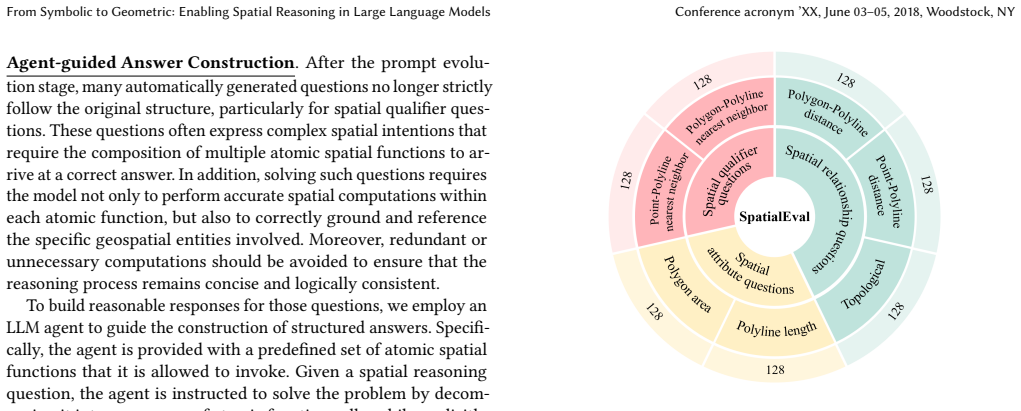
- The SpatialEval benchmark measures performance on attributes, distance, topology, and relative-position problems.
- Integrating geometric spatial representations produces more robust spatial reasoning than symbolic approaches alone.
Where Pith is reading between the lines
- If the spatial representations support explicit computation, SLM could extend to dynamic environments such as navigation or manipulation where new geometric relations must be calculated on the fly.
- The approach suggests that other continuous domains like time or physics might benefit from similar first-class modality treatment in language models.
- Success on SpatialEval would indicate that the model can generalize geometric operations beyond the specific examples in the instruction dataset.
Load-bearing premise
The learned spatial representations actually enable explicit geometric computation at inference time instead of acting as a more sophisticated form of symbolic pattern matching.
What would settle it
A controlled test in which SLM is forced to answer using only textual descriptions of the same spatial relations instead of its learned representations and shows equivalent performance to standard LLMs on SpatialEval tasks.
Figures

read the original abstract
Recent large language models (LLMs) often appear to exhibit spatial reasoning ability; however, this capability is largely \emph{symbolic}, arising from pattern matching over spatial language rather than true \emph{geometric} reasoning over space. Because LLMs operate on discrete tokens, they lack native support for continuous spatial representations, explicit geometric computation, and structured spatial operators. To address this limitation, we introduce the \emph{Spatial Language Model (SLM)}, the first multimodal LLM that treats location information as a first-class modality and enables geometric spatial reasoning within the model's inference process. SLM directly operates on learned spatial representations rather than textual descriptions of spatial relations. To support effective training, we construct a \emph{Spatial Instruction Dataset} that aligns spatial representations, atomic geometric operations, and natural language instructions. We further propose a new benchmark named \emph{SpatialEval}, which is designed to evaluate spatial reasoning across attributes, distance, topology, and relative-position tasks. Extensive experiments show that SLM significantly outperforms existing LLM-based approaches that rely on symbolic reasoning via prompt engineering or textual abstraction, demonstrating the benefits of integrating geometric spatial representations for robust spatial reasoning. Our instruction dataset, evaluation benchmark, model training codes, and models' checkpoints can be found at: \hyperlink{https://github.com/chuchen2017/SLM}{https://github.com/chuchen2017/SLM}.
Editorial analysis
A structured set of objections, weighed in public.
Referee Report
Summary. The paper introduces the Spatial Language Model (SLM), the first multimodal LLM that treats location information as a first-class modality to enable geometric spatial reasoning by directly operating on learned spatial representations. It constructs a Spatial Instruction Dataset aligning spatial representations, atomic geometric operations, and natural language instructions, and proposes the SpatialEval benchmark to evaluate spatial reasoning across attributes, distance, topology, and relative-position tasks. The central claim is that SLM significantly outperforms existing LLM-based approaches relying on symbolic reasoning via prompt engineering or textual abstraction.
Significance. If the empirical results hold, the work would be significant for addressing LLMs' lack of native support for continuous spatial representations and explicit geometric computation. The open release of the instruction dataset, SpatialEval benchmark, training code, and model checkpoints strengthens reproducibility and enables community follow-up on multimodal spatial reasoning.
major comments (2)
- [Abstract] Abstract: the claim of significant outperformance on SpatialEval is asserted without any numerical results, error bars, baseline comparisons, or ablation studies. The experimental section must supply these details (including specific metrics, baselines, and controls) because they are load-bearing for the central empirical claim.
- [Method] Method section (description of SLM inference): the distinction that SLM 'directly operates on learned spatial representations rather than textual descriptions of spatial relations' and supports 'explicit geometric computation' is invoked as the key advantage over symbolic approaches. Concrete evidence is needed showing how geometric operators are applied at inference time (e.g., via explicit distance or topology computations) rather than learned pattern matching, as this premise underpins the geometric-vs-symbolic framing.
minor comments (1)
- [Abstract] The GitHub link is provided but the manuscript should confirm that all released artifacts (dataset, benchmark, code, checkpoints) are complete and documented.
Simulated Author's Rebuttal
We thank the referee for the constructive feedback. We address each major comment below and outline revisions to improve clarity and empirical presentation while preserving the manuscript's core contributions.
read point-by-point responses
-
Referee: [Abstract] Abstract: the claim of significant outperformance on SpatialEval is asserted without any numerical results, error bars, baseline comparisons, or ablation studies. The experimental section must supply these details (including specific metrics, baselines, and controls) because they are load-bearing for the central empirical claim.
Authors: We agree that the abstract would be strengthened by referencing specific results. In the revised manuscript we will update the abstract to include key quantitative outcomes (e.g., accuracy on SpatialEval tasks with comparisons to prompt-based baselines) while keeping it concise. The experimental section already reports full metrics, error bars from multiple runs, baseline comparisons (including GPT variants with symbolic prompting and other multimodal models), ablation studies on the spatial modality and instruction dataset, and controls for task variants. We will add explicit cross-references from the abstract to these tables and figures. revision: yes
-
Referee: [Method] Method section (description of SLM inference): the distinction that SLM 'directly operates on learned spatial representations rather than textual descriptions of spatial relations' and supports 'explicit geometric computation' is invoked as the key advantage over symbolic approaches. Concrete evidence is needed showing how geometric operators are applied at inference time (e.g., via explicit distance or topology computations) rather than learned pattern matching, as this premise underpins the geometric-vs-symbolic framing.
Authors: We will revise the method section to include a dedicated inference subsection with a step-by-step description and pseudocode of the forward pass. Spatial tokens produced by the dedicated encoder are concatenated with text tokens and processed by the transformer; geometric relations (distance, topology, relative position) emerge from attention and feed-forward operations over the continuous spatial embeddings rather than from textual symbolic manipulation. While the model does not invoke separate hand-coded geometric primitives at inference (as it is an end-to-end neural architecture), the training on aligned spatial representations and atomic operations enables direct geometric computation in representation space. We will clarify this distinction and contrast it explicitly with the textual abstraction used by symbolic baselines. revision: partial
Circularity Check
No significant circularity identified
full rationale
The paper introduces SLM as a multimodal model, constructs a new Spatial Instruction Dataset and SpatialEval benchmark, and reports empirical outperformance versus symbolic LLM baselines. No equations, parameter fits, or self-citations are present in the provided text that reduce the central claim (geometric vs. symbolic reasoning) to quantities defined by the paper's own inputs or prior self-referential results. The distinction between operating on learned spatial representations versus textual descriptions is framed as an outcome of training on the new dataset and evaluation on the new benchmark, making the claims self-contained against external evaluation resources rather than internally circular.
Axiom & Free-Parameter Ledger
axioms (1)
- domain assumption Multimodal LLMs can be extended with an additional spatial modality that supports geometric operations.
invented entities (3)
-
Spatial Language Model (SLM)
no independent evidence
-
Spatial Instruction Dataset
no independent evidence
-
SpatialEval benchmark
no independent evidence
Reference graph
Works this paper leans on
-
[1]
Conference acronym ’XX, June 03–05, 2018, Woodstock, NY Trovato et al
Kai Chen, Yunhao Gou, Runhui Huang, Zhili Liu, Daxin Tan, Jing Xu, Chunwei Wang, Yi Zhu, Yihan Zeng, Kuo Yang, Dingdong Wang, Kun Xiang, Haoyuan Li, Haoli Bai, Jianhua Han, Xiaohui Li, Weike Jin, Nian Xie, Yu Zhang, James T. Conference acronym ’XX, June 03–05, 2018, Woodstock, NY Trovato et al. Kwok, Hengshuang Zhao, Xiaodan Liang, Dit-Yan Yeung, Xiao Che...
2018
-
[2]
An-Chieh Cheng, Hongxu Yin, Yang Fu, Qiushan Guo, Ruihan Yang, Jan Kautz, Xiaolong Wang, and Sifei Liu. 2024. SpatialRGPT: Grounded Spatial Reasoning in Vision-Language Models. InNeurIPS
2024
-
[3]
Chen Chu and Cyrus Shahabi. 2026. Geo2Vec: Shape- and Distance-Aware Neural Representation of Geospatial Entities.Proceedings of the AAAI Conference on Artificial Intelligence40, 23 (Mar. 2026), 18985–18993. doi:10.1609/aaai.v40i23. 38970
-
[4]
Gheorghe Comanici, Eric Bieber, Mike Schaekermann, and et al. 2025. Gemini 2.5: Pushing the Frontier with Advanced Reasoning, Multimodality, Long Context, and Next Generation Agentic Capabilities. arXiv:2507.06261 [cs.CL] https: //arxiv.org/abs/2507.06261
Pith/arXiv arXiv 2025
-
[5]
Jie Feng, Tianhui Liu, Yuwei Du, Siqi Guo, Yuming Lin, and Yong Li. 2025. CityGPT: Empowering Urban Spatial Cognition of Large Language Models. In Proceedings of the 31st ACM SIGKDD Conference on Knowledge Discovery and Data Mining V.2(Toronto ON, Canada)(KDD ’25). Association for Computing Machinery, New York, NY, USA, 591–602. doi:10.1145/3711896.3736878
-
[6]
Jie Feng, Shengyuan Wang, Tianhui Liu, Yanxin Xi, and Yong Li. 2025. Urban- LLaVA: A Multi-modal Large Language Model for Urban Intelligence with Spatial Reasoning and Understanding. arXiv:2506.23219 [cs.CV] https://arxiv.org/abs/ 2506.23219
arXiv 2025
-
[7]
Aaron Grattafiori, Abhimanyu Dubey, Abhinav Jauhri, Abhinav Pandey, Abhishek Kadian, and et al. 2024. The Llama 3 Herd of Models. arXiv:2407.21783 [cs.AI] https://arxiv.org/abs/2407.21783
Pith/arXiv arXiv 2024
-
[8]
Daya Guo, Dejian Yang, Haowei Zhang, and et al. Song. 2025. DeepSeek-R1 incentivizes reasoning in LLMs through reinforcement learning.Nature645, 8081 (Sept. 2025), 633–638. doi:10.1038/s41586-025-09422-z
-
[9]
Wes Gurnee and Max Tegmark. 2023. Language Models Represent Space and Time.arXiv preprint arXiv:2310.02207(2023)
arXiv 2023
-
[10]
Jiaming Han, Kaixiong Gong, Yiyuan Zhang, Jiaqi Wang, Kaipeng Zhang, Dahua Lin, Yu Qiao, Peng Gao, and Xiangyu Yue. 2024. OneLLM: One Framework to Align All Modalities with Language. InProceedings of the IEEE/CVF Conference on Computer Vision and Pattern Recognition (CVPR)
2024
-
[11]
Xixuan Hao, Wei Chen, Yibo Yan, Siru Zhong, Kun Wang, Qingsong Wen, and Yuxuan Liang. 2025. UrbanVLP: multi-granularity vision-language pretraining for urban socioeconomic indicator prediction. InProceedings of the Thirty-Ninth AAAI Conference on Artificial Intelligence (AAAI 2025). AAAI Press, Article 3126, 9 pages. doi:10.1609/aaai.v39i27.35024
-
[12]
Hu, Yelong Shen, Phillip Wallis, Zeyuan Allen-Zhu, Yuanzhi Li, Shean Wang, Lu Wang, and Weizhu Chen
Edward J. Hu, Yelong Shen, Phillip Wallis, Zeyuan Allen-Zhu, Yuanzhi Li, Shean Wang, Lu Wang, and Weizhu Chen. 2021. LoRA: Low-Rank Adaptation of Large Language Models. arXiv:2106.09685 [cs.CL] https://arxiv.org/abs/2106.09685
Pith/arXiv arXiv 2021
-
[13]
Yuhan Ji, Song Gao, Ying Nie, Ivan Majić, and Krzysztof Janowicz. 2025. Founda- tion models for geospatial reasoning: assessing the capabilities of large language models in understanding geometries and topological spatial relations.Inter- national Journal of Geographical Information Science39, 9 (2025), 1866–1903. arXiv:https://doi.org/10.1080/13658816.20...
-
[14]
Siyu Li, Toan Tran, Haowen Lin, John Krumm, Cyrus Shahabi, Lingyi Zhao, Khurram Shafique, and Li Xiong. 2025. Geo-Llama: Leveraging LLMs for Human Mobility Trajectory Generation with Spatiotemporal Constraints. arXiv:2408.13918 [cs.AI] https://arxiv.org/abs/2408.13918
arXiv 2025
-
[15]
Bin Lin, Yang Ye, Bin Zhu, Jiaxi Cui, Munan Ning, Peng Jin, and Li Yuan. 2024. Video-LLaVA: Learning United Visual Representation by Alignment Before Pro- jection. InProceedings of the 2024 Conference on Empirical Methods in Natu- ral Language Processing, Yaser Al-Onaizan, Mohit Bansal, and Yun-Nung Chen (Eds.). Association for Computational Linguistics, ...
2024
-
[16]
doi:10.18653/v1/2024.emnlp-main.342
-
[17]
Haotian Liu, Chunyuan Li, Qingyang Wu, and Yong Jae Lee. 2023. Visual Instruc- tion Tuning. arXiv:2304.08485 [cs.CV] https://arxiv.org/abs/2304.08485
Pith/arXiv arXiv 2023
-
[18]
G. Mai, K. Janowicz, R. Zhu, L. Cai, and N. Lao. 2021. Geographic Question Answering: Challenges, Uniqueness, Classification, and Future Directions.AGILE: GIScience Series2 (2021), 8. doi:10.5194/agile-giss-2-8-2021
-
[19]
Gengchen Mai, Chiyu Jiang, Weiwei Sun, Rui Zhu, Yao Xuan, Ling Cai, Krzysztof Janowicz, Stefano Ermon, and Ni Lao. 2023. Towards general-purpose represen- tation learning of polygonal geometries.GeoInformatica27, 2 (2023), 289–340
2023
-
[20]
Gengchen Mai, Xiaobai Yao, Yiqun Xie, Jinmeng Rao, Hao Li, Qing Zhu, Ziyuan Li, and Ni Lao. 2024. SRL: Towards a General-Purpose Framework for Spatial Representation Learning. InProceedings of the 32nd ACM International Conference on Advances in Geographic Information Systems(Atlanta, GA, USA)(SIGSPATIAL ’24). Association for Computing Machinery, New York...
arXiv 2024
-
[21]
Rohin Manvi, Samar Khanna, Gengchen Mai, Marshall Burke, David Lobell, and Stefano Ermon. 2024. GeoLLM: Extracting Geospatial Knowledge from Large Language Models. arXiv:2310.06213 [cs.CL] https://arxiv.org/abs/2310.06213
arXiv 2024
-
[22]
2025.Introducing GPT-5
OpenAI. 2025.Introducing GPT-5. https://openai.com/index/introducing-gpt-5/ Accessed: 2026-02-02
2025
-
[23]
Alec Radford, Jong Wook Kim, Chris Hallacy, Aditya Ramesh, Gabriel Goh, Sandhini Agarwal, Girish Sastry, Amanda Askell, Pamela Mishkin, Jack Clark, Gretchen Krueger, and Ilya Sutskever. 2021. Learning Transferable Visual Models From Natural Language Supervision. arXiv:2103.00020 [cs.CV] https://arxiv.org/ abs/2103.00020
Pith/arXiv arXiv 2021
-
[24]
Jonathan Roberts, Timo Lüddecke, Sowmen Das, Kai Han, and Samuel Al- banie. 2023. GPT4GEO: How a Language Model Sees the World’s Geography. arXiv:2306.00020 [cs.CL] https://arxiv.org/abs/2306.00020
arXiv 2023
-
[25]
Maria Despoina Siampou, Jialiang Li, John Krumm, Cyrus Shahabi, and Hua Lu. 2025. Poly2Vec: Polymorphic Fourier-Based Encoding of Geospatial Objects for GeoAI Applications. InForty-second International Conference on Machine Learning
2025
-
[26]
Smith, Daniel Khashabi, and Hannaneh Hajishirzi
Yizhong Wang, Yeganeh Kordi, Swaroop Mishra, Alisa Liu, Noah A. Smith, Daniel Khashabi, and Hannaneh Hajishirzi. 2023. Self-Instruct: Aligning Language Mod- els with Self-Generated Instructions. InProceedings of the 61st Annual Meeting of the Association for Computational Linguistics (Volume 1: Long Papers), Anna Rogers, Jordan Boyd-Graber, and Naoaki Oka...
-
[27]
Zehui Wang, Wolfram Höpken, and Dietmar Jannach. 2025. Beyond Visit Trajec- tories: Enhancing POI Recommendation via LLM-Augmented Text and Image Representations. InProceedings of the Nineteenth ACM Conference on Recom- mender Systems (RecSys ’25). Association for Computing Machinery, New York, NY, USA, 521–526. doi:10.1145/3705328.3748014
-
[28]
Shaolin Xie, Shang-Ling Hsu, Qihan Zhang, Yiming Gao, Cyrus Shahabi, and Ibrahim Sabek. 2025. Evaluating Intrinsic Geospatial Topological Reasoning in LLMs. InProceedings of the 1st ACM SIGSPATIAL International Workshop on Gen- erative and Agentic AI for Multi-Modality Space-Time Intelligence(The Graduate Hotel Minneapolis, Minneapolis, MN, USA)(GeoGenAge...
-
[29]
Runsen Xu, Xiaolong Wang, Tai Wang, Yilun Chen, Jiangmiao Pang, and Dahua Lin. 2024. PointLLM: Empowering Large Language Models to Understand Point Clouds. arXiv:2308.16911 [cs.CV] https://arxiv.org/abs/2308.16911
arXiv 2024
-
[30]
Ziwei Xu, Sanjay Jain, and Mohan Kankanhalli. 2025. Hallucination is Inevitable: An Innate Limitation of Large Language Models. arXiv:2401.11817 [cs.CL] https: //arxiv.org/abs/2401.11817
Pith/arXiv arXiv 2025
-
[31]
An Yang, Anfeng Li, Baosong Yang, and et al. 2025. Qwen3 Technical Report. arXiv preprint arXiv:2505.09388(2025)
Pith/arXiv arXiv 2025
-
[32]
Tianyi Zhou, Deqing Fu, Mahdi Soltanolkotabi, Robin Jia, and Vatsal Sharan
-
[33]
arXiv:2502.09741 [cs.CL] https://arxiv.org/abs/2502.09741
FoNE: Precise Single-Token Number Embeddings via Fourier Features. arXiv:2502.09741 [cs.CL] https://arxiv.org/abs/2502.09741
-
[34]
Zhilun Zhou, Jingyang Fan, Yu Liu, Fengli Xu, Depeng Jin, and Yong Li. 2024. Synergizing LLM Agents and Knowledge Graph for Socioeconomic Prediction in LBSN. arXiv:2411.00028 [cs.CL] https://arxiv.org/abs/2411.00028
arXiv 2024
-
[35]
Zhilun Zhou, Yuming Lin, Depeng Jin, and Yong Li. 2024. Large Language Model for Participatory Urban Planning. arXiv:2402.17161 [cs.AI] https://arxiv.org/abs/ 2402.17161 From Symbolic to Geometric: Enabling Spatial Reasoning in Large Language Models Conference acronym ’XX, June 03–05, 2018, Woodstock, NY Appendix A Experiment details All experiments and m...
arXiv 2024
discussion (0)
Sign in with ORCID, Apple, or X to comment. Anyone can read and Pith papers without signing in.