Single-particle shell strengths near the doubly magic nucleus ⁵⁶Ni and the ⁵⁶Ni(p,γ)⁵⁷Cu reaction rate in explosive astrophysical burning
Pith reviewed 2026-05-24 15:08 UTC · model grok-4.3
The pith
Cross-section measurements of deuteron reactions on radioactive nickel-56 yield spectroscopic factors that constrain the nickel-56 proton-capture rate under x-ray burst conditions.
A machine-rendered reading of the paper's core claim, the machinery that carries it, and where it could break.
Core claim
Angle-integrated cross-section data from 56Ni(d,n) and (d,p) stripping reactions determine the single-particle strengths of states in 57Cu and 57Ni; when these spectroscopic factors are compared with full pf-shell calculations using the GPFX1A interaction, they supply new bounds on the 56Ni(p,γ)57Cu rate for the rp-process conditions inside x-ray bursts.
What carries the argument
Spectroscopic factors extracted from measured angle-integrated (d,n) and (d,p) cross sections, which quantify the single-particle component of the low-lying states.
If this is right
- The updated rate changes the time 56Ni spends as a waiting point and therefore alters the predicted light curve and final abundances in x-ray burst models.
- Mirror symmetry between 57Cu and 57Ni states is tested at the level of individual spectroscopic factors.
- The same experimental approach can be applied to other nearby waiting-point nuclei to refine additional rp-process rates.
- Shell-model predictions for the pf shell near 56Ni are validated or refined by the new data.
Where Pith is reading between the lines
- If the spectroscopic factors hold, the same technique could be extended to measure strengths that control other proton-capture rates on even-even waiting points.
- Discrepancies between the extracted strengths and future ab-initio calculations would point to missing physics in the effective interaction.
- The constrained rate may affect estimates of how much material escapes the rp-process path to form heavier elements during repeated bursts.
Load-bearing premise
The reaction model used to convert measured cross sections into spectroscopic factors must correctly isolate the single-particle strength without large multi-step or compound-nucleus contributions.
What would settle it
A direct measurement of the 56Ni(p,γ)57Cu cross section at burst-relevant energies that lies outside the rate band derived from the reported spectroscopic factors.
Figures

read the original abstract
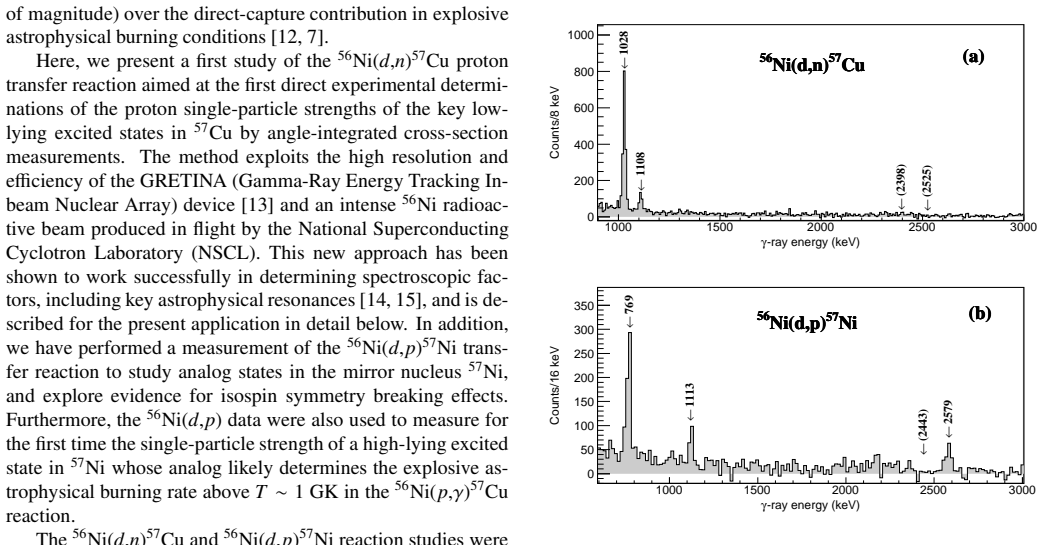
Angle-integrated cross-section measurements of the $^{56}$Ni(d,n) and (d,p) stripping reactions have been performed to determine the single-particle strengths of low-lying excited states in the mirror nuclei pair $^{57}$Cu-$^{57}$Ni situated adjacent to the doubly magic nucleus $^{56}$Ni. The reactions were studied in inverse kinematics utilizing a beam of radioactive $^{56}$Ni ions in conjunction with the GRETINA $\gamma$-array. Spectroscopic factors are compared with new shell-model calculations using a full $pf$ model space with the GPFX1A Hamiltonian for the isospin-conserving strong interaction plus Coulomb and charge-dependent Hamiltonians. These results were used to set new constraints on the $^{56}$Ni(p,$\gamma$)$^{57}$Cu reaction rate for explosive burning conditions in x-ray bursts, where $^{56}$Ni represents a key waiting point in the astrophysical rp-process.
Editorial analysis
A structured set of objections, weighed in public.
Referee Report
Summary. The manuscript reports angle-integrated cross-section measurements of the 56Ni(d,n)57Cu and 56Ni(d,p)57Ni stripping reactions performed in inverse kinematics with a radioactive 56Ni beam and the GRETINA gamma-ray array. Spectroscopic factors for low-lying states in the mirror pair 57Cu-57Ni are extracted, compared to new shell-model calculations in the full pf space using the GPFX1A Hamiltonian plus Coulomb and charge-dependent terms, and applied to derive updated constraints on the 56Ni(p,γ)57Cu reaction rate under x-ray burst conditions where 56Ni is a key rp-process waiting point.
Significance. If the spectroscopic factors are robust, the work supplies valuable experimental input for the astrophysical reaction rate at a critical waiting point, with direct relevance to nucleosynthesis models. The inverse-kinematics approach with gamma-ray detection on a radioactive beam is a technical strength, and the shell-model comparison provides a clear theoretical benchmark. The paper does not claim parameter-free results or machine-checked proofs, but the experimental data themselves constitute a falsifiable input for rate calculations.
major comments (2)
- [§4] §4 (DWBA analysis and SF extraction): the conversion of measured angle-integrated cross sections to spectroscopic factors assumes a direct-reaction model (DWBA or equivalent) that isolates the single-particle component without substantial multi-step or compound contributions. No quantitative validation is presented (e.g., angular-distribution fit quality, optical-potential sensitivity, or mirror-channel consistency checks), yet this step is load-bearing for the resonance strengths fed into the updated 56Ni(p,γ)57Cu rate.
- [Table 2] Table 2 or equivalent (spectroscopic factors and rate table): the claimed new constraints on the reaction rate for explosive burning conditions rest directly on the extracted SF values; without documented uncertainty from the reaction-model choice, the magnitude of the rate change relative to prior evaluations cannot be assessed for robustness.
minor comments (2)
- [Abstract] The abstract states that GRETINA was used but does not specify the reaction model employed for SF extraction; adding one sentence would improve clarity for readers outside the immediate subfield.
- [Figures] Figure captions for angular distributions (if present) should explicitly state the DWBA parameters and normalization procedure used.
Simulated Author's Rebuttal
We thank the referee for the careful and constructive review. We address the major comments point by point below.
read point-by-point responses
-
Referee: [§4] §4 (DWBA analysis and SF extraction): the conversion of measured angle-integrated cross sections to spectroscopic factors assumes a direct-reaction model (DWBA or equivalent) that isolates the single-particle component without substantial multi-step or compound contributions. No quantitative validation is presented (e.g., angular-distribution fit quality, optical-potential sensitivity, or mirror-channel consistency checks), yet this step is load-bearing for the resonance strengths fed into the updated 56Ni(p,γ)57Cu rate.
Authors: The experiment measured angle-integrated cross sections in inverse kinematics with a radioactive 56Ni beam and GRETINA, where full angular distributions were not feasible due to beam intensity and detector geometry. States were identified via gamma-ray coincidences, and DWBA calculations used standard global optical potentials. The extracted SFs are consistent with the new full-pf shell-model results and show close mirror symmetry between corresponding states in 57Cu and 57Ni, providing an internal consistency check. We will add a quantitative discussion of optical-potential sensitivity in the revised manuscript. revision: partial
-
Referee: [Table 2] Table 2 or equivalent (spectroscopic factors and rate table): the claimed new constraints on the reaction rate for explosive burning conditions rest directly on the extracted SF values; without documented uncertainty from the reaction-model choice, the magnitude of the rate change relative to prior evaluations cannot be assessed for robustness.
Authors: The rate update is based on the measured SFs, with direct comparison to prior evaluations shown. We agree that explicit quantification of reaction-model uncertainty would strengthen the assessment. In the revised manuscript we will include additional DWBA calculations with varied optical potentials and report the resulting range for the 56Ni(p,γ)57Cu rate under x-ray burst conditions. revision: yes
Circularity Check
Experimental cross sections and spectroscopic factors independent of fitted predictions or self-citation chains
full rationale
The paper reports new angle-integrated cross-section data from inverse-kinematics (d,n) and (d,p) reactions on 56Ni, extracts spectroscopic factors via standard reaction modeling, and compares them to shell-model results using the pre-existing GPFX1A Hamiltonian. No step reduces a claimed prediction to a fit performed on the same data, nor does any load-bearing premise rest solely on a self-citation whose validity is unverified outside the present work. The reaction-rate constraints follow directly from the measured strengths once the standard extraction is accepted; this extraction step is an external modeling assumption rather than an internal circular reduction. Score remains low because the central claims rest on independent experimental observables.
Axiom & Free-Parameter Ledger
axioms (2)
- domain assumption Distorted-wave Born approximation or equivalent reaction model accurately maps measured cross sections to single-particle spectroscopic factors
- domain assumption The GPFX1A Hamiltonian plus Coulomb and charge-dependent terms correctly describes the low-lying structure of the pf-shell nuclei under study
Reference graph
Works this paper leans on
-
[1]
C. B. Hinke, M. B¨ ohmer, P . Boutachkov, T. Faestermann, H . Geissel, J. Gerl, R. Gernh¨ auser, M. G´ orska, A. Gottardo, H. Grawe, J. L. Gre ¸bosz, R. Kr¨ ucken, N. Kurz, Z. Liu, L. Maier, F. Nowacki, S. Pietri,Z. Podoly´ ak, K. Sieja, K. Steiger, K. Straub, H. Weick, H.-J. Wollersheim, P . J. Woods, N. Al-Dahan, N. Alkhomashi, A. Atac ¸, A. Blazhev, N....
work page 2012
-
[2]
K. Auranen, D. Seweryniak, M. Albers, A. D. Ayangeakaa, S . Bot- toni, M. P . Carpenter, C. J. Chiara, P . Copp, H. M. David, D. T. Doherty, J. Harker, C. R. Ho ffman, R. V . F. Janssens, T. L. Khoo, S. A. Kuvin, T. Lauritsen, G. Lotay, A. M. Rogers, J. Sethi, C. Scholey, R. Talwar, W. B. Walters, P . J. Woods, and S. Zhu, Phys. Rev. Lett. 121, 182501 (2018). 4
work page 2018
- [3]
-
[4]
K. L. Y urkewicz, D. Bazin, B. A. Brown, C. M. Campbell, J. A . Church, D. C. Dinca, A. Gade, T. Glasmacher, M. Honma, T. Mizu saki, W. F. Mueller, H. Olliver, T. Otsuka, L. A. Riley, and J. R. Ter ry, Phys. Rev. C 70, 054319 (2004)
work page 2004
-
[5]
T. E. Cocolios, A. N. Andreyev, B. Bastin, N. Bree, J. B¨ uscher, J. Elseviers, J. Gentens, M. Huyse, Y . Kudryavt sev, D. Pauwels, T. Sonoda, P . van den Bergh, and P . van Duppen, Phys. Rev. Lett. 103, 102501 (2009)
work page 2009
-
[6]
R. K. Wallace and S. E. Woosley, Astrophys. J. Supp. 45, 389 (1981)
work page 1981
-
[7]
L. van Wormer, J. G¨ orres, C. Iliadis, M. Wiescher, and F.-K. Thielemann, Astrophys. J. 432, 326 (1994)
work page 1994
-
[8]
M. R. Bhat, Nucl. Data Sheets 85, 415 (1998)
work page 1998
-
[9]
K. E. Rehm, F. Borasi, C. L. Jiang, D. Ackermann, I. Ahmad, B. A. Brown, F. Brumwell, C. N. Davids, P . Decrock, S. M. Fischer, J . G¨ orres, J. Greene, G. Hackmann, B. Harss, D. Henderson, W. Henning, R . V . Janssens, G. McMichael, V . Nanal, D. Nisius, J. Nolen, R. C. P ardo, M. Paul, P . Reiter, J. P . Schiffer, D. Seweryniak, R. E. Segel, M. Wiescher,...
work page 1998
-
[10]
X. G. Zhou, H. Dejbakhsh, C. A. Gagliardi, J. Jiang, L. Tr ache, and R. E. Tribble, Phys. Rev. C 53, 982 (1996)
work page 1996
-
[11]
C. L. Jiang, K. E. Rehm, D. Ackermann, I. Ahmad, J. P . Gree ne, B. Harss, D. Henderson, W. F. Henning, R. V . F. Janssens, J. Nolen, R. C. Pardo, P . Reiter, J. P . Schiffer, D. Seweryniak, A. Sonzogni, J. Uusitalo, I. Wiedenh¨ over, A. H. Wuosmaa, F. Brumwell, G. McMichael, M . Paul, and R. E. Segel, Phys. Rev. C 80, 044613 (2009)
work page 2009
-
[12]
O. Forstner, H. Herndl, H. Oberhummer, H. Schatz, and B. A. Brown, Phys. Rev. C 64, 045801 (2001)
work page 2001
-
[13]
S. Paschalis, I. Y . Lee, A. O. Macchiavelli, C. M. Campbe ll, M. Cro- maz, S. Gros, J. Pavan, J. Qian, R. M. Clark, H. L. Crawford, D. Doering, P . Fallon, C. Lionberger, T. Loew, M. Petri, T. St ezel- berger, S. Zimmermann, D. C. Radford, K. Lagergren, D. Weiss haar, R. Winkler, T. Glasmacher, J. T. Anderson, and C. W. Beausang , Nucl. Instrum. Methods ...
work page 2013
-
[14]
A. Kankainen, P . J. Woods, F. Nunes, C. Langer, H. Schatz , V . Bader, T. Baugher, D. Bazin, B. A. Brown, J. Browne, D. T. Doherty, A. Estrade, A. Gade, A. Kontos, G. Lotay, Z. Meisel, F. Montes , S. Noji, G. Perdikakis, J. Pereira, F. Recchia, T. Redpath, R. Strobe rg, M. Scott, D. Seweryniak, J. Stevens, D. Weisshaar, K. Wimmer, and R. Ze gers, Eur. Ph...
work page 2016
-
[15]
A. Kankainen, P . J. Woods, H. Schatz, T. Poxon-Pearson, D. T. Doherty, V . Bader, T. Baugher, D. Bazin, B. A. Brown, J. Browne, A. Estr ade, A. Gade, J. Jos´ e, A. Kontos, C. Langer, G. Lotay, Z. Meisel, F . Montes, S. Noji, F. Nunes, G. Perdikakis, J. Pereira, F. Recchia, T. R edpath, R. Stroberg, M. Scott, D. Seweryniak, J. Stevens, D. Weissha ar, K. W...
work page 2017
-
[16]
D. J. Morrissey, B. M. Sherrill, M. Steiner, A. Stolz, an d I. Wiedenhoever, Nucl. Instrum. Methods Phys. Res. B 204, 90 (2003)
work page 2003
- [17]
-
[18]
D. Weisshaar, D. Bazin, P . C. Bender, C. M. Campbell, F. R ec- chia, V . Bader, T. Baugher, J. Belarge, M. P . Carpenter, H. L. Crawford, M. Cromaz, B. Elman, P . Fallon, A. Forney, A. Gade, J. Harker, N. Kobayashi, C. Langer, T. Lauritsen, I. Y . Lee, A . Lemas- son, B. Longfellow, E. Lunderberg, A. O. Macchiavelli, K. Mi ki, S. Momiyama, S. Noji, D. C....
work page 2017
-
[19]
E. Stiliaris, H. G. Bohlen, X. S. Chen, B. Gebauer, A. Mic zaika, W. von Oertzen, W. Weller, and T. Wilpert, Z. Phys. A 326, 139 (1987)
work page 1987
-
[20]
A. Jokinen, A. Nieminen, J. ¨Ayst¨ o, R. Borcea, E. Caurier, P . Dendooven, M. Gierlik, M. G´ orska, H. Grawe, M. Hellstr¨ om, M. Karny, Z. Janas, R. Kirchner, M. La Commara, G. Martinez-Pinedo, P . Mayet, H. Pent- til¨ a, A. Plochocki, M. Rejmund, E. Roeckl, M. Sawicka, C. Sc hlegel, K. Schmidt, and R. Schwengner, Eur. Phys. J. Direct 4, 1 (2002)
work page 2002
-
[21]
R. C. Johnson and P . C. Tandy, Nucl. Phys. A 235, 56 (1974)
work page 1974
-
[22]
R. L. V arner, W. J. Thompson, T. L. McAbee, E. J. Ludwig, a nd T. B. Clegg, Phys. Rep. 201, 57 (1991)
work page 1991
-
[23]
R. V . Reid, Jr., Ann. Phys. 50, 411 (1968)
work page 1968
-
[24]
F. D. Becchetti and G. W. Greenlees, Physical Review 182, 1190 (1969)
work page 1969
-
[25]
F. M. Nunes, A. Deltuva, and J. Hong, Phys. Rev. C 83, 034610 (2011)
work page 2011
-
[26]
University o f Surrey modified version of the code TWOFNR,
M. Tostevin, M. Igarashi, and N. Kishida, “University o f Surrey modified version of the code TWOFNR,” Private Communication
-
[27]
I. J. Thompson, Comput. Phys. Rep. 7, 167 (1988)
work page 1988
- [28]
-
[29]
W. E. Ormand and B. A. Brown, Nucl. Phys. A 491, 1 (1989)
work page 1989
- [30]
-
[31]
M. Wang, G. Audi, F. G. Kondev, W. J. Huang, S. Naimi, and X . Xu, Chin. Phys. C 41, 030003 (2017). 5
work page 2017
discussion (0)
Sign in with ORCID, Apple, or X to comment. Anyone can read and Pith papers without signing in.