A probabilistic bijection between twenty-vertex configurations with a free west boundary and Gelfand-Tsetlin patterns avoiding three equal entries in a row
Pith reviewed 2026-05-21 03:28 UTC · model grok-4.3
The pith
A probabilistic bijection maps twenty-vertex configurations with fixed west boundary to Gelfand-Tsetlin patterns avoiding three equal entries in a row.
A machine-rendered reading of the paper's core claim, the machinery that carries it, and where it could break.
Core claim
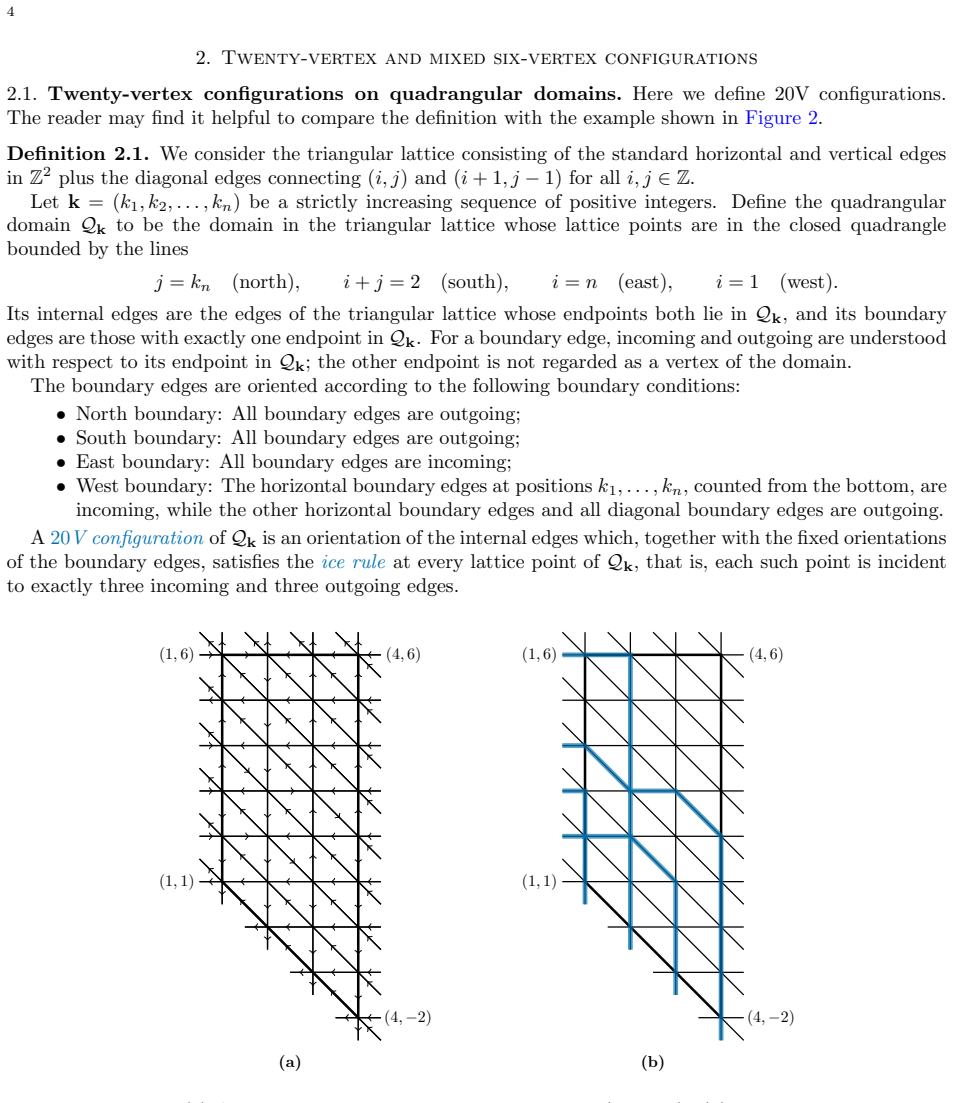
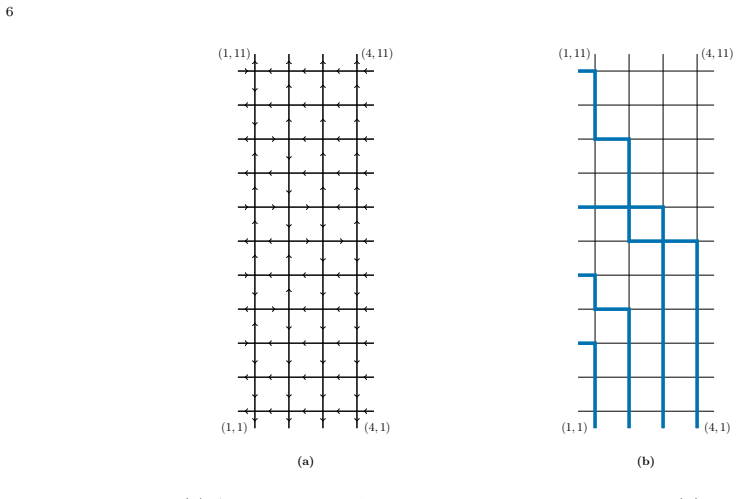
We construct a probabilistic bijection between twenty-vertex configurations on quadrangular domains and Gelfand-Tsetlin patterns avoiding three equal entries in a row. Under this bijection the west boundary of a configuration corresponds to the bottom row of a pattern; in particular the fixed-boundary case corresponds to patterns with bottom row (1, 2, …, n). Combining the bijection with the enumeration formula of Fischer and Schreier-Aigner for the patterns with bounded entries yields an enumeration formula for twenty-vertex configurations with free west boundary.
What carries the argument
The probabilistic bijection that maps each twenty-vertex configuration to a Gelfand-Tsetlin pattern while preserving the uniform or weighted measure and sending the west boundary data to the bottom row.
Load-bearing premise
The probabilistic bijection must map the two sets onto each other while preserving the probability measure so that known counts for the patterns transfer directly to the configurations.
What would settle it
Compute the number of twenty-vertex configurations with free west boundary on a small quadrangular domain (for example n=3) by direct enumeration or recursion and compare the result to the product formula transferred from the Gelfand-Tsetlin side; disagreement would show the bijection fails to preserve counts.
Figures




read the original abstract
We study a coincidence between two enumerations governed by the same product formula, reminiscent of the Robbins numbers: the unweighted enumeration of twenty-vertex configurations on quadrangular domains with fixed west boundary, and the weighted enumeration of Gelfand-Tsetlin patterns avoiding three equal entries in a row. This coincidence naturally raises the question of whether there is a combinatorial explanation relating these two enumerations. In this paper, we provide such an explanation by constructing a probabilistic bijection between twenty-vertex configurations on quadrangular domains and Gelfand-Tsetlin patterns avoiding three equal entries in a row. Under this probabilistic bijection, the west boundary of a twenty-vertex configuration corresponds to the bottom row of Gelfand-Tsetlin patterns; in particular, the fixed boundary case corresponds to Gelfand-Tsetlin patterns with bottom row $(1, 2, \ldots, n)$. Combining this correspondence with an enumeration formula of Fischer and Schreier-Aigner for Gelfand-Tsetlin pattern avoiding three equal entries in a row with bounded entries, we obtain an enumeration formula for twenty-vertex configurations with a free west boundary.
Editorial analysis
A structured set of objections, weighed in public.
Referee Report
Summary. The paper constructs a probabilistic bijection between twenty-vertex configurations on quadrangular domains (with free or fixed west boundary) and Gelfand-Tsetlin patterns avoiding three equal entries in a row. The bijection identifies the west boundary data with the bottom row of the GT pattern; the fixed-boundary case maps to patterns with bottom row exactly (1,2,…,n). Combining the bijection with the Fischer–Schreier-Aigner enumeration formula for bounded-entry GT patterns yields an explicit product formula for the twenty-vertex configurations with free west boundary.
Significance. If the measure-preserving property of the bijection holds for variable boundaries, the work supplies a direct combinatorial explanation for the shared product formula between these two families, extending the tradition of bijective proofs that relate vertex models to pattern-avoiding tableaux and alternating-sign matrices. The probabilistic nature of the map is a distinctive feature that could generalize to other boundary conditions.
major comments (2)
- [Abstract and bijection construction (implicitly §3–4)] The abstract and the description of the bijection verify the correspondence explicitly only for the fixed west-boundary case (bottom row (1,2,…,n)). For the free-boundary case the argument invokes the Fischer–Schreier-Aigner formula on patterns with bounded entries, but supplies no separate verification that the local probabilistic choices continue to induce the uniform (or correctly weighted) measure once the boundary values are allowed to vary. This step is load-bearing for the transferred enumeration.
- [Discussion of free-boundary extension] The measure-preservation claim when extending from fixed to free west boundary is not accompanied by an explicit argument ruling out hidden dependence on the boundary values. Without such an argument the transfer of the enumeration formula rests on an unverified extension of the probabilistic map.
minor comments (2)
- [Bijection definition] Clarify the precise probability weights used in the local choices of the bijection and state whether they are uniform or depend on the current configuration.
- [Examples] Add a short table or diagram illustrating the mapping for a small n (e.g., n=2 or n=3) to make the correspondence between boundary data and bottom rows concrete.
Simulated Author's Rebuttal
We thank the referee for their careful reading and insightful comments on the manuscript. The observations regarding the scope of the explicit verification and the need for a clearer argument on measure preservation for variable boundaries are well taken. We have revised the paper to strengthen the presentation of the bijection and its extension, as detailed in the point-by-point responses below.
read point-by-point responses
-
Referee: [Abstract and bijection construction (implicitly §3–4)] The abstract and the description of the bijection verify the correspondence explicitly only for the fixed west-boundary case (bottom row (1,2,…,n)). For the free-boundary case the argument invokes the Fischer–Schreier-Aigner formula on patterns with bounded entries, but supplies no separate verification that the local probabilistic choices continue to induce the uniform (or correctly weighted) measure once the boundary values are allowed to vary. This step is load-bearing for the transferred enumeration.
Authors: We thank the referee for highlighting this point. The bijection is constructed via local probabilistic rules at each step of the growth process, where the choice probabilities at a given position depend only on the current twenty-vertex configuration and the target entries in the Gelfand-Tsetlin pattern. The west-boundary data enters the construction solely through the bottom row of the pattern; once this row is fixed (whether to (1,2,…,n) or to arbitrary admissible values), the same local transition probabilities apply verbatim. Consequently, the measure-preservation argument used for the fixed case extends immediately to variable boundaries without additional global adjustments. To make this extension fully explicit, we have added a dedicated paragraph in the revised Section 4 that walks through the inductive step for arbitrary bottom rows and confirms that no hidden boundary dependence arises. revision: yes
-
Referee: [Discussion of free-boundary extension] The measure-preservation claim when extending from fixed to free west boundary is not accompanied by an explicit argument ruling out hidden dependence on the boundary values. Without such an argument the transfer of the enumeration formula rests on an unverified extension of the probabilistic map.
Authors: We agree that an explicit ruling-out of hidden dependence strengthens the exposition. In the revised manuscript we have inserted a new subsection (4.3) that examines the probability weights in detail. Each local choice probability is shown to be a function exclusively of the neighboring vertex states and the already-determined entries in the current row of the Gelfand-Tsetlin pattern; the only global datum is the prescribed bottom row, which is already accounted for by the correspondence. Because these weights are independent of any other boundary information, the overall measure on configurations remains correctly weighted for any admissible west-boundary data. This justifies the direct transfer of the Fischer–Schreier-Aigner enumeration formula to the free-boundary twenty-vertex model. revision: yes
Circularity Check
No significant circularity; derivation uses independent bijection plus external formula
full rationale
The paper constructs a probabilistic bijection mapping twenty-vertex configurations to Gelfand-Tsetlin patterns avoiding three equal entries in a row, with west boundary data corresponding to the bottom row (explicitly verified for the fixed case with bottom row (1,2,…,n)). It then transfers the enumeration by invoking the external formula of Fischer and Schreier-Aigner for patterns with bounded entries. No step reduces by construction to its own inputs, no parameters are fitted and renamed as predictions, and the supporting enumeration is cited from independent prior work rather than a self-citation chain. The derivation is therefore self-contained against external benchmarks.
Axiom & Free-Parameter Ledger
axioms (1)
- domain assumption The probabilistic bijection preserves the uniform measure on the two sets of objects.
Reference graph
Works this paper leans on
-
[1]
Di Francesco, Philippe , TITLE =. Electron. J. Combin. , FJOURNAL =. 2021 , NUMBER =. doi:10.37236/10227 , URL =
-
[2]
Di Francesco, Philippe and Guitter, Emmanuel , TITLE =. Electron. J. Combin. , FJOURNAL =. 2020 , NUMBER =. doi:10.37236/8809 , URL =
-
[3]
Fischer, Ilse and Schreier-Aigner, Florian , TITLE =. European J. Combin. , FJOURNAL =. 2024 , PAGES =. doi:10.1016/j.ejc.2024.103979 , URL =
-
[4]
Koutschan, Christoph and Krattenthaler, Christian and Schlosser, Michael J. , TITLE =. J. Symbolic Comput. , FJOURNAL =. 2025 , PAGES =. doi:10.1016/j.jsc.2024.102352 , URL =
-
[5]
Bufetov, Alexey and Petrov, Leonid , TITLE =. Forum Math. Sigma , FJOURNAL =. 2019 , PAGES =. doi:10.1017/fms.2019.36 , URL =
-
[6]
Aigner, Florian and Frieden, Gabriel , TITLE =. S\'em. Lothar. Combin. , FJOURNAL =. 2021 , PAGES =
work page 2021
-
[7]
Frieden, Gabriel and Schreier-Aigner, Florian , TITLE =. S\'em. Lothar. Combin. , FJOURNAL =. 2024 , PAGES =
work page 2024
-
[8]
and Rumsey, Jr., Howard , TITLE =
Robbins, David P. and Rumsey, Jr., Howard , TITLE =. Adv. in Math. , FJOURNAL =. 1986 , NUMBER =. doi:10.1016/0001-8708(86)90099-X , URL =
-
[9]
Mills, William H. and Robbins, David P. and Rumsey, Jr., Howard , TITLE =. J. Combin. Theory Ser. A , FJOURNAL =. 1986 , NUMBER =. doi:10.1016/0097-3165(86)90098-1 , URL =
-
[10]
Mills, William H. and Robbins, David P. and Rumsey, Jr., Howard , TITLE =. J. Combin. Theory Ser. A , FJOURNAL =. 1983 , NUMBER =. doi:10.1016/0097-3165(83)90068-7 , URL =
-
[11]
Ayyer, Arvind and Behrend, Roger E. and Fischer, Ilse , TITLE =. Adv. Math. , FJOURNAL =. 2020 , PAGES =. doi:10.1016/j.aim.2020.107125 , URL =
-
[12]
Australian Journal of Physics, vol
Twenty-vertex model on a triangular lattice , author=. Australian Journal of Physics, vol. 27, p. 813 , volume=
- [13]
-
[14]
Bufetov, Alexey and Matveev, Konstantin , TITLE =. Selecta Math. (N.S.) , FJOURNAL =. 2018 , NUMBER =. doi:10.1007/s00029-018-0442-y , URL =
discussion (0)
Sign in with ORCID, Apple, or X to comment. Anyone can read and Pith papers without signing in.