Persistent currents in signed directed networks
Pith reviewed 2026-06-27 22:30 UTC · model grok-4.3
The pith
Persistent currents in signed directed networks arise as thermodynamic responses to gauge-invariant fluxes defined on the cycle space.
A machine-rendered reading of the paper's core claim, the machinery that carries it, and where it could break.
Core claim
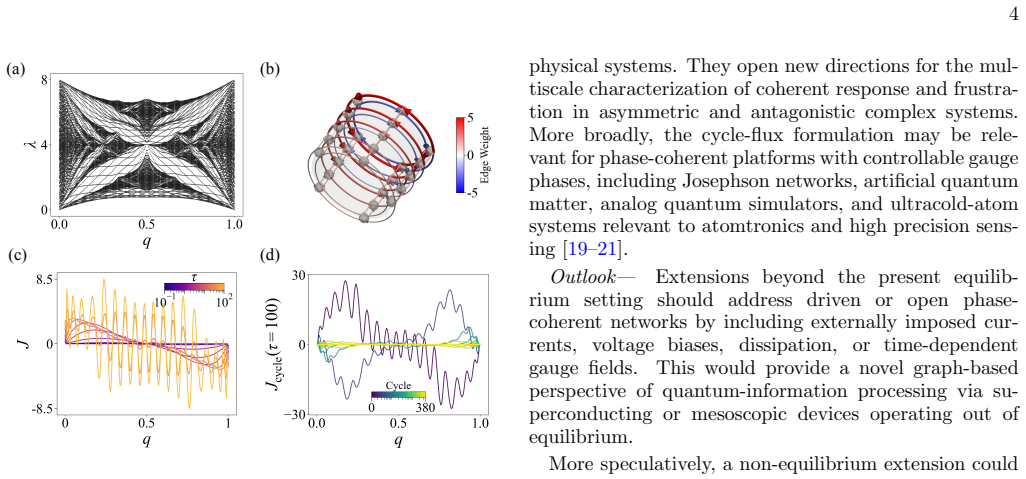
Interpreting the signed magnetic Laplacian as an effective Hamiltonian and the edge phases as a discrete gauge field allows persistent currents to be defined in signed directed networks. In the canonical ensemble, these currents arise as thermodynamic responses to variations of gauge-invariant fluxes defined on the cycle space. The currents are constrained to the divergence-free subspace and decompose onto independent cycles. This generalizes persistent currents from rings and lattices to arbitrary topologies, with their detection serving as a signature of quantum phase coherence and the cycle space geometry. A signed directed network is constructed that reproduces the Hofstadter butterfly s
What carries the argument
The signed magnetic Laplacian interpreted as an effective Hamiltonian, with associated edge phases as a discrete gauge field, enabling gauge-invariant fluxes on the cycle space and application of the thermodynamic response formalism.
If this is right
- Persistent currents provide a signature of the quantum phase coherence supported by the network.
- Persistent currents provide a direct signature of the geometry of the network's cycle space.
- The mapping links the role of the Laplacian operator in graph theory to that of a Hamiltonian in physical systems.
- The formulation allows a practical way to deal with quantum coherence for a variety of situations in quantum technologies.
- A signed directed network can be constructed to reproduce the Hofstadter butterfly spectrum.
Where Pith is reading between the lines
- Current measurements in fabricated quantum networks could serve as a probe of the underlying cycle space geometry.
- The same thermodynamic response approach might be applied to analyze coherence properties in other classes of graphs beyond the Hofstadter test case.
- Physical interpretations of additional graph operators could yield new simulation methods for topological phenomena in condensed matter systems.
Load-bearing premise
The signed magnetic Laplacian can be directly interpreted as an effective Hamiltonian and the associated edge phases as a discrete gauge field so that the thermodynamic response formalism applies to the network.
What would settle it
Construct a signed directed network with a known cycle space, vary the gauge-invariant fluxes, and measure whether the resulting currents remain confined to the divergence-free subspace and decompose exactly onto the independent cycles; any deviation from this decomposition falsifies the claim.
Figures

read the original abstract
Network theory can be fruitfully used to describe quantum coherence in physical systems. To that purpose we introduce persistent currents in signed directed networks by interpreting the signed magnetic Laplacian as an effective Hamiltonian and the associated edge phases as a discrete gauge field. In a canonical ensemble, persistent currents arise as thermodynamic responses to variations of gauge-invariant fluxes. We show that these fluxes are naturally defined on the cycle space of the network, and that the resulting currents are constrained to the divergence-free subspace and decompose onto independent cycles. This formulation provides a direct generalization of persistent currents from rings and lattices to arbitrary topologies. Detection of persistent currents provides a signature of the quantum phase coherence supported by the network, and a direct signature of the geometry of its cycle space. Such a mapping, not only allows a practical way to deal with quantum coherence for a variety of situations in the field of quantum technologies, but it also allows a physical interpretation of the importance of the Laplacian operator in graph theory, linking its role to the one of Hamiltonian (i.e. a tight-binding one) in physical systems. To test the power of the method, we construct a signed directed network that reproduces the Hofstadter butterfly spectrum.
Editorial analysis
A structured set of objections, weighed in public.
Referee Report
Summary. The manuscript introduces persistent currents in signed directed networks by interpreting the signed magnetic Laplacian as an effective Hamiltonian and edge phases as a discrete gauge field. In a canonical ensemble, persistent currents are defined as thermodynamic responses to variations of gauge-invariant fluxes defined on the cycle space; the resulting currents are constrained to the divergence-free subspace and decompose onto independent cycles. This is presented as a direct generalization of persistent currents from rings and lattices to arbitrary topologies, with a test case constructing a signed directed network that reproduces the Hofstadter butterfly spectrum.
Significance. If rigorously established, the framework would provide a useful bridge between graph theory and quantum coherence phenomena, offering a physical interpretation of the Laplacian operator and a method to detect quantum phase coherence via persistent currents in complex topologies relevant to quantum technologies. The Hofstadter butterfly reproduction, if accompanied by explicit construction details and quantitative validation, constitutes a non-trivial independent check.
major comments (3)
- [Abstract and §2] Abstract and §2 (mapping to effective Hamiltonian): the signed magnetic Laplacian is asserted to define a valid effective Hamiltonian whose spectrum furnishes a partition function Z = Tr exp(−βH), but no derivation, hermiticity proof, positivity check, or verification of trace-class properties is provided for arbitrary signed directed topologies; this is load-bearing for the thermodynamic response formalism and the claim that flux derivatives yield divergence-free currents.
- [§4] §4 (Hofstadter test): the reproduction of the Hofstadter butterfly spectrum is stated without details on how the signed directed network was constructed from the lattice model, how edge signs and phases were assigned, or quantitative measures of agreement (e.g., spectral overlap or error metrics), leaving the claimed independent validation unsupported.
- [§3] §3 (cycle-space fluxes): the assertion that fluxes are naturally defined on the cycle space and that currents decompose onto independent cycles is presented without an explicit derivation showing that the thermodynamic derivatives are automatically orthogonal to the divergence subspace or that the decomposition is unique and gauge-invariant under the sign structure.
minor comments (2)
- [§2] Notation for the signed magnetic Laplacian and edge phases should be introduced with explicit matrix definitions and an example on a small directed graph to clarify the discrete gauge field.
- [Abstract] The abstract claims a 'direct generalization' but does not reference prior work on magnetic Laplacians or persistent currents on graphs; adding 2–3 key citations would improve context.
Simulated Author's Rebuttal
We thank the referee for the careful reading and constructive comments, which help strengthen the manuscript. We address each major point below.
read point-by-point responses
-
Referee: [Abstract and §2] Abstract and §2 (mapping to effective Hamiltonian): the signed magnetic Laplacian is asserted to define a valid effective Hamiltonian whose spectrum furnishes a partition function Z = Tr exp(−βH), but no derivation, hermiticity proof, positivity check, or verification of trace-class properties is provided for arbitrary signed directed topologies; this is load-bearing for the thermodynamic response formalism and the claim that flux derivatives yield divergence-free currents.
Authors: We agree that an explicit justification is required. The manuscript introduces the signed magnetic Laplacian by direct analogy with the standard case but omits the full proofs. In the revision we will add an appendix deriving hermiticity from the signed adjacency structure, confirming non-negativity of the quadratic form, and verifying trace-class properties for finite networks. This will support the partition function and thermodynamic derivatives. revision: yes
-
Referee: [§4] §4 (Hofstadter test): the reproduction of the Hofstadter butterfly spectrum is stated without details on how the signed directed network was constructed from the lattice model, how edge signs and phases were assigned, or quantitative measures of agreement (e.g., spectral overlap or error metrics), leaving the claimed independent validation unsupported.
Authors: We accept that the construction details and validation metrics are insufficient. The network is obtained by replacing each plaquette with a directed cycle and assigning signs/phases to reproduce the magnetic translation operators. In the revision we will expand §4 with the explicit mapping rules, sign/phase assignment procedure, and quantitative measures (maximum eigenvalue deviation and spectral overlap). revision: yes
-
Referee: [§3] §3 (cycle-space fluxes): the assertion that fluxes are naturally defined on the cycle space and that currents decompose onto independent cycles is presented without an explicit derivation showing that the thermodynamic derivatives are automatically orthogonal to the divergence subspace or that the decomposition is unique and gauge-invariant under the sign structure.
Authors: The argument in §3 uses the algebraic decomposition of the edge space into cycle and cut spaces, which automatically enforces orthogonality. To address the request for explicit steps, the revision will include a short derivation proving orthogonality via the incidence matrix kernel, uniqueness of the cycle-basis decomposition, and invariance of the fluxes under sign-consistent gauge transformations. revision: yes
Circularity Check
No significant circularity; central mapping is explicit interpretation, properties derived independently, Hofstadter test external.
full rationale
The paper explicitly introduces the signed magnetic Laplacian as effective Hamiltonian by interpretation and derives the cycle-space fluxes and divergence-free currents from the cycle-space definition and thermodynamic response. No equations reduce a claimed prediction to a fitted parameter or self-citation chain; the Hofstadter butterfly construction is presented as an independent verification on a constructed network rather than a self-referential fit. The derivation remains self-contained against external benchmarks with no load-bearing self-citation or definitional collapse exhibited in the provided text.
Axiom & Free-Parameter Ledger
Reference graph
Works this paper leans on
-
[1]
Heider, The Journal of Psychology21, 107 (1946)
F. Heider, The Journal of Psychology21, 107 (1946)
1946
-
[2]
Cartwright and F
D. Cartwright and F. Harary, Psychological Review63, 277 (1956)
1956
-
[3]
J. J. Hopfield, Neural networks and physical systems with emergent collective computational abilities. (1882)
-
[4]
J. J. Hopfield, Journal of Theoretical Biology171, 53 (1994)
1994
-
[5]
Newman,Networks(Oxford University PressOxford, 2018)
M. Newman,Networks(Oxford University PressOxford, 2018)
2018
-
[6]
Masuda, M
N. Masuda, M. A. Porter, and R. Lambiotte, Physics Reports716-717, 1 (2017)
2017
-
[7]
De Domenico and J
M. De Domenico and J. Biamonte, Phys. Rev. X6, 041062 (2016)
2016
-
[8]
Villegas, T
P. Villegas, T. Gili, G. Caldarelli, and A. Gabrielli, Na- ture Physics19, 445 (2023). 5
2023
-
[9]
Cipollini and L
D. Cipollini and L. Schomaker, Phys. Rev. Res.7, 033009 (2025)
2025
-
[10]
M. A. Shubin, Communications in Mathematical Physics 164, 259 (1994)
1994
-
[11]
Fanuel, C
M. Fanuel, C. M. Ala´ ız, and J. A. K. Suykens, Phys. Rev. E95, 022302 (2017)
2017
-
[12]
Singh and Y
R. Singh and Y. Chen, Transactions on Machine Learning Research (2023)
2023
-
[13]
Peierls, Zeitschrift fur Physik80, 763–791 (1933)
R. Peierls, Zeitschrift fur Physik80, 763–791 (1933)
1933
-
[14]
Bergmann, Physics Reports107, 1–58 (1984)
G. Bergmann, Physics Reports107, 1–58 (1984)
1984
-
[15]
London,Superfluids, Vol
F. London,Superfluids, Vol. 1 (John Wiley & Sons, Inc.,
-
[16]
Onsager, Phys
L. Onsager, Phys. Rev. Lett.7, 50 (1961)
1961
-
[17]
Tinkham,Introduction to superconductivity (McGraw-Hill, 1975)
M. Tinkham,Introduction to superconductivity (McGraw-Hill, 1975)
1975
-
[18]
Imry,Introduction to mesoscopic physics(Oxford Uni- versity Press, 1997)
Y. Imry,Introduction to mesoscopic physics(Oxford Uni- versity Press, 1997)
1997
-
[19]
Amico, D
L. Amico, D. Anderson, M. Boshier, J.-P. Brantut, L.- C. Kwek, A. Minguzzi, and W. von Klitzing, Rev. Mod. Phys.94, 041001 (2022)
2022
-
[20]
Dalibard, F
J. Dalibard, F. Gerbier, G. Juzeli¯ unas, and P. ¨Ohberg, Rev. Mod. Phys.83, 1523 (2011)
2011
-
[21]
Goldman, G
N. Goldman, G. Juzeli¯ unas, P. ¨Ohberg, and I. B. Spiel- man, Reports on Progress in Physics77, 126401 (2014)
2014
-
[22]
Del Pace, K
G. Del Pace, K. Xhani, A. Muzi Falconi, M. Fedrizzi, N. Grani, D. Hernandez Rajkov, M. Inguscio, F. Scazza, W. J. Kwon, and G. Roati, Phys. Rev. X12, 041037 (2022)
2022
-
[23]
Grass, D
T. Grass, D. Bercioux, U. Bhattacharya, M. Lewenstein, H. S. Nguyen, and C. Weitenberg, Rev. Mod. Phys.97, 011001 (2025)
2025
-
[24]
E. H. Lieb and M. Loss, inStatistical Mechanics: Se- lecta of Elliott H. Lieb, edited by B. Nachtergaele, J. P. Solovej, and J. Yngvason (Springer, Berlin, Heidelberg,
-
[25]
Kunegis, S
J. Kunegis, S. Schmidt, A. Lommatzsch, J. Lerner, E. W. De Luca, and S. Albayrak, inProceedings of the 2010 SIAM International Conference on Data Mining(Society for Industrial and Applied Mathematics, 2010)
2010
-
[26]
G. Iannelli, P. Villegas, T. Gili, and A. Gabrielli, Topo- logical Symmetry Breaking in Antagonistic Dynamics (2025), arXiv:2504.00144
-
[27]
Ghavasieh and M
A. Ghavasieh and M. De Domenico, Nature Physics20, 512 (2024)
2024
-
[28]
B¨ uttiker, Y
M. B¨ uttiker, Y. Imry, and R. Landauer, Physics Letters A96, 365–367 (1983)
1983
-
[29]
Here, the support graph is the undirected graph obtained by ignoring edge orientation, so that each undirected edge e= (i, j) represents the pair of directed edges (i→j) and (j→i)
-
[30]
D. R. Hofstadter, Phys. Rev. B14, 2239 (1976)
1976
-
[31]
Markovi´ c, A
D. Markovi´ c, A. Mizrahi, D. Querlioz, and J. Grollier, Nature Reviews Physics2, 499–510 (2020)
2020
discussion (0)
Sign in with ORCID, Apple, or X to comment. Anyone can read and Pith papers without signing in.