GapFuzz: Cross-Plane Divergence Fuzzing for Distributed SDN Controllers
Pith reviewed 2026-06-27 12:18 UTC · model grok-4.3
The pith
GapFuzz detects cross-plane divergences between SDN controller clusters and the kernel datapath in 81.7 percent of timed tests.
A machine-rendered reading of the paper's core claim, the machinery that carries it, and where it could break.
Core claim
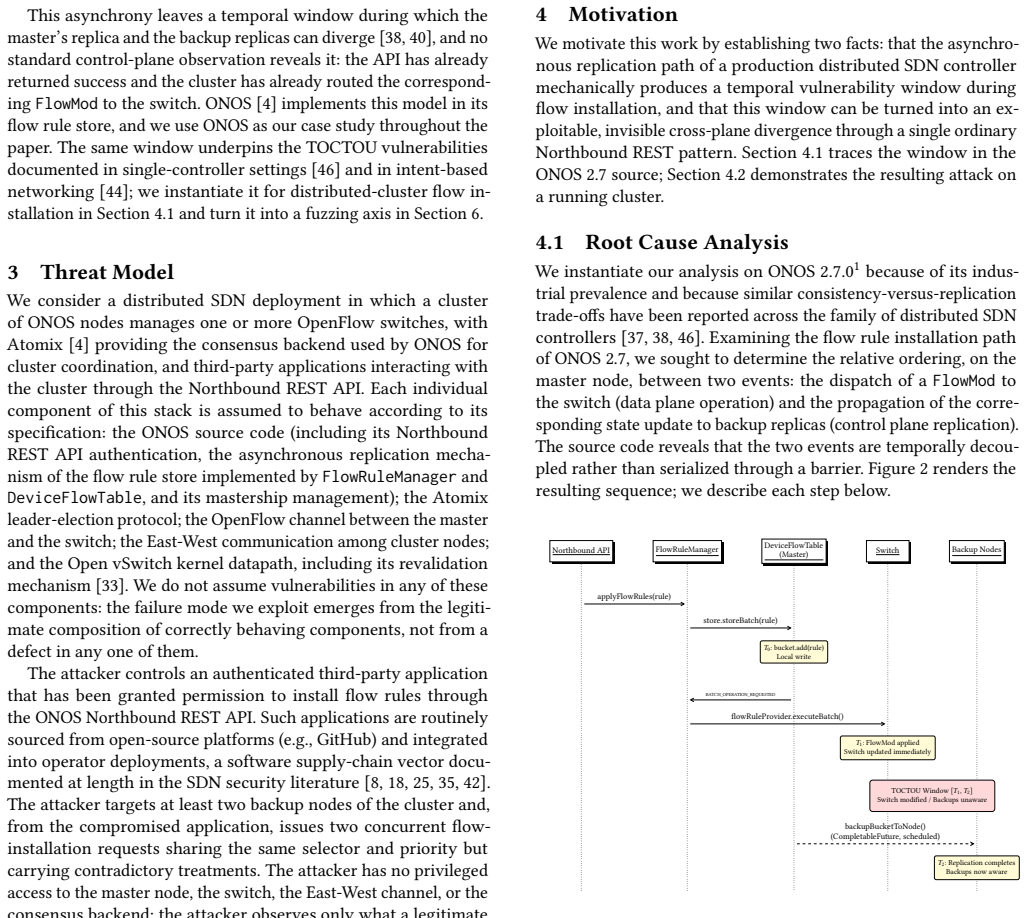
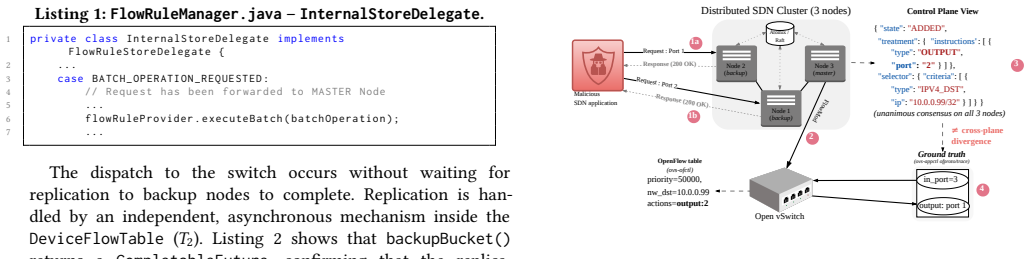
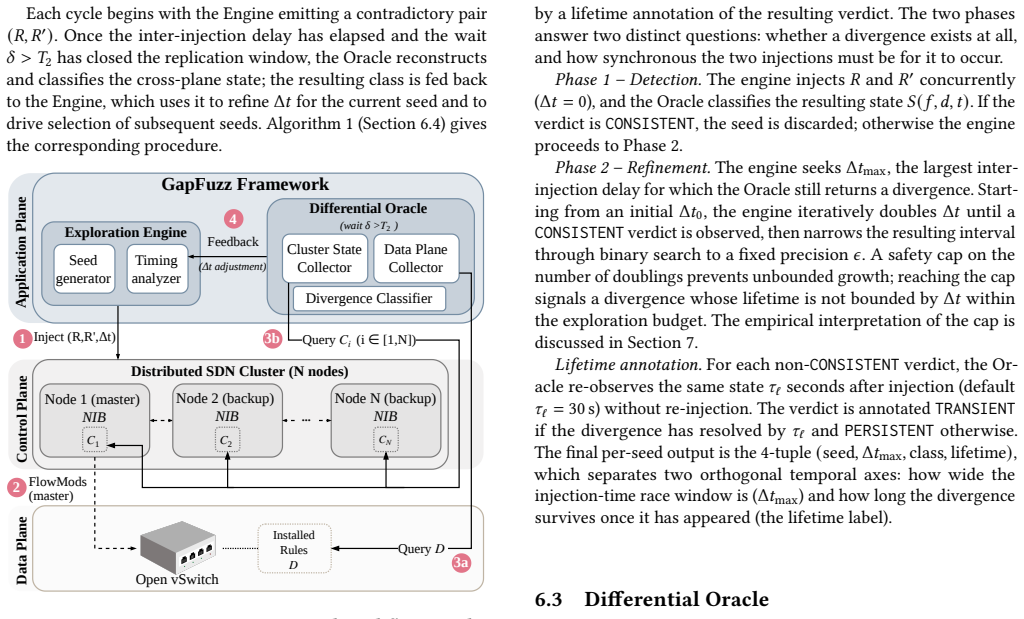
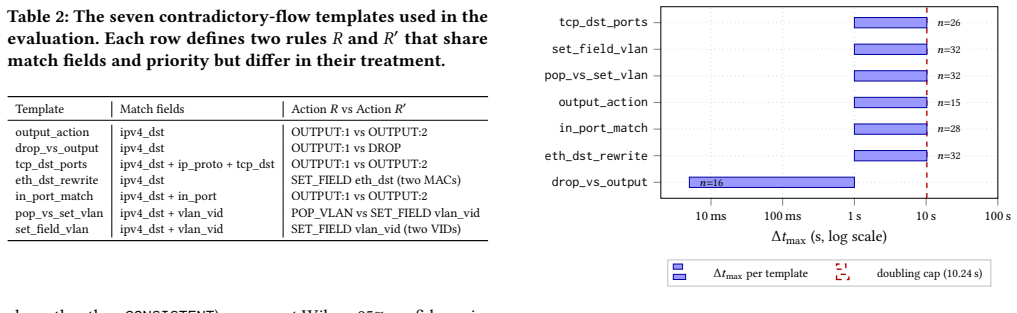
GapFuzz is a stateful concurrency fuzzer that injects pairs of contradictory requests on two non-master nodes with controlled inter-injection delay, reconstructs cross-plane state by querying all replicas and the kernel datapath via ovs-appctl ofproto/trace, and uses a two-phase timing search followed by a lifetime probe to classify each outcome as transient or persistent and to place it in one of four classes derived from the ONOS source. On a three-node ONOS 2.7 cluster this produces a divergent verdict in 81.7 percent of attempts, with every divergence between the cluster's authoritative state and the kernel datapath. Phase 2 isolates a 5 ms race window for one template and a doubling-cap
What carries the argument
The two-phase timing search on injection delay combined with the kernel-datapath probe that reads the actual action taken in the datapath.
If this is right
- Every detected divergence sits between the cluster's authoritative state and the kernel datapath.
- The kernel-datapath probe is required to reach the reported detection rate; the user-space probe alone misses many cases.
- 99.4 percent of divergences persist past 30 seconds.
- The timing search isolates a 5 ms race window for one template and larger windows up to 10.24 s for the others.
Where Pith is reading between the lines
- Distributed systems that rely on eventual consistency between application replicas and an underlying execution layer may need direct observation of that layer during testing.
- The same controlled-delay injection plus bottom-layer probe pattern could be tried on other replication-based systems such as distributed databases.
- Controller developers could use the identified race windows to tune synchronization intervals or add explicit cross-plane checks.
Load-bearing premise
The two-phase timing search together with the lifetime probe can reliably bound the injection-time window and correctly classify verdicts as transient or persistent.
What would settle it
An experiment that applies the same injection templates but finds that the kernel datapath action always matches at least one replica's reported state across repeated runs would show no cross-plane divergence of the claimed kind.
Figures

read the original abstract
Distributed Software-Defined Networking (SDN) clusters replicate flow state asynchronously between a master node and its backups, leaving a window during which two backup nodes can each commit a contradictory rule, the master can serialize both into the data plane, and the kernel datapath can latch onto an action that no node believes authoritative. Existing SDN fuzzers miss this fault: they confine their oracle to the control plane, target a single controller, or do not steer concurrency to provoke replication races. We present GapFuzz, a stateful concurrency fuzzer for distributed SDN clusters. GapFuzz injects pairs of contradictory Northbound requests on two non-master nodes with controlled inter-injection delay $\Delta t$, and reconstructs the global cross-plane state by querying every replica and the kernel-datapath action through ovs-appctl ofproto/trace. A two-phase timing search detects whether a divergence exists, then doubles and bisects on $\Delta t$ to bound the injection-time window; a lifetime probe labels each verdict transient or persistent and assigns it to one of four cross-plane state classes derived from the ONOS 2.7 source. On a three-node ONOS 2.7 cluster, GapFuzz produces a divergent verdict in 81.7% of attempts ($N=50$, Wilson 95% CI $[77.3, 85.4]$%); every divergence sits between the cluster's authoritative state and the kernel datapath. Phase 2 separates a 5 ms race window for one template from a doubling-cap regime ($\Delta t_{\max}=10.24$ s) for six others, and 99.4% of divergences persist past 30 s. Replacing the kernel-datapath probe with the OpenFlow user-space probe used by prior fuzzers drops detection by 26.6 percentage points overall and by 46.5 points after excluding canonicalization-forced verdicts.
Editorial analysis
A structured set of objections, weighed in public.
Referee Report
Summary. The paper presents GapFuzz, a stateful concurrency fuzzer for distributed SDN clusters. It injects pairs of contradictory Northbound requests on non-master nodes with controlled inter-injection delay Δt, reconstructs global cross-plane state via queries to replicas and the kernel datapath (using ovs-appctl ofproto/trace), employs a two-phase timing search (initial detection then doubling/bisection on Δt) plus a lifetime probe to bound the race window and classify verdicts as transient/persistent, and assigns them to one of four cross-plane classes. On a three-node ONOS 2.7 cluster it reports a divergent verdict in 81.7% of attempts (N=50, Wilson 95% CI [77.3, 85.4]%), with every divergence between the cluster's authoritative state and the kernel datapath; replacing the kernel probe with an OpenFlow user-space probe drops detection by 26.6 points overall.
Significance. If the timing search and lifetime probe are shown to be reliable, the result would be significant: it identifies a cross-plane divergence class missed by prior SDN fuzzers (which target only the control plane or single controllers), supplies a controlled empirical comparison, uses a Wilson interval for the headline rate, and demonstrates that 99.4% of detected divergences persist past 30 s while separating a 5 ms race window from a doubling-cap regime for other templates.
major comments (2)
- [Abstract] Abstract (description of two-phase timing search and lifetime probe): the central claims—the 81.7% divergence rate, the assertion that every divergence lies between authoritative state and kernel datapath, and the four-class assignment—rest on the two-phase search (initial detection followed by doubling and bisection on Δt) plus the lifetime probe correctly bounding the injection window and distinguishing transient from persistent outcomes. No validation, convergence test, or sensitivity analysis is supplied showing that the search terminates at the true race window or that probe latency is smaller than the minimum observable divergence lifetime; this is load-bearing for both the percentage and the 'all divergences are kernel-datapath' conclusion.
- [Abstract] Abstract (evaluation paragraph): the manuscript supplies no reference to the full experimental protocol, raw data, or source code, so it is impossible to confirm absence of post-hoc exclusions or to reproduce the timing-search behavior that underpins the reported detection rates and probe-comparison results.
Simulated Author's Rebuttal
We thank the referee for the detailed and constructive comments. We respond to each major comment below and indicate the revisions we will make.
read point-by-point responses
-
Referee: [Abstract] Abstract (description of two-phase timing search and lifetime probe): the central claims—the 81.7% divergence rate, the assertion that every divergence lies between authoritative state and kernel datapath, and the four-class assignment—rest on the two-phase search (initial detection followed by doubling and bisection on Δt) plus the lifetime probe correctly bounding the injection window and distinguishing transient from persistent outcomes. No validation, convergence test, or sensitivity analysis is supplied showing that the search terminates at the true race window or that probe latency is smaller than the minimum observable divergence lifetime; this is load-bearing for both the percentage and the 'all divergences are kernel-datapath' conclusion.
Authors: The two-phase timing search follows the established pattern of initial coarse detection followed by doubling and bisection to bound the race window, while the lifetime probe performs repeated queries to classify persistence. The reported results (5 ms race window for one template, doubling-cap regime for six others, and 99.4 % persistence past 30 s) provide empirical support that the procedure isolates the relevant timing intervals. We acknowledge that an explicit convergence test or sensitivity analysis with respect to probe latency is not present in the current manuscript. We will add a dedicated subsection describing the timing-search algorithm, its termination criteria, and a sensitivity study on probe latency in the revised version. revision: yes
-
Referee: [Abstract] Abstract (evaluation paragraph): the manuscript supplies no reference to the full experimental protocol, raw data, or source code, so it is impossible to confirm absence of post-hoc exclusions or to reproduce the timing-search behavior that underpins the reported detection rates and probe-comparison results.
Authors: The Evaluation section of the manuscript already specifies the three-node ONOS 2.7 cluster, the Northbound templates, the ovs-appctl probe, the two-phase search parameters, and the Wilson-interval calculation. To address reproducibility concerns, we will add an explicit pointer to the open-source GapFuzz implementation and a statement on the availability of the raw experimental traces in the revised manuscript. revision: yes
Circularity Check
No circularity: empirical measurement of external system behavior
full rationale
The paper describes an empirical fuzzer (GapFuzz) and reports measured detection rates (81.7% divergent verdicts) obtained by executing the tool against an external ONOS 2.7 cluster and observing the kernel datapath via ovs-appctl. No equations, fitted parameters, or self-citations are used to derive the reported percentages or the cross-plane class assignments; the results are direct observations of an external artifact. The two-phase timing search and lifetime probe are implementation details whose correctness is an empirical assumption, not a definitional reduction. The evaluation therefore remains self-contained against external benchmarks.
Axiom & Free-Parameter Ledger
axioms (2)
- domain assumption Contradictory Northbound requests injected on non-master nodes with controlled inter-injection delay can provoke replication races that reach the kernel datapath.
- domain assumption The ovs-appctl ofproto/trace command accurately reports the action latched by the kernel datapath.
Reference graph
Works this paper leans on
-
[1]
Daniel Abadi. 2012. Consistency Tradeoffs in Modern Distributed Database System Design: CAP is Only Part of the Story.Computer45, 2 (2012), 37–42. doi:10.1109/MC.2012.33
-
[2]
Carolyn Jane Anderson, Nate Foster, Arjun Guha, Jean-Baptiste Jeannin, Dexter Kozen, Cole Schlesinger, and David Walker. 2014. NetKAT: semantic foundations for networks. InProceedings of the 41st ACM SIGPLAN-SIGACT Symposium on Principles of Programming Languages(San Diego, California, USA)(POPL ’14). Association for Computing Machinery, New York, NY, USA...
arXiv 2014
-
[3]
Fetia Bannour, Sami Souihi, and Abdelhamid Mellouk. 2018. Distributed SDN Control: Survey, Taxonomy, and Challenges.IEEE Communications Surveys & Tutorials20, 1 (2018), 333–354. doi:10.1109/COMST.2017.2782482
-
[4]
Pankaj Berde, Matteo Gerola, Jonathan Hart, Yuta Higuchi, Masayoshi Kobayashi, Toshio Koide, Bob Lantz, Brian O’Connor, Pavlin Radoslavov, William Snow, and Guru Parulkar. 2014. ONOS: towards an open, distributed SDN OS. InProceedings of the Third Workshop on Hot Topics in Software Defined Networking(Chicago, Illinois, USA)(HotSDN ’14). Association for Co...
-
[5]
Marco Canini, Daniele Venzano, Peter Peresíni, Dejan Kostić, and Jennifer Rexford
-
[6]
In9th USENIX Symposium on Networked Systems Design and Implementation (NSDI 12)
A NICE Way to Test OpenFlow Applications. In9th USENIX Symposium on Networked Systems Design and Implementation (NSDI 12). USENIX Association, San Jose, CA, 127–140
-
[7]
Xiaofeng Chi, Bingquan Wang, Jingling Zhao, and Baojiang Cui. 2023. A Vul- nerability Detection Method for SDN with Optimized Fuzzing. InInternational Conference on Advanced Information Networking and Applications. Springer, 525– 536
2023
-
[8]
Shuhua Deng, Lihui Chen, and Xieping Gao. 2024. Manipulating Sensitive Match Fields to Poison Applications in SDN.IEEE Transactions on Network and Service Management21, 2 (2024), 2413–2425. doi:10.1109/TNSM.2023.3337434
-
[9]
Shuhua Deng, Xian Qing, Xiaofan Li, Xing Gao, and Xieping Gao. 2023. SDN Application Backdoor: Disrupting the Service via Poisoning the Topology. InIEEE INFOCOM 2023 - IEEE Conference on Computer Communications. 1–10. doi:10. 1109/INFOCOM53939.2023.10229058 11
arXiv 2023
-
[10]
Moustapha Awwalou Diouf, Samuel Ouya, Jacques Klein, and Tegawendé F Bissyandé. 2025. Software security in software-defined networking: A systematic literature review.arXiv preprint arXiv:2502.13828(2025)
arXiv 2025
-
[11]
Chi-Yao Hong, Srikanth Kandula, Ratul Mahajan, Ming Zhang, Vijay Gill, Mohan Nanduri, and Roger Wattenhofer. 2013. Achieving high utilization with software- driven WAN.SIGCOMM Comput. Commun. Rev.43, 4 (Aug. 2013), 15–26. doi:10. 1145/2534169.2486012
arXiv 2013
-
[12]
Sushant Jain, Alok Kumar, Subhasree Mandal, Joon Ong, Leon Poutievski, Arjun Singh, Subbaiah Venkata, Jim Wanderer, Junlan Zhou, Min Zhu, Jon Zolla, Urs Hölzle, Stephen Stuart, and Amin Vahdat. 2013. B4: experience with a globally- deployed software defined wan. InProceedings of the ACM SIGCOMM 2013 Con- ference on SIGCOMM(Hong Kong, China)(SIGCOMM ’13). ...
-
[13]
Samuel Jero, Xiangyu Bu, Cristina Nita-Rotaru, Hamed Okhravi, Richard Skowyra, and Sonia Fahmy. 2017. Beads: Automated attack discovery in openflow-based sdn systems. InInternational Symposium on Research in Attacks, Intrusions, and Defenses. Springer, 311–333
2017
-
[14]
Brighten Godfrey
Ahmed Khurshid, Wenxuan Zhou, Matthew Caesar, and P. Brighten Godfrey
-
[15]
VeriFlow: verifying network-wide invariants in real time. InProceedings of the First Workshop on Hot Topics in Software Defined Networks(Helsinki, Finland) (HotSDN ’12). Association for Computing Machinery, New York, NY, USA, 49–54. doi:10.1145/2342441.2342452
-
[16]
Jinwoo Kim, Minjae Seo, Eduard Marin, Seungsoo Lee, Jaehyun Nam, and Seung- won Shin. 2024. Ambusher: Exploring the Security of Distributed SDN Controllers Through Protocol State Fuzzing.IEEE Transactions on Information Forensics and Security19 (2024), 6264–6279. doi:10.1109/TIFS.2024.3402967
-
[17]
Jiwon Kim, Dave Jing Tian, and Benjamin E. Ujcich. 2025. Chimera: Fuzzing P4 Network Infrastructure for Multi-Plane Bug Detection and Vulnerability Discovery. In2025 IEEE Symposium on Security and Privacy (SP). 3088–3106. doi:10.1109/SP61157.2025.00194
-
[18]
Ujcich, and Dave (Jing) Tian
Jiwon Kim, Benjamin E. Ujcich, and Dave (Jing) Tian. 2023. Intender: Fuzzing Intent-Based Networking with Intent-State Transition Guidance. In32nd USENIX Security Symposium (USENIX Security 23). USENIX Association, Anaheim, CA, 4463–4480. https://www.usenix.org/conference/usenixsecurity23/presentation/ kim-jiwon
2023
-
[19]
Kyle Kingsbury. 2013. Jepsen: Distributed Systems Safety Research. https:// jepsen.io/. Accessed: 2026-05-02
2013
-
[20]
Diego Kreutz, Fernando M. V. Ramos, and Paulo Verissimo. 2013. Towards Secure and Dependable Software-Defined Networks. InProceedings of the Second ACM SIGCOMM Workshop on Hot Topics in Software Defined Networking (HotSDN ’13). 55–60. doi:10.1145/2491185.2491199
-
[21]
Diego Kreutz, Fernando M. V. Ramos, Paulo Esteves Veríssimo, Christian Esteve Rothenberg, Siamak Azodolmolky, and Steve Uhlig. 2015. Software-Defined Networking: A Comprehensive Survey.Proc. IEEE103, 1 (2015), 14–76. doi:10. 1109/JPROC.2014.2371999
arXiv 2015
-
[22]
Leslie Lamport. 2019. The part-time parliament. InConcurrency: the works of Leslie Lamport. 277–317
2019
-
[23]
Chanhee Lee, Changhoon Yoon, Seungwon Shin, and Sang Kil Cha. 2018. INDAGO: A New Framework For Detecting Malicious SDN Applications. In 2018 IEEE 26th International Conference on Network Protocols (ICNP). 220–230. doi:10.1109/ICNP.2018.00031
-
[24]
Seungsoo Lee, Jinwoo Kim, Seungwon Woo, Changhoon Yoon, Sandra Scott- Hayward, Vinod Yegneswaran, Phillip Porras, and Seungwon Shin. 2020. A comprehensive security assessment framework for software-defined networks. Computers & Security91 (2020), 101720. doi:10.1016/j.cose.2020.101720
-
[25]
Seungsoo Lee, Seungwon Woo, Jinwoo Kim, Jaehyun Nam, Vinod Yegneswaran, Phillip Porras, and Seungwon Shin. 2022. A Framework for Policy Inconsistency Detection in Software-Defined Networks.IEEE/ACM Transactions on Networking 30, 3 (2022), 1410–1423. doi:10.1109/TNET.2022.3140824
-
[26]
Seungsoo Lee, Changhoon Yoon, Chanhee Lee, Seungwon Shin, Vinod Yeg- neswaran, and Phillip A Porras. 2017. Delta: A security assessment framework for software-defined networks.. InNDSS
2017
-
[27]
Seungsoo Lee, Changhoon Yoon, and Seungwon Shin. 2016. The Smaller, the Shrewder: A Simple Malicious Application Can Kill an Entire SDN Environment. InProceedings of the 2016 ACM International Workshop on Security in Software Defined Networks & Network Function Virtualization(New Orleans, Louisiana, USA)(SDN-NFV Security ’16). Association for Computing Ma...
-
[28]
Dan Levin, Andreas Wundsam, Brandon Heller, Nikhil Handigol, and Anja Feld- mann. 2012. Logically centralized? state distribution trade-offs in software defined networks. InProceedings of the First Workshop on Hot Topics in Software Defined Networks(Helsinki, Finland)(HotSDN ’12). Association for Computing Machinery, New York, NY, USA, 1–6. doi:10.1145/23...
-
[29]
Hongliang Liang, Xiaoxiao Pei, Xiaodong Jia, Wuwei Shen, and Jian Zhang. 2018. Fuzzing: State of the art.IEEE Transactions on Reliability67, 3 (2018), 1199–1218
2018
-
[30]
Nick McKeown, Tom Anderson, Hari Balakrishnan, Guru Parulkar, Larry Pe- terson, Jennifer Rexford, Scott Shenker, and Jonathan Turner. 2008. OpenFlow: Enabling Innovation in Campus Networks.ACM SIGCOMM Computer Commu- nication Review38, 2 (2008), 69–74. doi:10.1145/1355734.1355746
-
[31]
Ruijie Meng, George Pîrlea, Abhik Roychoudhury, and Ilya Sergey. 2023. Greybox Fuzzing of Distributed Systems. InProceedings of the 2023 ACM SIGSAC Conference on Computer and Communications Security (CCS ’23). 1615–1629. doi:10.1145/ 3576915.3623097
arXiv 2023
-
[32]
Madanlal Musuvathi, Shaz Qadeer, Thomas Ball, Gerard Basler, Pira- manayagam Arumuga Nainar, and Iulian Neamtiu. 2008. Finding and Reproducing Heisenbugs in Concurrent Programs.. InOSDI, Vol. 8
2008
-
[33]
Raphaël Ollando, Seung Yeob Shin, and Lionel C. Briand. 2026. Learning-Guided Fuzzing for Testing Stateful SDN Controllers.ACM Transactions on Software Engineering and Methodology(2026). doi:10.1145/3733717
-
[34]
Diego Ongaro and John Ousterhout. 2014. In search of an understandable con- sensus algorithm. In2014 USENIX annual technical conference (USENIX ATC 14). 305–319
2014
-
[35]
Ben Pfaff, Justin Pettit, Teemu Koponen, Ethan Jackson, Andy Zhou, Jarno Raja- halme, Jesse Gross, Alex Wang, Joe Stringer, Pravin Shelar, Keith Amidon, and Martín Casado. 2015. The Design and Implementation of Open vSwitch. In12th USENIX Symposium on Networked Systems Design and Implementation (NSDI 15). USENIX Association, Oakland, CA, 117–130
2015
-
[36]
Philip Porras, Seungwon Shin, Vinod Yegneswaran, Martin Fong, Mabry Tyson, and Guofei Gu. 2012. A Security Enforcement Kernel for OpenFlow Networks. InProceedings of the First Workshop on Hot Topics in Software Defined Networks (HotSDN ’12). 121–126. doi:10.1145/2342441.2342466
-
[37]
Zia, Waseem Iqbal, Yawar Abbas, and Hammad Afzal
Bilal Rauf, Haider Abbas, Muhammad Usman, Tanveer A. Zia, Waseem Iqbal, Yawar Abbas, and Hammad Afzal. 2021. Application Threats to Exploit North- bound Interface Vulnerabilities in Software Defined Networks.ACM Comput. Surv.54, 6, Article 121 (July 2021), 36 pages. doi:10.1145/3453648
-
[38]
Mark Reitblatt, Nate Foster, Jennifer Rexford, Cole Schlesinger, and David Walker
-
[39]
InProceedings of the ACM SIGCOMM 2012 Conference
Abstractions for Network Update. InProceedings of the ACM SIGCOMM 2012 Conference. 323–334. doi:10.1145/2342356.2342427
-
[40]
Ermin Sakic and Wolfgang Kellerer. 2018. Impact of Adaptive Consistency on Distributed SDN Applications: An Empirical Study.IEEE Journal on Selected Areas in Communications36, 12 (Dec 2018), 2702–2715. doi:10.1109/JSAC.2018.2871309
-
[41]
Ermin Sakic and Wolfgang Kellerer. 2018. Response Time and Availability Study of RAFT Consensus in Distributed SDN Control Plane.IEEE Transactions on Network and Service Management15, 1 (2018), 304–318. doi:10.1109/TNSM.2017.2775061
-
[42]
Jawad Saidi, Stefan Schmid, Marco Canini, Thomas Zinner, and Anja Feldmann
Apoorv Shukla, S. Jawad Saidi, Stefan Schmid, Marco Canini, Thomas Zinner, and Anja Feldmann. 2020. Towards Consistent SDNs Through Network State Fuzzing.IEEE Transactions on Network and Service Management17, 2 (2020), 1156–1169. doi:10.1109/TNSM.2019.2955790
-
[43]
Dylan Smyth, Donna O’Shea, Victor Cionca, and Sean McSweeney. 2019. Attack- ing distributed software-defined networks by leveraging network state consis- tency.Computer Networks156 (2019), 9–19. doi:10.1016/j.comnet.2019.02.020
-
[44]
Kashyap Thimmaraju, Bhargava Shastry, Tobias Fiebig, Felicitas Hetzelt, Jean- Pierre Seifert, Anja Feldmann, and Stefan Schmid. 2018. Taking Control of SDN-based Cloud Systems via the Data Plane. InProceedings of the Symposium on SDN Research (SOSR ’18). 1–15. doi:10.1145/3185467.3185468
-
[45]
Ujcich, Samuel Jero, Anne Edmundson, Qi Wang, Richard Skowyra, James Landry, Adam Bates, William H
Benjamin E. Ujcich, Samuel Jero, Anne Edmundson, Qi Wang, Richard Skowyra, James Landry, Adam Bates, William H. Sanders, Cristina Nita-Rotaru, and Hamed Okhravi. 2018. Cross-App Poisoning in Software-Defined Networking. InPro- ceedings of the 2018 ACM SIGSAC Conference on Computer and Communications Security(Toronto, Canada)(CCS ’18). Association for Comp...
-
[46]
Ujcich, Uttam Thakore, and William H
Benjamin E. Ujcich, Uttam Thakore, and William H. Sanders. 2017. ATTAIN: An Attack Injection Framework for Software-Defined Networking. In2017 47th Annual IEEE/IFIP International Conference on Dependable Systems and Networks (DSN). 567–578. doi:10.1109/DSN.2017.59
-
[47]
Ben Weintraub, Jiwon Kim, Ran Tao, Cristina Nita-Rotaru, Hamed Okhravi, Dave (Jing) Tian, and Benjamin E. Ujcich. 2024. Exploiting Temporal Vulnerabil- ities for Unauthorized Access in Intent-based Networking. InProceedings of the 2024 on ACM SIGSAC Conference on Computer and Communications Security(Salt Lake City, UT, USA)(CCS ’24). Association for Compu...
-
[48]
Edwin B Wilson. 1927. Probable inference, the law of succession, and statistical inference.J. Amer. Statist. Assoc.22, 158 (1927), 209–212
1927
-
[49]
Lei Xu, Jeff Huang, Sungmin Hong, Jialong Zhang, and Guofei Gu. 2017. Attacking the Brain: Races in the SDN Control Plane. In26th USENIX Security Symposium (USENIX Security 17). USENIX Association, Vancouver, BC, 451–468. https://www. usenix.org/conference/usenixsecurity17/technical-sessions/presentation/xu-lei
2017
-
[50]
Jiangyuan Yao, Zhiliang Wang, Xia Yin, Xingang Shi, Yahui Li, and Chongrong Li. 2017. Testing Black-Box SDN Applications with Formal Behavior Models. In 2017 IEEE 25th International Symposium on Modeling, Analysis, and Simulation of Computer and Telecommunication Systems (MASCOTS). 110–120. doi:10.1109/ MASCOTS.2017.20 12
2017
discussion (0)
Sign in with ORCID, Apple, or X to comment. Anyone can read and Pith papers without signing in.