REVIEW 3 major objections 4 minor 18 references
SkillMentor claims that blind-spot diagnosis — discovering what an executor agent does not know — is a learnable capability, and that a Mentor trained only on its own diagnostic tasks improves frozen executors by 44.2% on average without hu
Reviewed by Pith at T0; open to challenge. T0 means a machine referee read the full paper against a public rubric. the ladder, T0–T4 →
T0 review · deepseek-v4-flash
2026-08-01 08:48 UTC pith:VDQHMK4T
load-bearing objection Solid empirical paper with a genuinely new framing, but the headline claim about 'learned diagnosis' is only as strong as the uncalibrated judge that supplies the training signal. the 3 major comments →
SkillMentor: LLM Agent Self-Evolution via Learning Blind-Spot Diagnosis
The pith
A machine-rendered reading of the paper's core claim, the machinery that carries it, and where it could break.
Core claim
The central claim is that blind-spot diagnosis is itself a learnable capability. A Mentor policy, trained via reinforcement learning on the diagnostic gap δ = max(0, s_reference − s_executor) and on executor-grounded skill utility, can discover recurrent failure modes of a frozen executor, curate them into reusable procedural skills, and thereby improve the executor's performance by an average of 44.2% relative to no skills. The paper also reports that a small trained Mentor outperforms a much larger prompted model, that weaker executors benefit more, and that skills transfer across models without retraining, especially from weaker to stronger executors.
What carries the argument
The load-bearing object is a blind spot, defined as a pair (T, c) where T is a task on which the executor consistently underperforms and c is a corrective skill. The learning signal is the diagnostic gap δ_i = max(0, s_i^M − s_i^E), the difference in scores between a strong reference model and the frozen executor on a Mentor-generated diagnostic task. This gap serves as the discovery reward and selects which failure to repair; the curation reward is the executor-grounded improvement Δ = s_c − s_E_max after a candidate skill is added. A skill repository stores the repairs, a decaying threshold tracks the shifting capability boundary, and joint optimization of discovery and curation via RL cre
Load-bearing premise
The entire learning signal rests on the diagnostic gap δ_i = max(0, s_reference − s_executor), which assumes the strong reference model and the LLM judge provide an unbiased, oracle-quality score of task success; if the judge systematically favors the reference model, or the generated diagnostic tasks are not actually solvable, 'diagnosis' degrades into stylistic imitation.
What would settle it
On a subset of tasks with programmatically checkable outcomes (e.g., unit-testable function calls), replace the LLM judge's scores with binary pass/fail from ground truth and retrain. If the performance gain largely evaporates, the learned signal was judge bias, not genuine blind-spot discovery. Alternatively, sample a batch of Mentor-generated diagnostic tasks and check by hand whether the reference model's trajectory is actually correct; if a substantial fraction are unsolvable, the diagnostic gap is an artifact.
If this is right
- A frozen executor can be improved purely through an external skill repository curated by a learned diagnosis policy, with no weight updates and no human-labeled data.
- Learned diagnostic skills transfer across models: a repository trained on a weaker executor often helps a stronger one, implying the skills encode portable procedural knowledge rather than model-specific quirks.
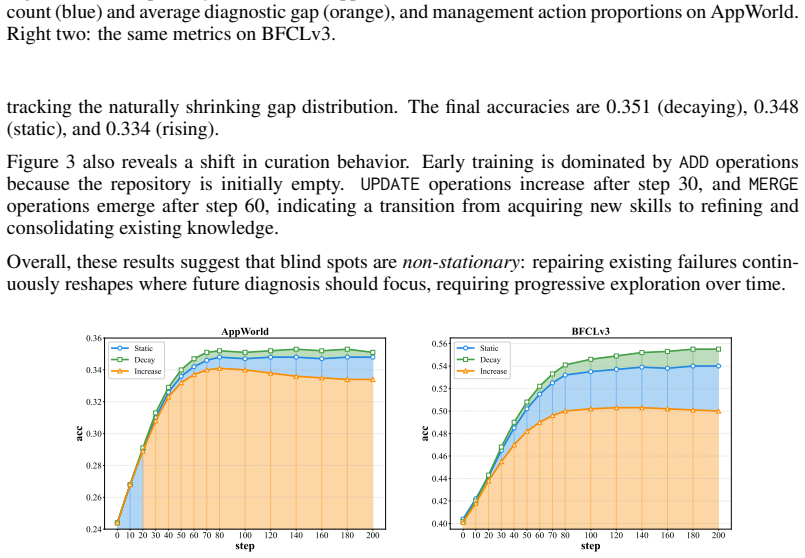
- Blind spots are non-stationary: successful repair shifts the failure distribution, which is why the curation threshold must decay as training progresses.
- A small RL-trained Mentor can outperform a much larger prompted model, suggesting that diagnostic skill is learned competence rather than a by-product of scale.
- The resulting skill repository is interpretable: skills are stored as human-readable Markdown with trigger conditions and step-by-step rules, making the executor's deficiencies inspectable.
Where Pith is reading between the lines
- Because most of the gain comes from 'mechanical' fixes (wrong parameter names, missing auth tokens, ghost APIs), the same discovery-and-curate loop could plausibly transfer to other API-driven tasks such as code repair or browser automation, where failures are similarly procedural.
- One testable extension: replace the LLM judge with a programmatic verifier on a subset of tasks with known ground truth. If the 44.2% gain mostly disappears, the learned diagnosis was chasing judge bias rather than genuine blind spots — a direct check on the paper's core assumption.
- The asymmetry that weaker-to-stronger transfer works better than stronger-to-weaker suggests the Mentor learns more from visible failure patterns than from near-perfect demonstrations; a concrete prediction is that deliberately degrading the training executor (e.g., adding more noise) would yield even broader repositories.
- Since the Mentor is trained only against a reference model of the same domain, the approach should be sensitive to reference-model quality; a cheap resilience test is to retrain with reference models of different sizes and measure how the diagnostic gap and final accuracy co-move.
Editorial analysis
A structured set of objections, weighed in public.
Referee Report
Summary. SkillMentor proposes a learned diagnosis policy (Mentor) that, with a frozen executor and no human labels, generates diagnostic tasks, measures a diagnostic gap between a strong reference model and the executor using an LLM judge, and curates corrective skills into an external repository. The policy is trained with GRPO on a discovery reward (gap size) and a curation reward (executor score improvement). On AppWorld and BFCLv3, across three executors, SkillMentor achieves on average +44.2% relative improvement over a no-skill baseline and outperforms prompt-based mentors. The paper argues that diagnosis is a learnable capability and that all improvement stems from it, since the executor is frozen and no supervision is used.
Significance. If the central claim is sustained, the work establishes a new axis for agent self-evolution: learning to discover and repair blind spots, with human-interpretable skills that transfer across models. The empirical package is strong: main tables, ablations, an 8x8 transfer matrix, sensitivity sweeps, and five rescue case studies. The 44.2% headline is arithmetically consistent with Table 1. However, the mechanism attribution depends on the validity of the LLM-judge-based diagnostic gap, which is not calibrated against objective success signals. The paper would be significantly stronger with such a calibration and with a recurrence check for blind spots; as written, the empirical results are credible but the central interpretational claim is not yet fully established.
major comments (3)
- [§3.3, Eq. (3)] The diagnostic gap δ_i = max(0, s_i^M − s_i^E) is computed from LLM-judge scores, and the same judge supplies s_c in the curation reward (Eq. 4) and the Δ > 0.5 gate. No calibration of the judge against the benchmarks' programmatic success signals is reported. If the judge systematically prefers the reference model's trajectory style or is merely noisy, the RL policy could improve judge scores without improving real capability. The final benchmark numbers are objective and impressive, but they do not by themselves establish the mechanism. Please report a calibration study on a sample: compare judge scores with AppWorld's programmatic pass/fail and BFCLv3's correctness metrics, with agreement statistics; also report judge accuracy for the executor's own trajectories. Without this, the abstract's claim that 'all improvements originate from the learned diagnostic capability' is not justifie
- [§3.1 vs §3.3–3.4] The blind-spot definition requires a 'task on which the Executor consistently underperforms' (recurrent), but the operationalization selects the single task q_max with the largest gap δ_max at a given step; no recurrence check is performed. A single high-gap task can trigger skill curation and reward, so the policy may be rewarded for one-off anomalies rather than recurrent failure modes. This inconsistency between the conceptual and operational definitions is load-bearing for the claim that the system learns to identify blind spots. Add a recurrence requirement (e.g., the same failure pattern must appear in multiple independently sampled tasks, or the curated skill must rescue a held-out task of the same type) or revise the definition to match the implementation.
- [§3.3 / Appendix C] The text states that the strong reference model M generates and scores its own trajectory (τ_i^M, s_i^M), while experiments identify the judge as DeepSeek-V4-Flash. Clarify whether M and the judge are the same model or different. If the judge is the same as the reference, self-preference bias is a concrete risk; if they are different, specify M and its relationship to the judge. Also, the paper does not verify that the generated diagnostic tasks are solvable by a correct procedure, which is necessary for the gap to represent a genuine capability gap rather than an artifact of task ill-posedness. A small human audit (e.g., 50 generated tasks, rating solvability and whether the executor's failure is a real blind spot) would substantially strengthen the diagnosis claims.
minor comments (4)
- [Table 1 and Appendix C figures] There are numerous typographical/formatting artifacts, e.g., 'Acc Step' column with merged decimals like '.010 21.0.009' and the reproduced prompt figures (Figures 6–10) are too small to read. Please proofread the tables and provide high-resolution text versions of all prompts.
- [§4.1] The sentence 'while BFCLv3 exhibits comparable increase' is confusing: Table 1 shows no step metric for BFCLv3. This clause appears to be a leftover or typo and should be clarified or removed.
- [Figure 4] The x-axis labels in the AppWorld plot appear to jump from 80 to 100, skipping 90 (and the 'step' ticks after 80 are irregular). Please verify the tick labels and align them with the actual evaluation steps.
- [Abstract] The phrase 'average of 44.2%' should specify that it is the average relative improvement across the six executor-benchmark combinations in Table 1 (three executors × two benchmarks), not a single benchmark average. This will avoid reader confusion.
Circularity Check
No significant circularity: the training rewards are internal learning signals, while the headline 44.2% improvement is measured on external AppWorld/BFCLv3 benchmarks.
full rationale
The paper's learning loop is self-referential in flavor: the discovery reward is defined as the diagnostic gap r_disc = δ_i = max(0, s^M_i − s^E_i) (Eq. 3), and the curation reward uses the executor-grounded utility Δ = s^c − s^E_max (Eq. 4). However, these quantities are used only as RL training signals and as an internal validation gate (Δ > 0.5). The central empirical claim—a 44.2% average relative improvement—is computed on the external AppWorld and BFCLv3 benchmark metrics reported in Table 1, not on δ_i or Δ. The skill repository is filtered by the executor-grounded gate, but that is a quality-control mechanism for admitting skills, not a prediction obtained from the training objective. The isolation claim that all progress originates from diagnosis is established by experimental design (frozen executor, no human-labeled data), not by defining the outcome in terms of the reward. No load-bearing self-citation or uniqueness theorem is invoked; the cited related works are by other groups. The possible uncalibrated LLM judge is a validity and reward-hacking risk, but it does not make the benchmark result equivalent to the training input by construction. I therefore find no circular step under the paper's own equations.
Axiom & Free-Parameter Ledger
free parameters (4)
- Gap threshold schedule =
0.5 decays by 0.002/step to floor 0.2
- Skill curation gate Δ =
>0.5
- Reward weights α_f, α_q =
0.3 / 0.7
- Eviction threshold =
0.05 success rate
axioms (5)
- standard math GRPO clipped-surrogate objective with group advantage normalization is a valid training rule.
- domain assumption A blind spot is a recurrent failure mode that can be mitigated by an external procedural skill.
- domain assumption The strong reference model's score s^M_i and the LLM judge provide an unbiased oracle-quality measure of task success.
- domain assumption Mentor exploration of the sandbox environment generates diagnostic tasks representative of real benchmark tasks.
- ad hoc to paper The linearly decaying threshold tracks a naturally shrinking gap distribution.
invented entities (1)
-
Blind spot tuple b=(T,c)
no independent evidence
read the original abstract
Agent self-evolution has primarily focused on learning how to act, while overlooking an equally important capability: learning to discover what an agent does not know. Existing approaches typically assume that failure discovery is given, focusing on how to repair failures once they are identified. We ask whether blind-spot diagnosis itself can be learned. We thus study diagnosis as an agent capability separate from execution, and exclude two alternative sources of progress: executor adaptation and human supervision. Under these constraints, performance cannot improve through executor updates or annotated examples, forcing all improvements to originate from the learned diagnostic capability. We propose SkillMentor, which trains a Mentor policy via reinforcement learning to generate diagnostic tasks, identify recurrent failure modes, and curate them into reusable corrective skills. Across AppWorld and BFCLv3, SkillMentor improves executor performance by an average of 44.2%. These results suggest that blind-spot diagnosis is a learnable capability, enabling self-evolution without updating executor weights or relying on human-curated data.
Figures




Reference graph
Works this paper leans on
-
[1]
Tool-r0: Self-evolving llm agents for tool-learning from zero data.arXiv preprint arXiv:2602.21320,
Emre Can Acikgoz, Cheng Qian, Jonas H ¨ubotter, Heng Ji, Dilek Hakkani-T ¨ur, and Gokhan Tur. Tool-r0: Self-evolving llm agents for tool-learning from zero data.arXiv preprint arXiv:2602.21320,
-
[3]
Jinyuan Fang, Yanwen Peng, Xi Zhang, Yingxu Wang, Xinhao Yi, Guibin Zhang, Yi Xu, Bin Wu, Siwei Liu, Zihao Li, Zhaochun Ren, Nikos Aletras, Xi Wang, Han Zhou, and Zaiqiao Meng. A comprehensive survey of self-evolving ai agents: A new paradigm bridging foundation models and lifelong agentic systems.arXiv preprint arXiv:2508.07407, 2025a. Runnan Fang, Yuan ...
-
[4]
Yu Li, Rui Miao, Zhengling Qi, and Tian Lan. Arise: Agent reasoning with intrinsic skill evolution in hierarchical reinforcement learning.arXiv preprint arXiv:2603.16060,
-
[5]
Pan, Guilin Qi, Haofen Wang, and Huajun Chen
Yuan Liang, Ruobin Zhong, Haoming Xu, Chen Jiang, Yi Zhong, Runnan Fang, Jia-Chen Gu, Shumin Deng, Yunzhi Yao, Mengru Wang, Shuofei Qiao, Xin Xu, Tongtong Wu, Kun Wang, Yang Liu, Zhen Bi, Jungang Lou, Yuchen Eleanor Jiang, Hangcheng Zhu, Gang Yu, Haiwen Hong, Longtao Huang, Hui Xue, Chenxi Wang, Yijun Wang, Zifei Shan, Xi Chen, Zhaopeng Tu, Feiyu Xiong, X...
-
[6]
Zhengxi Lu, Zhiyuan Yao, Jinyang Wu, Chengcheng Han, Qi Gu, Xunliang Cai, Weiming Lu, Jun Xiao, Yueting Zhuang, and Yongliang Shen. Skill0: In-context agentic reinforcement learning for skill internalization.arXiv preprint arXiv:2604.02268,
-
[7]
11 Siru Ouyang, Jun Yan, I-Hung Hsu, Yanfei Chen, Ke Jiang, Zifeng Wang, Rujun Han, Long T. Le, Samira Daruki, Xiangru Tang, Vishy Tirumalashetty, George Lee, Mahsan Rofouei, Hangfei Lin, Jiawei Han, Chen-Yu Lee, and Tomas Pfister. Reasoningbank: Scaling agent self-evolving with reasoning memory.arXiv preprint arXiv:2509.25140,
-
[9]
URLhttps://proceedings. mlr.press/v267/patil25a.html. Jiahao Qiu, Xuan Qi, Tongcheng Zhang, Xinzhe Juan, Jiacheng Guo, Yifu Lu, Yimin Wang, Zixin Yao, Qihan Ren, Xun Jiang, Xing Zhou, Dongrui Liu, Ling Yang, Yue Wu, Kaixuan Huang, Shilong Liu, Hongru Wang, and Mengdi Wang. Alita: Generalist agent enabling scalable agentic reasoning.arXiv preprint arXiv:25...
-
[10]
Zhihong Shao, Peiyi Wang, Qihao Zhu, Runxin Xu, Junxiao Song, Xiao Bi, Haowei Zhang, Mingchuan Zhang, Y . K. Li, Y . Wu, and Daya Guo. Deepseekmath: Pushing the limits of mathe- matical reasoning in open language models.arXiv preprint arXiv:2402.03300,
-
[12]
doi: 10.18653/v1/2024.acl-long.850
Association for Computational Linguistics. doi: 10.18653/v1/2024.acl-long.850. URL https://aclanthology.org/2024.acl-long.850/. Songjun Tu, Chengdong Xu, Qichao Zhang, Yaocheng Zhang, Xiangyuan Lan, Linjing Li, and Dongbin Zhao. Dynamic dual-granularity skill bank for agentic rl.arXiv preprint arXiv:2603.28716,
Pith/arXiv arXiv 2024
-
[13]
Reinforcement learning for self-improving agent with skill library.arXiv preprint arXiv:2512.17102,
Jiongxiao Wang, Qiaojing Yan, Yawei Wang, Yijun Tian, Soumya Smruti Mishra, Zhichao Xu, Megha Gandhi, Panpan Xu, and Lin Lee Cheong. Reinforcement learning for self-improving agent with skill library.arXiv preprint arXiv:2512.17102,
-
[14]
Peng Xia, Kaide Zeng, Jiaqi Liu, Can Qin, Fang Wu, Yiyang Zhou, Caiming Xiong, and Huaxiu Yao. Agent0: Unleashing self-evolving agents from zero data via tool-integrated reasoning.arXiv preprint arXiv:2511.16043,
-
[15]
Peng Xia, Jianwen Chen, Hanyang Wang, Jiaqi Liu, Kaide Zeng, Yu Wang, Siwei Han, Yiyang Zhou, Xujiang Zhao, Haifeng Chen, Zeyu Zheng, Cihang Xie, and Huaxiu Yao. Skillrl: Evolving agents via recursive skill-augmented reinforcement learning.arXiv preprint arXiv:2602.08234,
-
[16]
Skil- lopt: Executive strategy for self-evolving agent skills.arXiv preprint arXiv:2605.23904, 2026a
12 Yifan Yang, Ziyang Gong, Weiquan Huang, Qihao Yang, Ziwei Zhou, Zisu Huang, Yan Li, Xuemei Gao, Qi Dai, Bei Liu, Kai Qiu, Yuqing Yang, Dongdong Chen, Xue Yang, and Chong Luo. Skil- lopt: Executive strategy for self-evolving agent skills.arXiv preprint arXiv:2605.23904, 2026a. Yutao Yang, Junsong Li, Qianjun Pan, Bihao Zhan, Yuxuan Cai, Lin Du, Jie Zhou...
-
[17]
Hanrong Zhang, Shicheng Fan, Henry Peng Zou, Yankai Chen, Zhenting Wang, Jiayu Zhou, Chengze Li, Wei-Chieh Huang, Yifei Yao, Kening Zheng, Xue Liu, Xiaoxiao Li, and Philip S. Yu. Coevoskills: Self-evolving agent skills via co-evolutionary verification.arXiv preprint arXiv:2604.01687, 2026a. Haozhen Zhang, Quanyu Long, Jianzhu Bao, Tao Feng, Weizhi Zhang, ...
-
[18]
Absolute zero: Reinforced self-play reasoning with zero data.arXiv preprint arXiv:2505.03335,
Andrew Zhao, Yiran Wu, Yang Yue, Tong Wu, Quentin Xu, Yang Yue, Matthieu Lin, Shenzhi Wang, Qingyun Wu, Zilong Zheng, and Gao Huang. Absolute zero: Reinforced self-play reasoning with zero data.arXiv preprint arXiv:2505.03335,
-
[2024]
Yucheng Shi, Zhenwen Liang, Kishan Panaganti, Dian Yu, Wenhao Yu, and Haitao Mi. Learning to build the environment: Self-evolving reasoning rl via verifiable environment synthesis.arXiv preprint arXiv:2605.14392,
-
[2025]
Skillos: Learning skill curation for self-evolving agents.arXiv preprint arXiv:2605.06614,
Siru Ouyang, Jun Yan, Yanfei Chen, Rujun Han, Zifeng Wang, Bhavana Dalvi Mishra, Rui Meng, Chun-Liang Li, Yizhu Jiao, Kaiwen Zha, Maohao Shen, Vishy Tirumalashetty, George Lee, Ji- awei Han, Tomas Pfister, and Chen-Yu Lee. Skillos: Learning skill curation for self-evolving agents.arXiv preprint arXiv:2605.06614,
-
[2026]
Evoskill: Au- tomated skill discovery for multi-agent systems.arXiv preprint arXiv:2603.02766,
Salaheddin Alzubi, Noah Provenzano, Jaydon Bingham, Weiyuan Chen, and Tu Vu. Evoskill: Au- tomated skill discovery for multi-agent systems.arXiv preprint arXiv:2603.02766,
discussion (0)
Sign in with ORCID, Apple, or X to comment. Anyone can read and Pith papers without signing in.