Odd-parity perturbations of trace-quadratic f(R,T) black holes with anisotropic matter: admissible branches, axial ringdown, and a coupled-PINN benchmark
Pith reviewed 2026-06-28 09:01 UTC · model grok-4.3
The pith
The odd sector around admissible trace-quadratic f(R,T) black holes reduces exactly to Einstein gravity plus a frozen anisotropic fluid, producing a 22% shift in axial quasinormal modes with no resolved alpha dependence.
A machine-rendered reading of the paper's core claim, the machinery that carries it, and where it could break.
Core claim
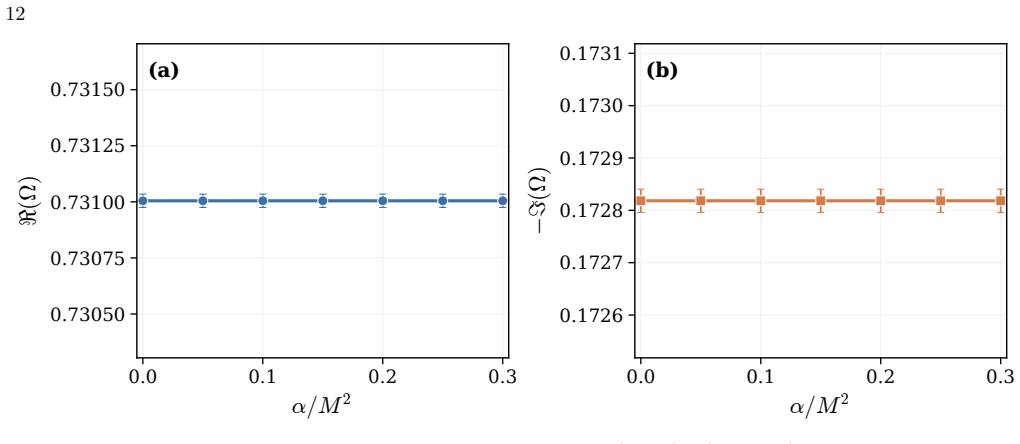
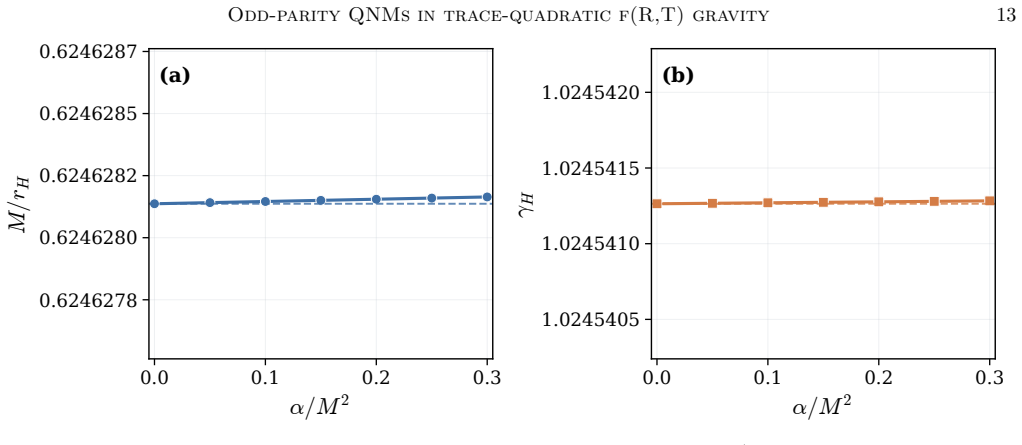
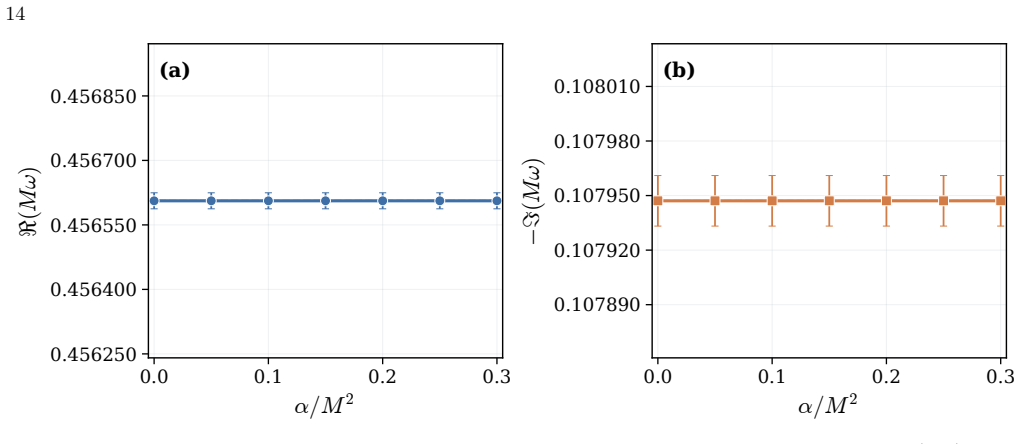
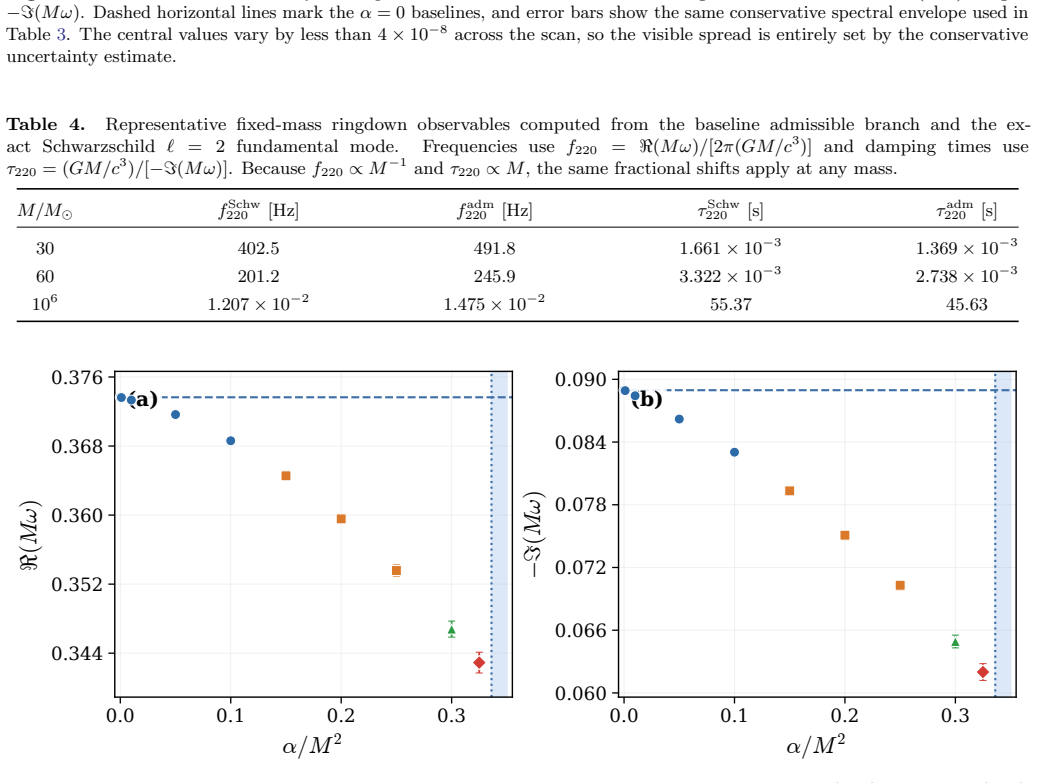
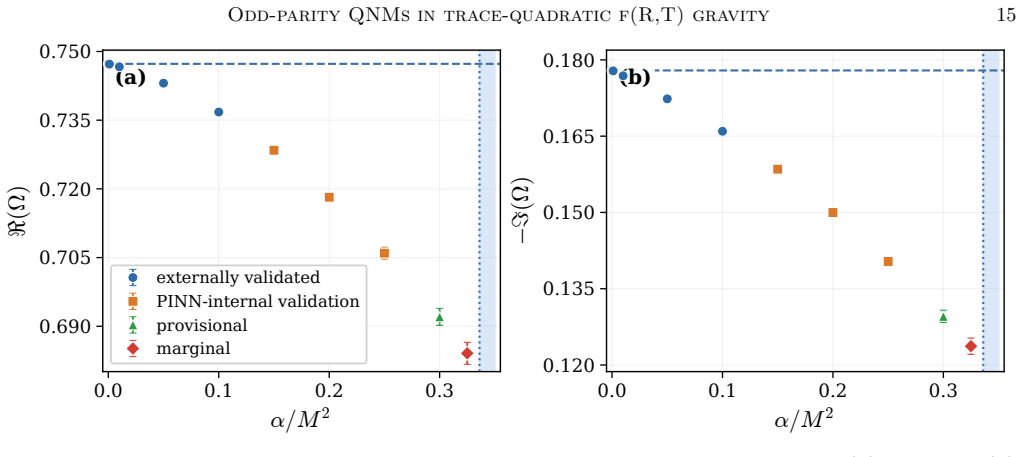
On static admissible backgrounds the odd sector is exactly equivalent to Einstein gravity coupled to a frozen effective anisotropic fluid, so the physical axial spectrum is governed by a single gauge-invariant master equation. For the anchored branch (w_r,w_t)=(-0.2,0.15) the mass-normalized spectrum differs from Schwarzschild by about 22%, whereas no statistically resolved direct alpha-dependence appears within the conservative spectral envelope over 0 less than or equal to alpha/M squared less than or equal to 0.3. Within this closure the main observable imprint in axial ringdown comes from the existence of the matter-supported branch itself, not from direct variation of the trace coupling
What carries the argument
the single gauge-invariant master equation that governs the axial sector once the odd-parity system is reduced on admissible backgrounds
Load-bearing premise
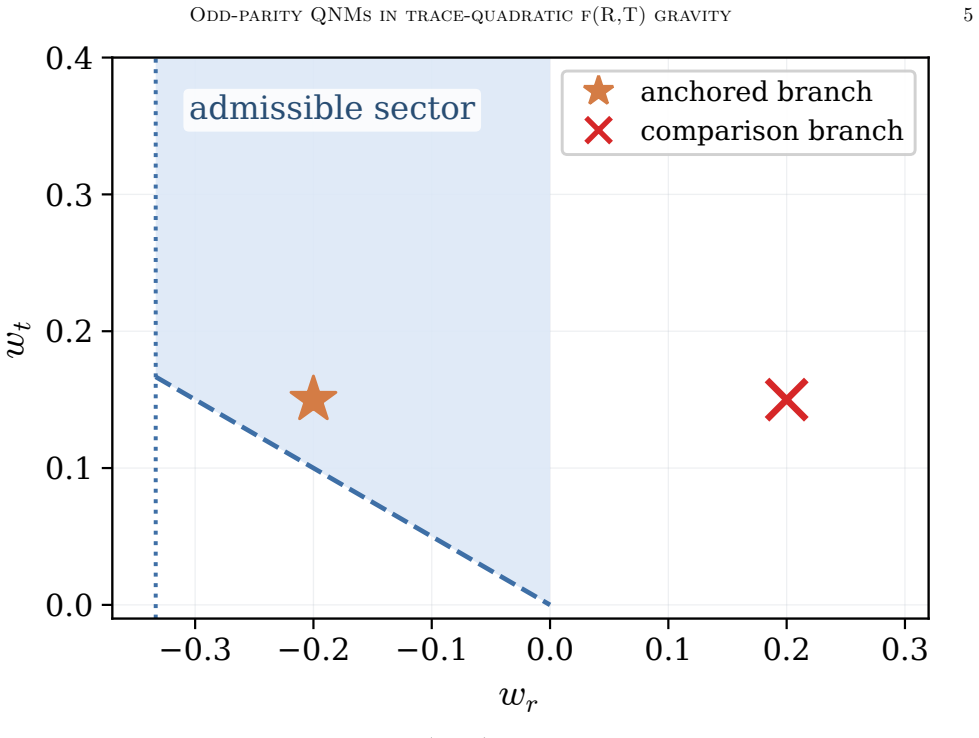
The constant closure parameters allow a regular horizon, asymptotic flatness, and hyperbolic evolution only for negative w_r.
What would settle it
Direct numerical integration of the background equations for any positive w_r value that produces a singular horizon or violates asymptotic flatness would confirm the claimed restriction to the negative-w_r family.
Figures


read the original abstract
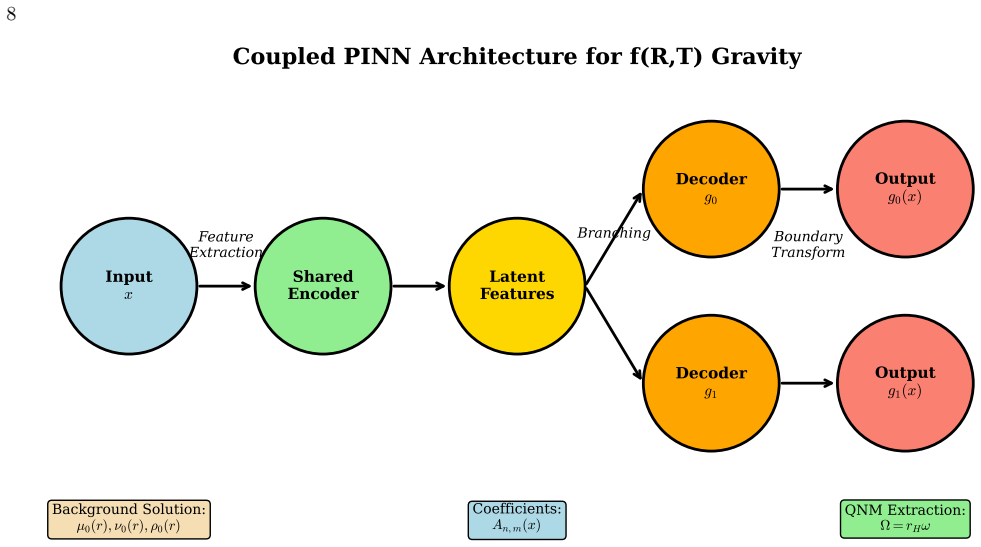
We study odd-parity gravitational perturbations of static black holes in trace-quadratic $f(R,T)=R+\alpha T^2$ gravity supported by an anisotropic effective fluid with constant closure parameters $(w_r,w_t)$. From the unreduced axial system and its principal symbol, we identify the sector of parameter space that supports a regular horizon, asymptotic flatness, and hyperbolic odd-sector evolution. Within this closure the admissible branch lies at negative $w_r$, while the commonly used positive-$w_r$ family fails the background regularity test and is kept only as a numerical comparison branch. On static admissible backgrounds the odd sector is exactly equivalent to Einstein gravity coupled to a frozen effective anisotropic fluid, so the physical axial spectrum is governed by a single gauge-invariant master equation. For the anchored branch $(w_r,w_t)=(-0.2,0.15)$ we compute the fundamental axial $\ell=2$ quasinormal mode with an exact Chebyshev solve. The mass-normalized spectrum differs from Schwarzschild by about $22\%$, whereas no statistically resolved direct $\alpha$-dependence appears within the conservative spectral envelope over $0\le \alpha/M^2\le 0.3$. We also construct a coupled physics-informed neural network for the unreduced two-field eigenproblem and use it to benchmark the inadmissible comparison branch. A closure-level audit of the anchored family shows positive diagnostic combinations associated with the null, weak, and dominant energy conditions, denominator safety in the modified balance law, and an effective exterior mass fraction of about $20\%$, while indicating that the constant-$(w_r,w_t)$ model should be read as an effective anisotropic stress rather than as a microphysical fluid. Within this closure, the main observable imprint in axial ringdown comes from the existence of the matter-supported branch itself, not from direct variation of the trace coupling.
Editorial analysis
A structured set of objections, weighed in public.
Referee Report
Summary. The paper studies odd-parity perturbations of static black holes in trace-quadratic f(R,T)=R+αT² gravity supported by an anisotropic fluid with constant closure parameters (w_r,w_t). It identifies the admissible branch (negative w_r) that permits regular horizons, asymptotic flatness, and hyperbolic evolution; shows that on such backgrounds the odd sector reduces exactly to Einstein gravity plus a frozen effective anisotropic fluid, yielding a single gauge-invariant master equation with no direct α dependence; computes the fundamental ℓ=2 axial QNM for the anchored branch (w_r,w_t)=(-0.2,0.15) via exact Chebyshev spectral method, finding a ~22% mass-normalized shift relative to Schwarzschild; benchmarks the inadmissible positive-w_r branch with a coupled PINN; and audits the anchored family for energy conditions and effective mass fraction.
Significance. If the claimed exact reduction holds, the result cleanly separates background effects from direct modified-gravity corrections in axial ringdown, showing that the dominant imprint arises from the existence of the matter-supported branch itself. The explicit energy-condition audit, denominator-safety check, and reproducible Chebyshev/PINN numerics strengthen the contribution; the absence of resolved α-dependence within 0≤α/M²≤0.3 is a falsifiable statement that can be tested against future data.
minor comments (3)
- [Abstract / Numerical results] The abstract states an 'exact Chebyshev solve' for the master equation; the main text should specify the polynomial degree, truncation error bound, and convergence test used to obtain the quoted 22% shift (e.g., in the section reporting the spectrum).
- [Reduction to master equation] The principal-symbol analysis establishing decoupling of the T² term is central; a brief appendix or inline derivation of the symbol for the unreduced axial system would make the 'exact equivalence' claim fully self-contained.
- [Background and closure] Notation for the effective fluid parameters (w_r,w_t) and the mass-normalized frequency should be introduced once with a clear table or equation reference to avoid ambiguity when comparing branches.
Simulated Author's Rebuttal
We thank the referee for their positive assessment, clear summary of our results, and recommendation of minor revision. No specific major comments were raised in the report.
Circularity Check
No significant circularity; central reduction is derived from unreduced equations
full rationale
The paper states that the odd sector equivalence to Einstein gravity plus frozen anisotropic fluid follows from explicit analysis of the unreduced axial system and its principal symbol on admissible backgrounds. The master equation and spectrum are then obtained by standard methods (Chebyshev solve) on backgrounds selected for regularity and energy conditions. No self-citations, fitted parameters renamed as predictions, or self-definitional steps are quoted or required for the load-bearing claims. The 22% shift is presented as a background property, consistent with the stated scope. The derivation chain is self-contained against external benchmarks.
Axiom & Free-Parameter Ledger
free parameters (2)
- (w_r,w_t) =
(-0.2,0.15)
- α/M² =
0–0.3
axioms (1)
- domain assumption The odd sector on admissible backgrounds is exactly equivalent to Einstein gravity coupled to a frozen effective anisotropic fluid.
Reference graph
Works this paper leans on
-
[1]
J. Aasi et al.\ (LIGO Scientific Collaboration), Advanced LIGO, Class.\ Quant.\ Grav.\ 32, 074001 (2015), arXiv:1411.4547 [gr-qc]
Pith/arXiv arXiv 2015
-
[2]
F. Acernese et al.\ (Virgo Collaboration), Advanced Virgo: a second-generation interferometric gravitational wave detector, Class.\ Quant.\ Grav.\ 32, 024001 (2015), arXiv:1408.3978 [gr-qc]
Pith/arXiv arXiv 2015
-
[3]
B. P. Abbott et al.\ (LIGO Scientific, Virgo), Observation of Gravitational Waves from a Binary Black Hole Merger, Phys.\ Rev.\ Lett.\ 116, 061102 (2016), arXiv:1602.03837 [gr-qc]
Pith/arXiv arXiv 2016
-
[4]
B. P. Abbott et al.\ (LIGO Scientific, Virgo), GWTC-1: A Gravitational-Wave Transient Catalog of Compact Binary Mergers Observed by LIGO and Virgo during the First and Second Observing Runs, Phys.\ Rev.\ X 9, 031040 (2019), arXiv:1811.12907 [astro-ph.HE]
Pith/arXiv arXiv 2019
-
[5]
R. Abbott et al.\ (LIGO Scientific, Virgo), GWTC-2: Compact Binary Coalescences Observed by LIGO and Virgo During the First Half of the Third Observing Run, Phys.\ Rev.\ X 11, 021053 (2021), arXiv:2010.14527 [gr-qc]
Pith/arXiv arXiv 2021
-
[6]
R. Abbott et al.\ (KAGRA, VIRGO, LIGO Scientific), GWTC-3: Compact Binary Coalescences Observed by LIGO and Virgo during the Second Part of the Third Observing Run, Phys.\ Rev.\ X 13, 041039 (2023), arXiv:2111.03606 [gr-qc]
Pith/arXiv arXiv 2023
-
[7]
E. Berti, K. Yagi, H. Yang, and N. Yunes, Extreme Gravity Tests with Gravitational Waves from Compact Binary Coalescences: (II) Ringdown, Gen.\ Rel.\ Grav.\ 50, 49 (2018), arXiv:1801.03587 [gr-qc]
Pith/arXiv arXiv 2018
-
[8]
O. Dreyer, B. J. Kelly, B. Krishnan, L. S. Finn, D. Garrison, and R. Lopez-Aleman, Black hole spectroscopy: Testing general relativity through gravitational wave observations, Class.\ Quant.\ Grav.\ 21, 787 (2004), arXiv:gr-qc/0309007
Pith/arXiv arXiv 2004
-
[9]
E. Berti, J. Cardoso, V. Cardoso, and M. Cavaglia, Matched-filtering and parameter estimation of ringdown waveforms, Phys.\ Rev.\ D 76, 104044 (2007), arXiv:0707.1202 [gr-qc]
Pith/arXiv arXiv 2007
-
[10]
K. D. Kokkotas and B. G. Schmidt, Quasinormal modes of stars and black holes, Living Rev.\ Rel.\ 2, 2 (1999), arXiv:gr-qc/9909058
Pith/arXiv arXiv 1999
-
[11]
E. Berti, V. Cardoso, and A. O. Starinets, Quasinormal modes of black holes and black branes, Class.\ Quant.\ Grav.\ 26, 163001 (2009), arXiv:0905.2975 [gr-qc]
Pith/arXiv arXiv 2009
-
[12]
R. A. Konoplya and A. Zhidenko, Quasinormal modes of black holes: From astrophysics to string theory, Rev.\ Mod.\ Phys.\ 83, 793 (2011), arXiv:1102.4014 [gr-qc]
Pith/arXiv arXiv 2011
-
[13]
D. D. Doneva, F. M. Ramazanoglu, H. O. Silva, T. P. Sotiriou, and S. S. Yazadjiev, Spontaneous scalarization, Rev.\ Mod.\ Phys.\ 96, 015004 (2024), arXiv:2211.01766 [gr-qc]
arXiv 2024
-
[14]
J. L. Bl\'azquez-Salcedo, L. M. Gonz\'alez-Romero, J. Kunz, S. Mojica, and F. Navarro-L\'erida, Axial quasinormal modes of Einstein-Gauss-Bonnet-dilaton neutron stars, Phys.\ Rev.\ D 93, 024052 (2016), arXiv:1511.03960 [gr-qc]
Pith/arXiv arXiv 2016
-
[15]
J. L. Blazquez-Salcedo, C. F. B. Macedo, V. Cardoso, V. Ferrari, L. Gualtieri, F. S. Khoo, J. Kunz, and P. Pani, Perturbed black holes in Einstein-dilaton-Gauss-Bonnet gravity: Stability, ringdown, and gravitational-wave emission, Phys.\ Rev.\ D 94, 104024 (2016), arXiv:1609.01286 [gr-qc]
arXiv 2016
-
[16]
J. L. Blazquez-Salcedo, D. D. Doneva, S. Kahlen, J. Kunz, P. Nedkova, and S. S. Yazadjiev, Axial perturbations of the scalarized Einstein-Gauss-Bonnet black holes, Phys.\ Rev.\ D 101, 104006 (2020), arXiv:2003.02862 [gr-qc]
arXiv 2020
-
[17]
J. L. Blazquez-Salcedo, D. D. Doneva, J. Kunz, and S. S. Yazadjiev, Radial perturbations of scalar-Gauss-Bonnet black holes beyond spontaneous scalarization, Phys.\ Rev.\ D 105, 124005 (2022), arXiv:2203.00709 [gr-qc]
arXiv 2022
-
[18]
Chern-Simons Modified General Relativity
S. Alexander and N. Yunes, Chern--Simons modified general relativity, Phys.\ Rep.\ 480, 1 (2009), doi:10.1016/j.physrep.2009.07.002, arXiv:0907.2562 [hep-th]
work page internal anchor Pith review Pith/arXiv arXiv doi:10.1016/j.physrep.2009.07.002 2009
-
[19]
T. Harko, F. S. N. Lobo, S. Nojiri, and S. D. Odintsov, f(R,T) gravity, Phys.\ Rev.\ D 84, 024020 (2011), arXiv:1104.2669 [gr-qc]
Pith/arXiv arXiv 2011
-
[20]
R. Lobato, O. Louren c o, P. H. R. S. Moraes, C. H. Lenzi, M. de Avellar, W. de Paula, M. Dutra, and M. Malheiro, Neutron stars in f(R,T) gravity using realistic equations of state in the light of massive pulsars and GW170817, J.\ Cosmol.\ Astropart.\ Phys.\ 12, 039 (2020), doi:10.1088/1475-7516/2020/12/039, arXiv:2009.04696 [astro-ph.HE]
-
[21]
L. C. N. Santos, F. M. da Silva, C. E. Mota, I. P. Lobo, and V. B. Bezerra, Kiselev black holes in f(R,T) gravity, Gen.\ Relativ.\ Gravit.\ 55, 94 (2023), doi:10.1007/s10714-023-03138-z, arXiv:2301.02534 [gr-qc]
-
[22]
T. Tangphati, M. Youk, and S. Ponglertsakul, Magnetically charged regular black holes in f(R,T) gravity coupled to nonlinear electrodynamics, J.\ High Energy Astrophys.\ 43, 66 (2024), doi:10.1016/j.jheap.2024.06.009
-
[23]
G. Mohan, R. Karmakar, R. J. Borah, and U. D. Goswami, Strong lensing effect and quasinormal modes of oscillations of black holes in f(R,T) gravity theory, Phys.\ Dark Univ.\ 49, 102007 (2025), doi:10.1016/j.dark.2025.102007, arXiv:2503.08402 [gr-qc]
-
[24]
T. Regge and J. A. Wheeler, Stability of a Schwarzschild Singularity, Phys.\ Rev.\ 108, 1063 (1957), doi:10.1103/PhysRev.108.1063
-
[25]
Chandrasekhar, The Mathematical Theory of Black Holes (Oxford University Press, Oxford, 1983)
S. Chandrasekhar, The Mathematical Theory of Black Holes (Oxford University Press, Oxford, 1983)
1983
-
[26]
B. F. Schutz and C. M. Will, Black hole normal modes: A semianalytic approach, Astrophys.\ J.\ 291, L33 (1985), doi:10.1086/184453
-
[27]
Iyer and C
S. Iyer and C. M. Will, Black Hole Normal Modes: A WKB Approach. 1. Foundations and Application of a Higher Order WKB Analysis of Potential Barrier Scattering, Phys.\ Rev.\ D 35, 3621 (1987)
1987
-
[28]
Iyer, BLACK HOLE NORMAL MODES: A WKB APPROACH
S. Iyer, BLACK HOLE NORMAL MODES: A WKB APPROACH. 2. SCHWARZSCHILD BLACK HOLES, Phys.\ Rev.\ D 35, 3632 (1987)
1987
-
[29]
Chandrasekhar and S
S. Chandrasekhar and S. L. Detweiler, The quasi-normal modes of the Schwarzschild black hole, Proc.\ Roy.\ Soc.\ Lond.\ A 344, 441 (1975)
1975
-
[30]
E. W. Leaver, An analytic representation for the quasi-normal modes of Kerr black holes, Proc.\ Roy.\ Soc.\ Lond.\ A 402, 285 (1985), doi:10.1098/rspa.1985.0119
-
[31]
H.-P. Nollert, Quasinormal modes of Schwarzschild black holes: The determination of quasinormal frequencies with very large imaginary parts, Phys.\ Rev.\ D 47, 5253 (1993), doi:10.1103/PhysRevD.47.5253
-
[32]
A. Jansen, Overdamped modes in Schwarzschild--de Sitter and a Mathematica package for the numerical computation of quasinormal modes, Eur.\ Phys.\ J.\ Plus 132, 546 (2017), doi:10.1140/epjp/i2017-11825-9, arXiv:1709.09178 [gr-qc]
work page internal anchor Pith review Pith/arXiv arXiv doi:10.1140/epjp/i2017-11825-9 2017
-
[33]
A. K.-W. Chung, P. Wagle, and N. Yunes, Spectral method for metric perturbations of black holes: Kerr background case in general relativity, Phys.\ Rev.\ D 109, 044072 (2024), arXiv:2312.08435 [gr-qc]
arXiv 2024
-
[34]
J. L. Bl\'azquez-Salcedo, F. S. Khoo, J. Kunz, and L. M. Gonz\'alez-Romero, Quasinormal modes of Kerr black holes using a spectral decomposition of the metric perturbations, Phys.\ Rev.\ D 109, 064028 (2024), arXiv:2312.10754 [gr-qc]
arXiv 2024
-
[35]
Raissi, P
M. Raissi, P. Perdikaris, and G. E. Karniadakis, Physics-informed neural networks: A deep learning framework for solving forward and inverse problems involving nonlinear partial differential equations, J.\ Comput.\ Phys.\ 378, 686 (2019)
2019
-
[36]
R. G. Nascimento, K. Fricke, and F. A. Viana, A tutorial on solving ordinary differential equations using python and hybrid physics-informed neural network, Eng.\ Appl.\ Artif.\ Intell.\ 96, 103996 (2020)
2020
-
[37]
R. Luna, J. Calderon Bustillo, J. J. S. Martinez, A. Torres-Forne, and J. A. Font, Solving the Teukolsky equation with physics-informed neural networks, Phys.\ Rev.\ D 107, 064025 (2023), arXiv:2212.06103 [gr-qc]
arXiv 2023
- [38]
-
[39]
A. M. Ncube, G. E. Harmsen, and A. S. Cornell, Investigating a New Approach to Quasinormal Modes: Physics-Informed Neural Networks, in 65th Annual Conference of the South African Institute of Physics (2021), arXiv:2108.05867 [gr-qc]
arXiv 2021
-
[40]
A. S. Cornell, A. Ncube, and G. Harmsen, Using physics-informed neural networks to compute quasinormal modes, arXiv:2205.08284 [physics.comp-ph] (2022)
arXiv 2022
- [41]
-
[42]
A. S. Cornell, S. R. Herbst, H. Noshad, and A. M. Ncube, Solving the Regge--Wheeler and Teukolsky equations: supervised vs.\ unsupervised physics-informed neural networks, arXiv:2402.11343 [gr-qc] (2024)
arXiv 2024
-
[43]
A. K.-W. Chung and N. Yunes, Quasinormal mode frequencies and gravitational perturbations of black holes with any subextremal spin in modified gravity through METRICS: The scalar-Gauss-Bonnet gravity case, Phys.\ Rev.\ D 110, 064019 (2024), doi:10.1103/PhysRevD.110.064019
-
[44]
R. Luna et al., Quasinormal Modes in Modified Gravity using Physics-Informed Neural Networks, Phys.\ Rev.\ D 109, 124064 (2024), arXiv:2404.11583 [gr-qc], doi:10.1103/PhysRevD.109.124064
-
[45]
Z.-H. Yang, Y.-H. Lei, X.-M. Kuang, and B. Wang, Gravitational odd-parity perturbation of a Horndeski hairy black hole: quasinormal mode and parameter constraint, Eur.\ Phys.\ J.\ C 85, 100 (2025), arXiv:2408.07418 [gr-qc]
arXiv 2025
-
[46]
S. Tomizuka et al., Quasinormal Modes from EFT of Black Hole Perturbations in Vector-Tensor Gravity, J.\ Cosmol.\ Astropart.\ Phys.\ 10, 056 (2025), arXiv:2505.15125 [gr-qc]
arXiv 2025
-
[47]
G. Antoniou, L. Gualtieri, and P. Pani, Gravitational quasinormal modes of black holes in quadratic gravity, Phys.\ Rev.\ D 111, 064059 (2025), arXiv:2412.15037 [gr-qc]
arXiv 2025
-
[48]
K. Martel and E. Poisson, Gravitational perturbations of the Schwarzschild spacetime: A practical covariant and gauge-invariant formalism, Phys.\ Rev.\ D 71, 104003 (2005), doi:10.1103/PhysRevD.71.104003, arXiv:gr-qc/0502028
work page internal anchor Pith review Pith/arXiv arXiv doi:10.1103/physrevd.71.104003 2005
-
[49]
X.-H. Feng and J. Peng, Axial gravitational perturbations of slowly-rotating compact objects in general relativity and beyond, arXiv:2404.16437 [gr-qc] (2024)
arXiv 2024
-
[50]
K. Destounis and F. Duque, Black-hole spectroscopy: quasinormal modes, ringdown stability and the pseudospectrum, in Compact Objects in the Universe, edited by E. Papantonopoulos and N. Mavromatos (Springer, Cham, 2024), arXiv:2308.16227 [gr-qc], doi:10.1007/978-3-031-55098-0\_6
-
[51]
A. D. Jagtap and G. E. Karniadakis, Extended Physics-Informed Neural Networks (XPINNs): A generalized space-time domain decomposition based deep learning framework for nonlinear partial differential equations, Commun.\ Comput.\ Phys.\ 28, 2002 (2020), doi:10.4208/cicp.OA-2020-0164
-
[52]
H. Jin, M. Mattheakis, and P. Protopapas, Physics-Informed Neural Networks for Quantum Eigenvalue Problems, arXiv:2203.00451 [cs.LG] (2022)
arXiv 2022
-
[53]
E. Berti, V. Cardoso, and C. M. Will, Gravitational-wave spectroscopy of massive black holes with the space interferometer LISA, Phys.\ Rev.\ D 73, 064030 (2006), doi:10.1103/PhysRevD.73.064030
-
[54]
J. Bao et al., Constraining modified gravity with ringdown signals: An explicit example, Phys.\ Rev.\ D 100, 084024 (2019), doi:10.1103/PhysRevD.100.084024
-
[55]
Classical and Quantum Gravity , abstract =
M. Punturo et al., The Einstein Telescope: a third-generation gravitational wave observatory, Class.\ Quantum Grav.\ 27, 194002 (2010), doi:10.1088/0264-9381/27/19/194002
-
[56]
Cosmic Explorer: The U.S. Contribution to Gravitational-Wave Astronomy beyond LIGO
D. Reitze et al., Cosmic Explorer: The U.S. Contribution to Gravitational-Wave Astronomy beyond LIGO, Bull.\ Am.\ Astron.\ Soc.\ 51, 35 (2019), doi:10.48550/arXiv.1907.04833, arXiv:1907.04833 [astro-ph.IM]
work page internal anchor Pith review Pith/arXiv arXiv doi:10.48550/arxiv.1907.04833 2019
-
[57]
L. Herrera and N. O. Santos, Local anisotropy in self-gravitating systems, Phys.\ Rep.\ 286, 53 (1997), doi:10.1016/S0370-1573(96)00042-7
-
[58]
W. H. Press, S. A. Teukolsky, W. T. Vetterling, and B. P. Flannery, Numerical Recipes: The Art of Scientific Computing, 3rd ed. (Cambridge University Press, Cambridge, 2007)
2007
-
[59]
Gaussian Error Linear Units (GELUs)
D. Hendrycks and K. Gimpel, Gaussian Error Linear Units (GELUs), arXiv:1606.08415 [cs.LG] (2016), doi:10.48550/arXiv.1606.08415
work page internal anchor Pith review Pith/arXiv arXiv doi:10.48550/arxiv.1606.08415 2016
-
[60]
D. P. Kingma and J. Ba, Adam: A Method for Stochastic Optimization, in International Conference on Learning Representations (ICLR) (2015), arXiv:1412.6980 [cs.LG], doi:10.48550/arXiv.1412.6980
work page internal anchor Pith review Pith/arXiv arXiv doi:10.48550/arxiv.1412.6980 2015
-
[61]
Paszke et al., PyTorch: An Imperative Style, High-Performance Deep Learning Library, in Advances in Neural Information Processing Systems 32 (NeurIPS 2019), pp.\ 8024--8035 (2019)
A. Paszke et al., PyTorch: An Imperative Style, High-Performance Deep Learning Library, in Advances in Neural Information Processing Systems 32 (NeurIPS 2019), pp.\ 8024--8035 (2019)
2019
-
[62]
C. W. Misner, K. S. Thorne, and J. A. Wheeler, Gravitation (W.\ H.\ Freeman, San Francisco, 1973)
1973
-
[63]
R. M. Wald, General Relativity (University of Chicago Press, Chicago, 1984)
1984
-
[64]
Weinberg, Gravitation and Cosmology: Principles and Applications of the General Theory of Relativity (John Wiley & Sons, New York, 1972)
S. Weinberg, Gravitation and Cosmology: Principles and Applications of the General Theory of Relativity (John Wiley & Sons, New York, 1972)
1972
discussion (0)
Sign in with ORCID, Apple, or X to comment. Anyone can read and Pith papers without signing in.