Quantile Adaptive Temperature Scaling for Confidence Calibration
Pith reviewed 2026-06-26 14:13 UTC · model grok-4.3
The pith
QaTS adapts temperature to empirical confidence quantiles to correct heterogeneous miscalibration in neural nets.
A machine-rendered reading of the paper's core claim, the machinery that carries it, and where it could break.
Core claim
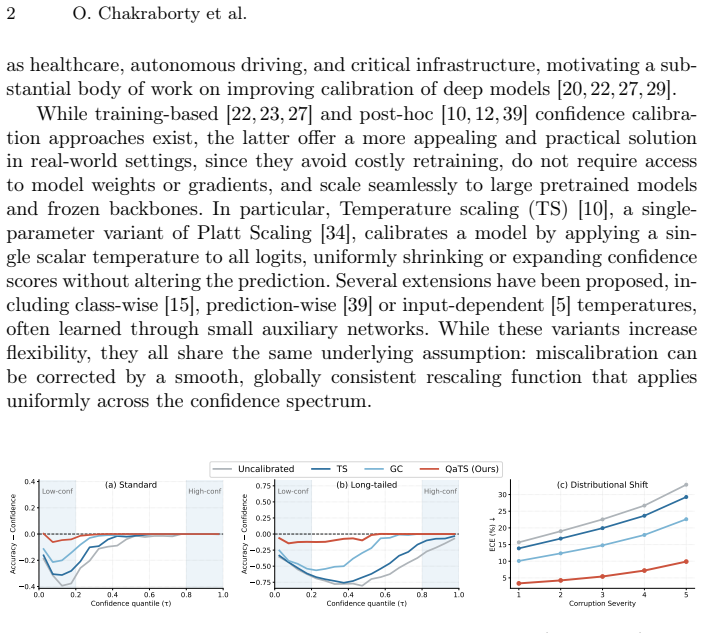
QaTS adapts the temperature as a function of a prediction's empirical confidence quantile by mapping confidences into quantile space, which normalizes the calibration problem, makes the miscalibration structure explicit, and enables a monotone temperature function that adapts across quantiles while leaving well-calibrated high-confidence predictions largely unchanged, yielding a sample-wise temperature robust across class imbalance and distributional shifts.
What carries the argument
Quantile Adaptive Temperature Scaling (QaTS): mapping each prediction's confidence to its empirical quantile rank so a single monotone temperature function can correct varying miscalibration.
If this is right
- Produces more reliable confidence estimates than prior post-hoc methods across datasets, architectures, and tasks.
- Handles class imbalance and distributional shift without retraining the model.
- Preserves high-confidence behavior while reducing discrepancies mainly in lower quantiles.
- Aligns directly with a reparameterized ECE objective for optimization.
- Delivers sample-wise temperatures that remain effective without altering the underlying predictions.
Where Pith is reading between the lines
- The quantile mapping might serve as a general preprocessing step for other calibration techniques that assume uniform error structure.
- Similar quantile adaptation could be tested on regression outputs or multi-label settings where confidence heterogeneity also appears.
- If the monotone function proves stable, it could support lightweight online recalibration when new unlabeled data arrives in batches.
- The approach implies that miscalibration is better viewed as a function of rank order than of raw confidence value.
Load-bearing premise
Mapping predictions into empirical confidence quantile space normalizes the miscalibration structure enough for one monotone temperature function to correct heterogeneous discrepancies.
What would settle it
A dataset or task where applying the learned quantile-to-temperature function produces higher ECE than standard temperature scaling or other post-hoc baselines.
Figures

read the original abstract
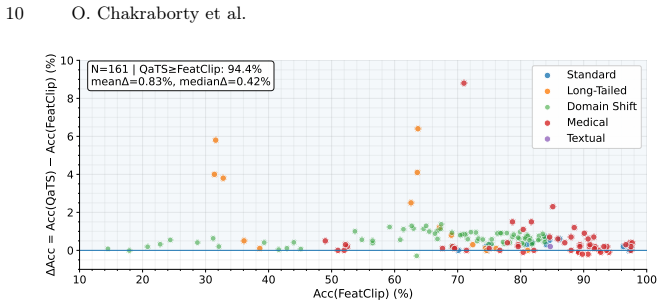
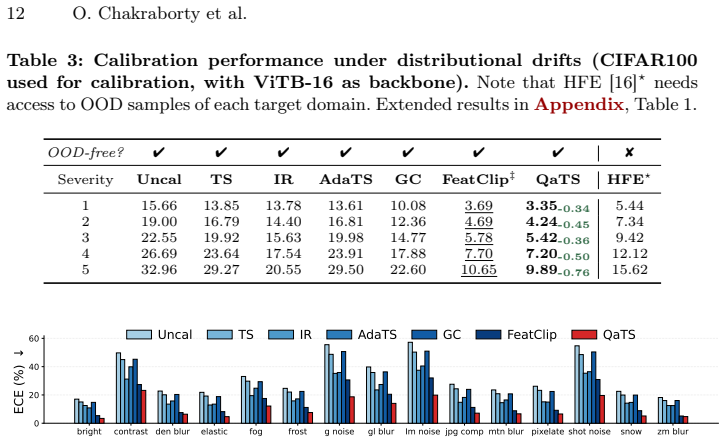
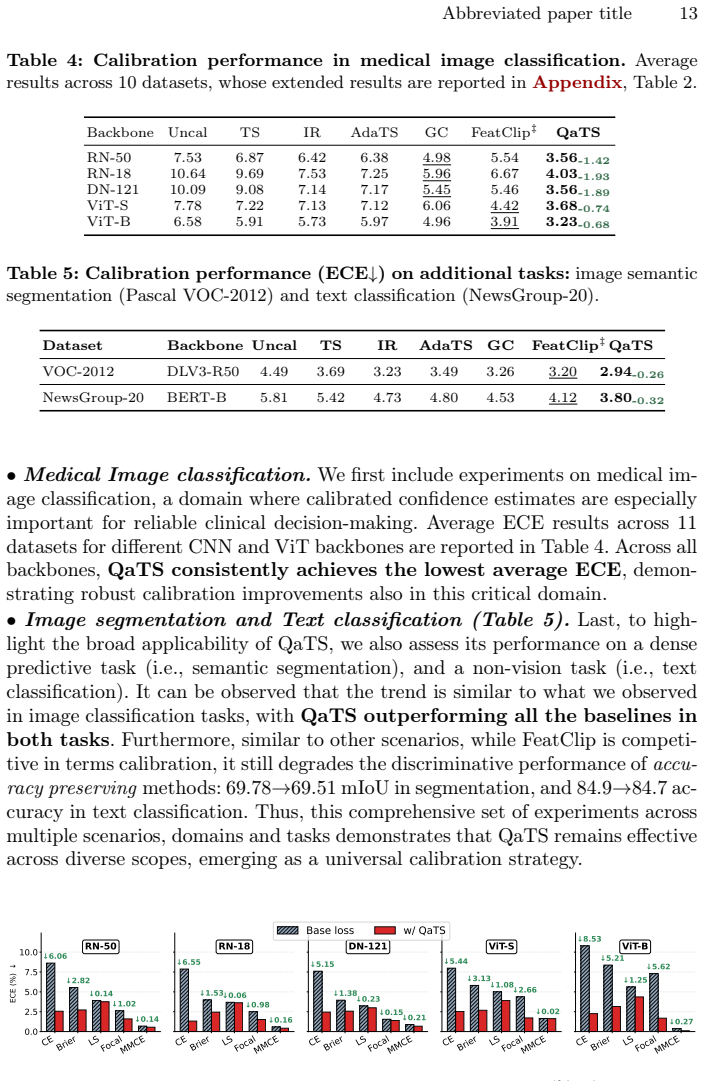
Deep neural networks often produce poorly calibrated confidence estimates, overstating their certainty even when predictions are incorrect. Temperature Scaling remains the most widely used posthoc calibration method due to its simplicity and effectiveness, yet its global, uniform rescaling of logits fails to correct the highly heterogeneous structure of miscalibration observed across the confidence spectrum. In particular, the largest correctness confidence discrepancies arise in different quantile regions depending on the setting, low confidence predictions, where uncertainty matters most, tend to exhibit the largest correctness confidence discrepancies, which standard TS leaves largely unaddressed. We introduce Quantile Adaptive Temperature Scaling (QaTS), a simple and efficient post hoc calibration method that adapts the temperature as a function of a predictions empirical confidence quantile. By mapping confidences into the quantile space, QaTS normalizes the calibration problem, makes the structure of miscalibration explicit and enables a monotone temperature function that adapts across quantiles while leaving well calibrated high confidence predictions largely unchanged. preserving high confidence behavior. This quantile aware formulation aligns naturally with a reparameterized Expected Calibration Error (ECE) objective and yields a sample wise temperature that is robust across a variety of challenging scenarios, such as class imbalance and distributional shifts. Across a broad range of datasets, architectures, evaluation scenarios and diverse tasks, QaTS consistently, and substantially, outperforms state of the art post hoc calibration methods, delivering more reliable and trustworthy confidence estimates without modifying model predictions.
Editorial analysis
A structured set of objections, weighed in public.
Referee Report
Summary. The paper introduces Quantile Adaptive Temperature Scaling (QaTS), a post-hoc calibration method that maps model confidences into empirical quantile space and applies a monotone temperature function adapted to those quantiles. This is motivated by the observation that standard temperature scaling applies a uniform correction and therefore leaves heterogeneous miscalibration—especially in low-confidence regions—uncorrected. The method is presented as aligning naturally with a reparameterized ECE objective and is claimed to deliver consistent, substantial gains over existing post-hoc methods across datasets, architectures, and tasks while leaving high-confidence predictions largely unchanged and without altering the underlying model outputs.
Significance. If the reported gains are reproducible and the experimental controls are adequate, QaTS would constitute a lightweight, practical refinement of temperature scaling that directly targets the quantile-dependent structure of miscalibration. The approach is conceptually coherent and could be useful in settings where calibration quality varies across the confidence spectrum.
major comments (1)
- [Abstract] Abstract: the central claim of consistent and substantial outperformance is asserted without any quantitative results, error bars, dataset names, architecture details, or ablation controls; the soundness of the contribution therefore cannot be evaluated from the provided summary.
minor comments (1)
- [Abstract] The abstract contains a duplicated phrase ('preserving high confidence behavior') that should be removed for clarity.
Simulated Author's Rebuttal
We thank the referee for the constructive review and for recognizing the conceptual coherence and potential utility of QaTS. We address the single major comment below.
read point-by-point responses
-
Referee: [Abstract] Abstract: the central claim of consistent and substantial outperformance is asserted without any quantitative results, error bars, dataset names, architecture details, or ablation controls; the soundness of the contribution therefore cannot be evaluated from the provided summary.
Authors: We agree that the abstract should supply concrete details to support its claims. In the revised manuscript we will expand the abstract to report representative quantitative gains (e.g., average ECE reductions with standard deviations), name the primary datasets and model architectures evaluated, and briefly indicate the range of tasks and evaluation protocols. These additions will be kept concise while preserving the abstract’s readability. revision: yes
Circularity Check
No significant circularity
full rationale
The paper defines QaTS as a direct post-hoc extension of temperature scaling that maps predictions to empirical confidence quantiles and applies a monotone adaptive temperature function, aligned with a reparameterized ECE objective. No derivation chain, equation, or result is shown to reduce by construction to its own inputs; the quantile remapping and temperature adaptation are independently specified design choices, not tautological fits or self-referential definitions. The central performance claims rest on empirical comparisons across datasets rather than internal equivalence, with no load-bearing self-citations or imported uniqueness theorems visible in the text.
Axiom & Free-Parameter Ledger
axioms (2)
- domain assumption Miscalibration structure is heterogeneous across the confidence spectrum and largest discrepancies occur in different quantile regions depending on the setting.
- domain assumption A monotone temperature function of quantile can adapt across regions while leaving well-calibrated high-confidence predictions largely unchanged.
Reference graph
Works this paper leans on
-
[1]
In: NeurIPS (2019),https://arxiv
Cao, K., Wei, C., Gaidon, A., Arechiga, N., Ma, T.: Learning imbalanced datasets with label-distribution-aware margin loss. In: NeurIPS (2019),https://arxiv. org/abs/1906.07413
-
[2]
Rethinking Atrous Convolution for Semantic Image Segmentation
Chen, L.C., Papandreou, G., Schroff, F., Adam, H.: Rethinking atrous convolution for semantic image segmentation. arXiv preprint arXiv:1706.05587 (2017)
work page internal anchor Pith review Pith/arXiv arXiv 2017
-
[3]
In: Proceedings of the IEEE/CVF Conference on Computer Vision and Pattern Recognition (CVPR)
Cheng, J., Vasconcelos, N.: Calibrating deep neural networks by pairwise con- straints. In: Proceedings of the IEEE/CVF Conference on Computer Vision and Pattern Recognition (CVPR). pp. 13709–13718 (2022)
2022
-
[4]
In: Proceedings of the 2019 conference of the North American chapter of the association for computational linguistics: human language technologies, volume 1 (long and short papers)
Devlin, J., Chang, M.W., Lee, K., Toutanova, K.: Bert: Pre-training of deep bidi- rectional transformers for language understanding. In: Proceedings of the 2019 conference of the North American chapter of the association for computational linguistics: human language technologies, volume 1 (long and short papers). pp. 4171–4186 (2019)
2019
-
[5]
In: Proceedings of the IEEE/CVF International Conference on Computer Vision
Ding, Z., Han, X., Liu, P., Niethammer, M.: Local temperature scaling for proba- bility calibration. In: Proceedings of the IEEE/CVF International Conference on Computer Vision. pp. 6889–6899 (2021)
2021
-
[6]
Everingham, M., Eslami, S.A., Van Gool, L., Williams, C.K., Winn, J., Zisserman, A.:Thepascalvisualobjectclasseschallenge:Aretrospective.Internationaljournal of computer vision111(1), 98–136 (2015)
2015
-
[7]
In: 2021 29th European Signal Processing Conference (EUSIPCO)
Frenkel,L.,Goldberger,J.:Networkcalibrationbyclass-basedtemperaturescaling. In: 2021 29th European Signal Processing Conference (EUSIPCO). pp. 1486–1490. IEEE (2021)
2021
-
[8]
Monthly weather review78(1), 1–3 (1950)
Glenn, W.B., et al.: Verification of Forecasts Expressed in Terms of Probability. Monthly weather review78(1), 1–3 (1950)
1950
-
[9]
Gong, Y., Lin, X., Yao, Y., Dietterich, T.G., Divakaran, A., Gervasio, M.: Confi- dencecalibrationfordomaingeneralizationundercovariateshift.In:Proceedingsof the IEEE/CVF international conference on computer vision. pp. 8958–8967 (2021)
2021
-
[10]
In: International conference on machine learning (ICML)
Guo, C., Pleiss, G., Sun, Y., Weinberger, K.Q.: On calibration of modern neural networks. In: International conference on machine learning (ICML). pp. 1321–1330. PMLR (2017)
2017
-
[11]
In: International Conference on Learning Representations (2021)
Gupta, K., Rahimi, A., Ajanthan, T., Mensink, T., Sminchisescu, C., Hartley, R.: Calibration of neural networks using splines. In: International Conference on Learning Representations (2021)
2021
-
[12]
In: Proceedings of the AAAI Conference on Artificial Intelligence
Hekler, A., Brinker, T.J., Buettner, F.: Test time augmentation meets post-hoc calibration: uncertainty quantification under real-world conditions. In: Proceedings of the AAAI Conference on Artificial Intelligence. pp. 14856–14864 (2023)
2023
-
[13]
Proceedings of the International Conference on Learning Representations (2019) 16 O
Hendrycks,D.,Dietterich,T.:Benchmarkingneuralnetworkrobustnesstocommon corruptions and perturbations. Proceedings of the International Conference on Learning Representations (2019) 16 O. Chakraborty et al
2019
-
[14]
In: Proceedings of the AAAI Conference on Artificial Intelligence
Joy, T., Pinto, F., Lim, S.N., Torr, P.H., Dokania, P.K.: Sample-dependent adap- tive temperature scaling for improved calibration. In: Proceedings of the AAAI Conference on Artificial Intelligence. vol. 37, pp. 14919–14926 (2023)
2023
-
[15]
In: International Conference on Machine Learning
Jung, S., Seo, S., Jeong, Y., Choi, J.: Scaling of class-wise training losses for post- hoc calibration. In: International Conference on Machine Learning. pp. 15421– 15434. PMLR (2023)
2023
-
[16]
In: European Conference on Computer Vision
Kim, M., Kwon, J.: Uncertainty calibration with energy based instance-wise scaling in the wild dataset. In: European Conference on Computer Vision. pp. 232–248 (2024)
2024
-
[17]
Master’s thesis, University of Toronto (2009),https://www.cs
Krizhevsky, A., Nair, V., Hinton, G.: Learning Multiple Layers of Features from Tiny Images. Master’s thesis, University of Toronto (2009),https://www.cs. toronto.edu/~kriz/learning-features-2009-TR.pdf
2009
-
[18]
In: International Conference on Machine Learning
Kumar, A., Sarawagi, S., Jain, U.: Trainable Calibration Measures for Neural Net- works from Kernel Mean Embeddings. In: International Conference on Machine Learning. pp. 2805–2814. PMLR (2018)
2018
-
[19]
In: International Conference on Medical Image Computing and Computer-Assisted Intervention (MICCAI) (2023)
Larrazabal, A., Martinez, C., Dolz, J., Ferrante, E.: Maximum Entropy on Er- roneous Predictions (MEEP): Improving model calibration for medical image segmentation. In: International Conference on Medical Image Computing and Computer-Assisted Intervention (MICCAI) (2023)
2023
-
[20]
In: International conference on medical image computing and computer-assisted intervention
Larrazabal, A.J., Martínez, C., Dolz, J., Ferrante, E.: Maximum entropy on erro- neous predictions: Improving model calibration for medical image segmentation. In: International conference on medical image computing and computer-assisted intervention. pp. 273–283. Springer (2023)
2023
-
[21]
In: Proceedings of the IEEE international conference on computer vision (ICCV)
Lin, T.Y., Goyal, P., Girshick, R., He, K., Dollár, P.: Focal Loss for Dense Object Detection. In: Proceedings of the IEEE international conference on computer vision (ICCV). pp. 2980–2988 (2017)
2017
-
[22]
In: Proceedings of the IEEE/CVF Conference on Computer Vision and Pattern Recognition (CVPR)
Liu, B., Ben Ayed, I., Galdran, A., Dolz, J.: The devil is in the margin: Margin- based label smoothing for network calibration. In: Proceedings of the IEEE/CVF Conference on Computer Vision and Pattern Recognition (CVPR). pp. 80–88 (2022)
2022
-
[23]
In: Proceedings of the IEEE/CVF Conference on Computer Vision and Pattern Recognition (CVPR)
Liu, B., Rony, J., Galdran, A., Dolz, J., Ben Ayed, I.: Class adaptive network calibration. In: Proceedings of the IEEE/CVF Conference on Computer Vision and Pattern Recognition (CVPR). pp. 16070–16079 (2023)
2023
-
[24]
In: CVPR (2019)
Liu, Z., Miao, Z., Zhan, X., Wang, J., Gong, B., Yu, S.X.: Large-Scale Long-Tailed Recognition in an Open World. In: CVPR (2019)
2019
-
[25]
Advances in neural information processing systems34, 15682–15694 (2021)
Minderer, M., Djolonga, J., Romijnders, R., Hubis, F., Zhai, X., Houlsby, N., Tran, D., Lucic, M.: Revisiting the calibration of modern neural networks. Advances in neural information processing systems34, 15682–15694 (2021)
2021
-
[26]
uci machine learning repository (1997)
Mitchell, T.: Twenty newsgroups [dataset]. uci machine learning repository (1997)
1997
-
[27]
Advances in Neural Information Processing Systems (NeurIPS)33, 15288–15299 (2020)
Mukhoti, J., Kulharia, V., Sanyal, A., Golodetz, S., Torr, P., Dokania, P.: Cal- ibrating deep neural networks using focal loss. Advances in Neural Information Processing Systems (NeurIPS)33, 15288–15299 (2020)
2020
-
[28]
Müller,R.,Kornblith,S.,Hinton,G.E.:Whendoeslabelsmoothinghelp?Advances in neural information processing systems (NeurIPS)32(2019)
2019
-
[29]
In: International Conference on Medical Image Computing and Computer-Assisted Intervention (MICCAI)
Murugesan, B., Adiga Vasudeva, S., Liu, B., Lombaert, H., Ben Ayed, I., Dolz, J.: Trust your neighbours: Penalty-based constraints for model calibration. In: International Conference on Medical Image Computing and Computer-Assisted Intervention (MICCAI). pp. 572–581 (2023)
2023
-
[30]
In: European Conference on Computer Vision
Murugesan, B., Silva-Rodríguez, J., Ayed, I.B., Dolz, J.: Robust calibration of large vision-language adapters. In: European Conference on Computer Vision. pp. 147–165. Springer (2024) Abbreviated paper title 17
2024
-
[31]
Advances in neural information process- ing systems (NeurIPS)32(2019)
Ovadia, Y., Fertig, E., Ren, J., Nado, Z., Sculley, D., Nowozin, S., Dillon, J., Lak- shminarayanan, B., Snoek, J.: Can you trust your model’s uncertainty? evaluating predictive uncertainty under dataset shift. Advances in neural information process- ing systems (NeurIPS)32(2019)
2019
-
[32]
In: Proceedings of the IEEE/CVF International Conference on Computer Vision (ICCV)
Park, H., Noh, J., Oh, Y., Baek, D., Ham, B.: Acls: Adaptive and conditional label smoothing for network calibration. In: Proceedings of the IEEE/CVF International Conference on Computer Vision (ICCV). pp. 3936–3945 (2023)
2023
-
[33]
In: International Conference on Learning Representations (ICLR) (2017)
Pereyra, G., Tucker, G., Chorowski, J., Kaiser, L., Hinton, G.: Regularizing neural networks by penalizing confident output distributions. In: International Conference on Learning Representations (ICLR) (2017)
2017
-
[34]
Advances in large margin classifiers10(3), 61–74 (1999)
Platt, J., et al.: Probabilistic outputs for support vector machines and comparisons to regularized likelihood methods. Advances in large margin classifiers10(3), 61–74 (1999)
1999
-
[35]
International journal of computer vision115(3), 211–252 (2015)
Russakovsky, O., Deng, J., Su, H., Krause, J., Satheesh, S., Ma, S., Huang, Z., Karpathy, A., Khosla, A., Bernstein, M., et al.: Imagenet Large Scale Visual Recog- nition Challenge. International journal of computer vision115(3), 211–252 (2015)
2015
-
[36]
In: Proceedings of the IEEE conference on computer vision and pattern recognition (CVPR)
Szegedy, C., Vanhoucke, V., Ioffe, S., Shlens, J., Wojna, Z.: Rethinking the incep- tion architecture for computer vision. In: Proceedings of the IEEE conference on computer vision and pattern recognition (CVPR). pp. 2818–2826 (2016)
2016
-
[37]
In: Pro- ceedings of the AAAI Conference on Artificial Intelligence
Tao, L., Dong, M., Xu, C.: Feature clipping for uncertainty calibration. In: Pro- ceedings of the AAAI Conference on Artificial Intelligence. pp. 20841–20849 (2025)
2025
-
[38]
Advances in Neural Information Processing Systems (NeurIPS)32 (2019)
Thulasidasan, S., Chennupati, G., Bilmes, J.A., Bhattacharya, T., Michalak, S.: On mixup training: Improved calibration and predictive uncertainty for deep neu- ral networks. Advances in Neural Information Processing Systems (NeurIPS)32 (2019)
2019
-
[39]
In: European conference on computer vision
Tomani, C., Cremers, D., Buettner, F.: Parameterized temperature scaling for boosting the expressive power in post-hoc uncertainty calibration. In: European conference on computer vision. pp. 555–569 (2022)
2022
-
[40]
In: Proceedings of the IEEE/CVF Conference on Computer Vision and Pattern Recognition
Tomani, C., Gruber, S., Erdem, M.E., Cremers, D., Buettner, F.: Post-hoc uncer- tainty calibration for domain drift scenarios. In: Proceedings of the IEEE/CVF Conference on Computer Vision and Pattern Recognition. pp. 10124–10132 (2021)
2021
-
[41]
Scientific data5(1), 180161 (2018)
Tschandl, P., Rosendahl, C., Kittler, H.: The ham10000 dataset, a large collection of multi-source dermatoscopic images of common pigmented skin lesions. Scientific data5(1), 180161 (2018)
2018
-
[42]
In: International Conference on Machine Learning (ICML)
Wei, H., Xie, R., Cheng, H., Feng, L., An, B., Li, Y.: Mitigating neural network overconfidence with logit normalization. In: International Conference on Machine Learning (ICML). pp. 23631–23644. PMLR (2022)
2022
-
[43]
Advances in Neural Information Processing Systems36, 68511–68538 (2023)
Xiong, M., Deng, A., Koh, P.W.W., Wu, J., Li, S., Xu, J., Hooi, B.: Proximity- informed calibration for deep neural networks. Advances in Neural Information Processing Systems36, 68511–68538 (2023)
2023
-
[44]
Advances in Neural Information Process- ing Systems36, 58448–58460 (2023)
Yang, J.Q., Zhan, D.C., Gan, L.: Beyond probability partitions: Calibrating neural networks with semantic aware grouping. Advances in Neural Information Process- ing Systems36, 58448–58460 (2023)
2023
-
[45]
In: IEEE 18th International Sympo- sium on Biomedical Imaging (ISBI)
Yang, J., Shi, R., Ni, B.: MedMNIST classification decathlon: A lightweight au- toML benchmark for medical image analysis. In: IEEE 18th International Sympo- sium on Biomedical Imaging (ISBI). pp. 191–195 (2021)
2021
-
[46]
Scientific Data10(1), 41 (2023) 18 O
Yang, J., Shi, R., Wei, D., Liu, Z., Zhao, L., Ke, B., Pfister, H., Ni, B.: MedM- NIST v2-A large-scale lightweight benchmark for 2D and 3D biomedical image classification. Scientific Data10(1), 41 (2023) 18 O. Chakraborty et al
2023
-
[47]
Advances in Neural Information Processing Systems35, 27510– 27523 (2022)
Yu, Y., Bates, S., Ma, Y., Jordan, M.: Robust calibration with multi-domain tem- perature scaling. Advances in Neural Information Processing Systems35, 27510– 27523 (2022)
2022
-
[48]
In: International Conference on Machine Learn- ing
Zadrozny, B., Elkan, C.: Obtaining calibrated probability estimates from decision trees and naive bayesian classifiers. In: International Conference on Machine Learn- ing. pp. 625–632 (2001)
2001
-
[49]
In: Proceedings of the eighth ACM SIGKDD international conference on Knowledge discovery and data mining
Zadrozny, B., Elkan, C.: Transforming classifier scores into accurate multiclass probability estimates. In: Proceedings of the eighth ACM SIGKDD international conference on Knowledge discovery and data mining. pp. 694–699 (2002)
2002
-
[50]
In: International conference on machine learning
Zhang, J., Kailkhura, B., Han, T.Y.J.: Mix-n-match: Ensemble and compositional methods for uncertainty calibration in deep learning. In: International conference on machine learning. pp. 11117–11128. PMLR (2020)
2020
-
[51]
In: International Conference on Machine Learning
Zhang, L., Deng, Z., Kawaguchi, K., Zou, J.: When and how mixup improves calibration. In: International Conference on Machine Learning. pp. 26135–26160. PMLR (2022) Quantile-Adaptive Temperature Scaling for Confidence Calibration Supplementary Material Anonymous ECCV submission A Dataset Details We evaluate QaTS across a diverse set of benchmarks covering...
discussion (0)
Sign in with ORCID, Apple, or X to comment. Anyone can read and Pith papers without signing in.