Single-Photon Fourier Transform
Pith reviewed 2026-05-25 03:15 UTC · model grok-4.3
The pith
Retrieving implicit global correlations in sparse single-photon streams enables precise photon classification and extraction of multiple ultra-weak signals.
A machine-rendered reading of the paper's core claim, the machinery that carries it, and where it could break.
Core claim
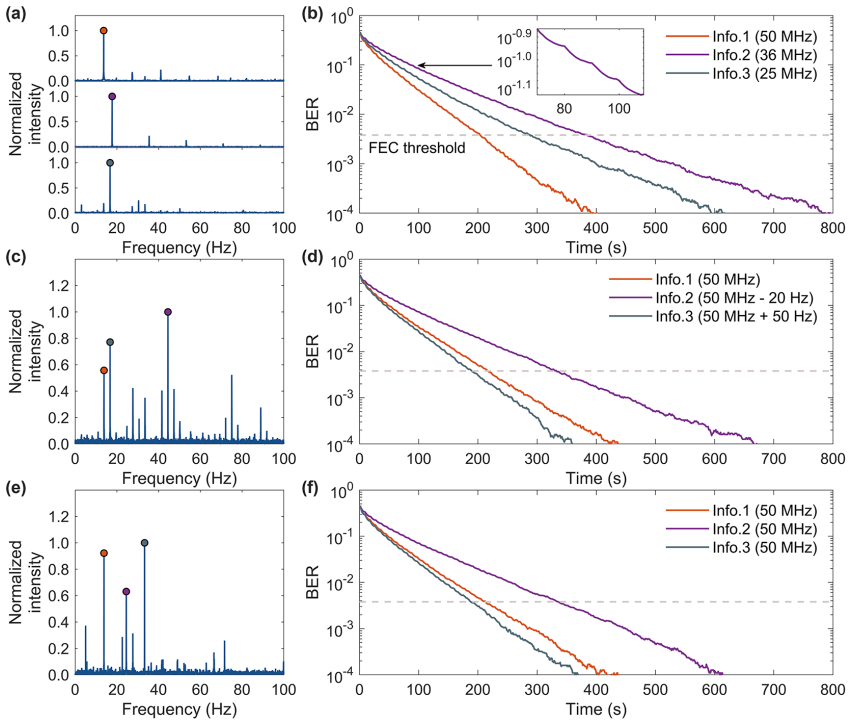
By retrieving the implicit correlation shared in the sparse single-photon stream globally, the scheme precisely classifies each photon and synchronously extracts multiple ultra-weak signals with high fidelity against extreme environments. Experiment results demonstrate multi-terminal expandability, wide frequency adaptability, 125 dB loss tolerance, and -10.4 dB signal-to-noise ratio robustness. Even when all terminals share the same pulse repetition frequency, the method recognizes free-running clock drift and separates distinct messages.
What carries the argument
Global retrieval of implicit correlations across the sparse single-photon stream, used to classify photons and separate signals.
If this is right
- The scheme supports simultaneous operation from multiple terminals.
- It adapts across a wide range of signal frequencies.
- It functions with up to 125 dB of loss.
- It extracts signals at -10.4 dB signal-to-noise ratio.
- It separates messages even when terminals share identical repetition frequencies by detecting clock drift.
Where Pith is reading between the lines
- The demonstrated loss tolerance suggests the method could support long-distance or obstructed links beyond the tested conditions.
- Handling of clock drift implies utility in asynchronous multi-terminal networks where timing is not synchronized in advance.
- The core mechanism may extend the reach of single-photon techniques to additional low-flux tasks such as multi-source imaging.
- The global correlation approach could be tested in other sparse-data domains outside optics to check generality.
Load-bearing premise
An implicit global correlation exists within the sparse single-photon stream and can be retrieved to classify photons and separate signals.
What would settle it
A controlled photon stream generated without the assumed global correlation structure, in which the scheme fails to classify photons or extract the intended signals.
Figures




read the original abstract
The extraction of information carried by light plays an increasingly important role in optical communication, imaging, and detection. However, the information can only be successfully extracted when the light pulse is comparably strong, leaving untouched scenarios where survived photons are extremely sparse. Here, we propose and experimentally demonstrate a single-photon Fourier transform scheme. By retrieving the implicit correlation shared in the sparse singlephoton stream globally, we are able to precisely classify each photon and synchronously extract multiple ultra-weak signals with high fidelity against extreme environments. Our experiment results give a full picture of the scheme in terms of multi-terminal expandability, wide frequency adaptability, 125 dB loss tolerance, and -10.4 dB signal-to-noise ratio robustness. Even when the pulse repetition frequencies of all terminals are the same, we can still recognize the free-running clock drift and separate different messages. Our work can be a general scheme to extend the capability boundary for all the extremely low-light-flux scenarios, and makes many challenging tasks possible, such as in-orbit optical communication network with complex topology, navigation in extremely lossy and noisy environments, and wide-range single-photon imaging with multi-source illumination.
Editorial analysis
A structured set of objections, weighed in public.
Referee Report
Summary. The manuscript proposes and experimentally demonstrates a single-photon Fourier transform scheme. By retrieving the implicit correlation shared in the sparse single-photon stream globally, the scheme classifies each photon and synchronously extracts multiple ultra-weak signals, with claimed experimental performance of multi-terminal expandability, wide frequency adaptability, 125 dB loss tolerance, -10.4 dB SNR robustness, and separation of free-running clock drifts even when pulse repetition frequencies are identical.
Significance. If the central claims hold and the enabling mechanism is validated, the work could extend single-photon techniques to extreme low-light-flux regimes, potentially enabling new capabilities in optical communication networks, navigation under high loss/noise, and multi-source imaging.
major comments (2)
- [Abstract] Abstract: the abstract asserts specific experimental performance metrics including 125 dB loss tolerance and -10.4 dB SNR robustness, but provides no description of the setup, data processing, error analysis, or verification, preventing any assessment of whether the data support the claims.
- [Core mechanism] Core mechanism (throughout): the enabling step of retrieving the implicit global correlation in the sparse single-photon stream to classify photons and perform synchronous extraction is not supplied with any derivation, algorithm, or statistical model, which is load-bearing for all reported performance metrics and the separation of clock drifts.
Simulated Author's Rebuttal
We thank the referee for their thorough review and constructive comments on our manuscript. We address each major comment below with point-by-point responses. We believe the experimental results support the claims, but we agree that additional clarity on the abstract and core mechanism will strengthen the paper.
read point-by-point responses
-
Referee: [Abstract] Abstract: the abstract asserts specific experimental performance metrics including 125 dB loss tolerance and -10.4 dB SNR robustness, but provides no description of the setup, data processing, error analysis, or verification, preventing any assessment of whether the data support the claims.
Authors: We acknowledge that the abstract is necessarily concise and does not detail the experimental setup, data processing, error analysis, or verification methods. These elements are described in the main text (experimental setup in Section II, data processing and correlation retrieval in Section III, error analysis and verification in Section IV and the supplementary material). To improve accessibility, we will revise the abstract to include a brief clause referencing the verification approach and key supporting sections while respecting length limits. This is a presentation issue rather than a flaw in the underlying data. revision: partial
-
Referee: [Core mechanism] Core mechanism (throughout): the enabling step of retrieving the implicit global correlation in the sparse single-photon stream to classify photons and perform synchronous extraction is not supplied with any derivation, algorithm, or statistical model, which is load-bearing for all reported performance metrics and the separation of clock drifts.
Authors: The manuscript outlines the principle of global correlation retrieval for photon classification in the introduction and methods sections, including how it enables synchronous extraction and drift separation even at identical PRFs. However, we agree that an explicit derivation, algorithm pseudocode, and statistical model are not presented with sufficient formality. We will add a dedicated subsection (or appendix) providing the mathematical formulation of the correlation function, the classification algorithm steps, and the underlying statistical model. This addition will directly support the reported metrics and clock-drift separation. revision: yes
Circularity Check
No circularity: experimental results presented without derivation chain reducing to fitted inputs or self-citations
full rationale
The paper is framed as a proposal and experimental demonstration of a single-photon Fourier transform scheme. The abstract states results from experiments (125 dB loss tolerance, -10.4 dB SNR robustness, clock-drift separation) without any equations, fitted parameters, or mathematical derivations that could reduce to inputs by construction. No self-citations, uniqueness theorems, or ansatzes are referenced in the provided text. The central mechanism ('retrieving the implicit correlation shared in the sparse single-photon stream globally') is described as an enabling step but is not derived from prior results within the paper; it is presented as the basis for the experimental classification and extraction. This is a standard experimental claim structure with no load-bearing self-referential fitting or renaming of known results. The derivation chain is therefore self-contained against external benchmarks and receives the default non-finding.
Axiom & Free-Parameter Ledger
Reference graph
Works this paper leans on
-
[1]
Optical fiber communication—An overview,
M. Arumugam, "Optical fiber communication—An overview,"Pramana57, 849–869 (2001)
work page 2001
-
[2]
Survey on free space op- tical communication: A communication theory perspec- tive,
M. A. Khalighi, and M. Uysal, "Survey on free space op- tical communication: A communication theory perspec- tive,"IEEE Communications Surveys & Tutorials16, 2231–2258 (2014)
work page 2014
-
[3]
Optical communication in space: Challenges and mitigation techniques,
H. Kaushal, and G. Kaddoum, "Optical communication in space: Challenges and mitigation techniques,"IEEE Com- munications Surveys & Tutorials19, 57 (2016)
work page 2016
-
[4]
Speckle-free laser imaging using random laser illumination,
B. Redding, M. A. Choma, and H. Cao, "Speckle-free laser imaging using random laser illumination,"Nature Photonics 6, 355–359 (2012)
work page 2012
-
[5]
Optical imaging of strain in two-dimensional crystals,
L. Mennel, M. M. Furchi, S. Wachter, M. Paur, D. K. Polyushkin, and T. Mueller, "Optical imaging of strain in two-dimensional crystals,"Nature Communications9, 1–6 (2018)
work page 2018
-
[6]
Laser ranging: a critical review of unusual techniques for distance measurement,
M. C. Amann, T. M. Bosch, M. Lescure, R. A. Myllylae, and M. Rioux, "Laser ranging: a critical review of unusual techniques for distance measurement,"Optical Engineering 40, 10–19 (2001)
work page 2001
-
[7]
High-speed photon-counting laser ranging for broad range of distances,
B.-C. Du, C.-K. Pang, D. Wu, Z.-H. Li, H. Peng, Y.-L. Tao, E. Wu, and G. Wu, "High-speed photon-counting laser ranging for broad range of distances,"Scientific Reports8, 1–6 (2018)
work page 2018
-
[8]
The lunar laser communications demonstration,
B. S. Robinson, D. M. Boroson, D. A. Burianek, and D. V . Murphy, "The lunar laser communications demonstration," In2011 International Conference on Space Optical Systems and Applications (ICSOS), 54–57 (IEEE, 2011)
work page 2011
-
[9]
J.-N. Shen, J.-L. Wang, X. Chen, C. Zhang, M.-W. Kong, Z.-J. Tong, and J. Xu, "Towards power-efficient long-reach underwater wireless optical communication using a multi- pixel photon counter,"Optics Express26, 23565–23571 (2018)
work page 2018
-
[10]
Q.-Q. Zhang, C.-K. Pang, L. Yang, Z.-H. Li, E. Wu, and G. Wu, "High sensitivity optical communication based on single-photon detection polarized pulse position modula- tion,"Optics Communications490, 126899 (2021)
work page 2021
-
[11]
N. Gisin, and R. Thew, "Quantum communication,"Nature Photonics1, 165–171 (2007)
work page 2007
-
[12]
Towards satellite-based quantum- secure time transfer,
H. Dai, Q. Shen, C.-Z. Wang, S.-L. Li, W.-Y. Liu, W.-Q. Cai, S.-K. Liao, J.-G. Ren, J. Yin, Y.-A. Chen, Q. Zhang, F.-H. Xu, C.-Z. Peng and J.-W. Pan, "Towards satellite-based quantum- secure time transfer,"Nature Physics16, 848–852 (2020)
work page 2020
-
[13]
A. Kirmani, D. Venkatraman, D. Shin, A. Colaço, F. N. Wong, J. H. Shapiro, and V . K. Goyal, "First-photon imaging,"Sci- ence343, 58-61 (2014)
work page 2014
-
[14]
Super-resolution single- photon imaging at 8.2 kilometers,
Z.-P . Li, X. Huang, P .-Y. Jiang, Y. Hong, C. Yu, Y. Cao, J. Zhang, F.-H. Xu, and J.-W. Pan, "Super-resolution single- photon imaging at 8.2 kilometers,"Optics express28, 4076– 4087 (2020)
work page 2020
-
[15]
Deep-space optical communications: Future perspectives and applica- tions,
H. Hemmati, A. Biswas, and I. B. Djordjevic, "Deep-space optical communications: Future perspectives and applica- tions,"Proceedings of the IEEE99, 2020-2039 (2011)
work page 2020
-
[16]
Photon-inter-correlation optical communication,
Z.-Q. Yan, C.-Q. Hu, Z.-M. Li, Z.-Y. Li, H. Zheng, and X.- M. Jin, "Photon-inter-correlation optical communication," arXiv:2104.08913 (2021)
-
[17]
Underwater photon-inter-correlation optical communi- cation,
Z.-Q. Yan, C.-Q. Hu, Z.-M. Li, Z.-Y. Li, H. Zheng, and X.-M. Jin, "Underwater photon-inter-correlation optical communi- cation,"Photonics Research9, 2360–2368 (2021)
work page 2021
-
[18]
C. H. Bennett, and G. Brassard,Proceedings of the IEEE Inter- national Conference on Computers, Systems and Signal Process- ing(IEEE New York, 1984)
work page 1984
-
[19]
K. Tamaki, H.-K. Lo, C. H. F. Fung, and B. Qi, "Phase encod- ing schemes for measurement-device-independent quan- tum key distribution with basis-dependent flaw,"Physical Review A85, 042307 (2012)
work page 2012
-
[20]
Experimental measurement-device-independent quantum key distribution,
Y. Liu, T.-Y. Chen, L.-J. Wang, H. Liang, G.-L. Shentu, J. Wang, K. Cui, H.-L. Yin, N.-L. Liu, L. Li, X.-F. Ma, J. S. Pelc, M. M. Fejer, C.-Z. Peng, Q. Zhang, and J.-W. Pan, "Experimental measurement-device-independent quantum key distribution,"Physical Review Letters111, 130502 (2013)
work page 2013
-
[21]
Overcoming the rate–distance limit of quantum key dis- tribution without quantum repeaters,
M. Lucamarini, Z.-L. Yuan, J. F. Dynes, and A. J. Shields, "Overcoming the rate–distance limit of quantum key dis- tribution without quantum repeaters,"Nature557, 400-403 (2018)
work page 2018
-
[22]
J.-P . Chen, C. Zhang, Y. Liu, C. Jiang, W.-J. Zhang, X.-L. Hu, J.-Y. Guan, Z.-W. Yu, H. Xu, J. Lin, M.-J. Li, H. Chen, H. Li, L.-X You, Z. Wang, X.-B. Wang, Q. Zhang, and J.-W. Pan, "Sending-or-not-sending with independent lasers: Secure twin-field quantum key distribution over 509 km,"Physical Review Letters124, 070501 (2020)
work page 2020
-
[23]
Experi- mental long-distance decoy-state quantum key distribution based on polarization encoding,
C.-Z. Peng, J. Zhang, D. Yang, W.-B. Gao, H.-X. Ma, H. Yin, H.-P . Zeng, T. Yang, X.-B. Wang, and J.-W. Pan, "Experi- mental long-distance decoy-state quantum key distribution based on polarization encoding,"Physical Review Letters98, 010505 (2007)
work page 2007
-
[24]
Experi- mental demonstration of free-space decoy-state quantum key distribution over 144 km,
T. Schmitt-Manderbach, H. Weier, M. Fürst, R. Ursin, F. Tiefenbacher, T. Scheidl, J. Perdigues, Z. Sodnik, C. Kurt- siefer, J. G. Rarity, A. Zeilinger, and H. Weinfurter, "Experi- mental demonstration of free-space decoy-state quantum key distribution over 144 km,"Physical Review Letters98, 010504 (2007)
work page 2007
-
[25]
Satellite-to- ground quantum key distribution,
S.-K. Liao, W.-Q. Cai, W.-Y. Liu, L. Zhang, Y. Li, J.-G. Ren, J. Yin, Q. Shen, Y. Cao, Z.-P . Li, and others, "Satellite-to- ground quantum key distribution,"Nature549, 43–47 (2017)
work page 2017
-
[26]
K.-j. Wei, W. Li, H. Tan, Y. Li, H. Min, W.-J. Zhang, H. Li, L.- X. You, Z. Wang, X. Jiang, T.-Y. Chen, S.-K. Liao, C.-Z. Peng, F.-H. Xu, and J.-W. Pan, "High-speed measurement-device- independent quantum key distribution with integrated sili- con photonics,"Physical Review X10, 031030 (2020)
work page 2020
-
[27]
Photon-efficient imaging with a single-photon camera,
D. Shin, F.-H. Xu, D. Venkatraman, R. Lussana, F. Villa, F. Zappa, V . K. Goyal, F. N. C. Wong, and J. H. Shapiro, "Photon-efficient imaging with a single-photon camera," Nature Communications7, 1–8 (2016)
work page 2016
-
[28]
Single-photon imaging over 200 km,
Li, Z.-P . et al. "Single-photon imaging over 200 km,"Optica 8, 344–349 (2021)
work page 2021
-
[29]
Thresholded single-photon underwater imaging and detection,
Z.-P . Li, J.-T. Ye, X. Huang, P .-Y. Jiang, Y. Cao, Y. Hong, C. Yu, J. Zhang, Q. Zhang, C.-Z. Peng, F.-H. Xu, and J.-W. Pan, "Thresholded single-photon underwater imaging and detection,"Optics Express29, 28124–28133 (2021)
work page 2021
-
[30]
Single-photon detectors for optical quan- tum information applications,
R. H. Hadfield, "Single-photon detectors for optical quan- tum information applications,"Nature Photonics3, 696–705 (2009)
work page 2009
-
[31]
Advances in InGaAs/InP single-photon detector systems for quantum communication,
J. Zhang, M. A. Itzler, H. Zbinden, and J.-W. Pan, "Advances in InGaAs/InP single-photon detector systems for quantum communication,"Light: Science & Applications4, e286–e286 (2015)
work page 2015
-
[32]
Advances in near-infrared avalanche diode single-photon detectors,
C. Liu, H.-F. Ye, and Y.-L. Shi, "Advances in near-infrared avalanche diode single-photon detectors,"Chip, 100005 (2022)
work page 2022
-
[33]
Effect of frequency offset on cooperative jam- ming cancellation in physical layer security,
W.-B. Guo, H.-Z. Zhao, W.-Z. Ma, C.-X. Li, Z.-Y. Lu, and Y.-X. Tang, "Effect of frequency offset on cooperative jam- ming cancellation in physical layer security," In2018 IEEE Globecom Workshops (GC Wkshps), 1–5 (IEEE, 2018)
work page 2018
-
[34]
Time synchroniza- tion in photon-limited deep space optical communications,
M. S. Bashir, and S. S. Muhammad, "Time synchroniza- tion in photon-limited deep space optical communications," IEEE Transactions on Aerospace and Electronic Systems56, 30– 40 (2019)
work page 2019
-
[35]
Y.-X. Ren, Z. Wang, P .-C. Liao, L. Li, G.-D. Xie, H. Huang, Z. Zhao, Y. Yan, N. Ahmed, A. Willner, and others, "Ex- perimental characterization of a 400 Gbit/s orbital angular momentum multiplexed free-space optical link over 120 m," Optics Letters41, 622–625 (2016)
work page 2016
-
[36]
S.-L. Mei, X.-Y. Liu, W.-L. Zhang, R. Liu, L.-R. Zheng, R.-Q. Guo, and P .-F. Tian, "High-bandwidth white-light system combining a micro-LED with perovskite quantum dots for visible light communication,"ACS Applied Materials & Inter- faces10, 5641–5648 (2018)
work page 2018
-
[37]
Relay-assisted free-space optical communication,
M. Safari, and M. Uysal, "Relay-assisted free-space optical communication,"IEEE Transactions on Wireless Communica- tions7, 5441–5449 (2008)
work page 2008
-
[38]
T. Tolker-Nielsen, and G. Oppenhauser, "In-orbit test re- sult of an operational optical intersatellite link between ARTEMIS and SPOT4, SILEX," InFree-Space Laser Communi- cation Technologies XIV, vol. 4635, 1–15 (SPIE, 2002)
work page 2002
-
[39]
Overview and results of the lunar laser communication demonstration,
D. M. Boroson, B. S. Robinson, D. V . Murphy, D. A. Burianek, F. Khatri, J. M. Kovalik, Z. Sodnik, and D. M. Cornwell, "Overview and results of the lunar laser communication demonstration," InFree-Space Laser Communication and At- mospheric Propagation XXVI, vol. 8971, 89710S (International Society for Optics and Photonics, 2014)
work page 2014
-
[40]
V . W. Chan, "Optical satellite networks,"Journal of Lightwave Technology21, 2811 (2003)
work page 2003
-
[41]
Practical decoy state for quantum key distribution,
X.-F. Ma, B. Qi, Y. Zhao, and H.-K. Lo, "Practical decoy state for quantum key distribution,"Physical Review A72, 012326 (2005)
work page 2005
-
[42]
On the poisson ap- proximation to photon distribution for faint lasers,
Y.-C. Hu, X. Peng, T.-J. Li, and H. Guo, "On the poisson ap- proximation to photon distribution for faint lasers,"Physics Letters A367, 173–176 (2007)
work page 2007
-
[43]
S.-Q. Hu, L. Mi, T.-H. Zhou, and W.-B. Chen, "35.88 atten- uation lengths and 3.32 bits/photon underwater optical wireless communication based on photon-counting receiver with 256-ppm,"Optics Express26, 21685–21699 (2018)
work page 2018
discussion (0)
Sign in with ORCID, Apple, or X to comment. Anyone can read and Pith papers without signing in.