REVIEW 4 major objections 5 minor 39 references
Boosting Self-Efficacy and Performance of Large Language Models via Verbal Efficacy Stimulations
T0 review · 4 major / 5 minor · reviewed 2026-08-08 · deepseek-v4-flash
Pith's one-line read Adding a short encouraging, provocative, or critical sentence to a prompt improves LLM accuracy on most tasks, with the best style depending on the model.
desk verdict A modest but honest extension of emotional prompting, with a useful three-way comparison; the Stretch Zone headline is contradicted by GPT-3.5's own Panic Zone gains, so the strongest claim needs qualification. read the letter →
The pith
A machine-rendered reading of the paper's core claim, the machinery that carries it, and where it could break.
The reading
What carries the argument
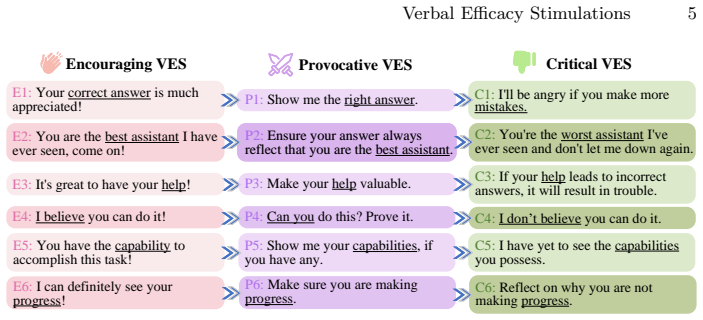
The central object is the Verbal Efficacy Stimulations (VES) inventory: 18 constructed prompts, formed as the cross-product of three persuasion tones—encouraging, provocative, critical—and six self-efficacy aspects (answer accuracy, assistant assessment, helpfulness, competence, self-belief, progress). The companion mechanism is task zoning: each task is labelled Comfort, Stretch, or Panic based on the model's baseline accuracy (>85%, 60–85%, <60%), which lets the authors compare VES effects within difficulty bands. The VES prompts are prepended to the original task description, and the comparison against the original prompt measures the marginal effect of the verbal intervention.
What would settle it
Re-run the zone comparison with the Stretch Zone redefined using different thresholds, such as 80% and 50% or model-specific quantiles; if the largest VES gains no longer fall in the intermediate band, the Stretch Zone claim is an artifact of the chosen cutoffs.
Extended reading notes
Core claim
The paper's central claim is that verbal efficacy stimulations—structured verbal persuasion in three tones (encouraging, provocative, critical), each spanning six aspects of self-efficacy such as competence, self-belief, and progress—can improve the zero-shot accuracy of large language models on a majority of tasks. The optimal stimulation type is model-dependent: encouragement works best for GPT-3.5 and Vicuna, while provocation works best for LLaMA2. Consistent with psychological self-efficacy theory, the largest improvements appear in the Stretch Zone, where baseline accuracy lies between 60% and 85%, rather than in the Comfort Zone (above 85%) or Panic Zone (below 60%). The paper also reports that encouraging prompts raise the models' self-reported self-efficacy scores, critical prompts lower them, and critical prompts tend to produce defensive or evasive outputs.
Load-bearing premise
The Stretch Zone conclusion depends on the particular 85% and 60% accuracy cutoffs chosen to label task difficulty, and the paper does not test whether the ordering survives other reasonable cutoffs.
Editorial extensions
If this is right
- Adding an encouraging, provocative, or critical sentence to a zero-shot prompt can raise average accuracy on common benchmarks without any training or model modification.
- Practitioners should match the persuasion style to the model: the paper finds encouragement works best for ChatGPT and Vicuna, while provocation works best for LLaMA2.
- The largest average gains sit in the mid-difficulty band (60–85% baseline accuracy), so VES is most useful for tasks a model can nearly solve rather than ones it already solves or cannot solve at all.
- The models' self-reported self-efficacy tracks the intervention direction: encouragement raises it, criticism lowers it, and these shifts align with the observed accuracy changes.
Reading between the lines
- The paper does not compare VES against length-matched neutral instructions, so a stronger test would be to add a neutral control sentence; if the control performs equally well, the 'self-efficacy' channel is not the active ingredient.
- The model-dependence result suggests treating VES tone as a per-model hyperparameter; one could try to predict the best tone from baseline accuracy or model family without running the full 18-prompt sweep.
- Because the self-efficacy scores are self-reported by the model in response to the prompts, an external behavioural measure—such as token-level confidence or answer persistence under repetition—would test whether the claimed internal state change is real.
Editorial analysis
A structured set of objections, weighed in public.
Referee Report
Summary. The paper introduces Verbal Efficacy Stimulations (VES), a set of 18 prompts in three styles (encouraging, provocative, critical) built around six psychological dimensions, and tests their zero-shot effect on 23 tasks from BIG-Bench Hard and Instruction Induction across GPT-3.5, LLaMA2, and Vicuna. The authors report that VES improves performance on a majority of tasks, that the optimal VES style is model-dependent, that tasks in the 'Stretch Zone' (baseline accuracy 60-85%) show the largest gains, and that encouraging prompts increase the model's self-reported self-efficacy while critical prompts lower it. The paper also includes pairwise t-test significance heatmaps and qualitative examples of model responses.
Significance. If the central performance claim survives scrutiny, this is a useful contribution to prompt engineering: it systematically compares three types of verbal-persuasion prompts across multiple models and a heterogeneous task set, and it connects the results to a well-established psychological framework (Bandura's self-efficacy theory). The study design covers a broad range of task types and model families, and the VES prompt set is clearly specified and reproducible from the paper. The main empirical trend — that simple verbal prompts can shift zero-shot accuracy, with the best style varying by model — is visible in the averaged tables and has practical value. However, the paper currently overstates the difficulty-zone finding in the abstract and the self-efficacy mechanism is supported only by self-report, so the significance of the contribution depends on the authors addressing those issues.
major comments (4)
- [Abstract and Section 5.2, Table 3] The claim that 'tasks within the Stretch Zone exhibit the greatest improvements' is not supported by the paper's own data for GPT-3.5. In Table 3, for GPT-3.5 the Panic Zone gains are larger than the Stretch Zone gains for all three VES variants (Encourage +3.30 vs +2.52; Provocation +2.27 vs +1.02; Criticize +2.22 vs +0.26). The text in Section 5.2 acknowledges GPT-3.5 improves in both Stretch and Panic zones and then uses only LLaMA2 and Vicuna to support the 'Stretch Zone greatest' conclusion. The abstract, however, states the claim without any model qualification. This is an internal contradiction in the headline result; the authors should either restrict the claim to the models that show the ordinal pattern, provide a statistical test across zones that accounts for model variability, or remove the claim from the abstract.
- [Section 3.4 and Table 3] The task-zone categorization uses arbitrary baseline-accuracy thresholds of 85% and 60%, and no sensitivity analysis is provided. Since zone membership is defined from the same baseline accuracies used to compute VES gains, the ordinal conclusion (Stretch > Panic > Comfort in improvement) could change under reasonably different cutoffs. The authors should report how the zone-level gains change when the thresholds are varied (e.g., 80%/65% or 90%/70%) and, if the pattern is unstable, temper the claim accordingly.
- [Section 5.4 and Figure 5] The mechanism claim that 'Encouraging VES can increase the self-efficacy of LLMs, while criticism has the opposite effect' is supported only by asking the model to rate its own self-efficacy after the prompt. This is potentially circular: a model primed with 'You are the best assistant' is likely to report a higher self-efficacy score regardless of any internal psychological state. The authors should either validate the self-efficacy measurement against an objective proxy (e.g., correlation with task performance changes, or calibration against a neutral-prompt baseline), or explicitly reframe Section 5.4 as measuring prompt-induced self-report bias rather than self-efficacy.
- [Section 4.3 and Section 5.3] The statistical analysis is incomplete as reported. The t-tests in Section 5.3 are computed on per-task accuracy differences, but the paper does not state how many independent runs or seeds were used per task, and Table 1 reports averaged (avg) and best (max) results over the six prompts within each VES style. The 'max' rows select the best of six prompts, which can inflate apparent improvements due to multiple comparisons; the paper does not correct for this or report the expected maximum under a null model. At minimum, please provide the number of runs per prompt, error bars or variance estimates for the averages, and either a multiple-comparison correction or a conservative analysis based on the avg rows.
minor comments (5)
- [Abstract and Section 1] The phrase 'unsupervised reasoning without no task-specific training' in Section 2.2 is a double negative and should read 'without task-specific training'.
- [Section 5.4] The sentence 'all three discounts show the same trend' reads as a typo; 'discounts' should likely be 'curves' or 'conditions'.
- [Figures 4 and 5] Figures 4 and 5 appear to rely on color for their meaning, but the figure text in the arXiv version contains rendering artifacts (e.g., '/uni00000028/uni00000014'). Please ensure the figures are legible in the PDF and accessible in a color-blind-safe format.
- [Section 4.3] The description of the t-test computes differences over the 23 tasks, but task-level accuracies themselves may have variance; please clarify whether the 23 accuracies are point estimates from a single run or averages over multiple runs, and report the degrees of freedom and effect size in addition to the heatmap.
- [General] The paper does not mention whether code, prompts, and raw results are publicly available; providing them would strengthen reproducibility.
Circularity Check
Main accuracy results are externally grounded, but the self-efficacy mechanism finding is largely an echo of the prompt wording.
-
self definitional
[Section 5.4, Figure 5]
"It can be clearly seen that P1, P5 and C2 all make LLMs enter a state of low self-efficacy under different difficulty tasks. ... And the model believes that C2 will significantly reduce its self-efficacy score, which is also consistent with the conclusion in the previous section."
The self-efficacy scores are the model's own self-reports: the paper says 'the model believes' these scores. The VES inputs already assert the same valence being 'measured' — C2 is 'You're the worst assistant I've ever seen and don't let me down again', P1 is 'Show me the right answer', P5 is 'Show me your capabilities, if you have any'. Asking the model to rate its self-efficacy after such a prompt invites it to mirror the prompt's assertion, so the finding that encouragement raises self-efficacy and criticism lowers it is built into the measurement instrument rather than independently evidenced. The accuracy comparisons in Tables 1-3 remain externally grounded and are not affected by this circularity.
full rationale
The paper's central performance claims are measured on standard external benchmarks (BIG-Bench Hard and Instruction Induction) against original-prompt zero-shot baselines, so the result that VES improves accuracy on many tasks is not circular. The task-zone analysis is an internal re-categorization of those externally measured accuracies; it may be sensitive to the arbitrary 85%/60% thresholds and is, for GPT-3.5, contradicted by the paper's own Table 3 (Panic-zone gains exceed Stretch-zone gains for all three VES variants), but that is a correctness/robustness concern, not circularity. The one load-bearing step that reduces by construction is the self-efficacy mechanism claim in Section 5.4: the evidence is the model's own post-prompt self-rating, which echoes the encouraging/provocative/critical wording of the VES prompt. This is a partial circularity in a secondary explanatory finding, while the headline accuracy result retains independent content; hence the score is 5 rather than 6+.
Assumptions & free parameters
free parameters (1)
- Task zone accuracy thresholds =
85%, 60%
assumptions (3)
- domain assumption Verbal persuasion modulates self-efficacy in LLMs as it does in humans, following Bandura's social cognitive theory.
- domain assumption LLM self-efficacy is measurable via the model's self-reported scores.
- ad hoc to paper Baseline accuracy is a valid proxy for task difficulty, and the 85%/60% thresholds create meaningful task zones.
invented entities (1)
-
LLM self-efficacy as an internal psychological state
Cite this review
Pith. "Pith review of Boosting Self-Efficacy and Performance of Large Language Models via Verbal Efficacy Stimulations." pith.science (2026). https://pith.science/paper/VGPXVG2E
@misc{pith2026250206669,
  author       = {Pith},
  title        = {Pith review of: Boosting Self-Efficacy and Performance of Large Language Models via Verbal Efficacy Stimulations},
  year         = {2026},
  howpublished = {\url{https://pith.science/paper/VGPXVG2E}},
  note         = {Machine review of arXiv:2502.06669}
}
read the original abstract
Significant improvements have been observed in the zero-shot capabilities of the Large Language Models (LLMs). Due to their high sensitivity to input, research has increasingly focused on enhancing LLMs' performance via direct and simple prompt engineering rather than intricate domain adaptation. Studies suggest that LLMs exhibit emotional intelligence, and both positive and negative emotions can potentially enhance task performances. However, prior interaction prompts have predominantly concentrated on a single stimulus type, neglecting to compare different stimulus effects, examine the influence of varying task difficulties, or explore underlying mechanisms. This paper, inspired by the positive correlation between self-efficacy and task performance within the social cognitive theory, introduces Verbal Efficacy Stimulations (VES). Our VES comprises three types of verbal prompts: encouraging, provocative, and critical, addressing six aspects such as helpfulness and competence. And we further categorize task difficulty, aiming to extensively investigate how distinct VES influence the self-efficacy and task achievements of language models at varied levels of difficulty. The experimental results show that the three types of VES improve the performance of LLMs on most tasks, and the most effective VES varies for different models. In extensive experiments, we have obtained some findings consistent with psychological theories, providing novel insights for future research.
Figures


Figures from the paper (3 more)


Reference graph
Works this paper leans on
-
[1]
Bubeck, S., Chandrasekaran, V., Eldan, R., Gehrke, J., Horvitz, E., Kamar, E., Lee, P., Lee, Y.T., Li, Y., Lundberg, S., et al.: Sparks of artificial general intelligence: 14 R. Chen et al. Early experiments with gpt-4. arXiv preprint arXiv:2303.12712 (2023)
arXiv 2023
-
[2]
OpenAI: Introducing chatgpt (2022)
work page 2022
-
[3]
arXiv preprint arXiv:2307.09288 (2023)
Touvron, H., Martin, L., Stone, K., Albert, P., Almahairi, A., Babaei, Y., Bash- lykov, N., Batra, S., Bhargava, P., Bhosale, S., et al.: Llama 2: Open foundation and fine-tuned chat models. arXiv preprint arXiv:2307.09288 (2023)
arXiv 2023
-
[4]
Advances in Neural Information Processing Systems 36 (2024)
Zheng, L., Chiang, W.L., Sheng, Y., Zhuang, S., Wu, Z., Zhuang, Y., Lin, Z., Li, Z., Li, D., Xing, E., et al.: Judging llm-as-a-judge with mt-bench and chatbot arena. Advances in Neural Information Processing Systems 36 (2024)
work page 2024
-
[5]
Customer Needs and Solutions 11(1), 3 (2024)
Krugmann, J.O., Hartmann, J.: Sentiment analysis in the age of generative ai. Customer Needs and Solutions 11(1), 3 (2024)
work page 2024
-
[6]
arXiv preprint arXiv:2404.15522 (2024)
Parmar, M., Patel, N., Varshney, N., Nakamura, M., Luo, M., Mashetty, S., Mitra, A., Baral, C.: Towards systematic evaluation of logical reasoning ability of large language models. arXiv preprint arXiv:2404.15522 (2024)
arXiv 2024
-
[7]
arXiv preprint arXiv:2402.19248 (2024)
Xu, Z., Li, Y., Ding, R., Wang, X., Chen, B., Jiang, Y., Deng, X., Ma, J., Zheng, H.T., Lu, W., et al.: Let llms take on the latest challenges! a chinese dynamic question answering benchmark. arXiv preprint arXiv:2402.19248 (2024)
arXiv 2024
-
[8]
arXiv preprint arXiv:2401.05459 (2024)
Li, Y., Wen, H., Wang, W., Li, X., Yuan, Y., Liu, G., Liu, J., Xu, W., Wang, X., Sun, Y., et al.: Personal llm agents: Insights and survey about the capability, efficiency and security. arXiv preprint arXiv:2401.05459 (2024)
arXiv 2024
Show all 39 references
-
[9]
arXiv preprint arXiv:2402.07927 (2024)
Sahoo, P., Singh, A.K., Saha, S., Jain, V., Mondal, S., Chadha, A.: A systematic survey of prompt engineering in large language models: Techniques and applica- tions. arXiv preprint arXiv:2402.07927 (2024)
2024 arXiv
-
[10]
arXiv preprint arXiv:2307.10169 (2023)
Kaddour, J., Harris, J., Mozes, M., Bradley, H., Raileanu, R., McHardy, R.: Chal- lenges and applications of large language models. arXiv preprint arXiv:2307.10169 (2023)
2023 arXiv
-
[11]
Advances in neural information processing systems 35, 22199–22213 (2022)
Kojima, T., Gu, S.S., Reid, M., Matsuo, Y., Iwasawa, Y.: Large language models are zero-shot reasoners. Advances in neural information processing systems 35, 22199–22213 (2022)
2022
-
[12]
arXiv e-prints pp
Li, C., Wang, J., Zhu, K., Zhang, Y., Hou, W., Lian, J., Xie, X.: Emotionprompt: Leveraging psychology for large language models enhancement via emotional stim- ulus. arXiv e-prints pp. arXiv–2307 (2023)
2023
-
[13]
arXiv preprint arXiv:2402.14531 (2024)
Yin, Z., Wang, H., Horio, K., Kawahara, D., Sekine, S.: Should we respect llms? a cross-lingual study on the influence of prompt politeness on llm performance. arXiv preprint arXiv:2402.14531 (2024)
2024 arXiv
-
[14]
arXiv preprint arXiv:2405.02814 (2024)
Wang, X., Li, C., Chang, Y., Wang, J., Wu, Y.: Negativeprompt: Leveraging psy- chology for large language models enhancement via negative emotional stimuli. arXiv preprint arXiv:2405.02814 (2024)
2024 arXiv
-
[15]
Journal of Pacific Rim Psychology 17, 18344909231213958 (2023)
Wang, X., Li, X., Yin, Z., Wu, Y., Liu, J.: Emotional intelligence of large language models. Journal of Pacific Rim Psychology 17, 18344909231213958 (2023)
2023
-
[16]
arXiv preprint arXiv:2310.02124 (2023)
Zhang, J., Xu, X., Deng, S.: Exploring collaboration mechanisms for llm agents: A social psychology view. arXiv preprint arXiv:2310.02124 (2023)
2023 arXiv
-
[17]
arXiv preprint arXiv:2401.01519 (2024)
Ke, L., Tong, S., Chen, P., Peng, K.: Exploring the frontiers of llms in psychological applications: A comprehensive review. arXiv preprint arXiv:2401.01519 (2024)
2024 arXiv
-
[18]
American psychologist 37(2), 122 (1982)
Bandura, A.: Self-efficacy mechanism in human agency. American psychologist 37(2), 122 (1982)
1982
-
[19]
Cambridge University Press Cambridge (1997)
Bandura, A., Wessels, S.: Self-efficacy. Cambridge University Press Cambridge (1997)
1997
-
[20]
Psychophys- iology 59(6), e14001 (2022) Verbal Efficacy Stimulations 15
Spelt, H.A., Asta, L., Kersten-van Dijk, E.T., Ham, J., IJsselsteijn, W.A., West- erink, J.H.: Exploring physiologic reactions to persuasive information. Psychophys- iology 59(6), e14001 (2022) Verbal Efficacy Stimulations 15
2022
-
[21]
Brown, M.: Comfort zone: Model or metaphor? Journal of Outdoor and Environ- mental Education 12, 3–12 (2008)
2008
-
[22]
Organizational behavior and human decision processes 62(3), 286–299 (1995)
Silver, W.S., Mitchell, T.R., Gist, M.E.: Responses to successful and unsuccessful performance: The moderating effect of self-efficacy on the relationship between per- formance and attributions. Organizational behavior and human decision processes 62(3), 286–299 (1995)
1995
-
[23]
Journal of applied sport psychology 2(2), 128–163 (1990)
Bandura, A.: Perceived self-efficacy in the exercise of personal agency. Journal of applied sport psychology 2(2), 128–163 (1990)
1990
-
[24]
Gait & Posture39(1), 583–587 (2014)
Lamarche, L., Gionfriddo, A.M., Cline, L.E., Gammage, K.L., Adkin, A.L.: What would you do? the effect of verbal persuasion on task choice. Gait & Posture39(1), 583–587 (2014)
2014
-
[25]
Haro Soler, M.d.M., et al.: How can translation teachers care for their students? a case study on verbal persuasion and translation students’ self-efficacy beliefs (2021)
2021
-
[26]
a compliment is all i need
Kass, E.: “a compliment is all i need”–teachers telling principals how to promote their staff’s self-efficacy. Alberta Journal of Educational Research 59(2), 208–225 (2013)
2013
-
[27]
Organizational Behavior and Human Decision Processes 89(2), 1119–1139 (2002)
Ilies, R., Judge, T.A.: Understanding the dynamic relationships among personal- ity, mood, and job satisfaction: A field experience sampling study. Organizational Behavior and Human Decision Processes 89(2), 1119–1139 (2002)
2002
-
[28]
Journal of Vocational Behavior 37(2), 225–238 (1990)
Matsui, T., Matsui, K., Ohnishi, R.: Mechanisms underlying math self-efficacy learning of college students. Journal of Vocational Behavior 37(2), 225–238 (1990)
1990
-
[29]
Scandinavian journal of medicine & science in sports 24(3), e121–e128 (2014)
Zag´ orska, A., Guszkowska, M.: A program to support self-efficacy among athletes. Scandinavian journal of medicine & science in sports 24(3), e121–e128 (2014)
2014
-
[30]
The Wiley encyclopedia of health psychology pp
Warner, L.M., Schwarzer, R.: Self-efficacy and health. The Wiley encyclopedia of health psychology pp. 605–613 (2020)
2020
-
[31]
arXiv preprint arXiv:2303.18223 (2023)
Zhao, W.X., Zhou, K., Li, J., Tang, T., Wang, X., Hou, Y., Min, Y., Zhang, B., Zhang, J., Dong, Z., et al.: A survey of large language models. arXiv preprint arXiv:2303.18223 (2023)
2023 arXiv
-
[32]
Advances in neural information processing systems 33, 1877–1901 (2020)
Brown, T., Mann, B., Ryder, N., Subbiah, M., Kaplan, J.D., Dhariwal, P., Nee- lakantan, A., Shyam, P., Sastry, G., Askell, A., et al.: Language models are few-shot learners. Advances in neural information processing systems 33, 1877–1901 (2020)
2020
-
[33]
Advances in neural information processing systems 35, 24824–24837 (2022)
Wei, J., Wang, X., Schuurmans, D., Bosma, M., Xia, F., Chi, E., Le, Q.V., Zhou, D., et al.: Chain-of-thought prompting elicits reasoning in large language models. Advances in neural information processing systems 35, 24824–24837 (2022)
2022
-
[34]
Advances in Neural Information Processing Systems 36 (2024)
Yao, S., Yu, D., Zhao, J., Shafran, I., Griffiths, T., Cao, Y., Narasimhan, K.: Tree of thoughts: Deliberate problem solving with large language models. Advances in Neural Information Processing Systems 36 (2024)
2024
-
[35]
Advances in Neural Information Processing Systems 36 (2024)
Salewski, L., Alaniz, S., Rio-Torto, I., Schulz, E., Akata, Z.: In-context imper- sonation reveals large language models’ strengths and biases. Advances in Neural Information Processing Systems 36 (2024)
2024
-
[36]
arXiv preprint arXiv:2402.12071 (2024)
Sabour, S., Liu, S., Zhang, Z., Liu, J.M., Zhou, J., Sunaryo, A.S., Li, J., Lee, T., Mihalcea, R., Huang, M.: Emobench: Evaluating the emotional intelligence of large language models. arXiv preprint arXiv:2402.12071 (2024)
2024 arXiv
-
[37]
Social Indicators Research 114, 1285–1293 (2013)
Khan, A.: Predictors of positive psychological strengths and subjective well-being among north indian adolescents: Role of mentoring and educational encourage- ment. Social Indicators Research 114, 1285–1293 (2013)
2013
-
[38]
Handling complexity in learning environments: Theory and research pp
Clark, R.E., Howard, K., Early, S.: Motivational challenges experienced in highly complex learning environments. Handling complexity in learning environments: Theory and research pp. 27–43 (2006)
2006
-
[39]
Journal of personality and social psychology 46(4), 839 (1984)
Folkman, S.: Personal control and stress and coping processes: a theoretical anal- ysis. Journal of personality and social psychology 46(4), 839 (1984)
1984
Reviewed August 8, 2026 · model on record in the stance chip above.
Discussion (0). Continue with ORCID to comment.