Investigating black hole accretion and feedback self-regulation in Seyfert galaxies using the FIRE-3 cosmological hydrodynamic simulations
Pith reviewed 2026-06-25 23:39 UTC · model grok-4.3
The pith
Simulations reproduce Seyfert galaxy diversity but miss observed anti-correlation between AGN luminosity and nuclear gas concentration.
A machine-rendered reading of the paper's core claim, the machinery that carries it, and where it could break.
Core claim
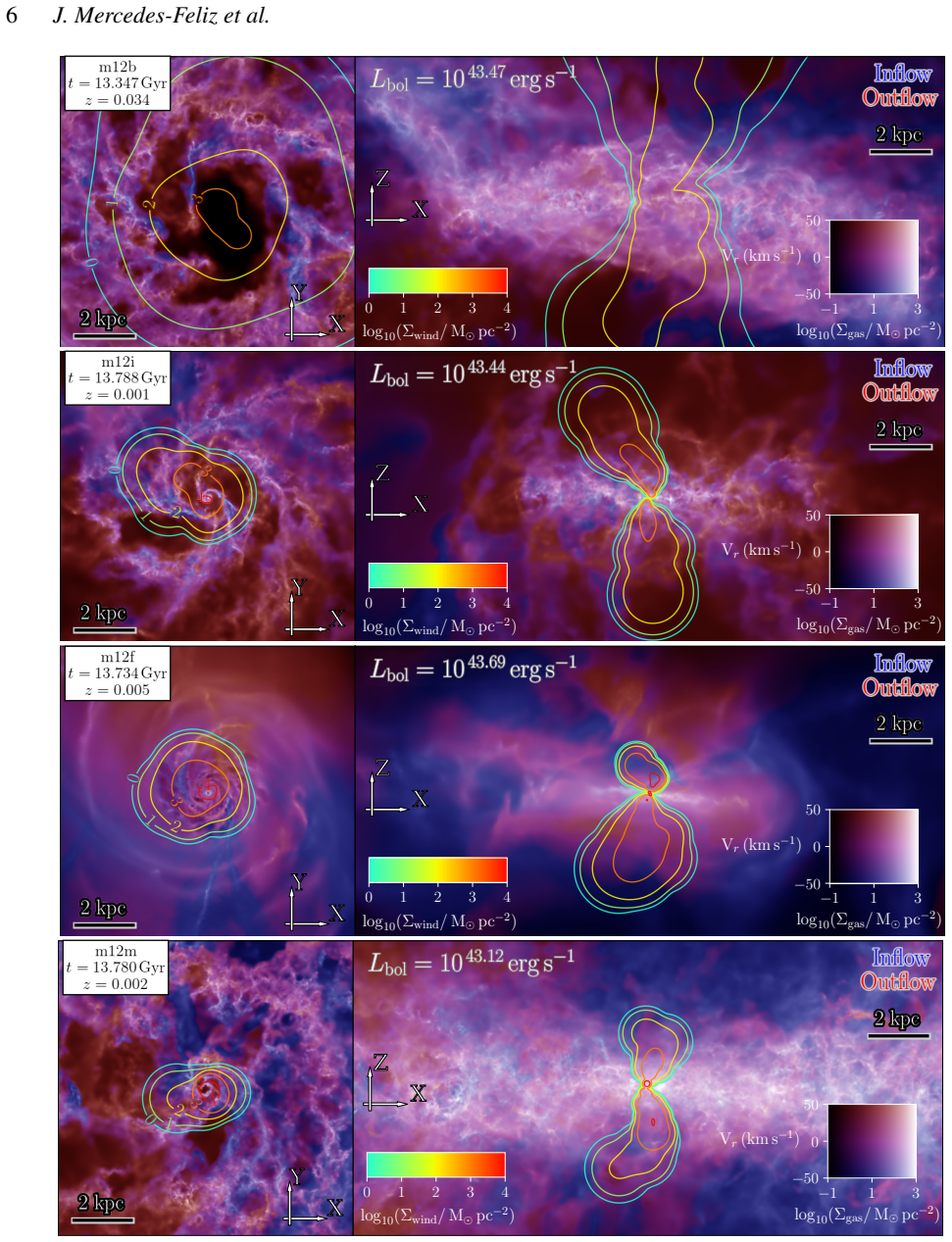
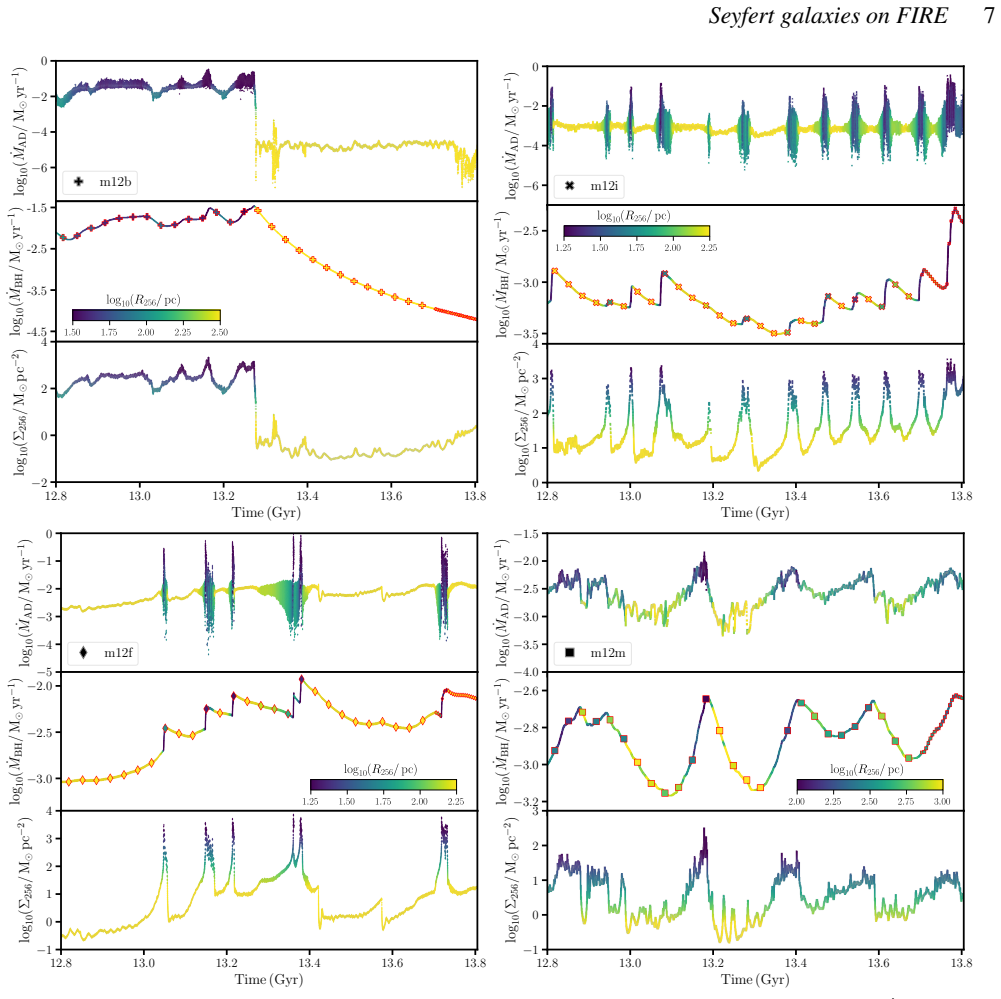
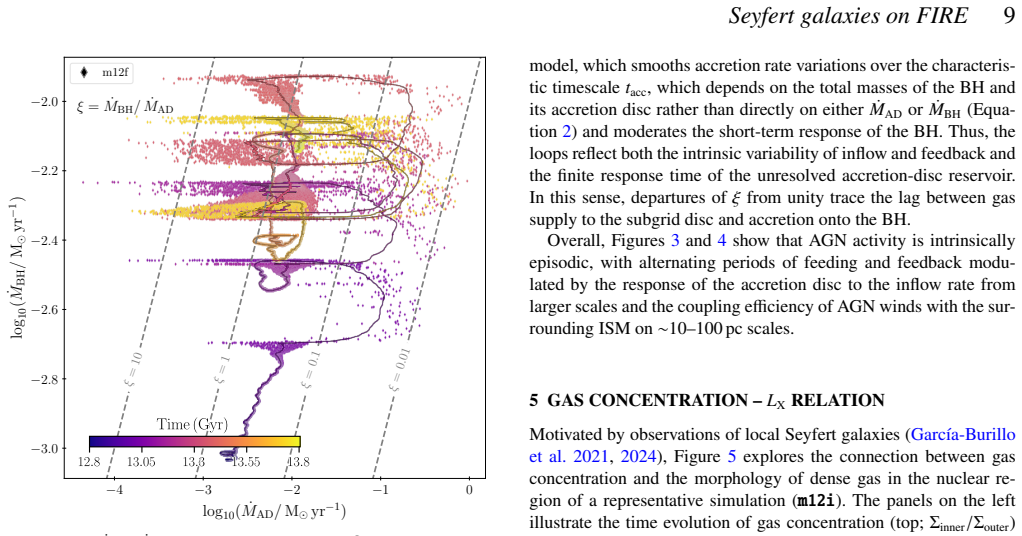
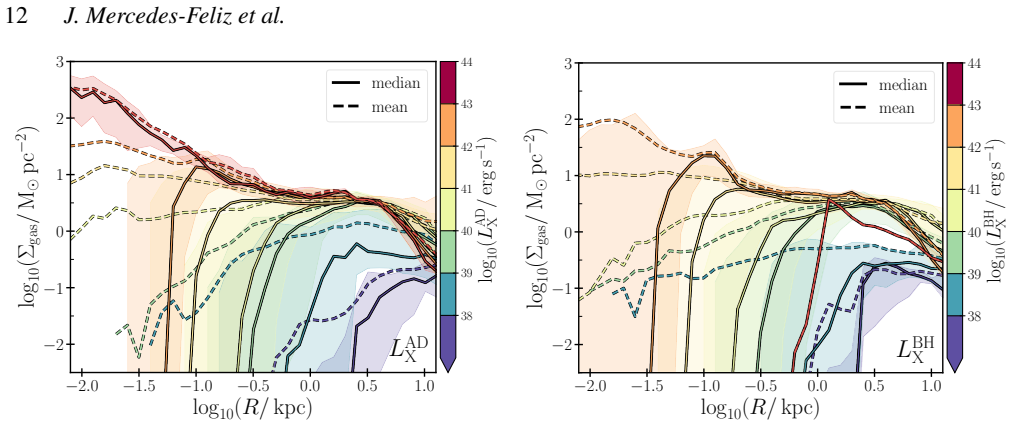
Focusing on the late-time evolution of four Milky Way-mass galaxies, the simulations show recurrent cycles of increased gas inflow toward the accretion disc, enhanced BH accretion, feedback self-regulation, and suppressed gas inflow rate until the next fueling event. AGN winds interact with the ISM and escape preferentially through low-density polar channels after opening central cavities on ~10-500pc scales, regulating BH growth and producing episodic behaviour on ~10-100Myr timescales. The simulations reproduce the observed diversity of nuclear morphologies, gas concentrations, and AGN luminosities in late-type Seyfert galaxies, but do not exhibit a clear anti-correlation between gas conce
What carries the argument
Recurrent cycles of gas inflow, black hole accretion, and AGN feedback self-regulation through polar wind channels and central cavity formation on 10-500 pc scales.
If this is right
- AGN feedback produces episodic behavior on 10-100 Myr timescales.
- Higher luminosity AGN are more common in galaxies with centrally-peaked gas distributions.
- Feedback-driven cavities allow coexistence of high AGN luminosity with gas reservoirs.
- The timing of gas inflow, accretion-disk depletion, and feedback-driven clearing is a key constraint on self-regulation models.
Where Pith is reading between the lines
- Improved resolution of accretion disk physics could change the timing and produce the missing anti-correlation.
- Future observations with matched spatial resolution and tracer selection can test if the simulated lack of anti-correlation is due to model limitations or observational effects.
- AGN self-regulation in these galaxies may be more episodic than steady models assume.
Load-bearing premise
Differences in sample selection, tracer choice, spatial resolution, and stochasticity in AGN fueling can fully account for the tension with observations rather than a shortcoming in the timing of gas inflow, accretion-disk depletion, and feedback-driven clearing on 50-200 pc scales.
What would settle it
Finding a clear anti-correlation between gas concentration on 50-200 pc scales and AGN luminosity in observations that closely match the simulation sample selection and resolution would falsify the simulation results if the tension persists.
Figures





read the original abstract
Recent observations of local Seyfert galaxies show an intriguing connection between Active Galactic Nuclei (AGN) luminosity and a deficit of molecular gas on ~50pc scales compared to 200pc, the plausible imprint of AGN feedback. Motivated by these findings, we investigate the interplay between supermassive black hole (BH) accretion, AGN feedback, and nuclear gas reservoirs using high-resolution cosmological hydrodynamic simulations implementing FIRE-3 multi-phase interstellar medium (ISM) physics and multi-component BH accretion and feedback models. Focusing on the late-time evolution of four Milky Way-mass galaxies, we find recurrent cycles of increased gas inflow toward the accretion disc, enhanced BH accretion, feedback self-regulation, and suppressed gas inflow rate until the next fueling event. AGN winds interact with the ISM and escape preferentially through low-density polar channels after opening central cavities on ~10-500pc scales, regulating BH growth and producing episodic behaviour on ~10-100Myr timescales. The simulations reproduce the observed diversity of nuclear morphologies, gas concentrations, and AGN luminosities in late-type Seyfert galaxies, but do not exhibit a clear anti-correlation between gas concentration and AGN luminosity. Higher-luminosity AGN ($L_X$~$10^{41.5-43}$ erg s$^{-1}$) powered by the accretion disc reservoir can coexist with feedback-driven cavities, consistent with observations, but they are more common in simulated galaxies with centrally-peaked gas distributions. Although differences in sample selection, tracer choice, spatial resolution, and stochasticity in AGN fueling may impact underlying concentration-luminosity trends, the apparent tension between simulations and observations points to the timing between gas inflow, accretion-disc depletion, and feedback-driven clearing on ~50-200pc scales as a key constraint on AGN self-regulation models.
Editorial analysis
A structured set of objections, weighed in public.
Referee Report
Summary. The paper presents FIRE-3 cosmological hydrodynamic simulations of four Milky Way-mass galaxies to investigate supermassive black hole accretion, AGN feedback, and nuclear gas reservoirs in Seyfert galaxies. It reports recurrent 10-100 Myr cycles of gas inflow, enhanced accretion, feedback self-regulation via polar winds that open cavities on 10-500 pc scales, and episodic suppression of inflow. The simulations reproduce observed diversity in nuclear morphologies, gas concentrations, and AGN luminosities but find no clear anti-correlation between gas concentration (50-200 pc) and AGN luminosity; the authors interpret the tension with observations as arising from the timing of inflow, disk depletion, and feedback clearing, while noting possible effects from sample selection, tracers, resolution, and stochasticity.
Significance. If the reported absence of anti-correlation and the identification of timing as a key constraint hold under broader sampling, the work would provide a useful forward-modeling benchmark for AGN self-regulation in multi-phase ISM simulations, clarifying how polar escape channels and episodic behavior shape nuclear gas distributions in late-type galaxies and offering a concrete target for refining accretion-disk and feedback prescriptions.
major comments (2)
- [Abstract] Abstract: The central claim of no clear anti-correlation between gas concentration and AGN luminosity, and the inference that timing on 50-200 pc scales is the key missing ingredient, rests on late-time snapshots from exactly four galaxies. Given the text's emphasis on recurrent stochastic fueling cycles, this sample size precludes separating model behavior from realization variance and undermines the robustness of attributing the tension to timing rather than undersampling.
- [Abstract] Abstract: No quantitative error bars on the reported diversity reproduction, no convergence tests, and no direct statistical comparison (e.g., Spearman rank or binned means with uncertainties) to the observational Seyfert sample are provided, preventing a rigorous assessment of whether the simulated lack of anti-correlation is statistically distinguishable from the observed trend.
minor comments (1)
- [Abstract] Abstract: The luminosity range notation "L_X~$10^{41.5-43}$" should be written explicitly as 10^{41.5} to 10^{43} erg s^{-1} for clarity.
Simulated Author's Rebuttal
We thank the referee for the constructive comments on our manuscript. We address each major comment point by point below, indicating planned revisions where appropriate.
read point-by-point responses
-
Referee: [Abstract] Abstract: The central claim of no clear anti-correlation between gas concentration and AGN luminosity, and the inference that timing on 50-200 pc scales is the key missing ingredient, rests on late-time snapshots from exactly four galaxies. Given the text's emphasis on recurrent stochastic fueling cycles, this sample size precludes separating model behavior from realization variance and undermines the robustness of attributing the tension to timing rather than undersampling.
Authors: We agree that the sample of four galaxies limits the ability to fully separate stochastic realization variance from systematic model behavior, particularly given the recurrent fueling cycles. The lack of anti-correlation and the timing interpretation are based on consistent patterns across all four galaxies, but we acknowledge this does not constitute a statistically robust separation. In the revised manuscript we will expand the abstract and discussion to explicitly qualify the sample-size limitation, state that the timing hypothesis is suggestive based on the available realizations, and note that larger samples will be required in future work to confirm the result. revision: partial
-
Referee: [Abstract] Abstract: No quantitative error bars on the reported diversity reproduction, no convergence tests, and no direct statistical comparison (e.g., Spearman rank or binned means with uncertainties) to the observational Seyfert sample are provided, preventing a rigorous assessment of whether the simulated lack of anti-correlation is statistically distinguishable from the observed trend.
Authors: We acknowledge that the current version describes diversity qualitatively without formal error bars, convergence tests, or statistical comparisons. In revision we will add uncertainties on the measured gas concentrations and AGN luminosities from the simulation snapshots and compute a Spearman rank correlation for the simulated points to enable direct comparison with the observational trend. We will also add a short discussion of resolution effects drawing on existing FIRE-3 convergence studies, while noting that dedicated higher-resolution runs for these specific galaxies are not feasible within the present computational allocation. These changes will allow a clearer statistical assessment of the simulated versus observed trends. revision: partial
Circularity Check
No significant circularity in forward-modeling simulation results
full rationale
The paper runs fixed FIRE-3 prescriptions on four Milky Way-mass galaxies and reports emergent outcomes (recurrent cycles, diversity of morphologies, absence of clear gas-concentration vs. AGN-luminosity anti-correlation). No parameters are fitted to the target observations, no equations reduce a claimed prediction to its inputs by construction, and no self-citation chain supplies a uniqueness theorem that forces the central result. The comparison to observations and qualitative interpretation of tension are post-simulation and do not alter the independence of the simulation outputs from the input physics.
Axiom & Free-Parameter Ledger
axioms (2)
- domain assumption Hydrodynamic equations and multi-phase ISM cooling/heating rates as implemented in FIRE-3
- domain assumption Multi-component black hole accretion and feedback model accurately captures real nuclear gas dynamics on 10-500 pc scales
Reference graph
Works this paper leans on
-
[1]
X-Ray Cavities in a Sample of 83 SPT-selected Clusters of Galaxies: Tracing the Evolution of AGN Feedback in Clusters of Galaxies out to z=1.2. , keywords =. doi:10.1088/0004-637X/805/1/35 , archivePrefix =. 1410.0025 , primaryClass =
work page internal anchor Pith review Pith/arXiv arXiv doi:10.1088/0004-637x/805/1/35
-
[2]
Cosmological baryon spread and impact on matter clustering in CAMELS. , keywords =. doi:10.1093/mnras/stae817 , archivePrefix =. 2307.11832 , primaryClass =
-
[3]
Exploring the effects of galaxy formation on matter clustering through a library of simulation power spectra. , keywords =. doi:10.1093/mnras/stz3199 , archivePrefix =. 1906.00968 , primaryClass =
-
[4]
Cosmological back-reaction of baryons on dark matter in the CAMELS simulations. , keywords =. doi:10.1093/mnras/stag525 , archivePrefix =. 2601.06258 , primaryClass =
-
[5]
Hydrodynamical Simulations of the Galaxy Population: Enduring Successes and Outstanding Challenges. , keywords =. doi:10.1146/annurev-astro-041923-043618 , archivePrefix =. 2309.17075 , primaryClass =
-
[6]
X-Raying CAMELS: Constraining Baryonic Feedback in the Circumgalactic Medium with the CAMELS Simulations and eRASS X-Ray Observations. , keywords =. doi:10.3847/1538-4357/adc450 , archivePrefix =. 2412.04559 , primaryClass =
-
[7]
EAGLE and Illustris-TNG Predictions for Resolved eROSITA X-Ray Observations of the Circumgalactic Medium around Normal Galaxies. , keywords =. doi:10.3847/2041-8213/ab846f , archivePrefix =. 2003.13889 , primaryClass =
-
[8]
Toward a Comprehensive Fueling-controlled Theory of the Growth of Massive Black Holes and Host Spheroids. , keywords =. doi:10.1086/523092 , archivePrefix =. 0705.4457 , primaryClass =
work page internal anchor Pith review Pith/arXiv arXiv doi:10.1086/523092
-
[9]
Dynamical delays between starburst and AGN activity in galaxy nuclei. , keywords =. doi:10.1111/j.1745-3933.2011.01179.x , archivePrefix =. 1101.4230 , primaryClass =
-
[10]
Probing the co-evolution of Supermassive Black Holes and their hosts from scaling relations pairwise residuals: dominance of stellar velocity dispersion and host halo mass. , keywords =. doi:10.1093/mnras/staf747 , archivePrefix =. 2505.02920 , primaryClass =
-
[11]
How Mergers May Affect the Mass Scaling Relation between Gravitationally Bound Systems. , keywords =. doi:10.1086/522774 , archivePrefix =. 0704.1860 , primaryClass =
work page internal anchor Pith review Pith/arXiv arXiv doi:10.1086/522774
-
[12]
On the evolution of the intrinsic scatter in black hole versus galaxy mass relations. , keywords =. doi:10.1111/j.1365-2966.2010.17006.x , archivePrefix =. 1005.2100 , primaryClass =
-
[13]
The non-causal origin of the black hole-galaxy scaling relations
The Non-causal Origin of the Black-hole-galaxy Scaling Relations. , keywords =. doi:10.1088/0004-637X/734/2/92 , archivePrefix =. 1006.0482 , primaryClass =
work page internal anchor Pith review Pith/arXiv arXiv doi:10.1088/0004-637x/734/2/92
-
[14]
Star Clusters Near and Far; Tracing Star Formation Across Cosmic Time. , keywords =. doi:10.1007/s11214-020-00690-x , archivePrefix =. 2005.06188 , primaryClass =
-
[15]
What drives the growth of black holes: A decade of progress. , keywords =. doi:10.1016/j.newar.2025.101733 , archivePrefix =. 2506.19166 , primaryClass =
-
[16]
The impact of bars and interactions on optically selected AGNs in spiral galaxies
The impact of bars and interactions on optically selected AGNs in spiral galaxies. , keywords =. doi:10.1051/0004-6361/201832796 , archivePrefix =. 1808.05536 , primaryClass =
work page internal anchor Pith review Pith/arXiv arXiv doi:10.1051/0004-6361/201832796
-
[17]
Resolving the nuclear obscuring disk in the Compton-thick Seyfert galaxy NGC5643 with ALMA
Resolving the Nuclear Obscuring Disk in the Compton-thick Seyfert Galaxy NGC 5643 with ALMA. , keywords =. doi:10.3847/1538-4357/aabe30 , archivePrefix =. 1804.04842 , primaryClass =
work page internal anchor Pith review Pith/arXiv arXiv doi:10.3847/1538-4357/aabe30
-
[18]
Nuclear molecular outflow in the Seyfert galaxy NGC 3227. , keywords =. doi:10.1051/0004-6361/201935431 , archivePrefix =. 1906.06889 , primaryClass =
-
[19]
The Galaxy Activity, Torus, and Outflow Survey (GATOS). II. Torus and polar dust emission in nearby Seyfert galaxies. , keywords =. doi:10.1051/0004-6361/202141219 , archivePrefix =. 2107.00244 , primaryClass =
-
[20]
AGN feedback in action in the molecular gas ring of the Seyfert galaxy NGC 7172. , keywords =. doi:10.1051/0004-6361/202346074 , archivePrefix =. 2305.15143 , primaryClass =
-
[21]
The Impact of Low-luminosity AGNs on Their Host Galaxies: A Radio and Optical Investigation of the Kiloparsec-scale Outflow in MaNGA 1-166919. , keywords =. doi:10.3847/1538-4357/abf5e1 , archivePrefix =. 2105.07335 , primaryClass =
-
[22]
Suppression of Star Formation in NGC 1266
Suppression of Star Formation in NGC 1266. , keywords =. doi:10.1088/0004-637X/798/1/31 , archivePrefix =. 1410.4556 , primaryClass =
work page internal anchor Pith review Pith/arXiv arXiv doi:10.1088/0004-637x/798/1/31
-
[23]
What Drives the Growth of Black Holes?
What drives the growth of black holes?. , keywords =. doi:10.1016/j.newar.2011.11.003 , archivePrefix =. 1112.1949 , primaryClass =
work page internal anchor Pith review Pith/arXiv arXiv doi:10.1016/j.newar.2011.11.003 2011
-
[24]
Black Hole-Galaxy Correlations without Self-Regulation
Black Hole-Galaxy Correlations without Self-regulation. , keywords =. doi:10.1088/0004-637X/770/1/5 , archivePrefix =. 1303.5058 , primaryClass =
work page internal anchor Pith review Pith/arXiv arXiv doi:10.1088/0004-637x/770/1/5
-
[25]
Cosmological Zoom Simulations of z = 2 Galaxies: The Impact of Galactic Outflows
Cosmological Zoom Simulations of z = 2 Galaxies: The Impact of Galactic Outflows. , keywords =. doi:10.1088/0004-637X/782/2/84 , archivePrefix =. 1303.6959 , primaryClass =
work page internal anchor Pith review Pith/arXiv arXiv doi:10.1088/0004-637x/782/2/84
-
[26]
Torque-Limited Growth of Massive Black Holes in Galaxies Across Cosmic Time
Torque-limited Growth of Massive Black Holes in Galaxies across Cosmic Time. , keywords =. doi:10.1088/0004-637X/800/2/127 , archivePrefix =. 1309.5963 , primaryClass =
work page internal anchor Pith review Pith/arXiv arXiv doi:10.1088/0004-637x/800/2/127
-
[27]
The Cosmic Baryon Cycle and Galaxy Mass Assembly in the FIRE Simulations
The cosmic baryon cycle and galaxy mass assembly in the FIRE simulations. , keywords =. doi:10.1093/mnras/stx1517 , archivePrefix =. 1610.08523 , primaryClass =
work page internal anchor Pith review Pith/arXiv arXiv doi:10.1093/mnras/stx1517
-
[28]
Black Holes on FIRE: Stellar Feedback Limits Early Feeding of Galactic Nuclei
Black holes on FIRE: stellar feedback limits early feeding of galactic nuclei. , keywords =. doi:10.1093/mnrasl/slx161 , archivePrefix =. 1707.03832 , primaryClass =
work page internal anchor Pith review Pith/arXiv arXiv doi:10.1093/mnrasl/slx161
-
[29]
Gravitational torque-driven black hole growth and feedback in cosmological simulations
Gravitational torque-driven black hole growth and feedback in cosmological simulations. , keywords =. doi:10.1093/mnras/stw2565 , archivePrefix =. 1603.08007 , primaryClass =
work page internal anchor Pith review Pith/arXiv arXiv doi:10.1093/mnras/stw2565
-
[30]
arXiv e-prints , keywords =
Cosmological simulations of quasar fueling to sub-parsec scales using Lagrangian hyper-refinement. arXiv e-prints , keywords =
-
[31]
Cosmological Simulations of Quasar Fueling to Subparsec Scales Using Lagrangian Hyper-refinement. , keywords =. doi:10.3847/1538-4357/ac09e8 , archivePrefix =. 2008.12303 , primaryClass =
-
[32]
, keywords =
in prep. , keywords =. doi:, archivePrefix =. , primaryClass =
-
[33]
Bar Formation and Destruction in the FIRE-2 Simulations. , keywords =. doi:10.3847/1538-4357/ad8b45 , archivePrefix =. 2309.16811 , primaryClass =
-
[34]
Ionized gas outflows and global kinematics of low-z luminous star forming galaxies
Ionized gas outflows and global kinematics of low-z luminous star-forming galaxies. , keywords =. doi:10.1051/0004-6361/201323324 , archivePrefix =. 1404.1082 , primaryClass =
work page internal anchor Pith review Pith/arXiv arXiv doi:10.1051/0004-6361/201323324
-
[35]
Ultrafaint Dwarfs in a Milky Way Context: Introducing the Mint Condition DC Justice League Simulations. , keywords =. doi:10.3847/1538-4357/abcafa , archivePrefix =. 2008.11207 , primaryClass =
-
[36]
Half of the Most Luminous Quasars May Be Obscured: Investigating the Nature of WISE-Selected Hot Dust-Obscured Galaxies. , keywords =. doi:10.1088/0004-637X/804/1/27 , archivePrefix =. 1408.1092 , primaryClass =
work page internal anchor Pith review Pith/arXiv arXiv doi:10.1088/0004-637x/804/1/27
-
[37]
ALMA captures feeding and feedback from the active galactic nucleus in NGC 613. , keywords =. doi:10.1051/0004-6361/201935845 , archivePrefix =. 1905.01979 , primaryClass =
-
[38]
Black hole feeding and star formation in NGC 1808. , keywords =. doi:10.1051/0004-6361/202039886 , archivePrefix =. 2011.09133 , primaryClass =
-
[39]
Jet-induced molecular gas excitation and turbulence in the Teacup. , keywords =. doi:10.1051/0004-6361/202345964 , archivePrefix =. 2302.13884 , primaryClass =
-
[40]
The DIANOGA simulations of galaxy clusters: characterising star formation in protoclusters. , keywords =. doi:10.1051/0004-6361/202038396 , archivePrefix =. 2006.13951 , primaryClass =
-
[41]
The inefficiency of stellar feedback in driving galactic outflows in massive galaxies at high redshift. , keywords =. doi:10.1093/mnras/stad2617 , archivePrefix =. 2211.08423 , primaryClass =
-
[42]
Digging deeper into NGC 6868 I: Stellar population. , keywords =. doi:10.1093/mnras/stad1148 , archivePrefix =. 2304.11194 , primaryClass =
-
[43]
A Local Baseline of the Black Hole Mass Scaling Relations for Active Galaxies. I. Methodology and Results of Pilot Study. , keywords =. doi:10.1088/0004-637X/726/2/59 , archivePrefix =. 1008.4602 , primaryClass =
work page internal anchor Pith review Pith/arXiv arXiv doi:10.1088/0004-637x/726/2/59
-
[44]
Overpressured Cocoons in Extragalactic Radio Sources. , keywords =. doi:10.1086/185542 , adsurl =
-
[45]
Spatially resolved evidence of the impact of quasar-driven outflows on recent star formation: the case of Mrk 34. , keywords =. doi:10.1093/mnrasl/slac016 , archivePrefix =. 2202.06788 , primaryClass =
-
[46]
Jet-Induced Emission-Line Nebulosity and Star Formation in the High-Redshift Radio Galaxy 4C41.17
Jet-induced Emission-Line Nebulosity and Star Formation in the High-Redshift Radio Galaxy 4C 41.17. , keywords =. doi:10.1086/309343 , archivePrefix =. astro-ph/9909218 , primaryClass =
work page internal anchor Pith review Pith/arXiv arXiv doi:10.1086/309343
-
[47]
Playing with positive feedback: external pressure-triggering of a star-forming disc galaxy
Playing with Positive Feedback: External Pressure-triggering of a Star-forming Disk Galaxy. , keywords =. doi:10.1088/2041-8205/812/2/L36 , archivePrefix =. 1503.05823 , primaryClass =
work page internal anchor Pith review Pith/arXiv arXiv doi:10.1088/2041-8205/812/2/l36 2041
-
[48]
External pressure-triggering of star formation in a disc galaxy: a template for positive feedback
External pressure-triggering of star formation in a disc galaxy: a template for positive feedback. , keywords =. doi:10.1093/mnras/stv2551 , archivePrefix =. 1507.00730 , primaryClass =
work page internal anchor Pith review Pith/arXiv arXiv doi:10.1093/mnras/stv2551
-
[49]
Multiphase Black Hole Feedback and a Bright [C II] Halo in a LoBAL Quasar at z 6.6. , keywords =. doi:10.3847/1538-4357/ad4a77 , archivePrefix =. 2404.12443 , primaryClass =
-
[50]
The relationship between the incidence of X-ray selected AGN in nearby galaxies & star-formation rate. , keywords =. doi:10.1093/mnras/stad1723 , archivePrefix =. 2306.10868 , primaryClass =
-
[51]
Virial shocks in galactic haloes?. , keywords =. doi:10.1046/j.1365-8711.2003.06955.x , archivePrefix =. astro-ph/0302161 , primaryClass =
-
[52]
Go with the Flow: Understanding Inflow Mechanisms in Galaxy Collisions
Go with the Flow: Understanding inflow mechanisms in galaxy collisions. , keywords =. doi:10.1093/mnras/sty1605 , archivePrefix =. 1806.05132 , primaryClass =
work page internal anchor Pith review Pith/arXiv arXiv doi:10.1093/mnras/sty1605
-
[53]
Stellar feedback-regulated black hole growth: driving factors from nuclear to halo scales. , keywords =. doi:10.1093/mnras/stad171 , archivePrefix =. 2210.09320 , primaryClass =
-
[54]
Effects of Multichannel Active Galactic Nuclei Feedback in FIRE Cosmological Simulations of Massive Galaxies. , keywords =. doi:10.3847/1538-4357/ad67ca , archivePrefix =. 2310.16086 , primaryClass =
-
[55]
Black hole-galaxy scaling relations in FIRE: the importance of black hole location and mergers. , keywords =. doi:10.1093/mnras/stac040 , archivePrefix =. 2007.12185 , primaryClass =
-
[56]
Multizone Modeling of Black Hole Accretion and Feedback in 3D GRMHD: Bridging Vast Spatial and Temporal Scales. , keywords =. doi:10.3847/1538-4357/ad9561 , archivePrefix =. 2405.13887 , primaryClass =
-
[57]
Bridging Scales in Black Hole Accretion and Feedback: Subgrid Prescription from First Principles. , keywords =. doi:10.3847/2041-8213/ae61ae , archivePrefix =. 2602.15560 , primaryClass =
-
[58]
Radiative and Momentum Based Mechanical AGN Feedback in a 3-Dimensional Galaxy Evolution Code
Radiative and Momentum-based Mechanical Active Galactic Nucleus Feedback in a Three-dimensional Galaxy Evolution Code. , keywords =. doi:10.1088/0004-637X/754/2/125 , archivePrefix =. 1205.2082 , primaryClass =
work page internal anchor Pith review Pith/arXiv arXiv doi:10.1088/0004-637x/754/2/125 2082
-
[59]
The impact of mechanical AGN feedback on the formation of massive early-type galaxies
The impact of mechanical AGN feedback on the formation of massive early-type galaxies. , keywords =. doi:10.1093/mnras/stv575 , archivePrefix =. 1403.1257 , primaryClass =
work page internal anchor Pith review Pith/arXiv arXiv doi:10.1093/mnras/stv575
-
[60]
Physics of Galactic Metals: Evolutionary Effects due to Production, Distribution, Feedback, and Interaction with Black Holes. , keywords =. doi:10.3847/1538-4357/aa7849 , archivePrefix =. 1610.09389 , primaryClass =
work page internal anchor Pith review Pith/arXiv arXiv doi:10.3847/1538-4357/aa7849
-
[61]
The Role of Black Hole Feedback on Size and Structural Evolution in Massive Galaxies
The Role of Black Hole Feedback on Size and Structural Evolution in Massive Galaxies. , keywords =. doi:10.3847/1538-4357/aae076 , archivePrefix =. 1809.02143 , primaryClass =
work page internal anchor Pith review Pith/arXiv arXiv doi:10.3847/1538-4357/aae076
-
[62]
H-AMR FORGE'd in FIRE. I. Magnetic State Transitions, Jet Launching, and Radiative Emission in Super-Eddington, Highly Magnetized Quasar Disks Formed from Cosmological Initial Conditions. , keywords =. doi:10.3847/1538-4357/ad9a86 , archivePrefix =. 2410.01877 , primaryClass =
-
[63]
The case for large-scale AGN feedback in galaxy formation simulations: insights from XFABLE. , keywords =. doi:10.1093/mnras/staf1435 , archivePrefix =. 2501.16983 , primaryClass =
-
[64]
The Impact of Outflows Driven by Active Galactic Nuclei on Metals in and around Galaxies. , keywords =. doi:10.3847/1538-4357/abba7d , archivePrefix =. 2009.10184 , primaryClass =
-
[65]
The Origins of Gas Accreted by Supermassive Black Holes: The Importance of Recycled Gas. , keywords =. doi:10.3847/1538-4357/ad245a , archivePrefix =. 2312.08449 , primaryClass =
-
[66]
Massive Molecular Outflows and Evidence for AGN Feedback from CO Observations
Massive molecular outflows and evidence for AGN feedback from CO observations. , keywords =. doi:10.1051/0004-6361/201322464 , archivePrefix =. 1311.2595 , primaryClass =
work page internal anchor Pith review Pith/arXiv arXiv doi:10.1051/0004-6361/201322464
-
[67]
AGN Feedback Compared: Jets versus Radiation
AGN feedback compared: jets versus radiation. , keywords =. doi:10.1093/mnras/sty708 , archivePrefix =. 1712.03955 , primaryClass =
work page internal anchor Pith review Pith/arXiv arXiv doi:10.1093/mnras/sty708
-
[68]
Radiative Feedback from Massive Black Holes in Elliptical Galaxies: AGN Flaring and Central Starburst Fueled by Recycled Gas. , keywords =. doi:10.1086/519833 , archivePrefix =. astro-ph/0703057 , primaryClass =
work page internal anchor Pith review Pith/arXiv arXiv doi:10.1086/519833
-
[69]
SUPER. I. Toward an unbiased study of ionized outflows in z 2 active galactic nuclei: survey overview and sample characterization. , keywords =. doi:10.1051/0004-6361/201833520 , archivePrefix =. 1809.04858 , primaryClass =
work page internal anchor Pith review Pith/arXiv arXiv doi:10.1051/0004-6361/201833520
-
[70]
The role of bars in AGN fueling in disk galaxies over the last seven billion years
The Role of Bars in AGN Fueling in Disk Galaxies Over the Last Seven Billion Years. , keywords =. doi:10.1088/0004-637X/802/2/137 , archivePrefix =. 1409.2871 , primaryClass =
work page internal anchor Pith review Pith/arXiv arXiv doi:10.1088/0004-637x/802/2/137
-
[71]
The impact of AGN-driven winds on physical and observable galaxy sizes. , keywords =. doi:10.1093/mnras/stad1528 , archivePrefix =. 2303.12858 , primaryClass =
-
[72]
The LOFAR Two-metre Sky Survey: the radio view of the cosmic star formation history. , keywords =. doi:10.1093/mnras/stad1602 , archivePrefix =. 2305.15510 , primaryClass =
-
[73]
Driving gas shells with radiation pressure on dust in radiation-hydrodynamic simulations
Driving gas shells with radiation pressure on dust in radiation-hydrodynamic simulations. , keywords =. doi:10.1093/mnras/stx2598 , archivePrefix =. 1703.05766 , primaryClass =
work page internal anchor Pith review Pith/arXiv arXiv doi:10.1093/mnras/stx2598
-
[74]
Quenching star formation with quasar outflows launched by trapped IR radiation
Quenching star formation with quasar outflows launched by trapped IR radiation. , keywords =. doi:10.1093/mnras/sty1514 , archivePrefix =. 1709.08638 , primaryClass =
work page internal anchor Pith review Pith/arXiv arXiv doi:10.1093/mnras/sty1514
-
[75]
Powering galactic superwinds with small-scale AGN winds. , keywords =. doi:10.1093/mnras/staa2321 , archivePrefix =. 2006.05997 , primaryClass =
-
[76]
Blowin' in the wind: both `negative' and `positive' feedback in an obscured high-z Quasar
Blowin' in the Wind: Both ``Negative'' and ``Positive'' Feedback in an Obscured High-z Quasar. , keywords =. doi:10.1088/0004-637X/799/1/82 , archivePrefix =. 1411.4208 , primaryClass =
work page internal anchor Pith review Pith/arXiv arXiv doi:10.1088/0004-637x/799/1/82
-
[77]
The MAGNUM survey: Positive feedback in the nuclear region of NGC 5643 suggested by MUSE
The MAGNUM survey: positive feedback in the nuclear region of NGC 5643 suggested by MUSE. , keywords =. doi:10.1051/0004-6361/201526581 , archivePrefix =. 1508.04464 , primaryClass =
work page internal anchor Pith review Pith/arXiv arXiv doi:10.1051/0004-6361/201526581
-
[78]
Observing positive and negative AGN feedback
Observing positive and negative AGN feedback. Nature Astronomy , keywords =. doi:10.1038/s41550-018-0404-5 , archivePrefix =. 1802.10305 , primaryClass =
work page internal anchor Pith review Pith/arXiv arXiv doi:10.1038/s41550-018-0404-5
-
[79]
Investigating the Star Formation Rates of Active Galactic Nucleus Hosts Relative to the Star-forming Main Sequence. , keywords =. doi:10.3847/1538-4357/ad2177 , archivePrefix =. 2401.13055 , primaryClass =
-
[80]
The many lives of active galactic nuclei: cooling flows, black holes and the luminosities and colours of galaxies. , keywords =. doi:10.1111/j.1365-2966.2005.09675.x , archivePrefix =. astro-ph/0508046 , primaryClass =
discussion (0)
Sign in with ORCID, Apple, or X to comment. Anyone can read and Pith papers without signing in.