(3+1)D event-by-event pre-equilibrium dynamics in heavy-ion collisions
Pith reviewed 2026-05-22 12:30 UTC · model grok-4.3
The pith
Extending pre-equilibrium dynamics to three dimensions plus time reveals sensitivity of longitudinal flow to hydrodynamic initialization time.
A machine-rendered reading of the paper's core claim, the machinery that carries it, and where it could break.
Core claim
The paper establishes that non-boost-invariant fluctuations can be propagated using three-plus-one-dimensional response functions derived from kinetic theory, and that this allows a complete simulation showing the dependence of the longitudinal structure of anisotropic flow on the time at which hydrodynamic evolution begins.
What carries the argument
The three-plus-one-dimensional response functions from kinetic theory that evolve the initial energy-momentum tensor while accounting for longitudinal fluctuations.
If this is right
- Simulations can now capture the full space-time evolution without boost invariance assumptions.
- Observables such as anisotropic flow vary with the choice of hydrodynamic start time.
- The shear stress tensor approaches Navier-Stokes estimates as the system evolves toward equilibrium.
- Event-by-event studies of pre-equilibrium effects become possible in full three dimensions.
Where Pith is reading between the lines
- Matching these predictions to experimental data could constrain the duration of the pre-equilibrium phase.
- This method might be combined with other initial state models to study a broader range of collision systems.
- Variations in flow structures could provide new tests of hydrodynamic descriptions at early times.
Load-bearing premise
The kinetic theory response functions accurately capture the evolution of fluctuations until the system reaches the hydrodynamic regime.
What would settle it
Experimental data on the rapidity dependence of anisotropic flow that does not match the predicted changes when varying the hydrodynamic initialization time would challenge the results.
Figures






read the original abstract
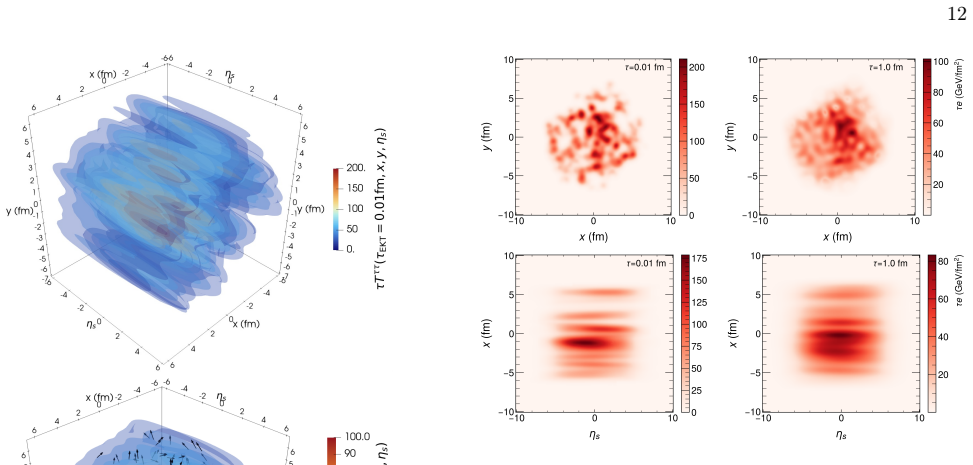
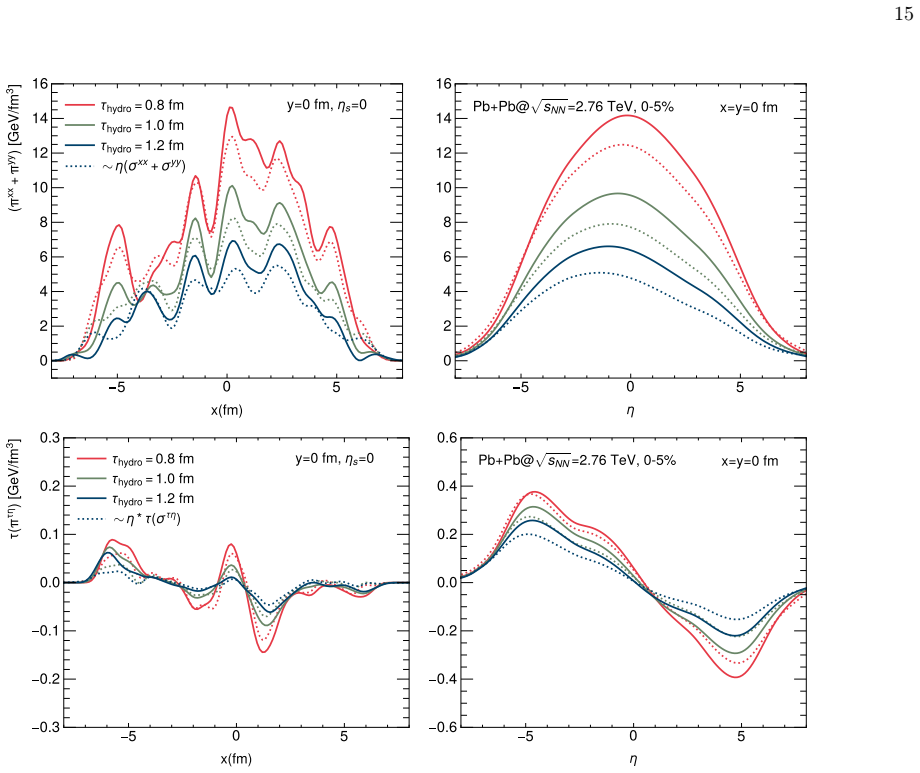
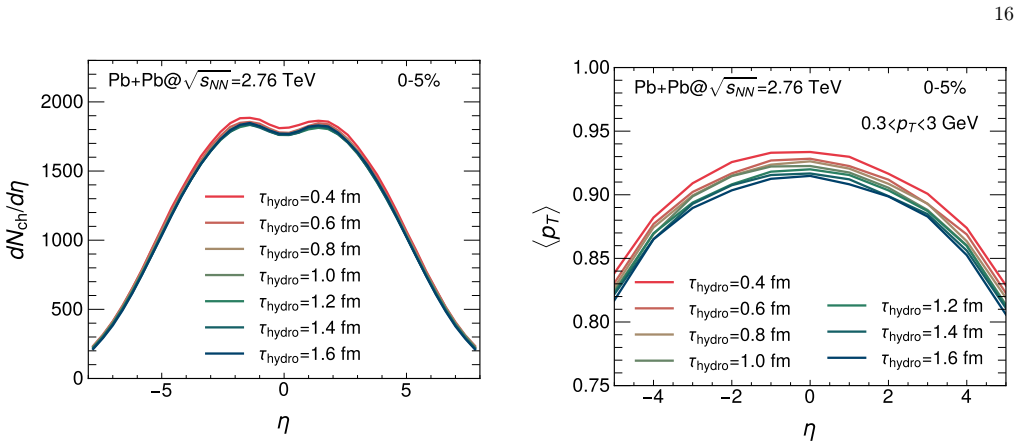
So far a major source of uncertainty in the study of heavy-ion collisions arises from the early time dynamics which includes initial state and pre-equilibrium dynamics. The state-of-the-art framework, KoMPoST, employs non-equilibrium Green's functions to propagate the initial energy-momentum tensor to the hydrodynamic phase, yet currently only treats transverse plane dynamics under boost-invariant conditions. In this work, we extend KoMPoST to include non-boost-invariant responses to initial conditions, essential for accurately capturing the longitudinal structures observed in heavy-ion collisions. Non-boost-invariant fluctuations on top of a homogeneous background are evolved using (3+1)D response functions calculated in kinetic theory. To assess kinetic theory's transition towards hydrodynamic evolution, we systematically compare the out-of-equilibrium shear-stress tensor from KoMPoST-3D with estimates based on Navier-Stokes hydrodynamics. Subsequently, a comprehensive (3+1)D framework, McDIPPER+KoMPoST-3D+CLVisc+SMASH, is utilized to simulate the complete spacetime evolution of heavy-ion collisions. The sensitivity of key observables, including longitudinal structure of anisotropic flow, to variations in the hydrodynamic initialization time is thoroughly investigated.
Editorial analysis
A structured set of objections, weighed in public.
Referee Report
Summary. The paper extends the KoMPoST framework from boost-invariant transverse dynamics to (3+1)D non-boost-invariant pre-equilibrium evolution. It computes kinetic-theory response functions for non-boost-invariant fluctuations superimposed on a homogeneous background, compares the resulting out-of-equilibrium shear-stress tensor to Navier-Stokes estimates, and then deploys the full event-by-event chain McDIPPER + KoMPoST-3D + CLVisc + SMASH to study the sensitivity of longitudinal structures in anisotropic flow (and other observables) to the hydrodynamic initialization time.
Significance. If the linear-response superposition remains accurate for realistic McDIPPER fluctuation amplitudes, the work supplies a practical route to incorporate longitudinal pre-equilibrium dynamics into full (3+1)D heavy-ion simulations, directly addressing a major source of uncertainty in early-time modeling. The systematic NS comparison and the complete simulation pipeline are concrete strengths that would be valuable to the community.
major comments (2)
- [Abstract (description of KoMPoST-3D extension) and the section detailing the response-function construction] The central claim that the framework captures the sensitivity of longitudinal flow structure to initialization time rests on the assumption that (3+1)D response functions computed on a homogeneous background can be linearly superposed to evolve the full fluctuating T^{μν} from McDIPPER. No direct validation against nonlinear kinetic evolution on inhomogeneous backgrounds with realistic transverse gradients is described; if the response deviates for the fluctuation amplitudes present in McDIPPER, both the pre-equilibrium evolution and the reported sensitivities would be affected.
- [Section on comparison of out-of-equilibrium shear-stress tensor] The abstract states that the shear-stress tensor from KoMPoST-3D is compared only to Navier-Stokes estimates. A quantitative assessment (e.g., relative difference as a function of proper time or fluctuation amplitude) is needed to establish how far the kinetic-theory result departs from hydrodynamics before the switch time; without such metrics the transition assessment remains qualitative.
minor comments (2)
- [Methodology section] Notation for the (3+1)D response functions and the decomposition into background plus fluctuation should be defined explicitly with an equation number for later reference.
- [Results figures] Figure captions should include the specific initialization times varied and the collision system (e.g., Pb-Pb at 5.02 TeV) to allow immediate interpretation of the sensitivity plots.
Simulated Author's Rebuttal
We thank the referee for the positive evaluation of our work and for the constructive comments. We address each major comment below and indicate the revisions made to the manuscript.
read point-by-point responses
-
Referee: The central claim that the framework captures the sensitivity of longitudinal flow structure to initialization time rests on the assumption that (3+1)D response functions computed on a homogeneous background can be linearly superposed to evolve the full fluctuating T^{μν} from McDIPPER. No direct validation against nonlinear kinetic evolution on inhomogeneous backgrounds with realistic transverse gradients is described; if the response deviates for the fluctuation amplitudes present in McDIPPER, both the pre-equilibrium evolution and the reported sensitivities would be affected.
Authors: We acknowledge that a direct numerical validation of the linear superposition against full nonlinear kinetic evolution on inhomogeneous backgrounds would strengthen the central claim. Such a validation is computationally demanding and was not performed in the present study. The approach extends the established linear-response framework of the original (2+1)D KoMPoST, where comparable approximations have been used successfully. In the revised manuscript we have added an explicit discussion of the expected range of validity, referencing the typical fluctuation amplitudes extracted from McDIPPER and noting that nonlinear corrections remain a topic for future work. revision: partial
-
Referee: The abstract states that the shear-stress tensor from KoMPoST-3D is compared only to Navier-Stokes estimates. A quantitative assessment (e.g., relative difference as a function of proper time or fluctuation amplitude) is needed to establish how far the kinetic-theory result departs from hydrodynamics before the switch time; without such metrics the transition assessment remains qualitative.
Authors: We agree that quantitative metrics improve the clarity of the comparison. In the revised manuscript we have added plots and tables showing the relative difference between the KoMPoST-3D shear-stress tensor and the Navier-Stokes estimate as a function of proper time, for several representative fluctuation amplitudes. These additions make the assessment of the hydrodynamic transition quantitative rather than qualitative. revision: yes
Circularity Check
No significant circularity; independent (3+1)D kinetic response functions and full-event simulations
full rationale
The paper computes new (3+1)D response functions in kinetic theory for non-boost-invariant fluctuations on a homogeneous background, then superposes them onto McDIPPER initial conditions before switching to hydrodynamics. This calculation is performed independently and compared against Navier-Stokes estimates as an external benchmark. The subsequent sensitivity study of longitudinal flow structure to initialization time is obtained from complete McDIPPER+KoMPoST-3D+CLVisc+SMASH event simulations; none of these steps reduce by definition or by self-citation to quantities already fitted inside the present work. Prior KoMPoST references provide context but are not load-bearing for the new 3D extension or the reported sensitivities.
Axiom & Free-Parameter Ledger
free parameters (1)
- hydrodynamic initialization time
axioms (1)
- domain assumption Kinetic theory response functions accurately capture non-boost-invariant pre-equilibrium evolution until hydrodynamics applies
Lean theorems connected to this paper
-
IndisputableMonolith/Cost/FunctionalEquation.leanwashburn_uniqueness_aczel unclear?
unclearRelation between the paper passage and the cited Recognition theorem.
Non-boost-invariant fluctuations on top of a homogeneous background are evolved using (3+1)D response functions calculated in kinetic theory... δT^μν(τ,x,η)/T^ττ = ∫ G^μν_αβ ... δT^αβ ... (Eq. 5)
-
IndisputableMonolith/Foundation/AlexanderDuality.leanalexander_duality_circle_linking unclear?
unclearRelation between the paper passage and the cited Recognition theorem.
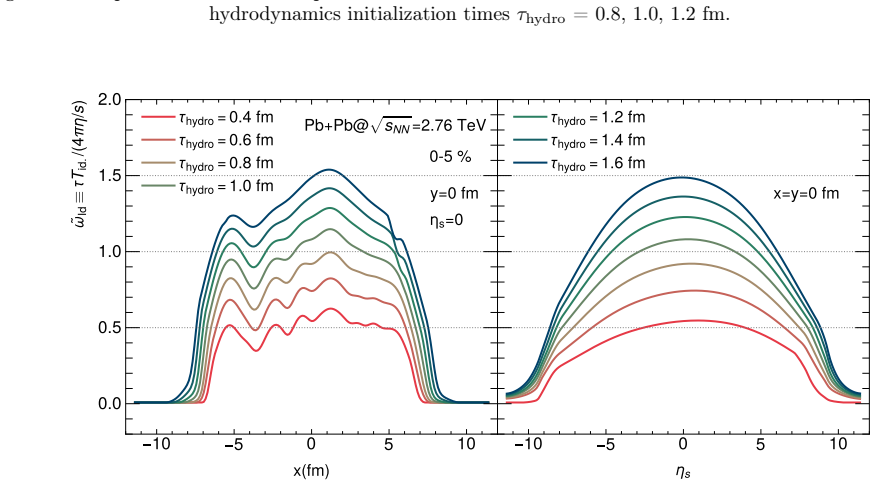
the background is locally transverse homogeneous and longitudinally boost-invariant... scaling variable ω̃ = T(τ)τ/(4πη/s)
What do these tags mean?
- matches
- The paper's claim is directly supported by a theorem in the formal canon.
- supports
- The theorem supports part of the paper's argument, but the paper may add assumptions or extra steps.
- extends
- The paper goes beyond the formal theorem; the theorem is a base layer rather than the whole result.
- uses
- The paper appears to rely on the theorem as machinery.
- contradicts
- The paper's claim conflicts with a theorem or certificate in the canon.
- unclear
- Pith found a possible connection, but the passage is too broad, indirect, or ambiguous to say the theorem truly supports the claim.
Forward citations
Cited by 1 Pith paper
-
Rapidity dependence of mean transverse momentum fluctuation and decorrelation in baryon-dense medium
Mean transverse momentum fluctuations in baryon-rich matter are driven by energy and baryon density variations, remain robust to baryon diffusion, and show splitting between protons and antiprotons.
Reference graph
Works this paper leans on
-
[1]
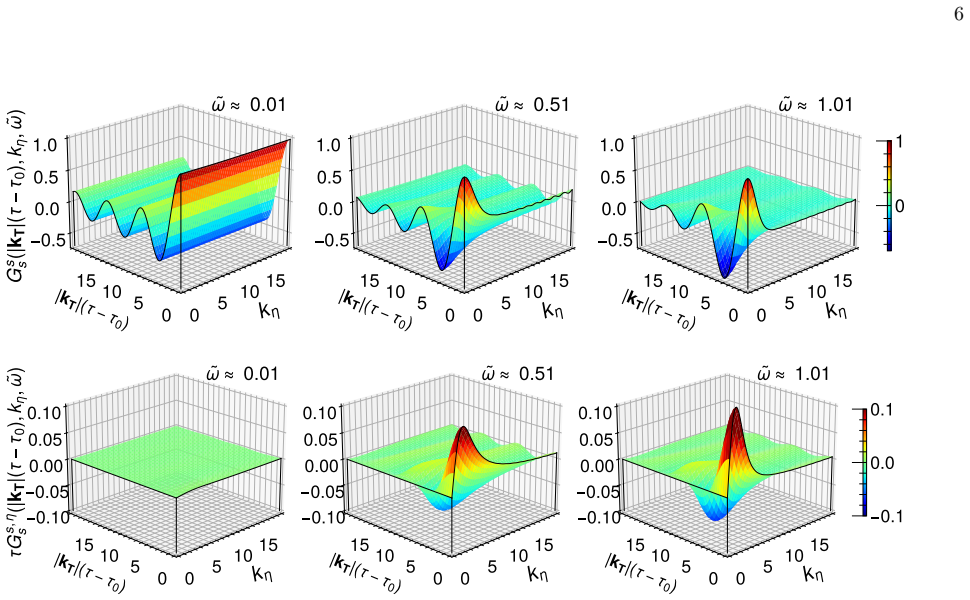
Green ’s functions in Fourier space In Fig. 1, we show the evolution of the energy response Gs s(∣kT∣∆τ≡∣kT∣(τ−τ0), kη)(upper panels) and the lon- gitudinal momentum responseG s,η s (∣kT∣∆τ, kη)(lower panels) to an initial energy perturbation as functions of transverse (∣kT∣∆τ) and longitudinal (kη) wavenumber. Different columns in Fig. 1 correspond to di...
-
[2]
Green ’s functions in coordinate space Based on the results in Fourier space, the response functions in coordinate space are obtained through the reverse Fourier transformation as defined in Eq. (10). In practice, since only a finite set of discrete points in Fourier space (∣kT∣∆τ, kη) are calculated within a lim- ited region of the kinetic theory evoluti...
-
[3]
By following the strategy of Ref
Hydrodynamic constitutive relations Since the non-equilibrium system approaches equilib- rium over the course of its evolution, at late times, the re- sponse functions from kinetic theory are expected to ap- proach the hydrodynamic regime, in which the different components are interrelated by the hydrodynamic consti- tutive relations. By following the str...
-
[4]
Strong- interaction matter under extreme conditions
From RTA to QCD: Comparison of energy response functions atk T =0andk η =0 So far we have presented the calculation of (3+1)D non-equilibrium response functions in kinetic theory in the relaxation time approximation. One step further is to calculate these response functions in QCD kinetic theory by formulating the collision integrals for background and pe...
work page 2000
-
[5]
A. Kurkela, A. Mazeliauskas, J.-F. Paquet, S. Schlicht- ing, and D. Teaney, Phys. Rev. C99, 034910 (2019), arXiv:1805.00961 [hep-ph]
work page internal anchor Pith review Pith/arXiv arXiv 2019
-
[6]
A. Kurkela, A. Mazeliauskas, J.-F. Paquet, S. Schlicht- ing, and D. Teaney, Phys. Rev. Lett.122, 122302 (2019), arXiv:1805.01604 [hep-ph]
work page internal anchor Pith review Pith/arXiv arXiv 2019
-
[7]
First Results from Pb+Pb collisions at the LHC
B. Muller, J. Schukraft, and B. Wyslouch, Ann. Rev. Nucl. Part. Sci.62, 361 (2012), arXiv:1202.3233 [hep-ex]
work page internal anchor Pith review Pith/arXiv arXiv 2012
-
[8]
Investigation of Hot QCD Matter: Theoretical Aspects
B. Müller, Phys. Scripta T158, 014004 (2013), arXiv:1309.7616 [nucl-th]
work page internal anchor Pith review Pith/arXiv arXiv 2013
- [9]
-
[10]
W. Ke, J. S. Moreland, J. E. Bernhard, and S. A. Bass, Phys. Rev. C96, 044912 (2017), arXiv:1610.08490 [nucl- th]
work page internal anchor Pith review Pith/arXiv arXiv 2017
- [11]
-
[12]
Fluctuating Glasma initial conditions and flow in heavy ion collisions
B. Schenke, P. Tribedy, and R. Venugopalan, Phys. Rev. Lett.108, 252301 (2012), arXiv:1202.6646 [nucl-th]
work page internal anchor Pith review Pith/arXiv arXiv 2012
-
[13]
Event-by-event gluon multiplicity, energy density and eccentricities at RHIC and LHC
B. Schenke, P. Tribedy, and R. Venugopalan, Phys. Rev. C86, 034908 (2012), arXiv:1206.6805 [hep-ph]
work page internal anchor Pith review Pith/arXiv arXiv 2012
-
[14]
Imprints of fluctuating proton shapes on flow in proton-lead collisions at the LHC
H. Mäntysaari, B. Schenke, C. Shen, and P. Tribedy, Phys. Lett. B772, 681 (2017), arXiv:1705.03177 [nucl- th]
work page internal anchor Pith review Pith/arXiv arXiv 2017
-
[15]
S. McDonald, S. Jeon, and C. Gale, Phys. Rev. C108, 064910 (2023), arXiv:2306.04896 [hep-ph]
- [16]
- [17]
-
[18]
H. Hirvonen, M. Kuha, J. Auvinen, K. J. Eskola, Y. Kanakubo, and H. Niemi, Phys. Rev. C110, 034911 (2024), arXiv:2407.01338 [hep-ph]
-
[19]
C. Shen, Z. Qiu, H. Song, J. Bernhard, S. Bass, and U. Heinz, Comput. Phys. Commun.199, 61 (2016), arXiv:1409.8164 [nucl-th]. 18
work page internal anchor Pith review Pith/arXiv arXiv 2016
-
[20]
3+1D hydrodynamic simulation of relativistic heavy-ion collisions
B. Schenke, S. Jeon, and C. Gale, Phys. Rev. C82, 014903 (2010), arXiv:1004.1408 [hep-ph]
work page internal anchor Pith review Pith/arXiv arXiv 2010
-
[21]
Elliptic and triangular flow in event-by-event (3+1)D viscous hydrodynamics
B. Schenke, S. Jeon, and C. Gale, Phys. Rev. Lett.106, 042301 (2011), arXiv:1009.3244 [hep-ph]
work page internal anchor Pith review Pith/arXiv arXiv 2011
- [22]
-
[23]
S. A. Basset al., Prog. Part. Nucl. Phys.41, 255 (1998), arXiv:nucl-th/9803035
work page internal anchor Pith review Pith/arXiv arXiv 1998
-
[24]
M. Bleicheret al., J. Phys. G25, 1859 (1999), arXiv:hep- ph/9909407
-
[25]
smash-transport/smash: Smash-3.1,
A. Wergieluk, J. Weil, J. Tindall, V. Steinberg, J. Stau- denmaier, A. Sorensen, A. Sciarra, A. Schäfer, R. Sat- tler, S. Ryu, J. Rothermel, J.-B. Rose, H. Roch, L. Prinz, H. Petersen, Z. Paulinyova, L.-G. Pang, D. Oliinychenko, J. Mohs, D. Mitrovic, M. Mayer, F. Li, N. Kübler, M. Kretz, T. Kehrenberg, G. Inghirami, R. Hirayama, J. Hammelmann, N. Götz, J....
work page 2024
-
[26]
J. Weilet al.(SMASH), Phys. Rev. C94, 054905 (2016), arXiv:1606.06642 [nucl-th]
work page internal anchor Pith review Pith/arXiv arXiv 2016
-
[27]
T. Sjostrand, S. Mrenna, and P. Z. Skands, JHEP05, 026 (2006), arXiv:hep-ph/0603175
work page internal anchor Pith review Pith/arXiv arXiv 2006
-
[28]
A Brief Introduction to PYTHIA 8.1
T. Sjostrand, S. Mrenna, and P. Z. Skands, Comput. Phys. Commun.178, 852 (2008), arXiv:0710.3820 [hep- ph]
work page internal anchor Pith review Pith/arXiv arXiv 2008
- [29]
-
[30]
J. S. Moreland, J. E. Bernhard, and S. A. Bass, Phys. Rev. C92, 011901 (2015), arXiv:1412.4708 [nucl-th]
work page internal anchor Pith review Pith/arXiv arXiv 2015
-
[31]
Continuous description of fluctuating eccentricities
J.-P. Blaizot, W. Broniowski, and J.-Y. Ollitrault, Phys. Lett. B738, 166 (2014), arXiv:1405.3572 [nucl-th]
work page internal anchor Pith review Pith/arXiv arXiv 2014
-
[32]
Non-Gaussian eccentricity fluctuations
H. Grönqvist, J.-P. Blaizot, and J.-Y. Ollitrault, Phys. Rev. C94, 034905 (2016), arXiv:1604.07230 [nucl-th]
work page internal anchor Pith review Pith/arXiv arXiv 2016
-
[33]
Free-streaming approximation in early dynamics of relativistic heavy-ion collisions
W. Broniowski, W. Florkowski, M. Chojnacki, and A. Kisiel, Phys. Rev.C80, 034902 (2009), arXiv:0812.3393 [nucl-th]
work page internal anchor Pith review Pith/arXiv arXiv 2009
-
[34]
J. Liu, C. Shen, and U. Heinz, Phys. Rev. C91, 064906(2015),[Erratum: Phys.Rev.C92, 049904(2015)], arXiv:1504.02160 [nucl-th]
work page internal anchor Pith review Pith/arXiv arXiv 2015
-
[35]
Universal Flow in the First Stage of Relativistic Heavy Ion Collisions
J. Vredevoogd and S. Pratt, Phys. Rev. C79, 044915 (2009), arXiv:0810.4325 [nucl-th]
work page internal anchor Pith review Pith/arXiv arXiv 2009
-
[36]
A fully dynamical simulation of central nuclear collisions
W. van der Schee, P. Romatschke, and S. Pratt, Phys. Rev. Lett.111, 222302 (2013), arXiv:1307.2539 [nucl-th]
work page internal anchor Pith review Pith/arXiv arXiv 2013
-
[37]
Light-Heavy Ion Collisions: A window into pre-equilibrium QCD dynamics?
P. Romatschke, Eur. Phys. J. C75, 305 (2015), arXiv:1502.04745 [nucl-th]
work page internal anchor Pith review Pith/arXiv arXiv 2015
- [38]
-
[39]
O. Garcia-Montero, A. Mazeliauskas, P. Plaschke, and S. Schlichting, JHEP03, 053 (2024), arXiv:2308.09747 [hep-ph]
-
[40]
O. Garcia-Montero, P. Plaschke, and S. Schlichting, Phys. Rev. D111, 034036 (2025), arXiv:2403.04846 [hep- ph]
-
[41]
B. Schenke, C. Shen, and D. Teaney, Phys. Rev. C102, 034905 (2020), arXiv:2004.00690 [nucl-th]
-
[42]
T. Nunes da Silva, D. Chinellato, M. Hippert, W. Serenone, J. Takahashi, G. S. Denicol, M. Luzum, and J. Noronha, Phys. Rev. C103, 054906 (2021), arXiv:2006.02324 [nucl-th]
-
[43]
Isotropization and hydrodynamization in weakly coupled heavy-ion collisions
A. Kurkela and Y. Zhu, Phys. Rev. Lett.115, 182301 (2015), arXiv:1506.06647 [hep-ph]
work page internal anchor Pith review Pith/arXiv arXiv 2015
-
[44]
G. Giacalone, A. Mazeliauskas, and S. Schlichting, Phys. Rev. Lett.123, 262301 (2019), arXiv:1908.02866 [hep- ph]
-
[45]
Initial state of Heavy-Ion Collisions: Isotropization and thermalization
A. Kurkela, Nucl. Phys. A956, 136 (2016), arXiv:1601.03283 [hep-ph]
work page internal anchor Pith review Pith/arXiv arXiv 2016
- [46]
-
[47]
Initial conditions for hydrodynamics from weakly coupled pre-equilibrium evolution
L. Keegan, A. Kurkela, A. Mazeliauskas, and D. Teaney, JHEP08, 171 (2016), arXiv:1605.04287 [hep-ph]
work page internal anchor Pith review Pith/arXiv arXiv 2016
-
[48]
M. A. York and G. D. Moore, Phys. Rev. D79, 054011 (2009), arXiv:0811.0729 [hep-ph]
work page internal anchor Pith review Pith/arXiv arXiv 2009
- [49]
-
[50]
Relativistic dissipative hydrodynamics from kinetic theory with relaxation time approximation
A. Jaiswal, Phys. Rev. C87, 051901 (2013), arXiv:1302.6311 [nucl-th]
work page internal anchor Pith review Pith/arXiv arXiv 2013
-
[51]
P. B. Arnold, G. D. Moore, and L. G. Yaffe, JHEP01, 030 (2003), arXiv:hep-ph/0209353
work page internal anchor Pith review Pith/arXiv arXiv 2003
- [52]
- [53]
-
[54]
T. Dore, X. Du, S. Schlichting, and Z. Jie, (2025), In preparation
work page 2025
- [55]
-
[56]
L. Pang, Q. Wang, and X.-N. Wang, Phys. Rev.C86, 024911 (2012), arXiv:1205.5019 [nucl-th]
work page internal anchor Pith review Pith/arXiv arXiv 2012
-
[57]
L.-G. Pang, H. Petersen, and X.-N. Wang, Phys. Rev. C 97, 064918 (2018), arXiv:1802.04449 [nucl-th]
work page internal anchor Pith review Pith/arXiv arXiv 2018
- [58]
-
[59]
O. Garcia-Montero, S. Schlichting, and J. Zhu, (2025), arXiv:2501.14872 [nucl-th]
-
[60]
O. Garcia-Montero, H. Elfner, and S. Schlichting, Phys. Rev. C109, 044916 (2024), arXiv:2308.11713 [hep-ph]
-
[61]
J. P. Blaizot, F. Gelis, and R. Venugopalan, Nucl. Phys. A743, 57 (2004), arXiv:hep-ph/0402257
work page internal anchor Pith review Pith/arXiv arXiv 2004
-
[62]
Probing colored glass via $q\bar{q}$ photoproduction
F. Gelis and A. Peshier, Nucl. Phys. A697, 879 (2002), arXiv:hep-ph/0107142
work page internal anchor Pith review Pith/arXiv arXiv 2002
-
[63]
Probing colored glass via $q\bar{q}$ photoproduction II: diffraction
F. Gelis and A. Peshier, Nucl. Phys. A707, 175 (2002), arXiv:hep-ph/0111227
work page internal anchor Pith review Pith/arXiv arXiv 2002
-
[64]
How Protons Shatter Colored Glass
A. Dumitru and L. D. McLerran, Nucl. Phys. A700, 492 (2002), arXiv:hep-ph/0105268
work page internal anchor Pith review Pith/arXiv arXiv 2002
-
[65]
Linearly polarized gluons and axial charge fluctuations in the Glasma
T. Lappi and S. Schlichting, Phys. Rev. D97, 034034 (2018), arXiv:1708.08625 [hep-ph]
work page internal anchor Pith review Pith/arXiv arXiv 2018
-
[66]
Forward Quark Jets from Protons Shattering the Colored Glass
A. Dumitru and J. Jalilian-Marian, Phys. Rev. Lett.89, 022301 (2002), arXiv:hep-ph/0204028
work page internal anchor Pith review Pith/arXiv arXiv 2002
-
[67]
The Color Glass Condensate and hadron production in the forward region
A. Dumitru, A. Hayashigaki, and J. Jalilian-Marian, Nucl. Phys. A765, 464 (2006), arXiv:hep-ph/0506308
work page internal anchor Pith review Pith/arXiv arXiv 2006
-
[68]
Exclusive diffractive processes at HERA within the dipole picture
H. Kowalski, L. Motyka, and G. Watt, Phys. Rev. D74, 074016 (2006), arXiv:hep-ph/0606272
work page internal anchor Pith review Pith/arXiv arXiv 2006
-
[69]
An Impact Parameter Dipole Saturation Model
H. Kowalski and D. Teaney, Phys. Rev. D68, 114005 (2003), arXiv:hep-ph/0304189
work page internal anchor Pith review Pith/arXiv arXiv 2003
-
[70]
G. S. Denicol, C. Gale, S. Jeon, A. Monnai, B. Schenke, and C. Shen, Phys. Rev. C98, 034916 (2018), arXiv:1804.10557 [nucl-th]
work page internal anchor Pith review Pith/arXiv arXiv 2018
-
[71]
G. S. Denicol, S. Jeon, and C. Gale, Phys. Rev. C90, 024912 (2014), arXiv:1403.0962 [nucl-th]
work page internal anchor Pith review Pith/arXiv arXiv 2014
-
[72]
The equation of state in (2+1)-flavor QCD
A. Bazavovet al.(HotQCD), Phys. Rev. D90, 094503 (2014), arXiv:1407.6387 [hep-lat]. 19
work page internal anchor Pith review Pith/arXiv arXiv 2014
-
[73]
S. Borsanyiet al., Nature539, 69 (2016), arXiv:1606.07494 [hep-lat]
work page internal anchor Pith review Pith/arXiv arXiv 2016
-
[74]
Particlization in hybrid models
P. Huovinen and H. Petersen, Eur. Phys. J. A48, 171 (2012), arXiv:1206.3371 [nucl-th]
work page internal anchor Pith review Pith/arXiv arXiv 2012
-
[75]
N. Borghini, R. Krupczak, and H. Roch, Eur. Phys. J. C84, 1128 (2024), arXiv:2407.10634 [nucl-th]
- [76]
-
[77]
Fluid Dynamics far from Local Equilibrium
P. Romatschke, Phys. Rev. Lett.120, 012301 (2018), arXiv:1704.08699 [hep-th]
work page internal anchor Pith review Pith/arXiv arXiv 2018
-
[78]
Strickland, JHEP12, 128 (2018), 1809.01200
M. Strickland, JHEP12, 128 (2018), arXiv:1809.01200 [nucl-th]
-
[79]
C. Chattopadhyay, S. Jaiswal, L. Du, U. Heinz, and S. Pal, Phys. Lett. B824, 136820 (2022), arXiv:2107.05500 [nucl-th]. Appendix A: Energy response functions in free-streaming limit In this section, we will give the analytical results of 3D response functions under free-streaming limit. In this case, the Boltzmann equations are ∂τ fBG (τ, pT , pη) =0,(A1)...
-
[80]
In Fourier space In Fig. 15, we show the evolution of the transverse mo- mentum response (Gv s(k∆τ, k η)), the pressure response (Gt,δ s (k∆τ, k η)andG η s(k∆τ, k η)) and shear stress re- sponse (Gt,k s (k∆τ, k η)andG v,η s (k∆τ, k η)) to an initial energy perturbation as a function ofk∆τandk η
discussion (0)
Sign in with ORCID, Apple, or X to comment. Anyone can read and Pith papers without signing in.