Secure Client and Server Geolocation Over the Internet
Pith reviewed 2026-05-25 15:19 UTC · model grok-4.3
The pith
CPV and SLV verify client and server locations on the Internet without allowing cheating.
A machine-rendered reading of the paper's core claim, the machinery that carries it, and where it could break.
Core claim
CPV and SLV are techniques designed to verify the geographic locations of clients and servers in realtime over the Internet while addressing a wide range of adversarial tactics to manipulate geolocation, including the use of IP-hiding technologies like VPNs and anonymizers.
What carries the argument
Client Presence Verification (CPV) and Server Location Verification (SLV), techniques that verify locations in real time while countering IP-hiding technologies.
If this is right
- Impersonation attempts in location-based authentication can be blocked.
- Location-dependent benefits become harder to claim falsely.
- Real-time checks remain effective even when anonymizing tools are used.
Where Pith is reading between the lines
- These verification steps could be added to standard network services to limit location spoofing.
- Mobile and edge computing setups might adopt similar checks for device positioning.
- New manipulation methods that emerge later would require updated versions of the same approach.
Load-bearing premise
The techniques summarized can be implemented to prevent the entity being geolocated from successfully cheating about its location in realtime.
What would settle it
A test where an entity using a VPN or anonymizer reports a false location that CPV or SLV accepts as correct.
Figures


read the original abstract
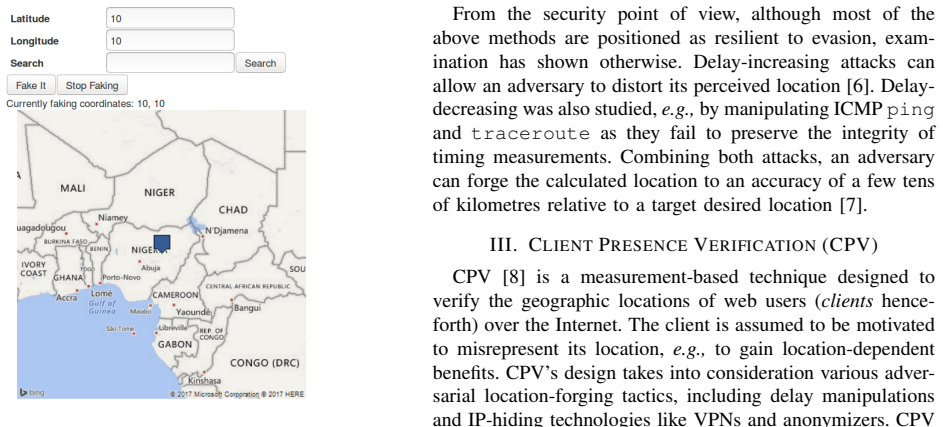
In this article, we provide a summary of recent efforts towards achieving Internet geolocation securely, \ie without allowing the entity being geolocated to cheat about its own geographic location. Cheating motivations arise from many factors, including impersonation (in the case locations are used to reinforce authentication), and gaining location-dependent benefits. In particular, we provide a technical overview of Client Presence Verification (CPV) and Server Location Verification (SLV)---two recently proposed techniques designed to verify the geographic locations of clients and servers in realtime over the Internet. Each technique addresses a wide range of adversarial tactics to manipulate geolocation, including the use of IP-hiding technologies like VPNs and anonymizers, as we now explain.
Editorial analysis
A structured set of objections, weighed in public.
Referee Report
Summary. The manuscript provides a summary of recent efforts towards achieving Internet geolocation securely, i.e., without allowing the entity being geolocated to cheat about its own geographic location. It focuses on a technical overview of Client Presence Verification (CPV) and Server Location Verification (SLV)---two recently proposed techniques designed to verify the geographic locations of clients and servers in realtime over the Internet while addressing a wide range of adversarial tactics including the use of IP-hiding technologies like VPNs and anonymizers.
Significance. As a descriptive overview consolidating prior work on secure geolocation, the paper could serve as a useful reference for researchers in network security and cryptography. However, because the manuscript supplies no new data, proofs, implementations, or quantitative evaluations, its significance is limited to synthesis rather than advancing the state of the art; credit is due for explicitly framing the problem around real-world cheating motivations such as impersonation and location-dependent benefits.
minor comments (1)
- The abstract states that the techniques 'address a wide range of adversarial tactics... as we now explain,' but the provided text does not include the promised technical details or citations to the original CPV/SLV papers; ensure the full manuscript supplies these references and a clear mapping from tactics to countermeasures.
Simulated Author's Rebuttal
We thank the referee for the careful reading and the positive recommendation to accept the manuscript. We agree that the work is a synthesis of prior efforts on secure geolocation and appreciate the recognition that it frames the problem around real-world cheating motivations.
Circularity Check
No significant circularity
full rationale
The paper is explicitly a descriptive technical overview and summary of prior CPV and SLV techniques rather than a derivation of new results. No equations, predictions, fitted parameters, or load-bearing derivation chain exist in the manuscript; the central content is a survey of existing methods addressing adversarial tactics. All claims reduce to external prior work without internal self-referential reduction or renaming of results as new predictions.
Axiom & Free-Parameter Ledger
Lean theorems connected to this paper
-
IndisputableMonolith/Foundation/RealityFromDistinction.leanreality_from_one_distinction unclear?
unclearRelation between the paper passage and the cited Recognition theorem.
CPV relies on three verifiers... estimate the smaller of the forward and reverse one-way delays... area(△xab)+area(△ybc)+area(△zca)≤ area(△xyz) +ϵ
-
IndisputableMonolith/Cost/FunctionalEquation.leanwashburn_uniqueness_aczel unclear?
unclearRelation between the paper passage and the cited Recognition theorem.
Techniques like CPV can mitigate against this by adapting known Proof-of-Work techniques
What do these tags mean?
- matches
- The paper's claim is directly supported by a theorem in the formal canon.
- supports
- The theorem supports part of the paper's argument, but the paper may add assumptions or extra steps.
- extends
- The paper goes beyond the formal theorem; the theorem is a base layer rather than the whole result.
- uses
- The paper appears to rely on the theorem as machinery.
- contradicts
- The paper's claim conflicts with a theorem or certificate in the canon.
- unclear
- Pith found a possible connection, but the passage is too broad, indirect, or ambiguous to say the theorem truly supports the claim.
Reference graph
Works this paper leans on
-
[1]
Zachary N. J. Peterson, Mark Gondree, and Robert Beverly. A Position Paper on Data Sovereignty: The Importance of Geolocating Data in the Cloud. In USENIX HotCloud, 2011
work page 2011
-
[2]
DRoP: DNS-based Router Positioning
Bradley Huffaker, Marina Fomenkov, and kc claffy. DRoP: DNS-based Router Positioning. SIGCOMM Comput. Commun. Rev. , 44(3):5–13, 2014
work page 2014
-
[3]
On Measuring the Geo- graphic Diversity of Internet Routes
Attila Csoma, Andr ´as Guly´as, and L´aszl´o Toka. On Measuring the Geo- graphic Diversity of Internet Routes. IEEE Communications Magazine , 55(5):192–197, 2017
work page 2017
-
[4]
IP geolocation databases: Unreliable? ACM SIGCOMM Computer Communication Review , 41(2):53–56, 2011
Ingmar Poese, Steve Uhlig, Mohamed Ali Kaafar, Benoit Donnet, and Bamba Gueye. IP geolocation databases: Unreliable? ACM SIGCOMM Computer Communication Review , 41(2):53–56, 2011
work page 2011
-
[5]
Internet geolocation: Evasion and counterevasion
James A Muir and Paul C van Oorschot. Internet geolocation: Evasion and counterevasion. ACM Computing Surveys , 42(1):4, 2009
work page 2009
-
[6]
Dude, where’s that IP?: Circumventing measurement-based IP geolocation
Phillipa Gill, Yashar Ganjali, Bernard Wong, and David Lie. Dude, where’s that IP?: Circumventing measurement-based IP geolocation. In USENIX Security, pages 241–256. USENIX Association, 2010
work page 2010
-
[7]
Accurate Manipulation of Delay-based Internet Geolocation
AbdelRahman Abdou, Ashraf Matrawy, and Paul C van Oorschot. Accurate Manipulation of Delay-based Internet Geolocation. In ACM AsiaCCS, pages 887–898. ACM, 2017
work page 2017
-
[8]
CPV: Delay-based Location Verification for the Internet
AbdelRahman Abdou, Ashraf Matrawy, and Paul C van Oorschot. CPV: Delay-based Location Verification for the Internet. IEEE Transactions on Dependable and Secure Computing (TDSC) , 14(2):130–144, 2017
work page 2017
-
[9]
Accurate one-way delay estimation with reduced client-trustworthiness
AbdelRahman Abdou, Ashraf Matrawy, and Paul C van Oorschot. Accurate one-way delay estimation with reduced client-trustworthiness. IEEE Communications Letter , 19(5), 2015
work page 2015
-
[10]
Taxing the queue: Hindering middleboxes from unauthorized large-scale traffic relaying
AbdelRahman Abdou, Ashraf Matrawy, and Paul C van Oorschot. Taxing the queue: Hindering middleboxes from unauthorized large-scale traffic relaying. IEEE Communications Letter , 19(1), 2015
work page 2015
-
[11]
Location Verification of Wireless Internet Clients: Evaluation and Im- provements
AbdelRahman Abdou, Ashraf Matrawy, and Paul C van Oorschot. Location Verification of Wireless Internet Clients: Evaluation and Im- provements. IEEE Transactions on Emerging Topics in Computing (TETC), 5(4):563–575, 2017
work page 2017
-
[12]
Server Location Verification (SLV) and Server Location Pinning: Augmenting TLS Authentication
AbdelRahman Abdou and Paul C van Oorschot. Server Location Verification (SLV) and Server Location Pinning: Augmenting TLS Authentication. ACM Transactions on Privacy and Security (TOPS) , 21(1):1:1–1:26, 2018
work page 2018
-
[13]
Characterizing large- scale routing anomalies: A case study of the china telecom incident
Rahul Hiran, Niklas Carlsson, and Phillipa Gill. Characterizing large- scale routing anomalies: A case study of the china telecom incident. In International Conference on Passive and Active Network Measurement , pages 229–238. Springer, 2013
work page 2013
-
[14]
Upgrading HTTPS in mid-air: An empirical study of strict transport security and key pinning
Michael Kranch and Joseph Bonneau. Upgrading HTTPS in mid-air: An empirical study of strict transport security and key pinning. In NDSS. Internet Society, 2015
work page 2015
discussion (0)
Sign in with ORCID, Apple, or X to comment. Anyone can read and Pith papers without signing in.