Bridging Single Distortion Artifacts and Multifactorial Clinical Quality: Few-shot Biparametric MRI Quality Assessment via Distortion-trained Prototypical Networks
Pith reviewed 2026-06-26 21:30 UTC · model grok-4.3
The pith
A model meta-trained only on distortion labels adapts to predict full clinical PI-QUAL scores from five samples.
A machine-rendered reading of the paper's core claim, the machinery that carries it, and where it could break.
Core claim
A model meta-trained solely on comparatively objective, readily obtainable distortion labels can effectively adapt to predicting complex, multi-factorial clinical quality scores such as PI-QUAL using only five representative samples.
What carries the argument
Few-shot biparametric prototypical network with dual-branch 3D ResNet, FiLM modulation, and gradient reversal layer, meta-trained on distortion labels.
If this is right
- Few-shot adaptation reduces the need for large annotated clinical quality datasets.
- Distortion serves as a practical proxy label that handles the observed class imbalance in PI-QUAL scores.
- The same pipeline can standardize quality control across sites with varying acquisition protocols.
- Outperformance over standard few-shot baselines holds on the two evaluated datasets.
Where Pith is reading between the lines
- The approach may generalize to other modalities where objective artifacts are abundant but subjective quality labels are scarce.
- Shared feature representations between distortion and broader quality factors could be tested by ablating the gradient reversal layer on morphology preservation.
- Extending the meta-training to include synthetic motion or noise could further reduce reliance on any single artifact type.
Load-bearing premise
Features learned from distortion labels transfer to other quality issues when conditioned on only five samples, and the gradient reversal removes acquisition biases without discarding morphology information relevant to PI-QUAL.
What would settle it
Performance on PI-QUAL prediction collapses to baseline levels on a held-out dataset where quality failures are dominated by non-distortion factors such as motion or noise.
Figures

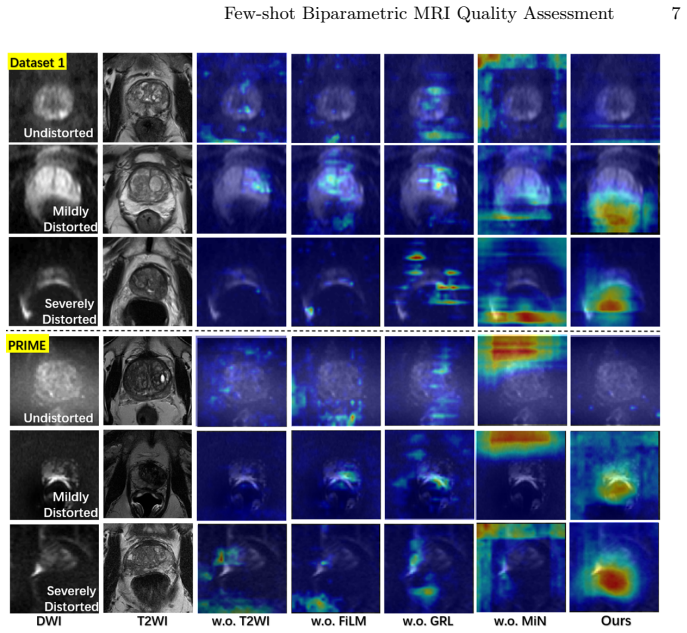
read the original abstract
Clinical prostate multi-parametric MRI relies heavily on high-quality diffusion-weighted imaging (DWI), yet reading DWI is frequently compromised by geometric distortion, often caused by rectal air. Assessing quality via the PI-QUAL scoring system is an emerging clinical standard, but it is subjective, time-consuming and suffers from a class imbalance where low-quality cases are diverse and relatively scarce. Using the PRIME clinical trial as an example, there are $6\%$ images with PI-QUAL scores lower than 4, $87\%$ of DWI issues are due to distortion. Many of the other clinical quality issues are under-represented. To address this common dual-scarcity of annotated clinical data, we propose a few-shot biparametric prototypical network for automated image quality assessment (IQA). Our framework utilizes a dual-branch 3D ResNet to fuse T2-weighted and DWI features, providing anatomical context to distinguish true morphology from distortion. To handle real-world heterogeneity, we introduce feature-wise linear modulation (FiLM) and a gradient reversal layer (GRL) to align feature distributions conditioned on varying b-values while suppressing acquisition-related biases. We demonstrate that a model meta-trained solely on comparatively objective, readily obtainable distortion labels can effectively adapt to predicting complex, multi-factorial clinical quality scores such as PI-QUAL using only five representative samples. Experimental results on two datasets show that our method significantly outperforms few-shot learning baselines for this challenging IQA task, offering a practically feasible and data-efficient solution for standardizing prostate MRI quality control in clinical workflows.
Editorial analysis
A structured set of objections, weighed in public.
Referee Report
Summary. The manuscript proposes a few-shot biparametric prototypical network for prostate MRI image quality assessment. A dual-branch 3D ResNet is meta-trained exclusively on distortion labels, then adapted to multi-factorial PI-QUAL scores using only five representative support samples. FiLM conditioning on b-value and a gradient reversal layer are introduced to handle acquisition heterogeneity and suppress domain biases while preserving anatomical context from T2-weighted and DWI inputs. Experiments on two datasets are reported to show outperformance over standard few-shot baselines.
Significance. If the central transfer result holds under rigorous controls, the work would demonstrate a viable route to data-efficient clinical IQA by leveraging readily obtainable distortion annotations for meta-training, addressing the scarcity and imbalance of PI-QUAL labels. This could support standardization of quality control in prostate mpMRI workflows where low-quality cases are rare and heterogeneous.
major comments (3)
- [Methods (GRL and domain alignment description)] The central claim that distortion-only meta-training plus GRL enables effective 5-shot adaptation to PI-QUAL rests on the untested assertion that the gradient reversal layer removes only acquisition biases while retaining morphology cues used by PI-QUAL scorers. No ablation isolates the GRL's effect on clinically relevant features (e.g., subtle anatomical cues that may co-vary with distortion severity), leaving the transfer mechanism unsupported.
- [Experiments (few-shot adaptation setup and sample selection)] The five representative support samples for the PI-QUAL adaptation experiments are described as 'representative' without a pre-specified selection protocol or cross-validation across multiple draws; post-hoc selection risks inflating the reported gains and undermines the few-shot generalization claim.
- [Abstract] Quantitative results, error bars, and details on train/test splits or sample sizes are absent from the abstract despite the claim of significant outperformance on two datasets; this makes it impossible to assess whether the gains are robust or driven by the specific choice of support set.
minor comments (2)
- [Methods] Notation for the prototypical network loss and the FiLM parameters should be defined explicitly with equations rather than described only in prose.
- [Figure 2] Figure captions for the network architecture diagram should clarify the exact placement of the GRL relative to the feature fusion step.
Simulated Author's Rebuttal
We thank the referee for the insightful comments, which have helped us identify areas for improvement in our manuscript. We address each major comment below and outline the revisions we plan to make.
read point-by-point responses
-
Referee: [Methods (GRL and domain alignment description)] The central claim that distortion-only meta-training plus GRL enables effective 5-shot adaptation to PI-QUAL rests on the untested assertion that the gradient reversal layer removes only acquisition biases while retaining morphology cues used by PI-QUAL scorers. No ablation isolates the GRL's effect on clinically relevant features (e.g., subtle anatomical cues that may co-vary with distortion severity), leaving the transfer mechanism unsupported.
Authors: We agree that an explicit ablation isolating the GRL's contribution to retaining morphology cues would strengthen the support for the transfer mechanism. While the dual-branch architecture is designed to provide anatomical context and the GRL targets acquisition biases, we did not include such an ablation in the original submission. In the revised manuscript, we will add an ablation study with and without the GRL, including feature visualizations or similarity metrics to demonstrate that clinically relevant cues are preserved. This will directly address the concern about the transfer mechanism. revision: yes
-
Referee: [Experiments (few-shot adaptation setup and sample selection)] The five representative support samples for the PI-QUAL adaptation experiments are described as 'representative' without a pre-specified selection protocol or cross-validation across multiple draws; post-hoc selection risks inflating the reported gains and undermines the few-shot generalization claim.
Authors: This is a valid concern regarding the robustness of the few-shot results. The term 'representative' was intended to indicate samples covering the range of quality scores, but we acknowledge the lack of a pre-specified protocol and multiple trials. We will revise the experiments section to define a clear selection protocol (e.g., stratified sampling based on distortion levels) and report performance across multiple independent draws of the support set, including mean and standard deviation to demonstrate generalization. revision: yes
-
Referee: [Abstract] Quantitative results, error bars, and details on train/test splits or sample sizes are absent from the abstract despite the claim of significant outperformance on two datasets; this makes it impossible to assess whether the gains are robust or driven by the specific choice of support set.
Authors: We will update the abstract to include key quantitative results with error bars, as well as details on the train/test splits and the number of samples used in the experiments. This will provide a more complete summary and allow readers to better evaluate the robustness of the reported outperformance. revision: yes
Circularity Check
No significant circularity; derivation is self-contained
full rationale
The paper meta-trains a dual-branch 3D ResNet prototypical network exclusively on distortion labels (an independent, objective task) and then performs few-shot adaptation to PI-QUAL scores. No equations, fitted parameters, or self-citations are shown that reduce the final PI-QUAL predictions to a direct function of the distortion training inputs by construction. The GRL and FiLM components are presented as architectural choices for domain alignment rather than tautological redefinitions. The central claim therefore rests on empirical transfer rather than definitional equivalence.
Axiom & Free-Parameter Ledger
free parameters (1)
- number of shots
axioms (1)
- domain assumption Distortion is the dominant and representative quality artifact that captures morphology distinctions needed for PI-QUAL
Reference graph
Works this paper leans on
-
[1]
Neuroim- age20(2), 870–888 (2003)
Andersson, J.L., Skare, S., Ashburner, J.: How to correct susceptibility distortions in spin-echo echo-planar images: application to diffusion tensor imaging. Neuroim- age20(2), 870–888 (2003)
2003
-
[2]
In: 2010 20th international conference on pattern recognition
Brodersen, K.H., Ong, C.S., Stephan, K.E., Buhmann, J.M.: The balanced ac- curacy and its posterior distribution. In: 2010 20th international conference on pattern recognition. pp. 3121–3124. IEEE (2010)
2010
-
[3]
IEEE Transactions on Geoscience and Remote Sensing60, 1–11 (2021)
Cheng, G., Cai, L., Lang, C., Yao, X., Chen, J., Guo, L., Han, J.: Spnet: Siamese- prototype network for few-shot remote sensing image scene classification. IEEE Transactions on Geoscience and Remote Sensing60, 1–11 (2021)
2021
-
[4]
Academic radiol- ogy21(6), 817–823 (2014)
Donato Jr, F., Costa, D.N., Yuan, Q., Rofsky, N.M., Lenkinski, R.E., Pe- drosa, I.: Geometric distortion in diffusion-weighted mr imaging of the prostate—contributing factors and strategies for improvement. Academic radiol- ogy21(6), 817–823 (2014)
2014
-
[5]
European urology oncology3(5), 615–619 (2020)
Giganti, F., Allen, C., Emberton, M., Moore, C.M., Kasivisvanathan, V., Group, P.S., et al.: Prostate imaging quality (pi-qual): a new quality control scoring system for multiparametric magnetic resonance imaging of the prostate from the precision trial. European urology oncology3(5), 615–619 (2020)
2020
-
[6]
Radiology309(1), e231130 (2023)
Giganti, F., Ng, A., Asif, A., Chan, V.W.S., Rossiter, M., Nathan, A., Khetrapal, P.,Dickinson,L.,Punwani,S.,Brew-Graves,C.,etal.:Globalvariationinmagnetic resonance imaging quality of the prostate. Radiology309(1), e231130 (2023)
2023
-
[7]
Hara, K., Kataoka, H., Satoh, Y.: Can spatiotemporal 3d cnns retrace the history of 2d cnns and imagenet? In: Proceedings of the IEEE conference on Computer Vision and Pattern Recognition. pp. 6546–6555 (2018)
2018
-
[8]
Magnetic resonance in medicine34(1), 65–73 (1995)
Jezzard, P., Balaban, R.S.: Correction for geometric distortion in echo planar im- ages from b0 field variations. Magnetic resonance in medicine34(1), 65–73 (1995)
1995
-
[9]
Neural Networks190, 107761 (2025) 10 Tang et al
Jiang, Z., Feng, Z., Niu, B.: Prototype-neighbor networks with task-specific en- hanced meta-learning for few-shot classification. Neural Networks190, 107761 (2025) 10 Tang et al
2025
-
[10]
European Urology Open Science84, 22–28 (2026)
van den Kroonenberg, D.L., Barentsz, J., Hamstra, B.J., van den Bosch, S.M., Gijsbertsen, J.J., Reitsma, J.B., Brembilla, G., Caglic, I., Raat, H., de Rooij, M., et al.: Real-world inter-rater agreement of pi-qual version 2 for prostate magnetic resonance imaging quality assessment and its association with diagnostic accuracy. European Urology Open Scienc...
2026
-
[11]
Expert Systems with Applications260, 125453 (2025)
Li, Y., He, J., Liu, H., Zhang, Y., Li, Z.: Semantic guided prototype learning for cross-domain few-shot hyperspectral image classification. Expert Systems with Applications260, 125453 (2025)
2025
-
[12]
Frontiers in neuroinformatics7, 45 (2013)
Lowekamp, B.C., Chen, D.T., Ibáñez, L., Blezek, D.: The design of simpleitk. Frontiers in neuroinformatics7, 45 (2013)
2013
-
[13]
JAMA334(13), 1170–1179 (2025)
Ng, A.B., Asif, A., Agarwal, R., Panebianco, V., Girometti, R., Ghai, S., Gómez- Gómez, E., Budäus, L., Barrett, T., Radtke, J.P., et al.: Biparametric vs multi- parametric mri for prostate cancer diagnosis: the prime diagnostic clinical trial. JAMA334(13), 1170–1179 (2025)
2025
-
[14]
Medical image analysis55, 136–147 (2019)
Oksuz, I., Ruijsink, B., Puyol-Antón, E., Clough, J.R., Cruz, G., Bustin, A., Prieto, C., Botnar, R., Rueckert, D., Schnabel, J.A., et al.: Automatic cnn-based detection of cardiac mr motion artefacts using k-space data augmentation and curriculum learning. Medical image analysis55, 136–147 (2019)
2019
-
[15]
In: Proceedings of the IEEE international conference on computer vision
Selvaraju, R.R., Cogswell, M., Das, A., Vedantam, R., Parikh, D., Batra, D.: Grad- cam: Visual explanations from deep networks via gradient-based localization. In: Proceedings of the IEEE international conference on computer vision. pp. 618–626 (2017)
2017
-
[16]
Journal of big data6(1), 1–48 (2019)
Shorten, C., Khoshgoftaar, T.M.: A survey on image data augmentation for deep learning. Journal of big data6(1), 1–48 (2019)
2019
-
[17]
Ad- vances in neural information processing systems30(2017)
Snell, J., Swersky, K., Zemel, R.: Prototypical networks for few-shot learning. Ad- vances in neural information processing systems30(2017)
2017
-
[18]
In: International Workshop on Efficient Medical Artificial Intelligence
Tang, Y., Rajwa, P., Ng, A., Wang, Y., Yan, W., Thorley, N., Asif, A., Allen, C., Dickinson, L., Giganti, F., et al.: Impact of clinical image quality on efficient foun- dation model finetuning. In: International Workshop on Efficient Medical Artificial Intelligence. pp. 194–204. Springer (2025)
2025
-
[19]
In: Proceedings of the IEEE conference on computer vision and pattern recognition
Tzeng, E., Hoffman, J., Saenko, K., Darrell, T.: Adversarial discriminative domain adaptation. In: Proceedings of the IEEE conference on computer vision and pattern recognition. pp. 7167–7176 (2017)
2017
-
[20]
Advances in neural information processing systems29(2016)
Vinyals, O., Blundell, C., Lillicrap, T., Wierstra, D., et al.: Matching networks for one shot learning. Advances in neural information processing systems29(2016)
2016
-
[21]
In: Proceedings of the European conference on computer vision (ECCV)
Woo, S., Park, J., Lee, J.Y., Kweon, I.S.: Cbam: Convolutional block attention module. In: Proceedings of the European conference on computer vision (ECCV). pp. 3–19 (2018)
2018
-
[22]
Yan, W., Chiu, B., Shen, Z., Yang, Q., Syer, T., Min, Z., Punwani, S., Emberton, M., Atkinson, D., Barratt, D.C., et al.: Combiner and hypercombiner networks: Rulestocombinemultimodalitymrimagesforprostatecancerlocalisation.Medical Image Analysis91, 103030 (2024)
2024
discussion (0)
Sign in with ORCID, Apple, or X to comment. Anyone can read and Pith papers without signing in.