Simulating frequency splittings and loss in Fabry-P\'erot cavities
Pith reviewed 2026-05-10 13:02 UTC · model grok-4.3
The pith
Finite-element simulations show that frequency splittings in Fabry-Perot cavity spectra arise from mirror-shape deviations and nonparaxial effects including spin-orbit coupling, while also yielding model-independent modal loss predictions.
A machine-rendered reading of the paper's core claim, the machinery that carries it, and where it could break.
Core claim
Finite-element simulations of optical cavities reveal frequency splittings in the resonance spectrum. The simulated fine structure is characterized by mirror-shape effects together with nonparaxial contributions that include spin-orbit coupling. The same calculations supply model-independent predictions of the modal losses for the cavity.
What carries the argument
Finite-element discretization of the electromagnetic fields inside the cavity geometry that incorporates realistic mirror surface deviations and nonparaxial wave propagation including spin-orbit coupling.
If this is right
- Frequency splittings can be calculated numerically for arbitrary mirror shapes without perturbative analytical approximations.
- Modal loss rates become available for any cavity mode directly from the simulation output.
- The contribution of spin-orbit coupling to the observed spectral fine structure can be isolated and quantified.
- Design iterations of cavity mirrors can be evaluated for their effect on both splitting and loss before fabrication.
Where Pith is reading between the lines
- The simulation approach could be applied to predict how temperature-induced mirror deformations would shift cavity spectra in real time.
- Similar finite-element models might be used to study analogous splitting phenomena in non-planar or whispering-gallery cavities.
- If the loss predictions hold, they could inform the choice of cavity parameters to reduce unwanted mode competition in lasers.
Load-bearing premise
The chosen finite-element mesh resolution and boundary conditions reproduce the physical behavior of the cavity without introducing numerical artifacts that could be mistaken for the reported frequency splittings or losses.
What would settle it
A side-by-side comparison of the simulated frequency values and loss rates against measured spectra and decay times from a real Fabry-Perot cavity with known mirror shapes would directly test whether the numerical splittings and losses match experiment.
Figures

read the original abstract
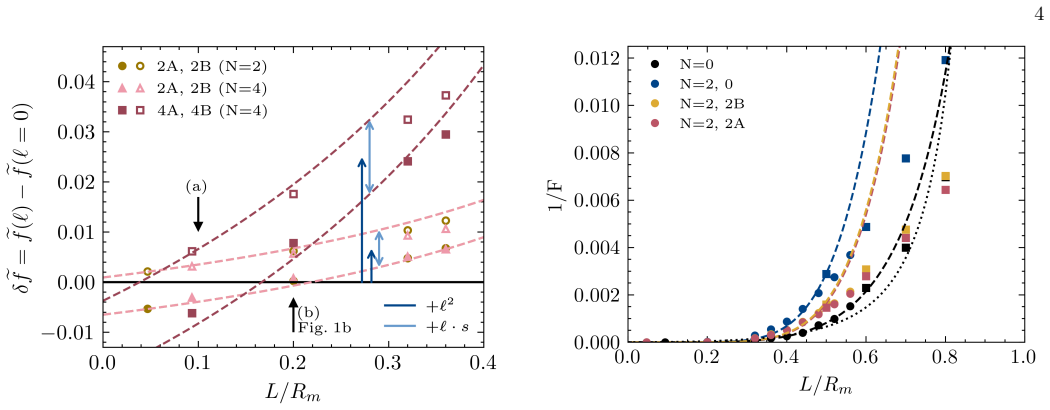
Finite-element simulations of optical cavities are presented, showing frequency splittings in the resonance spectrum. These can be directly compared to and understood by recent theory and experiments presented in van Exter et al. (2022, Phys. Rev. A 106, 013501), Koks et al. (2022, Phys. Rev. A 105, 063502) and Post et al. (2025, Phys. Rev. A 112, 033537). They provide strong evidence for the nonparaxial theory, but point out limitations of predicted mirror-shape corrections. The simulations also provide model-independent predictions of modal losses for optical cavities.
Editorial analysis
A structured set of objections, weighed in public.
Referee Report
Summary. The manuscript presents finite-element simulations of Fabry-Pérot cavities demonstrating frequency splittings in the resonance spectrum. These splittings are characterized as arising from mirror-shape and nonparaxial effects including spin-orbit coupling. The results are stated to support the theoretical framework and experimental observations in the authors' prior works (van Exter et al. 2022, Koks et al. 2022, Post et al. 2025) while also supplying model-independent predictions of modal losses.
Significance. If the numerical fidelity is established, the simulations would supply independent confirmation of the physical mechanisms proposed in the cited prior papers and yield practical, model-independent loss predictions useful for cavity design and optimization.
major comments (2)
- [Numerical methods / simulation setup] The manuscript provides no mesh-convergence tests, residual-error bounds, or comparisons to analytic limits such as paraxial Gaussian modes. This is load-bearing for the central claim because, without such checks, the reported frequency splittings and modal losses cannot be reliably distinguished from possible FEM artifacts due to insufficient resolution near curved mirrors or inadequate PML absorption (see skeptic note on discretization fidelity).
- [Results] Quantitative agreement between the simulated splittings/losses and the specific predictions of the cited prior works (van Exter 2022, Koks 2022, Post 2025) is not shown with error metrics or direct overlays; only qualitative support is asserted, weakening the claim that the simulations independently validate those results.
minor comments (2)
- [Abstract] The abstract would be clearer if it stated the specific cavity parameters (mirror radius of curvature, separation, wavelength range) over which the simulations were performed.
- [Figures] Figure captions should explicitly list the simulation parameters and mode indices shown to allow readers to reproduce the plotted spectra.
Simulated Author's Rebuttal
We thank the referee for the careful reading of our manuscript and the constructive comments. We address each major point below and indicate the changes that will be incorporated in the revised version.
read point-by-point responses
-
Referee: The manuscript provides no mesh-convergence tests, residual-error bounds, or comparisons to analytic limits such as paraxial Gaussian modes. This is load-bearing for the central claim because, without such checks, the reported frequency splittings and modal losses cannot be reliably distinguished from possible FEM artifacts due to insufficient resolution near curved mirrors or inadequate PML absorption (see skeptic note on discretization fidelity).
Authors: We agree that explicit verification of numerical accuracy is necessary to support the central claims. In the revised manuscript we will add a new subsection on numerical validation that reports mesh-convergence results for both resonance frequencies and quality factors, together with residual-error estimates obtained by successive refinement. We will also include direct comparisons of the simulated fundamental-mode frequencies and transverse profiles against the analytic paraxial Gaussian-beam solutions to confirm that the FEM implementation reproduces the expected behavior in the appropriate limit. Additional tests confirming that PML absorption is sufficient (residual reflection below the precision of the reported splittings) will be documented. revision: yes
-
Referee: Quantitative agreement between the simulated splittings/losses and the specific predictions of the cited prior works (van Exter 2022, Koks 2022, Post 2025) is not shown with error metrics or direct overlays; only qualitative support is asserted, weakening the claim that the simulations independently validate those results.
Authors: The manuscript’s primary contribution is the provision of model-independent loss predictions, which do not rely on the analytic approximations of the cited works. We nevertheless accept that a quantitative comparison would strengthen the validation statement. The revised results section will therefore contain overlaid plots of simulated frequency splittings versus the predictions of van Exter et al. (2022) and Koks et al. (2022), together with tabulated relative differences for each mode. These additions will make the degree of agreement explicit while preserving the emphasis on the independent, FEM-derived loss values. revision: yes
Circularity Check
Finite-element simulations provide independent numerical predictions of splittings and losses
full rationale
The paper presents finite-element simulations of Fabry-Pérot cavities that exhibit frequency splittings characterized by mirror shape and nonparaxial effects. The abstract explicitly positions the computed modal losses as model-independent predictions and states that the results support prior theoretical frameworks. No derivation chain, equations, or fitted parameters are shown to reduce by construction to self-citations or prior inputs; the central outputs arise directly from the numerical solution of the vector wave equation rather than being renamed or forced equivalents of the cited works. Self-citations appear but are not load-bearing for the simulation results themselves, which remain falsifiable against mesh convergence and analytic limits outside the present manuscript.
discussion (0)
Sign in with ORCID, Apple, or X to comment. Anyone can read and Pith papers without signing in.