REVIEW 4 major objections 5 minor 31 references
A phase field model of coupled crack and dislocations: emission, blunting, and the necessity of dissipative toughening
T0 review · 4 major / 5 minor · reviewed 2026-08-06 · deepseek-v4-flash
Pith's one-line read A single energy functional, minimized alone, decides whether a stressed crack cleaves or emits dislocations, and in the dissipationless limit emission shields a crack but does not toughen it.
desk verdict A carefully built variational model whose headline results hang on a degree-one dislocation energy the paper adopts rather than derives; worth engaging seriously, but read the d^-1 law and the zero-toughening claim with that premise in mind. read the letter →
The pith
A machine-rendered reading of the paper's core claim, the machinery that carries it, and where it could break.
The reading
What carries the argument
The load-bearing object is the nonsmooth dislocation energy density $\psi_d = q_c |\partial_s \beta| + (c^2/2)(\partial_s \beta)^2$, where $\partial_s \beta$ is the slip gradient along the slip direction and, up to $1/b$, the signed density of geometrically necessary edge dislocations. The degree-one term $q_c |\partial_s \beta|$ is the physical heart: it gives dislocation content a finite energetic cost per unit density even at vanishing density, turning the stability of the dislocation-free state into an integral criterion evaluated along one-dimensional slip chords, with sharp thresholds such as $\operatorname{osc}_{[0,L]} Q \le 2q_c$ for pinned ends. This same term is what converts a pointwise strength condition into a size-dependent nucleation criterion, and it is carried numerically by an ADMM soft-threshold step on the slip gradient.
What would settle it
The most direct check is the small-grain yield stress: measure initial yield as a function of grain size $d$ in passivated single-crystal samples; the model predicts $\tau_y \sim 2\mu k/(b\rho_s d)$, an exact $d^{-1}$ law with no fitted exponent, and a crossover away from the classical $d^{-1/2}$ Hall\textendash Petch scaling at larger sizes. Data showing only $d^{-1/2}$ everywhere would refute the energetic nucleation premise. A second decisive check is the closed-form nucleation load: in the paper's pinned square crystal the criterion predicts first slip at a dimensionless load of 0.00951, and the full nonlinear solver agrees within about 4%.
Extended reading notes
Core claim
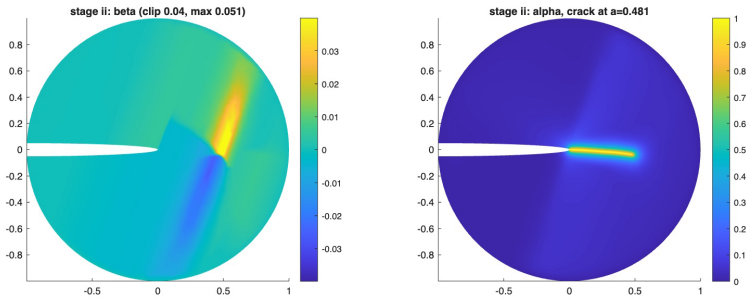
The paper's central claim is that cleavage and dislocation emission are not competing constitutive outcomes but two terms of one energy functional $J[u, \beta, \alpha]$: elastic energy degraded by damage, a dislocation energy $\psi_d = q_c |\partial_s \beta| + (c^2/2)(\partial_s \beta)^2$ for the geometrically necessary dislocations, and the Ambrosio\textendash Tortorelli fracture energy. Because the dislocation energy is not smooth at zero density, the stability condition for the dislocation-free state takes the integral form $|\int_\Omega \tau \, \delta\beta \, da| \le q_c \int_\Omega |\partial_s \delta\beta| \, da$, which the paper evaluates in closed form along slip chords: a pinned\textendash pinned chord yields the threshold $\operatorname{osc}_{[0,L]} Q \le 2q_c$, and a grain of size $d$ gives the yield stress $\tau_y \sim 2\mu k/(b\rho_s d)$. The coupled minimization then produces, without any fitted yield surface, the predicted order of events: surface microslip and dislocation bands at loads far below cleavage, blunting and shielding that elevate the initiation load by a factor of 1.2\textendash 1.7 in stress intensity, healing of the bands during growth, a traveling cluster of about 32 like-signed dislocations at standoff $1.4\ell$, and a steady-state dissipated fracture resistance equal to the elastic resistance to two parts per thousand. In the purely energetic limit, emission shields the crack but does not toughen it.
Load-bearing premise
A finite energetic cost per unit of newly created dislocation content must persist even at vanishing content; if the dislocation energy were smooth at zero density, the integral nucleation threshold, the inverse-grain-size yield stress, and the shielding-without-toughening result would not follow.
Editorial extensions
If this is right
- The emission\textendash cleavage competition requires no separate yield or nucleation criterion: a single energy functional decides it by minimization.
- Smaller grains are stronger with the specific $d^{-1}$ scaling $\tau_y \sim 2\mu k/(b\rho_s d)$, a size effect that no pointwise strength surface can produce; the paper also derives an inverse-thickness threshold for constrained shear.
- Bare free surfaces tangent to the slip plane are predicted to act as dislocation sources with vanishing threshold, while passivated surfaces and grain boundaries restore a finite threshold.
- In the coupled response, dislocation bands blunt and shield the tip, raising the initiation load by a factor of 1.2\textendash 1.7 in stress intensity; during growth a compact cluster travels with the tip, and the dissipated fracture resistance equals the elastic resistance.
- Toughening is dissipative: the dissipationless limit gives the exact zero intercept of the toughening curve, $\Gamma(0) = \Gamma_{\text{elastic}}$.
Reading between the lines
- A sharp experimental test of the model is the small-grain yield stress: if initial yield in the few-hundred-nanometer regime follows $d^{-1/2}$ rather than $d^{-1}$, the energetic nucleation premise would be contradicted.
- The grazing-chord prediction that a bare surface tangent to a slip plane is an inexhaustible low-threshold dislocation source could be tested directly by comparing coated and uncoated notches; the model predicts a finite threshold only in the passivated case.
- If the zero-toughening result is robust, measured fracture resistance in experiments must be attributed to dissipative wake mechanisms; separating stored from dissipated dislocation energy would change how R-curves in ductile fracture are interpreted.
- The two-stage picture suggests a concrete microstructure to look for in in situ crack-growth experiments: a compact like-signed dislocation cluster traveling at a standoff of the order of the damage length, with opposite-sign walls pinned at the grain boundary.
Editorial analysis
A structured set of objections, weighed in public.
Referee Report
Summary. This paper proposes a variational phase-field model of a cracked single crystal in which a damage field, a slip field, and geometrically necessary dislocations all descend from a single energy functional. The central results are: (i) an integral dislocation-nucleation criterion evaluated in closed form along slip chords, with a grain-size-dependent yield stress scaling as d^-1; (ii) numerical validation of the Griffith limit and of the nucleation threshold to 4% by a nonsmooth solver; (iii) coupled computations showing a two-stage response—dislocation band emission and blunting at loads an order of magnitude below cleavage, followed by crack growth with a traveling dislocation cluster; and (iv) a 'zero toughening' result: in the dissipationless (reversible-slip) limit, emission shields the crack but the dissipated fracture resistance equals the elastic one to two parts per thousand, implying that toughening requires dissipative slip resistance. The paper includes detailed numerical certificates: equipartition-based mesh diagnostics, a posteriori primal-gap bounds, and positive-lag checks for surfing measurements.
Significance. If correct, the paper makes a significant contribution to coupling fracture and dislocation physics. The chord criterion is a clean analytical result that converts a nonsmooth but convex energy into a closed-form nucleation condition, and the numerical methodology—especially the a posteriori certificates for measure-valued slip—is careful and reproducible. The model yields falsifiable predictions (emission loads, standoff, d^-1 scaling, surface-source asymmetry) and gives a precise statement of why dissipation is needed for toughening. The validation is genuinely two-sided: the Griffith limit is recovered with convergence diagnostics, and the nucleation threshold matches a full nonsmooth solver to 4%. The strength of the paper lies in its clarity and the care with which its numerical claims are certified.
major comments (4)
- [Section 2.2, Eq. (5); Section 3.3, Eq. (15)] The degree-one dislocation energy q_c|∂_s β| in Eq. (5) is the unique source of the nucleation threshold, as the paper itself states in Section 3.1 ('the threshold is governed by the competition between the elastic driving term and the degree-one BV term alone'). However, the justification that this term is 'the expansion of a logarithmic energy about ρ=0' is not mathematically sound: a logarithmic self-energy density such as |ρ| ln(1/(b²ρ)) has a divergent slope at ρ=0, and any regularized linear coefficient carries an outer cutoff (typically ln(d/b)). If the true energy were smooth at zero density, the first variation of the energy at β=0 would not vanish and the dislocation-free state would be unstable at any load; the thresholds of Section 3 and the d^-1 scaling of Eq. (15) would not follow. The paper should either derive the degree-one term as a controlled limit of a regularized logarithmic energy, stating the dependence of q_c on the cutoff, or present it explicitly as a phenomenological postulate. If q_c carries a cutoff ln(d/b), Eq. (15) becomes d^-1 ln(d/b), which changes the claimed size-effect scaling.
- [Section 3.4 and Appendix A] The corollary that a bare surface tangent to the slip plane acts as a dislocation source with vanishing threshold is explicitly unproved ('A rigorous analysis of the grazing limit is beyond the scope of this paper'). This result is load-bearing for the notched-disk computations: it predicts the surface micro-slip at loads two orders of magnitude below the band scale (Section 5.2) and the broad emission interval of Section 6.1. The numerical signatures (the √C divergence of the penalized multiplier and the activation of surface microslip) are suggestive, but the 1D chord reduction of Appendix A relies on chords with two distinct ends; at the tangency point the chord degenerates to a point and the reduction is not justified. I recommend replacing the claim of a vanishing threshold with a clearly labeled conjecture supported by the numerics, or supplying a rigorous asymptotic analysis for a model geometry such as a half-plane with a tangent characteristic.
- [Section 6.3, Eq. (20)] The statement 'emission shields the crack but does not toughen it' is made for the dissipationless limit. In the actual finite-grain computation, the stored dislocation energy slope is dE_disl/da = 0.17 G_c (Eq. (20)), so the total energy release rate exceeds the elastic resistance by about 16%. The paper attributes this to a finite-grain effect that would vanish in an unbounded domain. This is plausible, but it is not demonstrated; the measured slope is also stated to be the 'least certain number reported' (15% variation between solver schedules). The zero-toughening result should be formulated as a limit statement (rigid translation of the dislocation pattern in an infinite domain) and the finite-grain apparent toughening should be reported as a separate quantity, not folded into the 'zero toughening' claim.
- [Section 3.3, Eq. (15); Section 7] The comparison of Eq. (15) to the experimental d^-1 scaling of Li, Conrad, and Dunstan & Bushby is only qualitative. The model's prefactor 2μk/(bρ_s) contains the free parameter k; without a quantitative fit to a specific dataset, the prediction is not falsifiable in the strict sense claimed in Section 7 ('the model is predictive in the strict sense'). The paper should identify a specific experimental dataset (material, grain-size range, temperature) against which the predicted prefactor can be tested, or at least state the range of k over which the d^-1 scaling is consistent with the cited data.
minor comments (5)
- [Introduction and Section 2.2] The phrase 'expansion of a logarithmic energy about ρ=0' appears repeatedly; since this premise is the basis for the major concern above, I suggest replacing the phrase with a more precise statement of the regularized logarithmic energy and the sense in which the degree-one term approximates it.
- [Section 3.1, Eq. (11)] The resolved shear stress τ is defined as τ:=σ:P with σ=g(α)C:ε(u), but the definition appears after the first use; please move the definition before Eq. (11) for clarity.
- [Table 1 and Section 5.2] The nucleation test uses k=0.42, far from the physical calibration k=0.03; the departure is flagged, but a sentence explaining why this choice places the threshold in the Rice–Thomson window and whether the identified chord (longest crack-free chord versus crack-tip dipole) is robust to variations in k would help the reader.
- [Section 6.2] The statement 'coarse-graining N≈32 discrete dislocations in 8–9 walls within a region of extent ≈7ℓ' interprets the continuum density field; please state the criterion (e.g., integrated density threshold) used to count discrete dislocations from the density.
- [Throughout] The notation ∂_s β is typeset inconsistently as '∂ sβ' in several places; please ensure uniform mathematical formatting.
Circularity Check
No significant circularity: the paper's central results are derived from its stated energy functional, and the main imported constitutive assumption (degree-one dislocation energy) is explicit rather than hidden.
full rationale
The paper's derivation chain is, conditional on its stated energy functional, non-circular. The nucleation criterion follows by convex duality from the degree-one dislocation energy q_c|∂sβ| in Eq. (5), through the subdifferential condition (11) and the chord evaluation (13); the d^-1 size effect (15) is obtained from chord geometry and the assumed energy, not inserted as a fitted prediction. The Section 5.2 agreement (predicted threshold 0.00951 vs solver activation 0.0098-0.0100) is an internal consistency check between two evaluations of the same variational problem, not a fit of the predicted quantity: k=0.42 is explicitly flagged as a validation setting chosen for sharpness, not tuned to the threshold value. The zero-toughening result (Section 6.3) is computed from steady-state energy balance: with slip deliberately reversible (Section 2.2), the only dissipated energy is the damage term, and the measured finite-grain dislocation-energy slope (0.17) is small; the fracture-energy slope then equals the elastic resistance, a theorem of the stated dissipationless model rather than a restatement of its definition. The main external dependency is the degree-one dislocation energy itself, imported from the authors' earlier continuum dislocation theory (Berdichevsky 2006a,b; Berdichevsky and Le 2007) and not re-derived microscopically here; this is a legitimate evidence and correctness concern, but it is an exposed constitutive assumption rather than a hidden reduction of an output to an input. The unproved grazing-limit statement is a declared open mathematical point, not a circular step. No equation-level circularity is exhibited, so the paper receives score 0.
Assumptions & free parameters
free parameters (3)
- k (dimensionless dislocation energy factor) =
0.42 (nucleation test, Sec. 5.2); 0.03 (coupled run, Sec. 6)
- rho_s (saturated dislocation density) =
1.8e17 m^-2
- l (damage regularization length) =
0.02 L0 = 20 nm
assumptions (6)
- domain assumption The dislocation energy density is the logarithmic function of dislocation density, expanded to first two terms, with a degree-one term at zero density (Eq. 5).
- domain assumption Slip beta is not a state variable and cannot carry free energy; only the geometrically necessary dislocation density partial_s beta / b can (Sections 1 and 2.2).
- standard math The AT2 regularization of fracture energy Gamma-converges to Griffith surface energy and the damage field is irreversible.
- domain assumption Small strains, plane strain, single active slip system, isotropic elasticity.
- domain assumption Boundary partition: beta=0 on the grain boundary (passivated) and natural on the notch surface (free).
- domain assumption Slip has no irreversibility: it may heal (purely energetic limit).
Cite this review
Pith. "Pith review of A phase field model of coupled crack and dislocations: emission, blunting, and the necessity of dissipative toughening." pith.science (2026). https://pith.science/paper/VMMOOKAU
@misc{pith2026260804781,
  author       = {Pith},
  title        = {Pith review of: A phase field model of coupled crack and dislocations: emission, blunting, and the necessity of dissipative toughening},
  year         = {2026},
  howpublished = {\url{https://pith.science/paper/VMMOOKAU}},
  note         = {Machine review of arXiv:2608.04781}
}
read the original abstract
We propose a phase field model of a macrocracked single crystal in which the crack and the geometrically necessary dislocations descend from a single energy functional. Energy minimization alone then decides dislocation nucleation, through an integral criterion evaluated in closed form along slip chords. The criterion yields a size effect inaccessible to point-wise strength conditions: a grain-size-dependent yield stress. With slip suppressed the model reproduces Griffith fracture; with fracture suppressed, the nucleation load measured by the full non-smooth solver agrees with the closed-form nucleation criterion to four percent. The coupled computations produce a two-stage response: at loads an order of magnitude below cleavage, dislocation bands emitted from the notch tip blunt and shield it, raising the initiation load; once the crack grows, the bands heal; a compact cluster of like-signed dislocations travels with the tip, its canceling partner walls pinned at the grain boundary, and the dissipated fracture resistance equals the elastic one. In the purely energetic, dissipationless limit, emission shields the crack but does not toughen it; toughening requires dissipation, incorporated in the sequel through the threshold resistance to dislocation motion.
Figures


Figures from the paper (2 more)

Reference graph
Works this paper leans on
-
[1]
Approximation of functionals depend- ing on jumps by elliptic functionals viaΓ-convergence
Ambrosio, L., Tortorelli, V.M., 1990. Approximation of functionals depend- ing on jumps by elliptic functionals viaΓ-convergence. Communications on Pure and Applied Mathematics 43, 999–1036
work page 1990
-
[2]
Dislocation nucleation and work hard- ening in anti-plane constrained shear
Berdichevsky, V.L., Le, K.C., 2007. Dislocation nucleation and work hard- ening in anti-plane constrained shear. Continuum Mechanics and Thermo- dynamics 18, 455–467
work page 2007
-
[3]
Bilby, B.A., 1955. Types of dislocation source, in: Report of Bristol Confer- ence on Defects in Crystalline Solids (Bristol 1954, London: The Physical Society), pp. 124–133
work page 1955
-
[4]
Numerical experiments in revisited brittle fracture
Bourdin, B., Francfort, G.A., Marigo, J.J., 2000. Numerical experiments in revisited brittle fracture. Journal of the Mechanics and Physics of Solids 48, 797–826
2000
-
[5]
Boyd, S., Parikh, N., Chu, E., Peleato, B., Eckstein, J., 2011. Distributed optimization and statistical learning via the alternating direction method of multipliers. Foundations and Trends in Machine Learning 3, 1–122
work page 2011
-
[6]
A discrete dislocation analysis of mode I crack growth
Cleveringa, H.H.M., Van der Giessen, E., Needleman, A., 2000. A discrete dislocation analysis of mode I crack growth. Journal of the Mechanics and Physics of Solids 48, 1133–1157
work page 2000
-
[7]
Effect of grain size on the lower yield and flow stress of iron and steel
Conrad, H., 1963. Effect of grain size on the lower yield and flow stress of iron and steel. Acta Metallurgica 11, 75–77. De Lorenzis, L., Maurini, C., 2022. Nucleation under multi-axial loading in variational phase-field models of brittle fracture. International Journal of Fracture 237, 61–81. 33
work page 1963
-
[8]
Dunstan, D.J., Bushby, A.J., 2014. Grain size dependence of the strength of metals: The Hall–Petch effect does not scale as the inverse square root of grain size. International Journal of Plasticity 53, 56–65
work page 2014
Show all 31 references
-
[9]
Revisiting brittle fracture as an energy minimization problem
Francfort, G.A., Marigo, J.J., 1998. Revisiting brittle fracture as an energy minimization problem. Journal of the Mechanics and Physics of Solids 46, 1319–1342
1998
-
[10]
The phenomena of rupture and flow in solids
Griffith, A.A., 1921. The phenomena of rupture and flow in solids. Philosoph- ical Transactions of the Royal Society of London. Series A 221, 163–198
1921
-
[11]
Control- ling factors for the brittle-to-ductile transition in tungsten single crystals
Gumbsch, P., Riedle, J., Hartmaier, A., Fischmeister, H.F., 1998. Control- ling factors for the brittle-to-ductile transition in tungsten single crystals. Science 282, 1293–1295
1998
-
[12]
The deformation and ageing of mild steel: III Discussion of results
Hall, E.O., 1951. The deformation and ageing of mild steel: III Discussion of results. Proceedings of the Physical Society. Section B 64, 747–753. Hintermüller, M., Ito, K., Kunisch, K., 2002. The primal-dual active set strategy as a semismooth Newton method. SIAM Journal on O...
1951
-
[13]
Effective toughness of heterogeneous media
Hossain, M.Z., Hsueh, C.J., Bourdin, B., Bhattacharya, K., 2014. Effective toughness of heterogeneous media. Journal of the Mechanics and Physics of Solids 71, 15–32
2014
-
[14]
A phase field model for elastic-gradient-plastic solids undergoing hydrogen embrittle- ment
Kristensen, P.K., Niordson, C.F., Martínez-Pañeda, E., 2020. A phase field model for elastic-gradient-plastic solids undergoing hydrogen embrittle- ment. Journal of the Mechanics and Physics of Solids 143, 104093. Kröner, E., 1955. Der fundamentale Zusammenhang zwischen Verset...
2020
-
[15]
Fracture toughness of crystalline solids
Langer, J.S., 2021. Fracture toughness of crystalline solids. Physical Review E 103, 063004
2021
-
[16]
Thermodynamic dislocation theory for non-uniform plastic deformations
Le, K.C., 2018. Thermodynamic dislocation theory for non-uniform plastic deformations. Journal of the Mechanics and Physics of Solids 111, 157–169
2018
-
[17]
Theory of transition from brittle to ductile fracture
Le, K.C., Jeong, H., Tran, T.M., 2023. Theory of transition from brittle to ductile fracture. Physical Review E 107, 055006. 34
2023
-
[18]
Analytical solution of plane constrained shear problem for single crystals within continuum dislocation theory
Le, K.C., Sembiring, P., 2008. Analytical solution of plane constrained shear problem for single crystals within continuum dislocation theory. Archive of Applied Mechanics 78, 587–597
2008
-
[19]
Petch relation and grain boundary sources
Li, J.C.M., 1963. Petch relation and grain boundary sources. Transactions of the Metallurgical Society of AIME 227, 239–247. Martínez-Pañeda, E., Niordson, C.F., Gangloff, R.P., 2016. Strain gradient plasticity-based modeling of hydrogen environment assisted cracking. Acta Mat...
1963
-
[20]
Some geometrical relations in dislocated crystals
Nye, J.F., 1953. Some geometrical relations in dislocated crystals. Acta Metallurgica 1, 153–162
1953
-
[21]
Higher-order stress and grain size effects due to self-energy of geometrically necessary dislocations
Ohno, N., Okumura, D., 2007. Higher-order stress and grain size effects due to self-energy of geometrically necessary dislocations. Journal of the Mechanics and Physics of Solids 55, 1879–1898
2007
-
[22]
The cleavage strength of polycrystals
Petch, N.J., 1953. The cleavage strength of polycrystals. Journal of the Iron and Steel Institute 174, 25–28
1953
-
[23]
Apathindependentintegralandtheapproximateanalysisof strain concentration by notches and cracks
Rice, J.R., 1968. Apathindependentintegralandtheapproximateanalysisof strain concentration by notches and cracks. Journal of Applied Mechanics 35, 379–386
1968
-
[24]
Ductile versus brittle behaviour of crystals
Rice, J.R., Thomson, R., 1974. Ductile versus brittle behaviour of crystals. Philosophical Magazine 29, 73–97
1974
-
[25]
The conflicts between strength and toughness
Ritchie, R.O., 2011. The conflicts between strength and toughness. Nature Materials 10, 817–822. 35
2011
-
[26]
Maiti, T., Ebrahimi, A., Hochrainer, T., Fabritius, H.O., et al., 2019. DAMASK – The Düsseldorf Advanced Material Simulation Kit for model- ing multi-physics crystal plasticity, thermal, and damage phenomena from the single crystal up to the component scale. Computational Mate...
2019
-
[27]
A phase field model for damage in elasto-viscoplastic materials
Shanthraj, P., Sharma, L., Svendsen, B., Roters, F., Raabe, D., 2016. A phase field model for damage in elasto-viscoplastic materials. Computer Methods in Applied Mechanics and Engineering 312, 167–185
2016
-
[28]
Elasto- viscoplastic phase field modelling of anisotropic cleavage fracture
Shanthraj, P., Svendsen, B., Sharma, L., Roters, F., Raabe, D., 2017. Elasto- viscoplastic phase field modelling of anisotropic cleavage fracture. Journal of the Mechanics and Physics of Solids 99, 19–34
2017
-
[29]
Variational principles of nonlinear fracture me- chanics
Stumpf, H., Le, K.C., 1990. Variational principles of nonlinear fracture me- chanics. Acta Mechanica 83, 25–37
1990
-
[30]
Variational phase-field modeling of cohesive fracture with flexibly tunable strength surface
Vicentini, F., Heinzmann, J., Carrara, P., De Lorenzis, L., 2026. Variational phase-field modeling of cohesive fracture with flexibly tunable strength surface. Journal of the Mechanics and Physics of Solids 207, 106424
2026
-
[31]
Stability and crack nucleation in variational phase-field models of fracture: effects of length-scales and stress multi- axiality
Zolesi, C., Maurini, C., 2024. Stability and crack nucleation in variational phase-field models of fracture: effects of length-scales and stress multi- axiality. Journal of the Mechanics and Physics of Solids 192, 105802. 36
2024
Reviewed August 6, 2026 · model on record in the stance chip above.
Discussion (0). Continue with ORCID to comment.