EPEdit: Redefining Image Editing with Generative AI and User-Centric Design
Pith reviewed 2026-06-26 01:35 UTC · model grok-4.3
The pith
EPEdit performs diverse image editing tasks using zero-shot Stable Diffusion without requiring model fine-tuning.
A machine-rendered reading of the paper's core claim, the machinery that carries it, and where it could break.
Core claim
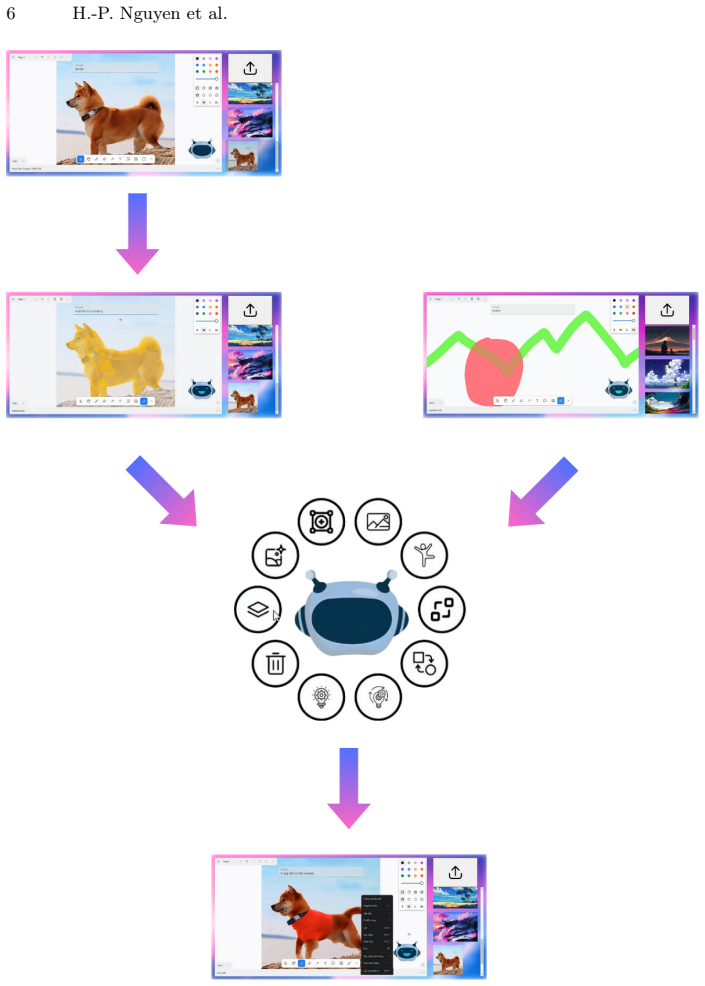
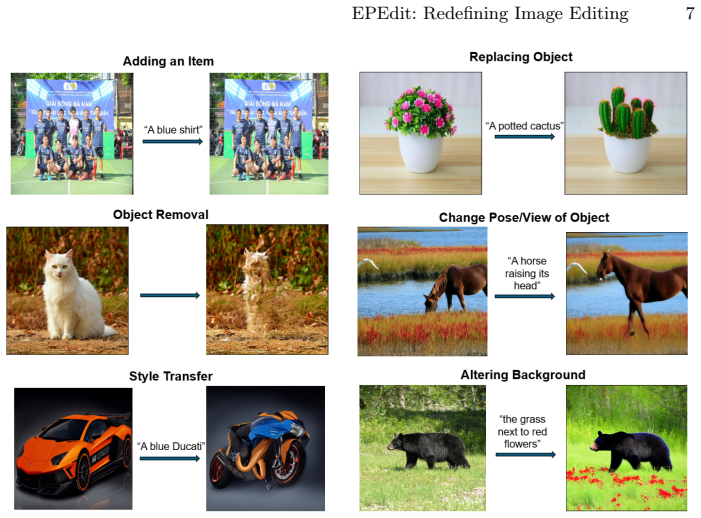
EPEdit integrates a robust backend framework with a user-friendly front-end interface that leverages zero-shot image editing algorithms based on the Stable Diffusion model, supporting image generation, object replacement, object removal, background modification, changes in object pose or perspective, region-specific editing, and thematic collection design all guided by masks and prompts, while user evaluations demonstrate outperformance over existing solutions.
What carries the argument
The zero-shot Stable Diffusion algorithms that enable mask-and-prompt guided edits across multiple task types without additional fine-tuning or adaptation.
Load-bearing premise
Zero-shot Stable Diffusion can reliably support the full listed range of editing tasks including object replacement, pose changes, and thematic collections without any fine-tuning or task-specific adaptation.
What would settle it
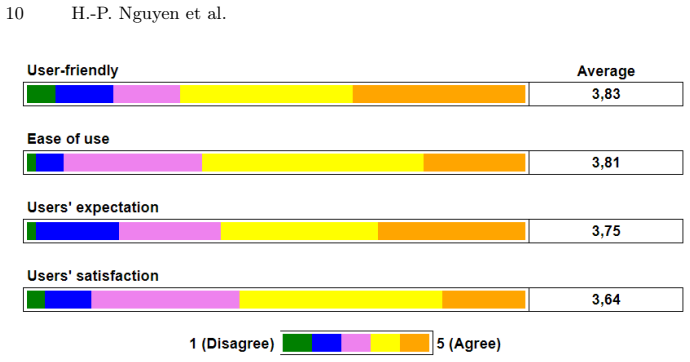
A user study in which participants rate EPEdit equal to or below tools such as Canva or Luminar Neo on image editing quality, thematic design output, or overall system performance.
Figures


read the original abstract
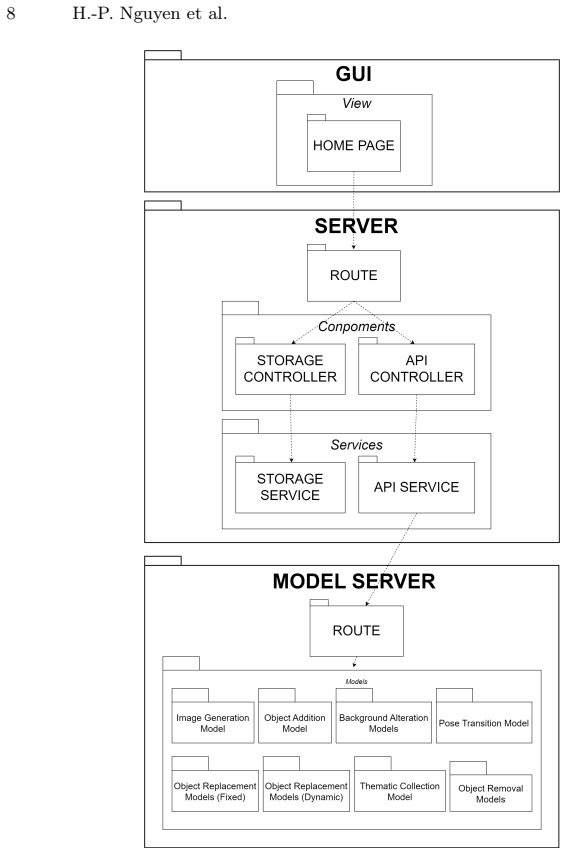
The demand for image manipulation has seen a significant increase recently. Traditional tools like Photoshop and Capture One, while powerful, require considerable expertise to use effectively. Generative AI has introduced alternative platforms, such as Luminar Neo, Pixlr X, and Canva. However, many of these solutions, including resource-heavy models like Stable Diffusion, often require substantial retraining and fine-tuning, leading to high costs for users. To address these challenges, we introduce Efficient Photo Editor (EPEdit), an application that integrates a robust backend framework with a user-friendly front-end interface. EPEdit supports a wide range of creative image editing tasks, including image generation, object replacement, object removal, background modification, changes in object pose or perspective, region-specific editing, and thematic collection design, all guided by masks and prompts. Users can interact with the system through simple text commands or by marking areas for precise adjustments, making it accessible even to those without technical expertise. At its core, EPEdit leverages zero-shot image editing algorithms based on Stable Diffusion model, removing the need for additional fine-tuning. This approach enables efficient image manipulation and thematic collection creation. User evaluations for tasks of image editing, thematic design, and overall system performance demonstrate that EPEdit outperforms existing solutions, offering a user-friendly, cost-effective solution for comprehensive image editing.
Editorial analysis
A structured set of objections, weighed in public.
Referee Report
Summary. The manuscript introduces EPEdit, an application combining a backend based on zero-shot Stable Diffusion algorithms with a user-friendly frontend. It claims support for a broad set of editing operations (image generation, object replacement/removal, background changes, pose/perspective edits, region-specific edits, and thematic collection design) using only masks and text prompts, without any fine-tuning or task-specific adaptation. The central empirical claim is that user evaluations on image editing, thematic design, and overall system performance show EPEdit outperforming existing solutions while remaining cost-effective and accessible.
Significance. If the zero-shot methods were shown to reliably handle structural tasks such as pose changes and if the user study were properly documented and controlled, the work could demonstrate a practical, low-cost interface for generative editing. As presented, however, the absence of any technical specification for the claimed zero-shot capabilities and the complete lack of study-design details prevent assessment of whether the performance claims hold.
major comments (2)
- [Abstract / User Evaluations] Abstract and User Evaluations section: the claim that 'user evaluations ... demonstrate that EPEdit outperforms existing solutions' supplies no information on participant count, recruitment, task instructions, metrics (e.g., Likert scales, success rates), control conditions, statistical tests, or inter-rater reliability. Without these details the outperformance assertion cannot be evaluated and is therefore not load-bearing evidence.
- [Abstract / §3–4] Core technical description (Abstract and §3–4): the paper asserts that unmodified zero-shot Stable Diffusion suffices for object pose/perspective changes and thematic collection design. No specific algorithm, equation, pseudocode, or reference to a zero-shot technique (e.g., prompt-to-prompt, null-text inversion, or any mask-guided variant) is provided, nor are failure cases or ablations shown. Standard zero-shot inpainting rarely achieves reliable structural control without adapters; this gap directly undermines the claim that the listed task range is supported without fine-tuning.
minor comments (2)
- [Abstract] The abstract lists seven distinct editing tasks but the manuscript does not clarify which operations are implemented via which backend call; a table mapping tasks to prompt/mask configurations would improve clarity.
- [Evaluation] No comparison table or quantitative metrics (FID, CLIP score, user-study means) are referenced against the named baselines (Luminar Neo, Pixlr X, Canva); adding such a table would allow readers to gauge the claimed advantages.
Simulated Author's Rebuttal
We thank the referee for their constructive comments. We address each major point below and will revise the manuscript to improve clarity and completeness.
read point-by-point responses
-
Referee: [Abstract / User Evaluations] Abstract and User Evaluations section: the claim that 'user evaluations ... demonstrate that EPEdit outperforms existing solutions' supplies no information on participant count, recruitment, task instructions, metrics (e.g., Likert scales, success rates), control conditions, statistical tests, or inter-rater reliability. Without these details the outperformance assertion cannot be evaluated and is therefore not load-bearing evidence.
Authors: We agree that the user study details were not adequately reported. In the revised manuscript we will expand the User Evaluations section to specify participant count, recruitment method, task instructions, metrics (including Likert scales and success rates), control conditions, statistical tests, and inter-rater reliability. This will allow readers to properly assess the performance claims. revision: yes
-
Referee: [Abstract / §3–4] Core technical description (Abstract and §3–4): the paper asserts that unmodified zero-shot Stable Diffusion suffices for object pose/perspective changes and thematic collection design. No specific algorithm, equation, pseudocode, or reference to a zero-shot technique (e.g., prompt-to-prompt, null-text inversion, or any mask-guided variant) is provided, nor are failure cases or ablations shown. Standard zero-shot inpainting rarely achieves reliable structural control without adapters; this gap directly undermines the claim that the listed task range is supported without fine-tuning.
Authors: We acknowledge that the technical description of the zero-shot methods is insufficient. The revised version will add explicit algorithm descriptions, equations, pseudocode, and references to the specific zero-shot techniques (e.g., mask-guided prompt-to-prompt variants) used for pose/perspective edits and thematic design. We will also include failure cases and ablations to demonstrate how structural control is achieved without fine-tuning or adapters. revision: yes
Circularity Check
No circularity: system description lacks derivations or self-referential reductions
full rationale
The paper describes an application (EPEdit) that integrates zero-shot Stable Diffusion for listed editing tasks and reports user evaluations as evidence of outperformance. No equations, parameter fittings, or mathematical derivations appear in the provided abstract or described content. Claims rest on external user studies rather than any internal chain that reduces by construction to inputs, self-citations, or renamed ansatzes. No load-bearing self-citations, uniqueness theorems, or fitted-input-as-prediction patterns are present, so the description is self-contained with no circular steps.
Axiom & Free-Parameter Ledger
Reference graph
Works this paper leans on
-
[1]
Medical Applications of Artificial Intelligence pp
Agah, A.: Introduction to medical applications of artificial intelligence. Medical Applications of Artificial Intelligence pp. 19–26 (2013)
2013
-
[2]
In: Pro- ceedings of the IEEE/CVF International Conference on Computer Vision (ICCV)
Cao, M., Wang, X., Qi, Z., Shan, Y., Qie, X., Zheng, Y.: Masactrl: Tuning-free mutual self-attention control for consistent image synthesis and editing. In: Pro- ceedings of the IEEE/CVF International Conference on Computer Vision (ICCV). pp. 22560–22570 (October 2023)
2023
-
[3]
In: Ran- zato, M., Beygelzimer, A., Dauphin, Y., Liang, P., Vaughan, J.W
Dhariwal, P., Nichol, A.: Diffusion models beat gans on image synthesis. In: Ran- zato, M., Beygelzimer, A., Dauphin, Y., Liang, P., Vaughan, J.W. (eds.) Advances in Neural Information Processing Systems. vol. 34, pp. 8780–8794. Curran As- sociates, Inc. (2021), https://proceedings.neurips.cc/paper_files/paper/2021/file/ 49ad23d1ec9fa4bd8d77d02681df5cfa-Paper.pdf
2021
-
[4]
Psychoradiology1(2), 94–107 (2021)
Li, F., Sun, H., Biswal, B.B., Sweeney, J.A., Gong, Q.: Artificial intelligence appli- cations in psychoradiology. Psychoradiology1(2), 94–107 (2021)
2021
-
[5]
Progress in energy and combustion science34(5), 574–632 (2008)
Mellit, A., Kalogirou, S.A.: Artificial intelligence techniques for photovoltaic ap- plications: A review. Progress in energy and combustion science34(5), 574–632 (2008)
2008
-
[6]
arXiv preprint arXiv:2112.10741 (2021)
Nichol, A., Dhariwal, P., Ramesh, A., Shyam, P., Mishkin, P., McGrew, B., Sutskever, I., Chen, M.: Glide: Towards photorealistic image generation and editing with text-guided diffusion models. arXiv preprint arXiv:2112.10741 (2021)
Pith/arXiv arXiv 2021
-
[7]
Ramesh, A., Dhariwal, P., Nichol, A., Chu, C., Chen, M.: Hierarchical text- conditional image generation with clip latents. arxiv 2022. arXiv preprint arXiv:2204.06125 (2022)
Pith/arXiv arXiv 2022
-
[8]
In: International conference on machine learning
Ramesh, A., Pavlov, M., Goh, G., Gray, S., Voss, C., Radford, A., Chen, M., Sutskever, I.: Zero-shot text-to-image generation. In: International conference on machine learning. pp. 8821–8831. Pmlr (2021)
2021
-
[9]
In: Proceedings of the IEEE/CVF conference on computer vision and pattern recognition
Rombach, R., Blattmann, A., Lorenz, D., Esser, P., Ommer, B.: High-resolution image synthesis with latent diffusion models. In: Proceedings of the IEEE/CVF conference on computer vision and pattern recognition. pp. 10684–10695 (2022)
2022
-
[10]
Transportation research circular pp
Sadek, A.W.: Artificial intelligence applications in transportation. Transportation research circular pp. 1–7 (2007)
2007
-
[11]
In: Koyejo, S., Mohamed, S., Agarwal, A., Belgrave, D., Cho, K., Oh, A
Saharia, C., Chan, W., Saxena, S., Li, L., Whang, J., Denton, E.L., Ghasemipour, K., Gontijo Lopes, R., Karagol Ayan, B., Salimans, T., Ho, J., Fleet, D.J., Norouzi, M.: Photorealistic text-to-image diffusion models with deep language understand- ing. In: Koyejo, S., Mohamed, S., Agarwal, A., Belgrave, D., Cho, K., Oh, A. (eds.) Advances in Neural Informa...
2022
-
[12]
In: Extended Abstracts of the CHI Conference on Human Factors in Computing Systems
Vo, D.K., Ly, D.N., Le, K.D., Nguyen, T.V., Tran, M.T., Le, T.N.: icontra: Toward thematic collection design via interactive concept transfer. In: Extended Abstracts of the CHI Conference on Human Factors in Computing Systems. CHI EA ’24, Association for Computing Machinery, New York, NY, USA (2024). https://doi. org/10.1145/3613905.3650788, https://doi.o...
-
[13]
arXiv preprint arXiv:2206.107892(3), 5 (2022)
Yu, J., Xu, Y., Koh, J.Y., Luong, T., Baid, G., Wang, Z., Vasudevan, V., Ku, A., Yang, Y., Ayan, B.K., et al.: Scaling autoregressive models for content-rich text-to-image generation. arXiv preprint arXiv:2206.107892(3), 5 (2022)
Pith/arXiv arXiv 2022
discussion (0)
Sign in with ORCID, Apple, or X to comment. Anyone can read and Pith papers without signing in.