Implementation of multi-grid Poisson solver in numerical relativity and its application to gravitational collapse of massive star
Pith reviewed 2026-06-27 08:27 UTC · model grok-4.3
The pith
A multi-grid Poisson solver for numerical relativity preserves baryonic mass to O(10^{-3}) percent and ADM quantities to O(10^{-2})--O(10^{-1}) percent during collapse of a 9-solar-mass star up to core bounce.
A machine-rendered reading of the paper's core claim, the machinery that carries it, and where it could break.
Core claim
We develop a new grid-based multi-grid Poisson solver in numerical relativity. We report the performance of the multi-grid Poisson solver in the initial value problems for two-puncture black holes, a static spherical neutron star, a uniformly rotating neutron star in equilibrium, and a gravitationally collapsing massive star. As a demonstration, we conduct a numerical-relativity neutrino-radiation-transfer hydrodynamics simulation of the gravitational collapse of the 9M_sun massive star up to the core bounce. During the simulation, we employ the constraint-preserving regrid prescription with the newly developed multi-grid Poisson solver to improve the resolution. It shows that the baryonic m
What carries the argument
The multi-grid Poisson solver embedded inside the constraint-preserving regrid prescription, which supplies the gravitational potential at each step of the dynamical evolution.
If this is right
- The solver achieves usable accuracy on two-puncture black-hole initial data.
- It reproduces equilibrium configurations of both static and uniformly rotating neutron stars.
- Baryonic mass stays conserved to O(10^{-3}) percent through the entire collapse run.
- ADM mass and ADM-like angular momentum stay conserved to O(10^{-2})--O(10^{-1}) percent up to core bounce.
- The same regrid-plus-solver combination supports neutrino-radiation hydrodynamics without destabilizing the evolution.
Where Pith is reading between the lines
- The method could be ported to other numerical-relativity codes that already use adaptive or regridding techniques.
- If the same accuracy holds for longer post-bounce evolution, the solver would enable extended supernova simulations with controlled constraint violations.
- Conservation of additional quantities such as linear momentum could be checked in the same framework to test broader applicability.
Load-bearing premise
The multi-grid Poisson solver maintains the required accuracy and stability when embedded inside the constraint-preserving regrid prescription during the dynamical evolution of a collapsing star.
What would settle it
Running the same 9-solar-mass collapse simulation and measuring ADM mass or angular momentum errors larger than O(10^{-1}) percent at core bounce would show the claimed conservation levels are not achieved.
Figures




read the original abstract
We develop a new grid-based multi-grid Poisson solver in numerical relativity. We report the performance of the multi-grid Poisson solver in the initial value problems for two-puncture black holes, a static spherical neutron star, a uniformly rotating neutron star in equilibrium, and a gravitationally collapsing massive star. As a demonstration, we conduct a numerical-relativity neutrino-radiation-transfer hydrodynamics simulation of the gravitational collapse of the $9M_\odot$ massive star in Ref.~\cite{Aguilera-Dena:2020mfh} up to the core bounce. During the simulation, we employ the constraint-preserving regird prescription with the newly developed multi-grid Poisson solver to improve the resolution. It shows that the baryonic mass, the Arnowit-Deser-Misner (ADM) mass, and the ADM-like angular momentum are, respectively, preserved with $O(10^{-3})\%$ and $O(10^{-2})$--$O(10^{-1})$\% accuracy.
Editorial analysis
A structured set of objections, weighed in public.
Referee Report
Summary. The manuscript presents the implementation of a grid-based multi-grid Poisson solver for numerical relativity. It reports performance on initial-value problems for two-puncture black holes, a static spherical neutron star, and a uniformly rotating neutron star in equilibrium. As the main application, the solver is embedded in a neutrino-radiation hydrodynamics simulation of the gravitational collapse of a 9 solar-mass star up to core bounce, using a constraint-preserving regrid prescription; the paper states that baryonic mass is conserved to O(10^{-3})% and ADM mass plus ADM-like angular momentum to O(10^{-2})--O(10^{-1})%.
Significance. If the reported conservation levels are robustly verified, the work supplies a practical multi-grid Poisson solver that can be paired with adaptive regridding in dynamical NR simulations, which is relevant for core-collapse supernova modeling. The explicit use of the solver inside a production collapse run with regridding is a concrete demonstration, though its strength depends on the missing verification steps noted below.
major comments (2)
- [abstract and collapse-simulation results] Abstract (final paragraph) and collapse-simulation section: the central claim that the multi-grid solver maintains the quoted conservation accuracies when combined with the constraint-preserving regrid during dynamical evolution rests on a single production run; the equilibrium tests (two-puncture BHs, static/rotating NS) contain no regridding or time evolution, and no isolated test of solver accuracy/stability under regrid operations is described.
- [performance reports for IVPs and collapse simulation] Results on initial-value problems and collapse run: conservation accuracies are stated without accompanying convergence tests, grid-resolution series, error-bar quantification, or direct comparison against analytic solutions or a reference Poisson solver, preventing independent assessment of the multi-grid method's order and truncation error.
minor comments (1)
- [abstract] Notation for the ADM-like angular momentum should be defined explicitly when first introduced.
Simulated Author's Rebuttal
We thank the referee for the constructive comments. We respond point by point below.
read point-by-point responses
-
Referee: [abstract and collapse-simulation results] Abstract (final paragraph) and collapse-simulation section: the central claim that the multi-grid solver maintains the quoted conservation accuracies when combined with the constraint-preserving regrid during dynamical evolution rests on a single production run; the equilibrium tests (two-puncture BHs, static/rotating NS) contain no regridding or time evolution, and no isolated test of solver accuracy/stability under regrid operations is described.
Authors: The equilibrium tests are static and do not incorporate regridding or evolution. The collapse simulation is a single production run that integrates the multi-grid solver with the constraint-preserving regrid. Conservation accuracies are measured directly from this run. We agree that an isolated test of the solver under regrid operations alone is not presented. In revision we will clarify in the abstract and collapse section that the reported accuracies are obtained from the integrated dynamical simulation. revision: yes
-
Referee: [performance reports for IVPs and collapse simulation] Results on initial-value problems and collapse run: conservation accuracies are stated without accompanying convergence tests, grid-resolution series, error-bar quantification, or direct comparison against analytic solutions or a reference Poisson solver, preventing independent assessment of the multi-grid method's order and truncation error.
Authors: Conservation figures are taken from the single production run. The manuscript does not include a resolution series, error bars, or comparisons to analytic/reference solutions. The multi-grid solver follows the standard second-order convergence of the underlying finite-difference discretization. We will add a short discussion of the expected order and how conservation is computed in the revised manuscript. revision: partial
Circularity Check
No significant circularity; implementation results are measured outcomes
full rationale
The paper reports development of a multi-grid Poisson solver and its performance via direct numerical tests (two-puncture BHs, static/rotating NS equilibria, and a 9Msun collapse simulation with regridding). Conservation figures (baryonic mass O(10^{-3})%, ADM mass/angular momentum O(10^{-2})--O(10^{-1})%) are simulation outputs, not fitted parameters or self-defined quantities. No equations reduce results to inputs by construction, no load-bearing self-citations, and no ansatz or uniqueness claims imported circularly. The work is a self-contained implementation report whose central claims rest on external numerical verification rather than tautological redefinitions.
Axiom & Free-Parameter Ledger
Reference graph
Works this paper leans on
-
[1]
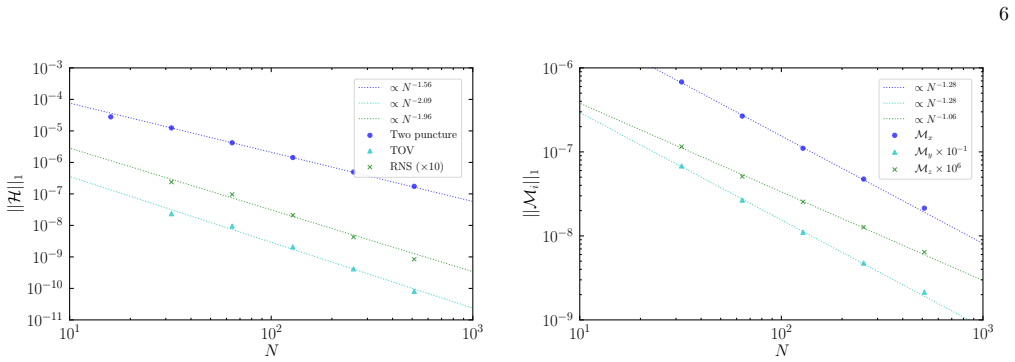
The conver- gence order is≈1.6 for the Hamiltonian constraint, and ≈1.1 for the Momentum constraint
Figure 3 plots the Hamiltonian constraint and the Momentum constraint as a function ofN. The conver- gence order is≈1.6 for the Hamiltonian constraint, and ≈1.1 for the Momentum constraint. Likely in the uni- formly rotating neutron star problem, the source termS i in Eqs. (3.9)–(3.10), which is discontinuous at the bound- ary between different chemical c...
-
[2]
Jacobi method The Jacobi method is a classical iterative scheme for solving discretized equations. For a nonlinear equation 8 0.0 0.1 0.2 0.3 0.4 0.5 0.6 0.7 0.8 t [s] 10−5 10−4 10−3 10−2 |MADM/MADM(0) − 1| ∆x(9) = 3.68 km ∆x(14) = 0.115 km ∆x(9) = 4.98 km ∆x(14) = 0.156125 km ∆x(9) = 7.56 km ∆x(14) = 0.23625 km 0.0 0.2 0.4 0.6 t [s] 10−5 10−4 10−3 10−2 |...
-
[3]
W4 method In contrast, the W4 method incorporates the depen- dence of the nonlinear source term on the solution more effectively. The W4 iteration can be written in a general form as x(k+1) =x (k) +ωXp (k), p(k+1) = (1−2ω)p (k) −Y b(x(k))−Ax (k) ,(A3) whereXandYare matrices that are ideally derived from the Jacobian matrix. In this setup, we chooseX=I and...
-
[4]
The restriction operator transfers information from the finer grid to the coarser gridx H =I H h xh
Restriction and Prolongation Operators In this subsection, we define the restriction and pro- longation operators used in our code. The restriction operator transfers information from the finer grid to the coarser gridx H =I H h xh. Specifi- cally, variables on the coarser grid are obtained using a weighted averaging scheme by applying a tensor-product st...
-
[5]
D. R. Aguilera-Dena, N. Langer, J. Antoniadis, and B. M¨ uller, Astrophys. J.901, 114 (2020), arXiv:2008.09132 [astro-ph.SR]
arXiv 2020
-
[6]
B. P. Abbott et al. (LIGO Scientific, Virgo), Phys. Rev. Lett.116, 061102 (2016), arXiv:1602.03837 [gr-qc]
Pith/arXiv arXiv 2016
-
[7]
B. P. Abbott et al. (LIGO Scientific, Virgo), Phys. Rev. Lett.119, 161101 (2017), arXiv:1710.05832 [gr-qc]
Pith/arXiv arXiv 2017
-
[8]
B. P. Abbott et al. (LIGO Scientific, Virgo, Fermi GBM, INTEGRAL, IceCube, AstroSat Cadmium Zinc Telluride Imager Team, IPN, Insight-Hxmt, ANTARES, Swift, AGILE Team, 1M2H Team, Dark Energy Camera GW-EM, DES, DLT40, GRAWITA, Fermi-LAT, ATCA, ASKAP, Las Cumbres Observatory Group, OzGrav, DWF (Deeper Wider Faster Program), AST3, CAAS- TRO, VINROUGE, MASTER,...
Pith/arXiv arXiv 2017
-
[9]
B. P. Abbott et al. (LIGO Scientific, Virgo), Phys. Rev. X9, 011001 (2019), arXiv:1805.11579 [gr-qc]
Pith/arXiv arXiv 2019
-
[10]
B. P. Abbott et al. (LIGO Scientific, Virgo), Phys. Rev. Lett.121, 161101 (2018), arXiv:1805.11581 [gr-qc]
Pith/arXiv arXiv 2018
- [11]
- [12]
-
[13]
K. Hayashi, K. Kiuchi, K. Kyutoku, Y. Sekiguchi, and M. Shibata, Phys. Rev. Lett.134, 211407 (2025), arXiv:2410.10958 [astro-ph.HE]. 10
arXiv 2025
-
[14]
S. Fujibayashi, K. Kiuchi, S. Wanajo, K. Kyutoku, Y. Sekiguchi, and M. Shibata, Astrophys. J.942, 39 (2023), arXiv:2205.05557 [astro-ph.HE]
arXiv 2023
-
[15]
S. Fujibayashi, M. Shibata, S. Wanajo, K. Kiuchi, K. Kyutoku, and Y. Sekiguchi, Phys. Rev. D101, 083029 (2020), arXiv:2001.04467 [astro-ph.HE]
arXiv 2020
-
[16]
S. Fujibayashi, S. Wanajo, K. Kiuchi, K. Kyutoku, Y. Sekiguchi, and M. Shibata, Astrophys. J.901, 122 (2020), arXiv:2007.00474 [astro-ph.HE]
arXiv 2020
-
[17]
S. Fujibayashi, M. Shibata, S. Wanajo, K. Kiuchi, K. Kyutoku, and Y. Sekiguchi, Phys. Rev. D102, 123014 (2020), arXiv:2009.03895 [astro-ph.HE]
arXiv 2020
-
[18]
S. Fujibayashi, K. Kiuchi, N. Nishimura, Y. Sekiguchi, and M. Shibata, Astrophys. J.860, 64 (2018), arXiv:1711.02093 [astro-ph.HE]
Pith/arXiv arXiv 2018
-
[19]
M. Shibata, S. Fujibayashi, and Y. Sekiguchi, Phys. Rev. D103, 043022 (2021), arXiv:2102.01346 [astro-ph.HE]
arXiv 2021
-
[20]
M. Shibata, S. Fujibayashi, and Y. Sekiguchi, Phys. Rev. D104, 063026 (2021), arXiv:2109.08732 [astro-ph.HE]
arXiv 2021
-
[21]
H. Gieg, R. Jaeger, M. Ujevic, and T. Dietrich, (2026), arXiv:2604.14225 [astro-ph.HE]
Pith/arXiv arXiv 2026
-
[22]
B. Daszuta, S. Bernuzzi, M. Jacobi, E. M. Guti´ errez, P. Hammond, W. Cook, and D. Radice, (2026), arXiv:2602.18290 [gr-qc]
arXiv 2026
-
[23]
E. R. Most and E. Quataert, Astrophys. J. Lett.947, L15 (2023), arXiv:2303.08062 [astro-ph.HE]
arXiv 2023
-
[24]
K. Hayashi, S. Fujibayashi, K. Kiuchi, K. Kyutoku, Y. Sekiguchi, and M. Shibata, (2021), arXiv:2111.04621 [astro-ph.HE]
arXiv 2021
-
[25]
K. Hayashi, K. Kiuchi, K. Kyutoku, Y. Sekiguchi, and M. Shibata, Phys. Rev. D107, 123001 (2023), arXiv:2211.07158 [astro-ph.HE]
arXiv 2023
- [26]
-
[27]
F. Foucart et al., Phys. Rev. D99, 044008 (2019), arXiv:1812.06988 [gr-qc]
Pith/arXiv arXiv 2019
-
[28]
M. Boyle et al., Class. Quant. Grav.36, 195006 (2019), arXiv:1904.04831 [gr-qc]
arXiv 2019
-
[29]
M. A. Scheel et al., Class. Quant. Grav.42, 195017 (2025), arXiv:2505.13378 [gr-qc]
arXiv 2025
-
[30]
S. Fujibayashi, Y. Sekiguchi, M. Shibata, and S. Wanajo, Astrophys. J.956, 100 (2023), arXiv:2212.03958 [astro- ph.HE]
arXiv 2023
-
[31]
S. Fujibayashi, A. T.-L. Lam, M. Shibata, and Y. Sekiguchi, Phys. Rev. D109, 023031 (2024), arXiv:2309.02161 [astro-ph.HE]
arXiv 2024
-
[32]
M. Shibata, S. Fujibayashi, A. T.-L. Lam, K. Ioka, and Y. Sekiguchi, Phys. Rev. D109, 043051 (2024), arXiv:2309.12086 [astro-ph.HE]
arXiv 2024
-
[33]
M. Shibata, S. Fujibayashi, S. Wanajo, K. Ioka, A. T.- L. Lam, and Y. Sekiguchi, Phys. Rev. D111, 123017 (2025), arXiv:2502.02077 [astro-ph.HE]
arXiv 2025
- [34]
-
[35]
T. Kuroda and M. Shibata, Mon. Not. Roy. Astron. Soc. 533, L107 (2024), arXiv:2404.02792 [astro-ph.HE]
arXiv 2024
-
[36]
T. Kuroda and M. Shibata, Mon. Not. Roy. Astron. Soc. 526, 152 (2023), arXiv:2307.06192 [astro-ph.HE]
arXiv 2023
-
[37]
A. T. L. Lam, M. Shibata, and K. Kiuchi, Phys. Rev. D 107, 043033 (2023), arXiv:2212.10891 [astro-ph.HE]
arXiv 2023
- [38]
-
[39]
P. C.-K. Cheong, T. Pitik, L. F. Longo Micchi, and D. Radice, Astrophys. J. Lett.978, L38 (2025), arXiv:2410.10938 [astro-ph.HE]
arXiv 2025
- [40]
-
[41]
F. Foucart et al., Phys. Rev. D103, 064007 (2021), arXiv:2010.14518 [gr-qc]
arXiv 2021
-
[42]
N. Deppe et al., Class. Quant. Grav.41, 245002 (2024), arXiv:2406.19038 [gr-qc]
arXiv 2024
-
[43]
P. Grandclement, J. Comput. Phys.229, 3334 (2010), arXiv:0909.1228 [gr-qc]
Pith/arXiv arXiv 2010
-
[44]
L. J. Papenfort, S. D. Tootle, P. Grandcl´ ement, E. R. Most, and L. Rezzolla, Phys. Rev. D104, 024057 (2021), arXiv:2103.09911 [gr-qc]
arXiv 2021
-
[45]
Balsara, J
D. Balsara, J. Comp. Phys.174, 614 (2001)
2001
-
[46]
K. Kiuchi, K. Kyutoku, and M. Shibata, Phys. Rev. D 86, 064008 (2012), arXiv:1207.6444 [astro-ph.HE]
Pith/arXiv arXiv 2012
-
[47]
D. Hilditch, S. Bernuzzi, M. Thierfelder, Z. Cao, W. Tichy, and B. Bruegmann, Phys. Rev. D88, 084057 (2013), arXiv:1212.2901 [gr-qc]
Pith/arXiv arXiv 2013
-
[48]
Y. Sekiguchi and M. Shibata, Astrophys. J.737, 6 (2011), arXiv:1009.5303 [astro-ph.HE]
Pith/arXiv arXiv 2011
-
[49]
T. Kuroda, T. Takiwaki, and K. Kotake, Astrophys. J. Suppl.222, 20 (2016), arXiv:1501.06330 [astro-ph.HE]
Pith/arXiv arXiv 2016
-
[50]
Brandt, Mathematics of Computation31, 333 (1977)
A. Brandt, Mathematics of Computation31, 333 (1977)
1977
-
[51]
J. D. Brown and L. L. Lowe, Journal of Computational Physics209, 582 (2005)
2005
-
[52]
Teunissen and R
J. Teunissen and R. Keppens, Computer Physics Com- munications245, 106866:1 (2019)
2019
-
[53]
Okawa, K
H. Okawa, K. Fujisawa, Y. Yamamoto, R. Hirai, N. Yasu- take, H. Nagakura, and S. Yamada, Applied Numerical Mathematics183, 157 (2023)
2023
-
[54]
K. Fujisawa, H. Okawa, Y. Yamamoto, and S. Yamada, Astrophys. J.872, 155 (2019), arXiv:1809.04358 [astro- ph.HE]
Pith/arXiv arXiv 2019
- [55]
- [56]
- [57]
- [58]
-
[59]
S. Brandt and B. Bruegmann, Phys. Rev. Lett.78, 3606 (1997), arXiv:gr-qc/9703066
Pith/arXiv arXiv 1997
-
[60]
C. W. Misner, K. S. Thorne, and J. A. Wheeler, Gravitation (1973)
1973
-
[61]
V. Paschalidis and N. Stergioulas, Living Rev. Rel.20, 7 (2017), arXiv:1612.03050 [astro-ph.HE]
Pith/arXiv arXiv 2017
-
[62]
J. W. York, Jr., Phys. Rev. Lett.82, 1350 (1999), arXiv:gr-qc/9810051
Pith/arXiv arXiv 1999
-
[63]
H. P. Pfeiffer and J. W. York, Jr., Phys. Rev. D67, 044022 (2003), arXiv:gr-qc/0207095
Pith/arXiv arXiv 2003
-
[64]
M¨ uther, M
H. M¨ uther, M. Prakash, and T. L. Ainsworth, Phys. Lett. B199, 469 (1987)
1987
-
[65]
Gourgoulhon, (2007), arXiv:gr-qc/0703035
E. Gourgoulhon, (2007), arXiv:gr-qc/0703035
Pith/arXiv arXiv 2007
-
[66]
Shibata, Numerical Relativity (World Scientific Pub- lishing Company, 2016)
M. Shibata, Numerical Relativity (World Scientific Pub- lishing Company, 2016)
2016
- [67]
-
[68]
Shibata and N
M. Shibata and N. Takashi, Phys. Rev. D52, 5428 (1995)
1995
-
[69]
T. W. Baumgarte and S. L. Shapiro, Phys. Rev. D59, 024007 (1998), arXiv:gr-qc/9810065
Pith/arXiv arXiv 1998
-
[70]
M. Campanelli, C. O. Lousto, P. Marronetti, and Y. Zlo- chower, Phys. Rev. Lett.96, 111101 (2006), arXiv:gr- qc/0511048
arXiv 2006
-
[71]
J. G. Baker, J. Centrella, D.-I. Choi, M. Koppitz, and J. van Meter, Phys. Rev. Lett.96, 111102 (2006), arXiv:gr-qc/0511103
Pith/arXiv arXiv 2006
-
[72]
A. Mignone and G. Bodo, Mon. Not. Roy. Astron. Soc. 364, 126 (2005), arXiv:astro-ph/0506414
Pith/arXiv arXiv 2005
-
[73]
C. J. White, J. M. Stone, and C. F. Gammie, Astro- phys. J. Suppl.225, 22 (2016), arXiv:1511.00943 [astro- ph.HE]
Pith/arXiv arXiv 2016
-
[74]
Colella and P
P. Colella and P. R. Woodward, Journal of Computa- tional Physics54, 174 (1984)
1984
-
[75]
Y. Sekiguchi, Prog. Theor. Phys.124, 331 (2010), arXiv:1009.3320 [astro-ph.HE]
Pith/arXiv arXiv 2010
-
[76]
Y. Sekiguchi, K. Kiuchi, K. Kyutoku, and M. Shibata, Phys. Rev. Lett.107, 051102 (2011), arXiv:1105.2125 [gr-qc]
Pith/arXiv arXiv 2011
-
[77]
Y. Sekiguchi, K. Kiuchi, K. Kyutoku, and M. Shibata, Phys. Rev. D91, 064059 (2015), arXiv:1502.06660 [astro- ph.HE]
Pith/arXiv arXiv 2015
-
[78]
Y. Sekiguchi, K. Kiuchi, K. Kyutoku, M. Shibata, and K. Taniguchi, Phys. Rev. D93, 124046 (2016), arXiv:1603.01918 [astro-ph.HE]
Pith/arXiv arXiv 2016
-
[79]
M. Hempel and J. Schaffner-Bielich, Nucl. Phys. A837, 210 (2010), arXiv:0911.4073 [nucl-th]
Pith/arXiv arXiv 2010
-
[80]
F. X. Timmes and F. D. Swesty, Astrophys. J. Suppl. 126, 501 (2000)
2000
discussion (0)
Sign in with ORCID, Apple, or X to comment. Anyone can read and Pith papers without signing in.