On the Charged Fragments Tagging in the ATLAS Detector during the 2025 Oxygen Campaign
Pith reviewed 2026-06-28 07:58 UTC · model grok-4.3
The pith
AFP detectors in ATLAS tag charged fragments during 2025 oxygen-ion collisions at the LHC.
A machine-rendered reading of the paper's core claim, the machinery that carries it, and where it could break.
Core claim
The insertion of AFP detectors on both sides during the 2025 oxygen campaign enables the tagging of scattered fragments in the recorded data, as demonstrated by preliminary studies of what could be visible in the AFP.
What carries the argument
The ATLAS Forward Proton (AFP) detectors inserted on proton and ion sides to tag charged fragments.
If this is right
- Many interesting studies become accessible with scattered fragments being tagged.
- Preliminary studies indicate what signals could be visible in the AFP during these collisions.
- Analysis ideas for proton-oxygen and oxygen-oxygen collisions are outlined.
Where Pith is reading between the lines
- Similar tagging could be applied to other ion species or future runs for broader studies of nuclear interactions.
- Combining AFP data with central ATLAS detectors might allow more complete event reconstruction in ion collisions.
Load-bearing premise
The AFP detectors can effectively detect and tag the charged fragments produced in these specific ion collisions as described in the preliminary studies.
What would settle it
Observation of no charged fragment signals or tagging rates significantly below expectations in the actual 2025 AFP data would falsify the claim.
Figures
read the original abstract
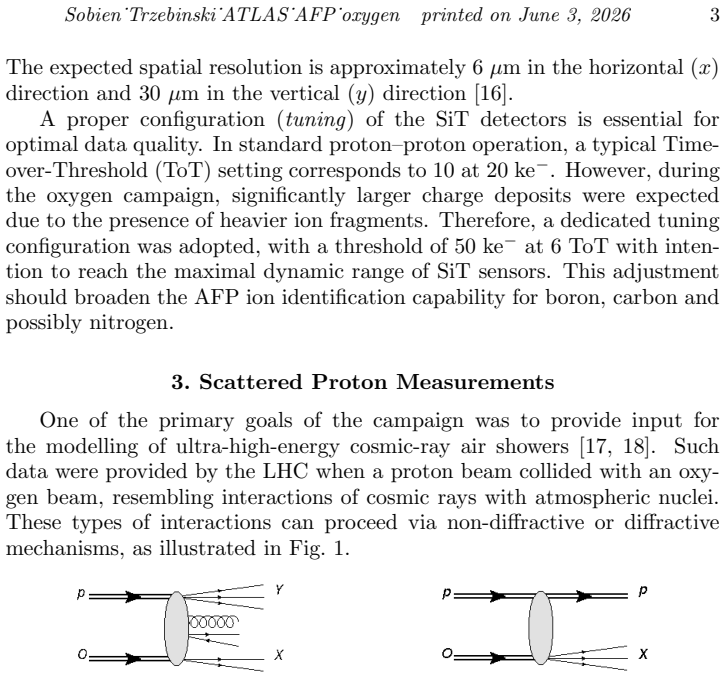
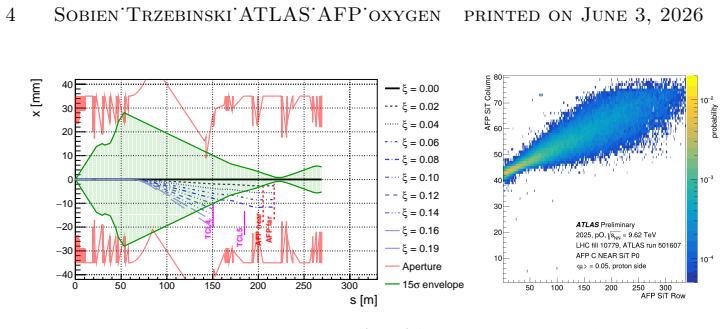
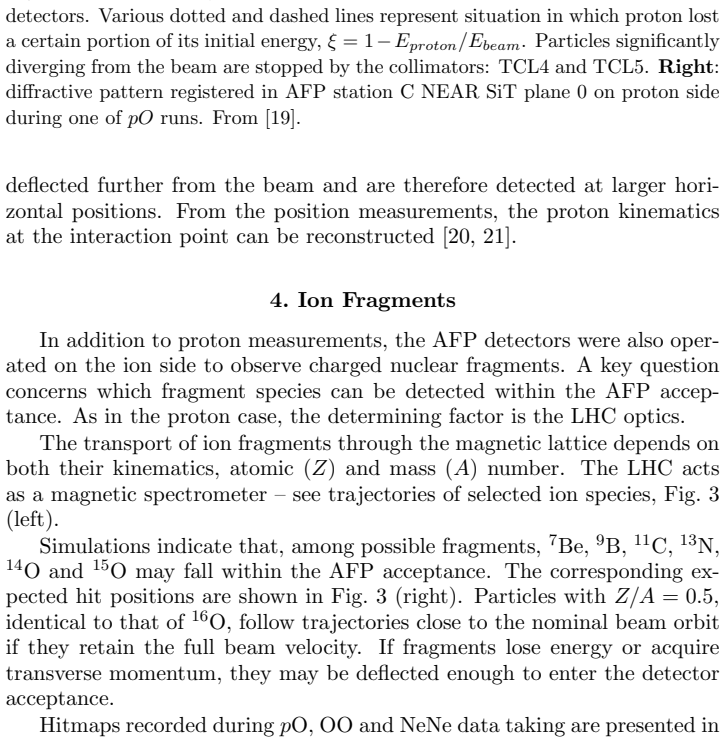
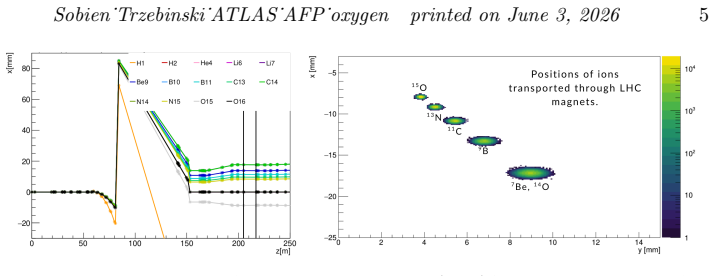
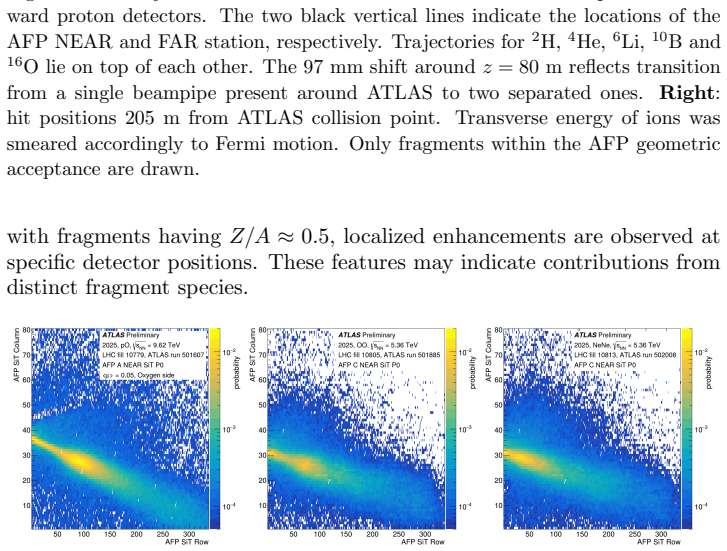
During the Summer of 2025 the LHC collided protons with oxygen, oxygen with oxygen and neon with neon. The ATLAS experiment recorded these data with its Forward Proton detectors (AFP) inserted on both: the proton and ion sides. This allows access to many interesting studies with scattered fragments being tagged. A few analysis ideas are presented followed by preliminary studies of what could be visible in the AFP.
Editorial analysis
A structured set of objections, weighed in public.
Referee Report
Summary. The manuscript describes the use of ATLAS Forward Proton (AFP) detectors inserted during the 2025 LHC oxygen campaign for p-O, O-O, and Ne-Ne collisions. It claims this configuration enables tagging of scattered charged fragments and thereby grants access to multiple physics studies; a short list of analysis ideas is followed by a reference to unspecified preliminary visibility studies in the AFP.
Significance. If the feasibility of fragment tagging were quantitatively demonstrated, the work could open a new experimental channel for studying nuclear fragmentation and structure in light-ion collisions by repurposing existing forward-proton infrastructure. The current text, however, supplies only conceptual statements without supporting metrics, so its potential impact remains unrealized.
major comments (2)
- [preliminary studies] The section following the analysis ideas (referred to as 'preliminary studies of what could be visible in the AFP') asserts that visibility studies have been performed yet contains no efficiency curves, acceptance calculations, resolution estimates, or background-rejection figures as a function of fragment charge, Z/A ratio, or rapidity. This absence is load-bearing for the central claim that AFP tagging is effective for the relevant nuclear fragments.
- [introduction / abstract] No quantitative assessment is given of how the AFP acceptance, timing resolution, or tracking performance (originally tuned for forward protons in pp running) translates to the kinematics and charge states of nuclear fragments in p-O, O-O, or Ne-Ne collisions. Without such numbers the assertion that 'many interesting studies' become accessible cannot be evaluated.
minor comments (1)
- [abstract] The abstract contains the phrasing 'on both: the proton and ion sides,' which is stylistically awkward and should be reworded for clarity.
Simulated Author's Rebuttal
We thank the referee for the constructive comments, which correctly identify that the manuscript is conceptual in nature. We address each major comment below and will revise the text to clarify the scope and limitations of the presented ideas and studies.
read point-by-point responses
-
Referee: [preliminary studies] The section following the analysis ideas (referred to as 'preliminary studies of what could be visible in the AFP') asserts that visibility studies have been performed yet contains no efficiency curves, acceptance calculations, resolution estimates, or background-rejection figures as a function of fragment charge, Z/A ratio, or rapidity. This absence is load-bearing for the central claim that AFP tagging is effective for the relevant nuclear fragments.
Authors: We agree that the preliminary studies section contains only qualitative kinematic considerations based on AFP geometry and does not include quantitative metrics such as efficiency curves, acceptance calculations, or resolution estimates. No dedicated Monte Carlo simulations for nuclear fragments were performed. We will revise this section to explicitly describe the studies as initial conceptual assessments, remove any implication of detailed quantitative visibility studies, and note that full simulations are beyond the scope of this short note. revision: yes
-
Referee: [introduction / abstract] No quantitative assessment is given of how the AFP acceptance, timing resolution, or tracking performance (originally tuned for forward protons in pp running) translates to the kinematics and charge states of nuclear fragments in p-O, O-O, or Ne-Ne collisions. Without such numbers the assertion that 'many interesting studies' become accessible cannot be evaluated.
Authors: We agree that the manuscript provides no quantitative assessment of how AFP performance parameters translate to nuclear fragments. The text is intended as a short communication highlighting an experimental opportunity rather than a full feasibility study. We will revise the abstract and introduction to use more cautious language, stating that the configuration may enable access to studies pending future quantitative work on acceptance and resolution for the relevant charge states and kinematics. revision: yes
Circularity Check
No circularity; paper is a conceptual note with no derivations, fits, or self-referential predictions
full rationale
The manuscript presents analysis ideas for tagging charged fragments with AFP detectors in 2025 ion runs and mentions 'preliminary studies' without any equations, parameter fits, predictions of derived quantities, or load-bearing self-citations. No derivation chain exists that could reduce to its own inputs. The central claim is a feasibility statement resting on detector performance assumptions, but this is not circularity per the enumerated patterns; it is simply an unquantified assertion. This is the normal non-finding for a short conceptual note.
Axiom & Free-Parameter Ledger
Reference graph
Works this paper leans on
-
[1]
Breweret al., CERN-TH-2021-028, arXiv:2103.01939
J. Breweret al., CERN-TH-2021-028, arXiv:2103.01939
- [2]
-
[3]
Bierlichet al., JHEP10(2018) 134
Ch. Bierlichet al., JHEP10(2018) 134
2018
-
[4]
EPOS LHC : test of collective hadronization with LHC data
T. Pieroget al., arXiv:1306.0121
work page internal anchor Pith review Pith/arXiv arXiv
-
[5]
Riehnet al., Phys
F. Riehnet al., Phys. Rev. D102(2020) 063002
2020
-
[6]
ATLAS Collaboration, arXiv:2509.05171
work page internal anchor Pith review Pith/arXiv arXiv
-
[7]
Grabowska-Bold, Acta Phys
I. Grabowska-Bold, Acta Phys. Pol. B Proc. Suppl.18(2025) 5-A10
2025
-
[8]
LHC results and hadronic interaction models
S. Ostapchenko, arXiv:1612.09461
work page internal anchor Pith review Pith/arXiv arXiv
-
[9]
M. Tasevsky, arXiv:1802.02818
work page internal anchor Pith review Pith/arXiv arXiv
- [10]
-
[11]
ATLAS Collaboration, JINST3(2008) S08003
2008
-
[12]
Avoniet al., JINST20(2025) P11021
G. Avoniet al., JINST20(2025) P11021
2025
-
[13]
ATLAS Collaboration, CERN-LHCC-2015-009, ATLAS-TDR-024
2015
-
[14]
LHCf Collaboration, JINST3(2008) S08006
2008
-
[15]
Garcia-Scivereset al., Nucl
M. Garcia-Scivereset al., Nucl. Instrum. Meth. A636(2011) S155
2011
-
[16]
Langeet al., JINST11(2016) P09005
J. Langeet al., JINST11(2016) P09005
2016
-
[17]
Parsonset al., Astropart
R. Parsonset al., Astropart. Phys.34(2011) 832
2011
-
[18]
R. D. Parsons and H. Schoorlemmer, Phys. Rev. D100(2019) 023010
2019
-
[19]
ATLAS Collaboration, Forward Detector Public Results
-
[20]
Staszewski and J
R. Staszewski and J. Chwastowski, Nucl. Instrum. Meth. A609(2009) 136
2009
-
[21]
Trzebinskiet al., ISRN High Energy Phys.2012(2012) 491460
M. Trzebinskiet al., ISRN High Energy Phys.2012(2012) 491460
2012
discussion (0)
Sign in with ORCID, Apple, or X to comment. Anyone can read and Pith papers without signing in.