REVIEW 3 major objections 4 minor 1 cited by
Transformers can perform in-context prediction on Permuted Congruential Generator sequences, with required context growing as the square root of the modulus.
Reviewed by Pith at T0; open to challenge. T0 means a machine referee read the full paper against a public rubric. the ladder, T0–T4 →
T0 review · deepseek-v4-flash
2026-08-04 07:03 UTC pith:VWPP6L7N
load-bearing objection Solid capability result — transformers can in-context learn PCGs and generalize to unseen parameters — but the sqrt(m) scaling law is softer than the abstract implies: the largest modulus is measured under a different training protocol and not at the predicted context length. the 3 major comments →
Learning Pseudorandom Numbers with Transformers: Permuted Congruential Generators, Curricula, and Interpretability
The pith
A machine-rendered reading of the paper's core claim, the machinery that carries it, and where it could break.
Core claim
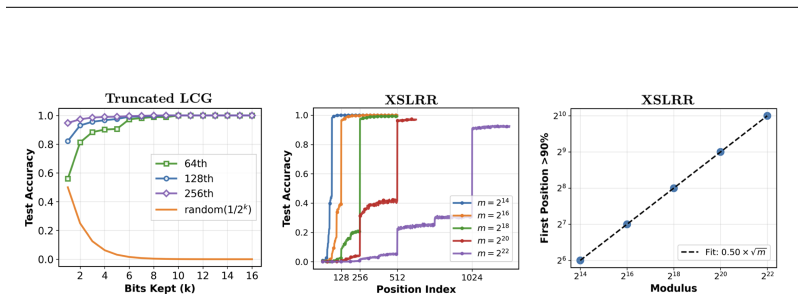
The central discovery is that Transformers can perform in-context prediction on PCG sequences without knowing the generator's parameters, generalizing to unseen multipliers and increments. For moduli m up to 2^22, the context length required to exceed 90% test accuracy follows 0.5 sqrt(m). For LCGs the analogous law is m^0.25, so PCG's output permutations make the task substantially harder. Training on large moduli requires a curriculum: initializing from a smaller-modulus model and slowly decaying the fraction of smaller-modulus data; without it, optimization stagnates at high loss for at least 75k steps. The paper further finds that the embedding layer encodes rotation-invariant zero-run s
What carries the argument
The central object is the PCG recurrence s_i = (a s_{i-1} + c) mod m with an output permutation f (shift, XOR, rotations, truncations) controlled by state bits. The key quantitative identity is the empirical scaling law: required context C(m) ~ 0.5 sqrt(m) for 90% accuracy, derived from accuracy-position curves. The curriculum mechanism—pretrained initialization plus exponential decay of smaller-modulus data mixing—carries the argument for scaling to m >= 2^20. The interpretability result uses PCA of the embedding matrix, where PC1 and PC2 correlate with total zero count and number of zero runs, respectively.
Load-bearing premise
The scaling law and the necessity of curriculum training are measured under a single training configuration up to m=2^22 with no error bars, so the claims assume that these behaviors persist at larger moduli and under longer training budgets.
What would settle it
Train on XSLRR with m=2^24 or m=2^26 using the same 75k-step budget and curriculum; if the context length required for 90% accuracy grows faster than sqrt(m), or if direct training without curriculum converges when given, say, 300k steps, the scaling law and the 'critical necessity' of curriculum would be refuted.
If this is right
- PCG outputs, including single-bit truncations, are predictable by Transformers from sequence context alone, without knowing the multiplier or increment.
- The required context grows as sqrt(m), steeper than the m^0.25 law for LCGs, so the permutation operations measurably increase the difficulty.
- Curriculum learning with a pretrained small-modulus model is necessary to train on moduli 2^20 and above within a fixed step budget; without it optimization stagnates.
- The embedding layer's rotation-invariant zero-run clusters transfer across moduli, explaining how pretrained initialization accelerates training.
- In combined training, the model separates generator types in its middle layers, allowing a single model to handle multiple PRNG variants.
Where Pith is reading between the lines
- If the sqrt(m) scaling extrapolates to m=2^64, a model would need roughly 2^32 in-context elements, so current Transformers would not threaten practical generators directly; the value is in studying the mechanism, not in a practical break.
- The rotation-invariant clustering suggests the model learns a representation of binary strings modulo rotation; one could test whether this is specific to PCGs with random rotations by training on LCGs with similar rotation output and checking whether the same clusters emerge.
- The curriculum finding may generalize to other algorithmic tasks where the target distribution is unimodal in difficulty; the paper's decay schedule comparison suggests exponential decay is a robust choice.
- A testable extension: measure whether the required context for other PCG variants (XSHRR, XSHRS) also follows sqrt(m), or whether the exponent depends on the permutation structure; the paper only reports the scaling for XSLRR.
Editorial analysis
A structured set of objections, weighed in public.
Referee Report
Summary. The paper studies whether Transformer models can learn to predict outputs of Permuted Congruential Generators (PCGs) in-context, given only a sequence of observed outputs and no explicit knowledge of the generator's parameters. The authors train GPT-style models on several PCG variants (TLCG, XSLRR, XSHRR, XSHRS) across moduli from 2^14 to 2^22, using up to 52M parameters and 5.4B tokens. They report high test accuracy on unseen (a,c) parameters, robust prediction even under single-bit truncation, successful joint learning of multiple generator types, a scaling law in which the context length required for 90% accuracy grows as 0.5*sqrt(m), the 'critical necessity' of curriculum learning/pretrained initialization for m>=2^20, and an interpretability result showing that token embeddings cluster by rotation-invariant zero-run patterns. The paper claims this goes beyond published classical PCG attacks, which assume the multiplier and modulus are known.
Significance. If the core results hold, this is a useful contribution to the empirical study of Transformers on structured algorithmic tasks: it shows that a non-linear, truncated state-update family can be learned in-context, and the embedding analysis is a valuable interpretability datapoint. The authors provide code and a detailed appendix with additional ablations, which supports reproducibility. The main advertised quantitative claim—the sqrt(m) scaling law—and the 'critical necessity' of curriculum learning are less secure and currently exceed the evidence. The capability result (reliable prediction across PCG variants) is convincing from Figures 2 and 3(left), but the scaling and curriculum claims need substantial qualification or additional experiments before the paper should be accepted.
major comments (3)
- [§4.2, Figure 3, Appendix B] The headline scaling law 'required context grows as 0.5*sqrt(m)' is not directly supported at the largest modulus. For m=2^22, Appendix B reports only the accuracy at position 1279 (0.9257), not at the predicted 0.5*sqrt(m)=1024. No position-1024 accuracy is shown, so the plotted point for m=2^22 does not correspond to the claimed threshold. Moreover, m=2^20 and m=2^22 use pretrained initialization and curriculum mixing from smaller moduli, while m=2^14–2^18 use direct training, so the fit conflates task difficulty with optimization budget and initialization. Please either report the actual first-crossing position under a consistent protocol, show that the conclusion is robust to these protocol differences, or explicitly reframe the claim as a property of the specific training configurations used.
- [§5, Figure 6, Abstract] The abstract's statement that curriculum learning is a 'critical necessity' for m>=2^20 is stronger than the evidence. Figure 6(a,b) shows that random initialization without curriculum does not converge within a fixed budget of 75k steps at m=2^20. This demonstrates a within-budget failure, not a necessity in general. To support 'requires', the authors should show that extended training still fails, or soften the claim to 'under our fixed compute budget, curriculum learning was necessary to reach strong performance.' As written, this is a load-bearing overstatement because it is presented as a main finding.
- [§4.2, §C.1, Figure 14] The scaling-law exponent is threshold-dependent and lacks uncertainty quantification. Using a fixed 90% threshold yields beta≈0.5, but changing to an additive epsilon-over-random threshold gives beta in [0.4,0.5], and a multiplicative gamma-over-random threshold gives beta in [0.33,0.34] (Section C.1). With a single run per modulus and no error bars, the abstract's 'grows as sqrt(m)' is not a robust law. Please report seeds or confidence intervals, and if the exponent varies with the accuracy threshold, qualify the claim accordingly.
minor comments (4)
- [Abstract] The phrase 'the number of in-context sequence elements required for near-perfect prediction grows as sqrt(m)' would be more accurate if qualified as 'in the configurations we tested, the context lengths used were approximately 0.5*sqrt(m)'.
- [Figure 3 caption] The caption states that accuracy improves 'once the context length reaches exactly 0.5*sqrt(m)'. The word 'exactly' is not supported by the data, since no accuracy at that exact position is reported for m=2^22, and for m=2^20 the reported evaluation is at position 640, not 512.
- [§5.2] The detail that only the overlapping portion of the embedding matrix is transferred (with new tokens randomly initialized) is important for interpreting the scaling results. Consider making it explicit in the main-text discussion around Figure 6, not only in the appendix.
- [General] The paper does not state whether results are single-seed or averaged. Since the scaling law is a central quantitative claim, a sentence describing the number of runs and seed handling would help.
Circularity Check
No significant circularity: the paper is an empirical measurement and comparison study, not a derivation that reduces to its inputs.
full rationale
This paper does not derive predictions from assumptions whose definitions already contain the target result. The headline claims—in-context prediction of PCG variants, the sqrt(m) scaling of required context, the necessity of curriculum training at large moduli, and rotational clustering in embeddings—are supported by direct measurements with specified training/evaluation protocols. The scaling law is a fitted description of observed accuracy-versus-position curves, not a parameter fitted to the target quantity and then reported as a prediction; the same data are used to fit the exponent, which is standard empirical curve fitting rather than circularity. The curriculum conclusion is an empirical comparison under a fixed 75k/100k-step budget, and the embedding analysis is a post-hoc PCA description. Citations to Tao et al. (2025) and Bouillaguet et al. (2020) serve as comparative baselines, and the paper's PCG-specific findings do not depend on those citations for their validity. Concerns raised about the largest-modulus point (m=2^22 reported at position 1279 rather than 0.5*sqrt(m)=1024) and about different training protocols across moduli are robustness/correctness concerns about an extrapolated empirical law, not evidence of a circular derivation. No self-definitional step, fitted-parameter-renamed-as-prediction step, or load-bearing self-citation chain appears in the manuscript.
Axiom & Free-Parameter Ledger
free parameters (4)
- scaling_law_prefactor =
~0.5 (claimed 1/2 sqrt(m))
- scaling_law_exponent =
0.5 for 90% threshold; 0.33-0.5 depending on threshold
- accuracy_threshold =
90%
- curriculum_mixing_ratio =
alpha=0.01 initial, exponential decay
axioms (4)
- standard math Hull-Dobell theorem conditions guarantee full period for LCG with modulus m.
- standard math The k-th lowest bit of a power-of-two LCG cycles with period 2^k.
- domain assumption Transformers trained with cross-entropy can learn a deterministic recurrence from finite in-context examples.
- standard math PCA of the embedding matrix reveals interpretable structure.
read the original abstract
We study the ability of Transformer models to learn sequences generated by Permuted Congruential Generators (PCGs), a widely used family of pseudo-random number generators (PRNGs). PCGs introduce substantial additional difficulty over linear congruential generators (LCGs) by applying a series of bit-wise shifts, XORs, rotations and truncations to the hidden state. We show that Transformers can nevertheless successfully perform in-context prediction on unseen sequences from diverse PCG variants, in tasks that are beyond published classical attacks. In our experiments we scale moduli up to $2^{22}$ using up to $50$ million model parameters and datasets with up to $5$ billion tokens. Surprisingly, we find even when the output is truncated to a single bit, it can be reliably predicted by the model. When multiple distinct PRNGs are presented together during training, the model can jointly learn them, identifying structures from different permutations. We demonstrate a scaling law with modulus $m$: the number of in-context sequence elements required for near-perfect prediction grows as $\sqrt{m}$. For larger moduli, optimization enters extended stagnation phases; in our experiments, learning moduli $m \geq 2^{20}$ requires incorporating training data from smaller moduli, demonstrating a critical necessity for curriculum learning. Finally, we analyze embedding layers and uncover a novel clustering phenomenon: the top principal components spontaneously group the integer inputs into bitwise rotationally-invariant clusters, revealing how representations can transfer from smaller to larger moduli.
Figures




Forward citations
Cited by 1 Pith paper
-
Pseudorandom Streams within Diffusion Models Act as Learnable Inputs That Affect Generation Quality
A diffusion model's training loss and output quality depend measurably on which pseudorandom orbit supplies its randomness, even after marginal-statistics control.
Reference graph
Works this paper leans on
-
[1]
Yoshua Bengio, J\' e r\^ o me Louradour, Ronan Collobert, and Jason Weston. Curriculum learning. In Proceedings of the 26th Annual International Conference on Machine Learning, ICML '09, pp.\ 41–48, New York, NY, USA, 2009. Association for Computing Machinery. ISBN 9781605585161. doi:10.1145/1553374.1553380. URL https://doi.org/10.1145/1553374.1553380
arXiv 2009
-
[2]
Practical seed-recovery for the pcg pseudo-random number generator
Charles Bouillaguet, Florette Martinez, and Julia Sauvage. Practical seed-recovery for the pcg pseudo-random number generator. IACR Transactions on Symmetric Cryptology, 2020 0 (3): 0 175–196, Sep. 2020. doi:10.13154/tosc.v2020.i3.175-196. URL https://tosc.iacr.org/index.php/ToSC/article/view/8700
-
[3]
Tom B. Brown, Benjamin Mann, Nick Ryder, Melanie Subbiah, Jared Kaplan, Prafulla Dhariwal, Arvind Neelakantan, Pranav Shyam, Girish Sastry, Amanda Askell, Sandhini Agarwal, Ariel Herbert-Voss, Gretchen Krueger, Tom Henighan, Rewon Child, Aditya Ramesh, Daniel M. Ziegler, Jeffrey Wu, Clemens Winter, Christopher Hesse, Mark Chen, Eric Sigler, Mateusz Litwin...
Pith/arXiv arXiv 2020
-
[4]
Emergent properties with repeated examples, 2024
François Charton and Julia Kempe. Emergent properties with repeated examples, 2024. URL https://arxiv.org/abs/2410.07041
Pith/arXiv arXiv 2024
-
[5]
Darshil Doshi, Aritra Das, Tianyu He, and Andrey Gromov. To grok or not to grok: Disentangling generalization and memorization on corrupted algorithmic datasets, 2024. URL https://arxiv.org/abs/2310.13061
Pith/arXiv arXiv 2024
-
[6]
An image is worth 16x16 words: Transformers for image recognition at scale, 2021
Alexey Dosovitskiy, Lucas Beyer, Alexander Kolesnikov, Dirk Weissenborn, Xiaohua Zhai, Thomas Unterthiner, Mostafa Dehghani, Matthias Minderer, Georg Heigold, Sylvain Gelly, Jakob Uszkoreit, and Neil Houlsby. An image is worth 16x16 words: Transformers for image recognition at scale, 2021. URL https://arxiv.org/abs/2010.11929
Pith/arXiv arXiv 2021
-
[7]
What can transformers learn in-context? a case study of simple function classes, 2023
Shivam Garg, Dimitris Tsipras, Percy Liang, and Gregory Valiant. What can transformers learn in-context? a case study of simple function classes, 2023. URL https://arxiv.org/abs/2208.01066
Pith/arXiv arXiv 2023
-
[8]
Grokking modular arithmetic, 2023
Andrey Gromov. Grokking modular arithmetic, 2023. URL https://arxiv.org/abs/2301.02679
Pith/arXiv arXiv 2023
-
[9]
Mamba: Linear-time sequence modeling with selective state spaces, 2024
Albert Gu and Tri Dao. Mamba: Linear-time sequence modeling with selective state spaces, 2024. URL https://arxiv.org/abs/2312.00752
Pith/arXiv arXiv 2024
-
[10]
Learning to grok: Emergence of in-context learning and skill composition in modular arithmetic tasks
Tianyu He, Darshil Doshi, Aritra Das, and Andrey Gromov. Learning to grok: Emergence of in-context learning and skill composition in modular arithmetic tasks. In A. Globerson, L. Mackey, D. Belgrave, A. Fan, U. Paquet, J. Tomczak, and C. Zhang (eds.), Advances in Neural Information Processing Systems, volume 37, pp.\ 13244--13273. Curran Associates, Inc.,...
2024
-
[11]
T. E. Hull and A. R. Dobell. Random number generators. SIAM Review, 4 0 (3): 0 230--254, 1962. doi:10.1137/1004061. URL https://doi.org/10.1137/1004061
-
[12]
Donald E. Knuth. The art of computer programming, volume 2 (3rd ed.): seminumerical algorithms. Addison-Wesley Longman Publishing Co., Inc., USA, 1997. ISBN 0201896842
1997
-
[13]
Testu01: A c library for empirical testing of random number generators
Pierre L'Ecuyer and Richard Simard. Testu01: A c library for empirical testing of random number generators. ACM Trans. Math. Softw., 33 0 (4), August 2007. ISSN 0098-3500. doi:10.1145/1268776.1268777. URL https://doi.org/10.1145/1268776.1268777
arXiv 2007
-
[14]
Michaud, Max Tegmark, and Mike Williams
Ziming Liu, Ouail Kitouni, Niklas Nolte, Eric J. Michaud, Max Tegmark, and Mike Williams. Towards understanding grokking: An effective theory of representation learning, 2022. URL https://arxiv.org/abs/2205.10343
Pith/arXiv arXiv 2022
-
[15]
Decoupled weight decay regularization, 2019
Ilya Loshchilov and Frank Hutter. Decoupled weight decay regularization, 2019. URL https://arxiv.org/abs/1711.05101
Pith/arXiv arXiv 2019
-
[16]
Progress measures for grokking via mechanistic interpretability, 2023
Neel Nanda, Lawrence Chan, Tom Lieberum, Jess Smith, and Jacob Steinhardt. Progress measures for grokking via mechanistic interpretability, 2023. URL https://arxiv.org/abs/2301.05217
Pith/arXiv arXiv 2023
-
[17]
In-context learning and induction heads, 2022
Catherine Olsson, Nelson Elhage, Neel Nanda, Nicholas Joseph, Nova DasSarma, Tom Henighan, Ben Mann, Amanda Askell, Yuntao Bai, Anna Chen, Tom Conerly, Dawn Drain, Deep Ganguli, Zac Hatfield-Dodds, Danny Hernandez, Scott Johnston, Andy Jones, Jackson Kernion, Liane Lovitt, Kamal Ndousse, Dario Amodei, Tom Brown, Jack Clark, Jared Kaplan, Sam McCandlish, a...
Pith/arXiv arXiv 2022
-
[18]
Melissa E. O'Neill. Pcg: A family of simple fast space-efficient statistically good algorithms for random number generation. Technical Report HMC-CS-2014-0905, Harvey Mudd College, Claremont, CA, September 2014
2014
-
[19]
Grokking: Generalization beyond overfitting on small algorithmic datasets, 2022
Alethea Power, Yuri Burda, Harri Edwards, Igor Babuschkin, and Vedant Misra. Grokking: Generalization beyond overfitting on small algorithmic datasets, 2022. URL https://arxiv.org/abs/2201.02177
Pith/arXiv arXiv 2022
-
[20]
Language models are unsupervised multitask learners
Alec Radford, Jeffrey Wu, Rewon Child, David Luan, Dario Amodei, and Ilya Sutskever. Language models are unsupervised multitask learners. OpenAI, 2019. URL https://cdn.openai.com/better-language-models/language_models_are_unsupervised_multitask_learners.pdf. Accessed: 2024-11-15
2019
-
[21]
Cryptography and machine learning
Ronald L Rivest. Cryptography and machine learning. In International Conference on the Theory and Application of Cryptology, pp.\ 427--439. Springer, 1991
1991
-
[22]
Eshika Saxena, Alberto Alfarano, Fran c ois Charton, Zeyuan Allen-Zhu, Emily Wenger, and Kristin Lauter. Making hard problems easier with custom data distributions and loss regularization: A case study in modular arithmetic. arXiv preprint arXiv:2410.03569, 2024
Pith/arXiv arXiv 2024
-
[23]
Roformer: Enhanced transformer with rotary position embedding, 2023
Jianlin Su, Yu Lu, Shengfeng Pan, Ahmed Murtadha, Bo Wen, and Yunfeng Liu. Roformer: Enhanced transformer with rotary position embedding, 2023. URL https://arxiv.org/abs/2104.09864
Pith/arXiv arXiv 2023
-
[24]
(how) can transformers predict pseudo-random numbers?, 2025
Tao Tao, Darshil Doshi, Dayal Singh Kalra, Tianyu He, and Maissam Barkeshli. (how) can transformers predict pseudo-random numbers?, 2025. URL https://arxiv.org/abs/2502.10390
Pith/arXiv arXiv 2025
-
[25]
Gomez, Lukasz Kaiser, and Illia Polosukhin
Ashish Vaswani, Noam Shazeer, Niki Parmar, Jakob Uszkoreit, Llion Jones, Aidan N. Gomez, Lukasz Kaiser, and Illia Polosukhin. Attention is all you need, 2023. URL https://arxiv.org/abs/1706.03762
Pith/arXiv arXiv 2023
-
[26]
Salsa: Attacking lattice cryptography with transformers
Emily Wenger, Mingjie Chen, Francois Charton, and Kristin E Lauter. Salsa: Attacking lattice cryptography with transformers. Advances in Neural Information Processing Systems, 35: 0 34981--34994, 2022
2022
-
[27]
Xiaoxia Wu, Ethan Dyer, and Behnam Neyshabur. When do curricula work?, 2021. URL https://arxiv.org/abs/2012.03107
Pith/arXiv arXiv 2021
-
[28]
The clock and the pizza: Two stories in mechanistic explanation of neural networks, 2023
Ziqian Zhong, Ziming Liu, Max Tegmark, and Jacob Andreas. The clock and the pizza: Two stories in mechanistic explanation of neural networks, 2023. URL https://arxiv.org/abs/2306.17844
Pith/arXiv arXiv 2023
-
[29]
write newline
" write newline "" before.all 'output.state := FUNCTION n.dashify 't := "" t empty not t #1 #1 substring "-" = t #1 #2 substring "--" = not "--" * t #2 global.max substring 't := t #1 #1 substring "-" = "-" * t #2 global.max substring 't := while if t #1 #1 substring * t #2 global.max substring 't := if while FUNCTION format.date year duplicate empty "emp...
discussion (0)
Sign in with ORCID, Apple, or X to comment. Anyone can read and Pith papers without signing in.