Quantum-enhanced Monte Carlo Tree Search framework for combinatorial optimization problems
Pith reviewed 2026-06-30 06:18 UTC · model grok-4.3
The pith
A hybrid MCTS algorithm with a neutral-atom quantum subroutine for action selection matches or outperforms classical solvers on TSP instances up to 100 cities.
A machine-rendered reading of the paper's core claim, the machinery that carries it, and where it could break.
Core claim
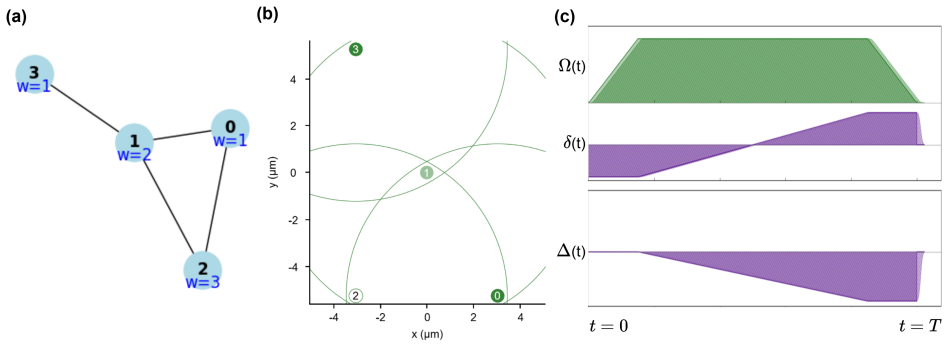
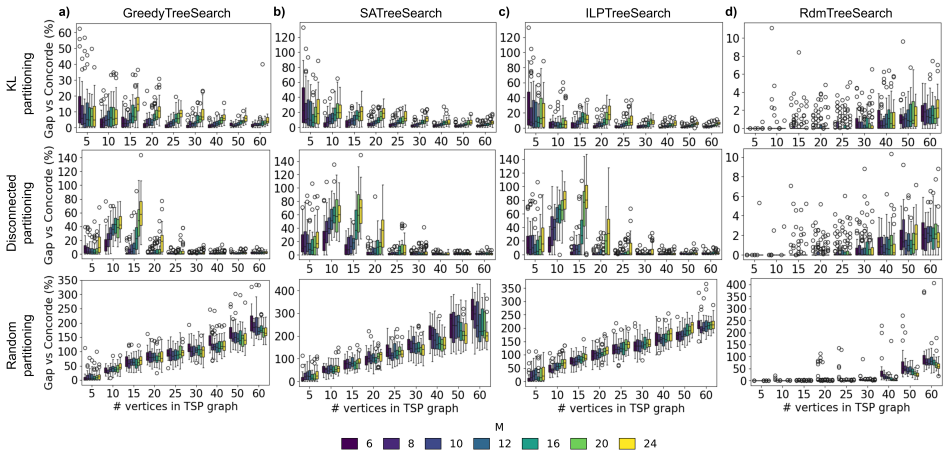
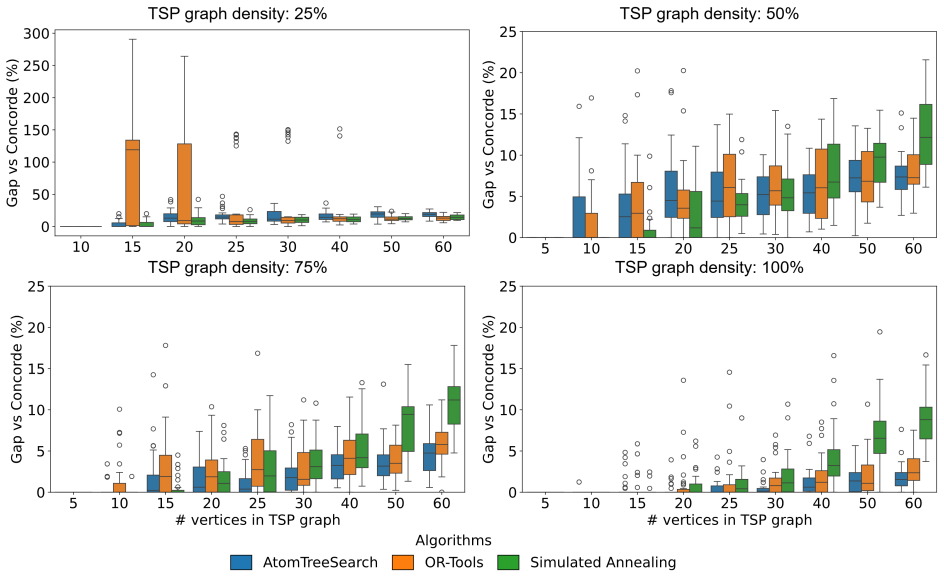
AtomTreeSearch integrates a quantum subroutine natively implementable on neutral-atom quantum computers within a Monte Carlo Tree Search framework. At each expansion step, a maximal weighted independent set of candidate actions provided by the quantum processor is selected, and these collective actions are performed to obtain a child node. On TSP instances of up to 60 cities on random Euclidean instances and up to 100 cities on TSPLIB instances, the hybrid algorithm generally matches or outperforms both OR-Tools and simulated annealing, and the quantum subroutine produces more diverse and higher-quality branches compared to classical alternate subroutines.
What carries the argument
The quantum subroutine that returns a maximal weighted independent set of candidate actions at each MCTS expansion step.
If this is right
- The hybrid method reaches competitive performance on standard TSPLIB instances with 100 cities.
- Quantum-selected branches exhibit higher diversity and quality than the classical subroutines examined.
- Embedding small quantum subroutines inside classical search trees offers a route to near-term utility for combinatorial optimization.
- The approach avoids full-problem QUBO formulations that exceed current hardware scale.
Where Pith is reading between the lines
- The same quantum MWIS step could be inserted into other tree-search or branch-and-bound solvers without changing the outer framework.
- If neutral-atom device sizes increase, the fraction of the search tree handled quantum-mechanically could grow while keeping the classical overhead fixed.
- Diversity gains from the quantum step may reduce the total number of MCTS simulations needed to reach a target solution quality.
Load-bearing premise
The quantum processor can reliably return a maximal weighted independent set of candidate actions that is both implementable on current neutral-atom hardware and superior in diversity and quality to classical selection methods.
What would settle it
A head-to-head run of the identical MCTS framework on the same TSP instances in which a classical MWIS solver or random selection produces branches of equal or greater diversity and quality, and yields equal or better final solution quality.
Figures




read the original abstract
Over the past decades, the operations research community has developed numerous effective optimization algorithms, yet quantum computing is emerging as a new computational paradigm with the potential to approach optimization problems more efficiently. Grover's algorithm offers a provable speedup for combinatorial optimization, but its circuit depth places it beyond current noisy intermediate-scale quantum (NISQ) devices. A more accessible alternative is to reformulate the optimization problem as a quadratic unconstrained binary optimization (QUBO) problem and apply quantum annealing; however, practical problem instances remain out of reach for existing hardware. We introduce AtomTreeSearch, a hybrid classical-quantum algorithm that integrates a quantum subroutine natively implementable on neutral-atom quantum computers within a Monte Carlo Tree Search framework. At each expansion step, a maximal weighted independent set of candidate actions provided by the quantum processor is selected, and these collective actions are performed to obtain a child node. We benchmark our method on the Traveling Salesman Problem, with instances of up to 60 cities on random Euclidean instances and up to 100 cities on TSPLIB instances. Our hybrid algorithm generally matches or outperforms both OR-Tools and simulated annealing on these instances, and we find that the quantum subroutine produces more diverse and higher-quality branches compared to classical alternate subroutines. These results suggest that carefully scoped quantum subroutines embedded in classical search frameworks represent a promising path toward near-term quantum utility in combinatorial optimization.
Editorial analysis
A structured set of objections, weighed in public.
Referee Report
Summary. The paper introduces AtomTreeSearch, a hybrid classical-quantum Monte Carlo Tree Search (MCTS) algorithm for combinatorial optimization that embeds a quantum maximal weighted independent set (MWIS) subroutine natively implementable on neutral-atom hardware. At each MCTS expansion step, the quantum processor supplies a set of collective actions; the method is benchmarked on TSP instances (random Euclidean up to 60 cities, TSPLIB up to 100 cities) and claims to match or outperform OR-Tools and simulated annealing while producing more diverse and higher-quality branches than classical subroutines.
Significance. If the reported performance advantage and hardware implementability are rigorously validated with statistical controls and device data, the work would illustrate a concrete route to near-term quantum utility by scoping quantum subroutines inside established classical search frameworks rather than attempting end-to-end quantum optimization. The absence of such validation in the current manuscript, however, leaves the practical significance unestablished.
major comments (3)
- [Abstract] Abstract: the central empirical claim that the hybrid algorithm 'generally matches or outperforms both OR-Tools and simulated annealing' is stated without error bars, exact instance counts, statistical tests, or any quantitative comparison tables, rendering the performance advantage unverifiable from the given material.
- [Abstract] Abstract: the assertion that 'the quantum subroutine produces more diverse and higher-quality branches compared to classical alternate subroutines' rests on the unverified assumption that neutral-atom hardware can reliably return MWIS solutions for the action sets arising in 60–100 city TSP MCTS expansions; no hardware run data, atom-count scaling, coherence limits, or noise-robustness analysis is supplied.
- [Method (implied)] The manuscript provides no implementation details (circuit depth, embedding strategy, or simulator vs. hardware distinction) for the MWIS oracle, which is load-bearing for the claim of native implementability on current neutral-atom devices.
minor comments (1)
- [Abstract] The abstract refers to 'random Euclidean instances' and 'TSPLIB instances' without specifying the precise instance sets or generation seeds, which would aid reproducibility.
Simulated Author's Rebuttal
We thank the referee for the constructive comments, which highlight areas where the manuscript can be strengthened for clarity and rigor. We respond to each major comment below.
read point-by-point responses
-
Referee: [Abstract] Abstract: the central empirical claim that the hybrid algorithm 'generally matches or outperforms both OR-Tools and simulated annealing' is stated without error bars, exact instance counts, statistical tests, or any quantitative comparison tables, rendering the performance advantage unverifiable from the given material.
Authors: We agree that the abstract would benefit from greater quantitative precision. In the revised manuscript we will expand the abstract and add a results table reporting mean performance metrics with standard deviations across runs, the exact number of TSP instances evaluated (random Euclidean and TSPLIB), and the outcomes of statistical significance tests against the OR-Tools and simulated-annealing baselines. revision: yes
-
Referee: [Abstract] Abstract: the assertion that 'the quantum subroutine produces more diverse and higher-quality branches compared to classical alternate subroutines' rests on the unverified assumption that neutral-atom hardware can reliably return MWIS solutions for the action sets arising in 60–100 city TSP MCTS expansions; no hardware run data, atom-count scaling, coherence limits, or noise-robustness analysis is supplied.
Authors: The diversity and quality comparisons are obtained from the MWIS solutions generated inside our simulation of the subroutine. We will revise the abstract to make this simulation basis explicit. The claim of native implementability is grounded in the MWIS problem’s known compatibility with Rydberg-atom arrays, but we acknowledge the lack of device-specific validation. A new discussion paragraph will be added outlining hardware considerations, scaling limits, and the distinction between the algorithmic contribution and future experimental work. revision: partial
-
Referee: [Method (implied)] The manuscript provides no implementation details (circuit depth, embedding strategy, or simulator vs. hardware distinction) for the MWIS oracle, which is load-bearing for the claim of native implementability on current neutral-atom devices.
Authors: We accept that these details are required. The revised methods section will contain a dedicated subsection describing the MWIS-to-neutral-atom embedding, the pulse-sequence considerations, the classical simulator used to generate the reported benchmark results, and explicit statements that all numerical experiments were performed in simulation rather than on hardware. revision: yes
- Provision of actual neutral-atom hardware execution data, atom-count scaling curves, coherence-time analysis, or noise-robustness benchmarks for the 60–100 city TSP action sets, as the original study evaluated the framework exclusively through classical simulation of the MWIS oracle.
Circularity Check
No circularity; claims rest on external benchmarks against OR-Tools and SA
full rationale
The paper introduces AtomTreeSearch as a hybrid MCTS framework embedding a quantum MWIS subroutine and reports performance via direct comparisons to OR-Tools and simulated annealing on TSP instances up to 100 cities. No equations, derivations, or parameter fittings are described that reduce by construction to the method's own inputs. No self-citation chains, uniqueness theorems, or ansatzes imported from prior author work are invoked to justify core claims. The quantum subroutine's reported diversity/quality gains are presented as empirical observations from the benchmarks rather than tautological redefinitions. This is the standard non-circular case of an algorithmic proposal validated externally.
Axiom & Free-Parameter Ledger
axioms (1)
- domain assumption A maximal weighted independent set of candidate actions can be obtained from the neutral-atom quantum processor and used directly to generate child nodes in MCTS.
Reference graph
Works this paper leans on
-
[1]
Journal of Statistical Physics 50(1):187--206, ISSN 1572-9613, ://dx.doi.org/10.1007/BF01022991
Aarts EHL, Korst JHM, van Laarhoven PJM (1988) A quantitative analysis of the simulated annealing algorithm: A case study for the traveling salesman problem. Journal of Statistical Physics 50(1):187--206, ISSN 1572-9613, ://dx.doi.org/10.1007/BF01022991
-
[2]
Nature Reviews Physics 6(12):718--735, ISSN 2522-5820, ://dx.doi.org/10.1038/s42254-024-00770-9
Abbas A, Ambainis A, Augustino B, B \"a rtschi A, Buhrman H, Coffrin C, Cortiana G, Dunjko V, Egger DJ, Elmegreen BG, Franco N, Fratini F, Fuller B, Gacon J, Gonciulea C, Gribling S, Gupta S, Hadfield S, Heese R, Kircher G, Kleinert T, Koch T, Korpas G, Lenk S, Marecek J, Markov V, Mazzola G, Mensa S, Mohseni N, Nannicini G, O'Meara C, Tapia EP, Pokutta S...
-
[3]
Allwright JR, Carpenter D (1989) A distributed implementation of simulated annealing for the travelling salesman problem. Parallel Computing 10(3):335--338, ISSN 0167-8191, ://dx.doi.org/https://doi.org/10.1016/0167-8191(89)90106-3
-
[4]
http://www.math.uwaterloo.ca/tsp/concorde/downloads/downloads.htm, last accessed: 2025-08-13
Applegate D, Bixby R, Chv \'a tal V, Cook W (2003) Concorde TSP solver, version 03.12.19. http://www.math.uwaterloo.ca/tsp/concorde/downloads/downloads.htm, last accessed: 2025-08-13
2003
-
[5]
Machine Learning 47(2):235--256, ISSN 1573-0565, ://dx.doi.org/10.1023/A:1013689704352
Auer P, Cesa-Bianchi N, Fischer P (2002) Finite-time Analysis of the Multiarmed Bandit Problem . Machine Learning 47(2):235--256, ISSN 1573-0565, ://dx.doi.org/10.1023/A:1013689704352
-
[6]
Barletta C, Garn W, Turner C, Fallah S (2023) Hybrid fleet capacitated vehicle routing problem with flexible Monte–Carlo Tree search . International Journal of Systems Science: Operations & Logistics 10(1):2102265, ://dx.doi.org/10.1080/23302674.2022.2102265
-
[7]
Neural Combinatorial Optimization with Reinforcement Learning
Bello I, Pham H, Le QV, Norouzi M, Bengio S (2017) Neural Combinatorial Optimization with Reinforcement Learning . ://arxiv.org/abs/1611.09940
work page internal anchor Pith review Pith/arXiv arXiv 2017
-
[8]
Bengio Y, Lodi A, Prouvost A (2020) Machine Learning for Combinatorial Optimization: a Methodological Tour d'Horizon . ://arxiv.org/abs/1811.06128
-
[9]
ORSA Journal on Computing 4(4):387--411, ://dx.doi.org/10.1287/ijoc.4.4.387
Bentley JJ (1992) Fast Algorithms for Geometric Traveling Salesman Problems . ORSA Journal on Computing 4(4):387--411, ://dx.doi.org/10.1287/ijoc.4.4.387
-
[10]
Bidzhiev K, Grava S, le Henaff P, Mendizabal M, Merhej E, Quelle A (2025) Efficient Emulation of Neutral Atom Quantum Hardware . ://arxiv.org/abs/2510.09813
-
[11]
Bjornsson Y, Finnsson H (2009) CadiaPlayer: A Simulation-Based General Game Player . IEEE Transactions on Computational Intelligence and AI in Games 1(1):4--15, ://dx.doi.org/10.1109/TCIAIG.2009.2018702
-
[12]
Zeitschrift f \"u r Physik 51(3):165--180, ISSN 0044-3328, ://dx.doi.org/10.1007/BF01343193
Born M, Fock V (1928) Beweis des Adiabatensatzes . Zeitschrift f \"u r Physik 51(3):165--180, ISSN 0044-3328, ://dx.doi.org/10.1007/BF01343193
-
[13]
Bourreau E, Fleury G, Lacomme P (2023) Indirect Quantum Approximate Optimization Algorithms: application to the TSP . ://arxiv.org/abs/2311.03294
-
[14]
Nature 317(6040):804--806
Brady RM (1985) Optimization strategies gleaned from biological evolution. Nature 317(6040):804--806
1985
-
[15]
Brassard G, Høyer P, Mosca M, Tapp A (2002) Quantum amplitude amplification and estimation. ://dx.doi.org/10.1090/conm/305/05215
-
[16]
Breu H, Kirkpatrick DG (1998) Unit disk graph recognition is NP-hard . Computational Geometry 9(1):3--24, ISSN 0925-7721, ://dx.doi.org/https://doi.org/10.1016/S0925-7721(97)00014-X, special Issue on Geometric Representations of Graphs
-
[17]
Browne CB, Powley E, Whitehouse D, Lucas SM, Cowling PI, Rohlfshagen P, Tavener S, Perez D, Samothrakis S, Colton S (2012) A Survey of Monte Carlo Tree Search Methods . IEEE Transactions on Computational Intelligence and AI in Games 4(1):1--43, ://dx.doi.org/10.1109/TCIAIG.2012.2186810
-
[18]
Bärtschi A, Eidenbenz S (2020) Grover Mixers for QAOA: Shifting Complexity from Mixer Design to State Preparation . 2020 IEEE International Conference on Quantum Computing and Engineering (QCE), 72--82 (Los Alamitos, CA, USA: IEEE Computer Society), ://dx.doi.org/10.1109/QCE49297.2020.00020
-
[19]
Caneva T, Calarco T, Montangero S (2011) Chopped random-basis quantum optimization. Phys. Rev. A 84:022326, ://dx.doi.org/10.1103/PhysRevA.84.022326
-
[20]
Cazalis J, Shah T, Chai Y, Jansen K, Kühn S (2024) Gaussian boson sampling for binary optimization. ://arxiv.org/abs/2412.14783
-
[21]
Cazals P, François A, Henriet L, Leclerc L, Marin M, Naghmouchi Y, da Silva Coelho W, Sikora F, Vitale V, Watrigant R, Garzillo MW, Dalyac C (2025 a ) Identifying hard native instances for the maximum independent set problem on neutral atoms quantum processors. ://arxiv.org/abs/2502.04291
-
[22]
Physical Review A 112(6), ISSN 2469-9934, ://dx.doi.org/10.1103/3sjz-gfmr
Cazals P, Sorondo A, Onofre V, Dalyac C, Coelho W, Vitale V (2025 b ) Quantum optimization on Rydberg-atom arrays with arbitrary connectivity: Gadget limitations and a heuristic approach . Physical Review A 112(6), ISSN 2469-9934, ://dx.doi.org/10.1103/3sjz-gfmr
-
[23]
Chao J, Rodriguez R, Crowe S (2023) Quantum Enhancements for AlphaZero . Proceedings of the Companion Conference on Genetic and Evolutionary Computation, 2179–2186, GECCO '23 Companion (New York, NY, USA: Association for Computing Machinery), ISBN 9798400701207, ://dx.doi.org/10.1145/3583133.3596302
-
[24]
Technical Report 388, Graduate School of Industrial Administration, Carnegie-Mellon University, Pittsburgh, PA
Christofides N (1976) Worst-case analysis of a new heuristic for the travelling salesman problem. Technical Report 388, Graduate School of Industrial Administration, Carnegie-Mellon University, Pittsburgh, PA
1976
-
[25]
Operations Research 12(4):568--581, ://dx.doi.org/10.1287/opre.12.4.568
Clarke G, Wright JW (1964) Scheduling of Vehicles from a Central Depot to a Number of Delivery Points . Operations Research 12(4):568--581, ://dx.doi.org/10.1287/opre.12.4.568
-
[26]
(2024) Combinatorial Optimization and Applications
Crainic TG, Gendreau M, Frangioni A, eds. (2024) Combinatorial Optimization and Applications. International Series in Operations Research & Management Science (Springer Cham), ://dx.doi.org/10.1007/978-3-031-57603-4
-
[27]
Operations Research 6(6):791--812, ://dx.doi.org/10.1287/opre.6.6.791
Croes GA (1958) A Method for Solving Traveling-Salesman Problems . Operations Research 6(6):791--812, ://dx.doi.org/10.1287/opre.6.6.791
-
[28]
da Costa PRdO, Rhuggenaath J, Zhang Y, Akcay A (2020) Learning 2-opt Heuristics for the Traveling Salesman Problem via Deep Reinforcement Learning . Pan SJ, Sugiyama M, eds., Proceedings of The 12th Asian Conference on Machine Learning, volume 129 of Proceedings of Machine Learning Research, 465--480 (PMLR), ://proceedings.mlr.press/v129/costa20a.html
2020
-
[29]
da Silva Coelho W, D'Arcangelo M, Henry LP (2022) Efficient protocol for solving combinatorial graph problems on neutral-atom quantum processors. ://arxiv.org/abs/2207.13030
-
[30]
Proceedings of the 31st International Conference on Neural Information Processing Systems, 6351–6361, NIPS'17 (Red Hook, NY, USA: Curran Associates Inc.), ISBN 9781510860964
Dai H, Khalil EB, Zhang Y, Dilkina B, Song L (2017) Learning combinatorial optimization algorithms over graphs. Proceedings of the 31st International Conference on Neural Information Processing Systems, 6351–6361, NIPS'17 (Red Hook, NY, USA: Curran Associates Inc.), ISBN 9781510860964
2017
-
[31]
Theses, Sorbonne Universit \'e , ://theses.hal.science/tel-04265956
Dalyac C (2023) Quantum many-body dynamics for combinatorial optimisation and machine learning . Theses, Sorbonne Universit \'e , ://theses.hal.science/tel-04265956
2023
-
[32]
Les Cahiers du GERAD G-2024-36, Groupe d’études et de recherche en analyse des décisions, GERAD, Montréal QC H3T 2A7, Canada, ://www.gerad.ca/fr/papers/G-2024-36
Desrosiers J, Lübbecke M, Desaulniers G, Gauthier JB (2024) Branch-and-Price . Les Cahiers du GERAD G-2024-36, Groupe d’études et de recherche en analyse des décisions, GERAD, Montréal QC H3T 2A7, Canada, ://www.gerad.ca/fr/papers/G-2024-36
2024
-
[33]
Biosystems 43(2):73--81, ISSN 0303-2647, ://dx.doi.org/https://doi.org/10.1016/S0303-2647(97)01708-5
Dorigo M, Gambardella LM (1997) Ant colonies for the travelling salesman problem. Biosystems 43(2):73--81, ISSN 0303-2647, ://dx.doi.org/https://doi.org/10.1016/S0303-2647(97)01708-5
-
[34]
Quantum optimization of maximum inde- pendent set using rydberg atom arrays
Ebadi S, Keesling A, Cain M, Wang TT, Levine H, Bluvstein D, Semeghini G, Omran A, Liu JG, Samajdar R, Luo XZ, Nash B, Gao X, Barak B, Farhi E, Sachdev S, Gemelke N, Zhou L, Choi S, Pichler H, Wang ST, Greiner M, Vuletić V, Lukin MD (2022) Quantum optimization of maximum independent set using Rydberg atom arrays . Science 376(6598):1209--1215, ://dx.doi.o...
-
[35]
A Quantum Approximate Optimization Algorithm
Farhi E, Goldstone J, Gutmann S (2014) A Quantum Approximate Optimization Algorithm . ://arxiv.org/abs/1411.4028
work page internal anchor Pith review Pith/arXiv arXiv 2014
-
[36]
Farhi E, Gutmann S (1998) Quantum computation and decision trees. Phys. Rev. A 58:915--928, ://dx.doi.org/10.1103/PhysRevA.58.915
-
[37]
Operations Research 4(1):61--75, ://dx.doi.org/10.1287/opre.4.1.61
Flood MM (1956) The Traveling-Salesman Problem . Operations Research 4(1):61--75, ://dx.doi.org/10.1287/opre.4.1.61
-
[38]
Frazier PI (2018) Bayesian Optimization, chapter 11, 255--278 ( Informs ), ://dx.doi.org/10.1287/educ.2018.0188
-
[39]
Fu ZH, Qiu KB, Zha H (2021) Generalize a Small Pre-trained Model to Arbitrarily Large TSP Instances . Proceedings of the AAAI Conference on Artificial Intelligence 35(8):7474--7482, ://dx.doi.org/10.1609/aaai.v35i8.16916
-
[40]
Geng X, Chen Z, Yang W, Shi D, Zhao K (2011) Solving the traveling salesman problem based on an adaptive simulated annealing algorithm with greedy search. Applied Soft Computing 11(4):3680--3689, ISSN 1568-4946, ://dx.doi.org/https://doi.org/10.1016/j.asoc.2011.01.039
-
[41]
arXiv preprint arXiv:2506.19298
Gibson J, Drouin-Touchette V, Kourtis S (2025) Quantum Counting in the Rydberg Blockade . arXiv preprint arXiv:2506.19298
-
[42]
Glover F (1986) Future paths for integer programming and links to artificial intelligence. Computers & Operations Research 13(5):533--549, ISSN 0305-0548, ://dx.doi.org/https://doi.org/10.1016/0305-0548(86)90048-1, applications of Integer Programming
-
[43]
Grover LK (1996) A fast quantum mechanical algorithm for database search. Proceedings of the Twenty-Eighth Annual ACM Symposium on Theory of Computing, 212–219, STOC '96 (New York, NY, USA: Association for Computing Machinery), ISBN 0897917855, ://dx.doi.org/10.1145/237814.237866
-
[44]
://www.gurobi.com
Gurobi Optimization, LLC (2024) Gurobi Optimizer Reference Manual . ://www.gurobi.com
2024
-
[45]
Varoquaux G, Vaught T, Millman J, eds., Proceedings of the 7th Python in Science Conference, 11 -- 15 (Pasadena, CA USA)
Hagberg AA, Schult DA, Swart PJ (2008) Exploring Network Structure, Dynamics, and Function using NetworkX . Varoquaux G, Vaught T, Millman J, eds., Proceedings of the 7th Python in Science Conference, 11 -- 15 (Pasadena, CA USA)
2008
-
[46]
Designing Adiabatic Quantum Optimization: A Case Study for the Traveling Salesman Problem
Heim B, Brown EW, Wecker D, Troyer M (2017) Designing Adiabatic Quantum Optimization: A Case Study for the Traveling Salesman Problem . ://arxiv.org/abs/1702.06248
work page internal anchor Pith review Pith/arXiv arXiv 2017
-
[47]
Held M, Karp RM (1962) A Dynamic Programming Approach to Sequencing Problems . Journal of the Society for Industrial and Applied Mathematics 10(1):196--210, ://dx.doi.org/10.1137/0110015
-
[48]
Quantum 4:327, ISSN 2521-327X, ://dx.doi.org/10.22331/q-2020-09-21-327
Henriet L, Beguin L, Signoles A, Lahaye T, Browaeys A, Reymond GO, Jurczak C (2020) Quantum computing with neutral atoms. Quantum 4:327, ISSN 2521-327X, ://dx.doi.org/10.22331/q-2020-09-21-327
-
[49]
Jeong CS, Kim MH (1991) Fast parallel simulated annealing for traveling salesman problem on SIMD machines with linear interconnections . Parallel Computing 17(2):221--228, ISSN 0167-8191, ://dx.doi.org/https://doi.org/10.1016/S0167-8191(05)80107-3
-
[50]
Johansson J, Nation P, Nori F (2012) QuTiP: An open-source Python framework for the dynamics of open quantum systems . Computer Physics Communications 183(8):1760--1772, ISSN 0010-4655, ://dx.doi.org/https://doi.org/10.1016/j.cpc.2012.02.021
-
[51]
Johansson J, Nation P, Nori F (2013) QuTiP 2: A Python framework for the dynamics of open quantum systems . Computer Physics Communications 184(4):1234--1240, ISSN 0010-4655, ://dx.doi.org/https://doi.org/10.1016/j.cpc.2012.11.019
-
[52]
Gutin G, Punnen AP, eds., The Traveling Salesman Problem and Its Variations, 369--443 (Kluwer Academic Publishers)
Johnson DS, McGeoch LA (2002) Experimental Analysis of Heuristics for the STSP . Gutin G, Punnen AP, eds., The Traveling Salesman Problem and Its Variations, 369--443 (Kluwer Academic Publishers)
2002
-
[53]
Jordan SP, Shutty N, Wootters M, Zalcman A, Schmidhuber A, King R, Isakov SV, Khattar T, Babbush R (2025) Optimization by Decoded Quantum Interferometry . ://arxiv.org/abs/2408.08292
-
[54]
Quantum annealing in the transverse Ising model,
Kadowaki T, Nishimori H (1998) Quantum annealing in the transverse Ising model . Physical Review E 58(5):5355–5363, ISSN 1095-3787, ://dx.doi.org/10.1103/physreve.58.5355
-
[55]
Kahng AB, Reda S (2004) Match twice and stitch: a new TSP tour construction heuristic . Operations Research Letters 32(6):499--509, ISSN 0167-6377, ://dx.doi.org/https://doi.org/10.1016/j.orl.2004.04.001
-
[56]
Khaneja N, Reiss T, Kehlet C, Schulte-Herbrüggen T, Glaser SJ (2005) Optimal control of coupled spin dynamics: design of NMR pulse sequences by gradient ascent algorithms . Journal of Magnetic Resonance 172(2):296--305, ISSN 1090-7807, ://dx.doi.org/https://doi.org/10.1016/j.jmr.2004.11.004
-
[57]
Khumalo MT, Chieza HA, Prag K, Woolway M (2025) An investigation of IBM quantum computing device performance on combinatorial optimisation problems . Neural Computing and Applications 37(2):611--626, ISSN 1433-3058, ://dx.doi.org/10.1007/s00521-022-07438-4
-
[58]
Quantum Information Processing 18(3), ISSN 1573-1332, ://dx.doi.org/10.1007/s11128-019-2206-9
Kieu TD (2019) The travelling salesman problem and adiabatic quantum computation: an algorithm. Quantum Information Processing 18(3), ISSN 1573-1332, ://dx.doi.org/10.1007/s11128-019-2206-9
-
[59]
Opti- mization by Simulated Annealing,
Kirkpatrick S, Gelatt CD, Vecchi MP (1983) Optimization by Simulated Annealing . Science 220(4598):671--680, ://dx.doi.org/10.1126/science.220.4598.671
-
[60]
F \"u rnkranz J, Scheffer T, Spiliopoulou M, eds., Machine Learning: ECML 2006, 282--293 (Berlin, Heidelberg: Springer Berlin Heidelberg), ISBN 978-3-540-46056-5
Kocsis L, Szepesv \'a ri C (2006) Bandit Based Monte-Carlo Planning . F \"u rnkranz J, Scheffer T, Spiliopoulou M, eds., Machine Learning: ECML 2006, 282--293 (Berlin, Heidelberg: Springer Berlin Heidelberg), ISBN 978-3-540-46056-5
2006
-
[61]
Technical report, University of Tartu
Kocsis L, Szepesv \'a ri C, Willemson J (2006) Improved Monte-Carlo Search . Technical report, University of Tartu
2006
-
[62]
Kool W, van Hoof H, Welling M (2019) Attention, Learn to Solve Routing Problems! International Conference on Learning Representations, ://openreview.net/forum?id=ByxBFsRqYm
2019
-
[63]
Krotov VF (1993) Global Methods in Optimal Control Theory, 74--121 (Boston, MA: Birkh \"a user Boston), ISBN 978-1-4612-0349-0, ://dx.doi.org/10.1007/978-1-4612-0349-0_3
-
[64]
Salvagnin D, Lombardi M, eds., Integration of AI and OR Techniques in Constraint Programming, 202--210 (Cham: Springer International Publishing), ISBN 978-3-319-59776-8
Kruber M, L \"u bbecke ME, Parmentier A (2017) Learning When to Use a Decomposition . Salvagnin D, Lombardi M, eds., Integration of AI and OR Techniques in Constraint Programming, 202--210 (Cham: Springer International Publishing), ISBN 978-3-319-59776-8
2017
-
[65]
Physics Reports 1153:1--62, ISSN 0370-1573, ://dx.doi.org/10.1016/j.physrep.2025.10.001
Lambert N, Gigu \`e re E, Menczel P, Li B, Hopf P, Su \'a rez G, Gali M, Lishman J, Gadhvi R, Agarwal R, Galicia A, Shammah N, Nation P, Johansson JR, Ahmed S, Cross S, Pitchford A, Nori F (2026) QuTiP 5: The Quantum Toolbox in Python . Physics Reports 1153:1--62, ISSN 0370-1573, ://dx.doi.org/10.1016/j.physrep.2025.10.001
-
[66]
Nature 619(7969):282--287, ISSN 1476-4687, ://dx.doi.org/10.1038/s41586-023-06095-4
Layden D, Mazzola G, Mishmash RV, Motta M, Wocjan P, Kim JS, Sheldon S (2023) Quantum-enhanced Markov chain Monte Carlo . Nature 619(7969):282--287, ISSN 1476-4687, ://dx.doi.org/10.1038/s41586-023-06095-4
-
[67]
Theses, Universit \'e Paris-Saclay , ://pastel.hal.science/tel-04745992
Leclerc L (2024) Quantum computing with Rydberg atoms : control and modelling for quantum simulation and practical algorithms . Theses, Universit \'e Paris-Saclay , ://pastel.hal.science/tel-04745992
2024
-
[68]
Physical Review A 111(3), ISSN 2469-9934, ://dx.doi.org/10.1103/physreva.111.032611
Leclerc L, Dalyac C, Bendotti P, Griset R, Mikael J, Henriet L (2025) Implementing transferable annealing protocols for combinatorial optimization on neutral-atom quantum processors: A case study on smart charging of electric vehicles. Physical Review A 111(3), ISSN 2469-9934, ://dx.doi.org/10.1103/physreva.111.032611
-
[69]
Lin S (1965) Computer solutions of the traveling salesman problem. The Bell System Technical Journal 44(10):2245--2269, ://dx.doi.org/10.1002/j.1538-7305.1965.tb04146.x
-
[70]
Operations Research 21(2):498--516, ://dx.doi.org/10.1287/opre.21.2.498
Lin S, Kernighan BW (1973) An Effective Heuristic Algorithm for the Traveling-Salesman Problem . Operations Research 21(2):498--516, ://dx.doi.org/10.1287/opre.21.2.498
-
[71]
Liu CY, Matsuyama H, hao Huang W, Yamashiro Y (2024) Quantum Local Search for Traveling Salesman Problem with Path-Slicing Strategy . ://arxiv.org/abs/2407.13616
-
[72]
TOP 25(2):207--236, ISSN 1863-8279, ://dx.doi.org/10.1007/s11750-017-0451-6
Lodi A, Zarpellon G (2017) On learning and branching: a survey. TOP 25(2):207--236, ISSN 1863-8279, ://dx.doi.org/10.1007/s11750-017-0451-6
-
[73]
Ising formulations of many NP problems
Lucas A (2014) Ising formulations of many NP problems . Frontiers in Physics 2, ISSN 2296-424X, ://dx.doi.org/10.3389/fphy.2014.00005
-
[74]
Ma \' n dziuk J, Nejman C (2015) UCT-Based Approach to Capacitated Vehicle Routing Problem . Rutkowski L, Korytkowski M, Scherer R, Tadeusiewicz R, Zadeh LA, Zurada JM, eds., Artificial Intelligence and Soft Computing, 679--690 (Cham: Springer International Publishing), ISBN 978-3-319-19369-4
2015
-
[75]
Marto n n \'ak R, Santoro GE, Tosatti E (2004) Quantum annealing of the traveling-salesman problem. Phys. Rev. E 70:057701, ://dx.doi.org/10.1103/PhysRevE.70.057701
-
[76]
Mason L, Baxter J, Bartlett P, Frean M (1999) Boosting Algorithms as Gradient Descent . Solla S, Leen T, M\" u ller K, eds., Advances in Neural Information Processing Systems, volume 12 (MIT Press), ://proceedings.neurips.cc/paper_files/paper/1999/file/96a93ba89a5b5c6c226e49b88973f46e-Paper.pdf
1999
-
[77]
Mazyavkina N, Sviridov S, Ivanov S, Burnaev E (2020) Reinforcement Learning for Combinatorial Optimization: A Survey . ://arxiv.org/abs/2003.03600
-
[78]
Mańdziuk J, Świechowski M (2017) UCT in Capacitated Vehicle Routing Problem with traffic jams . Information Sciences 406-407:42--56, ISSN 0020-0255, ://dx.doi.org/https://doi.org/10.1016/j.ins.2017.04.020
-
[79]
Meyer N, Ufrecht C, Periyasamy M, Scherer DD, Plinge A, Mutschler C (2024) A Survey on Quantum Reinforcement Learning . ://arxiv.org/abs/2211.03464
-
[80]
Quantum Machine Intelligence 6(1), ISSN 2524-4914, ://dx.doi.org/10.1007/s42484-024-00161-4
Mohanty N, Behera BK, Ferrie C (2024) Solving the vehicle routing problem via quantum support vector machines. Quantum Machine Intelligence 6(1), ISSN 2524-4914, ://dx.doi.org/10.1007/s42484-024-00161-4
discussion (0)
Sign in with ORCID, Apple, or X to comment. Anyone can read and Pith papers without signing in.