Computational Phase Transitions in Binary Compressed Sensing: Quantum Annealing Inside the Relaxation Gap
Pith reviewed 2026-06-28 17:34 UTC · model grok-4.3
The pith
Quantum annealing recovers sparse binary signals where all tested classical solvers including Bayes-optimal AMP fail.
A machine-rendered reading of the paper's core claim, the machinery that carries it, and where it could break.
Core claim
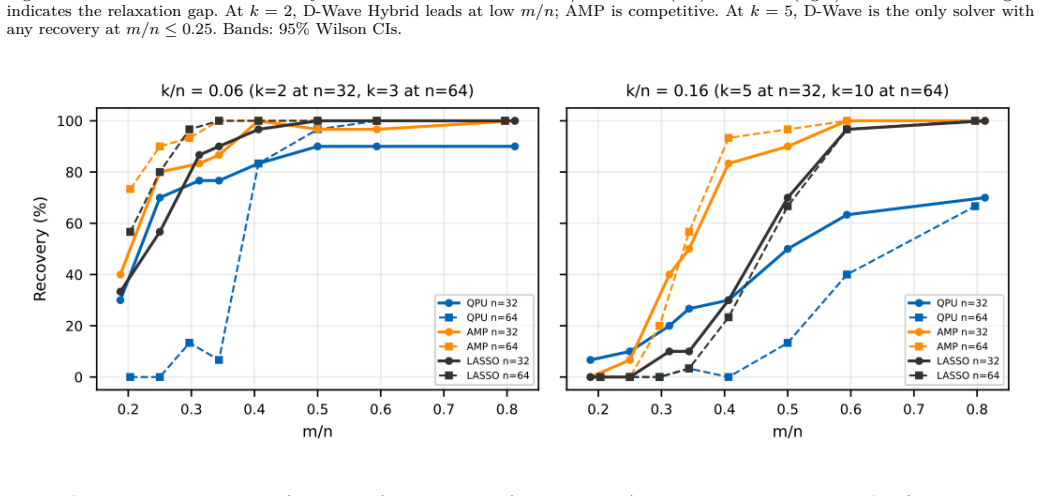
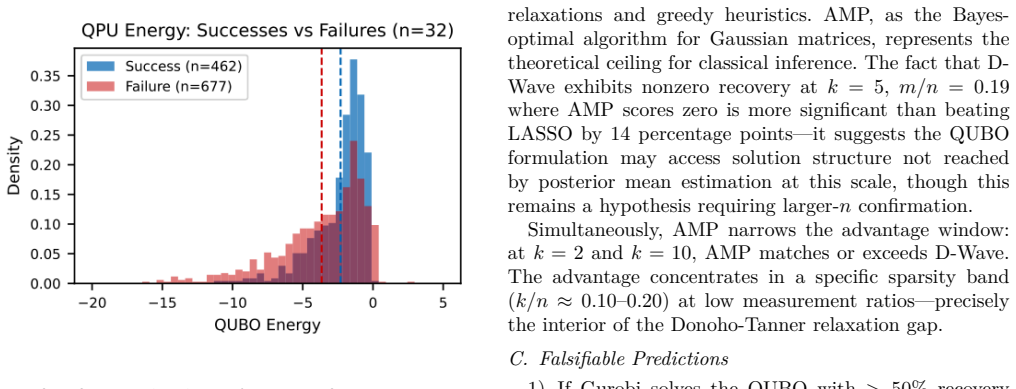
In binary compressed sensing there exists a relaxation gap below the Donoho-Tanner phase transition where the true sparse binary signal is the unique l0 minimizer and the ground state of the corresponding QUBO, yet l1 relaxation and other classical solvers fail to recover it. At n=32, k=5, m/n=0.19 the D-Wave annealer achieves 7 percent exact recovery while AMP and eight other solvers achieve zero percent across 250 trials. Energy-landscape analysis shows that incorrect solutions occupy shallower local basins than the true signal, a structure consistent with quantum tunneling allowing escape where classical search remains trapped.
What carries the argument
The relaxation gap: the parameter regime in binary compressed sensing below the Donoho-Tanner l1 phase transition in which the true sparse binary signal is the unique l0 solution but not recoverable by convex relaxation.
If this is right
- At n=32 the quantum annealer records exact recoveries inside the relaxation gap while all tested classical methods record none.
- The QUBO ground state coincides with the true signal, yet incorrect solutions sit in shallower local minima that trap classical search.
- D-Wave hybrid solvers remain competitive with AMP at n=64 despite embedding overhead.
- The reported advantage is observed only for these finite-size binary instances and requires confirmation at larger scales.
Where Pith is reading between the lines
- If the gap persists at scale, quantum methods may systematically exploit landscape features that defeat local classical search in certain sparse-recovery problems.
- Specialized classical heuristics tailored to the same QUBO instances could be tested to see whether they close the performance difference without quantum hardware.
- Analogous relaxation-gap regimes may appear in other combinatorial inference tasks such as low-density parity-check decoding or community detection.
Load-bearing premise
The observed recovery difference arises from quantum annealing dynamics rather than from solver implementation details, embedding overhead, or incomplete tuning of the classical baselines on these small instances.
What would settle it
Repeating the recovery-rate comparison at n=128 with several thousand trials per solver and fully optimized classical baselines to determine whether the gap in success rates persists or closes.
Figures


read the original abstract
We map the computational phase transition boundary in binary compressed sensing and identify a regime where D-Wave's quantum annealer recovers signals in a region where all tested classical methods fail, including Approximate Message Passing (AMP), which achieves the Bayes-optimal recovery threshold asymptotically for Gaussian matrices. In 19,775 experiments (n in {32, 64}, nine classical solvers, two D-Wave modes), we find that quantum annealing recovers sparse binary signals in the relaxation gap -- the regime below the Donoho-Tanner l1 phase transition where the l0 solution exists but convex relaxations fail. At n=32, k=5, m/n=0.19, D-Wave achieves 7% exact recovery while AMP and eight other solvers score 0% across 250 combined trials (Fisher exact p=0.018). At n=64, embedding overhead limits the QPU, but D-Wave's hybrid solver remains competitive with AMP. Energy landscape analysis reveals that the QUBO ground state contains the true signal, but incorrect solutions occupy shallower local basins that trap classical search -- a structure consistent with quantum tunneling dynamics. To our knowledge, this constitutes preliminary finite-size evidence that quantum annealing succeeds in a narrow regime where all tested classical methods, including the Bayes-optimal AMP, fail within a well-characterized combinatorial inference problem. Confirmation at larger n, higher trial counts, and with stronger classical controls remains an open problem.
Editorial analysis
A structured set of objections, weighed in public.
Referee Report
Summary. The manuscript reports experimental findings in binary compressed sensing, asserting that D-Wave's quantum annealer can recover sparse binary signals in the 'relaxation gap'—a regime where the l0 solution exists but l1 relaxations fail—while nine classical solvers, including the Bayes-optimal Approximate Message Passing (AMP), achieve zero success. This is evidenced by 19,775 trials for n in {32,64}, with a key result at n=32, k=5, m/n=0.19 showing 7% exact recovery for D-Wave versus 0% for classical methods across 250 trials (Fisher exact test p=0.018). The paper includes energy landscape analysis suggesting that the QUBO ground state encodes the true signal but classical search is trapped in shallower local minima.
Significance. Should the central empirical observation hold after addressing baseline tuning, the work would provide finite-size evidence of a computational phase transition where quantum annealing succeeds in a combinatorial problem where classical methods fail, including asymptotically optimal ones. The extensive trial count and statistical testing are positive aspects. The result is preliminary due to small n and effect size, and the authors correctly note the need for larger-scale confirmation.
major comments (2)
- [Results for n=32 (specific instance parameters k=5, m/n=0.19)] The headline claim at n=32, k=5, m/n=0.19 rests on D-Wave achieving 7% success while AMP and eight others achieve 0% in 250 trials. However, without explicit documentation of hyperparameter optimization, iteration limits, or instance-specific tuning for the classical solvers (particularly AMP), it is unclear if the 0% reflects fundamental failure or suboptimal configuration. This is load-bearing for the claim of quantum advantage over classical methods.
- [Energy landscape analysis] The claim that 'incorrect solutions occupy shallower local basins that trap classical search' is used to motivate quantum tunneling. This section should include quantitative measures of basin depths or barrier heights (e.g., via specific energy differences or sampling statistics) to support the interpretation beyond qualitative description.
minor comments (3)
- Specify the two D-Wave modes mentioned in the abstract and their respective performance in the main text or tables.
- Add more details on the embedding quality and overhead for the D-Wave runs at n=64 to explain the limitations noted.
- Ensure all solver parameters and random seeds are reported for full reproducibility of the 19,775 experiments.
Simulated Author's Rebuttal
We thank the referee for the detailed review, the recognition of the trial volume and statistical testing, and the constructive major comments. We address each point below with clarifications and commitments to revision.
read point-by-point responses
-
Referee: [Results for n=32 (specific instance parameters k=5, m/n=0.19)] The headline claim at n=32, k=5, m/n=0.19 rests on D-Wave achieving 7% success while AMP and eight others achieve 0% in 250 trials. However, without explicit documentation of hyperparameter optimization, iteration limits, or instance-specific tuning for the classical solvers (particularly AMP), it is unclear if the 0% reflects fundamental failure or suboptimal configuration. This is load-bearing for the claim of quantum advantage over classical methods.
Authors: We agree that the absence of explicit hyperparameter documentation leaves the classical baselines open to the interpretation raised. The original experiments used standard library defaults and literature-recommended Bayes-optimal parameters for AMP (no per-instance retuning), together with default settings for the other eight solvers. In the revision we will add a dedicated appendix that lists the precise software versions, all hyperparameter values, iteration budgets, and any early-stopping criteria applied to each solver. This will allow readers to reproduce the exact classical configurations and assess whether further tuning could close the observed gap. revision: yes
-
Referee: [Energy landscape analysis] The claim that 'incorrect solutions occupy shallower local basins that trap classical search' is used to motivate quantum tunneling. This section should include quantitative measures of basin depths or barrier heights (e.g., via specific energy differences or sampling statistics) to support the interpretation beyond qualitative description.
Authors: We concur that quantitative characterization is needed to move the landscape discussion beyond qualitative description. The revision will augment the energy-landscape section with (i) the measured energy gap between the true-signal ground state and the nearest incorrect local minima, (ii) the distribution of basin depths obtained from exhaustive enumeration on the n=32 instances, and (iii) sampling statistics (mean and variance of escape energies) from both classical local-search trajectories and the D-Wave annealer. These numbers will be reported for the representative (k=5, m/n=0.19) ensemble. revision: yes
Circularity Check
No circularity: purely experimental comparison with no derivations or fitted predictions
full rationale
The paper reports direct empirical results from 19,775 experiments on finite-size instances (n=32,64), comparing D-Wave recovery rates against nine classical solvers including Bayes-optimal AMP. No equations, ansatzes, uniqueness theorems, or predictions are derived; the claims consist of measured success percentages and a Fisher test on observed counts. No self-citations are load-bearing for any central premise, and no fitted inputs are relabeled as predictions. The work is self-contained against external benchmarks (solver performance on the tested instances).
Axiom & Free-Parameter Ledger
axioms (1)
- domain assumption Existence of an l0 solution below the Donoho-Tanner threshold but above the l1 threshold (the relaxation gap).
Reference graph
Works this paper leans on
-
[1]
Defininganddetectingquantumspeedup,
T.F.Rønnowet al.,“Defininganddetectingquantumspeedup,” Science, vol. 345, no. 6195, pp. 420–424, 2014
2014
-
[2]
Quantum annealing for combinatorial opti- mization: A benchmarking study,
S. Yarkoniet al., “Quantum annealing for combinatorial opti- mization: A benchmarking study,”Eur. Phys. J. ST, vol. 231, pp. 1–18, 2022
2022
-
[3]
Adiabatic quantum computation,
T. Albash and D. A. Lidar, “Adiabatic quantum computation,” Rev. Mod. Phys., vol. 90, p. 015002, 2018
2018
-
[4]
Observed universality of phase transitions in high-dimensional geometry, with implications for modern data analysis and signal processing,
D. L. Donoho and J. Tanner, “Observed universality of phase transitions in high-dimensional geometry, with implications for modern data analysis and signal processing,”Phil. Trans. R. Soc. A, vol. 367, no. 1906, pp. 4273–4293, 2009
1906
-
[5]
Preciseundersamplingtheorems,
D.L.DonohoandJ.Tanner,“Preciseundersamplingtheorems,” Proc. IEEE, vol. 98, no. 6, pp. 913–924, 2010
2010
-
[6]
Counting faces of randomly- projected polytopes when the projection radically lowers dimen- sion,
D. L. Donoho and J. Tanner, “Counting faces of randomly- projected polytopes when the projection radically lowers dimen- sion,”J. Amer. Math. Soc., vol. 22, no. 1, pp. 1–53, 2009
2009
-
[7]
Message-passing algorithms for compressed sensing,
D. L. Donoho, A. Maleki, and A. Montanari, “Message-passing algorithms for compressed sensing,”Proc. Natl. Acad. Sci. USA, vol. 106, no. 45, pp. 18914–18919, 2009
2009
-
[8]
Robust uncertainty principles: exact signal reconstruction from highly incomplete frequency information,
E. J. Candès, J. Romberg, and T. Tao, “Robust uncertainty principles: exact signal reconstruction from highly incomplete frequency information,”IEEE Trans. Inf. Theory, vol. 52, no. 2, pp. 489–509, 2006
2006
-
[9]
Compressed sensing,
D. L. Donoho, “Compressed sensing,”IEEE Trans. Inf. Theory, vol. 52, no. 4, pp. 1289–1306, 2006
2006
-
[10]
Quantum annealing in the transverse Ising model,
T. Kadowaki and H. Nishimori, “Quantum annealing in the transverse Ising model,”Phys. Rev. E, vol. 58, no. 5, pp. 5355– 5363, 1998
1998
-
[11]
Regression shrinkage and selection via the lasso,
R. Tibshirani, “Regression shrinkage and selection via the lasso,”J. R. Stat. Soc. B, vol. 58, no. 1, pp. 267–288, 1996
1996
-
[12]
Needell and J
D. Needell and J. A. Tropp, “CoSaMP,”Appl. Comput. Har- mon. Anal., vol. 26, no. 3, pp. 301–321, 2009
2009
-
[13]
A fast approach for overcomplete sparse decomposition based on smoothedℓ 0 norm,
H. Mohimani, M. Babaie-Zadeh, and C. Jutten, “A fast approach for overcomplete sparse decomposition based on smoothedℓ 0 norm,”IEEE Trans. Signal Process., vol. 57, no. 1, pp. 289–301, 2009
2009
-
[14]
Evidence for the utility of quantum computing before fault tolerance,
Y. Kimet al., “Evidence for the utility of quantum computing before fault tolerance,”Nature, vol. 618, pp. 500–505, 2023
2023
-
[15]
Sparse MRI,
M. Lustig, D. Donoho, and J. M. Pauly, “Sparse MRI,”Magn. Reson. Med., vol. 58, no. 6, pp. 1182–1195, 2007
2007
-
[16]
AneffectiveimplementationoftheLin-Kernighan traveling salesman heuristic,
K.Helsgaun,“AneffectiveimplementationoftheLin-Kernighan traveling salesman heuristic,”Eur. J. Oper. Res., vol. 126, no. 1, pp. 106–130, 2000
2000
-
[17]
The unconstrained binary quadratic programming problem: a survey,
G. Kochenbergeret al., “The unconstrained binary quadratic programming problem: a survey,”J. Comb. Optim., vol. 28, no. 1, pp. 58–81, 2014
2014
-
[18]
Milestones on the quantum utility highway: quantum annealing case study,
C. C. McGeoch and P. Farré, “Milestones on the quantum utility highway: quantum annealing case study,”ACM Trans. Quantum Comput., vol. 5, no. 1, 2024
2024
discussion (0)
Sign in with ORCID, Apple, or X to comment. Anyone can read and Pith papers without signing in.