Damping of Fast Radio Bursts in the Inner Magnetospheres of Magnetars
Pith reviewed 2026-06-26 19:35 UTC · model grok-4.3
The pith
FRBs excite Alfvénic fluctuations that cause strong nonlinear attenuation in magnetar magnetospheres
A machine-rendered reading of the paper's core claim, the machinery that carries it, and where it could break.
Core claim
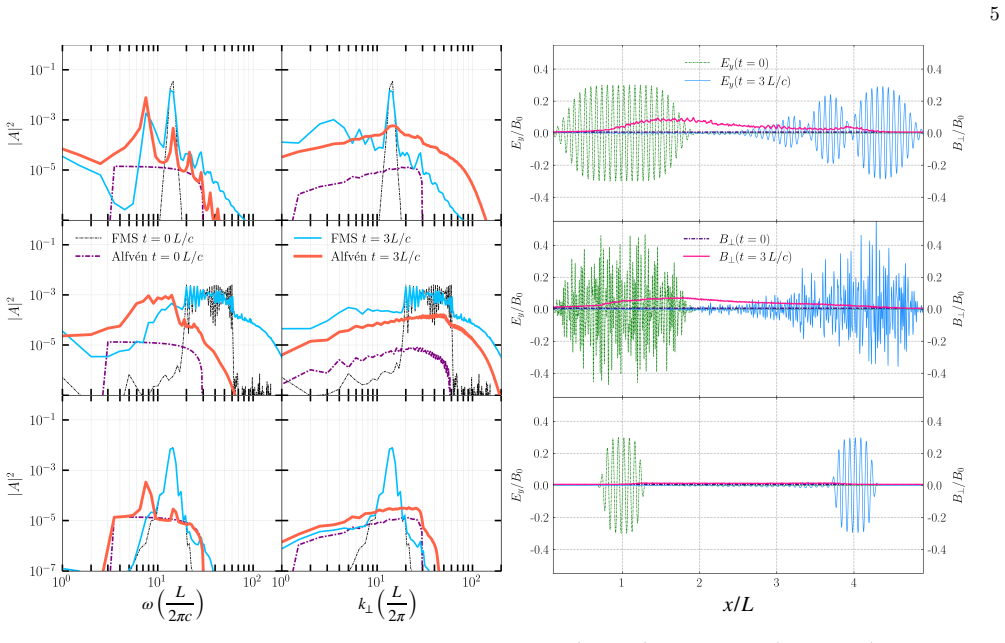
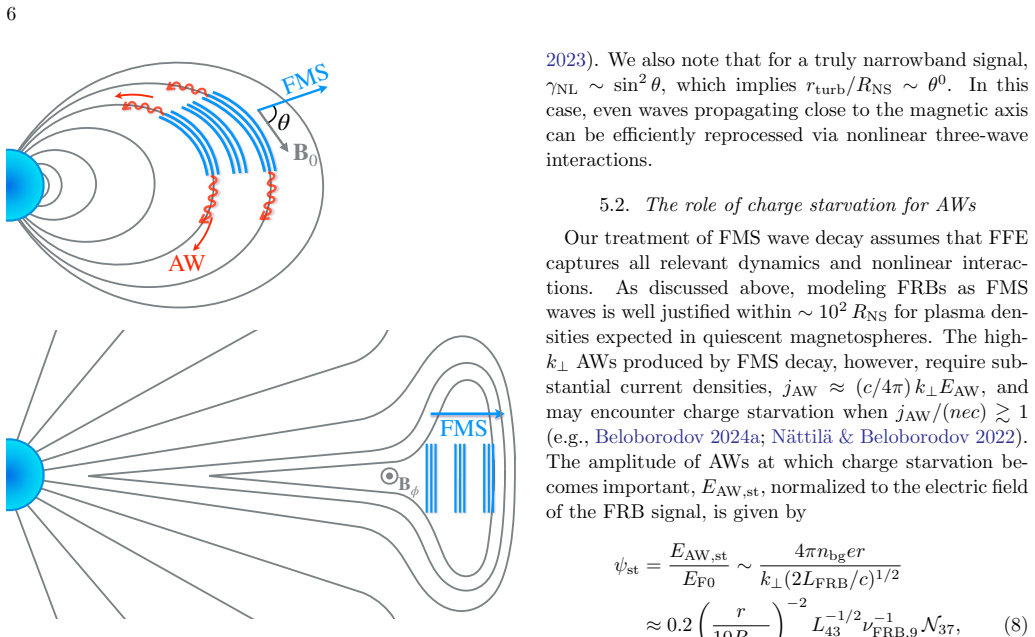
Using three-dimensional force-free electrodynamics simulations, the work demonstrates that FRBs excite Alfvénic fluctuations through resonant three-wave interactions, leading to strong nonlinear attenuation of the radio signal. In quiescent dipolar magnetospheres this decay remains efficient within approximately 10 to 100 magnetar radii, after which charge starvation of the excited Alfvén waves stops the process. For FRBs propagating inside relativistic magnetic outflows the interactions stay efficient and constrain the escape radius to at least 100 to 1000 magnetar radii for luminous bursts.
What carries the argument
Resonant three-wave interactions between fast magnetosonic waves and trapped Alfvén waves, modeled with three-dimensional force-free electrodynamics simulations
Load-bearing premise
GHz radio waves propagate as fast magnetosonic waves and undergo resonant three-wave interactions that transfer their energy into trapped Alfvén waves.
What would settle it
Detection of an unattenuated FRB emitted from within 10 magnetar radii, or a simulation that disables the three-wave coupling and finds no attenuation.
Figures

read the original abstract
We investigate the propagation of fast radio bursts (FRBs) through magnetar magnetospheres. Previous work showed that, in the inner magnetosphere, GHz radio waves propagate as fast magnetosonic waves and undergo resonant three-wave interactions that transfer their energy into trapped Alfv\'en waves. Using three-dimensional force-free electrodynamics simulations, we demonstrate that FRBs would excite Alfv\'enic fluctuations, leading to strong nonlinear attenuation of the radio signal. In quiescent dipolar magnetospheres, the nonlinear decay stays efficient within $\sim10$--$100$ magnetar radii; charge starvation of the excited Alfv\'en waves stops the decay at larger radii. For FRBs propagating within relativistic magnetic outflows launched during magnetospheric eruptions, three-wave interactions remain efficient and constrain the escape radius to $\gtrsim10^2$--$10^3$ magnetar radii for luminous bursts. Our results confirm that nonlinear plasma processes strongly limit the escape of FRBs from the inner magnetospheres of magnetars.
Editorial analysis
A structured set of objections, weighed in public.
Referee Report
Summary. The manuscript investigates FRB propagation in magnetar magnetospheres. It invokes prior results that GHz waves propagate as fast magnetosonic waves and undergo resonant three-wave decay into trapped Alfvén waves. Using 3D force-free electrodynamics (FFE) simulations, the authors claim that injected FRB pulses excite Alfvénic fluctuations, producing strong nonlinear attenuation. In quiescent dipolar fields the decay remains efficient inside ∼10–100 R_NS before charge starvation halts it; in relativistic outflows launched by eruptions the process remains efficient out to ≳10^2–10^3 R_NS for luminous bursts, thereby limiting escape from the inner magnetosphere.
Significance. If the simulations correctly capture the resonant three-wave coupling, the work supplies concrete radial bounds on where FRBs can escape magnetar magnetospheres and strengthens the case that nonlinear plasma processes are decisive near the star. The adoption of 3D FFE to quantify attenuation radii is a constructive extension of earlier analytic and lower-dimensional treatments.
major comments (2)
- [Numerical setup and results sections] The central claim—that the observed attenuation is produced by resonant three-wave interactions—rests on the assumption that the FFE evolution reproduces the frequency/wave-vector matching conditions and dispersion relations previously derived in non-FFE (MHD or kinetic) treatments. The manuscript invokes this mechanism from prior literature but does not demonstrate that the injected GHz pulses satisfy the resonance conditions inside the FFE code, where the constraints E·B=0 and |E|<|B| alter the allowed wave modes and nonlinear couplings. Without an explicit check (e.g., extracted dispersion relations or a controlled test of the decay channel), the reported attenuation radii cannot be unambiguously attributed to the intended physical process rather than to the force-free constraint or numerical dissipation.
- [Results and discussion of attenuation radii] The quantitative radial ranges (10–100 R_NS for dipolar cases; 10^2–10^3 R_NS for outflows) are presented as direct outcomes of the simulations, yet no resolution study, boundary-condition sensitivity test, or comparison run with the three-wave channel artificially suppressed is reported. These diagnostics are required to establish that the attenuation is converged and physically driven before the escape-radius conclusions can be used to constrain emission models.
minor comments (1)
- [Abstract] The abstract states that “charge starvation of the excited Alfvén waves stops the decay at larger radii” but does not define how charge starvation is implemented or diagnosed in the FFE runs; a brief clarifying sentence would help readers.
Simulated Author's Rebuttal
We thank the referee for the constructive and detailed comments. We address each major point below and will incorporate the suggested diagnostics and clarifications into a revised manuscript.
read point-by-point responses
-
Referee: The central claim—that the observed attenuation is produced by resonant three-wave interactions—rests on the assumption that the FFE evolution reproduces the frequency/wave-vector matching conditions and dispersion relations previously derived in non-FFE (MHD or kinetic) treatments. The manuscript invokes this mechanism from prior literature but does not demonstrate that the injected GHz pulses satisfy the resonance conditions inside the FFE code, where the constraints E·B=0 and |E|<|B| alter the allowed wave modes and nonlinear couplings. Without an explicit check (e.g., extracted dispersion relations or a controlled test of the decay channel), the reported attenuation radii cannot be unambiguously attributed to the intended physical process rather than to the force-free constraint or numerical dissipation.
Authors: We agree that an explicit verification of the resonance conditions within the FFE framework would strengthen the attribution of attenuation to the three-wave decay. Although the FFE equations support the relevant linear modes (fast magnetosonic and Alfvén waves) and permit nonlinear couplings, we will add to the revised manuscript an analysis that extracts dispersion relations from the simulation data at representative radii. We will also include a diagnostic showing energy transfer between modes consistent with the resonant channel. These additions will help rule out artifacts from the force-free constraints or dissipation. revision: yes
-
Referee: The quantitative radial ranges (10–100 R_NS for dipolar cases; 10^2–10^3 R_NS for outflows) are presented as direct outcomes of the simulations, yet no resolution study, boundary-condition sensitivity test, or comparison run with the three-wave channel artificially suppressed is reported. These diagnostics are required to establish that the attenuation is converged and physically driven before the escape-radius conclusions can be used to constrain emission models.
Authors: We concur that convergence and robustness tests are essential. In the revised version we will report a resolution study demonstrating that the measured attenuation radii converge with increasing grid resolution. We will also discuss sensitivity to the outer boundary conditions. A direct numerical suppression of the three-wave channel is not straightforward to implement in FFE, but we will add mode-decomposition diagnostics that isolate the contribution of the resonant coupling and confirm that the damping is not dominated by numerical effects. revision: yes
Circularity Check
No significant circularity; simulations provide independent content
full rationale
The paper cites prior literature for the three-wave resonant decay mechanism and then performs new 3D FFE simulations to show excitation of Alfvénic fluctuations and resulting attenuation. No equations, fitted parameters, or self-definitional steps are shown that reduce the reported attenuation radii (10-100 R_NS or 10^2-10^3 R_NS) to the input assumptions by construction. The simulation outcomes are presented as separate results, making the central claim self-contained against external benchmarks rather than a renaming or forced prediction.
Axiom & Free-Parameter Ledger
axioms (2)
- domain assumption GHz radio waves propagate as fast magnetosonic waves in the inner magnetosphere
- domain assumption Resonant three-wave interactions transfer energy from fast magnetosonic waves into trapped Alfvén waves
Reference graph
Works this paper leans on
-
[1]
Beloborodov, A. M. 2013, ApJ, 777, 114, doi: 10.1088/0004-637X/777/2/114 —. 2017, ApJL, 843, L26, doi: 10.3847/2041-8213/aa78f3 —. 2020, ApJ, 896, 142, doi: 10.3847/1538-4357/ab83eb 9 —. 2021, ApJL, 922, L7, doi: 10.3847/2041-8213/ac2fa0 —. 2022, PhRvL, 128, 255003, doi: 10.1103/PhysRevLett.128.255003 —. 2023, ApJ, 959, 34, doi: 10.3847/1538-4357/acf659 —...
-
[2]
1989, ApJ, 343, 839, doi: 10.1086/167754
Blaes, O., Blandford, R., Goldreich, P., & Madau, P. 1989, ApJ, 343, 839, doi: 10.1086/167754
-
[3]
Bransgrove, A., Beloborodov, A. M., & Levin, Y. 2020, ApJ, 897, 173, doi: 10.3847/1538-4357/ab93b7
-
[4]
Chatterjee, K., Philippov, A., Beloborodov, A. M., et al. 2026, arXiv e-prints, arXiv:2602.17755, doi: 10.48550/arXiv.2602.17755
-
[5]
Chen, A. Y., Yuan, Y., & Bernardi, D. 2024, arXiv e-prints, arXiv:2404.06431, doi: 10.48550/arXiv.2404.06431 CHIME/FRB Collaboration, Andersen, B. C., Bandura, K. M., et al. 2020, Nature, 587, 54, doi: 10.1038/s41586-020-2863-y CHIME/FRB Collaboration, Amiri, M., Andersen, B. C., et al. 2021, ApJS, 257, 59, doi: 10.3847/1538-4365/ac33ab
-
[6]
2023, ApJ, 957, 102, doi: 10.3847/1538-4357/acfa78
Golbraikh, E., & Lyubarsky, Y. 2023, ApJ, 957, 102, doi: 10.3847/1538-4357/acfa78
-
[7]
Kaspi, V. M., & Beloborodov, A. M. 2017, ARA&A, 55, 261, doi: 10.1146/annurev-astro-081915-023329
-
[8]
2020, MNRAS, 494, 2385, doi: 10.1093/mnras/staa774
Kumar, P., & Boˇ snjak,ˇZ. 2020, MNRAS, 494, 2385, doi: 10.1093/mnras/staa774
-
[9]
Li, X., Zrake, J., & Beloborodov, A. M. 2019, ApJ, 881, 13, doi: 10.3847/1538-4357/ab2a03 L¨ offler, F., Faber, J., Bentivegna, E., et al. 2012, Classical quant. grav., 29, 115001, doi: 10.1088/0264-9381/29/11/115001
-
[10]
2020, MNRAS, 498, 1397, doi: 10.1093/mnras/staa2450
Lu, W., Kumar, P., & Zhang, B. 2020, MNRAS, 498, 1397, doi: 10.1093/mnras/staa2450
-
[11]
2014, Monthly Notices of the Royal Astronomical Society: Letters, 442, L9
Lyubarsky, Y. 2014, Monthly Notices of the Royal Astronomical Society: Letters, 442, L9
2014
-
[12]
2020, ApJ, 897, 1, doi: 10.3847/1538-4357/ab97b5 —
Lyubarsky, Y. 2020, ApJ, 897, 1, doi: 10.3847/1538-4357/ab97b5 —. 2021, Universe, 7, 56, doi: 10.3390/universe7030056
-
[13]
2021, Emission Mechanisms of Fast Radio Bursts
Lyubarsky, Y. 2021, Emission Mechanisms of Fast Radio Bursts. https://arxiv.org/abs/2103.00470
arXiv 2021
-
[14]
Mahlmann, J. F., Aloy, M. A., Mewes, V., & Cerd´ a-Dur´ an, P. 2021a, A&A, 647, A57, doi: 10.1051/0004-6361/202038907 —. 2021b, A&A, 647, A58, doi: 10.1051/0004-6361/202038908
-
[15]
2022, The Astrophysical Journal Letters, 932, L20
Spitkovsky, A., & Hakobyan, H. 2022, The Astrophysical Journal Letters, 932, L20
2022
-
[16]
Metzger, B. D., Margalit, B., & Sironi, L. 2019, MNRAS, 485, 4091, doi: 10.1093/mnras/stz700 N¨ attil¨ a, J., & Beloborodov, A. M. 2022, PhRvL, 128, 075101, doi: 10.1103/PhysRevLett.128.075101
-
[17]
Petroff, E., Hessels, J. W. T., & Lorimer, D. R. 2019, A&A Rv, 27, 4, doi: 10.1007/s00159-019-0116-6 —. 2022, A&A Rv, 30, 2, doi: 10.1007/s00159-022-00139-w
-
[18]
2024, ApJ, 972, 124, doi: 10.3847/1538-4357/ad5d5b
Qu, Y., & Zhang, B. 2024, ApJ, 972, 124, doi: 10.3847/1538-4357/ad5d5b
-
[19]
2016, Carpet: Adaptive Mesh Refinement for the Cactus Framework, Astrophysics Source Code Library, record ascl:1611.016
Schnetter, E., Hawley, S., & Hawke, I. 2016, Carpet: Adaptive Mesh Refinement for the Cactus Framework, Astrophysics Source Code Library, record ascl:1611.016. http://ascl.net/1611.016
2016
-
[20]
Sironi, L., Plotnikov, I., N¨ attil¨ a, J., & Beloborodov, A. M. 2021, PhRvL, 127, 035101, doi: 10.1103/PhysRevLett.127.035101
-
[21]
2025, Nonlinear Decay of Fast Magnetosonic Waves through Weak Turbulence: Force-Free Electrodynamics Simulations
Solanki, S., Mahlmann, J., & Philippov, A. 2025, Nonlinear Decay of Fast Magnetosonic Waves through Weak Turbulence: Force-Free Electrodynamics Simulations
2025
-
[22]
T., et al
Stanzione, D., West, J., Evans, R. T., et al. 2020, in Practice and Experience in Advanced Research
2020
-
[23]
2023, MNRAS, 519, 497, doi: 10.1093/mnras/stac3565
Thompson, C. 2023, MNRAS, 519, 497, doi: 10.1093/mnras/stac3565
-
[24]
Thompson, C., & Duncan, R. C. 1996, ApJ, 473, 322, doi: 10.1086/178147
-
[25]
2025, PhRvL, 134, 035201, doi: 10.1103/PhysRevLett.134.035201
Vanthieghem, A., & Levinson, A. 2025, PhRvL, 134, 035201, doi: 10.1103/PhysRevLett.134.035201
-
[26]
M., Chen, A
Yuan, Y., Beloborodov, A. M., Chen, A. Y., et al. 2022
2022
-
[27]
2022, ApJ, 925, 53, doi: 10.3847/1538-4357/ac3979
Zhang, B. 2022, ApJ, 925, 53, doi: 10.3847/1538-4357/ac3979 —. 2023, Reviews of Modern Physics, 95, 035005, doi: 10.1103/RevModPhys.95.035005
discussion (0)
Sign in with ORCID, Apple, or X to comment. Anyone can read and Pith papers without signing in.