REVIEW 4 major objections 5 minor 99 references
The Evolution of Hypervelocity Supernova Survivors and the Outcomes of Interacting Double White Dwarf Binaries
T0 review · 4 major / 5 minor · reviewed 2026-08-08 · deepseek-v4-flash
Pith's one-line read The coolest hypervelocity stars are the cooling remnants of white dwarfs stripped to nearly nothing before their companions exploded as Type Ia supernovae.
desk verdict A plausible and honest first model for the cool D6 and LP 40-365 survivors, with the key caveat that the initial fully convective structure is assumed, not yet derived from hydrodynamics. read the letter →
The pith
A machine-rendered reading of the paper's core claim, the machinery that carries it, and where it could break.
The reading
What carries the argument
The central object is the initially fully convective, centrally heated low-mass star, built with MESA using custom Rosseland mean opacity tables for He-rich, C/O-rich, and O/Ne-rich compositions. These models evolve by Kelvin-Helmholtz contraction: they move down the fully convective Hayashi track at nearly constant effective temperature (about 6000 K), then, once the core becomes radiative, bounce to hotter temperatures and higher luminosities and settle onto the white-dwarf cooling sequence. The tracks serve as the theoretical map against which observed luminosities, effective temperatures, and ages of D6 and LP 40-365 survivors are compared, and their luminosities over time feed the rate estimate.
What would settle it
Detailed spectral fitting of D6-2 that measures its surface gravity and C/He abundance ratio: if the inferred mass is much above $0.02\,M_\odot$, or if the photospheric pressure is high enough to form the molecular C$_2$ bands that the current spectrum excludes, the Kelvin-Helmholtz contracting-remnant explanation fails.
Extended reading notes
Core claim
The paper's central claim is that the cool D6 hypervelocity stars are the Kelvin-Helmholtz contracting remnants of He or C/O white dwarfs that lost most of their mass and were heated to the center, with D6-2 matched by a $0.02\,M_\odot$ He-rich track and D6-1/D6-3 by a $0.15\,M_\odot$ C/O-rich track. The same initial-condition models, with O/Ne-rich composition, reproduce the LP 40-365 class, interpreted as kicked remnants of near-Chandrasekhar-mass O/Ne white dwarfs partially disrupted by oxygen deflagrations. The paper also derives that roughly 2% of Type Ia supernovae eject a D6-2-like survivor and 0.2% eject a D6-1/D6-3-like survivor.
Load-bearing premise
The entire identification rests on the assumption that a companion white dwarf that loses most of its mass becomes an initially fully convective, centrally heated star whose internal entropy is uniform; the paper constructs such stars rather than deriving them from hydrodynamic simulations, and Section 5 concedes the initial models are 'at best an approximation'.
Editorial extensions
If this is right
- If a companion white dwarf loses enough mass before or during the primary's explosion, it becomes a fully convective, very low-mass star whose cooling evolution matches the cool D6 survivors.
- The observed population implies that about 2% of Type Ia supernovae leave behind a D6-2-like He-rich survivor, and about 0.2% leave a D6-1/D6-3-like C/O-rich survivor, the latter rate being consistent with SN 2003fg-like events.
- The hottest D6 survivors are likely cases where only the surface layers of the companion were heated, not fully convective stars, pointing to a distinct channel.
- The LP 40-365 stars are the low-mass kicked remnants of O/Ne white dwarfs that approached the Chandrasekhar mass and underwent partial oxygen deflagrations; their explosions may appear as SN Iax or SN 2002es-like transients depending on the presence of an extended shell.
- Interacting double white dwarf binaries can produce a wide range of outcomes, including long-lived merger remnants, two-star Type Ia supernovae, hypervelocity survivors, and iron core-collapse supernovae from O/Ne mergers.
Reading between the lines
- A direct measurement of D6-2's surface gravity from an upcoming high-resolution spectrum would test the $0.02\,M_\odot$ interpretation: the model predicts a photosphere far more tenuous than standard white-dwarf analyses assume.
- The paper's cooling tracks imply the existence of very red, low-mass C/O-rich survivors that current color-based Gaia searches may miss; a dedicated red search could raise the inferred 0.2% rate.
- The same fully convective initial condition, if applied to O/Ne remnants, suggests LP 40-365 stars and the coolest D6 stars could form a continuous sequence of stripped white dwarfs, distinguished only by composition and kick velocity.
- If the D6-2 association with supernova remnant G70.0-21.5 is real, the low ejection velocity of a $0.02\,M_\odot$ remnant remains a puzzle that hydrodynamic simulations of the kick must resolve, possibly requiring a different mass-loss history.
Editorial analysis
A structured set of objections, weighed in public.
Referee Report
Summary. The paper calculates MESA evolutionary tracks of initially fully convective, centrally heated low-mass stars with He-rich, C/O-rich, and O/Ne-rich compositions, and compares them to the observed hypervelocity supernova survivors. It argues that the three coolest D6 stars are the Kelvin-Helmholtz contracting remnants of companion white dwarfs that lost most of their mass before and during the primary's explosion: D6-2 is matched by a 0.02 Msun He-rich track, while D6-1, D6-3, and possibly J1235-3752 are matched by a 0.15 Msun C/O-rich track. From the paucity of detected candidates the paper infers that roughly 2% of SNe Ia leave a D6-2-like survivor and 0.2% leave a D6-1/D6-3-like survivor. It further argues that the LP 40-365 class of hypervelocity stars are low-mass O/Ne-rich remnants of near-Chandrasekhar-mass O/Ne white dwarfs that underwent partial oxygen deflagrations. The paper closes with speculative diagrams of interacting double white dwarf outcomes.
Significance. If the central interpretation is correct, the paper provides the first quantitative explanation of the cool D6 hypervelocity stars and derives observationally motivated rates for the D6 channel, which is an important constraint on Type Ia supernova progenitor models. It also offers a concrete evolutionary connection between LP 40-365 stars and partial oxygen deflagrations of near-Chandrasekhar-mass O/Ne white dwarfs, and makes testable predictions, such as the existence of very red, very low-mass hypervelocity survivors. The MESA calculations are standard, the opacity treatment is described clearly, and the input files are publicly available at the cited Zenodo DOI. The paper is also honest about its limitations, explicitly noting in Section 5 that the initially fully convective models are 'at best an approximation' and flagging the D6-2 velocity puzzle. The main weakness is that the inferred survivor masses and the resulting rates rest on this assumed initial structure, which is not derived from hydrodynamic simulations.
major comments (4)
- [Section 2 and Section 5] The initial conditions are load-bearing but not derived. Section 2 states that 'we construct hot, fully convective stars' with a chosen composition, while Section 5 concedes that 'our initially fully convective models are at best an approximation of the actual initial conditions of these stars.' Because the Hayashi-track effective temperature and the Kelvin-Helmholtz timescale set the inferred masses, the D6-2 mass of 0.02 Msun, the D6-1/D6-3 mass of 0.15 Msun, and the rates in Section 3 all depend on the assumption that the post-impact remnant is homogeneous, fully convective, and centrally heated. If the real remnant retains composition gradients, a residual He layer, a degenerate core, or a different entropy profile, the inferred masses change and with them the rate estimates. Please either support this initial condition with a concrete argument or a parameter exploration (e.g., varying the entropy profile, residual He-shell mass, or degree of central heating) showing that the observed HR positions and ages are robust to such variations, or explicitly reframe the results as conditional on the assumed initial structure.
- [Section 2.1] The D6-2 velocity puzzle is an internal tension in the central mass inference. The paper states that D6-2's 'relatively low ejection velocity of 1050 km/s presents a puzzle' because the SN ejecta should naively accelerate a 0.02 Msun remnant to higher velocities, and it defers the resolution to future hydrodynamic simulations. Since the 0.02 Msun mass itself is inferred from the assumed Kelvin-Helmholtz cooling track and the association with G70.0-21.5, the paper should quantify whether any plausible momentum-deposition efficiency can simultaneously reproduce the cooling age and the observed low velocity. If the G70.0-21.5 association is instead a coincidence, the age and hence the inferred mass could be larger, which would remove the tension but also change the rate estimate. Please provide a quantitative discussion of this trade-off.
- [Section 2.1 and Figures 1-2] The observational properties of the three coolest D6 stars are estimated using He-atmosphere WD color relations even though 'these stars are clearly not He atmosphere WDs,' and no extinction correction is applied. The errors shown are only from parallax uncertainties. This systematic uncertainty directly affects the claimed agreement between the tracks and D6-1, D6-3 (0.15 Msun) and D6-2 (0.02 Msun). Please estimate how much plausible C/O- or He-rich atmosphere models and a reasonable range of extinction (e.g., 0.1-0.5 mag in the Gaia bandpass) would shift the derived Teff and luminosity, and whether the inferred masses would move by more than the spacing between adjacent tracks in Figures 1 and 2.
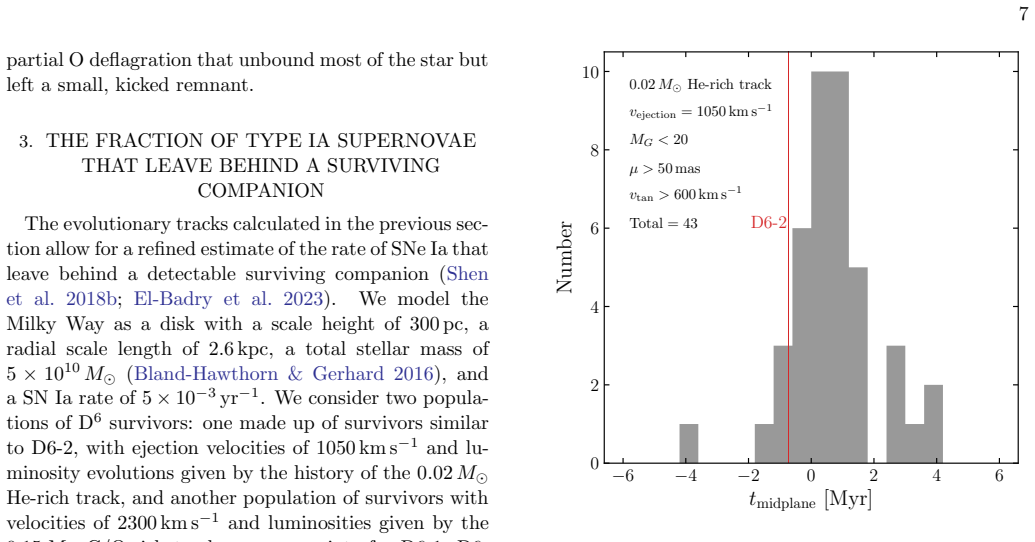
- [Section 3] The rate inversion assumes that the observed sample is complete for the stated selection criteria (MG < 20, proper motion > 50 mas/yr, tangential velocity > 600 km/s). The simulated histograms in Figures 4 and 5 count all stars in the model Galaxy that satisfy these criteria, and the paper then equates the detection of one D6-2-like star with a 2% rate and three C/O-rich survivors with a 0.2% rate. However, the actual discovery of D6 candidates depends on the completeness of the underlying Gaia and follow-up surveys, which is likely distance- and color-dependent and is not quantified here. Without a completeness model, the inferred rates should be presented as upper limits or as rates conditional on an assumed detection efficiency. Please either add a completeness estimate or soften the wording of the rate conclusions accordingly.
minor comments (5)
- [Section 2.1] There is a typo in the text: 'the stream from a a more massive C/O secondary WD' should read 'the stream from a more massive C/O secondary WD.'
- [Figure captions] The axis labels '104105' and '10□2' in the figure captions appear to be missing multiplication signs and superscripts; they should read e.g. '10^4 10^5' on the effective-temperature axis.
- [Table 1] The table header is rendered as 'T able 1' rather than 'Table 1.'
- [Section 2.1] The statement that 'the parameters of the three hottest D6 stars can be matched by a model with a mass ≳ 0.5 Msun' is not tied to a specific track in Figure 1 or Figure 2; please specify which model (composition and mass) is being compared and show it in the figures or in a separate figure.
- [Section 3] The simulated histograms use fixed ejection velocities for each survivor population, but the observed velocities (and hence the derived t_midplane values) have uncertainties that are not propagated into the histograms; a sentence acknowledging this limitation would be useful.
Circularity Check
No significant circularity: survivor masses are fitted parameters in a forward MESA evolution calculation, but the Kelvin-Helmholtz cooling timescales, age comparisons, and rate estimates provide independent physical content.
full rationale
The paper's central comparison is a forward stellar-evolution calculation: it constructs initially fully convective stars with specified masses and compositions, evolves them in MESA, and compares the resulting tracks to observed D6 and LP 40-365 stars. The masses (0.02, 0.15, ~0.25 Msun) are free parameters in this comparison, so the visual agreement in Figures 1-3 is a fit rather than an ab initio prediction; however, this is parameter inference, not circularity. The paper does not rename the fitted masses as predictions: it explicitly derives masses from the Kelvin-Helmholtz timescale scaling and the observed ages, and the cooling timescale, effective temperatures, and luminosity evolution are genuine physical outputs of the models. The rate estimates in Section 3 are inverse-detection-efficiency calculations: they ask how many stars like D6-2 or D6-1/D6-3 would be seen if every SN Ia produced such a survivor, then divide the observed count by that expectation. This is statistically conditioned on the tracks but is not a tautology, and the resulting ~0.2% C/O-survivor rate is checked against the independent SN 2003fg rate. Section 5's admission that the fully convective initial models are 'at best an approximation' flags a model limitation and a dependence on future hydrodynamical simulations, not a circular step; the initial condition is physically motivated by mass loss and ejecta heating (Section 1), not defined in terms of the output tracks. Self-citations (Shen et al. 2018b, 2024; Shen & Bildsten 2014) provide background context and prior results; none is invoked as a uniqueness theorem or as a substitute for this paper's calculation. No equation in the paper is shown to equal its input by construction, and no fitted parameter is renamed as a prediction. I therefore find no significant circularity.
Assumptions & free parameters
free parameters (6)
- D6-2 survivor mass =
0.02 M_sun (He-rich)
- D6-1/D6-3 survivor mass =
0.15 M_sun (C/O-rich)
- J1235-3752 survivor mass =
~0.25 M_sun (inferred)
- LP 40-365 survivor masses =
0.1 to 0.3 M_sun (O/Ne-rich)
- Initial heating luminosity =
L > 10 L_sun
- Ejection velocities for rate estimate =
1050 and 2300 km/s
assumptions (5)
- domain assumption The observed hypervelocity stars are surviving companions of SN Ia explosions (D6 scenario).
- ad hoc to paper The companion WD can be converted into a fully convective, centrally heated low-mass star by mass loss and ejecta impact.
- domain assumption MESA stellar evolution with the custom CMFGEN-based opacities correctly models these stars.
- domain assumption t_midplane (travel time from the Galactic midplane) is a valid proxy for survivor age.
- domain assumption In the rate estimate, the Milky Way disk model and extinction law are correct.
Cite this review
Pith. "Pith review of The Evolution of Hypervelocity Supernova Survivors and the Outcomes of Interacting Double White Dwarf Binaries." pith.science (2026). https://pith.science/paper/W2LUCKU3
@misc{pith2026250204451,
  author       = {Pith},
  title        = {Pith review of: The Evolution of Hypervelocity Supernova Survivors and the Outcomes of Interacting Double White Dwarf Binaries},
  year         = {2026},
  howpublished = {\url{https://pith.science/paper/W2LUCKU3}},
  note         = {Machine review of arXiv:2502.04451}
}
read the original abstract
The recent prediction and discovery of hypervelocity supernova survivors has provided strong evidence that the "dynamically driven double-degenerate double-detonation" (D6) Type Ia supernova scenario occurs in Nature. In this model, the accretion stream from the secondary white dwarf in a double white dwarf binary strikes the primary white dwarf violently enough to trigger a helium shell detonation, which in turn triggers a carbon/oxygen core detonation. If the secondary white dwarf survives the primary's explosion, it will be flung away as a hypervelocity star. While previous work has shown that the hotter observed D6 stars can be broadly understood as secondaries whose outer layers have been heated by their primaries' explosions, the properties of the cooler D6 stars have proven difficult to reproduce. In this paper, we show that the cool D6 stars can be explained by the Kelvin-Helmholtz contraction of helium or carbon/oxygen white dwarfs that underwent significant mass loss and core heating prior to and during the explosion of their white dwarf companions. We find that the current population of known D6 candidates is consistent with ~2% of Type Ia supernovae leaving behind a hypervelocity surviving companion. We also calculate the evolution of hot, low-mass oxygen/neon stars and find reasonable agreement with the properties of the LP 40-365 class of hypervelocity survivors, suggesting that these stars are the kicked remnants of near-Chandrasekhar-mass oxygen/neon white dwarfs that were partially disrupted by oxygen deflagrations. We use these results as motivation for schematic diagrams showing speculative outcomes of interacting double white dwarf binaries, including long-lived merger remnants, Type Ia supernovae, and several kinds of peculiar transients.
Figures


Figures from the paper (3 more)


Reference graph
Works this paper leans on
-
[1]
Asplund, M., Grevesse, N., Sauval, A. J., & Scott, P. 2009, ARA&A, 47, 481, doi: 10.1146/annurev.astro.46.060407.145222
arXiv 2009
-
[2]
Bauer, E. B., Chandra, V., Shen, K. J., & Hermes, J. J. 2021, ApJL, 923, L34, doi: 10.3847/2041-8213/ac432d
-
[3]
Bauer, E. B., White, C. J., & Bildsten, L. 2019, ApJ, 887, 68, doi: 10.3847/1538-4357/ab4ea4
-
[4]
Bhat, A., Bauer, E. B., Pakmor, R., et al. 2025, A&A, 693, A114, doi: 10.1051/0004-6361/202451371
-
[5]
2016, ARA&A, 54, 529, doi: 10.1146/annurev-astro-081915-023441
Bland-Hawthorn, J., & Gerhard, O. 2016, ARA&A, 54, 529, doi: 10.1146/annurev-astro-081915-023441
-
[6]
Blondin, S., Dessart, L., & Hillier, D. J. 2018, MNRAS, 474, 3931, doi: 10.1093/mnras/stx3058
-
[7]
Boos, S. J., Dessart, L., Shen, K. J., & Townsley, D. M. 2024a, submitted (arXiv:2410.22276), doi: 10.48550/arXiv.2410.22276
-
[8]
Boos, S. J., Townsley, D. M., & Shen, K. J. 2024b, ApJ, 972, 200, doi: 10.3847/1538-4357/ad5da2 12 Shen
Show all 99 references
-
[9]
Miles, B. J. 2021, ApJ, 919, 126, doi: 10.3847/1538-4357/ac07a2
2021 doi
-
[10]
2024, The Open Journal of Astrophysics, 7, 7, doi: 10.21105/astro.2310.16554
Braudo, J., & Soker, N. 2024, The Open Journal of Astrophysics, 7, 7, doi: 10.21105/astro.2310.16554
2024 arXiv
-
[11]
2016, ApJ, 821, 28, doi: 10.3847/0004-637X/821/1/28
Brooks, J., Bildsten, L., Schwab, J., & Paxton, B. 2016, ApJ, 821, 28, doi: 10.3847/0004-637X/821/1/28
2016 doi
-
[12]
2017, ApJ, 843, 151, doi: 10.3847/1538-4357/aa79a6
Paxton, B. 2017, ApJ, 843, 151, doi: 10.3847/1538-4357/aa79a6
2017 doi
-
[13]
R., Howell, D
Cao, Y., Kulkarni, S. R., Howell, D. A., et al. 2015, Nature, 521, 328, doi: 10.1038/nature14440
2015 doi
-
[14]
L., et al
Chandra, V., Hwang, H.-C., Zakamska, N. L., et al. 2022, MNRAS, 512, 6122, doi: 10.1093/mnras/stac883
2022 doi
- [15]
-
[16]
2014, MNRAS, 438, 14, doi: 10.1093/mnras/stt1766
Dan, M., Rosswog, S., Br¨ uggen, M., & Podsiadlowski, P. 2014, MNRAS, 438, 14, doi: 10.1093/mnras/stt1766
2014 doi
- [18]
-
[19]
Lau, H. H. B. 2015, MNRAS, 446, 2599, doi: 10.1093/mnras/stu2180
2015 doi
-
[20]
J., Chandra, V., et al
El-Badry, K., Shen, K. J., Chandra, V., et al. 2023, The Open Journal of Astrophysics, 6, 28, doi: 10.21105/astro.2306.03914
2023 arXiv
-
[21]
A., Neustadt, J
Fesen, R. A., Neustadt, J. M. M., Black, C. S., & Koeppel, A. H. D. 2015, ApJ, 812, 37, doi: 10.1088/0004-637X/812/1/37
2015 doi
-
[22]
K., Hillebrandt, W., et al
Fink, M., R¨ opke, F. K., Hillebrandt, W., et al. 2010, A&A, 514, A53, doi: 10.1051/0004-6361/200913892 Fitz Axen, M., & Nugent, P. 2023, ApJ, 953, 13, doi: 10.3847/1538-4357/acdd5d
2010 doi
- [23]
-
[24]
2022, Nature, 601, 201, doi: 10.1038/s41586-021-04155-1
Gal-Yam, A., Bruch, R., Schulze, S., et al. 2022, Nature, 601, 201, doi: 10.1038/s41586-021-04155-1
2022 doi
-
[25]
V., et al
Ganeshalingam, M., Li, W., Filippenko, A. V., et al. 2012, ApJ, 751, 142, doi: 10.1088/0004-637X/751/2/142 G¨ ansicke, B. T., Koester, D., Raddi, R., Toloza, O., &
2012 doi
-
[26]
Kepler, S. O. 2020, MNRAS, 496, 4079, doi: 10.1093/mnras/staa1761 Gentile Fusillo, N. P., Tremblay, P. E., Cukanovaite, E., et al. 2021, MNRAS, 508, 3877, doi: 10.1093/mnras/stab2672
2020 doi
-
[27]
2022, MNRAS, 515, 286, doi: 10.1093/mnras/stac1846
Ghosh, A., & Kushnir, D. 2022, MNRAS, 515, 286, doi: 10.1093/mnras/stac1846
2022 doi
-
[28]
B., Bhat, A., & Pakmor, R
Glanz, H., Perets, H. B., Bhat, A., & Pakmor, R. 2024, submitted (arXiv:2410.17306), doi: 10.48550/arXiv.2410.17306
2024 doi
-
[29]
T., et al
Gronow, S., Collins, C., Ohlmann, S. T., et al. 2020, A&A, 635, A169, doi: 10.1051/0004-6361/201936494
2020 doi
-
[30]
E., Sim, S
Gronow, S., Collins, C. E., Sim, S. A., & R¨ opke, F. K. 2021, A&A, 649, A155, doi: 10.1051/0004-6361/202039954
2021 doi
-
[31]
2010, ApJL, 709, L64, doi: 10.1088/2041-8205/709/1/L64
Guillochon, J., Dan, M., Ramirez-Ruiz, E., & Rosswog, S. 2010, ApJL, 709, L64, doi: 10.1088/2041-8205/709/1/L64
2010 doi
-
[32]
1961, PASJ, 13, 450
Hayashi, C. 1961, PASJ, 13, 450
1961
-
[33]
2011, CMFGEN: Probing the Universe through
Hillier, J. 2011, CMFGEN: Probing the Universe through
2011
-
[34]
A., Sullivan, M., Nugent, P
Howell, D. A., Sullivan, M., Nugent, P. E., et al. 2006, Nature, 443, 308, doi: 10.1038/nature05103
2006 doi
-
[35]
Hunter, J. D. 2007, Computing in Science & Engineering, 9, 90, doi: 10.1109/MCSE.2007.55
2007 doi
-
[36]
Iben, Jr., I., Nomoto, K., Tornambe, A., & Tutukov, A. V. 1987, ApJ, 317, 717, doi: 10.1086/165318
1987 doi
-
[37]
J., & Tutukov, A
Iben, I. J., & Tutukov, A. V. 1991, ApJ, 370, 615, doi: 10.1086/169848 Jacobson-Gal´ an, W. V., Polin, A., Foley, R. J., et al. 2020, ApJ, 896, 165, doi: 10.3847/1538-4357/ab94b8
1991 doi
-
[38]
2014, ApJ, 797, 83, doi: 10.1088/0004-637X/797/2/83
Jones, S., Hirschi, R., & Nomoto, K. 2014, ApJ, 797, 83, doi: 10.1088/0004-637X/797/2/83
2014 doi
-
[39]
K., Pakmor, R., et al
Jones, S., R¨ opke, F. K., Pakmor, R., et al. 2016, A&A, 593, A72, doi: 10.1051/0004-6361/201628321
2016 doi
-
[40]
K., Fryer, C., et al
Jones, S., R¨ opke, F. K., Fryer, C., et al. 2019, A&A, 622, A74, doi: 10.1051/0004-6361/201834381
2019 doi
- [41]
-
[42]
O., Koester, D., & Ourique, G
Kepler, S. O., Koester, D., & Ourique, G. 2016, Science, 352, 67, doi: 10.1126/science.aad6705
2016 doi
-
[43]
L., & Li, D
Kremer, K., Piro, A. L., & Li, D. 2021, ApJL, 917, L11, doi: 10.3847/2041-8213/ac13a0
2021 doi
-
[44]
A., Fink, M., et al
Kromer, M., Sim, S. A., Fink, M., et al. 2010, ApJ, 719, 1067, doi: 10.1088/0004-637X/719/2/1067
2010 doi
-
[45]
K., & Han, Z
Liu, Z.-W., R¨ opke, F. K., & Han, Z. 2023, Research in Astronomy and Astrophysics, 23, 082001, doi: 10.1088/1674-4527/acd89e
2023 doi
-
[46]
2022, MNRAS, 510, 1867, doi: 10.1093/mnras/stab3500
Lu, W., Beniamini, P., & Kumar, P. 2022, MNRAS, 510, 1867, doi: 10.1093/mnras/stab3500
2022 doi
-
[47]
1980, PASJ, 32, 303 13
Miyaji, S., Nomoto, K., Yokoi, K., & Sugimoto, D. 1980, PASJ, 32, 303 13
1980
-
[48]
Moll, R., Raskin, C., Kasen, D., & Woosley, S. E. 2014, ApJ, 785, 105, doi: 10.1088/0004-637X/785/2/105 Mor´ an-Fraile, J., Holas, A., R¨ opke, F. K., Pakmor, R., &
2014 doi
-
[49]
Schneider, F. R. N. 2024, A&A, 683, A44, doi: 10.1051/0004-6361/202347769
2024 doi
-
[50]
1968, Progress of Theoretical Physics, 39, 619, doi: 10.1143/PTP.39.619
Murai, T., Sugimoto, D., H¯ oshi, R., & Hayashi, C. 1968, Progress of Theoretical Physics, 39, 619, doi: 10.1143/PTP.39.619
1968 doi
-
[51]
M., Taubenberger, S., Blinnikov, S., Sorokina, E., & Hillebrandt, W
Noebauer, U. M., Taubenberger, S., Blinnikov, S., Sorokina, E., & Hillebrandt, W. 2016, MNRAS, 463, 2972, doi: 10.1093/mnras/stw2197
2016 doi
-
[52]
1982, ApJ, 253, 798, doi: 10.1086/159682 —
Nomoto, K. 1982, ApJ, 253, 798, doi: 10.1086/159682 —. 1984, ApJ, 277, 791, doi: 10.1086/161749
1982 doi
-
[53]
K., & Hillebrandt, W
Pakmor, R., Hachinger, S., R¨ opke, F. K., & Hillebrandt, W. 2011, A&A, 528, A117, doi: 10.1051/0004-6361/201015653
2011 doi
-
[54]
K., et al
Pakmor, R., Kromer, M., R¨ opke, F. K., et al. 2010, Nature, 463, 61, doi: 10.1038/nature08642
2010 doi
-
[55]
2012, ApJL, 747, L10, doi: 10.1088/2041-8205/747/1/L10
Pakmor, R., Kromer, M., Taubenberger, S., et al. 2012, ApJL, 747, L10, doi: 10.1088/2041-8205/747/1/L10
2012 doi
-
[56]
2013, ApJL, 770, L8, doi: 10.1088/2041-8205/770/1/L8
Pakmor, R., Kromer, M., Taubenberger, S., & Springel, V. 2013, ApJL, 770, L8, doi: 10.1088/2041-8205/770/1/L8
2013 doi
-
[57]
B., & Toonen, S
Pakmor, R., Zenati, Y., Perets, H. B., & Toonen, S. 2021, MNRAS, 503, 4734, doi: 10.1093/mnras/stab686
2021 doi
-
[58]
P., Collins, C
Pakmor, R., Callan, F. P., Collins, C. E., et al. 2022, MNRAS, 517, 5260, doi: 10.1093/mnras/stac3107
2022 doi
-
[59]
2024, A&A, 691, A179, doi: 10.1051/0004-6361/202451352
Pakmor, R., Pelisoli, I., Justham, S., et al. 2024, A&A, 691, A179, doi: 10.1051/0004-6361/202451352
2024 doi
-
[60]
2015, MNRAS, 449, 942, doi: 10.1093/mnras/stv337
Papish, O., Soker, N., Garc ´ ıa-Berro, E., & Aznar-Sigu´ an, G. 2015, MNRAS, 449, 942, doi: 10.1093/mnras/stv337
2015 doi
-
[61]
2011, ApJS, 192, 3, doi: 10.1088/0067-0049/192/1/3
Paxton, B., Bildsten, L., Dotter, A., et al. 2011, ApJS, 192, 3, doi: 10.1088/0067-0049/192/1/3
2011 doi
-
[62]
2013, ApJS, 208, 4, doi: 10.1088/0067-0049/208/1/4
Paxton, B., Cantiello, M., Arras, P., et al. 2013, ApJS, 208, 4, doi: 10.1088/0067-0049/208/1/4
2013 doi
-
[63]
2015, ApJS, 220, 15, doi: 10.1088/0067-0049/220/1/15
Paxton, B., Marchant, P., Schwab, J., et al. 2015, ApJS, 220, 15, doi: 10.1088/0067-0049/220/1/15
2015 doi
-
[64]
B., et al
Paxton, B., Schwab, J., Bauer, E. B., et al. 2018, ApJS, 234, 34, doi: 10.3847/1538-4365/aaa5a8
2018 doi
-
[65]
2019, ApJS, 243, 10, doi: 10.3847/1538-4365/ab2241
Paxton, B., Smolec, R., Schwab, J., et al. 2019, ApJS, 243, 10, doi: 10.3847/1538-4365/ab2241
2019 doi
-
[66]
B., Gal-Yam, A., Mazzali, P
Perets, H. B., Gal-Yam, A., Mazzali, P. A., et al. 2010, Nature, 465, 322, doi: 10.1038/nature09056
2010 doi
-
[67]
2019, ApJ, 873, 84, doi: 10.3847/1538-4357/aafb6a
Polin, A., Nugent, P., & Kasen, D. 2019, ApJ, 873, 84, doi: 10.3847/1538-4357/aafb6a
2019 doi
-
[68]
A., G¨ ansicke, B
Raddi, R., Hollands, M. A., G¨ ansicke, B. T., et al. 2018a, MNRAS, 479, L96, doi: 10.1093/mnrasl/sly103
-
[69]
A., Koester, D., et al
Raddi, R., Hollands, M. A., Koester, D., et al. 2018b, ApJ, 858, 3, doi: 10.3847/1538-4357/aab899 —. 2019, MNRAS, 489, 1489, doi: 10.1093/mnras/stz1618
2019 doi
-
[70]
M., & Shen, K
Rajavel, N., Townsley, D. M., & Shen, K. J. 2025, ApJ, 979, 54, doi: 10.3847/1538-4357/ada034
2025 doi
-
[71]
2014, ApJ, 788, 75, doi: 10.1088/0004-637X/788/1/75
Raskin, C., Kasen, D., Moll, R., Schwab, J., & Woosley, S. 2014, ApJ, 788, 75, doi: 10.1088/0004-637X/788/1/75
2014 doi
-
[72]
Timmes, F. X. 2012, ApJ, 746, 62, doi: 10.1088/0004-637X/746/1/62
2012 doi
- [73]
-
[74]
J., Sim, S
Ruiter, A. J., Sim, S. A., Pakmor, R., et al. 2013, MNRAS, 429, 1425, doi: 10.1093/mnras/sts423
2013 doi
-
[75]
2018, MNRAS, 476, 5303, doi: 10.1093/mnras/sty586 —
Schwab, J. 2018, MNRAS, 476, 5303, doi: 10.1093/mnras/sty586 —. 2019, ApJ, 885, 27, doi: 10.3847/1538-4357/ab425d —. 2021, ApJ, 906, 53, doi: 10.3847/1538-4357/abc87e
2018 doi
-
[76]
2016, MNRAS, 463, 3461, doi: 10.1093/mnras/stw2249
Schwab, J., Quataert, E., & Kasen, D. 2016, MNRAS, 463, 3461, doi: 10.1093/mnras/stw2249
2016 doi
-
[77]
J., Quataert, E., Dan, M., & Rosswog, S
Schwab, J., Shen, K. J., Quataert, E., Dan, M., & Rosswog, S. 2012, MNRAS, 427, 190, doi: 10.1111/j.1365-2966.2012.21993.x
2012
-
[78]
Shen, K. J. 2015, ApJL, 805, L6, doi: 10.1088/2041-8205/805/1/L6
2015 doi
-
[79]
J., & Bildsten, L
Shen, K. J., & Bildsten, L. 2014, ApJ, 785, 61, doi: 10.1088/0004-637X/785/1/61
2014 doi
-
[80]
J., Bildsten, L., Kasen, D., & Quataert, E
Shen, K. J., Bildsten, L., Kasen, D., & Quataert, E. 2012, ApJ, 748, 35, doi: 10.1088/0004-637X/748/1/35
2012 doi
-
[81]
J., Blondin, S., Kasen, D., et al
Shen, K. J., Blondin, S., Kasen, D., et al. 2021a, ApJL, 909, L18, doi: 10.3847/2041-8213/abe69b
-
[82]
J., Boos, S
Shen, K. J., Boos, S. J., & Townsley, D. M. 2024, ApJ, 975, 127, doi: 10.3847/1538-4357/ad7379
2024 doi
-
[83]
J., Boos, S
Shen, K. J., Boos, S. J., Townsley, D. M., & Kasen, D. 2021b, ApJ, 922, 68, doi: 10.3847/1538-4357/ac2304
-
[84]
J., Kasen, D., Miles, B
Shen, K. J., Kasen, D., Miles, B. J., & Townsley, D. M. 2018a, ApJ, 854, 52, doi: 10.3847/1538-4357/aaa8de
-
[85]
J., Quataert, E., & Pakmor, R
Shen, K. J., Quataert, E., & Pakmor, R. 2019, ApJ, 887, 180, doi: 10.3847/1538-4357/ab5370
2019 doi
-
[86]
J., Boubert, D., G¨ ansicke, B
Shen, K. J., Boubert, D., G¨ ansicke, B. T., et al. 2018b, ApJ, 865, 15, doi: 10.3847/1538-4357/aad55b
-
[87]
R., Foley, R
Siebert, M. R., Foley, R. J., Zenati, Y., et al. 2023, ApJ, 958, 173, doi: 10.3847/1538-4357/ad037f
2023 doi
-
[88]
A., R¨ opke, F
Sim, S. A., R¨ opke, F. K., Hillebrandt, W., et al. 2010, ApJL, 714, L52, doi: 10.1088/2041-8205/714/1/L52
2010 doi
-
[89]
2018, ApJ, 868, 90, doi: 10.3847/1538-4357/aae9ee
Tanikawa, A., Nomoto, K., & Nakasato, N. 2018, ApJ, 868, 90, doi: 10.3847/1538-4357/aae9ee
2018 doi
-
[90]
2019, ApJ, 885, 103, doi: 10.3847/1538-4357/ab46b6
Tanikawa, A., Nomoto, K., Nakasato, N., & Maeda, K. 2019, ApJ, 885, 103, doi: 10.3847/1538-4357/ab46b6
2019 doi
-
[91]
2017, in Handbook of Supernovae, ed
Taubenberger, S. 2017, in Handbook of Supernovae, ed. A. W. Alsabti & P. Murdin (New York: Springer), 317, doi: 10.1007/978-3-319-21846-5 37 14 Shen
2017 doi
-
[92]
M., Miles, B
Townsley, D. M., Miles, B. J., Shen, K. J., & Kasen, D. 2019, ApJL, 878, L38, doi: 10.3847/2041-8213/ab27cd
2019 doi
-
[93]
2017, Science, 357, 680, doi: 10.1126/science.aam8378
Vennes, S., Nemeth, P., Kawka, A., et al. 2017, Science, 357, 680, doi: 10.1126/science.aam8378
2017 doi
-
[94]
2024, A&A, 682, A42, doi: 10.1051/0004-6361/202348286
Werner, K., Reindl, N., Rauch, T., El-Badry, K., & B´ edard, A. 2024, A&A, 682, A42, doi: 10.1051/0004-6361/202348286
2024 doi
-
[95]
Wong, T. L. S., White, C. J., & Bildsten, L. 2024, ApJ, 973, 65, doi: 10.3847/1538-4357/ad6a11
2024 doi
-
[96]
2023a, MNRAS, 525, 6295, doi: 10.1093/mnras/stad2636
Wu, C., Xiong, H., Han, Z., & Wang, B. 2023a, MNRAS, 525, 6295, doi: 10.1093/mnras/stad2636
-
[97]
2023b, ApJL, 944, L54, doi: 10.3847/2041-8213/acb6f3
Wu, C., Xiong, H., Lin, J., et al. 2023b, ApJL, 944, L54, doi: 10.3847/2041-8213/acb6f3
-
[98]
2003, A&A, 412, L53, doi: 10.1051/0004-6361:20034607
Yoon, S.-C., & Langer, N. 2003, A&A, 412, L53, doi: 10.1051/0004-6361:20034607
2003 doi
-
[99]
B., Dessart, L., et al
Zenati, Y., Perets, H. B., Dessart, L., et al. 2023, ApJ, 944, 22, doi: 10.3847/1538-4357/acaf65
2023 doi
-
[100]
Zhang, M., Fuller, J., Schwab, J., & Foley, R. J. 2019, ApJ, 872, 29, doi: 10.3847/1538-4357/aafb34
2019 doi
Reviewed August 8, 2026 · model on record in the stance chip above.
Discussion (0). Continue with ORCID to comment.