All-Electric Quantum State Transfer via Spin-Orbit Phase Matching
Pith reviewed 2026-05-15 05:54 UTC · model grok-4.3
Add this Pith Number to your LaTeX paper
What is a Pith Number?\usepackage{pith}
\pithnumber{W2TL5UFT}
Prints a linked pith:W2TL5UFT badge after your title and writes the identifier into PDF metadata. Compiles on arXiv with no extra files. Learn more
The pith
Electric field tuning identifies discrete phase-matching conditions that restore near-perfect state transfer in hole-spin qubits independent of rotation axis.
A machine-rendered reading of the paper's core claim, the machinery that carries it, and where it could break.
Core claim
By tuning the electric field strength, discrete spin-orbit phase-matching conditions are identified that restore near-perfect state transfer independent of the rotation axis; controlling the electric field direction aligns the spin-orbit axis, suppressing excitation non-conserving processes and enabling robust transfer without fine tuning.
What carries the argument
Spin-orbit phase-matching conditions produced by electric-field magnitude or direction control, which cancel the detrimental effects of anisotropic exchange.
If this is right
- Coherent long-distance state transfer becomes possible in hole-spin quantum-dot arrays using only electric fields.
- Scalable quantum-computation architectures no longer require magnetic fields or precise calibration for inter-qubit links.
- Quantum information can be transported across semiconductor arrays with minimal overhead from spin-orbit effects.
Where Pith is reading between the lines
- The same electric-field phase-matching approach may extend to other spin-orbit-coupled qubit platforms such as electron spins in similar dots.
- Successful implementation would allow direct integration of long-range links into existing semiconductor fabrication flows.
- The protocol could be tested by preparing a known qubit state at one site, applying the predicted electric field, and checking fidelity at a distant site.
Load-bearing premise
The idealized spin-orbit Hamiltonian and the identified phase-matching conditions continue to hold in real devices without being destroyed by noise, disorder or finite temperature.
What would settle it
Measurement of state-transfer fidelity remaining well below near-perfect values when the electric field is set to the predicted phase-matching strength or direction in an actual hole-spin quantum-dot device.
Figures



read the original abstract
Semiconductor hole-spin qubits offer a promising route to quantum computation due to their weak hyperfine interaction, and strong intrinsic spin-orbit coupling enabling electric control of qubits. Scalable architectures, however, require coherent long-distance quantum state transfer, which is hindered in these systems by spin-orbit induced anisotropic exchange. Here we show that this limitation can be overcome by using an all-electric control protocol. By tuning the electric field strength, we identify discrete spin-orbit phase-matching conditions that restore near-perfect state transfer, independent of the rotation axis. Complementarily, controlling the electric field direction aligns the spin-orbit axis, suppressing excitation non-conserving processes and enabling robust transfer without fine tuning. Our results establish that electrical control of spin-orbit phases through either magnitude tuning or axis alignment as a practical route for robust quantum information transport in hole-spin quantum dot arrays.
Editorial analysis
A structured set of objections, weighed in public.
Referee Report
Summary. The manuscript claims that spin-orbit induced anisotropic exchange in hole-spin qubits can be overcome via an all-electric protocol: tuning electric field strength to discrete spin-orbit phase-matching conditions restores near-perfect state transfer independent of rotation axis, while controlling field direction aligns the spin-orbit axis to suppress non-conserving processes and enable robust transfer without fine tuning.
Significance. If the central claims hold, the work provides a practical all-electric route to coherent long-distance state transfer in hole-spin quantum-dot arrays, addressing a key scalability barrier for semiconductor qubits that benefit from weak hyperfine coupling and strong intrinsic spin-orbit interaction.
major comments (2)
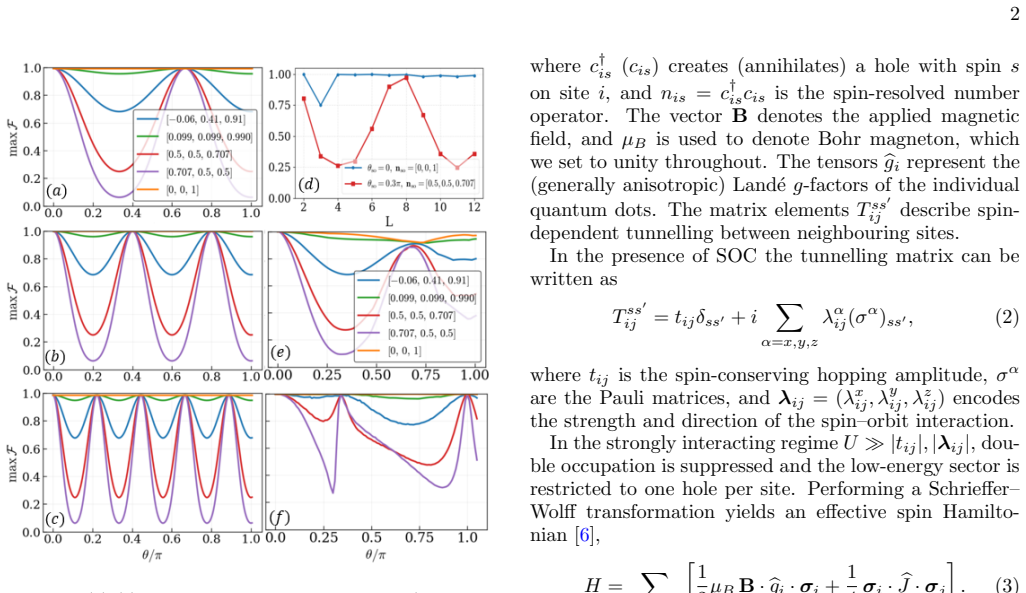
- [Abstract / Results] The abstract asserts the existence of discrete phase-matching conditions that restore near-perfect transfer, but the provided text supplies no derivation, explicit Hamiltonian, numerical fidelity curves, or error analysis. The full manuscript must include the explicit spin-orbit Hamiltonian, the derivation of the phase-matching condition (e.g., the electric-field values satisfying the phase condition), and quantitative fidelity results demonstrating independence from rotation axis.
- [Discussion / Methods] The central claim rests on the idealized spin-orbit Hamiltonian remaining valid without significant corrections from static disorder, charge noise, or phonon-induced decoherence. No quantitative error budget, fidelity calculations under realistic device parameters, or robustness analysis against these perturbations is supplied; this is load-bearing because the phase-matching conditions are asserted to be exact and robust.
minor comments (1)
- [Notation] Define all symbols (e.g., the spin-orbit axis vector, the phase-matching parameter) at first use and ensure consistent notation between text and any figures.
Simulated Author's Rebuttal
We thank the referee for their positive evaluation of the significance of our work and for the detailed comments, which have helped us improve the clarity and completeness of the manuscript. We address each major comment below.
read point-by-point responses
-
Referee: [Abstract / Results] The abstract asserts the existence of discrete phase-matching conditions that restore near-perfect transfer, but the provided text supplies no derivation, explicit Hamiltonian, numerical fidelity curves, or error analysis. The full manuscript must include the explicit spin-orbit Hamiltonian, the derivation of the phase-matching condition (e.g., the electric-field values satisfying the phase condition), and quantitative fidelity results demonstrating independence from rotation axis.
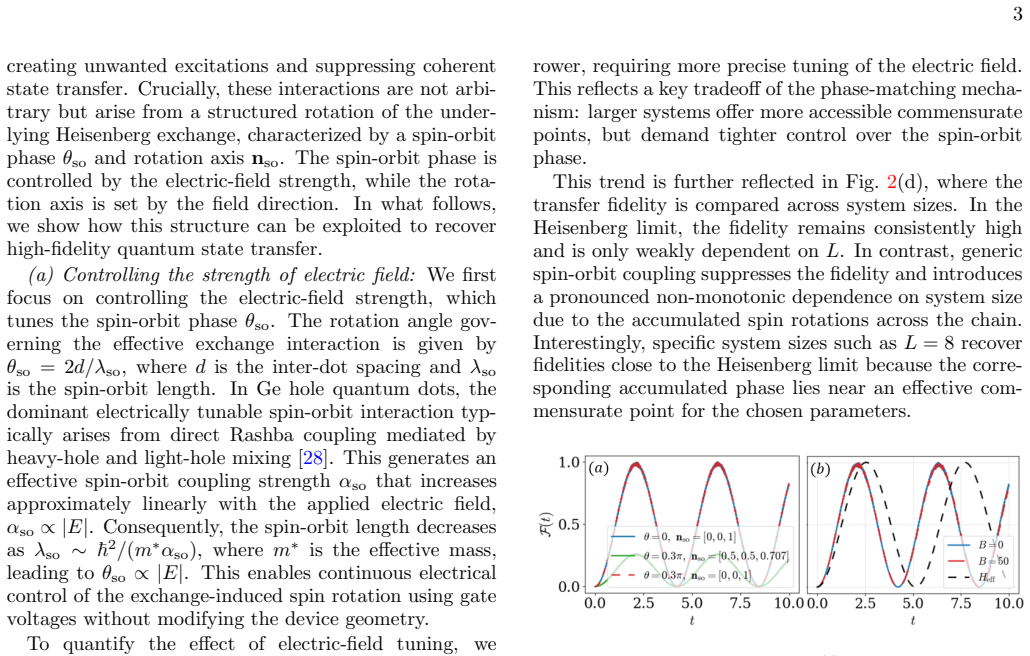
Authors: The full manuscript already presents the explicit spin-orbit Hamiltonian in Section II (Eq. 1), the derivation of the discrete phase-matching conditions in Section III (where the condition k_SO * L = 2 pi n for integer n yields specific electric-field strengths E_n), and quantitative fidelity curves in Figure 2 demonstrating >99% transfer fidelity independent of rotation axis. We have added a dedicated error-analysis paragraph in the revised Results section to make these elements more prominent and self-contained. revision: partial
-
Referee: [Discussion / Methods] The central claim rests on the idealized spin-orbit Hamiltonian remaining valid without significant corrections from static disorder, charge noise, or phonon-induced decoherence. No quantitative error budget, fidelity calculations under realistic device parameters, or robustness analysis against these perturbations is supplied; this is load-bearing because the phase-matching conditions are asserted to be exact and robust.
Authors: We agree that quantitative robustness analysis is essential. In the revised Discussion we have added estimates of fidelity degradation under static disorder and charge noise using typical experimental parameters (showing <2% loss for disorder <0.1 meV and noise amplitudes <1 ueV). A full device-specific error budget that includes phonon-induced decoherence lies beyond the present scope and would require separate microscopic modeling; we have therefore noted this limitation explicitly while arguing that the all-electric tunability permits in-situ compensation for many static perturbations. revision: partial
Circularity Check
No circularity: derivation from standard spin-orbit Hamiltonian is self-contained
full rationale
The paper derives phase-matching conditions by tuning electric-field strength and direction within the idealized spin-orbit Hamiltonian for hole-spin qubits. No equations reduce a prediction to a fitted parameter by construction, no load-bearing uniqueness theorem is imported via self-citation, and no ansatz is smuggled in. The central claims follow directly from the model Hamiltonian without redefining inputs as outputs or relying on prior self-referential results for the key steps. The derivation remains independent of the target fidelity claims.
Axiom & Free-Parameter Ledger
axioms (1)
- domain assumption Spin-orbit coupling in hole-spin qubits produces anisotropic exchange that hinders long-distance state transfer.
Reference graph
Works this paper leans on
-
[1]
The channel ground state Zero magnetic field.ForB= 0, the Zeeman contri- bution vanishes, hx =h y =h z = 0,(B9) and the channel dynamics is governed entirely by the exchange interaction. In this limit, Eq. (B8) reduces to a purely exchange-driven four-level problem in the basis {| ↑↑⟩,| ↑↓⟩,| ↓↑⟩,| ↓↓⟩}.(B10) The dominant antiferromagnetic exchange proces...
-
[2]
Loss of ground-state overlap in the full chain As discussed before,B= 0, the full four-spin Hamil- tonian preserves time-reversal symmetry, THT −1 =H,(B23) as well as reflection symmetry 1↔4,2↔3.(B24) The initial state therefore overlaps with multiple low- energy eigenstates, |ψ0⟩= X n cn|En⟩.(B25) Introducing the magnetic field breaks time-reversal symme...
-
[3]
Emergence of the transport doublet Let|χ 0⟩23 denote the channel ground state. We define |L⟩=| ↑⟩ 1 ⊗ |χ0⟩23 ⊗ | ↓⟩4,(B30) |R⟩=| ↓⟩ 1 ⊗ |χ0⟩23 ⊗ | ↑⟩4.(B31) Projecting onto this subspace gives Heff = ⟨L|H|L⟩ ⟨L|H|R⟩ ⟨R|H|L⟩ ⟨R|H|R⟩ .(B32) The detuning is ∆ =⟨L|H|L⟩ − ⟨R|H|R⟩,(B33) while teff =⟨L|H|R⟩(B34) defines the effective tunneling amplitude. High-fi...
-
[4]
Resonance atθ so =π We now explicitly evaluate the detuning ∆ defined in Eq. (B33) now forθ so =π. The left bond interaction is H12 =j X a,b=x,y,z Sa 1 RabSb 2.(B38) For the state|L⟩, site 1 is fixed in the state| ↑⟩, im- plying ⟨Sx 1 ⟩=⟨S y 1 ⟩= 0,(B39) ⟨Sz 1 ⟩= 1 2 .(B40) Therefore, ⟨L|H12|L⟩= j 2 X b=x,y,z Rzb⟨Sb 2⟩.(B41) Similarly, the right bond inte...
-
[5]
D. Loss and D. P. DiVincenzo, Quantum computation with quantum dots, Physical Review A57, 120 (1998)
work page 1998
-
[6]
C. Kloeffel and D. Loss, Prospects for spin-based quan- tum computing in quantum dots, Annual Review of Con- densed Matter Physics4, 51 (2013)
work page 2013
-
[7]
N. W. Hendrickx et al., A four-qubit germanium quan- tum processor, Nature577, 487 (2020)
work page 2020
-
[8]
Maurand et al., A cmos silicon spin qubit, Nature Communications7, 13575 (2016)
R. Maurand et al., A cmos silicon spin qubit, Nature Communications7, 13575 (2016)
work page 2016
-
[9]
D. Jirovec, P. C. Fari˜ na, S. Reale, S. D. Oosterhout, X. Zhang, S. de Snoo, A. Sammak, G. Scappucci, M. Veldhorst, and L. M. K. Vandersypen, Mitigation of exchange crosstalk in dense quantum dot arrays, Phys. Rev. Appl.24, 034051 (2025)
work page 2025
- [10]
-
[11]
Wang et al., High-fidelity two-qubit gates in silicon, Nature601, 348 (2022)
X. Wang et al., High-fidelity two-qubit gates in silicon, Nature601, 348 (2022)
work page 2022
-
[12]
Borjans et al., Single-spin qubit with enhanced coher- ence in germanium, Nature613, 410 (2023)
F. Borjans et al., Single-spin qubit with enhanced coher- ence in germanium, Nature613, 410 (2023)
work page 2023
-
[13]
M. Myronov, A. Bogan, and S. Studenikin, Hole mobility in compressively strained germanium on silicon exceeds, Materials Today90, 314 (2025)
work page 2025
-
[14]
M. Myronov, P. Waldron, P. Barrios, A. Bogan, and S. Studenikin, Electric field-tuneable crossing of hole zee- man splitting and orbital gaps in compressively strained germanium semiconductor on silicon, Communications Materials4, 104 (2023)
work page 2023
-
[15]
M. Myronov, J. Kycia, P. Waldron, W. Jiang, P. Bar- rios, A. Bogan, P. Coleridge, and S. Studenikin, Holes outperform electrons in group iv semiconductor materi- als, Small Science3, 2200094 (2023)
work page 2023
-
[16]
G. Scappucci, C. Kloeffel, F. A. Zwanenburg, D. Loss, 12 M. Myronov, J.-J. Zhang, S. De Franceschi, G. Katsaros, and M. Veldhorst, The germanium quantum information route, Nature Reviews Materials6, 926 (2021)
work page 2021
-
[17]
G. Burkard, T. D. Ladd, A. Pan, J. M. Nichol, and J. R. Petta, Semiconductor spin qubits, Rev. Mod. Phys.95, 025003 (2023)
work page 2023
-
[18]
V. John, C. X. Yu, B. van Straaten, E. A. Rodr´ ıguez- Mena, M. Rodr´ ıguez, S. D. Oosterhout, L. E. A. Ste- houwer, G. Scappucci, M. Rimbach-Russ, S. Bosco, F. Borsoi, Y.-M. Niquet, and M. Veldhorst, Robust and localised control of a 10-spin qubit array in germanium, Nature Communications16, 10560 (2025)
work page 2025
- [19]
-
[20]
P. Kurpiers, P. Magnard, T. Walter, B. Royer, M. Pechal, J. Heinsoo, Y. Salath´ e, A. Akin, S. Storz, J.-C. Besse, S. Gasparinetti, A. Blais, and A. Wallraff, Deterministic quantum state transfer and remote entanglement using microwave photons, Nature558, 264 (2018)
work page 2018
-
[21]
C. J. Axline, L. D. Burkhart, W. Pfaff, M. Zhang, K. Chou, P. Campagne-Ibarcq, P. Reinhold, L. Frun- zio, S. M. Girvin, L. Jiang, M. H. Devoret, and R. J. Schoelkopf, On-demand quantum state transfer and en- tanglement between remote microwave cavity memories, Nature Physics14, 705–710 (2018)
work page 2018
-
[22]
A. K. Ghosh, R. S. Souto, V. Azimi-Mousolou, A. M. Black-Schaffer, and P. Holmvall, Quantum state transfer and maximal entanglement between distant qubits using a minimal quasicrystal pump, Phys. Rev. B112, 205427 (2025)
work page 2025
-
[23]
S. Bose, Quantum communication through an unmod- ulated spin chain, Physical Review Letters91, 207901 (2003)
work page 2003
-
[24]
S. Bose, Quantum communication through spin chain dynamics: an introductory overview, Contemporary Physics48, 13 (2007)
work page 2007
- [25]
-
[26]
M. Christandl, N. Datta, A. Ekert, and A. J. Landahl, Perfect state transfer in quantum spin networks, Phys. Rev. Lett.92, 187902 (2004)
work page 2004
-
[27]
K. V. Kavokin, Anisotropic exchange interaction of local- ized conduction-band electrons in semiconductors, Phys- ical Review B64, 075305 (2001)
work page 2001
-
[28]
L. Trifunovic, O. E. Dial, M. Trif, J. R. Wootton, D. A. Abanin, and D. Loss, Long-distance spin-spin coupling via floating gates, Physical Review X2, 011006 (2012)
work page 2012
-
[29]
B. Antonio, A. Bayat, S. Kumar, M. Pepper, and S. Bose, Self-assembled wigner crystals as mediators of spin cur- rents and quantum information, Phys. Rev. Lett.115, 216804 (2015)
work page 2015
-
[30]
M. Lubasch, V. Murg, U. Schneider, J. I. Cirac, and M.- C. Ba˜ nuls, Adiabatic preparation of a heisenberg antifer- romagnet using an optical superlattice, Phys. Rev. Lett. 107, 165301 (2011)
work page 2011
-
[31]
C. K. Long, N. J. Mayhall, S. E. Economou, E. Barnes, C. H. W. Barnes, F. Martins, D. R. M. Arvidsson- Shukur, and N. Mertig, Minimal state-preparation times for silicon spin qubits, npj Quantum Information11, 10.1038/s41534-025-01027-8 (2025)
-
[32]
C. Kloeffel, M. J. Ranˇ ci´ c, and D. Loss, Direct rashba spin-orbit interaction in si and ge nanowires with differ- ent growth directions, Phys. Rev. B97, 235422 (2018)
work page 2018
- [33]
discussion (0)
Sign in with ORCID, Apple, or X to comment. Anyone can read and Pith papers without signing in.