Consequences of radially correlated rotation curves for galaxy mass models
Pith reviewed 2026-05-25 07:31 UTC · model grok-4.3
The pith
Accounting for correlations between consecutive points in galaxy rotation curves removes the apparent preference for cored dark matter halos over cuspy ones.
A machine-rendered reading of the paper's core claim, the machinery that carries it, and where it could break.
Core claim
Consecutive points in rotation curve measurements are correlated with each other, but this is usually ignored when constructing galaxy mass models. Applying a data-driven approach that includes the characteristic amplitude and scale length of such correlations as nuisance parameters yields improved fits for both Navarro-Frenk-White and pseudo-isothermal sphere dark halo models across 134 SPARC galaxies, frequently reaching chi-squared per degree of freedom near one. The inferred correlation amplitude and scale length are similar for both halo models and physically plausible at roughly 20 km/s and 5 kpc, though regarded as upper limits because the simple parametric form can absorb other unmod
What carries the argument
A simple parametric model for radial correlations in rotation curves, added as nuisance parameters during chi-squared minimization of galaxy mass models.
If this is right
- Goodness-of-fit values become acceptable for both NFW and pISO models in most galaxies.
- Uncertainties on the derived halo parameters increase and better reflect the actual constraining power of the data.
- The statistical preference for pISO models over NFW models disappears once correlations are allowed.
- Inferred correlation parameters remain similar whether NFW or pISO halos are assumed.
Where Pith is reading between the lines
- Many earlier mass-modeling studies that ignored correlations may need re-analysis to check whether their halo-shape conclusions hold.
- The same nuisance-parameter approach could be tested on kinematic data from other tracers such as stellar velocities or gas velocity fields.
- If the correlations turn out to be partly physical rather than purely observational, they could constrain models of how rotation curves are shaped by baryonic processes.
Load-bearing premise
The simple parametric form used for the correlations can absorb other systematic errors in the data without the fit distinguishing between them.
What would settle it
Direct measurement of the radial correlation function from repeated high-resolution observations of the same galaxies that yields amplitudes much below 20 km/s or scale lengths far from 5 kpc would show the nuisance parameters are not required at the reported level.
Figures



read the original abstract
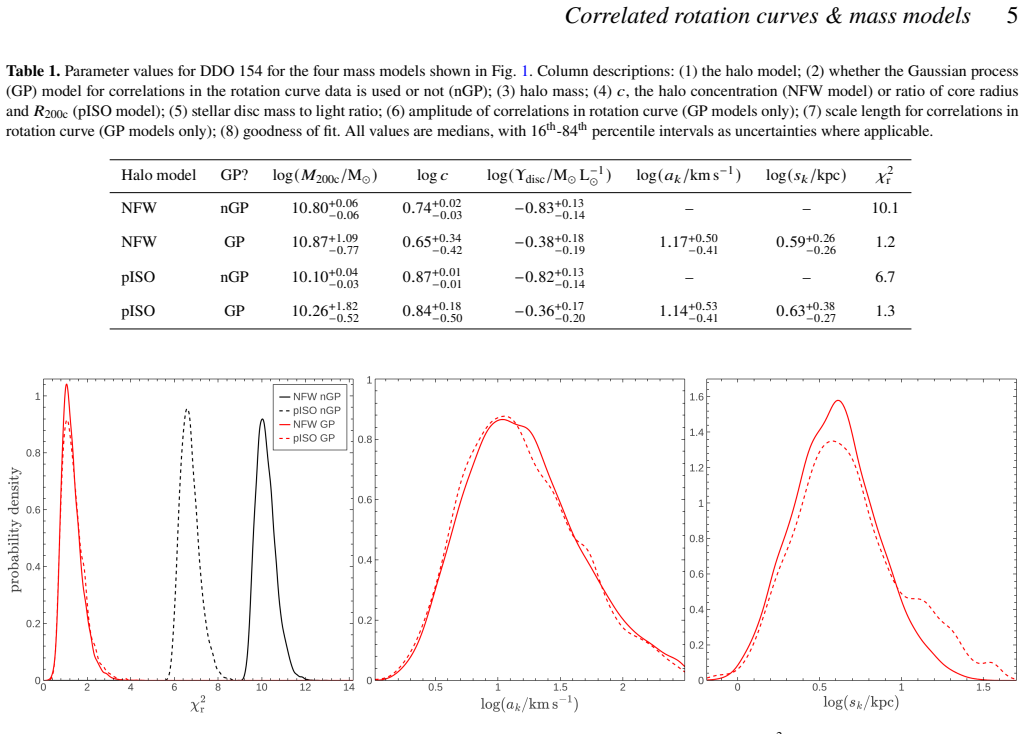
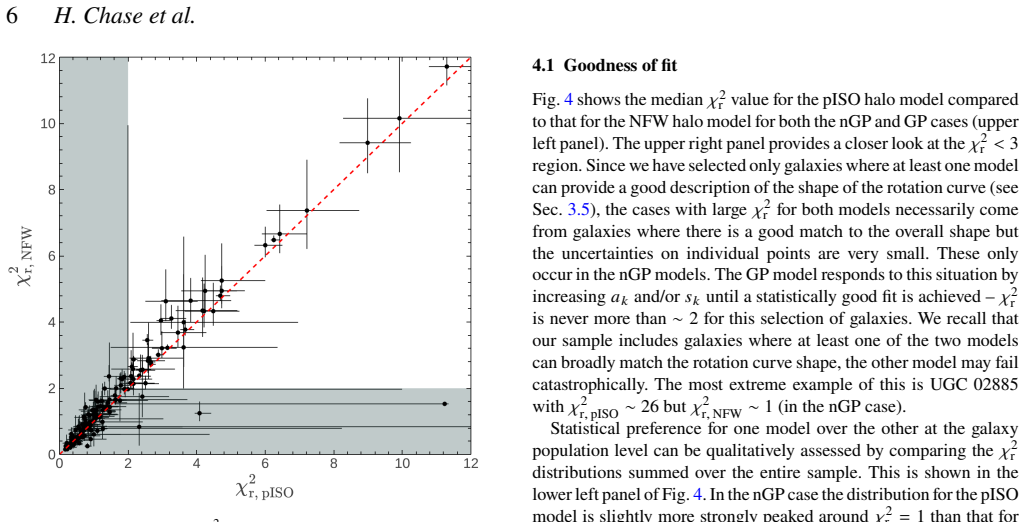
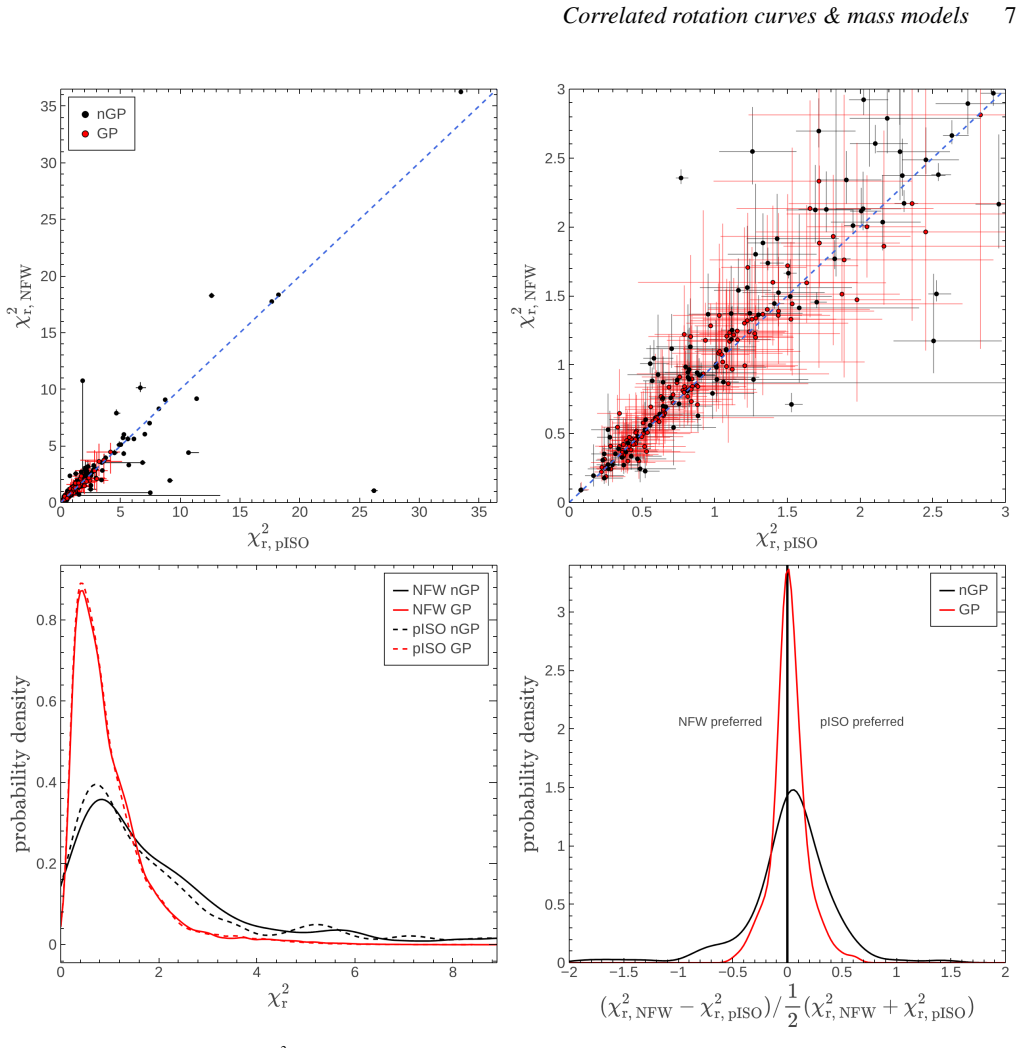
Consecutive points in rotation curve measurements are correlated with each other, but this is usually ignored when constructing galaxy mass models. We apply a recently proposed data-driven approach to include the characteristic amplitude and scale length of such correlations as `nuisance parameters'. We construct mass models for $134$ galaxies from the SPARC rotation curve compilation with Navarro-Frenk-White (NFW) and pseudo-isothermal sphere (pISO) models for the dark halo. Allowing for correlations in the rotation curves generally improves the goodness of fit for both halo models, often yielding a formally good fit ($\chi^2_\mathrm{r}\approx 1$) and model uncertainties that seem more representative of the constraining power of the data. For both halo models the inference on the typical correlation amplitude and scale length are very similar and physically plausible, $\sim 20\,\mathrm{km}\,\mathrm{s}^{-1}$ and $\sim 5\,\mathrm{kpc}$, respectively. The parametric form that we use to describe the correlations is intentionally simple, and our fitting approach makes the parameters describing possible correlations prone to `absorbing' other systematic errors, so we regard these estimates as upper limits. Without allowing for correlations we find a statistical preference for the pISO over the NFW model for $88$/$134$ galaxies; this preference essentially disappears when correlations are allowed for. Accounting for correlations in rotation curves when constructing mass models fundamentally affects how they are interpreted, highlighting an important systematic uncertainty that affects evidence for cusps or cores in dark matter haloes.
Editorial analysis
A structured set of objections, weighed in public.
Referee Report
Summary. The manuscript analyzes rotation curves for 134 SPARC galaxies, fitting NFW and pISO dark-matter halo models both with and without radial correlations treated as nuisance parameters (amplitude and scale length). It reports that including these correlations improves goodness-of-fit for both halo models (often reaching reduced χ² ≈ 1), yields more representative uncertainties, produces similar and plausible correlation parameters (~20 km s⁻¹ and ~5 kpc) for both models, and eliminates the statistical preference for pISO over NFW that exists (88/134 galaxies) when correlations are ignored. The parametric correlation form is noted as intentionally simple and prone to absorbing other systematics, so the amplitudes are interpreted as upper limits.
Significance. If the central results hold, the work identifies an important and commonly neglected systematic in rotation-curve mass modeling that can alter inferences about dark-matter halo profiles, particularly the cusp-core issue. The large sample, the explicit treatment of correlations as upper limits, and the demonstration that model preference is sensitive to this choice constitute a clear contribution to the literature on systematic uncertainties in galaxy dynamics.
major comments (1)
- [Methods] Methods section: The explicit functional form of the correlation kernel (or covariance matrix) and the precise likelihood implementation used when marginalizing over the nuisance parameters are not described at a level that allows independent reproduction of the reported χ² improvements and model-preference changes. This detail is load-bearing for the claim that the pISO preference disappears.
minor comments (2)
- [Results] Table 1 or equivalent summary table: reporting the fraction of galaxies for which each model achieves χ²_r < 1.5 both with and without correlations would make the quantitative impact on model preference clearer.
- [Figures] Figure captions: several figures showing example rotation-curve fits would benefit from explicit labels indicating whether the plotted uncertainties include the fitted correlation amplitude.
Simulated Author's Rebuttal
We thank the referee for their positive evaluation and recommendation for minor revision. The work highlights a commonly neglected systematic in rotation-curve modeling that affects inferences on dark-matter halo profiles. We address the single major comment below and will incorporate the requested details in the revised manuscript.
read point-by-point responses
-
Referee: [Methods] Methods section: The explicit functional form of the correlation kernel (or covariance matrix) and the precise likelihood implementation used when marginalizing over the nuisance parameters are not described at a level that allows independent reproduction of the reported χ² improvements and model-preference changes. This detail is load-bearing for the claim that the pISO preference disappears.
Authors: We agree that the Methods section requires additional explicit detail for full reproducibility. The correlation model follows the parametric covariance form introduced in the referenced prior work, with a kernel of the form C_ij = A² exp(-|r_i - r_j|/λ) plus the usual diagonal measurement variance, where A and λ are the nuisance parameters. The likelihood is the standard multivariate Gaussian with this full covariance matrix, and marginalization over A and λ is performed via nested sampling. In the revised manuscript we will insert the exact kernel expression, the full covariance construction, and the precise likelihood formula together with a brief description of the marginalization procedure. These additions will directly support reproduction of the χ² values and the change in model preference. revision: yes
Circularity Check
No significant circularity; derivation self-contained
full rationale
The paper fits correlation amplitude and scale length as nuisance parameters within a standard chi-squared framework for NFW vs pISO halo models on SPARC data. The central result (disappearance of pISO preference upon marginalization) follows directly from the likelihood comparison and is not equivalent to the nuisance parameters by construction. The explicit caveat that the parametric form can absorb systematics (treated as upper limits) is an independent caution rather than a hidden assumption. No self-citation, uniqueness theorem, or ansatz is load-bearing for the model-comparison claim. The derivation remains externally falsifiable via the data and standard statistics.
Axiom & Free-Parameter Ledger
free parameters (2)
- correlation amplitude =
~20 km/s
- correlation scale length =
~5 kpc
axioms (1)
- standard math After including the correlation model, the residuals follow a multivariate Gaussian distribution suitable for chi-squared likelihood.
Reference graph
Works this paper leans on
-
[1]
Aigrain S., Foreman-Mackey D., 2023, ARA&A, 61, 329 Allaert F., Gentile G., Baes M., 2017, A&A, 605, A55 Astropy Collaboration et al., 2022, ApJ, 935, 167 Bertone G., Hooper D., 2018, Reviews of Modern Physics, 90, 045002 Burkert A., 1995, ApJ, 447, L25 de Blok W. J. G., 2010, Advances in Astronomy, 2010, 789293 de Blok W. J. G., McGaugh S. S., Rubin V. C...
-
[2]
MNRAS000, 1–15 (2025) Correlated rotation curves & mass models13 Figure A2.As Fig
and its scatter is shown in the𝑀200c-𝑐NFW panel as a black line. MNRAS000, 1–15 (2025) Correlated rotation curves & mass models13 Figure A2.As Fig. A1 but for the pISO halo model. There is no analogue to the halo mass-concentration relation for the pISO dark halo model. MNRAS000, 1–15 (2025) 14H. Chase et al. Table B1.Goodness of fit for our four mass mod...
work page 2025
discussion (0)
Sign in with ORCID, Apple, or X to comment. Anyone can read and Pith papers without signing in.