REVIEW 2 major objections 4 minor 240 references
Object Learning and Robust 3D Reconstruction
T0 review · 2 major / 4 minor · reviewed 2026-08-16 · deepseek-v4-flash
Pith's one-line read Unsupervised object representations—learned from motion in 2D and geometric consistency in 3D—can segment objects of interest and ignore dynamic distractors, yielding cleaner 3D reconstruction from casual captures.
desk verdict A solid thesis compiling three peer-reviewed papers; the robust-3D methods are genuinely useful, but the robustness claim has a hidden high-occupancy ceiling that the thesis never acknowledges. read the letter →
The pith
A machine-rendered reading of the paper's core claim, the machinery that carries it, and where it could break.
The reading
What carries the argument
The machinery that carries the argument is the object hypothesis itself: a capsule is a part descriptor $c_k = (s_k, \theta_k, d_k)$ holding a canonical shape vector, a pose transformation, and a depth scalar; combined with a neural implicit decoder $D_\omega$, it yields a visible mask $\Lambda_k^+$ that explains a portion of the flow field $\Phi(u)=\sum_k \Lambda_k^+(u)[T_k(u)-u]$. In 3D, the corresponding mechanism is a trimmed estimator with a spatial-coherence prior: residuals $\epsilon(r)$ are thresholded at their median, blurred with a $3\times3$ kernel, and aggregated over $8\times8$ patches to set binary inlier/outlier weights $W(r)$, which are then used in an iteratively reweighted least-squares loss. SpotLessSplats replaces the RGB-residual classifier with a semantic-feature clustering or an MLP $H(F;\theta)$ trained on weak labels derived from lower/upper residual thresholds, and adds utilization-based pruning to stabilize Gaussian splatting. These mechanisms turn 'objectness' into a computable, self-supervising signal.
What would settle it
Capture a scene with a soft shadow cast by a moving person plus a fine static texture of similar residual magnitude; if the robust loss either leaves the shadow in or removes the texture, the spatial-coherence assumption fails.
Extended reading notes
Core claim
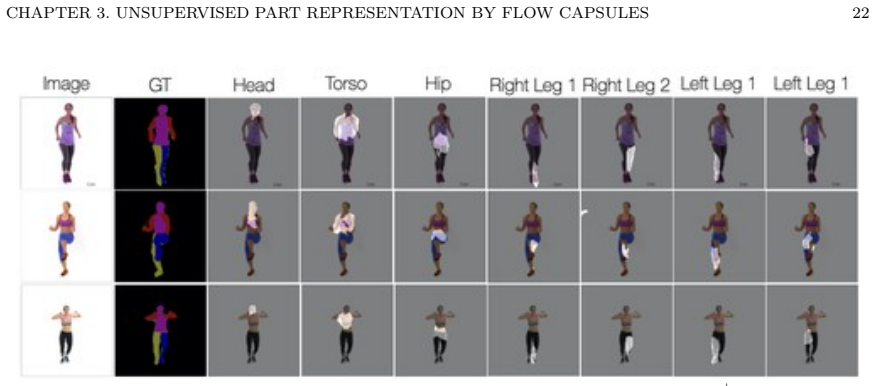
The thesis's central claim is that a network with an explicit object-based representation—parts that carry shape, pose, and depth in 2D; photometrically consistent regions in 3D—can learn to segment scenes without labels and thereby become more robust. In FlowCapsules, motion between video frames serves as the training signal: an encoder parses a single image into primary capsules, and a decoder renders their shapes; the capsules' poses and visibility masks produce a flow field that warps one frame toward the next, and optimizing this flow teaches the network which image regions are movable objects. In RobustNeRF, distractors are treated as outliers in a trimmed least-squares objective: pixels with high residual, spatially smoothed and patch-aggregated, are excluded from the NeRF loss. In SpotLessSplats, the same idea is transferred to 3D Gaussian splatting, but outlier detection uses semantic features from a text-to-image diffusion model rather than raw color, so distractors that share the background color are still masked.
Load-bearing premise
The load-bearing premise is that the objects worth keeping are exactly the regions that move together in 2D and look inconsistent across views in 3D, so motion and residual-based trimming can separate them from static background detail without supervision.
Editorial extensions
If this is right
- Casual captures—with pedestrians, pets, or moving shadows—can be reconstructed into clean 3D models without per-image labeling, because the optimizer itself learns which pixels to ignore.
- A single robust-loss recipe transfers from NeRF-style volumetric rendering to Gaussian splatting, so distractor handling need not be re-engineered for each new scene representation.
- Unsupervised part representations give viewpoint invariance and shape completion under occlusion, improving classification and segmentation on cluttered data.
- Reconstruction quality degrades gracefully as the fraction of cluttered training images grows: on one scene, RobustNeRF stays above 31 dB PSNR while the base mip-NeRF 360 drops from 33 to 25 dB.
- Utilization-based pruning removes floaters and cuts the number of Gaussians by a factor of 2 to 4.5 with little quality loss, even on clean scenes.
Reading between the lines
- Beyond the paper's demonstrations, the learned-outlier view could be pointed at transient phenomena the thesis does not test—specular highlights, rain, lens flare—as long as they are spatially coherent and photometrically inconsistent.
- A testable extension is to use the FlowCapsules motion cue to generate pseudo-masks for video frames and feed those masks to a 3D reconstructor, closing the loop between 2D object learning and 3D robustness without any labels.
- Because the thesis shows residual trimming is statistically inefficient on clean data, one could switch between robust and non-robust losses based on an online estimate of the clutter fraction, preserving quality when no distractors are present.
Signed reviews
Editorial analysis
A structured set of objections, weighed in public.
Referee Report
Summary. This PhD thesis bundles three published projects (FlowCapsules, RobustNeRF, SpotLessSplats) under the thesis that unsupervised, object-based representations improve robustness in image understanding and 3D reconstruction. Chapter 3 learns part capsules from motion via a self-supervised flow-rendering loss; Chapter 4 removes transient distractors in NeRF training through a trimmed, smoothed, patch-aggregated robust loss; Chapter 5 adapts this idea to 3D Gaussian Splatting using semantic features from a pre-trained diffusion model, with clustering or an MLP for outlier masks, plus utilization-based pruning. The empirical evaluation covers synthetic and real-world datasets (Geo, Exercise, Kubric, D2NeRF, RobustNeRF's own captures, NeRF On-the-go) with held-out clean test views, and consistently reports gains over mip-NeRF 360, D2NeRF, NeRF On-the-go, NeRF-HuGS, and vanilla 3DGS.
Significance. If the results hold, the thesis makes a solid contribution: RobustNeRF and SpotLessSplats provide practical, unsupervised ways to handle transient distractors in casual captures, and FlowCapsules demonstrates motion-supervised part discovery with shape completion under occlusion. The empirical work is extensive and mostly well-controlled, including paired distractor/distractor-free captures and held-out test views, and each chapter is an already-peer-reviewed publication. The methods are described in enough detail to reimplement, and several limitations (small distractors, soft shadows, semantically similar instances) are acknowledged explicitly. The reuse of published material makes the thesis a coherent anthology rather than a single new derivation, but its central claims are empirical and evaluated on external benchmarks as well as new datasets.
major comments (2)
- [Sec. 4.4.5 / Fig. 4.17] The central robustness claim of Chapter 4 has a hidden outlier-occupancy ceiling that is visible in the paper's own ablation. The trimming rule (4.8) uses a per-image median residual, the patch rule (4.10) requires at least 60% of a 16x16 neighborhood to be inliers, and the text around Fig. 4.17 states that in the hard Kubric setting (44% outlier pixels) any TR above 50% gives worse results. With the default TR=0.6, the method is already past its operating point on that scene, and the reconstruction degrades substantially. The limitation paragraphs in Sec. 4.5 mention small distractors and statistical inefficiency but do not acknowledge this high-occupancy ceiling, which is directly load-bearing for the claim of robust 3D modelling in casual captures. I recommend either adding a precise condition on distractor pixel fraction, or reporting a robustness curve (as in Fig. 4.17) for the natural scenes and stating the operating range explicitly in the conclusions.
- [Sec. 5.4.1, Eqs. (5.2)-(5.4) and Fig. 5.8] The SpotLessSplats masking pipeline inherits the same median-based ceiling from RobustNeRF. The weak labels U and L in Eqs. (5.8)-(5.9) are quantile masks from Eq. (5.2), which relies on a per-image/global median of residual magnitudes. If more than half the pixels in the histogram are distractors, the median falls inside the distractor residual distribution and the bootstrap labels are contaminated; the semantic clustering or MLP can then propagate the error rather than correct it. The thesis reports results on NeRF On-the-go 'high' occlusion scenes, but it does not quantify the outlier pixel fraction in those scenes, nor does it test SLS on the 44%-occupancy hard Kubric setup. Please add an explicit statement of the required inlier-majority condition, and include an experiment with controlled outlier fractions (e.g., the Kubric easy/medium/hard settings) for both SLS-agg and SLS-mlp.
minor comments (4)
- [Sec. 3.5.4, Table 3.3] The row 'No 6-Layer' in the occlusion-inductive-bias ablation is ambiguous: 'No' appears to mean 'without depth ordering', but the column header does not say so, and the reader must infer this from the surrounding text. Please rename the row to 'No depth ordering'.
- [Sec. 5.3] There is a typo '3DSG' in the sentence 'renders the entire image in a single forward pass'; it should read '3DGS'.
- [Abstract and Sec. 1.1] The phrase 'detecting and removal of the object of interest from the input images' in the abstract is confusing, because the 3D chapters remove distractors, not objects of interest. Please rephrase to 'detecting and removing transient distractors'.
- [Sec. 4.4.2 / Fig. 4.14] The D2NeRF hyperparameter tuning is reported as 'Config 1' being best, but the tuning is only done on two of the four datasets (Statue and Crab). This is acknowledged in the text, but it would help to state explicitly that the comparison to D2NeRF is therefore not a fully tuned baseline on all scenes.
Circularity Check
No significant circularity: central derivations are self-contained and validated on held-out benchmarks.
full rationale
The thesis's three projects are each evaluated against external ground truth or held-out clean views, so their central claims do not reduce to their inputs by construction. FlowCapsules learns part masks from a motion-warping proxy loss (Eqs. 3.5-3.7) and is scored by IoU against ground-truth masks on Geo/Exercise (Table 3.1); motion is an inductive bias, not a fitted label. RobustNeRF's trimming weights (Eqs. 4.8-4.10) are IRLS weights computed from current residuals, and the method is scored on distractor-free held-out frames (Fig. 4.11), with hyperparameters hand-chosen rather than fitted to the test set. SpotLessSplats' MLP masks (Eqs. 5.5-5.9) are weakly supervised by residual-derived labels, but the final reconstruction is evaluated on clean held-out views (Figs. 5.3, 5.5, 5.6), and ablations show that the semantic-feature component contributes over the residual-only RobustFilter. The frequent self-citations (e.g., Sabour et al. 2023 as the starting point for Chapter 5) are explanatory and are backed by experiments reported within the thesis itself; none functions as an unverified uniqueness theorem or imported ansatz. The acknowledged limitations—high-occupancy distractors in Fig. 4.17, small distractors in Sec. 4.5, and semantically similar instances/soft shadows in Sec. 5.5.4—are empirical boundary conditions, not circular reasoning.
Assumptions & free parameters
free parameters (7)
- RobustNeRF trim threshold TR =
0.6
- RobustNeRF patch and neighborhood size =
16x16 patch, 16 neighborhood
- SpotLessSplats pruning threshold kappa =
1e-8
- SpotLessSplats warm-up scheduler params =
beta1=3e-4, beta2=1.5
- SpotLessSplats clustering count C =
100
- SpotLessSplats feature config =
Stable Diffusion v2.1 layer 2, time step 261, empty prompt
- FlowCapsules capsule count K and encoding C =
K=8, C=32 (Geo); K=16, C=16 (Exercise)
assumptions (5)
- standard math Backpropagation and stochastic gradient descent can train the proposed networks.
- domain assumption COLMAP provides sufficiently accurate camera poses for 3D reconstruction.
- domain assumption Motion is a valid cue for object definition, based on Gestalt psychology and infant studies.
- ad hoc to paper Distractors appear as spatially coherent photometric outliers in casual captures.
- ad hoc to paper Pre-trained Stable Diffusion features encode semantic structure sufficient to distinguish distractors from static objects.
Cite this review
Pith. "Pith review of Object Learning and Robust 3D Reconstruction." pith.science (2026). https://pith.science/paper/WCNGDDZC
@misc{pith2026250417812,
  author       = {Pith},
  title        = {Pith review of: Object Learning and Robust 3D Reconstruction},
  year         = {2026},
  howpublished = {\url{https://pith.science/paper/WCNGDDZC}},
  note         = {Machine review of arXiv:2504.17812}
}
read the original abstract
In this thesis we discuss architectural designs and training methods for a neural network to have the ability of dissecting an image into objects of interest without supervision. The main challenge in 2D unsupervised object segmentation is distinguishing between foreground objects of interest and background. FlowCapsules uses motion as a cue for the objects of interest in 2D scenarios. The last part of this thesis focuses on 3D applications where the goal is detecting and removal of the object of interest from the input images. In these tasks, we leverage the geometric consistency of scenes in 3D to detect the inconsistent dynamic objects. Our transient object masks are then used for designing robust optimization kernels to improve 3D modelling in a casual capture setup. One of our goals in this thesis is to show the merits of unsupervised object based approaches in computer vision. Furthermore, we suggest possible directions for defining objects of interest or foreground objects without requiring supervision. Our hope is to motivate and excite the community into further exploring explicit object representations in image understanding tasks.
Figures


Figures from the paper (65 more)






Reference graph
Works this paper leans on
-
[1]
Adamkiewicz, M., Chen, T., Caccavale, A., Gardner, R., Culbertson, P., Bohg, J., and Schwager, M. (2022). Vision-only robot navigation in a neural radiance world. IEEE Robotics and Automation Letters
2022
-
[2]
Afshar, P., Mohammadi, A., and Plataniotis, K. N. (2018). Brain tumor type classification via capsule networks. In IEEE International Conference on Image Processing (ICIP) , pages 3129--3133. IEEE
2018
-
[3]
and Torresani, L
Ahmed, K. and Torresani, L. (2019). Star-caps: Capsule networks with straight-through attentive routing. In NeurIPS , pages 9098--9107
2019
-
[4]
Amir, S., Gandelsman, Y., Bagon, S., and Dekel, T. (2022). Deep ViT Features as Dense Visual Descriptors . What is Motion For Workshop in ECCV
2022
-
[5]
Arnab, A., Dehghani, M., Heigold, G., Sun, C., Lu c i \'c , M., and Schmid, C. (2021). Vivit: A video vision transformer. In Proceedings of the IEEE/CVF international conference on computer vision , pages 6836--6846
2021
-
[6]
and Lipman, Y
Atzmon, M. and Lipman, Y. (2020). Sal: Sign agnostic learning of shapes from raw data. In IEEE CVPR , pages 2565--2574
2020
-
[7]
Bai, S., Torr, P., et al. (2021). Visual parser: Representing part-whole hierarchies with transformers. arXiv preprint arXiv:2107.05790
arXiv 2021
-
[8]
Baker, N., Lu, H., Erlikhman, G., and Kellman, P. J. (2018). Deep convolutional networks do not classify based on global object shape. PLoS computational biology , 14(12):e1006613
2018
Show all 240 references
-
[9]
Bao, Z., Tokmakov, P., Jabri, A., Wang, Y.-X., Gaidon, A., and Hebert, M. (2022). Discovering objects that can move. In Proceedings of the IEEE/CVF Conference on Computer Vision and Pattern Recognition , pages 11789--11798
2022
-
[10]
Barron, J., Mildenhall, B., Tancik, M., Hedman, P., Martin-Brualla, R., and Srinivasan, P. (2021a). Mip-NeRF: A Multiscale Representation for Anti-Aliasing Neural Radiance Fields . In ICCV
2021
-
[11]
Barron, J. T. (2019). A general and adaptive robust loss function. CVPR
2019
-
[12]
T., Mildenhall, B., Tancik, M., Hedman, P., Martin-Brualla, R., and Srinivasan, P
Barron, J. T., Mildenhall, B., Tancik, M., Hedman, P., Martin-Brualla, R., and Srinivasan, P. P. (2021b). Mip-nerf: A multiscale representation for anti-aliasing neural radiance fields. ICCV
2021
-
[13]
T., Mildenhall, B., Verbin, D., Srinivasan, P
Barron, J. T., Mildenhall, B., Verbin, D., Srinivasan, P. P., and Hedman, P. (2022a). Mip- NeRF 360: Unbounded Anti - Aliased Neural Radiance Fields . In CVPR
2022
-
[14]
T., Mildenhall, B., Verbin, D., Srinivasan, P
Barron, J. T., Mildenhall, B., Verbin, D., Srinivasan, P. P., and Hedman, P. (2022b). Mip-nerf 360: Unbounded anti-aliased neural radiance fields. In CVPR
2022
-
[15]
Basri, R., Galun, M., Geifman, A., Jacobs, D., Kasten, Y., and Kritchman, S. (2020). Frequency bias in neural networks for input of non-uniform density. In ICML , pages 685--694
2020
-
[16]
F., Wu, J., Tenenbaum, J., and Yamins, D
Bear, D., Fan, C., Mrowca, D., Li, Y., Alter, S., Nayebi, A., Schwartz, J., Fei-Fei, L. F., Wu, J., Tenenbaum, J., and Yamins, D. L. (2020). Learning physical graph representations from visual scenes. NeurIPS
2020
-
[17]
Biederman, I. (1987). Recognition-by-components: a theory of human image understanding. Psychological review , 94(2):115
1987
-
[18]
T., Lensch, H
Boss, M., Engelhardt, A., Kar, A., Li, Y., Sun, D., Barron, J. T., Lensch, H. P., and Jampani, V. (2022). SAMURAI : S hape A nd M aterial from U nconstrained R eal-world A rbitrary I mage collections. In NeurIPS
2022
-
[19]
and Bethge, M
Brendel, W. and Bethge, M. (2019). Approximating cnns with bag-of-local-features models works surprisingly well on imagenet. arXiv preprint arXiv:1904.00760
2019 arXiv
-
[20]
P., Matthey, L., Watters, N., Kabra, R., Higgins, I., Botvinick, M., and Lerchner, A
Burgess, C. P., Matthey, L., Watters, N., Kabra, R., Higgins, I., Botvinick, M., and Lerchner, A. (2019). Monet: Unsupervised scene decomposition and representation. arXiv preprint arXiv:1901.11390
2019 arXiv
-
[21]
and Fox, D
Byravan, A. and Fox, D. (2017). Se3-nets: Learning rigid body motion using deep neural networks. IEEE ICRA
2017
-
[22]
Caron, M., Touvron, H., Misra, I., Jégou, H., Mairal, J., Bojanowski, P., and Joulin, A. (2021). Emerging Properties in Self - Supervised Vision Transformers . In ICCV
2021
-
[23]
Chabra, R., Lenssen, J., Ilg, E., Schmidt, T., Straub, J., Lovegrove, S., and Newcombe, R. (2020). Deep Local Shapes: Learning Local SDF Priors for Detailed 3D Reconstruction . In ECCV
2020
-
[24]
X., Funkhouser, T., Guibas, L., Hanrahan, P., Huang, Q., Li, Z., Savarese, S., Savva, M., Song, S., Su, H., Xiao, J., Yi, L., and Yu, F
Chang, A. X., Funkhouser, T., Guibas, L., Hanrahan, P., Huang, Q., Li, Z., Savarese, S., Savva, M., Song, S., Su, H., Xiao, J., Yi, L., and Yu, F. (2015). ShapeNet : An Information-Rich 3D model repository
2015
-
[25]
L., Tagliasacchi, A., and Sitzmann, V
Charatan, D., Li, S. L., Tagliasacchi, A., and Sitzmann, V. (2024). pixelsplat: 3d gaussian splats from image pairs for scalable generalizable 3d reconstruction. In CVPR
2024
-
[26]
B., Yamins, D
Chen, H., Venkatesh, R., Friedman, Y., Wu, J., Tenenbaum, J. B., Yamins, D. L., and Bear, D. M. (2022a). Unsupervised segmentation in real-world images via spelke object inference. arXiv preprint arXiv:2205.08515
2022 arXiv
-
[27]
Chen, J., Qin, Y., Liu, L., Lu, J., and Li, G. (2024a). Nerf-hugs: Improved neural radiance fields in non-static scenes using heuristics-guided segmentation. CVPR
2024
-
[28]
Chen, X., Zhang, Q., Li, X., Chen, Y., Feng, Y., Wang, X., and Wang, J. (2022b). Hallucinated neural radiance fields in the wild. In Proceedings of the IEEE/CVF Conference on Computer Vision and Pattern Recognition , pages 12943--12952
2022
-
[29]
Chen, X., Zhang, Q., Li, X., Chen, Y., Feng, Y., Wang, X., and Wang, J. (2022c). Hallucinated Neural Radiance Fields in the Wild . In CVPR
2022
-
[30]
Chen, Y., Xu, H., Zheng, C., Zhuang, B., Pollefeys, M., Geiger, A., Cham, T.-J., and Cai, J. (2024b). Mvsplat: Efficient 3d gaussian splatting from sparse multi-view images. arXiv preprint arXiv:2403.14627
2024 arXiv
-
[31]
Chen, Z., Funkhouser, T., Hedman, P., and Tagliasacchi, A. (2023). Mobilenerf: Exploiting the polygon rasterization pipeline for efficient neural field rendering on mobile architectures. In CVPR
2023
-
[32]
and Zhang, H
Chen, Z. and Zhang, H. (2019). Learning Implicit Fields for Generative Shape Modeling . In CVPR
2019
-
[33]
Chetverikov, D., Svirko, D., Stepanov, D., and Krsek, P. (2002). The trimmed iterative closest point algorithm. In ICPR , volume 3
2002
-
[34]
Chibane, J., Bansal, A., Lazova, V., and Pons-Moll, G. (2021). Stereo radiance fields (srf): Learning view synthesis for sparse views of novel scenes. In Proceedings of the IEEE/CVF Conference on Computer Vision and Pattern Recognition , pages 7911--7920
2021
-
[35]
Chng, S.-F., Ramasinghe, S., Sherrah, J., and Lucey, S. (2022). Garf: Gaussian activated radiance fields for high fidelity reconstruction and pose estimation. arXiv e-prints
2022
-
[36]
Dahmani, H., Bennehar, M., Piasco, N., Roldao, L., and Tsishkou, D. (2024). SWAG : Splatting in the Wild images with Appearance -conditioned Gaussians
2024
-
[37]
Deng, F., Zhi, Z., Lee, D., and Ahn, S. (2021). Generative scene graph networks. In ICLR
2021
-
[38]
Deng, J., Dong, W., Socher, R., Li, L.-J., Li, K., and Fei-Fei, L. (2009). Imagenet: A large-scale hierarchical image database. In IEEE CVPR , pages 248--255
2009
-
[39]
Dong, Y., Ruan, S., Su, H., Kang, C., Wei, X., and Zhu, J. (2022). Viewfool: Evaluating the robustness of visual recognition to adversarial viewpoints. Advances in Neural Information Processing Systems , 35:36789--36803
2022
-
[40]
Dosovitskiy, A., Beyer, L., Kolesnikov, A., Weissenborn, D., Zhai, X., Unterthiner, T., Dehghani, M., Minderer, M., Heigold, G., Gelly, S., et al. (2020). An image is worth 16x16 words: Transformers for image recognition at scale. arXiv preprint arXiv:2010.11929
2020 arXiv
-
[41]
B., and Wu, J
Du, Y., Zhang, Y., Yu, H.-X., Tenenbaum, J. B., and Wu, J. (2021). Neural radiance flow for 4d view synthesis and video processing. In ICCV . IEEE Computer Society
2021
-
[42]
Duarte, K., Rawat, Y., and Shah, M. (2018). Videocapsulenet: A simplified network for action detection. In NeurIPS
2018
-
[43]
El Banani, M., Raj, A., Maninis, K.-K., Kar, A., Li, Y., Rubinstein, M., Sun, D., Guibas, L., Johnson, J., and Jampani, V. (2024). Probing the 3d awareness of visual foundation models. In Proceedings of the IEEE/CVF Conference on Computer Vision and Pattern Recognition (CVPR) ...
2024
-
[44]
F., Mahendran, A., van Steenkiste, S., Greff, K., Mozer, M
Elsayed, G. F., Mahendran, A., van Steenkiste, S., Greff, K., Mozer, M. C., and Kipf, T. (2022). Savi++: Towards end-to-end object-centric learning from real-world videos. arXiv preprint arXiv:2206.07764
2022 arXiv
-
[45]
R., Jones, O
Engelcke, M., Kosiorek, A. R., Jones, O. P., and Posner, I. (2020). GENESIS : Generative scene inference and sampling with object-centric latent representations. In International Conference on Learning Representations
2020
-
[46]
Fang, J., Yi, T., Wang, X., Xie, L., Zhang, X., Liu, W., Nie ner, M., and Tian, Q. (2022). Fast dynamic radiance fields with time-aware neural voxels. arXiv preprint arXiv:2205.15285
2022 arXiv
-
[47]
Fridovich-Keil, S., Yu, A., Tancik, M., Chen, Q., Recht, B., and Kanazawa, A. (2022). Plenoxels: Radiance fields without neural networks. In Proceedings of the IEEE/CVF conference on computer vision and pattern recognition , pages 5501--5510
2022
-
[48]
Gadelha, M., Wang, R., and Maji, S. (2019). Shape reconstruction using differentiable projections and deep priors. In Proceedings of the IEEE/CVF International Conference on Computer Vision , pages 22--30
2019
-
[49]
Gao, C., Saraf, A., Kopf, J., and Huang, J.-B. (2021). Dynamic view synthesis from dynamic monocular video. In Proceedings of the IEEE/CVF International Conference on Computer Vision , pages 5712--5721
2021
-
[50]
Geiger, A., Lenz, P., Stiller, C., and Urtasun, R. (2013). Vision meets robotics: The kitti dataset. The International Journal of Robotics Research , 32(11):1231--1237
2013
-
[51]
Geirhos, R., Jacobsen, J.-H., Michaelis, C., Zemel, R., Brendel, W., Bethge, M., and Wichmann, F. A. (2020). Shortcut learning in deep neural networks. Nature Machine Intelligence , 2(11):665--673
2020
-
[52]
Goli, L., Reading, C., Sellán, S., Jacobson, A., and Tagliasacchi, A. (2024). Bayes' Rays : Uncertainty quantification in neural radiance fields. In CVPR
2024
-
[53]
Goyal, A., Lamb, A., Hoffmann, J., Sodhani, S., Levine, S., Bengio, Y., and Sch \"o lkopf, B. (2019). Recurrent independent mechanisms. arXiv preprint arXiv:1909.10893
2019 arXiv
-
[54]
J., Gnanapragasam, D., Golemo, F., Herrmann, C., Kipf, T., Kundu, A., Lagun, D., Laradji, I., Liu, H.-T
Greff, K., Belletti, F., Beyer, L., Doersch, C., Du, Y., Duckworth, D., Fleet, D. J., Gnanapragasam, D., Golemo, F., Herrmann, C., Kipf, T., Kundu, A., Lagun, D., Laradji, I., Liu, H.-T. D., Meyer, H., Miao, Y., Nowrouzezahrai, D., Oztireli, C., Pot, E., Radwan, N., Rebain, D....
2022
-
[55]
L., Kabra, R., Watters, N., Burgess, C., Zoran, D., Matthey, L., Botvinick, M., and Lerchner, A
Greff, K., Kaufman, R. L., Kabra, R., Watters, N., Burgess, C., Zoran, D., Matthey, L., Botvinick, M., and Lerchner, A. (2019). Multi-object representation learning with iterative variational inference. In International Conference on Machine Learning
2019
-
[56]
H., Valpola, H., and Schmidhuber, J
Greff, K., Rasmus, A., Berglund, M., Hao, T. H., Valpola, H., and Schmidhuber, J. (2016). Tagger: Deep unsupervised perceptual grouping. In Advances in Neural Information Processing Systems
2016
-
[57]
Greff, K., Van Steenkiste, S., and Schmidhuber, J. (2020). On the binding problem in artificial neural networks. arXiv preprint arXiv:2012.05208
2020 arXiv
-
[58]
Hahn, T., Pyeon, M., and Kim, G. (2019). Self-routing capsule networks. In NeurIPS
2019
-
[59]
He, K., Zhang, X., Ren, S., and Sun, J. (2016). Deep residual learning for image recognition. In Proceedings of the IEEE conference on computer vision and pattern recognition , pages 770--778
2016
-
[60]
Hedlin, E., Sharma, G., Mahajan, S., He, X., Isack, H., Rhodin, A. K. H., Tagliasacchi, A., and Yi, K. M. (2024). Unsupervised Keypoints from Pretrained Diffusion Models . In CVPR
2024
-
[61]
P., Mildenhall, B., Barron, J
Hedman, P., Srinivasan, P. P., Mildenhall, B., Barron, J. T., and Debevec, P. (2021). Baking neural radiance fields for real-time view synthesis. ICCV
2021
-
[62]
Hinton, G. (2021). How to represent part-whole hierarchies in a neural network. arXiv preprint arXiv:2102.12627
2021 arXiv
-
[63]
E., Krizhevsky, A., and Wang, S
Hinton, G. E., Krizhevsky, A., and Wang, S. D. (2011a). Transforming auto-encoders. In International conference on artificial neural networks , pages 44--51. Springer
2011
-
[64]
E., Krizhevsky, A., and Wang, S
Hinton, G. E., Krizhevsky, A., and Wang, S. D. (2011b). Transforming auto-encoders. In International Conference on Artifical Neural Networks
2011
-
[65]
E., Sabour, S., and Frosst, N
Hinton, G. E., Sabour, S., and Frosst, N. (2018a). Matrix capsules with em routing. In International conference on learning representations
2018
-
[66]
E., Sabour, S., and Frosst, N
Hinton, G. E., Sabour, S., and Frosst, N. (2018b). Matrix capsules with EM routing. In ICLR
2018
-
[67]
Ho, J., Jain, A., and Abbeel, P. (2020). Denoising diffusion probabilistic models. NeurIPS
2020
-
[68]
and Murphy, K
Huang, J. and Murphy, K. (2016). Efficient inference in occlusion-aware generative models of images. ICLR Workshop (arXiv:1511.06362)
2016 arXiv
-
[69]
and El-kenawy, E.-S
Ibrahim, A. and El-kenawy, E.-S. M. (2020). Image segmentation methods based on superpixel techniques: A survey. Journal of Computer Science and Information Systems
2020
-
[70]
Jain, A., Tancik, M., and Abbeel, P. (2021). Putting NeRF on a Diet: Semantically Consistent Few-Shot View Synthesis . In ICCV
2021
-
[71]
Jason, J., Harley, A., and Derpanis, K. (2016). Back to basics: U nsupervised learning of optical flow via brightness constancy and motion smoothnes. ECCV , pages 3--10
2016
-
[72]
Jeong, Y., Ahn, S., Choy, C., Anandkumar, A., Cho, M., and Park, J. (2021). Self-calibrating neural radiance fields. In ICCV
2021
-
[73]
J., and Black, M
Jepson, A., Fleet, D. J., and Black, M. J. (2002). A layered motion representation with occlusion and compact spatial support. ECCV , pages 692--706
2002
-
[74]
Johnson-Laird, P. N. (2010). Mental models and human reasoning. Proceedings of the National Academy of Sciences , 107(43):18243--18250
2010
-
[75]
and Frey, B
Jojic, N. and Frey, B. (2001). Learning flexible sprites in video layers. CVPR
2001
-
[76]
Kajiya, J. T. and Von Herzen, B. P. (1984). Ray tracing volume densities. In ACM TOG
1984
-
[77]
Kanizsa, G. (1976). Subjective contours. Scientific American , 234(4):48--53
1976
-
[78]
A., Schieber, H., Schischka, N., Görgülü, M., Grötzner, F., Ladikos, A., Roth, D., Navab, N., and Busam, B
Karaoglu, M. A., Schieber, H., Schischka, N., Görgülü, M., Grötzner, F., Ladikos, A., Roth, D., Navab, N., and Busam, B. (2023). Dynamon: Motion-aware fast and robust camera localization for dynamic nerf
2023
-
[79]
Karnewar, A., Ritschel, T., Wang, O., and Mitra, N. (2022). Relu fields: The little non-linearity that could. ACM TOG (Proc. SIGGRAPH)
2022
-
[80]
Kerbl, B., Kopanas, G., Leimkuehler, T., and Drettakis, G. (2023). 3D Gaussian Splatting for Real - Time Radiance Field Rendering . ACM TOG (Proc. SIGGRAPH)
2023
-
[81]
Kerbl, B., Meuleman, A., Kopanas, G., Wimmer, M., Lanvin, A., and Drettakis, G. (2024). A hierarchical 3d gaussian representation for real-time rendering of very large datasets. ACM TOG (Proc. SIGGRAPH)
2024
-
[82]
Kim, I., Choi, M., and Kim, H. J. (2023). Up-nerf: Unconstrained pose-prior-free neural radiance fields. arXiv:2311.03784
2023 arXiv
-
[83]
and Ba, J
Kingma, D. and Ba, J. (2014). Adam: A method for stochastic optimization. CoRR
2014
-
[84]
Kingma, D., Salimans, T., Poole, B., and Ho, J. (2021). Variational diffusion models. Advances in neural information processing systems , 34:21696--21707
2021
-
[85]
F., Mahendran, A., Stone, A., Sabour, S., Heigold, G., Jonschkowski, R., Dosovitskiy, A., and Greff, K
Kipf, T., Elsayed, G. F., Mahendran, A., Stone, A., Sabour, S., Heigold, G., Jonschkowski, R., Dosovitskiy, A., and Greff, K. (2021). Conditional object-centric learning from video. Under submission
2021
-
[86]
Klambauer, G., Unterthiner, T., Mayr, A., and Hochreiter, S. (2017). Self-normalizing neural networks. arXiv preprint arXiv:1706.02515
2017 arXiv
-
[87]
W., and Hinton, G
Kosiorek, A., Sabour, S., Teh, Y. W., and Hinton, G. E. (2019). Stacked capsule autoencoders. NeurIPS , pages 15486--15496
2019
-
[88]
Kulhanek, J., Peng, S., Kukelova, Z., Pollefeys, M., and Sattler, T. (2024). WildGaussians : 3D Gaussian Splatting In the Wild . arXiv
2024
-
[89]
and Seitz, S
Kutulakos, K. and Seitz, S. (2000). A theory of shape by space carving. IJCV
2000
-
[90]
and Bagci, U
LaLonde, R. and Bagci, U. (2018). Capsules for object segmentation. arXiv preprint arXiv:1804.04241
2018 arXiv
-
[91]
Lee, J., Kim, I., Heo, H., and Kim, H. J. (2023). Semantic-aware occlusion filtering neural radiance fields in the wild. arXiv preprint arXiv:2303.03966
2023 arXiv
-
[92]
Lee, S., Hwang, I., Kang, G.-C., and Zhang, B.-T. (2022). Improving robustness to texture bias via shape-focused augmentation. In Proceedings of the IEEE/CVF Conference on Computer Vision and Pattern Recognition , pages 4323--4331
2022
-
[93]
Levy, A., Matthews, M., Sela, M., Wetzstein, G., and Lagun, D. (2024). MELON : NeRF with Unposed Images in SO (3). In 3DV
2024
-
[94]
Li, P., Wang, S., Yang, C., Liu, B., Qiu, W., and Wang, H. (2023). Nerf-ms: Neural radiance fields with multi-sequence. In Proceedings of the IEEE/CVF International Conference on Computer Vision , pages 18591--18600
2023
-
[95]
Li, T., Slavcheva, M., Zollhoefer, M., Green, S., Lassner, C., Kim, C., Schmidt, T., Lovegrove, S., Goesele, M., Newcombe, R., et al. (2022). Neural 3d video synthesis from multi-view video. In Proceedings of the IEEE/CVF Conference on Computer Vision and Pattern Recognition ,...
2022
-
[96]
and Chen, J
Li, Z. and Chen, J. (2015). Superpixel segmentation using linear spectral clustering. In CVPR
2015
-
[97]
Li, Z., Niklaus, S., Snavely, N., and Wang, O. (2021a). Neural scene flow fields for space-time view synthesis of dynamic scenes. In Proceedings of the IEEE/CVF Conference on Computer Vision and Pattern Recognition , pages 6498--6508
2021
-
[98]
Li, Z., Niklaus, S., Snavely, N., and Wang, O. (2021b). Neural scene flow fields for space-time view synthesis of dynamic scenes. In CVPR
2021
-
[99]
Lin, C.-H., Ma, W.-C., Torralba, A., and Lucey, S. (2021a). Barf: Bundle-adjusting neural radiance fields. In CVPR
2021
-
[100]
Lin, C.-H., Ma, W.-C., Torralba, A., and Lucey, S. (2021b). BARF: Bundle-Adjusting Neural Radiance Fields . In ICCV
2021
-
[101]
D., Williams, F., Jacobson, A., Fidler, S., and Litany, O
Liu, H.-T. D., Williams, F., Jacobson, A., Fidler, S., and Litany, O. (2022a). Learning smooth neural functions via lipschitz regularization. ACM TOG
2022
-
[102]
J., Keppo, J., Shan, Y., Qie, X., and Shou, M
Liu, J.-W., Cao, Y.-P., Mao, W., Zhang, W., Zhang, D. J., Keppo, J., Shan, Y., Qie, X., and Shou, M. Z. (2022b). Devrf: Fast deformable voxel radiance fields for dynamic scenes. arXiv preprint arXiv:2205.15723
2022 arXiv
-
[103]
Liu, L., Gu, J., Zaw Lin, K., Chua, T.-S., and Theobalt, C. (2020). Neural sparse voxel fields. Advances in Neural Information Processing Systems , 33:15651--15663
2020
-
[104]
Liu, Y.-L., Gao, C., Meuleman, A., Tseng, H.-Y., Saraf, A., Kim, C., Chuang, Y.-Y., Kopf, J., and Huang, J.-B. (2023). Robust dynamic radiance fields. In Proceedings of the IEEE/CVF Conference on Computer Vision and Pattern Recognition , pages 13--23
2023
-
[105]
Locatello, F., Weissenborn, D., Unterthiner, T., Mahendran, A., Heigold, G., Uszkoreit, J., Dosovitskiy, A., and Kipf, T. (2020). Object-centric learning with slot attention. In Advances in Neural Information Processing Systems
2020
-
[106]
Lombardi, S., Simon, T., Saragih, J., Schwartz, G., Lehrmann, A., and Sheikh, Y. (2019). Neural volumes: Learning dynamic renderable volumes from images. ACM TOG
2019
-
[107]
Luiten, J., Kopanas, G., Leibe, B., and Ramanan, D. (2023). Dynamic 3d gaussians: Tracking by persistent dynamic view synthesis. arXiv preprint arXiv:2308.09713
2023 arXiv
-
[108]
H., Holynski, A., and Darrell, T
Luo, G., Dunlap, L., Park, D. H., Holynski, A., and Darrell, T. (2023). Diffusion Hyperfeatures : Searching Through Time and Space for Semantic Correspondence . In NeurIPS
2023
-
[109]
Ma, L., Li, X., Liao, J., Zhang, Q., Wang, X., Wang, J., and Sander, P. V. (2022). Deblur-nerf: Neural radiance fields from blurry images. In CVPR
2022
-
[110]
Mahendran, A., Thewlis, J., and Vedaldi, A. (2018). Self-supervised segmentation by grouping optical-flow. ECCV Workshop
2018
-
[111]
Marchisio, A., De Marco, A., Colucci, A., Martina, M., and Shafique, M. (2023). Robcaps: evaluating the robustness of capsule networks against affine transformations and adversarial attacks. In 2023 International Joint Conference on Neural Networks (IJCNN) , pages 1--9. IEEE
2023
-
[112]
S., Barron, J
Martin-Brualla, R., Radwan, N., Sajjadi, M. S., Barron, J. T., Dosovitskiy, A., and Duckworth, D. (2021a). Nerf in the wild: Neural radiance fields for unconstrained photo collections. In Proceedings of the IEEE/CVF Conference on Computer Vision and Pattern Recognition , pages...
2021
-
[113]
S., Barron, J
Martin-Brualla, R., Radwan, N., Sajjadi, M. S., Barron, J. T., Dosovitskiy, A., and Duckworth, D. (2021b). Nerf in the wild: Neural radiance fields for unconstrained photo collections. In CVPR
2021
-
[114]
Martin-Brualla, R., Radwan, N., Sajjadi, M. S. M., Barron, J., Dosovitskiy, A., and Duckworth, D. (2021c). NeRF in the Wild: Neural Radiance Fields for Unconstrained Photo Collections . In CVPR
2021
-
[115]
Mather, G. (2006). Foundations of perception . Psychology Press
2006
-
[116]
Mescheder, L., Oechsle, M., Niemeyer, M., Nowozin, S., and Geiger, A. (2019). Occupancy networks: Learning 3d reconstruction in function space. CVPR
2019
-
[117]
P., and Barron, J
Mildenhall, B., Hedman, P., Martin-Brualla, R., Srinivasan, P. P., and Barron, J. T. (2021). NeRF in the dark: High dynamic range view synthesis from noisy raw images. In CVPR
2021
-
[118]
Mildenhall, B., Srinivasan, P., Tancik, M., Barron, J., Ramamoorthi, R., and Ng, R. (2020a). NeRF: Representing Scenes as Neural Radiance Fields for View Synthesis . In ECCV
2020
-
[119]
P., Tancik, M., Ramamoorthi, R., and Ng, R
Mildenhall, B., Srinivasan, P. P., Tancik, M., Ramamoorthi, R., and Ng, R. (2020b). Nerf: Representing scenes as neural radiance fields for view synthesis. In ECCV
2020
-
[120]
P., Hedman, P., Martin-Brualla, R., and Barron, J
Mildenhall, B., Verbin, D., Srinivasan, P. P., Hedman, P., Martin-Brualla, R., and Barron, J. T. (2022). MultiNeRF : A Code Release for Mip-NeRF 360, Ref-NeRF , and RawNeRF
2022
-
[121]
and Van Nguyen, H
Mobiny, A. and Van Nguyen, H. (2018). Fast capsnet for lung cancer screening. In Conference on Medical Image Computing and Computer-Assisted Intervention , pages 741--749. Springer
2018
-
[122]
M\"uller, T., Evans, A., Schied, C., and Keller, A. (2022). Instant neural graphics primitives with a multiresolution hash encoding. ACM TOG (Proc. SIGGRAPH)
2022
-
[123]
M \"u ller, T., Evans, A., Schied, C., and Keller, A. (2022). Instant neural graphics primitives with a multiresolution hash encoding. TOG
2022
-
[124]
M \"u llner, D. (2011). Modern hierarchical, agglomerative clustering algorithms. arXiv
2011
-
[125]
T., Mildenhall, B., Sajjadi, M
Niemeyer, M., Barron, J. T., Mildenhall, B., Sajjadi, M. S. M., Geiger, A., and Radwan, N. (2022). Regnerf: Regularizing neural radiance fields for view synthesis from sparse inputs. In CVPR
2022
-
[126]
Oechsle, M., Peng, S., and Geiger, A. (2021). Unisurf: Unifying neural implicit surfaces and radiance fields for multi-view reconstruction. In ICCV
2021
-
[127]
Olah, C., Mordvintsev, A., and Schubert, L. (2017). Feature visualization. Distill , 2(11):e7
2017
-
[128]
Oquab, M., Darcet, T., Moutakanni, T., Vo, H. V., Szafraniec, M., Khalidov, V., Fernandez, P., Haziza, D., Massa, F., El-Nouby, A., Assran, M., Ballas, N., Galuba, W., Howes, R., Huang, P.-Y., Li, S.-W., Misra, I., Rabbat, M., Sharma, V., Synnaeve, G., Xu, H., Jegou, H., Maira...
2023
-
[129]
J., Florence, P., Straub, J., Newcombe, R., and Lovegrove, S
Park, J. J., Florence, P., Straub, J., Newcombe, R., and Lovegrove, S. (2019). DeepSDF: Learning Continuous Signed Distance Functions for Shape Representation . In CVPR
2019
-
[130]
T., Bouaziz, S., Goldman, D
Park, K., Sinha, U., Barron, J. T., Bouaziz, S., Goldman, D. B., Seitz, S. M., and Martin-Brualla, R. (2021a). Nerfies: Deformable neural radiance fields. In Proceedings of the IEEE/CVF International Conference on Computer Vision , pages 5865--5874
2021
-
[131]
T., Bouaziz, S., Goldman, D
Park, K., Sinha, U., Hedman, P., Barron, J. T., Bouaziz, S., Goldman, D. B., Martin-Brualla, R., and Seitz, S. M. (2021b). Hypernerf: a higher-dimensional representation for topologically varying neural radiance fields. ACM Transactions on Graphics (TOG)
2021
-
[132]
C., Kim, J.-Y., and Kang, N
Park, S., Son, M., Jang, S., Ahn, Y. C., Kim, J.-Y., and Kang, N. (2023). Temporal interpolation is all you need for dynamic neural radiance fields. In Proceedings of the IEEE/CVF Conference on Computer Vision and Pattern Recognition , pages 4212--4221
2023
-
[133]
Peng, S., Niemeyer, M., Mescheder, L., Pollefeys, M., and Geiger, A. (2020). Convolutional occupancy networks. In Computer Vision--ECCV 2020: 16th European Conference, Glasgow, UK, August 23--28, 2020, Proceedings, Part III 16 , pages 523--540. Springer
2020
-
[134]
and Hebert, P
Perreault, S. and Hebert, P. (2007). Median filtering in constant time. In IEEE Transactions on Image Processing
2007
-
[135]
W., Kabir, T., and Liu, F
Picard, R. W., Kabir, T., and Liu, F. (1993). Real-time recognition with the entire brodatz texture database. In CVPR
1993
-
[136]
T., and Mildenhall, B
Poole, B., Jain, A., Barron, J. T., and Mildenhall, B. (2022). Dreamfusion: Text-to-3d using 2d diffusion. arXiv preprint 2209.14988
2022 arXiv
-
[137]
Pumarola, A., Corona, E., Pons-Moll, G., and Moreno-Noguer, F. (2021). D-nerf: Neural radiance fields for dynamic scenes. In Proceedings of the IEEE/CVF Conference on Computer Vision and Pattern Recognition , pages 10318--10327
2021
-
[138]
R., Su, H., Mo, K., and Guibas, L
Qi, C. R., Su, H., Mo, K., and Guibas, L. J. (2017). Pointnet: Deep learning on point sets for 3d classification and segmentation. In Proceedings of the IEEE conference on computer vision and pattern recognition , pages 652--660
2017
-
[139]
Qian, Z., Wang, S., Mihajlovic, M., Geiger, A., and Tang, S. (2024). 3dgs-avatar: Animatable avatars via deformable 3d gaussian splatting. In Proceedings of the IEEE/CVF Conference on Computer Vision and Pattern Recognition , pages 5020--5030
2024
-
[140]
Rahaman, N., Baratin, A., Arpit, D., Draxler, F., Lin, M., Hamprecht, F., Bengio, Y., and Courville, A. (2019). On the spectral bias of neural networks. In ICML , pages 5301--5310. PMLR
2019
-
[141]
and Hanrahan, P
Ramamoorthi, R. and Hanrahan, P. (2001). An efficient representation for irradiance environment maps. In ACM TOG
2001
-
[142]
Ramesh, A., Dhariwal, P., Nichol, A., Chu, C., and Chen, M. (2022). Hierarchical text-conditional image generation with clip latents. arXiv
2022
-
[143]
Rawlinson, D., Ahmed, A., and Kowadlo, G. (2018). Sparse unsupervised capsules generalize better. CoRR
2018
-
[144]
M., Lagun, D., and Tagliasacchi, A
Rebain, D., Matthews, M., Yi, K. M., Lagun, D., and Tagliasacchi, A. (2022a). LOLNeRF: Learn from One Look . In CVPR
2022
-
[145]
M., Lagun, D., and Tagliasacchi, A
Rebain, D., Matthews, M., Yi, K. M., Lagun, D., and Tagliasacchi, A. (2022b). LOLNerf : Learn from one look. In CVPR
2022
-
[146]
Reizenstein, J., Shapovalov, R., Henzler, P., Sbordone, L., Labatut, P., and Novotny, D. (2021). Common objects in 3d: Large-scale learning and evaluation of real-life 3d category reconstruction. In ICCV
2021
-
[147]
P., Barron, J
Rematas, K., Liu, A., Srinivasan, P. P., Barron, J. T., Tagliasacchi, A., Funkhouser, T., and Ferrari, V. (2022a). Urban radiance fields. In Proceedings of the IEEE/CVF Conference on Computer Vision and Pattern Recognition , pages 12932--12942
2022
-
[148]
P., Barron, J
Rematas, K., Liu, A., Srinivasan, P. P., Barron, J. T., Tagliasacchi, A., Funkhouser, T., and Ferrari, V. (2022b). Urban radiance fields. CVPR
2022
-
[149]
P., Barron, J
Rematas, K., Liu, A., Srinivasan, P. P., Barron, J. T., Tagliasacchi, A., Funkhouser, T., and Ferrari, V. (2022c). Urban Radiance Fields . In CVPR
2022
-
[150]
Ren, W., Zhu, Z., Sun, B., Chen, J., Pollefeys, M., and Peng, S. (2024). NeRF On -the-go: Exploiting Uncertainty for Distractor -free NeRFs in the Wild . In CVPR
2024
-
[151]
Rombach, R., Blattmann, A., Lorenz, D., Esser, P., and Ommer, B. (2021). High-resolution image synthesis with latent diffusion models. 2022 ieee. In CVPR
2021
-
[152]
Rombach, R., Blattmann, A., Lorenz, D., Esser, P., and Ommer, B. (2022). High- Resolution Image Synthesis With Latent Diffusion Models . In CVPR
2022
-
[153]
J., and Carlone, L
Rosinol, A., Leonard, J. J., and Carlone, L. (2022). Nerf-slam: Real-time dense monocular slam with neural radiance fields. arXiv preprint arXiv:2210.13641
2022 arXiv
-
[154]
Sabour, S., Frosst, N., and Hinton, G. E. (2017a). Dynamic routing between capsules. Advances in neural information processing systems , 30
2017
-
[155]
Sabour, S., Frosst, N., and Hinton, G. E. (2017b). Dynamic routing between capsules. In NeurIPS
2017
-
[156]
J., and Tagliasacchi, A
Sabour, S., Goli, L., Kopanas, G., Matthews, M., Lagun, D., Guibas, L., Jacobson, A., Fleet, D. J., and Tagliasacchi, A. (2024). Spotlesssplats: Ignoring distractors in 3d gaussian splatting. arXiv preprint arXiv:2406.20055
2024 arXiv
-
[157]
Sabour, S., Tagliasacchi, A., Yazdani, S., Hinton, G., and Fleet, D. J. (2021). Unsupervised part representation by flow capsules. In International Conference on Machine Learning , pages 9213--9223. PMLR
2021
-
[158]
J., and Tagliasacchi, A
Sabour, S., Vora, S., Duckworth, D., Krasin, I., Fleet, D. J., and Tagliasacchi, A. (2023). Robustnerf: Ignoring distractors with robust losses. In Proceedings of the IEEE/CVF Conference on Computer Vision and Pattern Recognition , pages 20626--20636
2023
-
[159]
L., Ghasemipour, K., Gontijo Lopes, R., Karagol Ayan, B., Salimans, T., et al
Saharia, C., Chan, W., Saxena, S., Li, L., Whang, J., Denton, E. L., Ghasemipour, K., Gontijo Lopes, R., Karagol Ayan, B., Salimans, T., et al. (2022). Photorealistic text-to-image diffusion models with deep language understanding. NeurIPS
2022
-
[160]
S., Meyer, H., Pot, E., Bergmann, U., Greff, K., Radwan, N., Vora, S., Lu c i \'c , M., Duckworth, D., Dosovitskiy, A., et al
Sajjadi, M. S., Meyer, H., Pot, E., Bergmann, U., Greff, K., Radwan, N., Vora, S., Lu c i \'c , M., Duckworth, D., Dosovitskiy, A., et al. (2022). Scene representation transformer: Geometry-free novel view synthesis through set-latent scene representations. In Proceedings of t...
2022
-
[161]
Santoro, A., Faulkner, R., Raposo, D., Rae, J., Chrzanowski, M., Weber, T., Wierstra, D., Vinyals, O., Pascanu, R., and Lillicrap, T. (2018). Relational recurrent neural networks. Advances in neural information processing systems , 31
2018
-
[162]
Schonberger, J. L. and Frahm, J.-M. (2016). Structure-from-motion revisited. In Proceedings of the IEEE conference on computer vision and pattern recognition , pages 4104--4113
2016
-
[163]
Sch\" o nberger, J. L. and Frahm, J.-M. (2016). Structure-from-motion revisited. In CVPR
2016
-
[164]
Schonberger, J. L. and Frahm, J.-M. (2016). Structure-from-motion revisited. In CVPR
2016
-
[165]
L., Zheng, E., Pollefeys, M., and Frahm, J.-M
Sch\" o nberger, J. L., Zheng, E., Pollefeys, M., and Frahm, J.-M. (2016). Pixelwise view selection for unstructured multi-view stereo. In ECCV
2016
-
[166]
D., Patel, V., and Patel, Y
Shah, M., Gandhi, K., Joshi, S., Nagar, M. D., Patel, V., and Patel, Y. (2023). Adversarial attacks and defenses in capsule networks: A critical review of robustness challenges and mitigation strategies. In International Conference on Advanced Computing Techniques in Engineeri...
2023
-
[167]
and Hoffman, D
Singh, M. and Hoffman, D. (2001). Part-based representations of visual shape and implications for visual cognition. In Kellman, P. and Shipley, T., editors, From fragments to objects: Segmentation and grouping in vision , chapter 9, pages 401--459. Elsevier Science
2001
-
[168]
Sitzmann, V., Zollh \"o fer, M., and Wetzstein, G. (2019a). Scene representation networks: Continuous 3d-structure-aware neural scene representations. In Proc. NeurIPs
2019
-
[169]
Sitzmann, V., Zollhöfer, M., and Wetzstein, G. (2019b). Scene Representation Networks: Continuous 3D-Structure-Aware Neural Scene Representations . In NeurIPS
2019
-
[170]
and Hauberg, S
Skafte, N. and Hauberg, S. (2019). Explicit disentanglement of appearance and perspective in generative models. NeurIPS , pages 1018--1028
2019
-
[171]
M., and Szeliski, R
Snavely, N., Seitz, S. M., and Szeliski, R. (2006). Photo tourism: Exploring photo collections in 3d. In ACM TOG
2006
-
[172]
Sohn, K. (2016). Improved deep metric learning with multi-class n-pair loss objective. Advances in neural information processing systems , 29
2016
-
[173]
and Ermon, S
Song, Y. and Ermon, S. (2019). Generative modeling by estimating gradients of the data distribution. NeurIPS
2019
-
[174]
Spelke, E. S. (1990). Principles of object perception. Cognitive science , 14(1):29--56
1990
-
[175]
Spelke, E. S. and Kinzler, K. D. (2007). Core knowledge. Developmental science , 10(1):89--96
2007
-
[176]
Srivastava, N., Goh, H., and Salakhutdinov, R. (2019). Geometric capsule autoencoders for 3d point clouds. arXiv preprint arXiv:1912.03310
2019 arXiv
-
[177]
Sun, C., Sun, M., and Chen, H.-T. (2022a). Direct voxel grid optimization: Super-fast convergence for radiance fields reconstruction. In CVPR
2022
-
[178]
Sun, J., Chen, X., Wang, Q., Li, Z., Averbuch-Elor, H., Zhou, X., and Snavely, N. (2022b). Neural 3d reconstruction in the wild. In ACM SIGGRAPH 2022 Conference Proceedings , pages 1--9
2022
-
[179]
Sun, P., Kretzschmar, H., Dotiwalla, X., Chouard, A., Patnaik, V., Tsui, P., Guo, J., Zhou, Y., Chai, Y., Caine, B., et al. (2020a). Scalability in perception for autonomous driving: Waymo open dataset. In Proceedings of the IEEE/CVF conference on computer vision and pattern r...
2020
-
[180]
Sun, W., Jiang, W., Tagliasacchi, A., Trulls, E., and Yi, K. M. (2020b). ACNe: Attentive Context Normalization for Robust Permutation-Equivariant Learning . CVPR
2020
-
[181]
E., and Yi, K
Sun, W., Tagliasacchi, A., Deng, B., Sabour, S., Yazdani, S., Hinton, G. E., and Yi, K. M. (2020c). Canonical capsules: Unsupervised capsules in canonical pose. arXiv preprint
2020
-
[182]
E., and Yi, K
Sun, W., Tagliasacchi, A., Deng, B., Sabour, S., Yazdani, S., Hinton, G. E., and Yi, K. M. (2021). Canonical capsules: Self-supervised capsules in canonical pose. Advances in Neural Information Processing Systems , 34:24993--25005
2021
-
[183]
Suwajanakorn, S., Snavely, N., Tompson, J., and Norouzi, M. (2019). Discovery of latent 3d keypoints via end-to-end geometric reasoning. NeurIPS
2019
-
[184]
and Li, H
Tagliasacchi, A. and Li, H. (2016). Modern techniques and applications for real-time non-rigid registration. In Proc. SIGGRAPH Asia (Technical Course Notes)
2016
-
[185]
and Mildenhall, B
Tagliasacchi, A. and Mildenhall, B. (2022). Volume Rendering Digest (for NeRF)
2022
-
[186]
Takikawa, T. (2021). Neural geometric level of detail: Real-time rendering with implicit 3d shapes. In CVPR
2021
-
[187]
P., Barron, J
Tancik, M., Casser, V., Yan, X., Pradhan, S., Mildenhall, B., Srinivasan, P. P., Barron, J. T., and Kretzschmar, H. (2022a). Block-nerf: Scalable large scene neural view synthesis. In Proceedings of the IEEE/CVF Conference on Computer Vision and Pattern Recognition , pages 8248--8258
2022
-
[188]
P., Barron, J
Tancik, M., Casser, V., Yan, X., Pradhan, S., Mildenhall, B., Srinivasan, P. P., Barron, J. T., and Kretzschmar, H. (2022b). Block- NeRF : Scalable Large Scene Neural View Synthesis . In CVPR
2022
-
[189]
P., Mildenhall, B., Fridovich-Keil, S., Raghavan, N., Singhal, U., Ramamoorthi, R., Barron, J
Tancik, M., Srinivasan, P. P., Mildenhall, B., Fridovich-Keil, S., Raghavan, N., Singhal, U., Ramamoorthi, R., Barron, J. T., and Ng, R. (2020). Fourier features let networks learn high frequency functions in low dimensional domains. arXiv preprint arXiv:2006.10739
2020 arXiv
-
[190]
P., and Hariharan, B
Tang, L., Jia, M., Wang, Q., Phoo, C. P., and Hariharan, B. (2023). Emergent correspondence from image diffusion. In NeurIPS
2023
-
[191]
and Deng, J
Teed, Z. and Deng, J. (2020). RAFT : Recurrent all-pairs field transforms for optical flow. In ECCV
2020
-
[192]
Tewari, A., Thies, J., Mildenhall, B., Srinivasan, P., Tretschk, E., Yifan, W., Lassner, C., Sitzmann, V., Martin-Brualla, R., Lombardi, S., et al. (2022). Advances in neural rendering. In Computer Graphics Forum
2022
-
[193]
Thies, J., Zollh \"o fer, M., and Nie ner, M. (2019). Deferred neural rendering: Image synthesis using neural textures. Acm Transactions on Graphics (TOG) , 38(4):1--12
2019
-
[194]
Tretschk, E., Tewari, A., Golyanik, V., Zollh \"o fer, M., Lassner, C., and Theobalt, C. (2021). Non-rigid neural radiance fields: Reconstruction and novel view synthesis of a dynamic scene from monocular video. In ICCV
2021
-
[195]
Tschernezki, V., Larlus, D., and Vedaldi, A. (2021). NeuralDiff : Segmenting 3D objects that move in egocentric videos. In Proc. 3DV
2021
-
[196]
Turki, H., Ramanan, D., and Satyanarayanan, M. (2022). Mega-nerf: Scalable construction of large-scale nerfs for virtual fly-throughs. In Proceedings of the IEEE/CVF Conference on Computer Vision and Pattern Recognition , pages 12922--12931
2022
-
[197]
Van Steenkiste, S., Chang, M., Greff, K., and Schmidhuber, J. (2018). Relational neural expectation maximization: Unsupervised discovery of objects and their interactions. arXiv preprint arXiv:1802.10353
2018 arXiv
-
[198]
van Steenkiste, S., Zoran, D., Yang, Y., Rubanova, Y., Kabra, R., Doersch, C., Gokay, D., Pot, E., Greff, K., Hudson, D., et al. (2025). Moving off-the-grid: Scene-grounded video representations. Advances in Neural Information Processing Systems , 37:124319--124346
2025
-
[199]
N., Kaiser, ., and Polosukhin, I
Vaswani, A., Shazeer, N., Parmar, N., Uszkoreit, J., Jones, L., Gomez, A. N., Kaiser, ., and Polosukhin, I. (2017). Attention is all you need. Advances in neural information processing systems , 30
2017
-
[200]
D., Chang, M., Janner, M., Finn, C., Wu, J., Tenenbaum, J., and Levine, S
Veerapaneni, R., Co-Reyes, J. D., Chang, M., Janner, M., Finn, C., Wu, J., Tenenbaum, J., and Levine, S. (2020). Entity abstraction in visual model-based reinforcement learning. In Conference on Robot Learning , pages 1439--1456. PMLR
2020
-
[201]
T., and Srinivasan, P
Verbin, D., Hedman, P., Mildenhall, B., Zickler, T., Barron, J. T., and Srinivasan, P. P. (2022). Ref-NeRF : Structured view-dependent appearance for neural radiance fields. CVPR
2022
-
[202]
Vijayanarasimhan, S., Ricco, S., Schmid, C., Sukthankar, R., and Fragkiadaki, K. (2017). Sfm-net: Learning of structure and motion from video. arXiv preprint arXiv:1704.07804
2017 arXiv
-
[203]
S., Pot, E., Tagliasacchi, A., and Duckworth, D
Vora, S., Radwan, N., Greff, K., Meyer, H., Genova, K., Sajjadi, M. S., Pot, E., Tagliasacchi, A., and Duckworth, D. (2021). Nesf: Neural semantic fields for generalizable semantic segmentation of 3d scenes. TMLR
2021
-
[204]
H., Kubovy, M., E., P
Wagemans, J., Elder, J. H., Kubovy, M., E., P. S., A., P. M., M., S., and von der Heydt, R. (2012). A century of gestalt psychology in visual perception: I. perceptual grouping and figure–ground organization. Psychological Bulletin , 138(6):1172–1217
2012
-
[205]
Wang, C., Eckart, B., Lucey, S., and Gallo, O. (2021a). Neural trajectory fields for dynamic novel view synthesis. arXiv preprint arXiv:2105.05994
2021 arXiv
-
[206]
and Adelson , E
Wang , J. and Adelson , E. H. (1994). Representing moving images with layers. IEEE Trans Image Processing , 3(5):625--638
1994
-
[207]
Wang, J., Wang, P., Long, X., Theobalt, C., Komura, T., Liu, L., and Wang, W. (2022). Neuris: Neural reconstruction of indoor scenes using normal priors. arXiv preprint
2022
-
[208]
Wang, P., Liu, L., Liu, Y., Theobalt, C., Komura, T., and Wang, W. (2021b). Neus: Learning neural implicit surfaces by volume rendering for multi-view reconstruction. NeurIPS
2021
-
[209]
Wang, Y., Wang, J., and Qi, Y. (2024). WE - GS : An In -the-wild Efficient 3D Gaussian Representation for Unconstrained Photo Collections
2024
-
[210]
Wang, Z., Bovik, A., Sheikh, H., and Simoncelli, E. (2004). Image quality assessment: From error visibility to structural similarity. IEEE Transactions on Image Processing
2004
-
[211]
Wang, Z., Wu, S., Xie, W., Chen, M., and Prisacariu, V. A. (2021c). Nerf--: Neural radiance fields without known camera parameters. arXiv preprint arXiv:2102.07064
2021 arXiv
-
[212]
Wang, Z., Wu, S., Xie, W., Chen, M., and Prisacariu, V. A. (2021d). NeRF--: Neural Radiance Fields Without Known Camera Parameters
2021
-
[213]
Weiss, Y. (1997). Smoothness in layers: M otion segmentation using nonparametric mixture estima-tion. IEEE CVPR
1997
-
[214]
Wu, G., Yi, T., Fang, J., Xie, L., Zhang, X., Wei, W., Liu, W., Tian, Q., and Wang, X. (2024). 4d gaussian splatting for real-time dynamic scene rendering. In Proceedings of the IEEE/CVF Conference on Computer Vision and Pattern Recognition , pages 20310--20320
2024
-
[215]
Wu, T., Zhong, F., Cole, F., Tagliasacchi, A., and Oztireli, C. (2022a). D2nerf: Self-supervised decoupling of dynamic and static objects from a monocular video. In NeurIPS
2022
-
[216]
Wu, T., Zhong, F., Tagliasacchi, A., Cole, F., and Oztireli, C. (2022b). D2nerf: Self-supervised decoupling of dynamic and static objects from a monocular video. Advances in Neural Information Processing Systems , 35:32653--32666
2022
-
[217]
W., Zhong, F., Tagliasacchi, A., Cole, F., and Oztireli, C
Wu, T. W., Zhong, F., Tagliasacchi, A., Cole, F., and Oztireli, C. (2022c). D 2NeRF : Self - Supervised Decoupling of Dynamic and Static Objects from a Monocular Video . In NeurIPS
2022
-
[218]
Wu, Z., Rubanova, Y., Kabra, R., Hudson, D., Gilitschenski, I., Aytar, Y., van Steenkiste, S., Allen, K., and Kipf, T. (2025). Neural assets: 3d-aware multi-object scene synthesis with image diffusion models. Advances in Neural Information Processing Systems , 37:76289--76318
2025
-
[219]
Xian, W., Huang, J.-B., Kopf, J., and Kim, C. (2021). Space-time neural irradiance fields for free-viewpoint video. In CVPR
2021
-
[220]
Xie, Y., Takikawa, T., Saito, S., Litany, O., Yan, S., Khan, N., Tombari, F., Tompkin, J., Sitzmann, V., and Sridhar, S. (2022). Neural fields in visual computing and beyond. Comput. Graph. Forum
2022
-
[221]
Xu, J., Mei, Y., and Patel, V. M. (2024). Wild-gs: Real-time novel view synthesis from unconstrained photo collections
2024
-
[222]
T., Tenenbaum, J
Xu, Z., Liu, Z., Sun, C., Murphy, K., Freeman, W. T., Tenenbaum, J. B., and Wu, J. (2019). Unsupervised discovery of parts, structure, and dynamics. In ICLR
2019
-
[223]
Yan, C., Qu, D., Xu, D., Zhao, B., Wang, Z., Wang, D., and Li, X. (2024). Gs-slam: Dense visual slam with 3d gaussian splatting. In Proceedings of the IEEE/CVF Conference on Computer Vision and Pattern Recognition , pages 19595--19604
2024
-
[224]
Yang, Y., Zhang, S., Huang, Z., Zhang, Y., and Tan, M. (2023). Cross- Ray Neural Radiance Fields for Novel - View Synthesis from Unconstrained Image Collections . In ICCV
2023
-
[225]
Yi, T., Fang, J., Wang, J., Wu, G., Xie, L., Zhang, X., Liu, W., Tian, Q., and Wang, X. (2024). Gaussiandreamer: Fast generation from text to 3d gaussians by bridging 2d and 3d diffusion models. In Proceedings of the IEEE/CVF Conference on Computer Vision and Pattern Recogniti...
2024
-
[226]
Yu, A., Li, R., Tancik, M., Li, H., Ng, R., and Kanazawa, A. (2021a). PlenOctrees for Real-Time Rendering of Neural Radiance Fields . In ICCV
2021
-
[227]
Yu, A., Ye, V., Tancik, M., and Kanazawa, A. (2021b). pixelnerf: Neural radiance fields from one or few images. In Proc. CVPR
2021
-
[228]
Yu, A., Ye, V., Tancik, M., and Kanazawa, A. (2021c). pixelNeRF: Neural Radiance Fields from One or Few Images . In CVPR
2021
-
[229]
Yu, Z., Chen, A., Huang, B., Sattler, T., and Geiger, A. (2024). Mip-splatting: Alias-free 3d gaussian splatting. In CVPR
2024
-
[230]
Yu, Z., Peng, S., Niemeyer, M., Sattler, T., and Geiger, A. (2022). Monosdf: Exploring monocular geometric cues for neural implicit surface reconstruction. In NeurIPS
2022
-
[231]
Zhang, D., Wang, C., Wang, W., Li, P., Qin, M., and Wang, H. (2024). Gaussian in the Wild : 3D Gaussian Splatting for Unconstrained Image Collections
2024
-
[232]
P., Jampani, V., Sun, D., and Yang, M.-H
Zhang, J., Herrmann, C., Hur, J., Cabrera, L. P., Jampani, V., Sun, D., and Yang, M.-H. (2023). A Tale of Two Features : Stable Diffusion Complements DINO for Zero - Shot Semantic Correspondence . In NeurIPS
2023
-
[233]
Y., Ramanan, D., and Tulsiani, S
Zhang, J. Y., Ramanan, D., and Tulsiani, S. (2022). Relpose: Predicting probabilistic relative rotation for single objects in the wild. In ECCV
2022
-
[234]
Zhang, K., Riegler, G., Snavely, N., and Koltun, V. (2020). Nerf++: Analyzing and improving neural radiance fields. arXiv preprint arXiv:2010.07492
2020 arXiv
-
[235]
Zhang, Q., Nian Wu, Y., and Zhu, S.-C. (2018a). Interpretable convolutional neural networks. IEEE Conference on Computer Vision and Pattern Recognition , pages 8827--8836
2018
-
[236]
A., Shechtman, E., and Wang, O
Zhang, R., Isola, P., Efros, A. A., Shechtman, E., and Wang, O. (2018b). The unreasonable effectiveness of deep features as a perceptual metric. In CVPR
2018
-
[237]
and Huang, L
Zhao, L. and Huang, L. (2021). An investigation on sparsity of capsnets for adversarial robustness. In Proceedings of the 1st International Workshop on Adversarial Learning for Multimedia , pages 55--61
2021
-
[238]
Zhao, Y., Birdal, T., Deng, H., and Tombari, F. (2019). 3d point capsule networks. IEEE CVPR , pages 1009--1018
2019
-
[239]
R., and Pollefeys, M
Zhu, Z., Peng, S., Larsson, V., Xu, W., Bao, H., Cui, Z., Oswald, M. R., and Pollefeys, M. (2022). Nice-slam: Neural implicit scalable encoding for slam. In CVPR
2022
-
[240]
Zwicker, M., Pfister, H., Van Baar, J., and Gross, M. (2001). Surface splatting. In ACM TOG
2001
Reviewed August 16, 2026 · model on record in the stance chip above.
Discussion (0). Continue with ORCID to comment.