Mode-selective nonlinear interference for high-brightness and high-purity fiber-coupled SPDC sources
Pith reviewed 2026-06-30 10:06 UTC · model grok-4.3
The pith
Nonlinear interference in cascaded two-crystal SPDC sources engineers emission modes to raise the brightness-heralding-efficiency product by more than ten times over single-crystal limits while reaching near-unity spectral purity.
A machine-rendered reading of the paper's core claim, the machinery that carries it, and where it could break.
Core claim
In a cascaded two-crystal type-II SPDC source the nonlinear interference between the two crystals selectively suppresses or enhances specific spatial-spectral modes of the down-converted light. The resulting modal structure couples more efficiently into single-mode fiber, improving the brightness-heralding-efficiency product by more than one order of magnitude relative to any single-crystal source. The same interference mechanism simultaneously permits two independent routes to near-unity spectral purity while retaining high brightness or heralding efficiency, and the advantages are further enhanced when the crystals employ aperiodic poling that realizes Gaussian phase matching.
What carries the argument
mode-selective nonlinear interference of spatial-spectral SPDC modes inside the cascaded two-crystal nonlinear interferometer
If this is right
- The brightness-heralding-efficiency product exceeds the single-crystal limit by more than a factor of ten.
- Near-unity spectral purity becomes compatible with high brightness or high heralding efficiency using standard periodically poled crystals.
- Aperiodic poling with Gaussian phase matching supplies additional gains in modal control.
- The modal structure of the SPDC emission can be deliberately shaped by adjusting the relative phase or crystal parameters inside the interferometer.
Where Pith is reading between the lines
- The same cascaded-crystal interference could be applied to three or more crystals to achieve still finer control over higher-order spatial modes.
- The technique may translate to other nonlinear processes such as four-wave mixing in waveguides where modal selectivity is also required.
- Direct insertion of the source into entanglement-distribution or quantum-network testbeds would quantify whether the reported purity translates into higher entanglement fidelity.
Load-bearing premise
The measured performance gains arise purely from the intended mode-selective interference and are not dominated by experimental factors such as crystal misalignment or undetected losses.
What would settle it
If the measured spatial-spectral mode content fails to show the interference fringes predicted by the cascaded-crystal model, or if the reported efficiency gains disappear once crystal alignment and loss channels are independently verified, the central claim would be falsified.
Figures


read the original abstract
Single-mode-fiber-coupled spontaneous parametric down-conversion (SPDC) sources are a key resource for photonic quantum technologies, but in single-crystal geometries brightness, heralding efficiency, and spectral purity remain constrained by intrinsic trade-offs. Here, we show how nonlinear interference in a cascaded two-crystal type-II SPDC source can be used to engineer the modal structure of SPDC emission, improving the brightness--heralding-efficiency trade-off by more than one order of magnitude beyond the single-crystal limit. We further demonstrate two routes to near-unity spectral purity while retaining high brightness and/or heralding efficiency, even with standard periodically poled crystals, and study the additional advantages of aperiodic poling with Gaussian phase matching. Using a spectrally resolved Laguerre--Gauss modal decomposition, we show that these improvements arise from mode-selective interference of spatial-spectral SPDC modes within the nonlinear interferometer. We experimentally validate the model through sum-frequency-generation measurements of the spatial-spectral state.
Editorial analysis
A structured set of objections, weighed in public.
Referee Report
Summary. The manuscript claims that nonlinear interference in a cascaded two-crystal type-II SPDC source can be used to engineer the spatial-spectral modal structure of the emission. This yields more than an order-of-magnitude improvement in the brightness–heralding-efficiency trade-off relative to the single-crystal limit, together with two routes to near-unity spectral purity while retaining high brightness or heralding efficiency. The improvements are attributed to mode-selective interference, demonstrated via spectrally resolved Laguerre–Gauss decomposition and validated experimentally by sum-frequency-generation (SFG) measurements of the joint spatial-spectral state; both periodically poled and aperiodically poled crystals are considered.
Significance. If the quantitative claims hold after the experimental isolation issues are addressed, the result would be significant for photonic quantum technologies. It provides a practical route, using standard components, to relax the intrinsic brightness–purity–heralding trade-offs that limit single-crystal fiber-coupled SPDC sources. The Laguerre–Gauss modal analysis supplies mechanistic insight and the SFG validation is a concrete experimental strength.
major comments (2)
- [Abstract and §4] Abstract and §4 (experimental validation): the central claim that the >10× brightness–heralding gain and near-unity purity arise from mode-selective interference requires that differential losses, walk-off, or alignment tolerances in the cascaded geometry are not dominant. The manuscript does not present a complete loss budget nor a direct single-crystal control measurement performed under identical collection optics and fiber-coupling conditions; without these, the attribution to interference cannot be isolated.
- [§4] §4 and associated figures: the SFG data are stated to validate the modal model, yet the manuscript provides neither raw data, detailed error bars, nor explicit exclusion criteria for the quantitative extraction of brightness, heralding efficiency, and spectral purity. This prevents independent verification of the reported order-of-magnitude improvement and the near-unity purity values.
minor comments (2)
- [Figures] Figure captions should explicitly define the normalization used for heralding efficiency and brightness so that the single-crystal versus cascaded comparison is unambiguous.
- [§3] Notation for the Laguerre–Gauss mode indices (l, p) is introduced without a brief reminder of the radial and azimuthal conventions; a short parenthetical in §3 would improve readability.
Simulated Author's Rebuttal
We thank the referee for their careful review and constructive comments. We address each major comment below and will revise the manuscript to improve transparency on experimental controls and data presentation.
read point-by-point responses
-
Referee: [Abstract and §4] Abstract and §4 (experimental validation): the central claim that the >10× brightness–heralding gain and near-unity purity arise from mode-selective interference requires that differential losses, walk-off, or alignment tolerances in the cascaded geometry are not dominant. The manuscript does not present a complete loss budget nor a direct single-crystal control measurement performed under identical collection optics and fiber-coupling conditions; without these, the attribution to interference cannot be isolated.
Authors: We agree that a complete loss budget is required to strengthen isolation of the interference effect. In the revised manuscript we will add a detailed loss budget for the cascaded geometry, including all optical elements, walk-off contributions, and alignment tolerances, with direct comparison to the single-crystal case. A side-by-side single-crystal control under identical fiber-coupling conditions was not performed because the cascaded and single-crystal setups use different crystal lengths and poling; however, the spectrally resolved Laguerre–Gauss decomposition and SFG measurements directly probe the joint state and match the interference model predictions. We will expand §4 to explicitly discuss how these measurements exclude dominant loss or alignment artifacts and attribute the observed gains to mode-selective interference. revision: partial
-
Referee: [§4] §4 and associated figures: the SFG data are stated to validate the modal model, yet the manuscript provides neither raw data, detailed error bars, nor explicit exclusion criteria for the quantitative extraction of brightness, heralding efficiency, and spectral purity. This prevents independent verification of the reported order-of-magnitude improvement and the near-unity purity values.
Authors: We agree that additional documentation is needed for independent verification. In the revised manuscript and supplementary material we will include the raw SFG datasets, add detailed error bars to all quantitative figures, and provide explicit data-selection criteria together with the analysis procedures used to extract brightness, heralding efficiency, and spectral purity. These additions will enable readers to reproduce the reported order-of-magnitude improvement and near-unity purity values. revision: yes
Circularity Check
No significant circularity; derivation rests on experimental measurements and independent modal modeling
full rationale
The paper presents an experimental demonstration of nonlinear interference in a cascaded two-crystal SPDC source, supported by spectrally resolved Laguerre-Gauss modal decomposition and sum-frequency-generation validation of the spatial-spectral state. The central claims of improved brightness-heralding trade-off and near-unity purity are tied to measured data and a physical model of mode-selective interference, without evidence of predictions that reduce by construction to fitted parameters or self-citation chains. No load-bearing steps equate outputs to inputs via definition or renaming; the derivation chain remains self-contained against external benchmarks.
Axiom & Free-Parameter Ledger
axioms (1)
- domain assumption Modal structure of SPDC emission can be selectively engineered via nonlinear interference in cascaded crystals
Reference graph
Works this paper leans on
-
[1]
Laguerre-Gauss modes The definition for the Laguerre-Gauss (LG) modes used is given by LGℓ p(ρ, φ) = exp −ρ2w2 4 +iℓφ pX u=0 T p,ℓ u ρ2u+|ℓ|,(A1) with T p,ℓ u = r p! (p+|ℓ|)! π w√ 2 2u+|ℓ|+1 (−1)p+u(i)ℓ (p−u)! (|ℓ|+u)!u! (A2)
-
[2]
In general, it can be used to simulate any optical system that can be described with the ABCD formalism
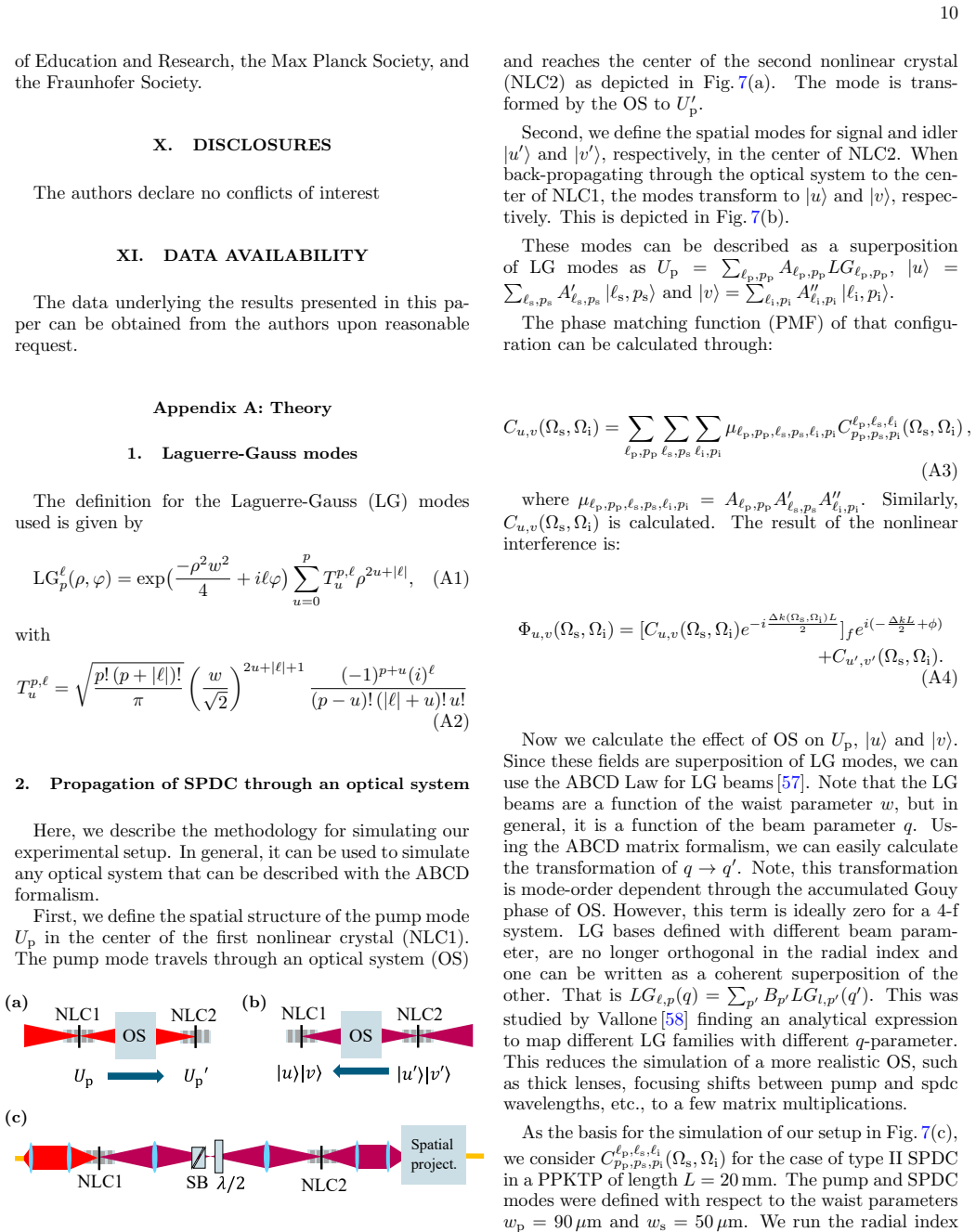
Propagation of SPDC through an optical system Here, we describe the methodology for simulating our experimental setup. In general, it can be used to simulate any optical system that can be described with the ABCD formalism. First, we define the spatial structure of the pump mode Up in the center of the first nonlinear crystal (NLC1). The pump mode travels...
-
[3]
Kaneda, K
F. Kaneda, K. Garay-Palmett, A. B. U’Ren, and P. G. Kwiat, Heralded single-photon source utilizing highly nondegenerate, spectrally factorable spontaneous para- metric downconversion, Opt. Express24, 10733 (2016)
2016
-
[4]
L.-A. Wu, H. J. Kimble, J. L. Hall, and H. Wu, Gener- ation of squeezed states by parametric down conversion, Phys. Rev. Lett.57, 2520 (1986)
1986
-
[5]
F. S. Roux, Quantifying entanglement of parametric down-converted states in all degrees of freedom, Phys. Rev. Res.2, 023137 (2020)
2020
-
[6]
H.-S. Zhong, H. Wang, Y.-H. Deng, M.-C. Chen, L.-C. Peng, Y.-H. Luo, J. Qin, D. Wu, X. Ding, Y. Hu, P. Hu, X.-Y. Yang, W.-J. Zhang, H. Li, Y. Li, X. Jiang, L. Gan, G. Yang, L. You, Z. Wang, L. Li, N.-L. Liu, C.-Y. Lu, and J.-W. Pan, Quantum computational advantage using photons, Science370, 1460 (2020), https://www.science.org/doi/pdf/10.1126/science.abe8770
-
[7]
Zhong, Y.-H
H.-S. Zhong, Y.-H. Deng, J. Qin, H. Wang, M.-C. Chen, L.-C. Peng, Y.-H. Luo, D. Wu, S.-Q. Gong, H. Su, Y. Hu, P. Hu, X.-Y. Yang, W.-J. Zhang, H. Li, Y. Li, X. Jiang, L. Gan, G. Yang, L. You, Z. Wang, L. Li, N.-L. Liu, J. J. Renema, C.-Y. Lu, and J.-W. Pan, Phase-programmable gaussian boson sampling using stimulated squeezed light, Phys. Rev. Lett.127, 180...
2021
-
[8]
R.-B. Jin, M. Takeoka, U. Takagi, R. Shimizu, and M. Sasaki, Highly efficient entanglement swapping and teleportation at telecom wavelength, Scientific Reports 5, 9333 (2015)
2015
-
[9]
M. Stefszky, K.-H. Luo, J.-L. Eickmann, S. Atzeni, F. L¨ utkewitte, C. Pandey, F. Schlue, J. Lammers, M. Roiz, T. Schapeler, L. Ares, M. Yahyapour, A. Kast- ner, J. Martinek, M. Mittermair, C. Sevilla, M. Leyen- decker, O. Kohout, D. Mitin, R. Holzwarth, J. Sper- ling, T. Bartley, F. Steinlechner, B. Brecht, and C. Sil- berhorn, Benchmarking gaussian and ...
-
[10]
dos Santos Martins, N
L. dos Santos Martins, N. Laurent-Puig, P. Lefebvre, S. Neves, and E. Diamanti, Realizing a compact, high- fidelity, telecom-wavelength source of multipartite entan- gled photons, Opt. Express33, 53468 (2025)
2025
-
[11]
Pickston, J
A. Pickston, J. Ho, A. Ulibarrena, F. Grasselli, M. Proi- etti, C. L. Morrison, P. Barrow, F. Graffitti, and A. Fedrizzi, Conference key agreement in a quantum net- work, npj Quantum Information9, 82 (2023)
2023
-
[12]
Kurtsiefer, M
C. Kurtsiefer, M. Oberparleiter, and H. Weinfurter, High- efficiency entangled photon pair collection in type-ii para- metric fluorescence, Phys. Rev. A64, 023802 (2001)
2001
-
[13]
F. A. Bovino, P. Varisco, A. M. Colla, G. Castagnoli, G. D. Giuseppe, and A. V. Sergienko, Effective fiber- coupling of entangled photons for quantum communica- tion, Optics Communications227, 343 (2003)
2003
-
[14]
Dragan, Efficient fiber coupling of down-conversion photon pairs, Phys
A. Dragan, Efficient fiber coupling of down-conversion photon pairs, Phys. Rev. A70, 053814 (2004)
2004
-
[15]
Andrews, E
R. Andrews, E. Pike, and S. Sarkar, Optimal coupling of entangled photons into single-mode optical fibers, Opt. Express12, 3264 (2004)
2004
-
[16]
Ljunggren and M
D. Ljunggren and M. Tengner, Optimal focusing for max- imal collection of entangled narrow-band photon pairs into single-mode fibers, Phys. Rev. A72, 062301 (2005)
2005
-
[17]
Fedrizzi, T
A. Fedrizzi, T. Herbst, A. Poppe, T. Jennewein, and A. Zeilinger, A wavelength-tunable fiber-coupled source of narrowband entangled photons, Opt. Express15, 15377 (2007)
2007
-
[18]
A. Ling, A. Lamas-Linares, and C. Kurtsiefer, Abso- lute emission rates of spontaneous parametric down- conversion into single transverse gaussian modes, Phys. Rev. A77, 043834 (2008)
2008
-
[19]
R. S. Bennink, Optimal collinear gaussian beams for spontaneous parametric down-conversion, Phys. Rev. A 81, 053805 (2010)
2010
-
[20]
Palacios, R
S. Palacios, R. de J. Le´ on-Montiel, M. Hendrych, A. Va- lencia, and J. P. Torres, Flux enhancement of photons entangled in orbital angular momentum, Opt. Express 19, 14108 (2011)
2011
-
[21]
Guerreiro, A
T. Guerreiro, A. Martin, B. Sanguinetti, N. Bruno, H. Zbinden, and R. T. Thew, High efficiency coupling of photon pairs in practice, Opt. Express21, 27641 (2013)
2013
-
[22]
Steinlechner, Sources of Photonic Entanglement for Applications in Space, Ph.D
F. Steinlechner, Sources of Photonic Entanglement for Applications in Space, Ph.D. thesis, Universitat Polit` ecnica de Catalunya (UPC), ICFO – Institut de Ci` encies Fot` oniques, Castelldefels, Spain (2015), phD thesis; Supervisor: Valerio Pruneri
2015
-
[23]
Minozzi, S
M. Minozzi, S. Bonora, A. V. Sergienko, G. Vallone, and P. Villoresi, Optimization of two-photon wave function in parametric down conversion by adaptive optics control of the pump radiation, Opt. Lett.38, 489 (2013)
2013
-
[24]
J. M. Varga, J. Lasa-Alonso, M. Molezuelas-Ferreras, N. Tischler, and G. Molina-Terriza, Bandwidth con- trol of the biphoton wavefunction exploiting spatio- temporal correlations, Optics Communications504, 127461 (2022)
2022
-
[25]
Sevilla-Guti´ errez, V
C. Sevilla-Guti´ errez, V. R. Kaipalath, and F. Stein- lechner, Gaussian mode coupling of spectrally broad- band photons from bulk spontaneous parametric down- conversion: A spatial-spectral mode analysis of fiber cou- pling, Phys. Rev. A (2026)
2026
-
[26]
Gatti, E
A. Gatti, E. Brambilla, L. Caspani, O. Jedrkiewicz, and L. A. Lugiato,xentanglement: The nonfactorable spa- tiotemporal structure of biphoton correlation, Phys. Rev. Lett.102, 223601 (2009)
2009
-
[27]
C. I. Osorio, A. Valencia, and J. P. Torres, Spatiotempo- ral correlations in entangled photons generated by spon- taneous parametric down conversion, New Journal of Physics10, 113012 (2008)
2008
-
[28]
Meyer-Scott, N
E. Meyer-Scott, N. Montaut, J. Tiedau, L. Sansoni, H. Herrmann, T. J. Bartley, and C. Silberhorn, Limits on the heralding efficiencies and spectral purities of spec- trally filtered single photons from photon-pair sources, 12 Phys. Rev. A95, 061803 (2017)
2017
-
[29]
A. B. U’Ren, R. K. Erdmann, M. de la Cruz-Gutierrez, and I. A. Walmsley, Generation of two-photon states with an arbitrary degree of entanglement via nonlinear crystal superlattices, Phys. Rev. Lett.97, 223602 (2006)
2006
-
[30]
Riazi, C
A. Riazi, C. Chen, E. Y. Zhu, A. V. Gladyshev, P. G. Kazansky, J. E. Sipe, and L. Qian, Biphoton shaping with cascaded entangled-photon sources, npj Quantum Information5, 77 (2019)
2019
-
[31]
Riazi, E
A. Riazi, E. Y. Zhu, D. Xu, and L. Qian, Entangling entanglement: coupling frequency and polarization of biphotons on demand, npj Quantum Information10, 38 (2024)
2024
-
[32]
J. Li, J. Su, L. Cui, T. Xie, Z. Y. Ou, and X. Li, Gen- eration of pure-state single photons with high heralding efficiency by using a three-stage nonlinear interferometer, Applied Physics Letters116, 204002 (2020)
2020
-
[33]
L. Cui, J. Wang, J. Li, M. Ma, Z. Y. Ou, and X. Li, Pro- grammable photon pair source, APL Photonics7, 016101 (2022)
2022
-
[34]
Lemieux, M
S. Lemieux, M. Manceau, P. R. Sharapova, O. V. Tikhonova, R. W. Boyd, G. Leuchs, and M. V. Chekhova, Engineering the frequency spectrum of bright squeezed vacuum via group velocity dispersion in an su(1,1) inter- ferometer, Phys. Rev. Lett.117, 183601 (2016)
2016
-
[35]
R.-B. Jin, R. Shiina, and R. Shimizu, Quantum manip- ulation of biphoton spectral distributions in a 2d fre- quency space toward arbitrary shaping of a biphoton wave packet, Opt. Express26, 21153 (2018)
2018
-
[36]
R.-B. Jin, H. Oshima, T. Yagisawa, M. Yabuno, S. Miki, F. China, H. Terai, and R. Shimizu, Two-photon spec- tral modulation via temporal manipulation: Quantum optical synthesis of spectral modes from temporal square waves, Applied Physics Letters121, 244002 (2022)
2022
-
[37]
Quantum optical synthesis of high-dimensional ultrafast frequency-bin qudits
P. Koviri, T. Okita, R. Yabumoto, Y. Fujihashi, M. Yabuno, H. Terai, S. Miki, K. P. Nayak, and R. Shimizu, Quantum optical synthesis of high- dimensional ultrafast frequency-bin qudits (2026), arXiv:2605.14314 [quant-ph]
work page internal anchor Pith review Pith/arXiv arXiv 2026
-
[38]
A. M. P´ erez, T. S. Iskhakov, P. Sharapova, S. Lemieux, O. V. Tikhonova, M. V. Chekhova, and G. Leuchs, Bright squeezed-vacuum source with 1.1 spatial mode, Optics Letters39, 2403 (2014)
2014
-
[39]
Scharwald, L
D. Scharwald, L. Gehse, and P. R. Sharapova, Schmidt modes carrying orbital angular momentum generated by cascaded systems pumped with laguerre–gaussian beams, APL Photonics10, 016112 (2025)
2025
-
[40]
A. V. Paterova and L. A. Krivitsky, Nonlinear interfer- ence in crystal superlattices, Light: Science & Applica- tions9, 82 (2020)
2020
-
[41]
Lamas-Linares, J
A. Lamas-Linares, J. C. Howell, and D. Bouwmeester, Stimulated emission of polarization-entangled photons, Nature412, 887 (2001)
2001
-
[42]
Ferreri, M
A. Ferreri, M. Santandrea, M. Stefszky, K. H. Luo, H. Herrmann, C. Silberhorn, and P. R. Sharapova, Spectrally multimode integrated SU(1,1) interferometer, Quantum5, 461 (2021)
2021
-
[43]
Qin, Y.-H
J. Qin, Y.-H. Deng, H.-S. Zhong, L.-C. Peng, H. Su, Y.-H. Luo, J.-M. Xu, D. Wu, S.-Q. Gong, H.-L. Liu, H. Wang, M.-C. Chen, L. Li, N.-L. Liu, C.-Y. Lu, and J.-W. Pan, Unconditional and robust quantum metrolog- ical advantage beyond n00n states, Phys. Rev. Lett.130, 070801 (2023)
2023
-
[44]
Houde and N
M. Houde and N. Quesada, Waveguided sources of con- sistent, single-temporal-mode squeezed light: The good, the bad, and the ugly, AVS Quantum Science5, 011404 (2023)
2023
-
[45]
Ansari, J
V. Ansari, J. M. Donohue, B. Brecht, and C. Silberhorn, Tailoring nonlinear processes for quantum optics with pulsed temporal-mode encodings, Optica5, 534 (2018)
2018
-
[46]
Karpi´ nski, C
M. Karpi´ nski, C. Radzewicz, and K. Banaszek, Experi- mental characterization of three-wave mixing in a multi- mode nonlinear ktiopo4 waveguide, Applied Physics Let- ters94, 181105 (2009)
2009
-
[47]
Kaneda, J
F. Kaneda, J. Oikawa, M. Yabuno, F. China, S. Miki, H. Terai, Y. Mitsumori, and K. Edamatsu, Spectral char- acterization of photon-pair sources via classical sum- frequency generation, Opt. Express28, 38993 (2020)
2020
-
[48]
L. G. Helt and M. J. Steel, Effect of scattering loss on connections between classical and quantum processes in second-order nonlinear waveguides, Opt. Lett.40, 1460 (2015)
2015
-
[49]
N. A. Lange, T. Schapeler, J. P. H¨ opker, M. Protte, and T. J. Bartley, Degenerate photons from a cryogenic spon- taneous parametric down-conversion source, Phys. Rev. A108, 023701 (2023)
2023
-
[50]
Lerch, B
S. Lerch, B. Bessire, C. Bernhard, T. Feurer, and A. Ste- fanov, Tuning curve of type-0 spontaneous parametric down-conversion, J. Opt. Soc. Am. B30, 953 (2013)
2013
-
[51]
D. Song, L. Gao, D. Wang, R. Jin, Y. Jin, C. Yuan, H. Cai, S. Wang, Q. Luo, J. Wang, and Y. Wang, Com- parative study on quasi-phase-matching of type-0, type-i, and type-ii configurations for spdc in ppln crystals, Opt. Continuum4, 1380 (2025)
2025
-
[52]
C. K. Law, I. A. Walmsley, and J. H. Eberly, Continu- ous frequency entanglement: Effective finite hilbert space and entropy control, Phys. Rev. Lett.84, 5304 (2000)
2000
-
[53]
W. P. Grice, A. B. U’Ren, and I. A. Walmsley, Eliminat- ing frequency and space-time correlations in multiphoton states, Phys. Rev. A64, 063815 (2001)
2001
-
[54]
A. B. U’Ren, C. Silberhorn, R. Erdmann, K. Banaszek, W. P. Grice, I. A. Walmsley, and M. G. Raymer, Gen- eration of pure-state single-photon wavepackets by con- ditional preparation based on spontaneous parametric downconversion, Laser Physics15, 146 (2005)
2005
-
[55]
P. J. Mosley, J. S. Lundeen, B. J. Smith, P. Wasylczyk, A. B. U’Ren, C. Silberhorn, and I. A. Walmsley, Heralded generation of ultrafast single photons in pure quantum states, Phys. Rev. Lett.100, 133601 (2008)
2008
-
[56]
Baghdasaryan, C
B. Baghdasaryan, C. Sevilla-Guti´ errez, F. Steinlech- ner, and S. Fritzsche, Generalized description of the spatio-temporal biphoton state in spontaneous paramet- ric down-conversion, Phys. Rev. A106, 063711 (2022)
2022
-
[57]
A. Mair, A. Vaziri, G. Weihs, and A. Zeilinger, Entangle- ment of the orbital angular momentum states of photons, Nature412, 313 (2001)
2001
-
[58]
Sevilla-Guti´ errez, V
C. Sevilla-Guti´ errez, V. R. Kaipalath, B. Baghdasaryan, M. Gr¨ afe, S. Fritzsche, and F. Steinlechner, Spectral properties of transverse laguerre-gauss modes in para- metric down-conversion, Phys. Rev. A109, 023534 (2024)
2024
-
[59]
J. P. Tach´ e, Derivation of abcd law for laguerre-gaussian beams, Appl. Opt.26, 2698 (1987)
1987
-
[60]
Vallone, Role of beam waist in laguerre–gauss expan- sion of vortex beams, Opt
G. Vallone, Role of beam waist in laguerre–gauss expan- sion of vortex beams, Opt. Lett.42, 1097 (2017)
2017
-
[61]
G. D. Boyd and D. A. Kleinman, Parametric interac- tion of focused gaussian light beams, Journal of Applied 13 Physics39, 3597 (1968). [60] M. Hiekkam¨ aki, S. Prabhakar, and R. Fickler, Near- perfect measuring of full-field transverse-spatial modes of light, Opt. Express27, 31456 (2019)
1968
discussion (0)
Sign in with ORCID, Apple, or X to comment. Anyone can read and Pith papers without signing in.