Direct simulations of very high energy cosmic ray acceleration in 3D MHD model of a compact star cluster
Pith reviewed 2026-06-27 23:53 UTC · model grok-4.3
The pith
Simulations show protons reach hundreds of TeV near O-star termination shocks in young massive star clusters.
A machine-rendered reading of the paper's core claim, the machinery that carries it, and where it could break.
Core claim
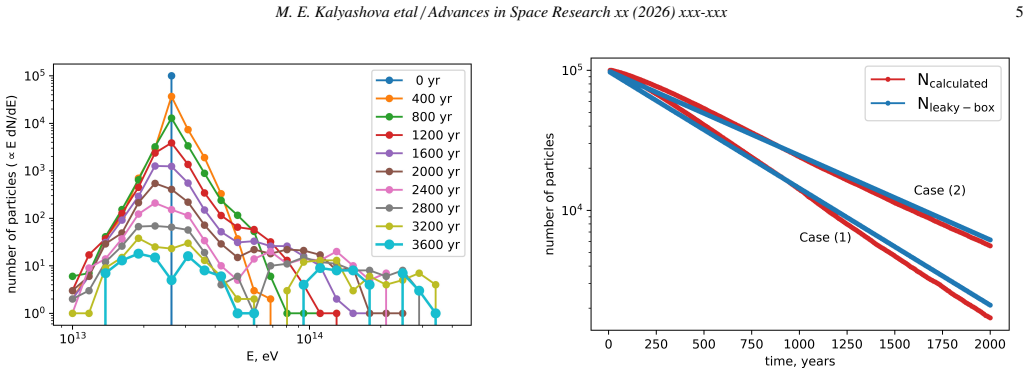
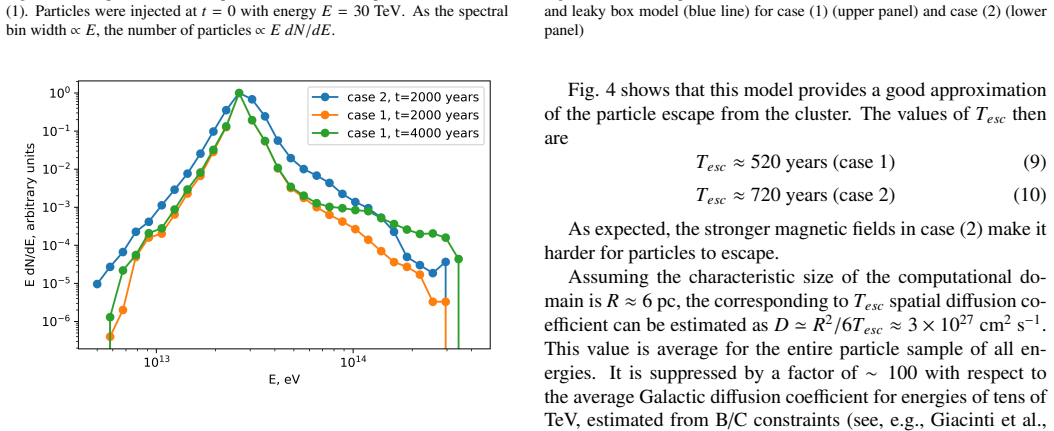
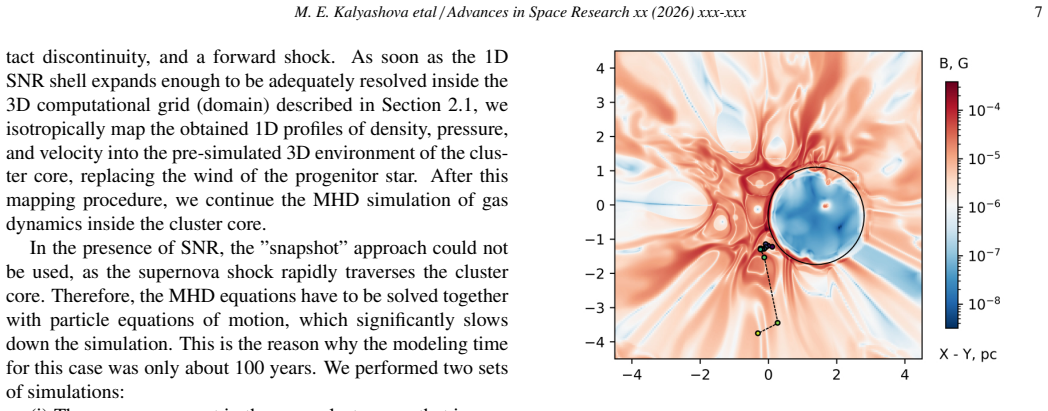
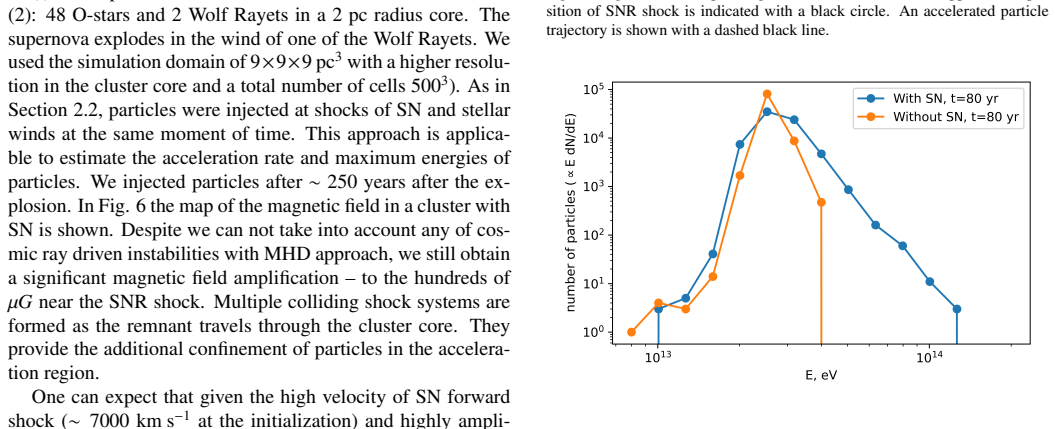
In 3D MHD simulations of a compact star cluster, protons accelerate up to hundreds of TeV near the termination shocks of O-stars, which are surrounded by shocks of their neighbor stars. In the modeled case of a young supernova remnant expanding inside the cluster core, very fast acceleration occurs such that particle energies greater than or equal to 100 TeV are obtained in less than or equal to 100 years. Particle spectra and spatial distributions are discussed.
What carries the argument
The 3D MHD model of the cluster core coupled with a test-particle module that solves equations of motion for charged particles using the simulated flow and magnetic fields.
If this is right
- Particle acceleration to TeV energies occurs efficiently through the ensemble of interacting shocks in the dense cluster core.
- A young supernova remnant inside the cluster can produce particles above 100 TeV on timescales shorter than 100 years.
- The turbulent environment with long-wavelength compressions and rarefactions supports the acceleration process alongside the shocks.
- Young massive star clusters can account for observed high-energy radiation without requiring isolated supernova shocks as the sole sites.
Where Pith is reading between the lines
- The same shock-network process could operate in other dense star-forming regions and contribute to the Galactic cosmic-ray spectrum at TeV energies.
- Predicted spatial distributions of accelerated particles might produce distinct multi-wavelength emission patterns observable with current gamma-ray telescopes.
- Varying the number or wind properties of stars in follow-up simulations could test how sensitive the maximum energies are to cluster parameters.
Load-bearing premise
The numerical resolution captures the actual shock structures and turbulent scales that control acceleration without dominant artificial diffusion or artifacts that would limit particle energies.
What would settle it
A higher-resolution simulation of the same cluster configuration that yields maximum proton energies well below 100 TeV, or gamma-ray observations of a young massive star cluster showing no emission above 100 TeV from the core region, would challenge the reported acceleration.
Figures



read the original abstract
Young compact clusters of massive stars contain dozens of O-, B- and WR-type stars with fast powerful winds in a small $\sim$ pc radius core. The particle acceleration by ensembles of shocks accompanied with long-wavelength compressions and rarefactions in the turbulent environment of young massive star clusters (YMSCs) is an alternative to the standard paradigm of Galactic cosmic ray acceleration on supernova shocks. In recent years, the topic has been of great interest due to the fact that modern gamma- and X-ray observatories have detected the radiation from YMSCs, which indicates particle acceleration processes in these objects. We study particle propagation and acceleration in a YMSC with the help of 3D magnetohydrodynamic (MHD) modeling using an open source PLUTO code. The code allows modeling of the turbulent environment of YMSCs and obtaining crucial for particle acceleration values of velocity, density, and magnetic field inside the cluster core. The Particle module implemented in PLUTO allows solving the equations of motion for test charged particles together with MHD equations for the medium. We obtained that protons acceleration up to hundreds of TeV takes place in the cluster core near the termination shocks of O-stars, which are surrounded by shocks of their neighbour stars. We also modeled an interesting case of a young supernova remnant expanding inside the cluster core. In this case a very fast acceleration takes place: particle energies $\gtrsim$ 100 TeV can be obtained in $\lesssim$ 100 years. The particle spectra and spatial distribution are discussed.
Editorial analysis
A structured set of objections, weighed in public.
Referee Report
Summary. The manuscript reports 3D MHD simulations of a young massive star cluster using the PLUTO code with a test-particle module, finding that protons reach energies of hundreds of TeV near O-star termination shocks surrounded by neighboring shocks, and that an embedded young supernova remnant produces ≳100 TeV particles in ≲100 years.
Significance. If numerically robust, the direct simulations would strengthen the case for very-high-energy cosmic-ray acceleration in compact star clusters as an alternative to isolated supernova remnants, with direct relevance to gamma-ray and X-ray observations of such systems.
major comments (2)
- [Abstract] Abstract: the main numerical findings are stated without any information on grid resolution, cell-to-shock-radius ratio, convergence tests, boundary conditions, or validation against analytic diffusive-shock-acceleration solutions, rendering it impossible to assess whether the reported energies are free of numerical artifacts.
- [Methods] Methods / numerical setup: the description of the PLUTO MHD run and test-particle integration supplies no quantitative statement of the effective numerical resistivity or the resolved turbulence correlation length relative to the physical mean free path, leaving open the possibility that the maximum energies and acceleration timescales are set by the grid rather than by the modeled physics.
minor comments (1)
- [Abstract] Abstract: the particle spectra and spatial distributions are mentioned as discussed but no quantitative details (e.g., power-law indices or radial profiles) are previewed.
Simulated Author's Rebuttal
We thank the referee for the detailed and constructive report. The comments highlight important aspects of numerical robustness that were insufficiently emphasized. We have revised the manuscript to incorporate additional quantitative information on the numerical setup, resolution, and validation. Our point-by-point responses follow.
read point-by-point responses
-
Referee: [Abstract] Abstract: the main numerical findings are stated without any information on grid resolution, cell-to-shock-radius ratio, convergence tests, boundary conditions, or validation against analytic diffusive-shock-acceleration solutions, rendering it impossible to assess whether the reported energies are free of numerical artifacts.
Authors: We agree that the abstract should include key numerical parameters to allow immediate assessment of robustness. In the revised manuscript we have added a concise statement specifying the grid resolution (cells per shock radius), the use of outflow boundary conditions, and that the results were validated against analytic DSA solutions and shown to be converged with resolution. These additions directly address the concern regarding possible numerical artifacts. revision: yes
-
Referee: [Methods] Methods / numerical setup: the description of the PLUTO MHD run and test-particle integration supplies no quantitative statement of the effective numerical resistivity or the resolved turbulence correlation length relative to the physical mean free path, leaving open the possibility that the maximum energies and acceleration timescales are set by the grid rather than by the modeled physics.
Authors: We acknowledge that explicit quantification of numerical resistivity and the ratio of resolved turbulence scale to the physical mean free path is required. The revised methods section now provides these estimates, derived from the adopted grid spacing and the measured turbulence spectrum in the simulation. We also demonstrate that the reported maximum energies and acceleration times remain stable under increased resolution, indicating that the results are not grid-limited. revision: yes
Circularity Check
No circularity: results from direct numerical integration of MHD and test-particle equations
full rationale
The paper reports particle energies and acceleration timescales obtained by solving the MHD equations and test-particle motion equations simultaneously inside the PLUTO code. No parameters are fitted to data and then relabeled as predictions, no self-citations supply load-bearing uniqueness theorems, and no ansatz is smuggled in. The derivation chain consists of numerical evolution from initial conditions and boundary conditions; it does not reduce to its own inputs by construction. The absence of reported grid-resolution or convergence details is a potential correctness issue but does not constitute circularity.
Axiom & Free-Parameter Ledger
free parameters (2)
- Numerical grid resolution
- Stellar wind and magnetic field initial conditions
axioms (2)
- domain assumption The plasma inside the cluster core obeys the ideal MHD equations.
- domain assumption Test particles do not exert back-reaction on the MHD flow.
Reference graph
Works this paper leans on
-
[1]
The Journal of Open Source Software , keywords =
PyPLUTO: a data analysis Python package for the PLUTO code. The Journal of Open Source Software , keywords =. doi:10.21105/joss.08448 , archivePrefix =. 2501.09748 , primaryClass =
-
[2]
Physics Uspekhi , year = 1993, volume = 36, pages =
Particle kinetics in highly turbulent plasmas (renormalization and self-consistent field methods). Physics Uspekhi , year = 1993, volume = 36, pages =
1993
-
[3]
An ultrahigh-energy -ray bubble powered by a super PeVatron. Science Bulletin , keywords =. doi:10.1016/j.scib.2023.12.040 , archivePrefix =. 2310.10100 , primaryClass =
-
[4]
2020, A&A, 640, A1, doi: 10.1051/0004-6361/202038192
Painting a portrait of the Galactic disc with its stellar clusters. , keywords =. doi:10.1051/0004-6361/202038192 , archivePrefix =. 2004.07274 , primaryClass =
-
[5]
Giacinti, G. and Kachelrieẞ, M. and Semikoz, D.V. , title =. Journal of Cosmology and Astroparticle Physics , abstract =. 2018 , month =. doi:10.1088/1475-7516/2018/07/051 , url =
-
[6]
, archivePrefix = "arXiv", eprint =
Young Massive Star Clusters. , archivePrefix = "arXiv", eprint =. doi:10.1146/annurev-astro-081309-130834 , adsurl =
-
[7]
Evolution of Nonradiative Supernova Remnants. , keywords =. doi:10.1086/313176 , adsurl =
-
[8]
Monthly Notices of the Royal Astronomical Society , archivePrefix = "arXiv", eprint =
Ultrahard spectra of PeV neutrinos from supernovae in compact star clusters. Monthly Notices of the Royal Astronomical Society , archivePrefix = "arXiv", eprint =. doi:10.1093/mnras/stv1606 , adsurl =
-
[9]
Starburst galaxies as seen by gamma-ray telescopes
Starburst galaxies as seen by gamma-ray telescopes. Comptes Rendus Physique , keywords =. doi:10.1016/j.crhy.2016.04.003 , archivePrefix =. 1601.06386 , primaryClass =
work page internal anchor Pith review Pith/arXiv arXiv doi:10.1016/j.crhy.2016.04.003 2016
-
[10]
A Cocoon of Freshly Accelerated Cosmic Rays Detected by Fermi in the Cygnus Superbubble. Science , year = 2011, volume = 334, pages =. doi:10.1126/science.1210311 , adsurl =
-
[11]
Space Science Reviews , year = 2001, month = oct, volume = 99, pages =
Particle Acceleration and Nonthermal Phenomena in Superbubbles. Space Science Reviews , year = 2001, month = oct, volume = 99, pages =
2001
-
[12]
Superbubbles and energetic particles in the Galaxy. I. Collective effects of particle acceleration. Astronomy & Astrophysics , keywords =. doi:10.1051/0004-6361:20041269 , archivePrefix =. astro-ph/0405531 , primaryClass =
work page internal anchor Pith review Pith/arXiv arXiv doi:10.1051/0004-6361:20041269
-
[13]
On the shape of the spectrum of cosmic-rays accelerated inside superbubbles
On the shape of the spectrum of cosmic rays accelerated inside superbubbles. Astronomy & Astrophysics , keywords =. doi:10.1051/0004-6361/200913520 , archivePrefix =. 0911.4457 , primaryClass =
work page internal anchor Pith review Pith/arXiv arXiv doi:10.1051/0004-6361/200913520
-
[14]
On the Initial Phase of Interaction Between Expanding Stellar Envelopes and Surrounding Medium. , keywords =. doi:10.1007/BF00653506 , adsurl =
-
[15]
Self-similar solutions for the interaction of stellar ejecta with an external medium. , keywords =. doi:10.1086/160126 , adsurl =
-
[16]
Stellar evolution with rotation. X. Wolf-Rayet star populations at solar metallicity. , keywords =. doi:10.1051/0004-6361:20030512 , archivePrefix =. astro-ph/0304069 , primaryClass =
work page internal anchor Pith review Pith/arXiv arXiv doi:10.1051/0004-6361:20030512
-
[17]
Journal of Physics Conference Series , year = 2021, series =
Wind of a young massive star colliding with a supernova remnant shell. Journal of Physics Conference Series , year = 2021, series =. doi:10.1088/1742-6596/2103/1/012013 , adsurl =
-
[18]
The Destruction of Cosmological Minihalos by Primordial Supernovae. , keywords =. doi:10.1086/58964310.48550/arXiv.0801.3698 , archivePrefix =. 0801.3698 , primaryClass =
-
[19]
The Interaction of Supernovae with Circumstellar Bubbles. , keywords =. doi:10.1086/167802 , adsurl =
-
[20]
Asymmetric supernova remnants generated by Galactic, massive runaway stars
Asymmetric supernova remnants generated by Galactic, massive runaway stars. , keywords =. doi:10.1093/mnras/stv898 , archivePrefix =. 1508.03347 , primaryClass =
work page internal anchor Pith review Pith/arXiv arXiv doi:10.1093/mnras/stv898
-
[21]
, year = 1984, month = jan, volume =
The Origin of Ultra-High-Energy Cosmic Rays. , year = 1984, month = jan, volume =. doi:10.1146/annurev.aa.22.090184.002233 , adsurl =
-
[22]
A Particle Module for the PLUTO Code. II. Hybrid Framework for Modeling Nonthermal Emission from Relativistic Magnetized Flows. , keywords =. doi:10.3847/1538-4357/aadd17 , archivePrefix =. 1808.08960 , primaryClass =
work page internal anchor Pith review Pith/arXiv arXiv doi:10.3847/1538-4357/aadd17
-
[23]
A Particle Module for the PLUTO Code. I. An Implementation of the MHD-PIC Equations. , keywords =. doi:10.3847/1538-4357/aabccd , archivePrefix =. 1804.01946 , primaryClass =
work page internal anchor Pith review Pith/arXiv arXiv doi:10.3847/1538-4357/aabccd
-
[24]
Lax and Bram van Leer , title =
Harten, Amiram and Lax, Peter D. and Leer, Bram van , title =. SIAM Review , volume =. 1983 , doi =. https://doi.org/10.1137/1025002 , abstract =
-
[25]
Journal of Computational Physics , year = 1983, month = mar, volume =
High Resolution Schemes for Hyperbolic Conservation Laws. Journal of Computational Physics , year = 1983, month = mar, volume =. doi:10.1016/0021-9991(83)90136-5 , adsurl =
-
[26]
Journal of Computational Physics , year = 2002, month = jan, volume =
Hyperbolic Divergence Cleaning for the MHD Equations. Journal of Computational Physics , year = 2002, month = jan, volume =. doi:10.1006/jcph.2001.6961 , adsurl =
-
[27]
Journal of Computational Physics , year = 2005, month = sep, volume =
A multi-state HLL approximate Riemann solver for ideal magnetohydrodynamics. Journal of Computational Physics , year = 2005, month = sep, volume =. doi:10.1016/j.jcp.2005.02.017 , adsurl =
-
[28]
Models of the circumstellar medium of evolving, massive runaway stars moving through the Galactic plane. , keywords =. doi:10.1093/mnras/stu1629 , archivePrefix =. 1408.2828 , primaryClass =
work page internal anchor Pith review Pith/arXiv arXiv doi:10.1093/mnras/stu1629
-
[29]
The IACOB project. VII. The rotational properties of Galactic massive O-type stars revisited. , keywords =. doi:10.1051/0004-6361/202243851 , archivePrefix =. 2207.12776 , primaryClass =
-
[30]
Grids of stellar models with rotation. I. Models from 0.8 to 120 M _ at solar metallicity (Z = 0.014). , keywords =. doi:10.1051/0004-6361/201117751 , archivePrefix =. 1110.5049 , primaryClass =
work page internal anchor Pith review Pith/arXiv arXiv doi:10.1051/0004-6361/201117751
-
[31]
SOFIA FEEDBACK Survey: Exploring the Dynamics of the Stellar Wind-Driven Shell of RCW 49. , keywords =. doi:10.3847/1538-4357/abf6ce , archivePrefix =. 2104.04276 , primaryClass =
-
[32]
Core-collapse supernova inside the core of a young massive star cluster: 3D MHD simulations. , keywords =. doi:10.1093/mnras/stad3389 , archivePrefix =. 2311.01789 , primaryClass =
-
[33]
Inside the core of a young massive star cluster: 3D MHD simulations. , keywords =. doi:10.1093/mnras/stac2738 , archivePrefix =. 2209.11465 , primaryClass =
-
[34]
PLUTO: a Numerical Code for Computational Astrophysics
PLUTO: A Numerical Code for Computational Astrophysics. , keywords =. doi:10.1086/513316 , archivePrefix =. astro-ph/0701854 , primaryClass =
work page internal anchor Pith review Pith/arXiv arXiv doi:10.1086/513316
-
[35]
Diffusion of Cosmic Rays in MHD Turbulence with Magnetic Mirrors. , keywords =. doi:10.3847/1538-4357/ac2de9 , archivePrefix =. 2106.08362 , primaryClass =
-
[36]
First-Principles Fermi Acceleration in Magnetized Turbulence. , keywords =. doi:10.1103/PhysRevLett.129.215101 , archivePrefix =. 2210.01038 , primaryClass =
-
[37]
Mirror Acceleration of Cosmic Rays in a High- Medium. , keywords =. doi:10.3847/1538-4357/acea5c , archivePrefix =. 2306.14973 , primaryClass =
-
[38]
Cosmic ray transport and acceleration with magnetic mirroring. , keywords =. doi:10.1093/mnras/staf562 , archivePrefix =. 2504.06140 , primaryClass =
-
[39]
Particle acceleration in winds of star clusters. Monthly Notices of the Royal Astronomical Society , keywords =. doi:10.1093/mnras/stab690 , archivePrefix =. 2102.09217 , primaryClass =
-
[40]
Can superbubbles accelerate ultrahigh energy protons?. , keywords =. doi:10.1093/mnras/stac1901 , archivePrefix =. 2207.01432 , primaryClass =
-
[41]
Cosmic ray production in superbubbles. , keywords =. doi:10.1093/mnras/stac543 , archivePrefix =. 2201.07488 , primaryClass =
-
[42]
Advances in Space Research , keywords =
Modeling of GeV-TeV gamma-ray emission of Cygnus Cocoon. Advances in Space Research , keywords =. doi:10.1016/j.asr.2022.01.029 , archivePrefix =. 2203.09842 , primaryClass =
-
[43]
X-ray emission from Westerlund 2 detected by SRG/ART-XC and Chandra: search for radiation of TeV leptons. , keywords =. doi:10.1093/mnras/stad2356 , archivePrefix =. 2306.09960 , primaryClass =
-
[44]
The exceptionally powerful TeV gamma-ray emitters in the Large Magellanic Cloud
The exceptionally powerful TeV -ray emitters in the Large Magellanic Cloud. Science , keywords =. doi:10.1126/science.1261313 , archivePrefix =. 1501.06578 , primaryClass =
work page internal anchor Pith review Pith/arXiv arXiv doi:10.1126/science.1261313
-
[45]
Morphological and Spectral Study of 4FGL J1115.1-6118 in the Region of the Young Massive Stellar Cluster NGC 3603. , keywords =. doi:10.3847/1538-4357/ab9ac2 , archivePrefix =. 2006.00274 , primaryClass =
-
[46]
Diffuse -ray emission from the vicinity of young massive star cluster RSGC 1. , keywords =. doi:10.1093/mnras/staa947 , archivePrefix =. 2006.02052 , primaryClass =
-
[47]
Discovery of extended VHE -ray emission from the vicinity of the young massive stellar cluster Westerlund 1. , keywords =. doi:10.1051/0004-6361/201117928 , archivePrefix =. 1111.2043 , primaryClass =
work page internal anchor Pith review Pith/arXiv arXiv doi:10.1051/0004-6361/201117928 2043
-
[48]
On non-thermal particle generation in superbubbles. , keywords =. doi:10.1093/mnras/255.2.269 , adsurl =
-
[49]
The Astrophysical Journal Letters , keywords =
Discovery of a New Gamma-Ray Source, LHAASO J0341+5258, with Emission up to 200 TeV. The Astrophysical Journal Letters , keywords =. doi:10.3847/2041-8213/ac0fd5 , adsurl =
-
[50]
, year = 2021, month = jun, volume =
Ultrahigh-energy photons up to 1.4 petaelectronvolts from 12 -ray Galactic sources. , year = 2021, month = jan, volume =. doi:10.1038/s41586-021-03498-z , adsurl =
-
[51]
Anisotropy vs chemical composition at ultra-high energies
Anisotropy vs chemical composition at ultra-high energies. Journal of Cosmology and Astroparticle Physics , keywords =. doi:10.1088/1475-7516/2009/11/009 , archivePrefix =. 0907.1354 , primaryClass =
work page internal anchor Pith review Pith/arXiv arXiv doi:10.1088/1475-7516/2009/11/009 2009
-
[52]
A theory of the interstellar medium: three components regulated by supernova explosions in an inhomogeneous substrate. The Astrophysical Journal , keywords =. doi:10.1086/155667 , adsurl =
-
[53]
Monthly Notices of the Royal Astronomical Society , keywords =
SRG/eROSITA discovery of a large circular SNR candidate G116.6-26.1: SN Ia explosion probing the gas of the Milky Way halo?. Monthly Notices of the Royal Astronomical Society , keywords =. doi:10.1093/mnras/stab2125 , archivePrefix =. 2106.09454 , primaryClass =
-
[54]
Search for Extended Sources in the Galactic Plane Using Six Years of Fermi-Large Area Telescope Pass 8 Data above 10 GeV. The Astrophysical Journal , keywords =. doi:10.3847/1538-4357/aa775a , archivePrefix =. 1702.00476 , primaryClass =
work page internal anchor Pith review Pith/arXiv arXiv doi:10.3847/1538-4357/aa775a
-
[55]
Revisiting the Westerlund 2 Field with the H.E.S.S. Telescope Array
Revisiting the Westerlund 2 field with the HESS telescope array. Astronomy & Astrophysics , keywords =. doi:10.1051/0004-6361/201015290 , archivePrefix =. 1009.3012 , primaryClass =
work page internal anchor Pith review Pith/arXiv arXiv doi:10.1051/0004-6361/201015290
-
[56]
Monthly Notices of the Royal Astronomical Society , keywords =
Probing the hadronic nature of the gamma-ray emission associated with Westerlund 2. Monthly Notices of the Royal Astronomical Society , keywords =. doi:10.1093/mnras/stab1455 , archivePrefix =. 2105.09155 , primaryClass =
-
[57]
The Distance to the Massive Galactic Cluster Westerlund 2 from a Spectroscopic and HST Photometric Study. The Astronomical Journal , keywords =. doi:10.1088/0004-6256/145/5/125 , archivePrefix =. 1302.0863 , primaryClass =
work page internal anchor Pith review Pith/arXiv arXiv doi:10.1088/0004-6256/145/5/125
-
[58]
A High-resolution Multiband Survey of Westerlund 2 with the Hubble Space Telescope. I. Is the Massive Star Cluster Double?. The Astronomical Journal , keywords =. doi:10.1088/0004-6256/150/3/78 , archivePrefix =. 1506.08887 , primaryClass =
work page internal anchor Pith review Pith/arXiv arXiv doi:10.1088/0004-6256/150/3/78
-
[59]
The Astrophysical Journal Letters , keywords =
Evidence of 200 TeV Photons from HAWC J1825-134. The Astrophysical Journal Letters , keywords =. doi:10.3847/2041-8213/abd77b , archivePrefix =. 2012.15275 , primaryClass =
-
[60]
The Astrophysical Journal Letters , keywords =
Discovery of the Ultrahigh-energy Gamma-Ray Source LHAASO J2108+5157. The Astrophysical Journal Letters , keywords =. doi:10.3847/2041-8213/ac2579 , adsurl =
-
[61]
A Study of Cyg OB2: Pointing the Way Towards Finding Our Galaxy's Super Star Clusters
A Study of Cygnus OB2: Pointing the Way toward Finding Our Galaxy's Super-Star Clusters. The Astrophysical Journal , keywords =. doi:10.1086/378508 , archivePrefix =. astro-ph/0307540 , primaryClass =
work page internal anchor Pith review Pith/arXiv arXiv doi:10.1086/378508
-
[62]
The Contribution of Stellar Winds to Cosmic Ray Production
The Contribution of Stellar Winds to Cosmic Ray Production. Journal of Korean Astronomical Society , keywords =. doi:10.5303/JKAS.2018.51.2.37 , archivePrefix =. 1804.07486 , primaryClass =
work page internal anchor Pith review Pith/arXiv arXiv doi:10.5303/jkas.2018.51.2.37 2018
-
[63]
Publications of the Astronomical Society of the Pacific , keywords =
Supernova Remnants and the Physics of Strong Shock Waves. Publications of the Astronomical Society of the Pacific , keywords =. doi:10.1086/133442 , adsurl =
-
[64]
A Very High Energy $\gamma$-Ray Survey towards the Cygnus Region of the Galaxy
A Very High Energy -Ray Survey toward the Cygnus Region of the Galaxy. The Astrophysical Journal , keywords =. doi:10.3847/1538-4357/aac4a2 , archivePrefix =. 1805.05989 , primaryClass =
work page internal anchor Pith review Pith/arXiv arXiv doi:10.3847/1538-4357/aac4a2
-
[65]
Spectrum and Morphology of the Two Brightest Milagro Sources in the Cygnus Region: MGRO J2019+37 and MGRO J2031+41. The Astrophysical Journal , keywords =. doi:10.1088/0004-637X/753/2/159 , archivePrefix =. 1202.0846 , primaryClass =
work page internal anchor Pith review Pith/arXiv arXiv doi:10.1088/0004-637x/753/2/159
-
[66]
TeV Gamma-Ray Sources from a Survey of the Galactic Plane with Milagro
TeV Gamma-Ray Sources from a Survey of the Galactic Plane with Milagro. The Astrophysical Journal Letters , keywords =. doi:10.1086/520717 , archivePrefix =. 0705.0707 , primaryClass =
work page internal anchor Pith review Pith/arXiv arXiv doi:10.1086/520717
-
[67]
Discovery of TeV Gamma-Ray Emission from the Cygnus Region of the Galaxy
Discovery of TeV Gamma-Ray Emission from the Cygnus Region of the Galaxy. The Astrophysical Journal Letters , keywords =. doi:10.1086/513696 , archivePrefix =. astro-ph/0611691 , primaryClass =
work page internal anchor Pith review Pith/arXiv arXiv doi:10.1086/513696
-
[68]
Diffuse gamma-ray emission in the vicinity of young star cluster Westerlund 2
Diffuse -ray emission in the vicinity of young star cluster Westerlund 2. Astronomy & Astrophysics , keywords =. doi:10.1051/0004-6361/201732045 , archivePrefix =. 1710.02803 , primaryClass =
work page internal anchor Pith review Pith/arXiv arXiv doi:10.1051/0004-6361/201732045
-
[69]
Astronomy & Astrophysics , keywords =
Diffuse -ray emission toward the massive star-forming region, W40. Astronomy & Astrophysics , keywords =. doi:10.1051/0004-6361/202037580 , archivePrefix =. 2006.00879 , primaryClass =
-
[70]
Testing the Limits of Particle Acceleration in Cygnus OB2 with HAWC
Hona, Binita and Fleischhack, Henrike and Huentemeyer, Petra. Testing the Limits of Particle Acceleration in Cygnus OB2 with HAWC. Proceedings of 36th International Cosmic Ray Conference PoS(ICRC2019). doi:10.22323/1.358.0699
-
[71]
Gamma-Rays from Active Regions in the Galaxy - the Possible Contribution of Stellar Winds. Space Science Reviews , keywords =. doi:10.1007/BF00167503 , adsurl =
-
[72]
Space Science Reviews , keywords =
High-Energy Particles and Radiation in Star-Forming Regions. Space Science Reviews , keywords =. doi:10.1007/s11214-020-00663-0 , archivePrefix =. 2003.11534 , primaryClass =
-
[73]
Monthly Notices of the Royal Astronomical Society , keywords =
Particle acceleration at colliding shock waves. Monthly Notices of the Royal Astronomical Society , keywords =. doi:10.1093/mnras/staa799 , archivePrefix =. 2003.03411 , primaryClass =
-
[74]
Astronomy & Astrophysics , keywords =
The cosmic-ray content of the Orion-Eridanus superbubble. Astronomy & Astrophysics , keywords =. doi:10.1051/0004-6361/201937205 , archivePrefix =. 2001.10139 , primaryClass =
-
[75]
The Astrophysical Journal , keywords =
Cosmic Rays in Superbubbles. The Astrophysical Journal , keywords =. doi:10.3847/1538-4357/ab24c6 , adsurl =
-
[76]
The Massive Star Population of Cygnus OB2
The massive star population of Cygnus OB2. Monthly Notices of the Royal Astronomical Society , keywords =. doi:10.1093/mnras/stv323 , archivePrefix =. 1502.05718 , primaryClass =
work page internal anchor Pith review Pith/arXiv arXiv doi:10.1093/mnras/stv323
-
[77]
The Astrophysical Journal Letters , keywords =
Observation of Photons above 300 TeV Associated with a High-energy Neutrino from the Cygnus Region. The Astrophysical Journal Letters , keywords =. doi:10.3847/2041-8213/ac14b2 , archivePrefix =. 2105.07242 , primaryClass =
-
[78]
The Astrophysical Journal Letters , keywords =
PeV Photon and Neutrino Flares from Galactic Gamma-Ray Binaries. The Astrophysical Journal Letters , keywords =. doi:10.3847/2041-8213/ac2f3d , archivePrefix =. 2110.11189 , primaryClass =
-
[79]
The Astrophysical Journal Letters , keywords =
Origin of Galactic Sub-PeV Diffuse Gamma-Ray Emission: Constraints from High-energy Neutrino Observations. The Astrophysical Journal Letters , keywords =. doi:10.3847/2041-8213/ac02c5 , archivePrefix =. 2104.05609 , primaryClass =
-
[80]
Identification of the TeV Gamma-ray Source ARGO J2031+4157 with the Cygnus Cocoon
Identification of the TeV Gamma-Ray Source ARGO J2031+4157 with the Cygnus Cocoon. The Astrophysical Journal , keywords =. doi:10.1088/0004-637X/790/2/152 , archivePrefix =. 1406.6436 , primaryClass =
work page internal anchor Pith review Pith/arXiv arXiv doi:10.1088/0004-637x/790/2/152
discussion (0)
Sign in with ORCID, Apple, or X to comment. Anyone can read and Pith papers without signing in.