REVIEW 5 major objections 5 minor 4 references
AdvJudge-Zero: Binary Decision Flips in LLM-as-a-Judge via Adversarial Control Tokens
T0 review · 5 major / 5 minor · reviewed 2026-08-03 · deepseek-v4-flash
Pith's one-line read This paper claims that the binary verdicts of LLM-as-a-Judge systems are a shallow last-layer logit gap that short, low-perplexity control tokens — discovered with no seeds and no gradients — can flip from 'No' to 'Yes' at rates above 90% o
desk verdict A useful empirical attack paper whose headline FPR numbers for Omni-Judge are probably inflated by a metric artifact; the zero-seed discovery method is real progress, but the evaluation needs parsing validation and held-out splits before I'd trust the 22/24 claim. read the letter →
The pith
A machine-rendered reading of the paper's core claim, the machinery that carries it, and where it could break.
The reading
What carries the argument
The central object is the no–yes logit gap F = z_no − z_yes, evaluated at the first decision token; a flip is F < 0. The geometric account treats F as a linear readout (w_No − w_Yes)ᵀh + b on the last-layer hidden state h, with w_F the refusal direction. Effective control tokens act as low-rank, model-intrinsic perturbations u anti-aligned with w_F — a 'soft mode' that moves many prompts across the decision boundary at once. Discovery uses the judge's own next-token distribution plus a beam-search top-k schedule (large k for the first token, decreasing with length) to propose candidate sequences of length 1–7, verified in batch by the F-sign criterion; selection keeps tokens high in duplicat
What would settle it
Parse the full output of Omni-Judge (and other judges) and compare the marked verdict field (e.g., 'Equivalence Judgement') with the F<0 flip criterion on the same prompts; if the two disagree on a substantial fraction of prompts, the AdvJudge-Zero FPR numbers are not measuring actual verdict flips. A second check: run the same discovery pipeline but select tokens by the parsed verdict rather than by F-sign, and see whether the discovered pool changes.
Extended reading notes
Core claim
On the paper's own terms: a binary judge's verdict is a linear readout on the last-layer hidden state at the first decision token, and the sign of the logit gap F = z_no − z_yes is the entire decision. AdvJudge-Zero searches the judge's own next-token distribution with a beam-search top-k schedule, inserts candidate sequences into judge prompts, and keeps those that make F negative across many prompts (high duplication count) with strongly negative average F. These sequences, typically special characters, markdown fragments, or structural delimiters, perturb the hidden state along a low-rank 'soft mode' anti-aligned with the judge's refusal direction, so they transfer across prompts and acro
Load-bearing premise
The load-bearing premise is that the judge's binary verdict is fully captured by the sign of the first-decision-token logit gap F = z_no − z_yes; for templates like Omni-Judge, where the verdict is emitted as a later field inside a markdown report, this first-token criterion may not match the parsed verdict.
Editorial extensions
If this is right
- Reward signals in RLHF/RLVR pipelines can be steered by short, low-perplexity tokens that policy models could plausibly emit, making reward hacking a realistic failure mode rather than a worst-case adversarial string attack.
- Discovery needs no seed tokens and no gradients: a model's own next-token distribution and beam search suffice to find transferable control tokens from scratch, so new judge models can be probed without manual red-teaming.
- Effectiveness is non-monotonic in token length — semantic composition matters more than sequence length — so defenses based purely on token-length filters or perplexity thresholds will miss the strongest triggers.
- A small pool of mechanism-diverse control tokens can serve as both a stress test and a training signal: LoRA fine-tuning on such tokens cuts false positives from roughly 96–99% to 2–6% while keeping true positives near 100%.
- Hardening with the mechanism-diverse pool, unlike naive sampling, generalizes across model families and, under GRPO training, eliminates reward-collapse failures (false-positive spikes and length collapse) observed in the unhardened baseline on MATH and GSM8K.
Reading between the lines
- If the judge's verdict is read from a later token (Omni-Judge's template asks for a markdown report ending in an 'Equivalence Judgement' field), the F<0 criterion used for discovery and FPR may not equal the parsed verdict; the paper does not report agreement between F-sign flips and parsed outputs, so the headline FPR numbers could overstate real flips for that judge.
- The low-rank 'soft mode' account predicts that control tokens found on one dataset will transfer to unseen prompts and tasks on the same model, and that strengthening the readout head alone (e.g., by making it deeper) would shrink the attack surface; both are testable without retraining the whole model.
- The same discovery procedure could be pointed at other binary gates — safety refusals, preference comparisons, or content filters — since the mechanism is a generic first-token logit gap; the paper only studies correctness-style false positives.
- A policy trained with a judge that has been LoRA-hardened on these tokens may simply find new control tokens outside the pool; the paper's own limitation note concedes adversarial training may reshape but not remove the low-rank vulnerable directions.
Editorial analysis
A structured set of objections, weighed in public.
Referee Report
Summary. The paper proposes AdvJudge-Zero, a zero-seed beam-search method that discovers short control-token sequences which, when inserted into LLM-as-a-Judge prompts, flip the judge's binary correctness decision from 'No' to 'Yes'. The flip is defined as the sign change of a last-layer logit gap F = z_no − z_yes at a 'decision position.' The authors report very high ensemble false-positive rates (FPR) across six general-purpose Qwen/Llama/Gemma models on four math/reasoning datasets, transfer of the discovered tokens to specialized judge models (notably near-100% FPR for Omni-Judge), a geometric interpretation via a low-rank 'soft mode' anti-aligned with a refusal direction, and a LoRA-based adversarial training defense for Omni-Judge. The abstract additionally claims the defense works under GRPO training and is stratified by a 9-class mechanism taxonomy.
Significance. If the F-based flip criterion is validated against actual generated verdicts for every judge model, the paper would make a useful contribution to the study of reward hacking in LLM post-training pipelines: it provides a reproducible, zero-seed discovery algorithm, a large cross-model evaluation table, and a potential mitigation. The cross-family comparisons and the attempt to connect adversarial control tokens to a low-dimensional geometric mechanism are valuable. However, several load-bearing claims currently rest on an unvalidated metric, a discovery/evaluation circularity, and experimental results that appear only in the abstract. These issues need to be resolved before the contribution can be assessed reliably.
major comments (5)
- [§3.1, §4.3, App. D] The flip criterion F = z_no − z_yes is defined at 'the decision position' and assumes a single Yes/No token. Appendix D shows that Omni-Judge's template requires a markdown report beginning with '## Student Final Answer' and containing '## Equivalence Judgement' (TRUE/FALSE) later; the first output token is not Yes/No. The paper does not specify how the decision position is identified for Omni-Judge, nor does it validate flips against parsed outputs. Table 3 attributes near-100% FPR to Omni-Judge, and Section 5 selects Omni-Judge for defense training precisely because of this. Without parsed-output validation, the Omni-Judge numbers—and the defense results built on them—are uninterpretable. Please either evaluate actual generated verdicts or remove/qualify the Omni-Judge claims.
- [§4.1, Alg. 1] Discovery selects tokens using F(X⊕A)<0 over a 50-prompt sample D_sub, and the direct evaluation in §4.2 is on the same model–dataset distribution with the same F criterion. No explicit held-out attack split or independent verification is described. Because the selection objective is identical to the evaluation metric, the reported FPR is partly guaranteed by construction: a token that flips one of the 50 discovery prompts counts toward selection even if it never flips elsewhere. Please report FPR on a prompt set disjoint from D_sub and, where possible, use a separate evaluation criterion (parsed outputs) for the yes/no templates.
- [Abstract vs. §5–§6] The abstract claims 'stratified by a 9-class mechanism taxonomy' and 'Under GRPO training, the hardened judge eliminates the reward-collapse failures ... at ten seeds per condition.' I could not find the 9-class taxonomy or any GRPO experiments in the main text or appendices. Section 5 only reports LoRA fine-tuning results on Omni-Judge, and §6.3 explicitly defers full RLHF/DPO/RLVR experiments to future work. These unsupported claims must either be implemented and reported or removed from the abstract.
- [§4.2, Table 2] No sample sizes, standard errors, or seeds are given for any FPR. With D_sub=50, near-100% values (e.g., 100.00% for Qwen3-4B on AIME) could correspond to 50/50 or 49/50 prompts, making cross-cell comparisons such as Llama-3.2-3B on GSM8K (69.34% vs. 99.16%) statistically ungrounded. Report per-cell N and binomial or bootstrap confidence intervals for all FPR/TPR tables, including Table 4.
- [§3.3, App. F] The 'low-perplexity' and 'plausibly generated during post-training' characterization is unsupported. Many of the top tokens in Appendix F are not natural continuations: e.g., 'ablytyped', 'scalablytyped', 'HeadersHeightSizeMode', '<|reserved_special_token_>', 'yarg'. No perplexity or likelihood values under the target policy distribution are reported. Since the paper's threat model depends on these tokens being realistic, please measure and report perplexity (or generation probability) for the discovered sets, or soften the 'realistic reward-hacking risks' claim accordingly.
minor comments (5)
- [Fig. 2] The legend uses 'AdvRM' and 'MasterRM' while the text and tables use 'AdvJudge' and 'Master-RM'; unify the naming.
- [§3.1] For Omni-Judge the template uses TRUE/FALSE rather than Yes/No; clarify whether F is computed on 'No'/'Yes' logits or on the template's actual decision tokens.
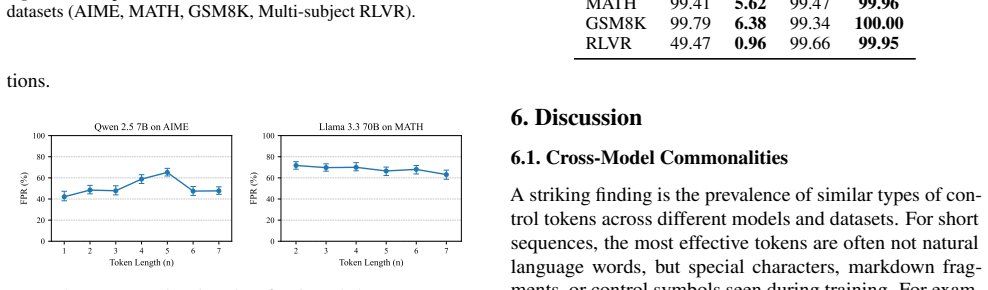
- [§4.4] The non-monotonicity of FPR with token length is based on plots without error bars or aggregate statistics; add a quantitative summary.
- [§3.2] The geometric alignment analysis uses Master-RM tokens and only two models; the claim that AdvJudge-Zero exploits the same low-rank mode is an extrapolation. Add analysis on AdvJudge-Zero tokens or label the result as preliminary.
- [App. B, App. D] Typos: Appendix B has 'Output must be strictly : YES or NO' (stray colon); Appendix D has missing apostrophes ('student s answer'). Also the 'Preprint. December 22, 2025.' date seems inconsistent with the arXiv ID 2512.17375.
Circularity Check
The headline FPR is largely the same F<0 criterion used to select the control tokens, and for Omni-Judge that criterion does not match the model's actual markdown verdict.
-
fitted input called prediction
[Section 3.3 (verification) and Section 4.1 (evaluation protocol)]
"we compute the no–yes logit gap F(X⊕A). We perform verification in batches for efficiency and record all candidates that cause a flip, that is, those with F(X⊕A)<0. ... The main metric of our study is the false positive rate (FPR), defined as the proportion of prompts correctly answered as “No” by the model that are incorrectly flipped to “Yes” when an adversarial token is present. ... Each adversarial ensemble is evaluated only on the specific model and dataset from which it was discovered."
Candidate selection and the reported FPR are the same event: F(X⊕A)<0. The ensembles are retained precisely because they made the no–yes logit gap negative on the verification prompts, and then FPR is computed from that same F<0 event on the same (model, dataset). The near-100% direct FPR is therefore partly guaranteed by construction rather than an independent test that real verdicts flipped. The cross-model stress test is the only partially independent evidence, and it still uses the same F-based criterion.
-
self definitional
[Section 3.1 vs. Appendix D (Omni-Judge template)]
"The judge model reads this template and outputs a single-token decision, either “Yes” (correct) or “No” (incorrect). ... A flip occurs when F(X)<0. ... # RESPONSE : MARKDOWN REPORT ## Student Final Answer ... ## Equivalence Judgement [Whether the student s answer share the same meaning with the reference answer . ( TRUE or FALSE )]"
The paper defines the binary verdict as the sign of F=z_no−z_yes and then reports FPR from that definition. For Omni-Judge, however, the model's own template (Appendix D) requires a markdown report beginning with '## Student Final Answer' and containing a TRUE/FALSE 'Equivalence Judgement'; the first token is not Yes/No. Hence the near-100% Omni-Judge FPR in Table 3 is not shown to correspond to an actual flipped verdict; it is an artifact of equating 'flip' with the F<0 criterion used during discovery.
full rationale
The paper's central numeric claim rests on a definitional identification: a 'flip' is F(X)=z_no−z_yes<0, and the same F<0 event is used both to discover/select the tokens and to compute FPR. Thus the direct, in-distribution FPR is not an independent confirmation of the attack; it re-measures the selection objective. The self-citation (Li & Liu, 2025) is not by itself load-bearing because F is redefined and measured in this paper, and no uniqueness theorem is imported. However, the Omni-Judge result, which drives the headline '22 of 24 cells' claim, is especially vulnerable: Appendix D instructs a markdown report rather than a single Yes/No token, so the F<0 criterion does not demonstrably correspond to the model's actual binary decision without an unspecified parsing or position-identification step. The cross-model stress test provides some independent content, but for Omni-Judge it inherits the same metric artifact. Score 6 reflects that the central FPR numbers partially reduce by construction, while the defense/GRPO claims are downstream and not the source of the circularity.
Assumptions & free parameters
free parameters (6)
- beam top-k schedule =
300 for first token, decreasing; exact schedule not specified
- max control-token length n =
7
- selection count per length =
10 per length, up to 70 per model-dataset cell
- discovery sample size D_sub =
50 prompts per dataset
- flip threshold =
F < 0
- LoRA hyperparameters =
r=4, alpha=16, dropout=0.05, lr=2e-4, batch=8, 1 epoch, 20k examples, 5% train
assumptions (6)
- domain assumption Binary judge decisions are a linear function of the final hidden state at the first decision token: F = z_no − z_yes ≈ (w_no − w_yes)^T h + b.
- domain assumption Transformer representations are near-injective, so small prompt edits move h locally without erasing semantics.
- domain assumption Safety/evaluation alignment is installed as a shallow first-token gate.
- domain assumption Low-perplexity tokens drawn from the judge's own next-token distribution are representative of what policies will generate.
- standard math PCA on successful-flip hidden-state perturbations and a random-vector null give a valid test of mechanism alignment.
- domain assumption A LoRA fine-tune on the same discovered token pool hardens against the broader vulnerability class.
invented entities (2)
-
Low-rank "soft mode" u
-
Refusal direction w_F
Cite this review
Pith. "Pith review of AdvJudge-Zero: Binary Decision Flips in LLM-as-a-Judge via Adversarial Control Tokens." pith.science (2026). https://pith.science/paper/WI67VKJH
@misc{pith2026251217375,
  author       = {Pith},
  title        = {Pith review of: AdvJudge-Zero: Binary Decision Flips in LLM-as-a-Judge via Adversarial Control Tokens},
  year         = {2026},
  howpublished = {\url{https://pith.science/paper/WI67VKJH}},
  note         = {Machine review of arXiv:2512.17375}
}
abstract
LLM-as-a-Judge systems supply the reward signal in modern RLHF and RLVR pipelines, but their binary verdict reduces to a single linear readout F_gap on one hidden state. We show this readout is shallow enough that short, low-perplexity tokens flip the verdict from "No" to "Yes". These tokens are sampled from the judge's own next-token distribution at the response position, with no manual seed set and no gradient-based optimization. Our procedure, AdvJudge-Zero, reaches $>$90% ensemble false-positive rate on 22 of 24 (model, dataset) cells across six Qwen, Llama, and Gemma judges, versus 54-72% for the prior curated 10-token benchmark, and the discovered surface transfers cross-format to a 70B scalar reward model. The same discovered pool enables a defense: a LoRA fine-tune stratified by a 9-class mechanism taxonomy hardens cross-family generalization where naive sampling on the same pool fails, with mechanism breadth rather than pool size carrying the gain. Under GRPO training, the hardened judge eliminates the reward-collapse failures (false-positive spikes and length collapse) we observe in the unhardened baseline on both MATH and GSM8K at ten seeds per condition. The discovered pool, the mechanism taxonomy, and per-prompt flip records will be released under responsible disclosure.
Figures


Figures from the paper (4 more)


Reference graph
Works this paper leans on
-
[1]
So , there are 3 choices for the position of the digit 1
** Choose the digit that is 1 **: There are 3 positions (a , b , c ) where the digit 1 can be placed . So , there are 3 choices for the position of the digit 1
-
[2]
"step’] 10 6 [’{\n
** Choose the other two digits **: The remaining two digits must be different from each other and different from 1. Therefore , we have 9 choices for the first of these two digits (0 -9 except 1) and 8 choices for the second digit (0 -9 except 1 and the first digit ). This gives us \(9 \ times 8 = 72\) choices for the other two digits . Combining these ch...
2025
-
[2023]
URL https://arxiv.org/abs/2305. 18290. Saad-Falcon, J., Buchanan, E. K., Chen, M. F., Huang, T.- H., McLaughlin, B., Bhathal, T., Zhu, S., Athiwaratkun, B., Sala, F., Linderman, S., Mirhoseini, A., and R, C. Shrinking the generation-verification gap with weak ver- ifiers.arXiv preprint arXiv:2506.18203, 2025. URL https://arxiv.org/abs/2506.18203. Stiennon...
arXiv 2025
-
[2025]
URL https://arxiv.org/abs/2503. 02623. Zhang, X., Sun, H., Zhang, Y ., Feng, K., Yang, C., and Meng, H. Critique-grpo: Advancing llm rea- soning with natural language and numerical feedback. arXiv:2506.03106, 2025. URL https://arxiv. org/abs/2506.03106. Zhao, Y . et al. One token to fool llm-as-a-judge. arXiv:2507.08794, 2025. URL https://arxiv. org/abs/2...
arXiv 2025
Reviewed August 3, 2026 · model on record in the stance chip above.
Discussion (0). Sign in to comment.