Strain-tuned orbital-dependent electronic correlations in FeTe thin films
Pith reviewed 2026-06-26 07:02 UTC · model grok-4.3
The pith
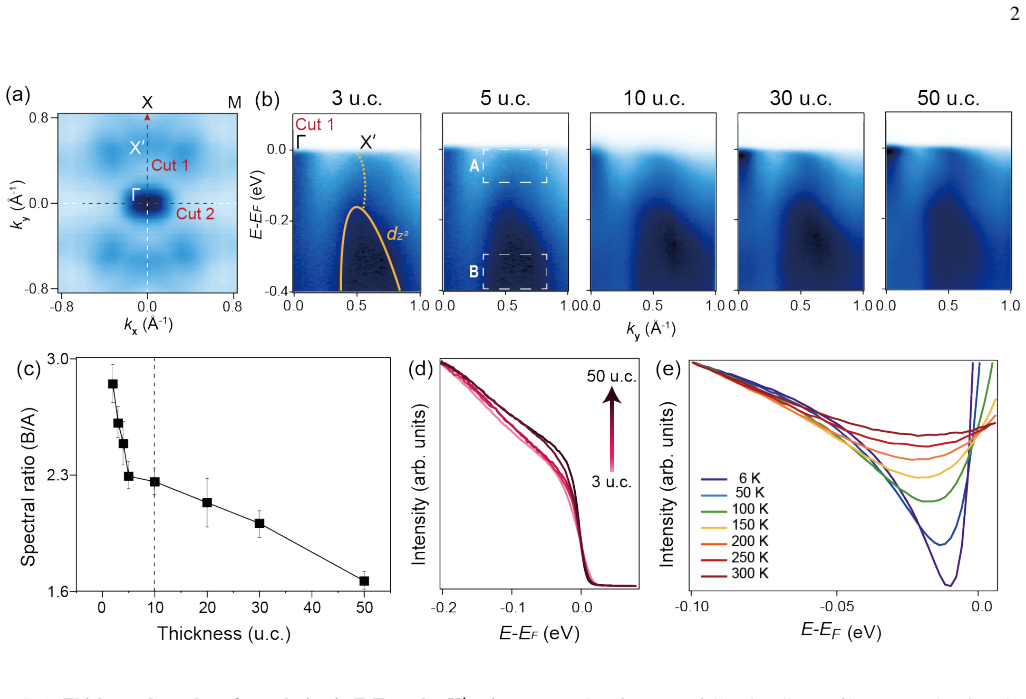
Tensile strain in FeTe thin films drives spectral weight transfer between d_xy and d_z2 orbitals as evidence of an orbital-selective Mott phase distinct from doping.
A machine-rendered reading of the paper's core claim, the machinery that carries it, and where it could break.
Core claim
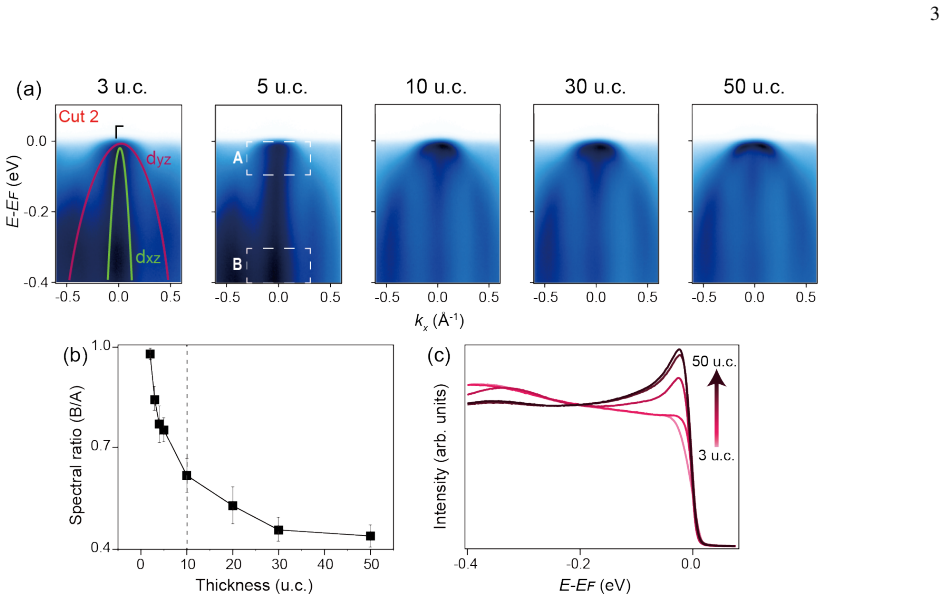
Applying tensile strain to FeTe thin films allows precise control of the system without other impurities that may arise from chemical doping. Using angle-resolved photoemission spectroscopy, a spectral weight transfer between d_xy and d_z2 orbitals is observed as evidence of an orbital-selective Mott phase. Beyond this, strain-induced effects on the d_xz orbital demonstrate how the electron hopping mechanism defines the electronic properties, with these changes distinct from those produced by Se doping. The work establishes a direct correlation between epitaxial strain and the evolution of electronic structures in FeTe.
What carries the argument
Spectral weight transfer between d_xy and d_z2 orbitals under tensile strain, taken as the indicator of an orbital-selective Mott phase observed by ARPES.
If this is right
- Tensile strain can induce an orbital-selective Mott phase in FeTe while avoiding impurity scattering from chemical dopants.
- The d_xz orbital responds through changes in electron hopping that are unique to the strained lattice.
- Electronic structure evolves in direct proportion to the applied epitaxial strain.
- Strain and doping produce separable modifications to the orbital-dependent correlations.
Where Pith is reading between the lines
- If strain cleanly separates orbital selectivity from doping, the same approach could be used to tune other iron chalcogenides or related correlated systems.
- The hopping mechanism highlighted for the d_xz orbital suggests that lattice distortion alone may control bandwidth in these materials.
- Device structures incorporating strained FeTe layers could exploit the orbital-selective regime for transport studies without substitutional disorder.
Load-bearing premise
The spectral weight transfer measured by ARPES is produced by the epitaxial tensile strain itself and constitutes evidence of an orbital-selective Mott phase that differs from chemical doping effects.
What would settle it
ARPES spectra collected on identically strained FeTe films that show no transfer of weight between d_xy and d_z2 orbitals, or that display the same orbital changes when Se doping is applied without strain, would falsify the central claim.
Figures


read the original abstract
Iron chalcogenides exhibit rich phenomena which are governed by orbital-dependent electronic interactions and strong electronic correlation. In particular, many studies have explored orbital selectivity in FeTe through Se doping. Here, applying tensile strain to thin films allows us to precisely control the system without other impurities that may arise from chemical doping to investigate the emergent behaviors in FeTe. Using angle-resolved photoemission spectroscopy, we observe a spectral weight transfer between $d_{\rm xy}$ and $d_{\rm z^{2}}$ orbitals, evidence of an orbital-selective Mott phase (OSMP). Beyond OSMP, we reveal hitherto unobserved strain-induced effects, distinct from chemical doping. The evolution of $d_{\rm xz}$ orbital demonstrates how electron hopping mechanism plays an important role in defining the electronic properties of the system. Our findings highlight a direct correlation between epitaxial strain and the evolution of electronic structures in FeTe.
Editorial analysis
A structured set of objections, weighed in public.
Referee Report
Summary. The manuscript reports that epitaxial tensile strain applied to FeTe thin films enables impurity-free tuning of the system, with ARPES data showing spectral weight transfer between the d_xy and d_z2 orbitals interpreted as evidence for an orbital-selective Mott phase (OSMP). Additional strain-induced changes, including evolution of the d_xz orbital linked to electron hopping, are claimed to be distinct from effects of Se chemical doping.
Significance. If substantiated, the results would demonstrate a clean experimental route to isolate strain effects on orbital-dependent correlations in iron chalcogenides, offering a complementary approach to doping studies for probing OSMP and related emergent phenomena.
major comments (2)
- [Abstract / Results] The central claim that the observed d_xy to d_z2 spectral weight transfer constitutes direct evidence of an OSMP induced by tensile strain (rather than growth or substrate artifacts) is load-bearing but rests on unshown quantitative controls: orbital character assignment, background subtraction procedures, and direct comparison to unstrained reference films are not presented with sufficient detail to establish the causal link.
- [Abstract / Discussion] The assertion that strain-induced effects are distinct from Se-doping effects requires explicit side-by-side data or analysis (e.g., doping-dependent spectra or quantitative metrics of orbital evolution); without such comparisons the distinction remains under-determined and weakens the novelty claim relative to existing doping literature.
minor comments (1)
- Notation for orbitals (d_xy, d_z2, d_xz) should be consistently formatted with proper subscripts throughout.
Simulated Author's Rebuttal
We thank the referee for the detailed and constructive report. We address the two major comments point-by-point below, indicating where revisions will be made to strengthen the manuscript.
read point-by-point responses
-
Referee: [Abstract / Results] The central claim that the observed d_xy to d_z2 spectral weight transfer constitutes direct evidence of an OSMP induced by tensile strain (rather than growth or substrate artifacts) is load-bearing but rests on unshown quantitative controls: orbital character assignment, background subtraction procedures, and direct comparison to unstrained reference films are not presented with sufficient detail to establish the causal link.
Authors: We agree that additional explicit documentation of these controls will strengthen the causal attribution to strain. In the revised manuscript we will add a dedicated methods subsection and supplementary figure that (i) detail the polarization-dependent ARPES assignments used to identify d_xy and d_z2 character, (ii) describe the background-subtraction protocol applied to the energy-distribution curves, and (iii) present direct side-by-side ARPES spectra and integrated intensities from strained and unstrained reference films grown under identical conditions. These additions will make the quantitative controls transparent and directly address the concern about possible growth or substrate artifacts. revision: yes
-
Referee: [Abstract / Discussion] The assertion that strain-induced effects are distinct from Se-doping effects requires explicit side-by-side data or analysis (e.g., doping-dependent spectra or quantitative metrics of orbital evolution); without such comparisons the distinction remains under-determined and weakens the novelty claim relative to existing doping literature.
Authors: We acknowledge that an explicit comparative panel would make the distinction clearer. The revised manuscript will include a new figure that overlays the strain-dependent evolution of the d_xz orbital intensity and bandwidth against published Se-doping series (with quantitative metrics such as orbital-selective spectral-weight ratios). This comparison will highlight the strain-specific hopping changes that are not reproduced by isovalent doping, thereby reinforcing the novelty of the strain-tuning route. revision: yes
Circularity Check
No derivation chain; purely experimental ARPES observations with no model fitting or predictions
full rationale
The paper reports ARPES measurements on tensile-strained FeTe thin films, documenting spectral weight transfer between d_xy and d_z2 orbitals as evidence for an orbital-selective Mott phase, plus strain-induced effects distinct from Se doping. No equations, theoretical derivations, parameter fitting, or predictions appear in the provided text. Claims rest on direct experimental data rather than any chain that could reduce to fitted inputs or self-citations. This matches the default expectation for non-circular experimental reports.
Axiom & Free-Parameter Ledger
Reference graph
Works this paper leans on
-
[1]
Paglione and R
J. Paglione and R. L. Greene, High-temperature superconduc- tivity in iron-based materials, Nature physics6, 645 (2010)
2010
-
[2]
M. Kim, S. Choi, W. H. Brito, and G. Kotliar, Orbital-selective Mott transition effects and nontrivial topology of iron chalco- genide, Physical review letters132, 136504 (2024)
2024
-
[3]
I. A. Zaliznyak, Z. Xu, J. M. Tranquada, G. Gu, A. M. Tsvelik, and M. B. Stone, Unconventional temperature enhanced mag- netism in Fe1.1Te, Physical review letters107, 216403 (2011)
2011
-
[4]
L. Wang, F. Hardy, T. Wolf, P. Adelmann, R. Fromknecht, P. Schweiss, and C. Meingast, Superconductivity-enhanced ne- maticity and “s + d” gap symmetry in Fe(Se 1−xSx), physica status solidi (b)254, 1600153 (2017)
2017
-
[5]
Subedi, L
A. Subedi, L. Zhang, D. J. Singh, and M.-H. Du, Density functional study of FeS, FeSe, and FeTe: Electronic struc- ture, magnetism, phonons, and superconductivity, Physical Re- view B—Condensed Matter and Materials Physics78, 134514 (2008)
2008
-
[6]
Greger, M
M. Greger, M. Kollar, and D. V ollhardt, Emergence of a com- mon energy scale close to the orbital-selective Mott transition, Physical Review Letters110, 046403 (2013)
2013
-
[7]
Zhang, K
P. Zhang, K. Yaji, T. Hashimoto, Y . Ota, T. Kondo, K. Okazaki, Z. Wang, J. Wen, G. D. Gu, H. Ding, et al., Observation of topological superconductivity on the surface of an iron-based superconductor, Science360, 182 (2018)
2018
-
[8]
Zhang, Z
P. Zhang, Z. Wang, X. Wu, K. Yaji, Y . Ishida, Y . Kohama, G. Dai, Y . Sun, C. Bareille, K. Kuroda,et al., Multiple topolog- ical states in iron-based superconductors, Nature Physics15, 41 (2019)
2019
-
[9]
Ishida, M
K. Ishida, M. Tsujii, S. Hosoi, Y . Mizukami, S. Ishida, A. Iyo, H. Eisaki, T. Wolf, K. Grube, H. v. L ¨ohneysen, et al., Novel electronic nematicity in heavily hole-doped iron pnictide super- conductors, Proceedings of the National Academy of Sciences 117, 6424 (2020)
2020
-
[10]
Yu and Q
R. Yu and Q. Si, Orbital-selective Mott phase in multiorbital models for alkaline iron selenides K1−xFe2−ySe2, Physical Re- view Letters110, 146402 (2013)
2013
-
[11]
X.-L. Peng, Y . Li, X.-X. Wu, H.-B. Deng, X. Shi, W.-H. Fan, M. Li, Y .-B. Huang, T. Qian, P. Richard, et al., Observation of topological transition in high-Tc superconducting monolayer FeTe1−xSex films on SrTiO 3(001), Physical Review B100, 155134 (2019)
2019
-
[12]
T. Liu, J. Hu, B. Qian, D. Fobes, Z. Q. Mao, W. Bao, M. Reehuis, S. Kimber, K. Proke ˇs, S. Matas, et al., From (π,
-
[13]
magnetic order to superconductivity with (π,π) magnetic resonance in Fe1.02Te1−xSex, Nature Materials9, 718 (2010)
2010
-
[14]
M. Yi, Y . Zhang, Z.-X. Shen, and D. Lu, Role of the orbital degree of freedom in iron-based superconductors, npj Quantum Materials2, 57 (2017)
2017
-
[15]
Z. Yin, K. Haule, and G. Kotliar, Kinetic frustration and the nature of the magnetic and paramagnetic states in iron pnictides and iron chalcogenides, Nature materials10, 932 (2011)
2011
-
[16]
de’Medici, G
L. de’Medici, G. Giovannetti, and M. Capone, Selective Mott physics as a key to iron superconductors, Physical review letters 112, 177001 (2014)
2014
-
[17]
Q. Si, R. Yu, and E. Abrahams, High-temperature supercon- ductivity in iron pnictides and chalcogenides, Nature Reviews Materials1, 1 (2016)
2016
-
[18]
Nakajima, S
M. Nakajima, S. Ishida, T. Tanaka, K. Kihou, Y . Tomioka, T. Saito, C. Lee, H. Fukazawa, Y . Kohori, T. Kakeshita, et al., Normal-state charge dynamics in doped BaFe 2As2: Roles of 6 doping and necessary ingredients for superconductivity, Scien- tific reports4, 5873 (2014)
2014
-
[19]
X. Niu, S. Chen, J. Jiang, Z. Ye, T. Yu, D. Xu, M. Xu, Y . Feng, Y . Yan, B. Xie,et al., A unifying phase diagram with correlation-driven superconductor-to-insulator transition for the 122 series of iron chalcogenides, Physical Review B93, 054516 (2016)
2016
-
[20]
Maheshwari, V
P. Maheshwari, V . R. Reddy, and V . Awana, Heat capacity and m¨ossbauer study of self-flux grown FeTe single crystal, Journal of Superconductivity and Novel Magnetism31, 1659 (2018)
2018
-
[21]
Jiang, C
J. Jiang, C. He, Y . Zhang, M. Xu, Q. Q. Ge, Z. R. Ye, F. Chen, B. P. Xie, and D. L. Feng, Distinct in-plane resistiv- ity anisotropy in a detwinned FeTe single crystal: Evidence for a Hund’s metal, Phys. Rev. B88, 115130 (2013)
2013
-
[22]
Seo, J.-H
S. Seo, J.-H. Kang, M. J. Oh, I.-S. Jeong, J. Jiang, G. Gu, J.-W. Lee, J. Lee, H. Noh, M. Liu, et al., Origin of the emergence of higher T c than bulk in iron chalcogenide thin films, Scientific reports7, 9994 (2017)
2017
-
[23]
E. Ieki, K. Nakayama, Y . Miyata, T. Sato, H. Miao, N. Xu, X.-P. Wang, P. Zhang, T. Qian, P. Richard,et al., Evolution from inco- herent to coherent electronic states and its implications for su- perconductivity in FeTe1−xSex, Physical Review B89, 140506 (2014)
2014
-
[24]
Z. Liu, M. Yi, Y . Zhang, J. Hu, R. Yu, J.-X. Zhu, R.-H. He, Y . Chen, M. Hashimoto, R. Moore,et al., Experimental obser- vation of incoherent-coherent crossover and orbital-dependent band renormalization in iron chalcogenide superconductors, Physical Review B92, 235138 (2015)
2015
-
[25]
Huang, R
J. Huang, R. Yu, Z. Xu, J.-X. Zhu, J. S. Oh, Q. Jiang, M. Wang, H. Wu, T. Chen, J. D. Denlinger,et al., Correlation-driven elec- tronic reconstruction in FeTe1−xSex, Communications Physics 5, 29 (2022)
2022
-
[26]
M. Yi, Z. Liu, Y . Zhang, R. Yu, J.-X. Zhu, J. Lee, R. Moore, F. Schmitt, W. Li, S. Riggs, et al., Observation of univer- sal strong orbital-dependent correlation effects in iron chalco- genides, Nature communications6, 7777 (2015)
2015
-
[27]
Z. Ye, Y . Zhang, F. Chen, M. Xu, J. Jiang, X. Niu, C. Wen, L. Xing, X. Wang, C. Jin, et al., Extraordinary doping effects on quasiparticle scattering and bandwidth in iron-based super- conductors, Physical Review X4, 031041 (2014)
2014
-
[28]
Z. P. Yin, K. Haule, and G. Kotliar, Fractional power-law behav- ior and its origin in iron-chalcogenide and ruthenate supercon- ductors: Insights from first-principles calculations, Phys. Rev. B86, 195141 (2012)
2012
-
[29]
Y . Sato, S. Nagahama, S. Kitou, H. Sagayama, I. Belopol- ski, R. Yoshimi, M. Kawamura, A. Tsukazaki, N. Kanazawa, T. Nomoto, et al., Superconductivity and suppressed mono- clinic distortion in FeTe films enabled by higher-order epitaxy, Nature Communications16, 10913 (2025)
2025
-
[30]
Y . Han, W. Y . Li, L. X. Cao, X. Y . Wang, B. Xu, B. R. Zhao, Y . Q. Guo, and J. L. Yang, Superconductivity in iron telluride thin films under tensile stress, Phys. Rev. Lett.104, 017003 (2010)
2010
-
[31]
See Supplemental Material at https://link.aps.org/supplemental/ 10.1103/xffv-kpjp for experimental details, sample character- ization, additional electronic structure data and detailed data analysis
-
[32]
S. Tan, Y . Zhang, M. Xia, Z. Ye, F. Chen, X. Xie, R. Peng, D. Xu, Q. Fan, H. Xu, et al., Interface-induced superconduc- tivity and strain-dependent spin density waves in FeSe/SrTiO 3 thin films, Nature materials12, 634 (2013)
2013
-
[33]
Ricci and G
F. Ricci and G. Profeta, van der waals interaction in iron-chalcogenide superconductors, Physical Review B—Condensed Matter and Materials Physics87, 184105 (2013)
2013
-
[34]
Kim, M.-S
Y . Kim, M.-S. Kim, D. Kim, M. Kim, M. Kim, C.-M. Cheng, J. Choi, S. Jung, D. Lu, J. H. Kim, et al., Kondo interaction in FeTe and its potential role in the magnetic order, Nature com- munications14, 4145 (2023)
2023
-
[35]
P.-H. Lin, Y . Texier, A. Taleb-Ibrahimi, P. Le F`evre, F. Bertran, E. Giannini, M. Grioni, and V . Brouet, Nature of the bad metal- lic behavior of Fe1.06Te inferred from its evolution in the mag- netic state, Physical review letters111, 217002 (2013)
2013
-
[36]
Y . Xia, D. Qian, L. Wray, D. Hsieh, G. F. Chen, J. L. Luo, N. L. Wang, and M. Z. Hasan, Fermi surface topology and low-lying quasiparticle dynamics of parent Fe 1+xTeSe superconductor, Phys. Rev. Lett.103, 037002 (2009)
2009
-
[37]
Liu, R.-H
Z. Liu, R.-H. He, D. Lu, M. Yi, Y . Chen, M. Hashimoto, R. G. Moore, S.-K. Mo, E. A. Nowadnick, J. Hu, et al., Measure- ment of coherent polarons in the strongly coupled antiferro- magnetically ordered iron-chalcogenide Fe 1.02Te using angle- resolved photoemission spectroscopy, Physical review letters 110, 037003 (2013)
2013
-
[38]
Yu and Q
R. Yu and Q. Si, Orbital-selective Mott phase in multiorbital models for iron pnictides and chalcogenides, Physical Review B96, 125110 (2017)
2017
-
[39]
Z. Wang, M. Schmidt, J. Fischer, V . Tsurkan, M. Greger, D. V ollhardt, A. Loidl, and J. Deisenhofer, Orbital-selective metal–insulator transition and gap formation above Tc in super- conducting Rb1−xFe2−ySe2, Nature Communications5, 3202 (2014)
2014
-
[40]
X. Ding, Y . Pan, H. Yang, and H.-H. Wen, Strong and non- monotonic temperature dependence of hall coefficient in super- conducting KxFe2−ySe2 single crystals, Physical Review B89, 224515 (2014)
2014
-
[41]
W. Li, C. Zhang, S. Liu, X. Ding, X. Wu, X. Wang, H.-H. Wen, and M. Xiao, Mott behavior in K xFe2−ySe2 superconductors studied by pump-probe spectroscopy, Physical Review B89, 134515 (2014)
2014
-
[42]
Y . Pu, Z. Huang, H. Xu, D. Xu, Q. Song, C. Wen, R. Peng, and D. Feng, Temperature-induced orbital selective localiza- tion and coherent-incoherent crossover in single-layer FeSe/Nb: BaTiO3/KTaO3, Physical Review B94, 115146 (2016)
2016
-
[43]
M. Yi, D. Lu, R. Yu, S. Riggs, J.-H. Chu, B. Lv, Z. Liu, M. Lu, Y .-T. Cui, M. Hashimoto, et al., Observation of temperature-induced crossover to an orbital-selective Mott phase in A xFe2−ySe2 (A = K, Rb) superconductors, Physical review letters110, 067003 (2013)
2013
-
[44]
A. B. Morfoot, T. K. Kim, M. D. Watson, A. A. Haghighirad, S. J. Singh, N. Bultinck, and A. I. Coldea, Resurgence of su- perconductivity and the role of d xy hole band in FeSe 1−xTex, Communications Physics6, 362 (2023)
2023
-
[45]
F. Chen, B. Zhou, Y . Zhang, J. Wei, H.-W. Ou, J.-F. Zhao, C. He, Q.-Q. Ge, M. Arita, K. Shimada, H. Namatame, M. Taniguchi, Z.-Y . Lu, J. Hu, X.-Y . Cui, and D. L. Feng, Elec- tronic structure of Fe1.04Te0.66Se0.34, Phys. Rev. B81, 014526 (2010)
2010
-
[46]
S. L. Skornyakov, V . I. Anisimov, D. V ollhardt, and I. Leonov, Effect of electron correlations on the electronic structure and phase stability of FeSe upon lattice expansion, Phys. Rev. B96, 035137 (2017)
2017
-
[47]
Y . Sato, S. Nagahama, S. Kitou, H. Sagayama, I. Belopol- ski, R. Yoshimi, M. Kawamura, A. Tsukazaki, N. Kanazawa, T. Nomoto,et al., Higher-order epitaxy: A pathway to suppress- ing structural instability and emergent superconductivity, arXiv preprint arXiv:2510.07947 10.48550/arXiv.2510.07947 (2025)
-
[48]
Q. L. He, H. Liu, M. He, Y . H. Lai, H. He, G. Wang, K. T. Law, R. Lortz, J. Wang, and I. K. Sou, Two-dimensional super- 7 conductivity at the interface of a Bi 2Te3/FeTe heterostructure, Nature communications5, 4247 (2014)
2014
-
[49]
Manna, A
S. Manna, A. Kamlapure, L. Cornils, T. H ¨anke, E. Hede- gaard, M. Bremholm, B. Iversen, P. Hofmann, J. Wiebe, and R. Wiesendanger, Interfacial superconductivity in a bi-collinear antiferromagnetically ordered FeTe monolayer on a topological insulator, Nature communications8, 14074 (2017)
2017
-
[50]
Tk´aˇc, S
V . Tk´aˇc, S. V orobiov, P. Baloh, M. V ondr´aˇcek, G. Springholz, K. Carva, P. Szab´o, P. Hofmann, and J. Honolka, Multiphase su- perconductivity at the interface between ultrathin FeTe islands and Bi2Te3, npj 2D Materials and Applications8, 52 (2024)
2024
-
[51]
H. T. Yi, X. Yao, D. Jain, Y .-T. Chan, A.-H. Chen, M. Brahlek, K. Kisslinger, K. Du, M.-G. Han, Y . Zhu, et al., Universal su- perconductivity in FeTe and all-iron-based ferromagnetic su- perconductor heterostructures, Advanced Functional Materials 35, 2418259 (2025)
2025
-
[52]
Ciechan, M
A. Ciechan, M. J. Winiarski, and M. Samsel-Czekała, Magnetic phase transitions and superconductivity in strained FeTe, Jour- nal of Physics: Condensed Matter26, 025702 (2013)
2013
-
[53]
H. Song, Y . Kim, S. Lee, S. Lee, Y . Kim, Y . Lee, and C. Kim, Growth and characterization of FeTe thin films under tensile strain, Journal of the Korea Institute of Applied Superconduc- tivity and Cryogenics26, 20 (2024)
2024
-
[54]
D. C. Johnston, The puzzle of high temperature superconduc- tivity in layered iron pnictides and chalcogenides, Advances in Physics59, 803 (2010)
2010
-
[55]
J. K. Glasbrenner, I. Mazin, H. O. Jeschke, P. Hirschfeld, R. Fernandes, and R. Valent´ı, Effect of magnetic frustration on nematicity and superconductivity in iron chalcogenides, Nature Physics11, 953 (2015)
2015
-
[56]
F. Ma, W. Ji, J. Hu, Z.-Y . Lu, and T. Xiang, First-principles calculations of the electronic structure of tetragonalα-FeTe and α-FeSe crystals: Evidence for a bicollinear antiferromagnetic order, Physical review letters102, 177003 (2009)
2009
-
[57]
Z.-J. Yan, Z. Wang, B. Xia, S. Paolini, Y .-T. Chan, N. Dihingia, H. Rong, P. Xiao, K. D. Halanayake, J. Song, et al., Stoichio- metric FeTe is a superconductor, Nature , 1 (2026)
2026
discussion (0)
Sign in with ORCID, Apple, or X to comment. Anyone can read and Pith papers without signing in.