Universality and variability of the heavy r-process element abundance pattern from a nonequilibrium approach
Pith reviewed 2026-06-26 21:39 UTC · model grok-4.3
The pith
A nonequilibrium freeze-out model accounts for both the universal pattern and variations in heavy r-process element abundances across stars.
A machine-rendered reading of the paper's core claim, the machinery that carries it, and where it could break.
Core claim
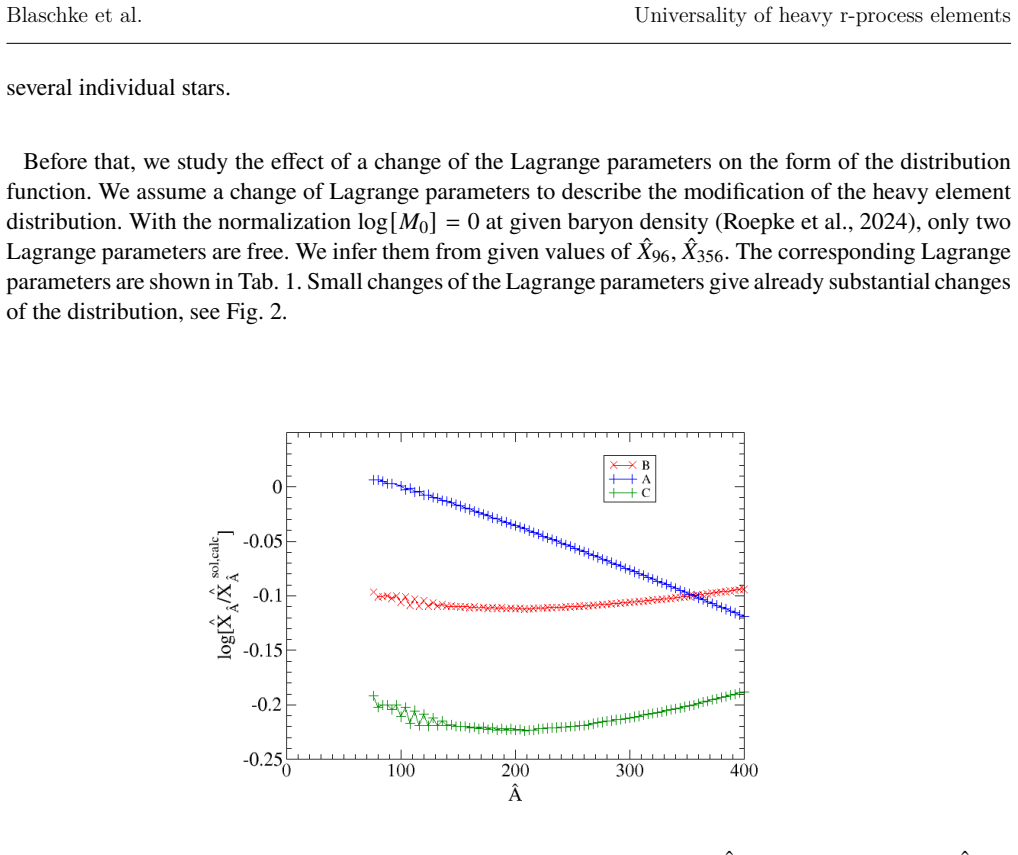
A nonequilibrium freeze-out approach provides a natural way of accounting for the typical abundance pattern and its variation. The coarse-grained distribution of heavy r-process elements in several astrophysical objects is characterized by Lagrange parameters that show only minor fluctuations when comparing different stars, with larger deviations observed in stars with low metallicity. The determination of these parameters can be instrumental in identifying possible sources for the formation of heavy elements, in particular density fluctuations considered as a source for the production of heavy elements in the early Universe.
What carries the argument
Nonequilibrium freeze-out approach using Lagrange parameters to characterize the coarse-grained distribution of heavy r-process elements.
If this is right
- The observed universality of heavy-element ratios follows from the shared freeze-out dynamics rather than identical production sites.
- Larger parameter deviations in low-metallicity stars trace differences in the astrophysical conditions under which the elements formed.
- Density fluctuations in the early Universe become a viable mechanism for generating the observed heavy-element patterns.
- Measured Lagrange parameters can serve as diagnostics to distinguish among candidate astrophysical sources of r-process material.
Where Pith is reading between the lines
- The same parameter framework might be applied to metal-poor halo stars to test whether their abundance scatter matches predicted early-Universe conditions.
- If the Lagrange parameters correlate with specific observables such as neutron-star merger rates or supernova yields, the method could help map individual r-process events to their sites.
- Extending the approach to lighter elements or different freeze-out timescales could reveal whether similar nonequilibrium descriptions apply beyond the heavy r-process regime.
Load-bearing premise
The coarse-grained distribution of heavy r-process elements can be meaningfully characterized by a small set of Lagrange parameters whose fluctuations across stars directly reflect differences in astrophysical production conditions.
What would settle it
A large sample of stars showing r-process abundance patterns that cannot be fit by any consistent set of Lagrange parameters, or showing no systematic change in those parameters despite clear differences in metallicity and other production indicators.
Figures



read the original abstract
A striking feature in the observed chemical composition of the majority of stars is the universality of the relative abundances of the heavy elements, although some outliers exist. We demonstrate that a nonequilibrium freeze-out approach provides a natural way of accounting for the typical abundance pattern and its variation. Here, we use a phenomenological method to characterize the coarse-grained distribution of heavy $r$-process elements in several astrophysical objects. The Lagrange parameters show only minor fluctuations when comparing different stars. Larger deviations are observed in stars with low metallicity. The variations in the Lagrange parameters for these stars are presented. The determination of the Lagrange parameters can be instrumental in identifying possible sources for the formation of heavy elements. In particular, density fluctuations are considered as a source for the production of heavy elements in the early Universe.
Editorial analysis
A structured set of objections, weighed in public.
Referee Report
Summary. The manuscript claims that a nonequilibrium freeze-out approach provides a natural way of accounting for the typical abundance pattern of heavy r-process elements and its variation across astrophysical objects. Using a phenomenological maximum-entropy characterization of the coarse-grained distribution, the Lagrange parameters exhibit only minor fluctuations when comparing different stars, with larger deviations observed in low-metallicity stars. The determination of these parameters is proposed as a tool for identifying possible sources of heavy-element formation, including density fluctuations in the early Universe.
Significance. If the central claim holds, the work supplies a falsifiable phenomenological framework that links nonequilibrium dynamics to observed r-process abundance patterns via stable Lagrange parameters. This could help constrain astrophysical production conditions and distinguish among candidate sites. The explicit construction of the model, including the mapping from freeze-out to the chosen constraints, is a strength that turns the reported parameter stability into direct, testable support rather than an unexamined assumption.
minor comments (3)
- [Abstract] The abstract would benefit from a concise statement of the specific constraints employed in the maximum-entropy procedure and the number of Lagrange parameters retained.
- A table or supplementary figure listing the numerical values of the Lagrange parameters for each star (or group of stars) would allow quantitative assessment of the claimed 'minor fluctuations' and the larger deviations at low metallicity.
- The manuscript should clarify whether the chosen constraints are derived from the underlying nonequilibrium dynamics or selected phenomenologically for descriptive power.
Simulated Author's Rebuttal
We thank the referee for the positive assessment of our work and the recommendation for minor revision. The referee's summary correctly captures the central claim regarding the nonequilibrium freeze-out model and the stability of the Lagrange parameters.
Circularity Check
No significant circularity identified
full rationale
The derivation relies on a phenomenological maximum-entropy characterization of coarse-grained r-process abundances via a small set of Lagrange parameters whose values are extracted from observed patterns in multiple stars. The reported minor fluctuations in these parameters across stars constitute a direct, falsifiable comparison to the input data rather than a restatement by construction; the nonequilibrium freeze-out mapping supplies an independent interpretive layer whose predictions (parameter stability under typical conditions, larger deviations at low metallicity) can be tested against external abundance measurements. No load-bearing step reduces to self-definition, fitted-input renaming, or a self-citation chain; the central claim therefore retains independent content against external benchmarks.
Axiom & Free-Parameter Ledger
free parameters (1)
- Lagrange parameters
axioms (1)
- domain assumption The coarse-grained distribution of heavy r-process elements admits a statistical description via a small number of Lagrange multipliers.
Reference graph
Works this paper leans on
-
[1]
J., Lombardo , L., Visentin , G., Arcones , A., et al
Alencastro Puls , A., Kuske , J., Hansen , C. J., Lombardo , L., Visentin , G., Arcones , A., et al. (2025). Chemical Evolution of R-process Elements in Stars (CERES): IV. An observational run-up of the third r-process peak with Hf, Os, Ir, and Pt . 693, A294. doi:10.1051/0004-6361/202452537 2025A&A...693A.294A
-
[2]
Arnould , M., Goriely , S., and Takahashi , K. (2007). The r-process of stellar nucleosynthesis: Astrophysics and nuclear physics achievements and mysteries . 450, 97--213. doi:10.1016/j.physrep.2007.06.002 2007PhR...450...97A
-
[3]
Ashraf , M. Z., Cui , W., and Li , H. (2025). The Abundance Origin of a Highly r-process Enhanced r-II Star: LAMOST J020623.21+494127.9 . Research in Astronomy and Astrophysics 25, 085015. doi:10.1088/1674-4527/ade350 2025RAA....25h5015A
-
[4]
Barbuy , B., Spite , M., Hill , V., Primas , F., Plez , B., Cayrel , R., et al. (2011). First stars. XV. Third-peak r-process element and actinide abundances in the uranium-rich star CS31082-001 . 534, A60. doi:10.1051/0004-6361/201117450 2011A&A...534A..60B
-
[5]
and Mottelson , B
Bohr , A. and Mottelson , B. (1969). Nuclear Structure (W.A. Benjamin, Inc., New York) BohrM
1969
-
[6]
Bonifacio , P., Caffau , E., Fran c ois , P., and Spite , M. (2025). The most metal-poor stars . 33, 2. doi:10.1007/s00159-025-00159-2 2025A&ARv..33....2B
-
[7]
Synthesis of the Elements in Stars
Burbidge, M. E., Burbidge, G. R., Fowler, W. A., and Hoyle, F. (1957). Synthesis of the elements in stars . Rev. Mod. Phys. 29, 547--650. doi:10.1103/RevModPhys.29.547 Burbidge:1957vc
-
[8]
Cain , M., Frebel , A., Ji , A. P., Placco , V. M., Ezzeddine , R., Roederer , I. U., et al. (2020). The R-Process Alliance: A Very Metal-poor, Extremely r-process-enhanced Star with [Eu/Fe] = + 2.2, and the Class of r-III Stars . 898, 40. doi:10.3847/1538-4357/ab97ba 2020ApJ...898...40C
-
[9]
Cescutti , G. and Chiappini , C. (2014). Explaining the Ba, Y, Sr, and Eu abundance scatter in metal-poor halo stars: constraints to the r-process . 565, A51. doi:10.1051/0004-6361/201423432 2014A&A...565A..51C
-
[10]
Cescutti , G., Romano , D., Matteucci , F., Chiappini , C., and Hirschi , R. (2015). The role of neutron star mergers in the chemical evolution of the Galactic halo . 577, A139. doi:10.1051/0004-6361/201525698 2015A&A...577A.139C
-
[11]
Chen , H.-Y., Landry , P., Read , J. S., and Siegel , D. M. (2025). Inference of Multichannel r-process Element Enrichment in the Milky Way Using Binary Neutron Star Merger Observations . 985, 154. doi:10.3847/1538-4357/add0af 2025ApJ...985..154C
-
[12]
Choplin , A., Goriely , S., and Siess , L. (2022). Synthesis of thorium and uranium in asymptotic giant branch stars . 667, L13. doi:10.1051/0004-6361/202244928 2022A&A...667L..13C
-
[13]
Choplin , A., Goriely , S., Siess , L., and Martinet , S. (2025). Synthesis of actinides and short-lived radionuclides during i-process nucleosynthesis in AGB stars . European Physical Journal A 61, 68. doi:10.1140/epja/s10050-025-01522-8 2025EPJA...61...68C
-
[14]
Choplin , A., Siess , L., Goriely , S., and Martinet , S. (2024). Production of Lithium and Heavy Elements in AGB Stars Experiencing PIEs . Galaxies 12, 66. doi:10.3390/galaxies12050066 2024Galax..12...66C
-
[15]
L., Belczynski , K., Korobkin , O., Chru \'s li \'n ska , M., Vassh , N., et al
C \^o t \'e , B., Fryer , C. L., Belczynski , K., Korobkin , O., Chru \'s li \'n ska , M., Vassh , N., et al. (2018). The Origin of r-process Elements in the Milky Way . 855, 99. doi:10.3847/1538-4357/aaad67 2018ApJ...855...99C
-
[16]
C\^ot\'e, B. et al. (2019). Neutron Star Mergers Might not be the Only Source of r-Process Elements in the Milky Way . Astrophys. J. 875, 106. doi:10.3847/1538-4357/ab10db Cote:2018qku
-
[17]
Cowan , J. J., Pfeiffer , B., Kratz , K. L., Thielemann , F. K., Sneden , C., Burles , S., et al. (1999). R-Process Abundances and Chronometers in Metal-poor Stars . 521, 194--205. doi:10.1086/307512 1999ApJ...521..194C
-
[18]
Reviews of Modern Physics , keywords =
Cowan , J. J., Sneden , C., Lawler , J. E., Aprahamian , A., Wiescher , M., Langanke , K., et al. (2021). Origin of the heaviest elements: The rapid neutron-capture process . Reviews of Modern Physics 93, 015002. doi:10.1103/RevModPhys.93.015002 2021RvMP...93a5002C
-
[19]
J., Thielemann , F.-K., and Truran , J
Cowan , J. J., Thielemann , F.-K., and Truran , J. W. (1991). The R-process and nucleochronology . 208, 267--394. doi:10.1016/0370-1573(91)90070-3 1991PhR...208..267C
-
[20]
de Jes \'u s Mendoza-Temis, J., Wu, M.-R., Mart \' nez-Pinedo, G., Langanke, K., Bauswein, A., and Janka, H.-T. (2015). Nuclear robustness of the r process in neutron-star mergers . Phys. Rev. C 92, 055805. doi:10.1103/PhysRevC.92.055805 deJesusMendoza-Temis:2014owk
-
[21]
Dinh Thi , H., Fantina , A. F., and Gulminelli , F. (2023). The proto-neutron star inner crust in the liquid phase . 672, A160. doi:10.1051/0004-6361/202245061 2023A&A...672A.160D
-
[22]
Duflo , J. and Zuker , A. P. (1995). Microscopic mass formulas . 52, R23--R27. doi:10.1103/PhysRevC.52.R23 1995PhRvC..52...23D
-
[23]
Eichler, M. et al. (2015). The Role of Fission in Neutron Star Mergers and its Impact on the r-Process Peaks . Astrophys. J. 808, 30. doi:10.1088/0004-637X/808/1/30 Eichler:2014kma
-
[24]
J., Barbuy , B., Spite , M., Hill , V., Castilho , B., et al
Ernandes , H., Castro , M. J., Barbuy , B., Spite , M., Hill , V., Castilho , B., et al. (2023). Reanalysis of neutron-capture elements in the benchmark r-rich star CS 31082-001 . 524, 656--677. doi:10.1093/mnras/stad1764 ernandez2023a
-
[25]
Farouqi , K., Frebel , A., and Thielemann , F.-K. (2025). Deciphering the Origins of the Elements Through Galactic Archeology . arXiv e-prints , arXiv:2503.18233doi:10.48550/arXiv.2503.18233 2025arXiv250318233F
-
[26]
K., Rosswog , S., and Kratz , K
Farouqi , K., Thielemann , F. K., Rosswog , S., and Kratz , K. L. (2022). Correlations of r-process elements in very metal-poor stars as clues to their nucleosynthesis sites . 663, A70. doi:10.1051/0004-6361/202141038 2022A&A...663A..70F
-
[27]
Fischer , T., Bastian , N.-U., Blaschke , D., Cierniak , M., Hempel , M., Kl \"a hn , T., et al. (2017). The State of Matter in Simulations of Core-Collapse supernovae Reflections and Recent Developments . 34, e067. doi:10.1017/pasa.2017.63 2017PASA...34...67F
-
[28]
Fischer , T., Hempel , M., Sagert , I., Suwa , Y., and Schaffner-Bielich , J. (2014). Symmetry energy impact in simulations of core-collapse supernovae . European Physical Journal A 50, 46. doi:10.1140/epja/i2014-14046-5 2014EPJA...50...46F
-
[29]
Frebel , A. (2018). From Nuclei to the Cosmos: Tracing Heavy-Element Production with the Oldest Stars . Annual Review of Nuclear and Particle Science 68, 237--269. doi:10.1146/annurev-nucl-101917-021141 2018ARNPS..68..237F
-
[30]
Frebel , A. (2024). Metal-Poor Stars in the Milky Way System . arXiv e-prints , arXiv:2411.15415doi:10.48550/arXiv.2411.15415 2024arXiv241115415F
-
[31]
H., Asali , Y., Kado-Fong , E., Kallivayalil , N., et al
Geha , M., Mao , Y.-Y., Wechsler , R. H., Asali , Y., Kado-Fong , E., Kallivayalil , N., et al. (2024). The SAGA Survey. IV. The Star Formation Properties of 101 Satellite Systems around Milky Way mass Galaxies . 976, 118. doi:10.3847/1538-4357/ad61e7 2024ApJ...976..118G
-
[32]
Gonin, M., Hasinger, G., Blaschke, D., Ivanytskyi, O., and R \"o pke, G. (2025). Primordial black-hole formation and heavy r-process element synthesis from the cosmological QCD transition. Two aspects of an inhomogeneous early Universe . Eur. Phys. J. A 61, 170. doi:10.1140/epja/s10050-025-01639-w Gonin:2025uvc
-
[33]
Goriely , S. (2015). The fundamental role of fission during r-process nucleosynthesis in neutron star mergers . European Physical Journal A 51, 22. doi:10.1140/epja/i2015-15022-3 2015EPJA...51...22G
-
[34]
J., Montes , F., and Arcones , A
Hansen , C. J., Montes , F., and Arcones , A. (2014). How Many Nucleosynthesis Processes Exist at Low Metallicity? 797, 123. doi:10.1088/0004-637X/797/2/123 2014ApJ...797..123H
-
[35]
J., Primas , F., Hartman , H., Kratz , K
Hansen , C. J., Primas , F., Hartman , H., Kratz , K. L., Wanajo , S., Leibundgut , B., et al. (2012). Silver and palladium help unveil the nature of a second r-process . 545, A31. doi:10.1051/0004-6361/201118643 2012A&A...545A..31H
-
[36]
Hansen , T. T., Roederer , I. U., Shah , S. P., Ezzeddine , R., Beers , T. C., Frebel , A., et al. (2025). The R-Process Alliance: Hunting for gold in the near-UV spectrum of 2MASS J05383296 5904280 . 697, A127. doi:10.1051/0004-6361/202554123 2025A&A...697A.127H
-
[37]
Haynes , C. J. and Kobayashi , C. (2019). Galactic simulations of r-process elemental abundances . 483, 5123--5134. doi:10.1093/mnras/sty3389 2019MNRAS.483.5123H
-
[38]
Hirai , Y., Ishimaru , Y., Saitoh , T. R., Fujii , M. S., Hidaka , J., and Kajino , T. (2015). Enrichment of r-process Elements in Dwarf Spheroidal Galaxies in Chemo-dynamical Evolution Model . 814, 41. doi:10.1088/0004-637X/814/1/41 2015ApJ...814...41H
-
[39]
M., Frebel , A., McLaughlin , G
Holmbeck , E. M., Frebel , A., McLaughlin , G. C., Mumpower , M. R., Sprouse , T. M., and Surman , R. (2019). Actinide-rich and Actinide-poor r-process-enhanced Metal-poor Stars Do Not Require Separate r-process Progenitors . 881, 5. doi:10.3847/1538-4357/ab2a01 2019ApJ...881....5H
-
[40]
Honda , S., Aoki , W., Ishimaru , Y., and Wanajo , S. (2007). Neutron-Capture Elements in the Very Metal-poor Star HD 88609: Another Star with Excesses of Light Neutron-Capture Elements . 666, 1189--1197. doi:10.1086/520034 2007ApJ...666.1189H
-
[41]
Hotokezaka , K., Beniamini , P., and Piran , T. (2018). Neutron star mergers as sites of r-process nucleosynthesis and short gamma-ray bursts . International Journal of Modern Physics D 27, 1842005. doi:10.1142/S0218271818420051 2018IJMPD..2742005H
-
[42]
Huang , Y. Y., Cui , Q. Q., Wu , X. H., and Zhang , S. Q. (2025). Correlation Between U/Th and Pb/Os Abundance Ratios and its Application in Nuclear Cosmochronology . 988, 22. doi:10.3847/1538-4357/ade390 2025ApJ...988...22H
-
[43]
Iljinov , A. S., Mebel , M. V., Bianchi , N., De Sanctis , E., Guaraldo , C., Lucherini , V., et al. (1992). Phenomenological statistical analysis of level densities, decay widths and lifetimes of excited nuclei . 543, 517--557. doi:10.1016/0375-9474(92)90278-R 1992NuPhA.543..517I
-
[44]
Ishimaru , Y., Wanajo , S., and Prantzos , N. (2015). Neutron Star Mergers as the Origin of r-process Elements in the Galactic Halo Based on the Sub-halo Clustering Scenario . 804, L35. doi:10.1088/2041-8205/804/2/L35 2015ApJ...804L..35I
-
[45]
I., Simmerer , J., Sneden , C., Lawler , J
Ivans , I. I., Simmerer , J., Sneden , C., Lawler , J. E., Cowan , J. J., Gallino , R., et al. (2006). Near-Ultraviolet Observations of HD 221170: New Insights into the Nature of r-Process-rich Stars . 645, 613--633. doi:10.1086/504069 2006ApJ...645..613I
-
[46]
Just , O., Bauswein , A., Ardevol Pulpillo , R., Goriely , S., and Janka , H. T. (2015). Comprehensive nucleosynthesis analysis for ejecta of compact binary mergers . 448, 541--567. doi:10.1093/mnras/stv009 2015MNRAS.448..541J
-
[47]
Just , O., Vijayan , V., Xiong , Z., Goriely , S., Soultanis , T., Bauswein , A., et al. (2023). End-to-end Kilonova Models of Neutron Star Mergers with Delayed Black Hole Formation . 951, L12. doi:10.3847/2041-8213/acdad2 2023ApJ...951L..12J
-
[48]
Kirby , E. N., Ji , A. P., and Kovalev , M. (2023). r-process Abundance Patterns in the Globular Cluster M92 . 958, 45. doi:10.3847/1538-4357/acf309 2023ApJ...958...45K
-
[49]
Kiss , M. and Tr \'o cs \'a nyi , Z. (2010). A unified model for nucleosynthesis of heavy elements in stars . In Journal of Physics Conference Series (IOP), vol. 202 of Journal of Physics Conference Series, 012024. doi:10.1088/1742-6596/202/1/012024 2010JPhCS.202a2024K
-
[50]
Kobayashi , C. (2025). Nucleosynthesis and the chemical enrichment of galaxies . arXiv e-prints , arXiv:2506.20436doi:10.48550/arXiv.2506.20436 2025arXiv250620436K
-
[51]
Kobayashi , C. (2026). Nucleosynthesis and the chemical enrichment of galaxies . In Encyclopedia of Astrophysics. vol. 2, 744--777. doi:10.1016/B978-0-443-21439-4.00141-3 2026enap....2..744K
-
[52]
Kuske , J., Arcones , A., and Reichert , M. (2025). Complete survey of r-process conditions: the (un-)robustness of the r-process(-es) . arXiv e-prints , arXiv:2506.00092doi:10.48550/arXiv.2506.00092 2025arXiv250600092K
-
[53]
Lin , Y., Li , H., Jiang , R., Aoki , W., Honda , S., He , Z., et al. (2025). An Actinide-boost Star Discovered in the Gaia-Sausage-Enceladus . 984, L43. doi:10.3847/2041-8213/adc8a3 2025ApJ...984L..43L
-
[54]
Lippuner, J. and Roberts, L. F. (2017). SkyNet: A modular nuclear reaction network library . Astrophys. J. Suppl. 233, 18. doi:10.3847/1538-4365/aa94cb Lippuner:2017tyn
-
[55]
Lodders , K. (2021). Relative Atomic Solar System Abundances, Mass Fractions, and Atomic Masses of the Elements and Their Isotopes, Composition of the Solar Photosphere, and Compositions of the Major Chondritic Meteorite Groups . 217, 44. doi:10.1007/s11214-021-00825-8 2021SSRv..217...44L
-
[56]
Magner , A. G., Sanzhur , A. I., Fedotkin , S. N., Levon , A. I., and Shlomo , S. (2021). Semiclassical shell-structure micro-macroscopic approach for the level density . 104, 044319. doi:10.1103/PhysRevC.104.044319 2021PhRvC.104d4319M
-
[57]
Mashonkina , L., Christlieb , N., and Eriksson , K. (2014). The Hamburg/ESO R-process Enhanced Star survey (HERES). X. HE 2252-4225, one more r-process enhanced and actinide-boost halo star . 569, A43. doi:10.1051/0004-6361/201424017 2014A&A...569A..43M
-
[58]
Matteucci, F. (2012). Chemical Evolution of Galaxies (Springer Berlin, Heidelberg) Matteucci2012
2012
-
[59]
NuDat 3.0
[Dataset] National Nuclear Data Center (2024). NuDat 3.0 . https://www.nndc.bnl.gov/nudat/. Accessed: 2024-07-28 nuclei
2024
-
[60]
Natowitz, J. B., Pais, H., and R\"opke, G. (2023). Employing ternary fission of Pu242 as a probe of very neutron-rich matter . Phys. Rev. C 107, 014618. doi:10.1103/PhysRevC.107.014618 Natowitz:2022npi
-
[61]
Ojima , T., Ishimaru , Y., Wanajo , S., Prantzos , N., and Fran c ois , P. (2018). Stochastic Chemical Evolution of Galactic Subhalos and the Origin of r-process Elements . 865, 87. doi:10.3847/1538-4357/aada11 2018ApJ...865...87O
-
[62]
\"O zen , C. and Alhassid , Y. (2025). Direct local parametrization of nuclear state densities using the back-shifted Bethe formula . 1058, 123034. doi:10.1016/j.nuclphysa.2025.123034 2025NuPhA105823034O
-
[63]
Prantzos , N., Abia , C., Chen , T., de Laverny , P., Recio-Blanco , A., Athanassoula , E., et al. (2023). On the origin of the Galactic thin and thick discs, their abundance gradients and the diagnostic potential of their abundance ratios . 523, 2126--2145. doi:10.1093/mnras/stad1551 2023MNRAS.523.2126P
-
[64]
Psaltis , A., Jacobi , M., Montes , F., Arcones , A., Hansen , C. J., and Schatz , H. (2024). Neutrino-driven Outflows and the Elemental Abundance Patterns of Very Metal-poor Stars . 966, 11. doi:10.3847/1538-4357/ad2dfb 2024ApJ...966...11P
-
[65]
Rauscher, T. (2003). Nuclear partition functions at temperatures exceeding 10**10 K . Astrophys. J. Suppl. 147, 403. doi:10.1086/375733 Rauscher:2003ti
-
[66]
Rauscher , T., Thielemann , F.-K., and Kratz , K.-L. (1997). Nuclear level density and the determination of thermonuclear rates for astrophysics . 56, 1613--1625. doi:10.1103/PhysRevC.56.1613 1997PhRvC..56.1613R
-
[67]
Reichert , M., Winteler , C., Korobkin , O., Arcones , A., Bliss , J., Eichler , M., et al. (2023). The Nuclear Reaction Network WinNet . 268, 66. doi:10.3847/1538-4365/acf033 reichert2023a
-
[68]
Ricigliano , G., Jacobi , M., and Arcones , A. (2024). Impact of nuclear matter properties on the nucleosynthesis and the kilonova from binary neutron star merger ejecta . 533, 2096--2112. doi:10.1093/mnras/stae1979 ricigliano2024
-
[69]
Roederer , I. U., Beers , T. C., Hattori , K., Placco , V. M., Hansen , T. T., Ezzeddine , R., et al. (2024). The R-Process Alliance: 2MASS J22132050 5137385, the Star with the Highest-known r-process Enhancement at [Eu/Fe] = +2.45 . 971, 158. doi:10.3847/1538-4357/ad57bf 2024ApJ...971..158R
-
[70]
Roederer , I. U., Cowan , J. J., Pignatari , M., Beers , T. C., Den Hartog , E. A., Ezzeddine , R., et al. (2022 a ). The R-Process Alliance: Abundance Universality among Some Elements at and between the First and Second R-Process Peaks . 936, 84. doi:10.3847/1538-4357/ac85bc 2022ApJ...936...84R
-
[71]
Roederer , I. U., Lawler , J. E., Den Hartog , E. A., Placco , V. M., Surman , R., Beers , T. C., et al. (2022 b ). The R-process Alliance: A Nearly Complete R-process Abundance Template Derived from Ultraviolet Spectroscopy of the R-process-enhanced Metal-poor Star HD 222925 . 260, 27. doi:10.3847/1538-4365/ac5cbc 2022ApJS..260...27R
-
[72]
Roederer , I. U., Sakari , C. M., Placco , V. M., Beers , T. C., Ezzeddine , R., Frebel , A., et al. (2018). The R-Process Alliance: A Comprehensive Abundance Analysis of HD 222925, a Metal-poor Star with an Extreme R-process Enhancement of [Eu/H] = -0.14 . 865, 129. doi:10.3847/1538-4357/aadd92 2018ApJ...865..129R
-
[73]
Roederer , I. U., Vassh , N., Holmbeck , E. M., Mumpower , M. R., Surman , R., Cowan , J. J., et al. (2023). Element abundance patterns in stars indicate fission of nuclei heavier than uranium . Science 382, 1177--1180. doi:10.1126/science.adf1341 2023Sci...382.1177R
-
[74]
Roepke, G., Blaschke, D., and Roepke, F. K. (2024). Heavy element abundances from a universal primordial distribution . arXiv:2411.00535 [astro-ph.SR] Roepke:2024fzj
arXiv 2024
-
[75]
R \"o pke , G. (1987). Element abundances in hot nuclear matter . Physics Letters B 185, 281--286. doi:10.1016/0370-2693(87)91000-8 1987PhLB..185..281R
-
[76]
o pke , G., Blaschke , D., and R \
R \"o pke , G., Blaschke , D., and R \"o pke , F. K. (2025). Distribution of Heavy-Element Abundances Generated by Decay from a Quasi-Equilibrium State . Universe 11, 323. doi:10.3390/universe11100323 2025Univ...11..323R
-
[77]
R\"opke, G., Natowitz, J. B., and Pais, H. (2021). Nonequilibrium information entropy approach to ternary fission of actinides . Phys. Rev. C 103, 061601. doi:10.1103/PhysRevC.103.L061601 Ropke:2020hbm
-
[78]
J., Macias , P., Fragos , T., and Scannapieco , E
Safarzadeh , M., Ramirez-Ruiz , E., Andrews , J. J., Macias , P., Fragos , T., and Scannapieco , E. (2019 a ). r-process Enrichment of the Ultra-faint Dwarf Galaxies by Fast-merging Double-neutron Stars . 872, 105. doi:10.3847/1538-4357/aafe0e 2019ApJ...872..105S
-
[79]
Safarzadeh , M., Sarmento , R., and Scannapieco , E. (2019 b ). On Neutron Star Mergers as the Source of r-process-enhanced Metal-poor Stars in the Milky Way . 876, 28. doi:10.3847/1538-4357/ab1341 2019ApJ...876...28S
-
[80]
Saleem , M., Chen , H.-Y., Siegel , D. M., Landry , P., Read , J. S., and Wang , K. (2025). Mergers Fall Short: Non-merger Channels Required for Galactic Heavy Element Production . arXiv e-prints , arXiv:2508.06020doi:10.48550/arXiv.2508.06020 2025arXiv250806020S
discussion (0)
Sign in with ORCID, Apple, or X to comment. Anyone can read and Pith papers without signing in.