REVIEW 3 major objections 3 minor
Only 9 of 29 LLMs beat chance on 'probably'/'might' inference
Reviewed by Pith at T0; open to challenge. T0 means a machine referee read the full paper against a public rubric. the ladder, T0–T4 →
2026-08-03 01:38 UTC pith:WQUAFJNJ
load-bearing objection Useful benchmark and a sensible metric, but the headline '9/29' rests on two mislabeled inference templates; the qualitative conclusion still holds. the 3 major comments →
Benchmarking LLM Competence on Logical Inference over Probability Operators
The pith
A machine-rendered reading of the paper's core claim, the machinery that carries it, and where it could break.
Core claim
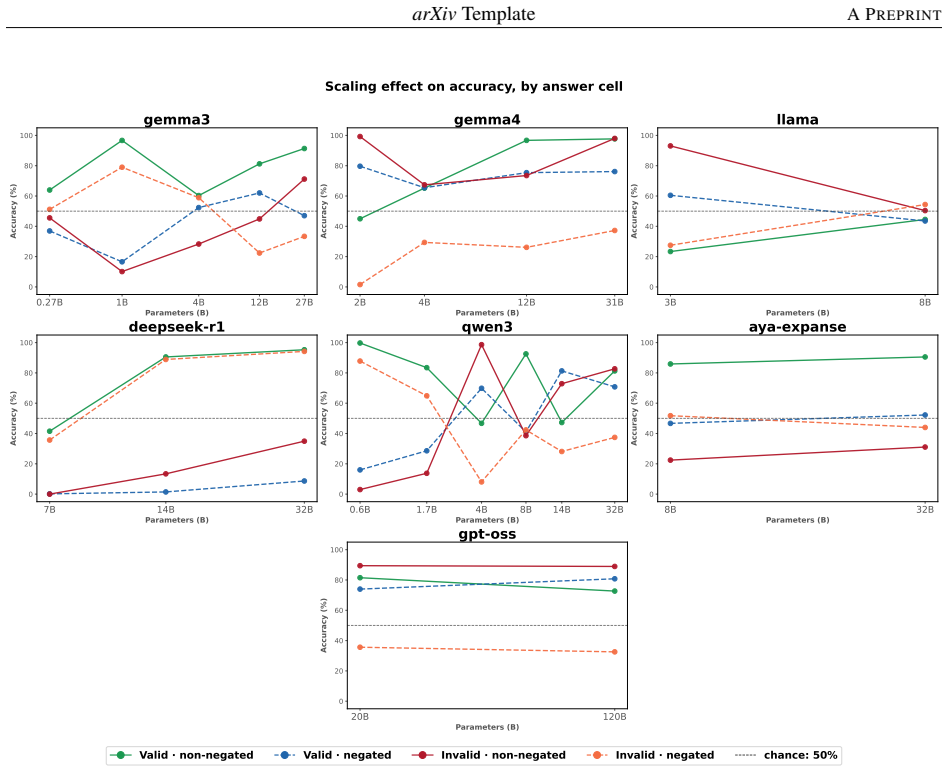
In the paper's own terms, the central discovery is that performance on this benchmark is dominated by answer bias: accuracy on questions with a correct answer of Yes and accuracy on questions with a correct answer of No diverge sharply for most models, and the worse of the two (the competence floor) falls at or below chance for 20 of 29 models. The benchmark is built as a 2x2 grid crossing inference validity with question negation, so each cell has a known gold answer; a constant-Yes responder scores near zero on the floor despite 55% overall accuracy. The paper also reports that the finding is negation-independent (the affirmative-only floor correlates r=0.90 with the full floor) and that s
What carries the argument
The central object is the competence floor, Floor = min(Acc(Yes), Acc(No)), where Acc(Yes) averages accuracy on the two cells whose correct answer is Yes and Acc(No) on the two cells whose correct answer is No. It has an absolute random baseline of 0.5: a constant responder scores 0, a coin flipper 0.5, a competent reasoner near 1. The benchmark's design makes the floor meaningful: every inference template is crossed with affirmative and negated question forms, so the same logical content produces prompts with each gold answer; this 'validity-by-negation' structure turns answer bias from a nuisance into a measurable quantity. A secondary mechanism is the systematic variation of question form
Load-bearing premise
The load-bearing premise is that every template's gold answer is unambiguously correct; under the paper's own threshold semantics, at least two 'valid' templates (Chancy Modus Tollens and Conditional-to-Comparative) admit counterexamples, so the 9-of-29 headline rests on those labels being right.
What would settle it
Regrade the models on a version of the benchmark whose gold labels are computed from the paper's own semantics (probably = p>=0.5, material 'if'), marking Chancy Modus Tollens and Conditional-to-Comparative invalid while keeping the three invalid templates invalid; then count how many of 29 models clear the 0.5 floor. If substantially more than 9 or 10 clear it, the claim that models rely on fixed answer bias rather than logic is not supported for those models. A single probability assignment — p(phi and psi)=0.05, p(phi and not psi)=0.5, p(not phi and psi)=0.05, p(not phi and not psi)=0.4 — s
If this is right
- Overall accuracy on binary logical-reasoning benchmarks can be inflated by answer bias; the competence floor should be reported alongside it, since the floor has an absolute chance baseline and is not inflated by a constant Yes/No preference.
- Current open-weight and frontier LLMs are not reliable for zero-shot inferences over graded epistemic modals: 20 of 29 models score at or below chance on the floor.
- Negation strategy is a confound in benchmark design: 'Does it not follow that...?' causes a broad collapse (21 of 29 models drop at least 10 points), and prefix versus word-'not' negation differ by up to 64 points on identical content.
- The answer bias is a model-level property carried across all templates, not an artifact of one inference type; restricting to uncontestable inferences still leaves only 10 of 29 models above the floor.
- Surface demographics (name nationality, gender, activity scenario) shift accuracy for many models, with the largest effects appearing as task refusal rather than answer flips.
Where Pith is reading between the lines
- If the competence floor became a standard summary for binary-question reasoning benchmarks, many published accuracy numbers would need reinterpretation: a model scoring 55% overall with a 0.10 floor is better described as biased than competent.
- The 'Does it not follow' collapse suggests a syntactic processing failure specific to negation inside entailment verbs; a testable extension is to probe logically equivalent negations across other languages or with different presupposition-carrying verbs.
- The paper's own probability semantics (probably = probability at least 0.5, with material 'if') implies that at least two of its 'valid' templates admit counterexamples; if gold labels were regraded under that semantics, a model that rejects Chancy Modus Tollens might be reasoning rather than biased.
- Answer priors of the kind measured here are in principle removable by calibration; a natural next experiment is to divide out each model's Yes/No prior and ask whether the residual accuracy tracks the logic.
Editorial analysis
A structured set of objections, weighed in public.
Referee Report
Summary. The paper introduces a benchmark for zero-shot inference over English probability operators (probably, might, must), containing 14,320 procedurally generated prompts across fifteen templates (thirteen distinct inference patterns, labeled ten valid and three invalid). It evaluates 29 models and summarizes performance with a 'competence floor' (the minimum of accuracy on Yes-correct and No-correct items), which has an absolute random baseline of 0.5. The central claim is that only 9 of 29 models exceed this floor, indicating that most models answer from a fixed yes/no bias rather than from the logical inference. Secondary findings concern sensitivity to question form, negation strategy, activity, and name nationality/gender.
Significance. The benchmark is well-motivated and large, with systematic controls for question form, negation, and demographic surface features. The competence floor is a simple, parameter-free diagnostic with an absolute baseline, and the yes/no decomposition of accuracy is a useful contribution to LLM evaluation. The robustness checks (conjunction variants, per-template analysis, scale trends) are extensive. If the label and uncertainty issues are fixed, this would be a solid contribution to the literature on LLM reasoning bias. The qualitative conclusion—that answer bias rather than logical inference explains most performance—appears likely to survive, but the exact '9/29' claim and the 'unambiguous correct response' framing are not supported by the current analysis.
major comments (3)
- [§3.1.1 / Table 1] Chancy Modus Tollens (schema P r(ϕ→ψ), P r(¬ψ) ⇒ P r(¬ϕ)) and Conditional-to-Comparative (P r(ϕ→ψ) ⇒ ψ⪰ϕ) are marked Valid, but under the semantics fixed in §3.1 (P r(A) iff p(A)≥0.5, material 'if') they are invalid. For CMT, take p(ϕ∧ψ)=0.05, p(ϕ∧¬ψ)=0.5, p(¬ϕ∧ψ)=0.05, p(¬ϕ∧¬ψ)=0.4; then p(ϕ→ψ)=0.5 and p(¬ψ)=0.9 hold while p(¬ϕ)=0.45, so P r(¬ϕ) is false. For CtC, take p(ϕ∧ψ)=0.2, p(ϕ∧¬ψ)=0.4, p(¬ϕ∧ψ)=0.1, p(¬ϕ∧¬ψ)=0.3; then p(ϕ→ψ)=0.6 but p(ψ)=0.3 < p(ϕ)=0.6. The failure is not an artifact of ≥ vs >; strict > gives the same result. Since these items are scored against Yes, a model obeying the paper's own semantics is penalized. The labels must be corrected or the semantics must license these inferences; the claim of 'unambiguous correct responses' (§7) cannot survive as written.
- [Abstract / §4.1 / §6 / §7] The headline 'only 9/29 models exceed random baseline' is not stable under the paper's own robustness analysis. §6 reports that the conservative core (three invalid templates plus four basic valid ones) yields 10 of 29 models above 0.5, while removing only the two most contestable templates leaves 9/29. The 9 vs 10 count is small, but the claim is stated as exact. Once the template labels are corrected per comment 1, the count should be recomputed and reported with the exact template set; the qualitative conclusion that most models are below the floor appears robust, but the specific number in the abstract is not.
- [§3.4 / §4.1 / Table 3] No uncertainty quantification is provided for the binary 'exceeds chance' classification. Many floors sit just above 0.5 (gemma3:12b 0.518, gpt-oss:120b 0.526), and the number of responses per validity×negation cell is not stated (the paper says '80 surface prompts per template' without saying how this maps to cells). The floor is the minimum of two correlated proportions, so its sampling distribution is not a simple binomial. Report cell-level n, standard errors or bootstrap CIs, and a test (or conservative correction) before deciding which models exceed 0.5. This is needed to make the 9/29 claim quantitative.
minor comments (3)
- [§3.1.1] The prose schema for Chancy Modus Tollens uses '¬probably ψ' while Table 1 uses 'P r(¬ψ)'; these are different at p=0.5 and should be disambiguated.
- [§2.3] 'This aligns with our results The' is missing a period or conjunction before 'The'.
- [§3.2] The phrase 'pining for agreement' is unclear; consider 'angling for agreement' or 'signaling expected agreement'.
Circularity Check
No significant circularity: the benchmark's gold labels come from external semantics work, and the competence floor is a defined statistic computed from measured model outputs, not a fitted parameter.
full rationale
The paper's central claim—that most LLMs exhibit a fixed answer bias rather than reliable logical inference—is an empirical measurement, not a derivation from its own definitions. The gold labels for the inference templates are imported from external semantics literature (Yalcin 2010; Kratzer 2012; Lassiter 2017), not from the models' responses, and no parameter is fitted to the evaluation data and then renamed as a prediction. The competence floor (Eq. 4, min of Acc(Yes) and Acc(No)) is an explicitly defined summary statistic with an absolute 0.5 baseline; the '9 of 29 models exceed random chance' result is computed directly from the per-cell accuracies in Table 3, so it is a reported measurement rather than a built-in consequence of a fitted constant. The robustness checks in §4.1 and §6 (affirmative-only floor, conservative template core, removal of contestable axioms) provide independent confirmation rather than circular support. The paper's own acknowledgement that Conditional-to-Comparative and Probably-to-not-probably-not depend on contestable axioms is a validity/robustness caveat, not a circularity: the conservative core still yields the same qualitative conclusion (10/29 above 0.5). The only self-citations (e.g., Shi, Grissom II, and Trinh 2022 in §2.2) are illustrative related work and are not load-bearing for the benchmark's validity or the headline result. No step in the derivation chain reduces by construction to its own inputs.
Axiom & Free-Parameter Ledger
free parameters (1)
- Probability threshold for 'probably' =
≥ 0.5
axioms (5)
- domain assumption 'Probably φ' means p(φ) ≥ 0.5; 'might φ' means p(φ) > 0; 'certain φ' means p(φ) = 1.
- domain assumption Material implication reading of 'if φ then ψ' in Chancy Modus Ponens/Tollens and Conditional-to-Comparative.
- domain assumption The 10 valid/3 invalid inference patterns from Yalcin (2010) are accepted as gold standard.
- domain assumption The first token parsed as Yes/No reflects the model's inference; longer generations would not change conclusions.
- domain assumption Temperature τ=0 and one run per prompt yield stable accuracy.
Cite this review
Pith. "Pith review of Benchmarking LLM Competence on Logical Inference over Probability Operators." pith.science (2026). https://pith.science/paper/WQUAFJNJ
@misc{pith2026260727405,
  author       = {Pith},
  title        = {Pith review of: Benchmarking LLM Competence on Logical Inference over Probability Operators},
  year         = {2026},
  howpublished = {\url{https://pith.science/paper/WQUAFJNJ}},
  note         = {Machine review of arXiv:2607.27405}
}
read the original abstract
Both expressions of uncertainty and inferences are ubiquitous in natural language, and valid inferences over natural-language expressions of uncertainty are necessary for not only everyday conversations but also for high-stakes domains such as medicine and law. While large language models are increasingly evaluated on logical reasoning tasks, disentangling principled, symbolic reasoning from clever surface-level pattern matching is fraught with difficulty. We introduce a benchmark for reasoning over probability operators--inference over sentences with gradable epistemic modals (e.g., probably, might, must) containing 14,320 procedurally-generated English prompts across fifteen inference templates, systematically varying question form, negation strategy, and surface content. Evaluating 29 models, we find that most show answer biases independent of the logical form, a systematic preference for Yes or No. We summarize this with a competence floor: the worse of a model's accuracy on Yes-correct and No-correct items. Only 9 of 29 models exceed random chance. We also test variations in question form, verb phrases/activity, and both the gender and origin of names used in the prompts, finding biases across every axis.
Figures



This paper was first reviewed by deepseek-v4-flash on August 3, 2026.
discussion (0)
Sign in with ORCID, Apple, or X to comment. Anyone can read and Pith papers without signing in.