Higher-order effects in amplitude-assisted polarisation extraction with machine-learning techniques
Pith reviewed 2026-07-02 09:51 UTC · model grok-4.3
The pith
Machine learning extracts longitudinal boson production rates from NLO QCD simulations of di-boson events.
A machine-rendered reading of the paper's core claim, the machinery that carries it, and where it could break.
Core claim
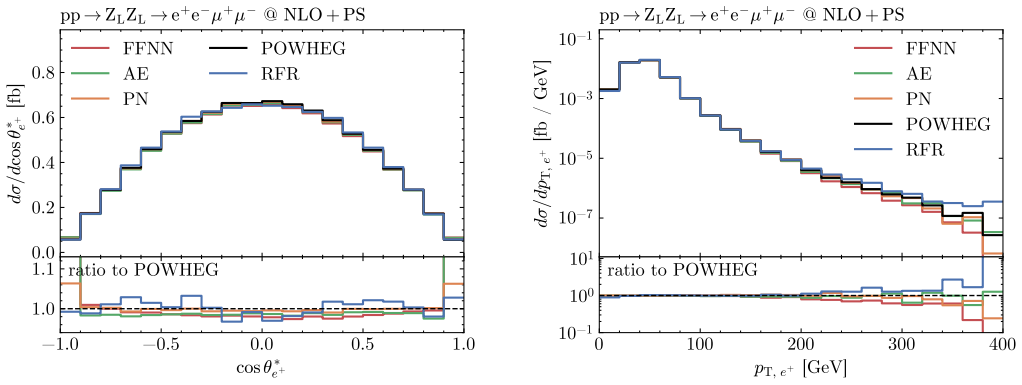
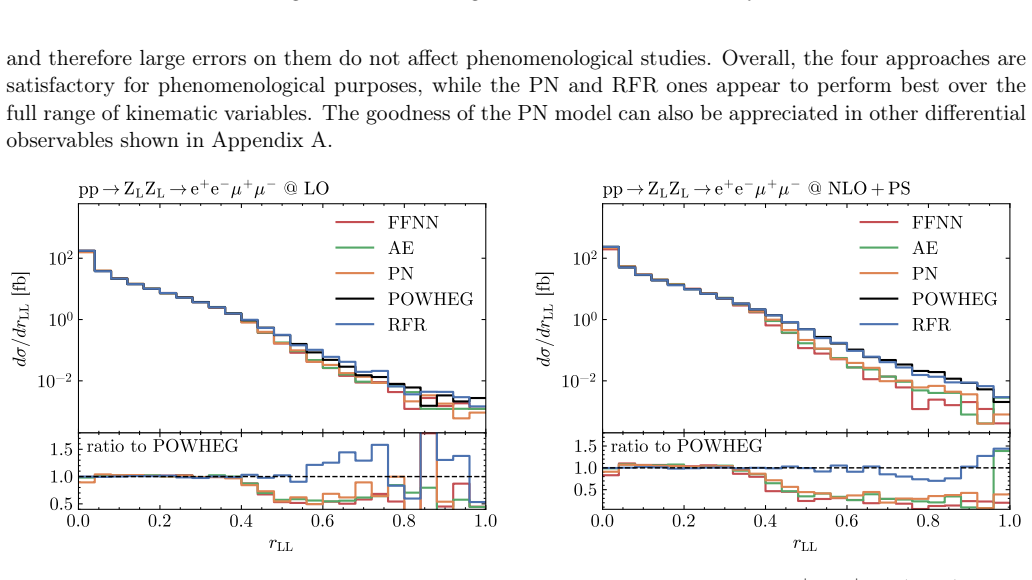
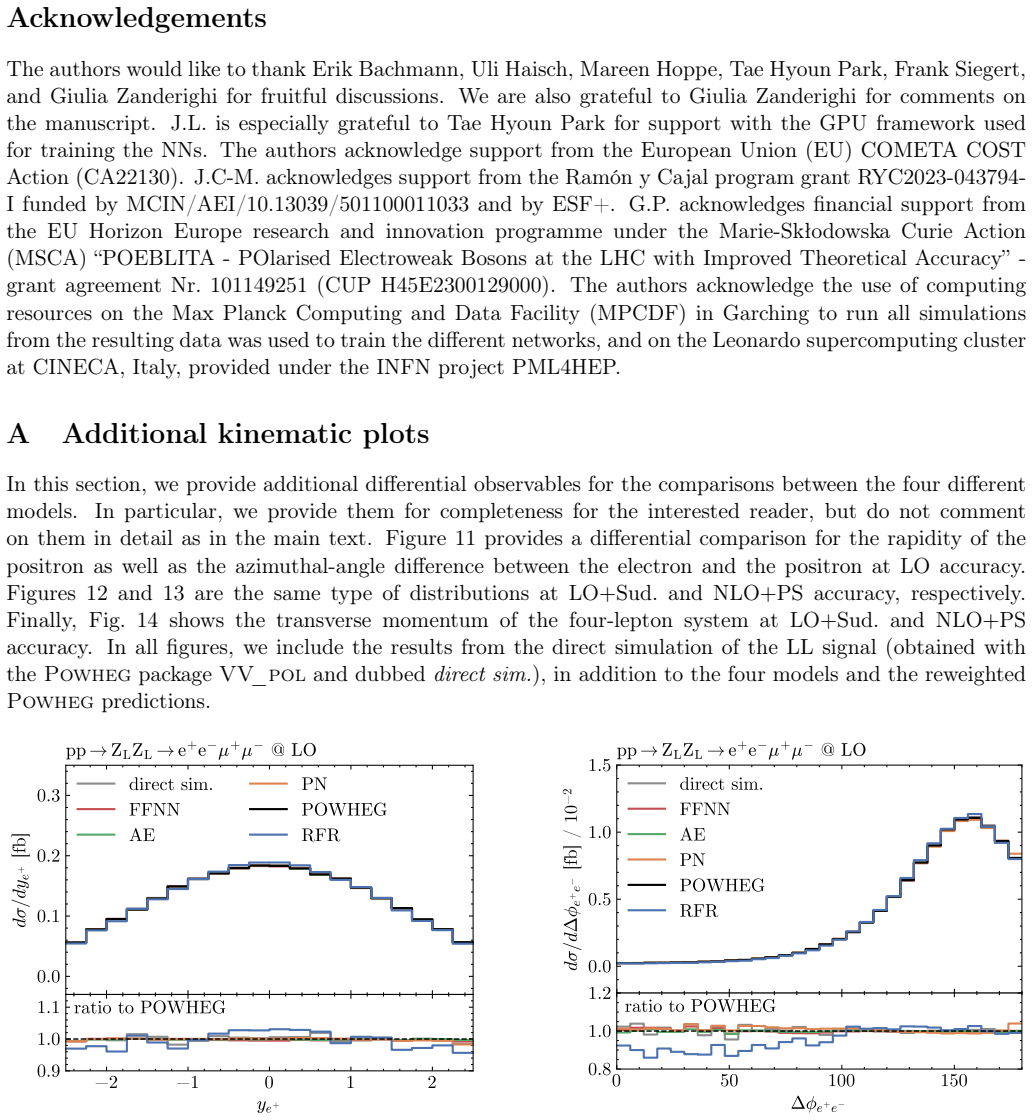
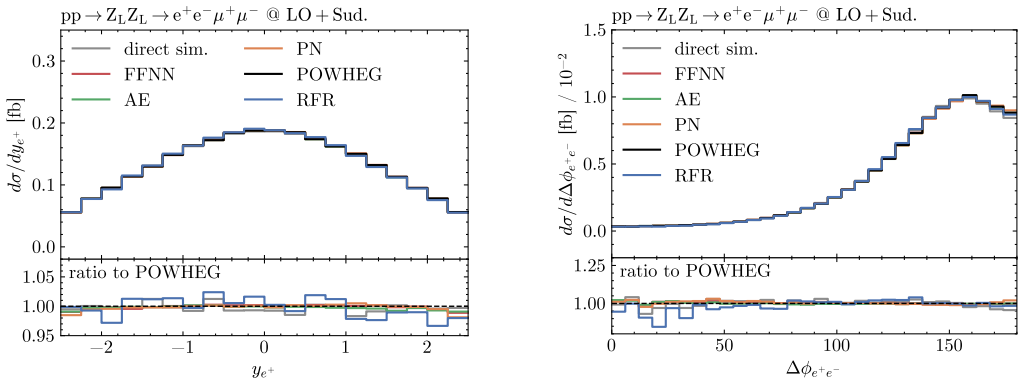
We present the first amplitude-assisted regression procedure at next-to-leading-order accuracy in QCD, supplemented with parton-shower effects, using machine-learning techniques to extract the rate of longitudinal-boson production in high-energy collisions. Several neural-network architectures are presented and benchmarked against a standard random-forest regressor, demonstrating the robustness of the results for di-boson production at the LHC.
What carries the argument
Amplitude-assisted regression procedure that feeds precise theoretical amplitudes into machine-learning models to regress polarization fractions from event-level kinematics.
If this is right
- The regression works at NLO QCD plus parton showers for di-boson final states.
- Neural-network models yield results comparable in robustness to random-forest models.
- The method supplies a concrete extraction procedure for longitudinal boson rates.
- Inclusion of higher-order corrections improves the accuracy of the polarization extraction.
Where Pith is reading between the lines
- The same training strategy could be adapted to other final states containing polarized vector bosons.
- Validation against real data would test whether NLO training reduces theory uncertainties in polarization measurements.
- If the method proves stable, it might be combined with existing experimental analyses to tighten limits on electroweak parameters.
Load-bearing premise
The simulated events used for training accurately represent the polarization fractions that will be observed in real LHC data.
What would settle it
Apply the trained regressor to actual LHC collision data and compare the extracted longitudinal rates against independent experimental measurements of the same polarization fractions.
Figures
read the original abstract
With increasing experimental precision, the prospect of extracting the polarisation of electroweak gauge bosons is becoming particularly attractive. To this end, regression and classification procedures based on precise and accurate theoretical predictions are becoming increasingly important. In this work, we present the first amplitude-assisted regression procedure at next-to-leading-order accuracy in QCD, supplemented with parton-shower effects, using machine-learning techniques to extract the rate of longitudinal-boson production in high-energy collisions. Several neural-network architectures are presented and benchmarked against a standard random-forest regressor, demonstrating the robustness of the results for di-boson production at the LHC.
Editorial analysis
A structured set of objections, weighed in public.
Referee Report
Summary. The manuscript presents the first amplitude-assisted regression procedure at next-to-leading-order accuracy in QCD, supplemented with parton-shower effects, using machine-learning techniques to extract the rate of longitudinal-boson production in di-boson processes at the LHC. Several neural-network architectures are benchmarked against a random-forest regressor, with claims of robust performance in closure tests.
Significance. If the central results hold, the work would advance polarization extraction methods by incorporating higher-order QCD effects and parton showers into an ML framework, a timely development for LHC precision measurements. Credit is due for the systematic benchmarking across multiple architectures and the explicit inclusion of NLO + shower effects, which strengthens the methodology over leading-order approaches.
major comments (1)
- [Results section] Results section (around the performance tables): the reported stability of the regression across architectures lacks quantitative metrics such as mean absolute error, correlation coefficients, or pull distributions with uncertainties; without these, the claim that the procedure extracts rates at NLO accuracy cannot be fully assessed for precision.
minor comments (2)
- [Abstract] The abstract would benefit from including at least one key numerical result (e.g., extracted fraction or closure-test accuracy) to substantiate the robustness claim.
- [§2] Notation for the amplitude-assisted features should be defined more explicitly in §2 to clarify how NLO matrix elements enter the input variables.
Simulated Author's Rebuttal
We thank the referee for the positive assessment of our work and the recommendation for minor revision. We address the single major comment below.
read point-by-point responses
-
Referee: [Results section] Results section (around the performance tables): the reported stability of the regression across architectures lacks quantitative metrics such as mean absolute error, correlation coefficients, or pull distributions with uncertainties; without these, the claim that the procedure extracts rates at NLO accuracy cannot be fully assessed for precision.
Authors: We agree that the inclusion of additional quantitative metrics would strengthen the presentation. The current manuscript reports performance tables for multiple architectures in closure tests and benchmarks against random forests, but does not explicitly provide mean absolute errors, correlation coefficients, or pull distributions with uncertainties. In the revised manuscript we will augment the results section with these metrics (including uncertainties) to allow a fuller assessment of the NLO precision. revision: yes
Circularity Check
No significant circularity; method is a standard ML regression on simulated data
full rationale
The paper introduces an amplitude-assisted ML regression at NLO QCD + parton shower for extracting longitudinal boson polarization fractions from di-boson production. The procedure trains regressors (NNs and random forests) on simulated events whose polarization labels are known by construction from the generator; the output is a trained model whose performance is validated on held-out simulated samples. No derivation, uniqueness theorem, or ansatz is invoked that reduces the reported extraction to a fitted parameter or self-citation by construction. The simulation-to-data transfer assumption is stated as a standard caveat in the abstract and is not presented as a derived result. The central claim therefore remains an empirical demonstration of a computational technique rather than a closed logical loop.
Axiom & Free-Parameter Ledger
Reference graph
Works this paper leans on
-
[1]
A. Ballestrero, E. Maina, and G. Pelliccioli,Wboson polarization in vector boson scattering at the LHC. JHEP03(2018) 170,arXiv:1710.09339 [hep-ph]
-
[2]
D. Buarque Franzosi, O. Mattelaer, R. Ruiz, and S. Shil,Automated predictions from polarized matrix elements. JHEP04(2020) 082,arXiv:1912.01725 [hep-ph]
-
[3]
A. Ballestrero, E. Maina, and G. Pelliccioli,Polarized vector boson scattering in the fully leptonic WZ and ZZ channels at the LHC. JHEP09(2019) 087,arXiv:1907.04722 [hep-ph]
-
[4]
A. Ballestrero, E. Maina, and G. Pelliccioli,Different polarization definitions in same-signW W scattering at the LHC. Phys. Lett. B811(2020) 135856,arXiv:2007.07133 [hep-ph]
-
[5]
A. Denner and G. Pelliccioli,Polarized electroweak bosons inW+W − production at the LHC including NLO QCD effects. JHEP09(2020) 164,arXiv:2006.14867 [hep-ph]
-
[6]
A. Denner and G. Pelliccioli,NLO QCD predictions for doubly-polarizedW Zproduction at the LHC. Phys. Lett. B814(2021) 136107,arXiv:2010.07149 [hep-ph]
-
[7]
R. Poncelet and A. Popescu,NNLO QCD study of polarisedW+W − production at the LHC. JHEP 07(2021) 023,arXiv:2102.13583 [hep-ph]
-
[8]
A. Denner and G. Pelliccioli,NLO EW and QCD corrections to polarized ZZ production in the four-charged-lepton channel at the LHC. JHEP10(2021) 097,arXiv:2107.06579 [hep-ph]
- [9]
- [10]
- [11]
-
[12]
G. Pelliccioli and G. Zanderighi,Polarised-boson pairs at the LHC with NLOPS accuracy. Eur. Phys. J. C84(2024) no. 1, 16,arXiv:2311.05220 [hep-ph]
- [13]
- [14]
- [15]
- [16]
- [17]
-
[18]
C. Carrivaleet al.,Precise standard-model predictions for polarised Z-boson pair production and decay at the LHC. Eur. Phys. J. C85(2025) no. 11, 1342,arXiv:2505.09686 [hep-ph]
- [19]
-
[20]
M. Del Gratta, F. Fabbri, M. Grossi, F. Maltoni, D. Pagani, G. Pelliccioli, and A. Vicini,Z-boson quantum tomography at next-to-leading order. JHEP02(2026) 056,arXiv:2509.20456 [hep-ph]
-
[21]
G. Pelliccioli and R. Poncelet,Precise predictions for joint polarization fractions in WZ production at the LHC. Phys. Rev. D113(2026) no. 5, 053008,arXiv:2510.25898 [hep-ph]
- [22]
-
[23]
The Four Polarizations of the $W$ at High Energies
T. Basu and R. Ruiz,The Four Polarizations of theWat High Energies.arXiv:2512.10015 [hep-ph]
work page internal anchor Pith review Pith/arXiv arXiv
- [24]
- [25]
- [26]
- [27]
-
[28]
M. Javurkova, R. Ruiz, R. C. L. de Sá, and J. Sandesara,Polarized ZZ pairs in gluon fusion and vector boson fusion at the LHC. Phys. Lett. B855(2024) 138787,arXiv:2401.17365 [hep-ph]
- [29]
-
[30]
J. Searcy, L. Huang, M.-A. Pleier, and J. Zhu,Determination of theW Wpolarization fractions in pp→W ±W ±jjusing a deep machine learning technique. Phys. Rev. D93(2016) no. 9, 094033, arXiv:1510.01691 [hep-ph]. 28
work page internal anchor Pith review Pith/arXiv arXiv 2016
-
[31]
J. Lee, N. Chanon, A. Levin, J. Li, M. Lu, Q. Li, and Y. Mao,Polarization fraction measurement in same-sign WW scattering using deep learning. Phys. Rev. D99(2019) no. 3, 033004, arXiv:1812.07591 [hep-ph]
work page internal anchor Pith review Pith/arXiv arXiv 2019
- [32]
- [33]
- [34]
- [35]
- [36]
- [37]
- [38]
-
[39]
D. Lombardi, M. Wiesemann, and G. Zanderighi,W+W− production at NNLO+PS with MINNLOP S. JHEP11(2021) 230,arXiv:2103.12077 [hep-ph]
- [40]
- [41]
-
[42]
Kondo,Dynamical Likelihood Method for Reconstruction of Events With Missing Momentum
K. Kondo,Dynamical Likelihood Method for Reconstruction of Events With Missing Momentum. 1: Method and Toy Models. J. Phys. Soc. Jap.57(1988) 4126–4140
1988
-
[43]
Kondo,Dynamical likelihood method for reconstruction of events with missing momentum
K. Kondo,Dynamical likelihood method for reconstruction of events with missing momentum. 2: Mass spectra for 2→2 processes. J. Phys. Soc. Jap.60(1991) 836–844
1991
-
[44]
R. H. Dalitz and G. R. Goldstein,The Decay and polarization properties of the top quark. Phys. Rev. D45(1992) 1531–1543
1992
-
[45]
R. H. Dalitz and G. R. Goldstein,Analysis of top-antitop production and dilepton decay events and the top quark mass. Phys. Lett. B287(1992) 225–230. 29
1992
-
[46]
Kondo, T
K. Kondo, T. Chikamatsu, and S. H. Kim,Dynamical likelihood method for reconstruction of events with missing momentum. 3: Analysis of a CDF high p(T) e mu event as t anti-t production. J. Phys. Soc. Jap.62(1993) 1177–1182
1993
-
[47]
Y. Gao, A. V. Gritsan, Z. Guo, K. Melnikov, M. Schulze, and N. V. Tran,Spin Determination of Single-Produced Resonances at Hadron Colliders. Phys. Rev. D81(2010) 075022,arXiv:1001.3396 [hep-ph]
work page internal anchor Pith review Pith/arXiv arXiv 2010
-
[48]
On the spin and parity of a single-produced resonance at the LHC
S. Bolognesi, Y. Gao, A. V. Gritsan, K. Melnikov, M. Schulze, N. V. Tran, and A. Whitbeck,On the spin and parity of a single-produced resonance at the LHC. Phys. Rev. D86(2012) 095031, arXiv:1208.4018 [hep-ph]
work page internal anchor Pith review Pith/arXiv arXiv 2012
-
[49]
Constraining anomalous HVV interactions at proton and lepton colliders
I. Andersonet al.,Constraining Anomalous HVV Interactions at Proton and Lepton Colliders. Phys. Rev. D89(2014) no. 3, 035007,arXiv:1309.4819 [hep-ph]
work page internal anchor Pith review Pith/arXiv arXiv 2014
- [50]
- [51]
-
[52]
The Matrix Element Method and QCD Radiation
J. Alwall, A. Freitas, and O. Mattelaer,The Matrix Element Method and QCD Radiation. Phys. Rev. D83(2011) 074010,arXiv:1010.2263 [hep-ph]
work page internal anchor Pith review Pith/arXiv arXiv 2011
-
[53]
J. M. Campbell, W. T. Giele, and C. Williams,The Matrix Element Method at Next-to-Leading Order. JHEP11(2012) 043,arXiv:1204.4424 [hep-ph]
work page internal anchor Pith review Pith/arXiv arXiv 2012
-
[54]
Extending the Matrix Element Method to Next-to-Leading Order
J. M. Campbell, W. T. Giele, and C. Williams, “Extending the Matrix Element Method to Next-to-Leading Order,” in47th Rencontres de Moriond on QCD and High Energy Interactions, pp. 319–322. 5, 2012.arXiv:1205.3434 [hep-ph]
work page internal anchor Pith review Pith/arXiv arXiv 2012
-
[55]
J. M. Campbell, R. K. Ellis, W. T. Giele, and C. Williams,Finding the Higgs Boson in Decays toZγ using the Matrix Element Method at Next-to-Leading Order. Phys. Rev. D87(2013) no. 7, 073005, arXiv:1301.7086 [hep-ph]
work page internal anchor Pith review Pith/arXiv arXiv 2013
-
[56]
T. Martini and P. Uwer,Extending the Matrix Element Method beyond the Born approximation: Calculating event weights at next-to-leading order accuracy. JHEP09(2015) 083,arXiv:1506.08798 [hep-ph]
work page internal anchor Pith review Pith/arXiv arXiv 2015
-
[57]
The matrix element method at next-to-leading order for arbitrary jet algorithms
R. Baumeister and S. Weinzierl,Matrix element method at next-to-leading order for arbitrary jet algorithms. Phys. Rev. D95(2017) no. 3, 036019,arXiv:1612.07252 [hep-ph]
work page internal anchor Pith review Pith/arXiv arXiv 2017
- [58]
- [59]
-
[60]
T. Martini, T. Nuraliyev, and P. Uwer,Determination of the top-quark mass from top-quark pair events with the matrix element method at next-to-leading order: Potential and prospects. Phys. Rev. D 107(2023) no. 7, 076013,arXiv:2301.03280 [hep-ph]. 30
-
[61]
Tartarin,Contribution to the study of the Higgs boson self-coupling in theb¯bγγchannel using the matrix element method at NLO with the ATLAS experiment at LHC, CERN
M. Tartarin,Contribution to the study of the Higgs boson self-coupling in theb¯bγγchannel using the matrix element method at NLO with the ATLAS experiment at LHC, CERN. PhD thesis, 2025
2025
-
[62]
M. Tartarin and J. Stark,Development of the Matrix Element Method at Next-to-Leading Order for the Measurement of the Higgs Self-Couplingλ3H. PoSEPS-HEP2025(2026) 363, arXiv:2602.02303 [hep-ph]
work page internal anchor Pith review Pith/arXiv arXiv 2026
-
[63]
Matrix element method at NLO: A fine proof of concept in POWHEG
U. Haisch, J. Linder, L. Schnell, M. Wiesemann, and G. Zanderighi,Matrix element method at NLO: A fine proof of concept in POWHEG, 2026.arXiv:2606.11083 [hep-ph], https://arxiv.org/abs/2606.11083
work page internal anchor Pith review Pith/arXiv arXiv 2026
-
[64]
A New Method for Combining NLO QCD with Shower Monte Carlo Algorithms
P. Nason,A New method for combining NLO QCD with shower Monte Carlo algorithms. JHEP11 (2004) 040,arXiv:hep-ph/0409146
work page internal anchor Pith review Pith/arXiv arXiv 2004
-
[65]
Matching NLO QCD computations with Parton Shower simulations: the POWHEG method
S. Frixione, P. Nason, and C. Oleari,Matching NLO QCD computations with Parton Shower simulations: the POWHEG method. JHEP11(2007) 070,arXiv:0709.2092 [hep-ph]
work page internal anchor Pith review Pith/arXiv arXiv 2007
-
[66]
A general framework for implementing NLO calculations in shower Monte Carlo programs: the POWHEG BOX
S. Alioli, P. Nason, C. Oleari, and E. Re,A general framework for implementing NLO calculations in shower Monte Carlo programs: the POWHEG BOX. JHEP06(2010) 043,arXiv:1002.2581 [hep-ph]
work page internal anchor Pith review Pith/arXiv arXiv 2010
-
[67]
T. Sjöstrand, S. Ask, J. R. Christiansen, R. Corke, N. Desai, P. Ilten, S. Mrenna, S. Prestel, C. O. Rasmussen, and P. Z. Skands,An introduction to PYTHIA 8.2. Comput. Phys. Commun.191(2015) 159–177,arXiv:1410.3012 [hep-ph]
work page internal anchor Pith review Pith/arXiv arXiv 2015
-
[68]
On the Treatment of Resonances in Next-to-Leading Order Calculations Matched to a Parton Shower
T. Ježo and P. Nason,On the Treatment of Resonances in Next-to-Leading Order Calculations Matched to a Parton Shower. JHEP12(2015) 065,arXiv:1509.09071 [hep-ph]
work page internal anchor Pith review Pith/arXiv arXiv 2015
-
[69]
Recola2: REcursive Computation of One-Loop Amplitudes 2
A. Denner, J.-N. Lang, and S. Uccirati,Recola2: REcursive Computation of One-Loop Amplitudes 2. Comput. Phys. Commun.224(2018) 346–361,arXiv:1711.07388 [hep-ph]
work page internal anchor Pith review Pith/arXiv arXiv 2018
-
[70]
R. G. Stuart,General renormalization of the gauge invariant perturbation expansion near theZ0 resonance. Phys. Lett. B272(1991) 353–358
1991
-
[71]
R. G. Stuart,Gauge invariance, analyticity and physical observables at theZ0 resonance. Phys. Lett. B262(1991) 113–119
1991
-
[72]
$\order(\Gamma)$ Corrections to $W$ pair production in $e^+e^-$ and $\gamma\gamma$ collisions
A. Aeppli, F. Cuypers, and G. J. van Oldenborgh,O(Γ)corrections toWpair production ine+e− andγγcollisions. Phys. Lett. B314(1993) 413–420,arXiv:hep-ph/9303236 [hep-ph]
work page internal anchor Pith review Pith/arXiv arXiv 1993
-
[73]
Unstable particles in One Loop Calculations
A. Aeppli, G. J. van Oldenborgh, and D. Wyler,Unstable particles in one loop calculations. Nucl. Phys. B428(1994) 126–146,arXiv:hep-ph/9312212 [hep-ph]
work page internal anchor Pith review Pith/arXiv arXiv 1994
-
[74]
A. Denner, S. Dittmaier, M. Roth, and L. Wieders,Electroweak corrections to charged-current e+e− →4fermion processes: Technical details and further results. Nucl. Phys. B724(2005) 247–294, arXiv:hep-ph/0505042. [Erratum: Nucl. Phys. B854(2012) 504]
work page internal anchor Pith review Pith/arXiv arXiv 2005
-
[75]
A. Denner and S. Dittmaier,Electroweak Radiative Corrections for Collider Physics. Phys. Rept.864 (2020) 1–163,arXiv:1912.06823 [hep-ph]. [83]Particle Data GroupCollaboration, S. Navaset al.,Review of particle physics. Phys. Rev. D110 (2024) no. 3, 030001. 31
-
[76]
Bardin, A
D. Bardin, A. Leike, T. Riemann, and M. Sachwitz,Energy-dependent width effects ine+e− annihilation near the Z-boson pole. Phys. Lett. B206(1988) 539–542
1988
-
[77]
LHAPDF6: parton density access in the LHC precision era
A. Buckley, J. Ferrando, S. Lloyd, K. Nordström, B. Page, M. Rüfenacht, M. Schönherr, and G. Watt,LHAPDF6: parton density access in the LHC precision era. Eur. Phys. J. C75(2015) 132, arXiv:1412.7420 [hep-ph]. [86]NNPDFCollaboration, R. D. Ballet al.,Parton distributions from high-precision collider data. Eur. Phys. J. C77(2017) no. 10, 663,arXiv:1706.004...
work page internal anchor Pith review Pith/arXiv arXiv 2015
-
[78]
M. Grazzini, S. Kallweit, J. M. Lindert, S. Pozzorini, and M. Wiesemann,NNLO QCD+NLO EW with Matrix+OpenLoops: precise predictions for vector-boson pair production. JHEP02(2020) 087, arXiv:1912.00068 [hep-ph]
- [79]
-
[80]
J. M. Cornwall, D. N. Levin, and G. Tiktopoulos,Derivation of Gauge Invariance from High-Energy Unitarity Bounds on theSMatrix. Phys. Rev. D10(1974) 1145. [Erratum: Phys. Rev. D 11 (1975) 972]
1974
discussion (0)
Sign in with ORCID, Apple, or X to comment. Anyone can read and Pith papers without signing in.