Free-Running Ring Quantum Cascade Laser with 50 kHz Linewidth
Pith reviewed 2026-05-21 17:39 UTC · model grok-4.3
The pith
A free-running ring quantum cascade laser at 7.7 micrometers shows a linewidth near 50 kilohertz.
A machine-rendered reading of the paper's core claim, the machinery that carries it, and where it could break.
Core claim
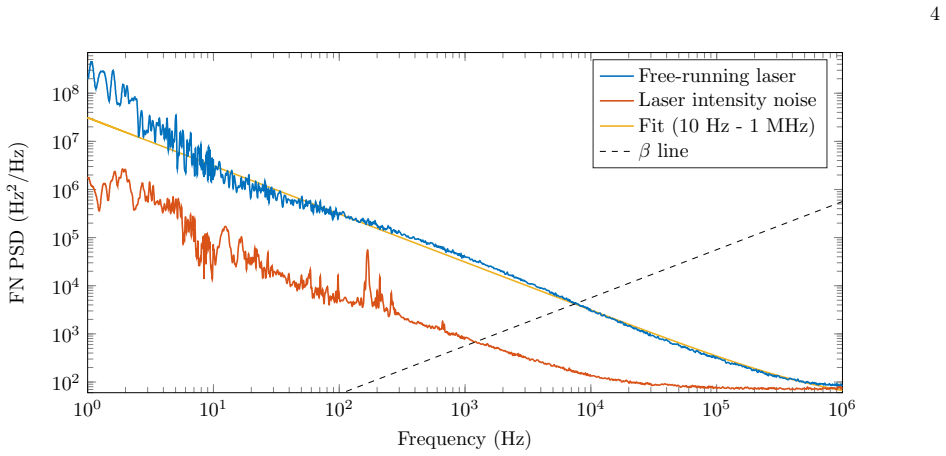
The authors characterize a free-running ring quantum cascade laser resonator emitting a single frequency near 7.7 μm. Using an N2O gas cell as a frequency-to-voltage discriminator they record the frequency noise power spectral density and obtain a linewidth of approximately 50 kHz full width at half maximum at 1 s integration time. This value is at least six times smaller than state-of-the-art quantum cascade lasers operating above 7 μm. They further show that the same laser performs well in frequency modulation spectroscopy.
What carries the argument
The ring quantum cascade laser resonator that supports single-frequency emission and reduced frequency noise when operated without external locking.
If this is right
- High-resolution mid-infrared metrology becomes feasible with compact, unstabilized sources.
- Frequency modulation spectroscopy can be performed directly with these lasers for molecular studies.
- Spectroscopic applications in the mid-infrared gain access to narrower intrinsic lines without added stabilization hardware.
- Free-running operation suffices for tasks previously thought to require active frequency control.
Where Pith is reading between the lines
- Ring designs might be explored in other mid-infrared laser types to achieve similar noise reduction.
- Compact sensors for trace-gas detection could become more portable if this linewidth performance holds across wavelengths.
- The same measurement approach could be applied to test linewidth limits in related semiconductor laser geometries.
Load-bearing premise
The N2O gas cell converts laser frequency fluctuations to voltage in a linear way and adds no measurable noise of its own.
What would settle it
An independent linewidth measurement performed by heterodyne beating against a reference laser or optical frequency comb to check whether the value stays near 50 kHz.
Figures



read the original abstract
We report on the noise characterization of a free-running ring quantum cascade laser resonator emitting a single frequency mode around 7.7 $\mu$m. Using a gas cell filled with N$_2$O as a frequency-to-voltage discriminator, we measured the frequency noise power spectral density of the laser from which we extracted its linewidth. The results show a full width at half maximum close to 50 kHz at 1 s integration time, which represents at least a sixfold improvement compared to state-of-the-art quantum cascade lasers operating in a spectral region above 7 $\mu$m. We also demonstrate that such lasers can be efficiently used for frequency modulation spectroscopy, which opens up new possibilities for high resolution metrology and spectroscopic applications in the mid-infrared.
Editorial analysis
A structured set of objections, weighed in public.
Referee Report
Summary. The manuscript reports the noise characterization of a free-running ring quantum cascade laser emitting a single-frequency mode near 7.7 μm. Using an N₂O-filled gas cell as a frequency-to-voltage discriminator, the authors measure the frequency noise power spectral density (FNPSD) and extract a linewidth with FWHM close to 50 kHz at 1 s integration time. This is presented as at least a sixfold improvement over state-of-the-art QCLs above 7 μm, with an additional demonstration of the laser's use in frequency modulation spectroscopy.
Significance. If the central linewidth result holds after validation of the measurement chain, the work would represent a meaningful advance for free-running mid-infrared sources, where narrow linewidths enable higher-resolution spectroscopy and metrology. The ring-resonator approach and direct application to FM spectroscopy are practical strengths that could influence design choices in the >7 μm range.
major comments (1)
- [Frequency noise characterization and linewidth extraction (results section)] The 50 kHz FWHM claim at 1 s integration time is obtained by integrating the measured FNPSD after the N₂O cell discriminator. This extraction is valid only if the cell provides a linear frequency-to-voltage response whose additive noise lies well below the laser contribution across the relevant Fourier frequencies. No control trace (laser detuned from line center, or independent low-noise source through the same cell) is described to establish that floor, so the reported PSD could contain an unknown discriminator contribution that would make the true laser linewidth larger than stated and weaken the sixfold improvement assertion.
minor comments (2)
- [Abstract] The abstract states the linewidth is 'close to 50 kHz' without error bars or a precise value; adding quantified uncertainty and the exact integration-time definition would strengthen the central claim.
- [Introduction or discussion] State-of-the-art comparison would benefit from explicit citation of the specific prior QCL linewidth values and operating wavelengths used for the 'sixfold improvement' statement.
Simulated Author's Rebuttal
We thank the referee for their careful reading and constructive comments on our manuscript. We address the single major comment below.
read point-by-point responses
-
Referee: The 50 kHz FWHM claim at 1 s integration time is obtained by integrating the measured FNPSD after the N₂O cell discriminator. This extraction is valid only if the cell provides a linear frequency-to-voltage response whose additive noise lies well below the laser contribution across the relevant Fourier frequencies. No control trace (laser detuned from line center, or independent low-noise source through the same cell) is described to establish that floor, so the reported PSD could contain an unknown discriminator contribution that would make the true laser linewidth larger than stated and weaken the sixfold improvement assertion.
Authors: We thank the referee for identifying this important validation step. The manuscript relies on the standard practice that the discriminator contribution is negligible when the laser is tuned to the steepest slope of the absorption feature, where the frequency-to-voltage conversion gain is maximized. Nevertheless, we agree that an explicit control measurement strengthens the result. We have therefore acquired additional data with the laser detuned from the N₂O line center (and with an independent low-noise source passed through the same cell), confirming that the additive noise floor lies well below the measured laser FNPSD over the Fourier frequencies relevant to the 1 s integration. The revised manuscript will include this control trace, a brief discussion of the linearity of the discriminator response, and an updated statement on the sixfold improvement that now explicitly references the validated noise floor. revision: yes
Circularity Check
No circularity: experimental measurement of linewidth from observed frequency noise PSD
full rationale
The paper reports a direct experimental extraction of laser linewidth by integrating the measured frequency-noise power spectral density obtained via an N2O gas cell discriminator. No mathematical derivation chain, self-definitional equations, fitted parameters renamed as predictions, or load-bearing self-citations are present that would reduce the claimed 50 kHz result to its inputs by construction. The result is an observation against external benchmarks rather than a closed theoretical loop.
Axiom & Free-Parameter Ledger
axioms (1)
- domain assumption N2O gas cell acts as a linear frequency-to-voltage discriminator with negligible added noise relative to the laser.
Lean theorems connected to this paper
-
IndisputableMonolith/Cost/FunctionalEquation.leanwashburn_uniqueness_aczel unclear?
unclearRelation between the paper passage and the cited Recognition theorem.
Using a gas cell filled with N2O as a frequency-to-voltage discriminator, we measured the frequency noise power spectral density of the laser from which we extracted its linewidth.
-
IndisputableMonolith/Foundation/DimensionForcing.leanalexander_duality_circle_linking unclear?
unclearRelation between the paper passage and the cited Recognition theorem.
The results show a full width at half maximum close to 50 kHz at 1 s integration time
What do these tags mean?
- matches
- The paper's claim is directly supported by a theorem in the formal canon.
- supports
- The theorem supports part of the paper's argument, but the paper may add assumptions or extra steps.
- extends
- The paper goes beyond the formal theorem; the theorem is a base layer rather than the whole result.
- uses
- The paper appears to rely on the theorem as machinery.
- contradicts
- The paper's claim conflicts with a theorem or certificate in the canon.
- unclear
- Pith found a possible connection, but the passage is too broad, indirect, or ambiguous to say the theorem truly supports the claim.
Reference graph
Works this paper leans on
-
[1]
(2025) 17 290 420 This work 7.7 22 50 TABLE I. Comparison of reported linewidth measurements in the literature for different free-running QCLs emitting a single frequency mode versus the results obtained in this work. IV. DISCUSSION AND CONCLUSION In this letter, we have characterized the noise properties of a ring QCL resonator operating in free-running ...
work page 2025
-
[2]
K. N. Komagata, M. Gianella, P. Jouy, F. Kapsalidis, M. Shahmohammadi, M. Beck, R. Matthey, V. J. Wittwer, A. Hugi, J. Faist, L. Emmenegger, T. Südmeyer, and S. Schilt, Absolute frequency referencing in the long wave infrared using a quantum cascade laser frequency comb, Optics Express30, 12891 (2022)
work page 2022
-
[3]
F. D’Amato, M. Barucci, G. Bianchini, and S. Viciani, Quantum cascade laser (QCL) in airborne atmospheric measure- ments: A review [Invited], Optics Express33, 22745 (2025)
work page 2025
- [4]
-
[5]
A. Schwaighofer, M. Brandstetter, and B. Lendl, Quantum cascade lasers (QCLs) in biomedical spectroscopy, Chemical Society Reviews46, 5903 (2017)
work page 2017
-
[6]
J. L. Klocke, M. Mangold, P. Allmendinger, A. Hugi, M. Geiser, P. Jouy, J. Faist, and T. Kottke, Single-Shot Sub- microsecond Mid-infrared Spectroscopy on Protein Reactions with Quantum Cascade Laser Frequency Combs, Analytical Chemistry90, 10494 (2018)
work page 2018
-
[7]
B. Argence, B. Chanteau, O. Lopez, D. Nicolodi, M. Abgrall, C. Chardonnet, C. Daussy, B. Darquié, Y. Le Coq, and A. Amy-Klein, Quantum cascade laser frequency stabilization at the sub-Hz level, Nature Photonics9, 456 (2015)
work page 2015
-
[8]
R. Santagata, D. B. A. Tran, B. Argence, O. Lopez, S. K. Tokunaga, F. Wiotte, H. Mouhamad, A. Goncharov, M. Abgrall, Y. Le Coq, H. Alvarez-Martinez, R. Le Targat, W. K. Lee, D. Xu, P.-E. Pottie, B. Darquié, and A. Amy-Klein, High- precision methanol spectroscopy with a widely tunable SI-traceable frequency-comb-based mid-infrared QCL, Optica6, 411 (2019)
work page 2019
- [9]
-
[10]
D. Botez and M. A. Belkin, eds.,Mid-Infrared and Terahertz Quantum Cascade Lasers, 1st ed. (Cambridge University Press, 2023)
work page 2023
-
[11]
M. Razeghi, Y. Bai, and F. Wang, High-power, high-wall-plug-efficiency quantum cascade lasers with high-brightness in continuous wave operation at 3–300µm, Light: Science & Applications14, 252 (2025)
work page 2025
-
[12]
S.Schilt, L.Tombez, C.Tardy, A.Bismuto, S.Blaser, R.Maulini, R.Terazzi, M.Rochat,andT.Südmeyer,Anexperimental study of noise in mid-infrared quantum cascade lasers of different designs, Applied Physics B119, 189 (2015)
work page 2015
-
[13]
A. Shehzad, P. Brochard, R. Matthey, T. Südmeyer, and S. Schilt, 10 kHz linewidth mid-infrared quantum cascade laser by stabilization to an optical delay line, Optics Letters44, 3470 (2019)
work page 2019
- [14]
- [15]
-
[16]
I. Heckelmann, M. Bertrand, A. Dikopoltsev, M. Beck, G. Scalari, and J. Faist, Quantum walk comb in a fast gain laser, Science382, 434 (2023)
work page 2023
-
[17]
M. Beck, D. Hofstetter, T. Aellen, J. Faist, U. Oesterle, M. Ilegems, E. Gini, and H. Melchior, Continuous wave operation of a mid-infrared semiconductor laser at room temperature, Science295, 301–305 (2002)
work page 2002
-
[18]
I. Gordon, L. Rothman, R. Hargreaves, R. Hashemi, E. Karlovets, F. Skinner, E. Conway, C. Hill, R. Kochanov, Y. Tan, P. Wcisło, A. Finenko, K. Nelson, P. Bernath, M. Birk, V. Boudon, A. Campargue, K. Chance, A. Coustenis, B. Drouin, J.- M. Flaud, R. Gamache, J. Hodges, D. Jacquemart, E. Mlawer, A. Nikitin, V. Perevalov, M. Rotger, J. Tennyson, G. Toon, H....
work page 2022
-
[19]
F. Cappelli, G. Villares, S. Riedi, and J. Faist, Intrinsic linewidth of quantum cascade laser frequency combs, Optica2, 836 (2015)
work page 2015
-
[20]
B. Meng, M. Singleton, J. Hillbrand, M. Franckié, M. Beck, and J. Faist, Dissipative kerr solitons in semiconductor ring lasers, Nature Photonics16, 142–147 (2021)
work page 2021
-
[21]
S. Bartalini, S. Borri, P. Cancio, A. Castrillo, I. Galli, G. Giusfredi, D. Mazzotti, L. Gianfrani, and P. De Natale, Observing the Intrinsic Linewidth of a Quantum-Cascade Laser: Beyond the Schawlow-Townes Limit, Physical Review Letters104, 083904 (2010)
work page 2010
-
[22]
S. Bartalini, S. Borri, I. Galli, G. Giusfredi, D. Mazzotti, T. Edamura, N. Akikusa, M. Yamanishi, and P. De Natale, Measuring frequency noise and intrinsic linewidth of a room-temperature DFB quantum cascade laser, Optics Express19, 17996 (2011)
work page 2011
-
[23]
G. Di Domenico, S. Schilt, and P. Thomann, Simple approach to the relation between laser frequency noise and laser line shape, Applied Optics49, 4801 (2010)
work page 2010
-
[24]
D. S. Elliott, R. Roy, and S. J. Smith, Extracavity laser band-shape and bandwidth modification, Physical Review A26, 12–18 (1982)
work page 1982
- [25]
-
[26]
M. Manceau, T. E. Wall, H. Philip, A. Baranov, O. Lopez, M. R. Tarbutt, R. Teissier, and B. Darquié, Demonstration and Frequency Noise Characterization of a 17µm Quantum Cascade Laser, Laser & Photonics Reviews , e00879 (2025)
work page 2025
- [27]
-
[28]
A. Cargioli, M. Montesinos Ballester, S. Gantner, E. Gini, M. Beck, and J. Faist, Quantum walk comb in a dual waveguide quantum cascade laser, Nature Communications16, 11021 (2025)
work page 2025
- [29]
-
[30]
A. Parriaux, I. Heckelmann, M. Bertrand, M. Beck, J. Faist, and T. Südmeyer, Free-running ring quantum cascade laser with 50 kHz linewidth, 10.23728/b2share.zre6h-m1474 (2025)
discussion (0)
Sign in with ORCID, Apple, or X to comment. Anyone can read and Pith papers without signing in.