Mapping Political-Elite Networks in Europe with a Multilingual Joint Entity-Relation Extraction Pipeline
Pith reviewed 2026-06-26 03:42 UTC · model grok-4.3
The pith
A fully open multilingual pipeline extracts directed signed relations from news text to build temporal political-elite knowledge graphs.
A machine-rendered reading of the paper's core claim, the machinery that carries it, and where it could break.
Core claim
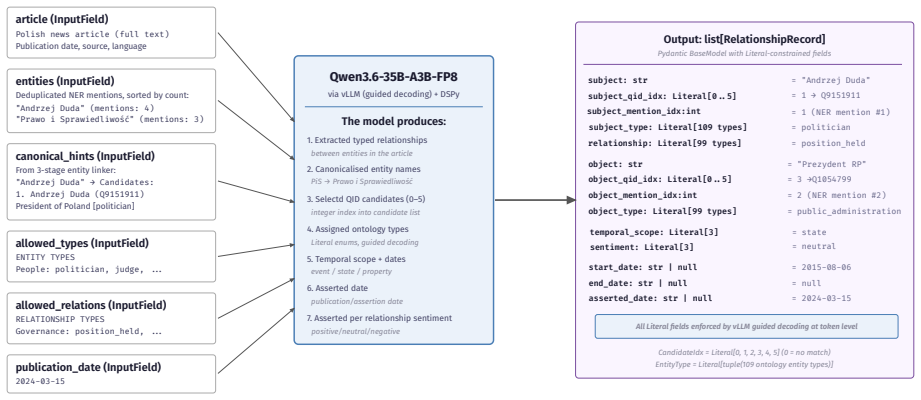
We present a modular, fully open-weight pipeline for multilingual joint entity-relation extraction that builds signed, temporal knowledge graphs from massive unstructured news corpora. It combines span-based NER with a three-stage linking cascade to language-independent Wikidata identifiers and a high-throughput ontology-constrained mixture-of-experts model with guided decoding. A full-coverage spot-check against a 3491-relation gold standard shows high textual correctness. Two large-scale case studies validate the pipeline against the public record: in Austria it reconstructs a party's complete lifecycle including fractures and convictions; in Poland it maps state-enterprise patronage and t
What carries the argument
Ontology-constrained mixture-of-experts model with guided decoding that extracts directed signed relationships grounded in a domain ontology after Wikidata entity linking.
If this is right
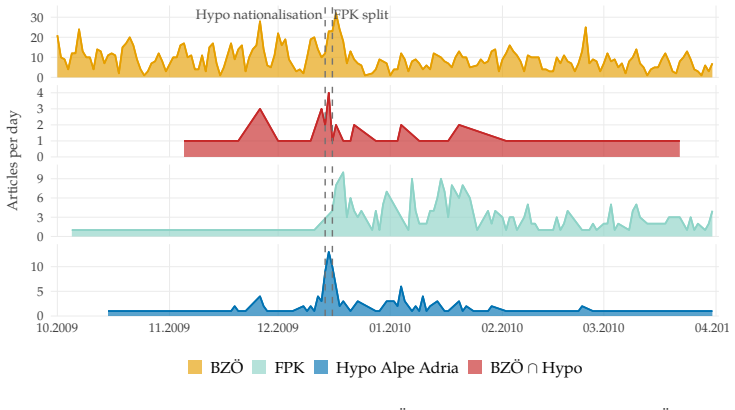
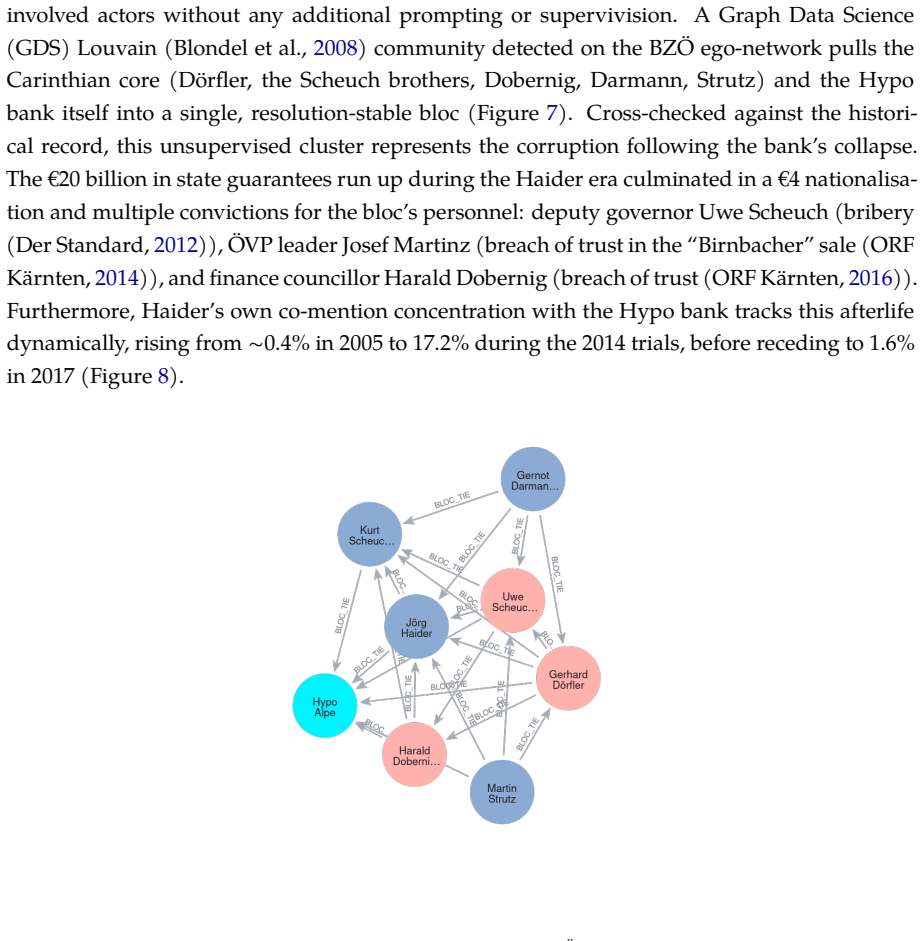
- The pipeline reconstructs a political party's full lifecycle, dating fractures and tracking personnel into successor factions and convictions.
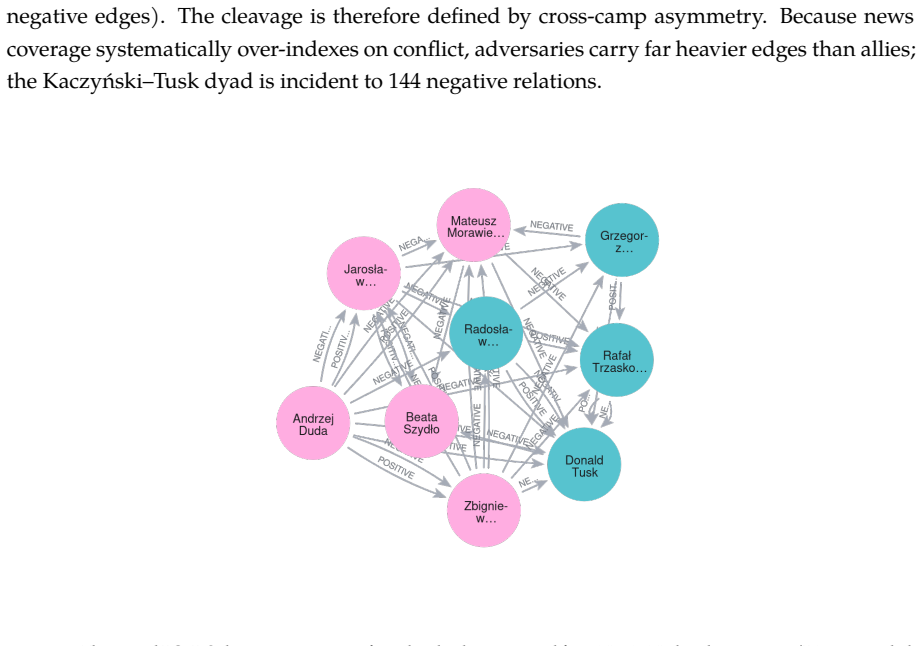
- It uncovers overlapping economic-governance networks and the structurally balanced signed conflict network between major parties in Poland.
- The method supplies a replicable foundation for cross-national studies of elite coalitions without intensive manual coding.
Where Pith is reading between the lines
- The same pipeline could be run on corpora from additional European countries to compare network structures across different electoral systems.
- Signed relation graphs produced this way could be tested for structural balance properties that distinguish adversarial from cooperative elite clusters.
- Extending the temporal window of the input corpora would allow tracking how elite networks evolve after elections or scandals.
Load-bearing premise
The signed relations extracted from news text accurately reflect real-world political ties rather than journalistic framing or selection bias.
What would settle it
Independent historical records for the Austrian party case study that show different dates for internal fractures or personnel movements than those recovered by the pipeline.
Figures








read the original abstract
Whether political elites organise into rent-seeking coalitions that capture public resources or civic networks that sustain governance is a central question in comparative politics. Yet observing these complex, informal, and adversarial ties at scale has historically required intensive manual coding, while automated text-as-data methods have largely been limited to simple co-occurrence. Recent large language model (LLM) approaches offer a path forward but often rely on proprietary APIs, lack cross-lingual capability, and struggle with scalable entity resolution. We present a modular, fully open-weight pipeline for multilingual joint entity-relation extraction that builds signed, temporal knowledge graphs from massive unstructured news corpora. It combines span-based named-entity recognition (NER) with a three-stage linking cascade mapping mentions to language-independent Wikidata identifiers; a high-throughput, ontology-constrained mixture-of-experts model then uses guided decoding to extract directed, signed relationships grounded in a domain ontology. A full-coverage spot-check against a 3491-relation gold standard shows high textual correctness (68.2% strict to 93.7% lenient). Two large-scale case studies validate the pipeline against the public record. In Austria, it reconstructs a political party's complete lifecycle, dating internal fractures and tracking personnel into successor factions and court convictions. In a Polish corpus, it uncovers the overlapping economic and governance networks of state-enterprise patronage, alongside the structurally balanced, signed conflict network of the polarized Civic Platform (Platforma Obywatelska, PO)--Law and Justice (Prawo i Sprawiedliwo\'s\'c, PiS) duopoly. By bridging raw multilingual text and structured relational data, our framework provides a robust, replicable foundation for cross-national empirical computational social science.
Editorial analysis
A structured set of objections, weighed in public.
Referee Report
Summary. The paper presents a modular, fully open-weight multilingual pipeline for joint entity-relation extraction that constructs signed, temporal knowledge graphs of political elites from large news corpora. It combines span-based NER, a three-stage Wikidata linking cascade, and an ontology-constrained mixture-of-experts model with guided decoding. Validation consists of a full-coverage spot-check on a 3491-relation gold standard (68.2% strict to 93.7% lenient textual correctness) plus two case studies that reconstruct Austrian party lifecycles and Polish state-enterprise patronage and PO-PiS conflict networks, claiming these outputs provide a replicable foundation for cross-national computational social science.
Significance. If the extracted signed relations can be shown to correspond to real political ties rather than source-text framing, the pipeline would offer a scalable, replicable alternative to manual coding for studying elite coalitions and patronage at European scale. The open-weight design and cross-lingual capability are genuine strengths that could support reproducible work in comparative politics.
major comments (2)
- [Abstract] Abstract: the reported gold-standard evaluation measures only whether the model recovers the relation as stated in the source sentence (textual fidelity). It provides no independent test that the extracted signed edges match actual political ties rather than journalistic selection, framing, or omission. Because the Austrian and Polish case studies likewise compare output only to the same public-record sources used for training text, this untested assumption is load-bearing for the central claim that the pipeline produces usable networks for downstream social-science tasks such as coalition detection.
- [Abstract] Abstract: no details are supplied on model architecture, training data composition, inter-annotator agreement for the gold standard, or error analysis. Without these, it is impossible to assess whether the 68.2–93.7 % figures support the claim of a robust, replicable pipeline.
Simulated Author's Rebuttal
We thank the referee for these comments, which highlight important distinctions in validation scope. We respond point-by-point below.
read point-by-point responses
-
Referee: [Abstract] Abstract: the reported gold-standard evaluation measures only whether the model recovers the relation as stated in the source sentence (textual fidelity). It provides no independent test that the extracted signed edges match actual political ties rather than journalistic selection, framing, or omission. Because the Austrian and Polish case studies likewise compare output only to the same public-record sources used for training text, this untested assumption is load-bearing for the central claim that the pipeline produces usable networks for downstream social-science tasks such as coalition detection.
Authors: We agree the gold standard measures textual fidelity to source sentences, which is a prerequisite for any extraction pipeline. The case studies provide qualitative alignment with documented public events but do not constitute an independent test against non-media ground truth for political ties. We will revise the abstract, add a limitations paragraph on media framing/selection effects, and note implications for coalition-detection tasks. revision: partial
-
Referee: [Abstract] Abstract: no details are supplied on model architecture, training data composition, inter-annotator agreement for the gold standard, or error analysis. Without these, it is impossible to assess whether the 68.2–93.7 % figures support the claim of a robust, replicable pipeline.
Authors: The full manuscript details model architecture (Section 3), training data (Section 4.1), IAA during gold-standard construction, and error analysis (Section 5). To improve accessibility we will expand the abstract with concise references to these elements and key metrics. revision: yes
Circularity Check
No circularity; engineering pipeline with external validation
full rationale
The manuscript presents a modular NLP pipeline for joint entity-relation extraction, evaluated via a held-out 3491-relation gold standard (68.2 % strict / 93.7 % lenient) and two case studies that compare output to the same public-record corpora used as input text. No equations, fitted parameters, predictions, uniqueness theorems, or ansatzes appear; the central claims rest on empirical performance against external benchmarks rather than any derivation that reduces to its own inputs by construction. Self-citations, if present, are not load-bearing for any mathematical or definitional step.
Axiom & Free-Parameter Ledger
Reference graph
Works this paper leans on
-
[1]
Valuing Public Goods in a Populist World: A Comparative Analysis of Network Dynamics and Societal Outcomes , date =
-
[2]
Networks and the Rule of Law: Uncovering Socio-Economic Outcomes , date =
-
[3]
Lazzaroni, Ruggero Marino and Lasser, Jana and Solovev, Kirill , title =. 2605.18337 , eprinttype =
-
[4]
doi:10.1371/journal.pone.0313149 , journaltitle =
Bro, Naim , title =. doi:10.1371/journal.pone.0313149 , journaltitle =
-
[5]
Keller, Franziska B. , title =. doi:10.1017/jea.2015.3 , journaltitle =
-
[6]
and Gleditsch, Kristian Skrede and Chiozza, Giacomo , title =
Goemans, Henk E. and Gleditsch, Kristian Skrede and Chiozza, Giacomo , title =. doi:10.1177/0022343308100719 , journaltitle =
-
[7]
doi:10.1017/S0003055420000490 , journaltitle =
Nyrup, Jacob and Bramwell, Stuart , title =. doi:10.1017/S0003055420000490 , journaltitle =
-
[8]
doi:10.1017/S1049096525000046 , journaltitle =
Lee, Kyuwon and Paci, Simone and Park, Jeongmin and You, Hye Young and Zheng, Sylvan , title =. doi:10.1017/S1049096525000046 , journaltitle =
-
[9]
doi:10.1080/19331681.2024.2417263 , journaltitle =
Arslan, Muhammad and Munawar, Saba and Cruz, Christophe , title =. doi:10.1080/19331681.2024.2417263 , journaltitle =
-
[10]
doi:10.1111/ajps.70050 , journaltitle =
Benoit, Kenneth and De Marchi, Scott and Laver, Conor and Laver, Michael and Ma, Jinshuai , title =. doi:10.1111/ajps.70050 , journaltitle =
-
[11]
doi:10.1177/20531680241236239 , journaltitle =
Heseltine, Michael and Clemm von Hohenberg, Bernhard , title =. doi:10.1177/20531680241236239 , journaltitle =
-
[12]
Zaratiana, Urchade and Tomeh, Nadi and Holat, Pierre and Charnois, Thierry , booktitle =
-
[13]
and Moazam, Hanna and Miller, Heather and Zaharia, Matei and Potts, Christopher , booktitle =
Khattab, Omar and Singhvi, Arnav and Maheshwari, Paridhi and Zhang, Zhiyuan and Santhanam, Keshav and Vardhamanan, Sri and Haq, Saiful and Sharma, Ashutosh and Joshi, Thomas T. and Moazam, Hanna and Miller, Heather and Zaharia, Matei and Potts, Christopher , booktitle =
-
[14]
Karstens, Mikaela and Soules, Michael J. and Dietrich, Nick , title =. doi:10.1017/S1049096522001317 , journaltitle =
-
[15]
Extracting Knowledge from Parliamentary Debates for Studying Political Culture and Language , pages =
Tamper, Minna and Leal, Rafael and Sinikallio, Laura and Leskinen, Petri and Tuominen, Jouni and Hyvönen, Eero , booktitle =. Extracting Knowledge from Parliamentary Debates for Studying Political Culture and Language , pages =
-
[16]
Fenwick, Clare and Shirali, Ramin and Fazekas, Mihaly and Kantorowicz, Jaroslaw , title =
-
[17]
The Rise and Decline of Nations: Economic Growth, Stagflation, and Social Rigidities , date =
Olson, Mancur , publisher =. The Rise and Decline of Nations: Economic Growth, Stagflation, and Social Rigidities , date =
-
[18]
and Leonardi, Robert and Nanetti, Raffaella Y
Putnam, Robert D. and Leonardi, Robert and Nanetti, Raffaella Y. , publisher =. Making Democracy Work: Civic Traditions in Modern Italy , date =
-
[19]
, publisher =
Acemoglu, Daron and Robinson, James A. , publisher =. Why Nations Fail: The Origins of Power, Prosperity, and Poverty , date =
-
[20]
Political Networks: The Structural Perspective , series =
Knoke, David , publisher =. Political Networks: The Structural Perspective , series =
-
[21]
Grimmer, Justin and Stewart, Brandon M. , title =. doi:10.1093/pan/mps028 , journaltitle =
-
[22]
and Stewart, Brandon M
Grimmer, Justin and Roberts, Margaret E. and Stewart, Brandon M. , publisher =. Text as Data: A New Framework for Machine Learning and the Social Sciences , date =
-
[23]
doi:10.1111/1468-4446.13203 , journaltitle =
Bühlmann, Felix and Christesen, Caroline Ahler and Cousin, Bruno and Denord, François and Ellersgaard, Christoph Houman and Lagneau-Ymonet, Paul and Larsen, Anton Grau and Savage, Mike and Thine, Sylvain and Young, Kevin and others , title =. doi:10.1111/1468-4446.13203 , journaltitle =
-
[24]
doi:10.1017/psrm.2017.28 , journaltitle =
Mahdavi, Paasha , title =. doi:10.1017/psrm.2017.28 , journaltitle =
-
[25]
doi:10.1093/pan/mpn006 , journaltitle =
van Atteveldt, Wouter and Kleinnijenhuis, Jan and Ruigrok, Nel , title =. doi:10.1093/pan/mpn006 , journaltitle =
-
[26]
doi:10.1017/nws.2025.4 , journaltitle =
Angst, Mario and Müller, Neitah Noemi and Walker, Viviane , title =. doi:10.1017/nws.2025.4 , journaltitle =
-
[27]
Zhu, Yifei and Yang, Songpo and Zhu, Jiangnan and Jiang, Junyan , title =. 2603.18010 , eprinttype =
-
[28]
doi:10.3233/SW-222986 , journaltitle =
Sevgili, Özge and Shelmanov, Artem and Arkhipov, Mikhail and Panchenko, Alexander and Biemann, Chris , title =. doi:10.3233/SW-222986 , journaltitle =
-
[29]
and Hussain, Shakeel and Smith, Geoffrey , title =
Guellil, Imane and Garcia-Dominguez, Antonio and Lewis, Peter R. and Hussain, Shakeel and Smith, Geoffrey , title =. doi:10.1007/s10115-023-02059-2 , journaltitle =
-
[30]
Multilingual Autoregressive Entity Linking
De Cao, Nicola and Wu, Ledell and Popat, Kashyap and Artetxe, Mikel and Goyal, Naman and Plekhanov, Mikhail and Zettlemoyer, Luke and Cancedda, Nicola and Riedel, Sebastian and Petroni, Fabio , title =. doi:10.1162/tacl_a_00460 , journaltitle =
-
[31]
WikiProject Every Politician , url =
-
[32]
EveryPolitician: Data About Every National Legislature in the World , url =
-
[33]
Miles, Alistair and Bechhofer, Sean , institution =
-
[34]
Grammar-Constrained Decoding for Structured
Geng, Saibo and Josifoski, Martin and Peyrard, Maxime and West, Robert , booktitle =. Grammar-Constrained Decoding for Structured
-
[35]
doi:10.31286/JP.97.1.7 , journaltitle =
Kieraś, Witold and Woliński, Marcin , title =. doi:10.31286/JP.97.1.7 , journaltitle =
-
[36]
, booktitle =
Qi, Peng and Zhang, Yuhao and Zhang, Yuhui and Bolton, Jason and Manning, Christopher D. , booktitle =. Stanza: A Python Natural Language Processing Toolkit for Many Human Languages , pages =
-
[37]
Garbe, Wolf , title =
-
[38]
Qdrant: High-Performance Vector Search Engine , date =
-
[39]
and Zhang, Hao and Stoica, Ion , booktitle =
Kwon, Woosuk and Li, Zhuohan and Zhuang, Siyuan and Sheng, Ying and Zheng, Lianmin and Yu, Cody Hao and Gonzalez, Joseph E. and Zhang, Hao and Stoica, Ion , booktitle =. Efficient Memory Management for Large Language Model Serving with PagedAttention , pages =
-
[40]
doi:10.1177/0888325420953485 , journaltitle =
Szarzec, Katarzyna and Totleben, Bartosz and Piątek, Dawid , title =. doi:10.1177/0888325420953485 , journaltitle =
-
[41]
doi:10.1111/j.1475-6765.2004.00169.x , journaltitle =
McMenamin, Iain , title =. doi:10.1111/j.1475-6765.2004.00169.x , journaltitle =
-
[42]
doi:10.1177/0888325420950800 , journaltitle =
Bill, Stanley , title =. doi:10.1177/0888325420950800 , journaltitle =
-
[43]
The Hidden Cost of Structure: How Constrained Decoding Affects Language Model Performance , pages =
Schall, Maximilian and de Melo, Gerard , booktitle =. The Hidden Cost of Structure: How Constrained Decoding Affects Language Model Performance , pages =. doi:10.26615/978-954-452-098-4-124 , url =
-
[44]
A Glimpse into Babel: An Analysis of Multilinguality in Wikidata , date =
Kaffee, Lucie-Aimée and Piscopo, Alessandro and Vougiouklis, Pavlos and Simperl, Elena and Carr, Leslie and Pintscher, Lydia , booktitle =. A Glimpse into Babel: An Analysis of Multilinguality in Wikidata , date =
-
[45]
doi:10.1140/epjds/s13688-024-00514-w , journaltitle =
Schoch, David and Chan, Chung-hong and Wagner, Claudia and Bleier, Arnim , title =. doi:10.1140/epjds/s13688-024-00514-w , journaltitle =
-
[46]
and Desposato, Scott and Dreber, Anna and Genovese, Federica and Green, Donald P
Brodeur, Abel and Esterling, Kevin and Ankel-Peters, Jörg and Bueno, Natália S. and Desposato, Scott and Dreber, Anna and Genovese, Federica and Green, Donald P. and Hepplewhite, Matthew and Hoces de la Guardia, Fernando and Johannesson, Magnus and Kotsadam, Andreas and Miguel, Edward and Velez, Yamil R. and Young, Lauren , title =. doi:10.1177/2053168024...
-
[47]
, publisher =
Burt, Ronald S. , publisher =. Structural Holes: The Social Structure of Competition , date =
-
[48]
Padgett, John F. and Ansell, Christopher K. , title =. doi:10.1086/230190 , journaltitle =
-
[49]
Hopkins, Daniel J. and King, Gary , title =. doi:10.1111/j.1540-5907.2009.00428.x , journaltitle =
-
[50]
doi:10.1162/99608f92.5317da47 , journaltitle =
Chen, Lingjiao and Zaharia, Matei and Zou, James , title =. doi:10.1162/99608f92.5317da47 , journaltitle =
-
[51]
doi:10.1080/01402380600842452 , journaltitle =
Markowski, Radosław , title =. doi:10.1080/01402380600842452 , journaltitle =
-
[52]
doi:10.1177/0002716218809322 , journaltitle =
Tworzecki, Hubert , title =. doi:10.1177/0002716218809322 , journaltitle =
-
[53]
doi:10.1177/002234336500200104 , journaltitle =
Galtung, Johan and Ruge, Mari Holmboe , title =. doi:10.1177/002234336500200104 , journaltitle =
-
[54]
doi:10.1080/1461670X.2016.1150193 , journaltitle =
Harcup, Tony and O'Neill, Deirdre , title =. doi:10.1080/1461670X.2016.1150193 , journaltitle =
-
[55]
doi:10.2753/PPC1075-8216550304 , journaltitle =
Heinisch, Reinhard , title =. doi:10.2753/PPC1075-8216550304 , journaltitle =
-
[56]
doi:10.1177/1354068811400522 , journaltitle =
Luther, Kurt Richard , title =. doi:10.1177/1354068811400522 , journaltitle =
-
[57]
The Haider Phenomenon in Austria , location =
-
[58]
and Plasser, Fritz , editor =
Müller, Wolfgang C. and Plasser, Fritz , editor =. Austria: The 1990 Campaign , location =. Electoral Strategies and Political Marketing , publisher =
1990
-
[59]
227, National Bank of Poland) , date =
The Constitution of the Republic of Poland (Art. 227, National Bank of Poland) , date =
-
[60]
Cartwright, Dorwin and Harary, Frank , title =
-
[61]
Schuldspruch gegen Ex-
-
[62]
Dobernig-Urteil ist rechtskräftig , date =
-
[63]
Revisiting Large Language Models as Zero-Shot Relation Extractors , pages =
Li, Guozheng and Wang, Peng and Ke, Wenjun , booktitle =. Revisiting Large Language Models as Zero-Shot Relation Extractors , pages =
-
[64]
Wikidata: a free collaborative knowledgebase , url =
Vrandečić, Denny and Krötzsch, Markus , title =. doi:10.1145/2629489 , journaltitle =
-
[65]
From Louvain to Leiden: Guaranteeing Well-Connected Communities
Traag, Vincent A. and Waltman, Ludo and van Eck, Nees Jan , title =. doi:10.1038/s41598-019-41695-z , journaltitle =
-
[66]
Fast unfolding of communities in large networks , year =
Blondel, Vincent D. and Guillaume, Jean-Loup and Lambiotte, Renaud and Lefebvre, Etienne , title =. doi:10.1088/1742-5468/2008/10/P10008 , journaltitle =
-
[67]
doi:10.1080/0022250X.2001.9990249 , journaltitle =
Brandes, Ulrik , title =. doi:10.1080/0022250X.2001.9990249 , journaltitle =
-
[68]
Page, Lawrence and Brin, Sergey and Motwani, Rajeev and Winograd, Terry , institution =. The
-
[69]
Content Analysis: An Introduction to Its Methodology , edition =
Krippendorff, Klaus , publisher =. Content Analysis: An Introduction to Its Methodology , edition =
discussion (0)
Sign in with ORCID, Apple, or X to comment. Anyone can read and Pith papers without signing in.