When Multi-Sensor Fusion Fails to Generalize: Cattle Posture Classification Under Animal-Level and Temporal Distribution Shift
Pith reviewed 2026-06-26 00:22 UTC · model grok-4.3
The pith
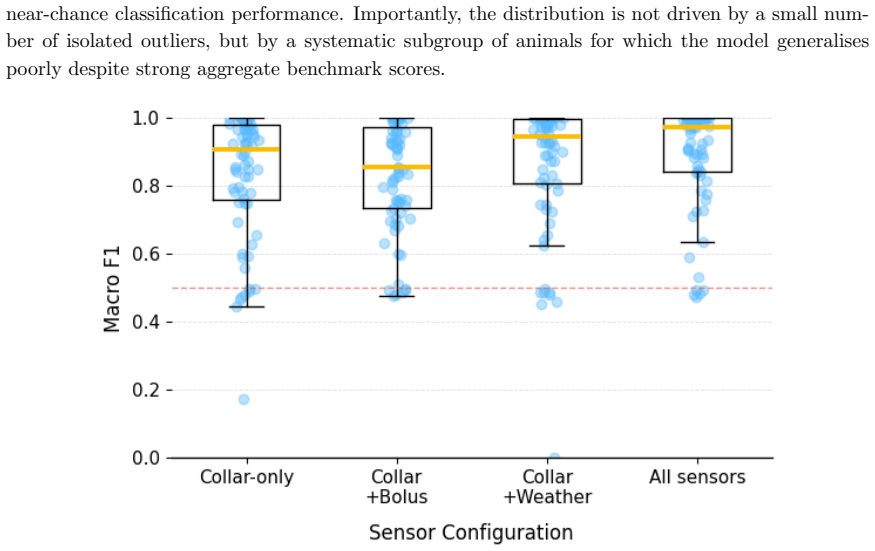
Cattle posture classifiers using multiple sensors reach 0.94 F1 within one year but fall to 0.49 F1 on data from the next year.
A machine-rendered reading of the paper's core claim, the machinery that carries it, and where it could break.
Core claim
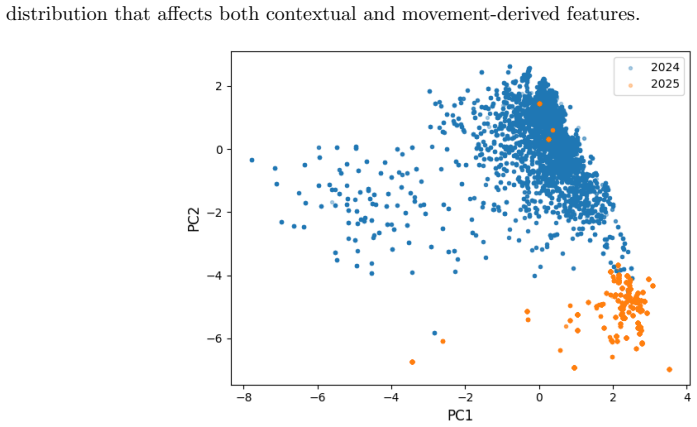
Multimodal models achieve macro-F1 of 0.94 under random within-year splits but only 0.49 under cross-year evaluation on previously unseen animals; explainability shows continued dependence on rumen-bolus and environmental features whose distributions differ between years, and distribution-shift tests confirm the mismatch.
What carries the argument
The progressive evaluation ladder (random split, leave-one-animal-out, cross-year on new cohort) together with SHAP-based feature reliance and feature-distribution comparison between recording years.
If this is right
- Common random-split protocols substantially overestimate performance that will be seen in later years.
- Adding more sensor modalities can increase rather than decrease sensitivity to temporal distribution shift.
- Benchmark accuracy on a single season is not sufficient evidence that a livestock classifier is deployment-ready.
- Robustness evaluation must include animal-level and year-level hold-outs to reflect real operating conditions.
Where Pith is reading between the lines
- The same evaluation gap is likely to appear in other sensor-fusion tasks in agriculture whenever the underlying biological or environmental signals drift seasonally.
- A practical next step would be to test whether explicit domain-adaptation layers or year-specific calibration can recover the lost cross-year performance without new labels.
- Livestock researchers may need to collect multi-year data as a standard part of model validation rather than treating one season as representative.
Load-bearing premise
The observed drop between the two years is produced by changes in the measured sensor features rather than by unrecorded differences in herd management, sensor placement, or animal health.
What would settle it
Re-training or recalibrating the same models on features whose distributions have been matched between years and then observing whether cross-year macro-F1 returns to the within-year level.
Figures



read the original abstract
Automated cattle posture-classification systems frequently report near-perfect accuracy, yet their robustness under realistic deployment conditions remains largely unknown. In particular, it is unclear whether multimodal sensor fusion improves generalisation or leads models to rely on context-specific signals that fail under distribution shift. Here, we evaluate the robustness of automated posture classification (lying versus standing) using collar accelerometers, rumen-bolus sensors, and environmental measurements collected from a pasture-based beef cattle herd across two consecutive years (2024-2025). XGBoost served as the primary model, with Logistic Regression, Random Forest, and Long Short-Term Memory networks evaluated as comparative baselines. Model robustness was assessed under progressively more stringent evaluation protocols, ranging from conventional random train-test splits to leave-one-animal-out validation and cross-year evaluation on an independent cohort of previously unseen animals recorded one year later. While multimodal models achieved strong within-year performance (macro-F1 0.94), the performance declined substantially under cross-year evaluation (macro-F1 0.49). Explainability analysis revealed persistent reliance on rumen-bolus activity and environmental variables even when predictive performance deteriorated. Distribution-shift diagnostics further confirmed substantial differences in feature distributions between recording years. Our findings demonstrate that commonly used evaluation protocols can substantially overestimate real-world performance and that multimodal sensor fusion may reduce, rather than improve, robustness under temporal distribution shift. More broadly, the results highlight that benchmark accuracy alone is insufficient to assess deployment readiness and underscore the need for robustness-centred evaluation in livestock-monitoring research.
Editorial analysis
A structured set of objections, weighed in public.
Referee Report
Summary. The manuscript evaluates multimodal sensor fusion (collar accelerometers, rumen-bolus sensors, environmental measurements) for binary cattle posture classification (lying vs. standing) on a pasture-based beef herd. Using XGBoost and baselines, it reports strong within-year performance (macro-F1 0.94) that degrades sharply under leave-one-animal-out and especially cross-year evaluation on an independent 2025 cohort (macro-F1 0.49). Distribution-shift diagnostics and explainability analyses indicate reliance on bolus and environmental features; the authors conclude that standard protocols overestimate real-world performance and that fusion can reduce rather than enhance robustness under temporal shift.
Significance. If the reported performance gap is attributable to isolated temporal feature shift, the work supplies concrete evidence that multimodal livestock-monitoring systems require robustness-centred evaluation protocols beyond conventional random or within-year splits. The use of an independent later-year cohort and explicit distribution diagnostics strengthens the external grounding of the result.
major comments (3)
- [§4.2–4.3 and Table 3] §4.2–4.3 and Table 3: the central claim that multimodal fusion reduces temporal robustness rests on the macro-F1 drop (0.94 within-year to 0.49 cross-year) being caused by changes in the joint feature distribution. The manuscript reports no quantitative controls or measurements for inter-year differences in herd composition, collar/bolus placement, calibration drift, or pasture conditions; without these, the attribution cannot be isolated from potential confounds.
- [§3.3] §3.3 (Data collection): the two recording years are treated as an independent temporal axis, yet no explicit matching or statistical test is provided for baseline animal physiology or management practices between 2024 and 2025 cohorts; this leaves open whether the observed feature-distribution shift is the sole driver of the performance degradation.
- [§5.2] §5.2 (Explainability): the persistent reliance on rumen-bolus activity and environmental variables is used to support the fusion-harm claim, but the analysis does not quantify how much of the cross-year drop is explained by these features versus other unmeasured variables; a feature-ablation or partial-dependence comparison across years would be required to make the causal link load-bearing.
minor comments (3)
- [Abstract and §4] The abstract states 'multimodal sensor fusion may reduce, rather than improve, robustness' but the results section compares only one multimodal configuration against unimodal baselines; a fuller ablation of sensor combinations would clarify the claim.
- [Figure 4] Figure 4 (feature distributions): axis labels and year-specific legends are difficult to distinguish in grayscale; adding explicit year annotations would improve readability.
- [§3.4] The LSTM baseline description omits hyper-parameter search details and sequence length; these should be reported for reproducibility.
Simulated Author's Rebuttal
We thank the referee for their thorough review and constructive feedback on our work. We provide point-by-point responses to the major comments below, indicating planned revisions where appropriate.
read point-by-point responses
-
Referee: [§4.2–4.3 and Table 3] the central claim that multimodal fusion reduces temporal robustness rests on the macro-F1 drop (0.94 within-year to 0.49 cross-year) being caused by changes in the joint feature distribution. The manuscript reports no quantitative controls or measurements for inter-year differences in herd composition, collar/bolus placement, calibration drift, or pasture conditions; without these, the attribution cannot be isolated from potential confounds.
Authors: We agree that without quantitative controls for all potential confounds, full isolation of the cause is not possible. The manuscript's distribution-shift diagnostics demonstrate substantial changes in feature distributions between years, and the cross-year evaluation uses an independent cohort to simulate real-world temporal shift. We will revise §4.3 to include an explicit discussion of unmeasured factors such as possible calibration drift and pasture variations as limitations, while maintaining that the observed performance degradation highlights the risks of relying on within-year evaluations. revision: partial
-
Referee: [§3.3] the two recording years are treated as an independent temporal axis, yet no explicit matching or statistical test is provided for baseline animal physiology or management practices between 2024 and 2025 cohorts; this leaves open whether the observed feature-distribution shift is the sole driver of the performance degradation.
Authors: The 2025 cohort consists of previously unseen animals recorded one year later, as stated in §3.3. We did not include formal statistical tests for matching between cohorts. In the revision, we will add a table or text comparing available baseline characteristics (such as number of animals, recording durations, and any recorded physiological metrics) between the two years to provide additional context. revision: yes
-
Referee: [§5.2] the persistent reliance on rumen-bolus activity and environmental variables is used to support the fusion-harm claim, but the analysis does not quantify how much of the cross-year drop is explained by these features versus other unmeasured variables; a feature-ablation or partial-dependence comparison across years would be required to make the causal link load-bearing.
Authors: The SHAP-based explainability in §5.2 shows consistent reliance on bolus and environmental features. To strengthen the causal link, we will incorporate additional analyses in the revision: (1) feature ablation experiments evaluating model performance with and without these features under cross-year conditions, and (2) partial dependence plots for key features computed separately on each year's data. revision: yes
Circularity Check
No significant circularity; empirical evaluation on held-out cross-year data
full rationale
The paper reports empirical model performance (macro-F1 scores) computed directly on independent test partitions: random splits, leave-one-animal-out, and cross-year evaluation on a later cohort of unseen animals. No equations, fitted parameters renamed as predictions, self-definitional loops, or load-bearing self-citations appear in the described methodology or results. The central claim about fusion reducing robustness rests on observable performance degradation and feature-distribution diagnostics between the two recording years, which are measured quantities external to any internal fitting procedure. This is the most common honest non-finding for an applied ML evaluation paper.
Axiom & Free-Parameter Ledger
axioms (1)
- domain assumption The two consecutive years capture a representative temporal distribution shift independent of unmeasured management or calibration changes.
Reference graph
Works this paper leans on
-
[1]
Effects of the daily heat load duration exceeding determined heat load thresholds on activity traits of lactating dairy cows
Heinicke J, Hoffmann G, Ammon C, Amon B, and Amon T. Effects of the daily heat load duration exceeding determined heat load thresholds on activity traits of lactating dairy cows. Journal of thermal biology 2018;77:67–74
2018
-
[2]
Lying behavior as an indicator of lameness in dairy cows
Ito K, Keyserlingk M von, LeBlanc S, and Weary D. Lying behavior as an indicator of lameness in dairy cows. Journal of Dairy Science 2010;93:3553–60
2010
-
[3]
Effect of solar radiation on dairy cattle behaviour, use of shade and body temperature in a pasture-based system
Tucker CB, Rogers AR, and Sch¨ utz KE. Effect of solar radiation on dairy cattle behaviour, use of shade and body temperature in a pasture-based system. Applied Animal Behaviour Science 2008;109:141–54. 16
2008
-
[4]
Deep transfer learning in sheep activity recognition using accelerometer data
Kleanthous N, Hussain A, Khan W, Sneddon J, and Liatsis P. Deep transfer learning in sheep activity recognition using accelerometer data. Expert Systems with Applications 2022;207:117925
2022
-
[5]
Data Augmentation for Inertial Sensor Data in CNNs for Cattle Behavior Classification
Li C, Tokgoz K, Fukawa M, et al. Data Augmentation for Inertial Sensor Data in CNNs for Cattle Behavior Classification. IEEE Sensors Letters 2021;5
2021
-
[6]
Development and Analysis of a CNN- and Transfer-Learning-Based Classification Model for Automated Dairy Cow Feeding Behavior Recognition from Accelerometer Data
Bloch V, Frondelius L, Arcidiacono C, Mancino M, and Pastell M. Development and Analysis of a CNN- and Transfer-Learning-Based Classification Model for Automated Dairy Cow Feeding Behavior Recognition from Accelerometer Data. Sensors 2023, Vol. 23, Page 2611 2023;23:2611
2023
-
[7]
Evaluation of three-dimensional accelerom- eters to monitor and classify behavior patterns in cattle
Robert B, White BJ, Renter DG, and Larson RL. Evaluation of three-dimensional accelerom- eters to monitor and classify behavior patterns in cattle. Computers and Electronics in Agri- culture 2009;67:80–4
2009
-
[8]
Classification and Analysis of Multiple Cattle Unitary Behaviors and Movements Based on Machine Learning Methods
Li Y, Shu H, Bindelle J, et al. Classification and Analysis of Multiple Cattle Unitary Behaviors and Movements Based on Machine Learning Methods. Animals 2022;12:1060
2022
-
[9]
Recognising Cattle Behaviour with Deep Residual Bidirectional LSTM Model Using a Wearable Movement Monitoring Collar
Wu Y, Liu M, Peng Z, Liu M, Wang M, and Peng Y. Recognising Cattle Behaviour with Deep Residual Bidirectional LSTM Model Using a Wearable Movement Monitoring Collar. Agriculture 2022, Vol. 12, Page 1237 2022;12:1237
2022
-
[10]
Cattle behaviour classification from collar, halter, and ear tag sensors
Rahman A, Smith DV, Little B, Ingham AB, Greenwood PL, and Bishop-Hurley GJ. Cattle behaviour classification from collar, halter, and ear tag sensors. Information Processing in Agriculture 2018;5:124–33
2018
-
[11]
Convolutional Neural Network for time series cattle behaviour classification
Kasfi KT, Hellicar A, and Rahman A. Convolutional Neural Network for time series cattle behaviour classification. ACM International Conference Proceeding Series 2016:8–12
2016
-
[12]
Behavioral classification of data from collars containing motion sensors in grazing cattle
Gonz´ alez LA, Bishop-Hurley GJ, Handcock RN, and Crossman C. Behavioral classification of data from collars containing motion sensors in grazing cattle. Computers and Electronics in Agriculture 2015;110:91–102
2015
-
[13]
An automated sensor-based method of simple be- havioural classification of sheep in extensive systems
Umst¨ atter C, Waterhouse A, and Holland JP. An automated sensor-based method of simple be- havioural classification of sheep in extensive systems. Computers and Electronics in Agriculture 2008;64:19–26
2008
-
[14]
Inference of Animal Activity From GPS Collar Data on Free-Ranging Cattle
Ungar ED, Henkin Z, Gutman M, Dolev A, Genizi A, and Ganskopp D. Inference of Animal Activity From GPS Collar Data on Free-Ranging Cattle. Rangeland Ecology & Management 2005;58:256–66
2005
-
[15]
The effect of heat stress on time spent lying by cows in a housing system
Herbut P and Angrecka S. The effect of heat stress on time spent lying by cows in a housing system. Annals of Animal Science 2018;18:825–33
2018
-
[16]
Rumination and its relationship to feeding and lying behavior in Holstein dairy cows
Schirmann K, Chapinal N, Weary D, Heuwieser W, and Keyserlingk M von. Rumination and its relationship to feeding and lying behavior in Holstein dairy cows. Journal of Dairy Science 2012;95:3212–7
2012
-
[17]
Cow behaviour pattern recognition using a three-dimensional accelerometer and support vector ma- chines
Martiskainen P, J¨ arvinen M, Sk¨ on JP, Tiirikainen J, Kolehmainen M, and Mononen J. Cow behaviour pattern recognition using a three-dimensional accelerometer and support vector ma- chines. Applied Animal Behaviour Science 2009;119:32–8
2009
-
[18]
Classification of behaviour in housed dairy cows using an accelerometer-based activity monitoring system
V´ azquez Diosdado JA, Barker ZE, Hodges HR, et al. Classification of behaviour in housed dairy cows using an accelerometer-based activity monitoring system. 2015. 17
2015
-
[19]
Classification of multiple cattle behavior patterns using a recurrent neural network with long short-term memory and inertial measurement units
Peng Y, Kondo N, Fujiura T, et al. Classification of multiple cattle behavior patterns using a recurrent neural network with long short-term memory and inertial measurement units. Com- puters and Electronics in Agriculture 2019;157:247–53
2019
-
[20]
A unified approach to interpreting model predictions
Lundberg SM and Lee SI. A unified approach to interpreting model predictions. Advances in neural information processing systems 2017;30
2017
-
[21]
Shortcut learning in deep neural networks
Geirhos R, Jacobsen JH, Michaelis C, et al. Shortcut learning in deep neural networks. Nature Machine Intelligence 2020;2:665–73
2020
-
[22]
Unmask- ing Clever Hans predictors and assessing what machines really learn
Lapuschkin S, W¨ aldchen S, Binder A, Montavon G, Samek W, and M¨ uller KR. Unmask- ing Clever Hans predictors and assessing what machines really learn. Nature communications 2019;10:1096
2019
-
[23]
DORA: Exploring Outlier Repre- sentations in Deep Neural Networks
Bykov K, Deb M, Grinwald D, Muller KR, and H¨ ohne MM. DORA: Exploring Outlier Repre- sentations in Deep Neural Networks. Transactions on Machine Learning Research 2023
2023
-
[24]
Mark my words: Dangers of watermarked images in imagenet
Bykov K, M¨ uller KR, and H¨ ohne MMC. Mark my words: Dangers of watermarked images in imagenet. In:European Conference on Artificial Intelligence. Springer. 2023:426–34. 18 A Appendix A.1 Herd Composition The data for this study were sourced from a herd of 180 cows in Brandenburg, Germany. Since April 2024, 164 individuals have been equipped with the eSh...
2023
discussion (0)
Sign in with ORCID, Apple, or X to comment. Anyone can read and Pith papers without signing in.