Optimal parameterization of nonequilibrium generalized master equations from discrete-time experimental data
Pith reviewed 2026-06-29 01:44 UTC · model grok-4.3
The pith
A maximum-likelihood procedure using optimal transport constructs physically feasible discrete-time generalized master equations from nonequilibrium data.
A machine-rendered reading of the paper's core claim, the machinery that carries it, and where it could break.
Core claim
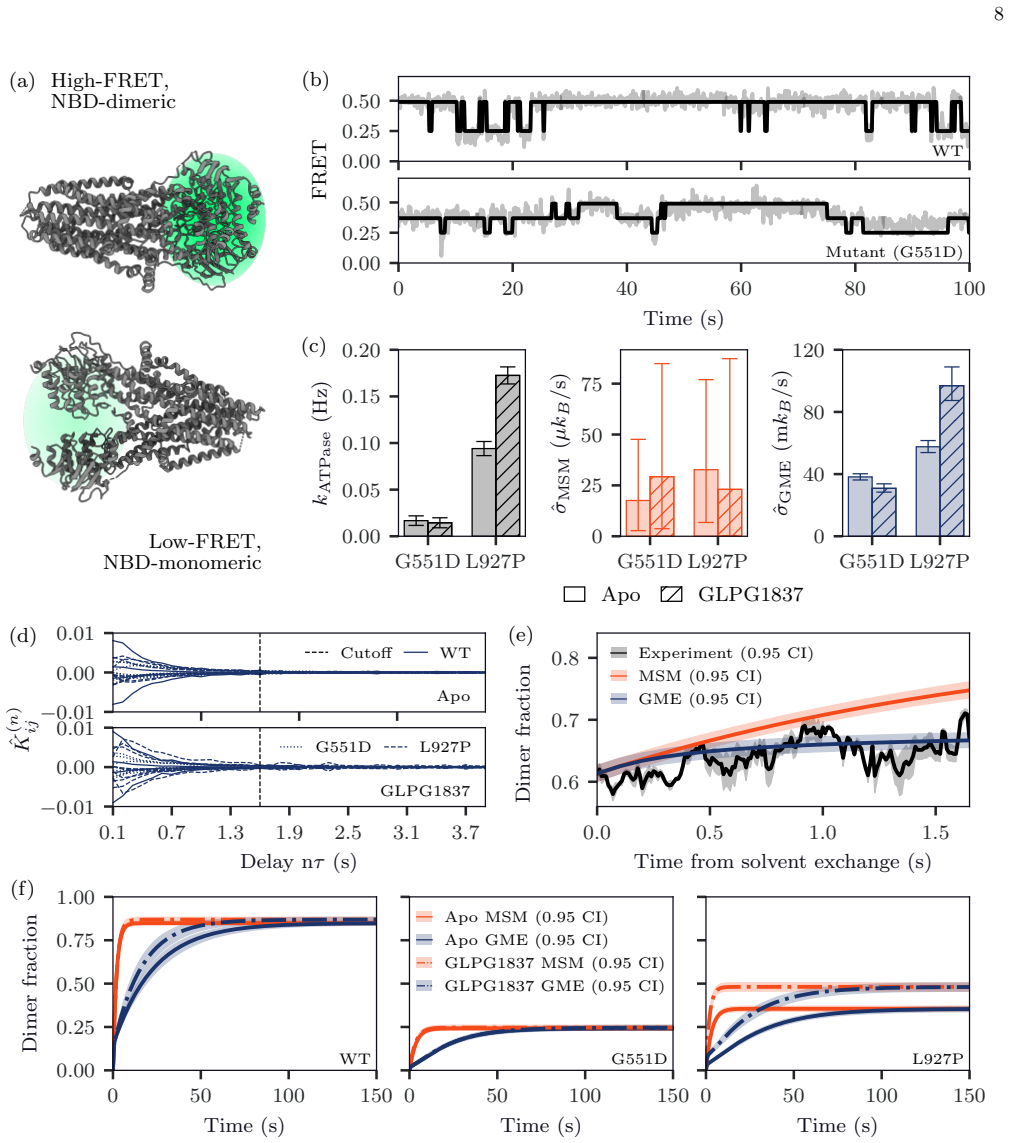
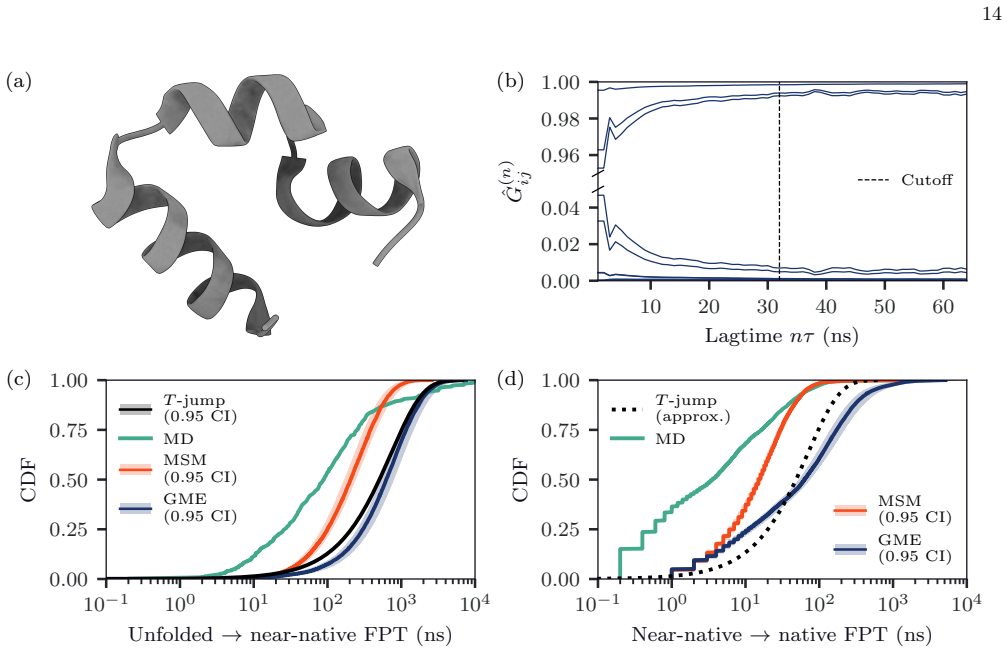
The authors present a maximum-likelihood-based procedure to parameterize formally exact, physically feasible, discrete-time generalized master equations from experiments and simulations in and out of equilibrium. By adapting algorithms from optimal transport, they construct conditional-maximum-likelihood estimators for both Nakajima-Zwanzig memory kernels and time-convolutionless GME propagators. When applied to experimental and simulated data, these estimators recover key kinetic parameters including relaxation rates, irreversibilities, dwell times, and first-passage times.
What carries the argument
Conditional-maximum-likelihood estimators of Nakajima-Zwanzig memory kernels and time-convolutionless GME propagators, built by adapting optimal transport algorithms to enforce physical constraints in discrete time.
If this is right
- The method recovers relaxation rates, irreversibilities, dwell times, and first-passage times from data.
- Discrete-time GMEs serve as a physically and statistically principled alternative to Markov state models for kinetic analyses.
- The estimators apply to both experimental recordings and simulated trajectories in and out of equilibrium.
- They satisfy physical constraints for both memory kernels and propagators.
Where Pith is reading between the lines
- This approach could extend to other coarse-grained systems where memory arises from hidden degrees of freedom.
- Optimal transport methods may generally help enforce constraints in statistical inference for dynamical systems.
- Integration with techniques for defining states from high-dimensional data could broaden applicability.
Load-bearing premise
Adapting optimal transport algorithms produces estimators that satisfy the physical constraints required for generalized master equations applied to discrete-time data.
What would settle it
Observing that the inferred propagators produce negative probabilities or fail to match the empirical transition statistics in validation data would falsify the claim that the estimators are physically feasible and accurate.
Figures



read the original abstract
Kinetic analyses of experiments often require coarse-grained descriptions, but complex systems rarely conform to the widely used modeling assumptions of Markovianity and thermodynamic equilibrium. Memory is indeed a general and often inevitable consequence of coarse-graining. Markov state models (MSMs) are a popular choice of coarse-grained description, but require microstate assignments -- which are rarely experimentally tunable -- to macrostates that minimize memory. Generalized master equations (GMEs) circumvent this limitation of MSMs by explicitly capturing memory. However, GMEs are difficult to parameterize and usually formally approximate in the experimentally relevant discrete-time setting. Here we introduce a maximum-likelihood-based procedure to parameterize formally exact, physically feasible, discrete-time generalized master equations from experiments and simulations in and out of equilibrium. By adapting algorithms typically used in optimal transport, we construct physical-constraint-satisfying conditional-maximum-likelihood estimators of both exact Nakajima-Zwanzig memory kernels and time-convolutionless GME propagators in discrete time. Applying these estimators to three examples -- experimental recordings of F\"orster-resonance energy-transfer in an ion channel, experimental nanoparticle tracking of a processive molecular motor, and simulated folding of a benchmark protein domain -- we recover kinetic parameters including relaxation rates, irreversibilities, dwell times, and first-passage times. These results establish discrete-time GMEs as a physically and statistically principled alternative to MSMs for kinetic analyses of experimental and simulated biomolecular systems.
Editorial analysis
A structured set of objections, weighed in public.
Referee Report
Summary. The manuscript introduces a maximum-likelihood procedure, adapted from optimal transport algorithms, to parameterize formally exact and physically feasible discrete-time generalized master equations (both Nakajima-Zwanzig memory kernels and time-convolutionless propagators) from experimental and simulation data in and out of equilibrium. The estimators are constructed to satisfy constraints including positivity, normalization, and detailed balance where applicable; the method is demonstrated on three examples (FRET recordings in an ion channel, nanoparticle tracking of a processive motor, and simulated protein domain folding), recovering quantities such as relaxation rates, irreversibilities, dwell times, and first-passage times.
Significance. If the central construction holds, the work supplies a statistically rigorous and constraint-enforcing alternative to Markov state models for non-Markovian kinetic analysis of biomolecular data. It enables direct use of discrete-time recordings without requiring microstate-to-macrostate assignments that minimize memory, and the explicit use of conditional maximum-likelihood estimators with physical feasibility is a clear strength.
minor comments (3)
- [Methods] The manuscript would benefit from a short, self-contained paragraph in the methods section explicitly linking the regularized transport problem to the KKT conditions of the original constrained MLE, even if the full derivation is in the supplement.
- [Results] In the three validation examples, the reported kinetic parameters (e.g., first-passage times in the protein-folding case) should include uncertainty estimates derived from the estimator; this is a standard expectation for maximum-likelihood procedures.
- [Theory] Notation for the discrete-time projection operators and the memory kernel discretization should be unified across the Nakajima-Zwanzig and time-convolutionless sections to avoid reader confusion.
Simulated Author's Rebuttal
We thank the referee for the positive summary, significance assessment, and recommendation of minor revision. No major comments were provided in the report.
Circularity Check
No significant circularity; derivation self-contained
full rationale
The paper derives conditional-maximum-likelihood estimators for discrete-time Nakajima-Zwanzig kernels and time-convolutionless propagators by recasting the constrained likelihood maximization as a regularized optimal-transport problem whose solution is shown to satisfy the KKT conditions of the original constrained MLE; the discrete-time projection operators remain exact by construction. No equation reduces a claimed prediction or first-principles result to a quantity defined solely by the fitted parameters themselves, no uniqueness theorem is imported from self-citation, and no ansatz is smuggled via prior work. The three validation examples on independent experimental and simulation data supply external checks, confirming the central procedure is not equivalent to its inputs by definition.
Axiom & Free-Parameter Ledger
axioms (2)
- standard math Maximum likelihood estimation yields optimal estimators for the GME parameters under the stated model assumptions.
- domain assumption Optimal transport algorithms can be adapted to produce estimators that satisfy physical constraints such as probability conservation.
Reference graph
Works this paper leans on
-
[1]
[121] to a single unfolded macrostate
to a single near-native macrostate, and all states described as partly or fully unfolded by Ref. [121] to a single unfolded macrostate. These macrostates reflect the three implied by two-stage folding inT-jump experiments [120]. Using Alg. 2 with Alg. 3 for information projec- tions, we estimate conditional-maximum-likelihood TCL- GME-DT propagators with ...
-
[2]
kinetic distances
to project transition-matrix iterates onto the feasi- ble set, suggesting connections between entropic optimal transport—a celebrated use of the Sinkhorn-Knopp al- gorithm [45]—and coarse-grained kinetic modeling. Ap- proaches that interpret flux matrices as transport plans between macrostates may merit further investigation. Previous works minimize “kine...
-
[3]
The usual Knight-Ruiz-U¸ car algorithm [112] differs from Alg. 5 in lacking the initial geometric symmetriza- tion ˆΘ←sqrt( ˆΘ⊙ ˆΘT); it only preserves the symmetry of already symmetric input fluxes ˆΘ during projection onto the feasible set defined by Eqs. 47-49. Alg. 5 neverthe- less minimizesD KL(Θ∥ ˆΘ) subject to Eqs. 47-49 and 51 with initial geometr...
-
[4]
47-49 equals the projection of ˆΘ onto the set satisfying Eqs
Thus symmetry-preserving projection of sqrt(ˆΘ⊙ ˆΘT) onto the set satisfying Eqs. 47-49 equals the projection of ˆΘ onto the set satisfying Eqs. 47-49 and 51. We now describe a Levenberg-Marquardt algorithm [114, 115] for projecting local-flux estimates ˆΘ onto the subset satisfying Eq. 54. We note that maximizing Eq. 60 is equivalent to minimizing the lo...
1927
-
[5]
00 U (n) ij 0 1 2 3 4 5 6 7 8 9 Delay nτ 10−1 10−5 10−9 K(n) ij Diagrammatic Analytic 0 1 2 3 4 5 6 7 8 9 10 Lagtime nτ
-
[6]
00 G(n) ij Cutoff 102 103 104 105 106 Observation time N τ
-
[7]
00 ∥ ˆU (n) − U (n)∥2 n = 1 (0.95 CI) n = 2 (0.95 CI) n = 3 (0.95 CI) 102 103 104 105 106 Observation time N τ
-
[8]
00 ∥ ˆK(n) − K(n)∥2 n = 0 (0.95 CI) n = 1 (0.95 CI) n = 2 (0.95 CI) 102 103 104 105 106 Observation time N τ
-
[9]
00 ∥ ˆG(n) − G(n)∥2 (a) (b) (c) (d) (e) (f) (g) (h) FIG. 5. Convergence in an adversarial toy example. The coarse-grained MJP in (a) generates example macrostate series (b) and lacks separation of timescales. Transition rates between microstatesµ 3 andµ 4, which are coarse-grained into a single macrostate, equal transition rates among macrostatesµ 1,µ 2, ...
-
[10]
Schilling, Coarse-grained modeling out of equilib- rium, Phys
T. Schilling, Coarse-grained modeling out of equilib- rium, Phys. Rep.972, 1 (2022)
2022
-
[11]
Schilling, Evolution equations for open systems and collective variables: Which equation would you like to solve by molecular dynamics simulation?, J
T. Schilling, Evolution equations for open systems and collective variables: Which equation would you like to solve by molecular dynamics simulation?, J. Chem. Phys.161, 191501 (2024)
2024
-
[12]
Trubiano and M
A. Trubiano and M. F. Hagan, Markov state model approach to simulate self-assembly, Phys. Rev. X14, 041063 (2024)
2024
-
[13]
Sartore, F
S. Sartore, F. Teichmann, and G. Stock, Markov-type state models to describe non-Markovian dynamics, J. Chem. Theory Comput.21, 2757 (2025)
2025
-
[14]
B. E. Husic, K. A. McKiernan, H. K. Wayment-Steele, M. M. Sultan, and V. S. Pande, A minimum variance clustering approach produces robust and interpretable coarse-grained models, J. Chem. Theory Comput.14, 1071 (2018)
2018
-
[15]
G. R. Bowman, Improved coarse-graining of Markov state models via explicit consideration of statistical un- certainty, J. Chem. Phys.137, 134111 (2012)
2012
-
[16]
P´ erez-Hern´ andez, F
G. P´ erez-Hern´ andez, F. Paul, T. Giorgino, G. De Fab- ritiis, and F. No´ e, Identification of slow molecular order parameters for Markov model construction, J. Chem. Phys.139, 015102 (2013)
2013
-
[17]
G. Diez, D. Nagel, and G. Stock, Correlation-based fea- ture selection to identify functional dynamics in pro- teins, J. Chem. Theory Comput.18, 5079 (2022)
2022
-
[18]
J. D. Chodera and F. No´ e, Markov state models of biomolecular conformational dynamics, Curr. Opin. Struct. Biol.25, 135 (2015)
2015
-
[19]
B. E. Husic and V. S. Pande, Markov state models: from an art to a science, J. Am. Chem. Soc.140, 2386 (2018)
2018
-
[20]
No´ e, G
F. No´ e, G. De Fabritiis, and C. Clementi, Machine learning for protein folding and dynamics, Curr. Opin. Struct. Biol.60, 77 (2020)
2020
-
[21]
No´ e and C
F. No´ e and C. Clementi, Kinetic distance and kinetic maps from molecular dynamics simulation, J. Chem. Theory Comput.11, 5002 (2015)
2015
-
[22]
K. A. Beauchamp, R. McGibbon, Y.-S. Lin, and V. S. Pande, Simple few-state models reveal hidden complex- ity in protein folding, Proc. Natl. Acad. Sci. U.S.A.109, 17807 (2012)
2012
-
[23]
C. R. Schwantes and V. S. Pande, Improvements in Markov state model construction reveal many non- native interactions in the folding of NTL9, J. Chem. Theory Comput.9, 2000 (2013)
2000
-
[24]
W. C. Swope, J. W. Pitera, and F. Suits, Describing protein folding kinetics by molecular dynamics simula- tions. 1. Theory, The Journal of Physical Chemistry B 108, 6571 (2004)
2004
-
[25]
Prinz, J
J.-H. Prinz, J. D. Chodera, and F. No´ e, Spectral rate theory for two-state kinetics, Phys. Rev. X4, 011020 (2014)
2014
-
[26]
Knoch and T
F. Knoch and T. Speck, Non-equilibrium Markov state modeling of periodically driven biomolecules, J. Chem. Phys.150, 054103 (2019)
2019
-
[27]
Prinz, H
J.-H. Prinz, H. Wu, M. Sarich, B. Keller, M. Senne, M. Held, J. D. Chodera, C. Sch¨ utte, and F. No´ e, Markov models of molecular kinetics: generation and validation, J. Chem. Phys.134, 174105 (2011)
2011
-
[28]
K. A. Dill and D. Shortle, Denatured states of proteins, Annu. Rev. Biochem.60, 795 (1991)
1991
-
[29]
Gonzalez-Ballestero, Tutorial: projector approach to master equations for open quantum systems, Quantum 8, 1454 (2024)
C. Gonzalez-Ballestero, Tutorial: projector approach to master equations for open quantum systems, Quantum 8, 1454 (2024)
2024
-
[30]
A. J. Dominic III, T. Sayer, S. Cao, T. E. Markland, X. Huang, and A. Montoya-Castillo, Building insightful, memory-enriched models to capture long-time biochem- ical processes from short-time simulations, Proc. Natl. Acad. Sci. U.S.A.120, e2221048120 (2023)
2023
-
[31]
Tokuyama and H
M. Tokuyama and H. Mori, Statistical-mechanical ap- proach to random frequency modulations and the Gaus- sian memory function, Prog. Theor. Exp. Phys.54, 918 (1975)
1975
-
[32]
Nakajima, On quantum theory of transport phenom- ena: steady diffusion, Prog
S. Nakajima, On quantum theory of transport phenom- ena: steady diffusion, Prog. Theor. Exp. Phys.20, 948 (1958)
1958
-
[33]
Zwanzig, Memory effects in irreversible thermody- namics, Phys
R. Zwanzig, Memory effects in irreversible thermody- namics, Phys. Rev.124, 983 (1961)
1961
-
[34]
Kidon, E
L. Kidon, E. Y. Wilner, and E. Rabani, Exact calcula- tion of the time convolutionless master equation gener- ator: Application to the nonequilibrium resonant level model, J. Chem. Phys.143, 234110 (2015)
2015
-
[35]
Gu, Diagrammatic representation and nonperturba- tive approximations of the exact time-convolutionless master equation, J
B. Gu, Diagrammatic representation and nonperturba- tive approximations of the exact time-convolutionless master equation, J. Chem. Phys.160, 204113 (2024)
2024
-
[36]
Shi and E
Q. Shi and E. Geva, A new approach to calculating the memory kernel of the generalized quantum master equa- tion for an arbitrary system–bath coupling, J. Chem. Phys.119, 12063 (2003)
2003
-
[37]
Vroylandt, L
H. Vroylandt, L. Gouden` ege, P. Monmarch´ e, F. Pietrucci, and B. Rotenberg, Likelihood-based non-Markovian models from molecular dynamics, Proc. Natl. Acad. Sci. U.S.A.119, e2117586119 (2022)
2022
-
[38]
A. V. Oppenheim and R. W. Schafer,Discrete-Time Signal Processing, 3rd ed. (Prentice Hall Press, Upper Saddle River, New Jersey, United States of America, 2009)
2009
-
[39]
Larsson and V
S. Larsson and V. Thom´ ee,Partial Differential Equa- tions with Numerical Methods(Springer Berlin, Heidel- berg, Baden-W¨ urttemberg, Germany, 2003)
2003
-
[40]
E. C. Goonetilleke and X. Huang, Targeting bacte- rial RNA polymerase: Harnessing simulations and ma- chine learning to design inhibitors for drug-resistant pathogens, Biochemistry64, 1169 (2025)
2025
-
[41]
Y. Wu, S. Cao, Y. Qiu, and X. Huang, Tutorial on how to build non-Markovian dynamic models from molecu- lar dynamics simulations for studying protein conforma- tional changes, J. Chem. Phys.160, 121501 (2024)
2024
-
[42]
Lorpaiboon, S
C. Lorpaiboon, S. C. Guo, J. Strahan, J. Weare, and A. R. Dinner, Accurate estimates of dynamical statistics using memory, The Journal of Chemical Physics160, 084108 (2024)
2024
-
[43]
I. C. Unarta, S. Cao, E. C. Goonetilleke, J. Niu, S. H. Gellman, and X. Huang, Submillisecond atomistic molecular dynamics simulations reveal hydrogen bond- driven diffusion of a guest peptide in protein–RNA con- densate, The Journal of Physical Chemistry B128, 2347 (2024)
2024
-
[44]
A. J. Dominic III, S. Cao, A. Montoya-Castillo, and X. Huang, Memory unlocks the future of biomolecular dynamics: Transformative tools to uncover physical in- 24 sights accurately and efficiently, Journal of the Ameri- can Chemical Society145, 9916 (2023)
2023
-
[45]
S. Cao, Y. Qiu, M. L. Kalin, and X. Huang, Integra- tive generalized master equation: A method to study long-timescale biomolecular dynamics via the integrals of memory kernels, The Journal of Chemical Physics 159, 134106 (2023)
2023
-
[46]
Makri, Discrete generalized quantum master equa- tions, J
N. Makri, Discrete generalized quantum master equa- tions, J. Chem. Theory Comput.21, 5037 (2025)
2025
-
[47]
S. Cao, A. Montoya-Castillo, W. Wang, T. E. Markland, and X. Huang, On the advantages of exploiting memory in Markov state models for biomolecular dynamics, J. Chem. Phys.153, 014105 (2020)
2020
-
[48]
Sayer and A
T. Sayer and A. Montoya-Castillo, Compact and com- plete description of non-Markovian dynamics, J. Chem. Phys.158, 014105 (2023)
2023
-
[49]
Mori, Transport, collective motion, and Brownian motion, Prog
H. Mori, Transport, collective motion, and Brownian motion, Prog. Theor. Exp. Phys.33, 423 (1965)
1965
-
[50]
Zwanzig, Ensemble method in the theory of irre- versibility, J
R. Zwanzig, Ensemble method in the theory of irre- versibility, J. Chem. Phys.33, 1338 (1960)
1960
-
[51]
A. S. Nemirovski and D. B. Yudin,Slozhnost’ zadach i effecktivnost’ metodov optimizacii(Nauka, Moscow, Russian Soviet Federative Socialist Republic, Union of Soviet Socialist Republics, 1979)
1979
-
[52]
L. M. Bregman, A relaxation method of finding a com- mon point of convex sets and its application to the solu- tion of problems in convex programming, U.S.S.R. Com- put. Math. Math. Phys.7, 200 (1967)
1967
-
[53]
Knopp and R
P. Knopp and R. Sinkhorn, Concerning nonnegative ma- trices and doubly stochastic matrices, Pacific J. Math 21, 343 (1967)
1967
-
[54]
M. Cuturi, Sinkhorn distances: lightspeed computation of optimal transport, inProceedings of the 27th Inter- national Conference on Neural Information Processing Systems - Volume 2, NIPS’13 (Curran Associates Inc., Red Hook, New York, United States of America, 2013) pp. 2292–2300
2013
-
[55]
Meng and D
X.-L. Meng and D. B. Rubin, Maximum likelihood esti- mation via the ECM algorithm: A general framework, Biometrika80, 267 (1993)
1993
-
[56]
F¨ orster, Zwischenmolekulare Energiewanderung und Fluoreszenz, Ann
T. F¨ orster, Zwischenmolekulare Energiewanderung und Fluoreszenz, Ann. Phys. (Berl.)437, 55 (1948)
1948
-
[57]
Levring, D
J. Levring, D. S. Terry, Z. Kilic, G. Fitzgerald, S. C. Blanchard, and J. Chen, CFTR function, pathology, and pharmacology at single-molecule resolution, Nature 616, 606 (2023)
2023
-
[58]
Kobayashi, H
R. Kobayashi, H. Ueno, C.-B. Li, and H. Noji, Rotary catalysis of bovine mitochondrial F 1-ATPase studied by single-molecule experiments, Proc. Natl. Acad. Sci. U.S.A.117, 1447 (2020)
2020
-
[59]
Piana, K
S. Piana, K. Lindorff-Larsen, and D. E. Shaw, Protein folding kinetics and thermodynamics from atomistic simulation, Proc. Natl. Acad. Sci. U.S.A.109, 17845 (2012)
2012
-
[60]
Hummer and A
G. Hummer and A. Szabo, Optimal dimensionality re- duction of multistate kinetic and Markov-state models, J. Phys. Chem. B119, 9029 (2014)
2014
-
[61]
Inferring bro- ken detailed balance in the absence of observable cur- rents
D. Hartich and A. Godec, Comment on “Inferring bro- ken detailed balance in the absence of observable cur- rents”, Nat. Commun.15, 8678 (2024)
2024
-
[62]
Inferring broken de- tailed balance in the absence of observable currents
G. Bisker, I. A. Mart´ ınez, J. M. Horowitz, and J. M. R. Parrondo, Reply to: Comment on “Inferring broken de- tailed balance in the absence of observable currents”, Nat. Commun.15, 8679 (2024)
2024
-
[63]
Stella and S
L. Stella and S. Melchionna, Equilibration and sampling in molecular dynamics simulations of biomolecules, J. Chem. Phys.109, 10115 (1998)
1998
-
[64]
E. B. Walton and K. J. VanVliet, Equilibration of exper- imentally determined protein structures for molecular dynamics simulation, Phys. Rev. E74, 061901 (2006)
2006
-
[65]
Chapman, On the Brownian displacements and ther- mal diffusion of grains suspended in a non-uniform fluid, Proceedings of the Royal Society of London
S. Chapman, On the Brownian displacements and ther- mal diffusion of grains suspended in a non-uniform fluid, Proceedings of the Royal Society of London. Series A, Containing Papers of a Mathematical and Physical Character119, 34 (1928)
1928
-
[66]
Kolmogoroff, ¨Uber die analytischen Methoden in der Wahrscheinlichkeitsrechnung, Mathematische Annalen 104, 415 (1931)
A. Kolmogoroff, ¨Uber die analytischen Methoden in der Wahrscheinlichkeitsrechnung, Mathematische Annalen 104, 415 (1931)
1931
-
[67]
Tokuyama and H
M. Tokuyama and H. Mori, Statistical-mechanical the- ory of random frequency modulations and generalized Brownian motions, Prog. Theor. Exp. Phys.55, 411 (1976)
1976
-
[68]
Chaturvedi and F
S. Chaturvedi and F. Shibata, Time-convolutionless projection operator formalism for elimination of fast variables. Applications to Brownian motion, Z. Phys. B35, 297 (1979)
1979
-
[69]
Timm, Time-convolutionless master equation for quantum dots: Perturbative expansion to arbitrary or- der, Phys
C. Timm, Time-convolutionless master equation for quantum dots: Perturbative expansion to arbitrary or- der, Phys. Rev. B83, 115416 (2011)
2011
-
[70]
C. W. Sinclair and J. Rottler, Influence of solute induced memory on interface migration, Phys. Rev. Mater.9, 123402 (2025)
2025
-
[71]
Bement and J
P. Bement and J. Rottler, Models for polymer dynam- ics from dimensionality reduction techniques, J. Chem. Phys.163, 104902 (2025)
2025
-
[72]
Strasberg and M
P. Strasberg and M. Esposito, Non-Markovianity and negative entropy production rates, Phys. Rev. E99, 012120 (2019)
2019
-
[73]
Maldonado-Mundo, P
D. Maldonado-Mundo, P. ¨Ohberg, B. W. Lovett, and E. Andersson, Investigating the generality of time-local master equations, Phys. Rev. A86, 042107 (2012)
2012
-
[74]
Chru´ sci´ nski and A
D. Chru´ sci´ nski and A. Kossakowski, Non-Markovian quantum dynamics: Local versus nonlocal, Phys. Rev. Lett.104, 070406 (2010)
2010
-
[75]
S. C. Hou, X. X. Yi, S. X. Yu, and C. H. Oh, Singularity of dynamical maps, Phys. Rev. A86, 012101 (2012)
2012
-
[76]
Nestmann, V
K. Nestmann, V. Bruch, and M. R. Wegewijs, How quantum evolution with memory is generated in a time- local way, Phys. Rev. X11, 021041 (2021)
2021
-
[77]
E. M. Laine, K. Luoma, and J. Piilo, Local-in-time mas- ter equations with memory effects: applicability and in- terpretation, J. Phys. B45, 154004 (2012)
2012
-
[78]
Brandner, Dynamics of microscale and nanoscale systems in the weak-memory regime: A mathemati- cal framework beyond the Markov approximation, Phys
K. Brandner, Dynamics of microscale and nanoscale systems in the weak-memory regime: A mathemati- cal framework beyond the Markov approximation, Phys. Rev. E111, 014137 (2025)
2025
-
[79]
Shabani and D
A. Shabani and D. A. Lidar, Completely positive post- Markovian master equation via a measurement ap- proach, Phys. Rev. A71, 020101 (2005)
2005
-
[80]
Gerry and D
M. Gerry and D. Segal, Full counting statistics and co- herences: Fluctuation symmetry in heat transport with the unified quantum master equation, Phys. Rev. E107, 054115 (2023)
2023
discussion (0)
Sign in with ORCID, Apple, or X to comment. Anyone can read and Pith papers without signing in.