REVIEW 3 major objections 5 minor 2 cited by
This paper determines the full (M, g²) phase diagram of the single-flavor Gross–Neveu–Wilson model by contracting its Grassmann tensor-network path integral, finding an Aoki phase bounded by c=1/2 critical lines that terminates at finite st
Reviewed by Pith at T0; open to challenge. T0 means a machine referee read the full paper against a public rubric. the ladder, T0–T4 →
T0 review · deepseek-v4-flash
2026-08-02 20:56 UTC pith:X4CEQJ6C
load-bearing objection First Lagrangian phase diagram of the Nf=1 Gross-Neveu-Wilson model with a credible qualitative picture but an unresolved scaling discrepancy that makes the central-charge labels conditional. the 3 major comments →
Phase diagram of the single-flavor Gross--Neveu--Wilson model from the Grassmann corner transfer matrix renormalization group
The pith
A machine-rendered reading of the paper's core claim, the machinery that carries it, and where it could break.
Core claim
The central numerical result is the (M, g²) phase diagram of the single-flavor Gross–Neveu–Wilson model obtained by approximately contracting the two-dimensional Grassmann tensor network representation of the path integral. The Aoki phase, detected via the pseudoscalar condensate computed with an impurity tensor, is bounded by critical lines with central charge c=1/2, consistent with the two-dimensional Ising universality class. The topological insulator and trivial phases are separated by critical lines with c=1. The Aoki phase terminates at triple points near (M, g²) ≈ (±0.812, 0.89), contrary to the large-N_f phase diagram, and the topological insulating lobes are identified by a fully do
What carries the argument
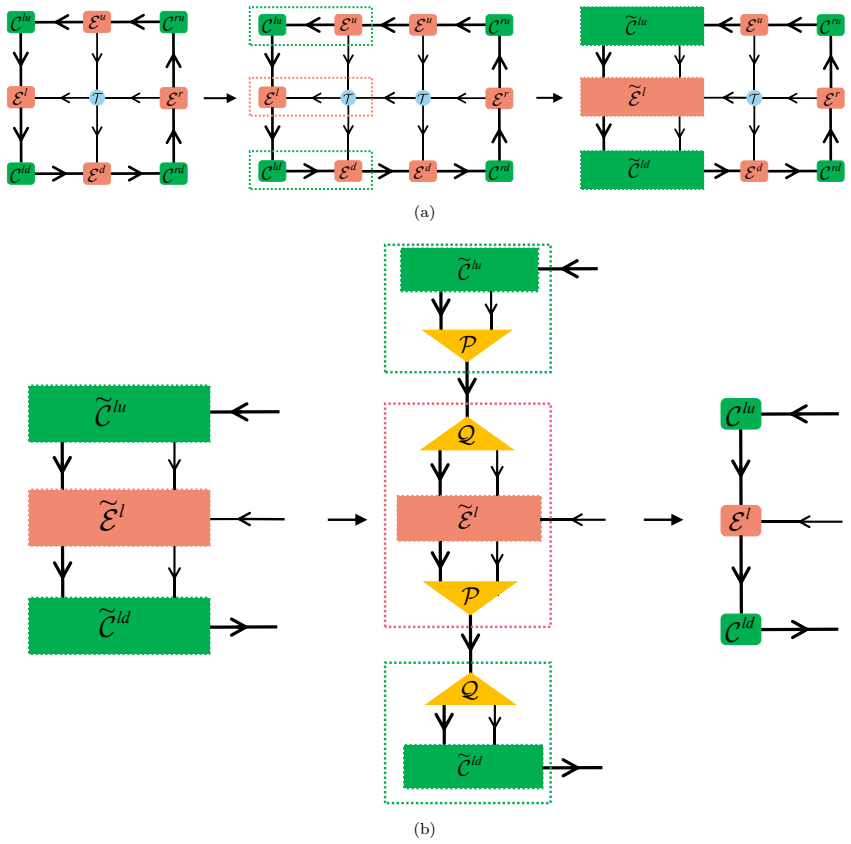
The central mechanism is the Grassmann corner transfer matrix renormalization group (CTMRG): the lattice path integral is written as a uniform two-dimensional Grassmann tensor network with local bond dimension 4, and the infinite environment is approximated by corner and edge tensors truncated to bond dimension D, updated with Grassmann projectors derived from singular value decomposition. The universality classes are read off from the finite-entanglement scaling relation S_D ≈ (c/6) log ξ_D, where ξ_D is the effective correlation length obtained from the row-to-row or column-to-column transfer matrices. The pseudoscalar condensate is evaluated by inserting a local impurity Grassmann tensor,
Load-bearing premise
The central-charge labels rest on the finite-entanglement scaling formula S_D ≈ (c/6) log ξ_D; Appendix C reports a fitted exponent κ ≈ 1.48 that deviates from the predicted 2.03, so if that scaling form is not valid in this Grassmann CTMRG implementation, the c=1/2 and c=1 phase-boundary assignments would not be established.
What would settle it
At M=0, compute the pseudoscalar condensate for g² > 0.9 with bond dimension much larger than 208 under periodic boundary conditions using an independent contraction scheme, and check whether it extrapolates to zero; also test data collapse at the claimed critical points using the predicted κ = 6/(c(√(12/c)+1)). A nonzero extrapolated condensate or a collapse requiring κ far from the predicted value would overturn the strong-coupling termination or the central-charge labels.
If this is right
- If the phase diagram is correct, the continuum limit of the single-flavor theory is approached through c=1/2 Ising critical lines (Aoki boundaries) and c=1 lines (topological/trivial boundary), and the Aoki phase is confined to finite g².
- The impurity-tensor measurement of the pseudoscalar condensate provides a sign-problem-free order parameter for spontaneous Z₂ parity breaking in an odd-flavor Wilson-fermion theory.
- The doubly degenerate entanglement spectrum inside the two lobes provides a practical diagnostic for the topological insulator phase without computing a topological invariant.
- The triple-point location (M, g²) ≈ (±0.812, 0.89) is a concrete prediction that can be sharpened by higher-bond-dimension simulations.
- The qualitative agreement with Hamiltonian-formalism results, with differences attributed to temporal doublers in the Lagrangian formulation, suggests the phase structure is robust across formalisms.
Where Pith is reading between the lines
- If the strong-coupling termination is confirmed, the single-flavor Aoki phase is a weak-to-intermediate coupling phenomenon, and the large-N_f phase diagram is misleading at N_f=1; a testable extension is to measure the pseudoscalar condensate at even larger D or with alternative boundary conditions to settle whether parity is broken at all g² at M=0.
- The discrepancy between the fitted κ ≈ 1.48 and the predicted κ ≈ 2.03 for c=1/2 suggests the finite-entanglement scaling of this Grassmann CTMRG is not identical to the standard MPS form; if so, the quantitative c values carry an unquantified systematic error, and a cross-check using an independent method such as direct transfer-matrix spectra at fixed large D would be valuable.
- The same Grassmann CTMRG pipeline could be run for N_f=2 to test whether the Aoki phase survives and whether the two-lobe phase remains topological, connecting the parity-broken phase to flavor dependence in Wilson-fermion theories.
- A direct computation of the Zak phase or another topological invariant inside the two lobes would turn the entanglement-spectrum signature into a quantitative identification of the symmetry-protected topological phase and could be done with the same converged environments.
Editorial analysis
A structured set of objections, weighed in public.
Referee Report
Summary. The paper develops a Grassmann corner transfer matrix renormalization group (CTMRG) algorithm for two-dimensional lattice fermions and applies it to the single-flavor Gross–Neveu–Wilson (GNW) model. The partition function is represented as a Grassmann tensor network and contracted by CTMRG, with the pseudoscalar condensate used to identify the Aoki phase, the entanglement entropy used to extract central charges of phase boundaries, and the entanglement spectrum used to identify a topological insulating phase. The authors report a phase diagram with an Aoki phase bounded by c=1/2 critical lines, topological and trivial phases separated by c=1 critical lines, and no Aoki phase at strong coupling, with a triple point around (M,g^2)=(0.812,0.89). The numerical machinery is benchmarked against free Wilson fermions and cross-checked partially with HOTRG.
Significance. If the central-charge assignments are reliable, this is an important first complete Lagrangian-formulation phase diagram of the N_f=1 GNW model, with nontrivial implications for lattice QCD with odd flavor numbers and for tensor-network methods for fermions. The paper ships a new Grassmann CTMRG implementation and demonstrates its superior accuracy relative to TRG/BTRG/HOTRG in benchmark tests (Fig. 4), plus an independent HOTRG cross-check of the strong-coupling termination of the Aoki phase (Appendix B). The entanglement-spectrum doubling inside the lobe is a clear, falsifiable signature. However, the universal-class labels in Fig. 5 rest on a finite-entanglement scaling relation whose validity the paper itself calls into question, and the pseudoscalar-condensate definition involves an h->0 limit whose numerical implementation is not documented.
major comments (3)
- [Appendix C and Sec. IV.B.2] The central-charge assignments c=1/2 and c=1, which are load-bearing for the phase diagram in Fig. 5, rely entirely on Eq. (III.16), S_D approx (c/6) log xi_D, applied at each claimed critical point. Appendix C reports that the finite-entanglement scaling xi_D ~ D^kappa requires kappa approx 1.48 for the best data collapse at the c=1/2 points, while Eq. (C.2) predicts kappa approx 2.03 for c=1/2. The authors state that this deviation is 'significantly larger' than previously reported and leave its origin to future work. If Eq. (III.16) has uncontrolled corrections in this Grassmann CTMRG implementation, the slopes in Figs. 10 and 12 do not necessarily equal c/6, and the extracted values c=0.498(3), c=0.500(4), c=1.01(3) do not establish the claimed universality classes. An independent confirmation, e.g. from critical exponents, finite-size scaling, or a different tensor-network algorithm
- [Sec. III.A, Eqs. (III.3)-(III.7)] The pseudoscalar condensate is defined by Eq. (III.3) with a double limit: first the thermodynamic limit, then h->0. The impurity tensor I_n is introduced, but the numerical sections (Figs. 6-8 and 15) never state the values of h used, whether results are extrapolated in h, or how the h->0 limit is implemented in the CTMRG contraction. This is not a mere presentation issue because the magnitude of the condensate, including its vanishing at strong coupling, is a central claim. Without a specified h-extrapolation procedure, the reader cannot assess systematic errors in the order parameter or in the location of the Aoki-phase boundaries extracted from it.
- [Sec. IV.B.4, Fig. 17] The triple-point estimate (M,g^2) approx (0.812,0.89) is based on the difference Delta M between correlation-length peaks as a function of g^2, but no extrapolation to D->infinity or a criterion for 'vanishingly small' Delta M is given. The text says the two transition points are close and a reliable finite-entanglement analysis is left for future work, yet the triple point is used in the schematic phase diagram (Fig. 14) and in the summary. An uncertainty estimate for the triple-point location would be needed to support this part of the phase diagram.
minor comments (5)
- [Fig. 5] The heat map legend is not labeled; it is unclear whether it represents the absolute value of the pseudoscalar condensate on a linear or logarithmic scale. Adding a color-bar label and a scale would improve readability.
- [Sec. III.B.1, Eq. (III.15)] The reduced density matrix rho_D is defined graphically; the text would benefit from a brief verbal description of how the four corner matrices are contracted and traced to yield a D x D density matrix.
- [Sec. IV.B.3, Fig. 13] The caption calls Fig. 13(c) 'the SPT phase', while the main text says it is inside the lobe and later identifies it as a topological insulator. This terminology is inconsistent; the figure label should match the phase name used in the text.
- [Appendix C, Eq. (C.2)] The formula kappa = 6/[c(sqrt(12/c)+1)] is quoted from MPS literature. It would be useful to clarify whether this expression is expected to hold exactly for CTMRG of a two-dimensional classical system or only approximately, given that Appendix C itself finds a substantially different kappa.
- [General] Several spots have missing spaces or typographical issues, e.g. 'N f ' in the introduction and 'g2 = 0.9' in Sec. IV.B.4. A careful proofread is recommended.
Circularity Check
No significant circularity; central charges are extracted from slopes of entanglement entropy versus correlation length, not imposed, and the phase diagram is cross-checked by independent benchmarks.
full rationale
The paper’s central quantitative claims are obtained by a first-principles Grassmann CTMRG contraction, not by fitting the target conclusions into the calculation. The central charges are read off as the slope of S_D versus log ξ_D via Eq. (III.16), with reported values c=0.498(3), c=0.500(4), and c=1.01(3); these values are not assumed inputs but outputs of linear fits. The only place where c=1/2 appears as an input is the Appendix C data-collapse consistency check, which is explicitly framed as supporting evidence rather than as the source of the c values. The admitted deviation in the finite-entanglement exponent κ (κ≈1.48 versus Eq. (C.2) prediction κ≈2.03) is an accuracy/scaling-validity concern that the authors disclose and leave for future work; it does not make the slope extraction circular. The results are also benchmarked against the analytic free-Wilson-fermion solution in Sec. IV A and cross-checked by an independent HOTRG calculation in Appendix B. Self-citations, including Ref. [32] for the Grassmann tensor coefficient and Ref. [23] for the previously known Hamiltonian-formalism phase diagram, are prior published technical or consistency references and are not used as circular justifications of the present numerical predictions. No fitted parameter is renamed as a prediction, no self-definitional step is present, and no uniqueness or load-bearing theorem is imported from the authors’ own prior work.
Axiom & Free-Parameter Ledger
free parameters (3)
- Extrapolation constants a and C in pi = a/D + C =
fit-dependent, not tabulated
- Effective finite-entanglement exponent kappa =
approx 1.48
- Wilson parameter r =
1
axioms (4)
- domain assumption Finite-entanglement scaling S_D = (c/6) log xi_D and xi_D ~ D^kappa with kappa=6/(c(sqrt(12/c)+1)) apply to this 2D Grassmann CTMRG computation.
- domain assumption A doubly degenerate entanglement spectrum implies a symmetry-protected topological (SPT) phase in the N_f=1 GNW model.
- domain assumption The pseudoscalar condensate computed from open-boundary CTMRG environments equals the periodic thermodynamic-limit value, with a properly implemented h->0 limit.
- domain assumption The Wilson term with r=1 removes doublers and the model reproduces the expected free-fermion continuum behavior near M=±2.
read the original abstract
We investigate the phase structure of the single-flavor Gross--Neveu model with Wilson fermions using the Grassmann corner transfer matrix renormalization group (CTMRG). The path integral is formulated as a two-dimensional Grassmann tensor network and approximately contracted by the Grassmann CTMRG algorithm. We investigate the phase diagram by varying the fermion mass and the four-fermion coupling, using the pseudoscalar condensate as an order parameter for the $\mathbb{Z}_{2}$ parity symmetry breaking phase. The universality classes of the phase boundaries are identified through the central charge $c$ obtained via scaling analysis of the entanglement entropy. Furthermore, we extract the quantity related to the entanglement spectrum from the converged CTMRG environments, allowing us to distinguish the topological insulator phase and the trivial phase. The resulting phase structure suggests that the Aoki phase is separated from the other phases by critical lines characterized by $c=1/2$, while the critical lines with $c=1$ separate the topological insulating and trivial phases. Our numerical results also indicate that the Aoki phase does not persist in the strong-coupling regime for the single-flavor theory.
Figures




Forward citations
Cited by 2 Pith papers
-
Grassmann tensor networks
Grassmann tensor networks are introduced from basic operations to algorithm Grassmannization and validated on models from particle physics and condensed matter.
-
Grassmann tensor networks
Provides a detailed introduction to Grassmann tensor operations and their use in standard tensor-network algorithms, with validation on models in particle and condensed-matter physics.
Reference graph
Works this paper leans on
-
[1]
The corner transfer matrices are nothing but the corner matricesC lu,C ru,C ld,C rd
Correlation length, entanglement entropy, and spectrum The CTMRG algorithm directly deals with corner, row-to-row, and column-to-column transfer matrices. The corner transfer matrices are nothing but the corner matricesC lu,C ru,C ld,C rd. On the other hand, the row-to-row transfer 8 matrix is defined by two edge tensorsE l andE r via l r u d .(III.11...
-
[2]
Aoki phase atM= 0 We first investigate the parity symmetry–broken phase atM= 0. Fig. 6 shows the resulting pseudoscalar condensate as a function ofg 2. The finite-Deffects appear to be well suppressed forg 2 ≳0.7, where a clear signal of spontaneous parity symmetry breaking is observed up tog 2 ∼0.9. In contrast, the behavior of the pseudoscalar condensat...
-
[3]
We now study the phase boundaries of the Aoki phase by employing the pseudoscalar condensate, correlation length, and entanglement entropy
Phase boundaries of the Aoki phase According to the large-Nf saddle-point approximation, the phase diagram exhibits two lobes within which the parity symmetry remains unbroken in the weak-coupling regime. We now study the phase boundaries of the Aoki phase by employing the pseudoscalar condensate, correlation length, and entanglement entropy. Fig. 8 shows...
-
[4]
In the weak-coupling regime, thesec= 1/2 critical lines partially form the two-lobe structure
Topological insulating phase So far, our CTMRG simulations indicate that the Aoki phase is separated by critical lines characterized byc= 1/2. In the weak-coupling regime, thesec= 1/2 critical lines partially form the two-lobe structure. Away from theM= 0 line in the weak-coupling region, the CTMRG finds that the Aoki phase rapidly disappears. Nevertheles...
-
[5]
Since we have already found thec= 1 critical line, separating the topological insulating phase from the trivial phase, we expect the phase structure schematically shown in Fig
Triple point We finally address the fate of two critical lines characterized byc= 1/2. Since we have already found thec= 1 critical line, separating the topological insulating phase from the trivial phase, we expect the phase structure schematically shown in Fig. 14: twoc= 1/2 critical lines merge at a certain point, while a single critical line with c= 1...
-
[6]
Nambu and G
Y. Nambu and G. Jona-Lasinio,Dynamical Model of Elementary Particles Based on an Analogy with Superconductivity. 1.,Phys. Rev.122(1961) 345–358
1961
-
[7]
Nambu and G
Y. Nambu and G. Jona-Lasinio,Dynamical model of elementary particles based on an analogy with superconductivity. II., Phys. Rev.124(1961) 246–254
1961
-
[8]
K. G. Wilson,Confinement of Quarks,Phys. Rev. D10(1974) 2445–2459
1974
-
[9]
H. B. Nielsen and M. Ninomiya,No Go Theorem for Regularizing Chiral Fermions,Phys. Lett. B105(1981) 219–223
1981
-
[10]
K. G. Wilson,Quarks and Strings on a Lattice, in13th International School of Subnuclear Physics: New Phenomena in Subnuclear Physics, 11, 1975
1975
-
[11]
Kawamoto,Towards the Phase Structure of Euclidean Lattice Gauge Theories with Fermions,Nucl
N. Kawamoto,Towards the Phase Structure of Euclidean Lattice Gauge Theories with Fermions,Nucl. Phys. B190 (1981) 617–669
1981
-
[12]
Aoki,New Phase Structure for Lattice QCD with Wilson Fermions,Phys
S. Aoki,New Phase Structure for Lattice QCD with Wilson Fermions,Phys. Rev. D30(1984) 2653
1984
-
[13]
Aoki,A Solution to the U(1) Problem on a Lattice,Phys
S. Aoki,A Solution to the U(1) Problem on a Lattice,Phys. Rev. Lett.57(1986) 3136
1986
-
[14]
Aoki,U(1) Problem and Lattice QCD,Nucl
S. Aoki,U(1) Problem and Lattice QCD,Nucl. Phys. B314(1989) 79–111
1989
-
[15]
Vafa and E
C. Vafa and E. Witten,Parity Conservation in QCD,Phys. Rev. Lett.53(1984) 535
1984
-
[16]
Aoki and A
S. Aoki and A. Gocksch,Spontaneous Breaking of Parity in Quenched Lattice QCD With Wilson Fermions,Phys. Lett. B 231(1989) 449–452
1989
-
[17]
S. Aoki, A. Ukawa and T. Umemura,Finite temperature phase structure of lattice QCD with Wilson quark action,Phys. Rev. Lett.76(1996) 873–876, [hep-lat/9508008]
Pith/arXiv arXiv 1996
-
[18]
S. R. Sharpe and R. L. Singleton, Jr,Spontaneous flavor and parity breaking with Wilson fermions,Phys. Rev. D58 (1998) 074501, [hep-lat/9804028]
Pith/arXiv arXiv 1998
-
[19]
V. Azcoiti, G. Di Carlo, E. Follana and A. Vaquero,Elucidating the Vacuum Structure of the Aoki Phase,Nucl. Phys. B 870(2013) 138–158, [1208.0761]
Pith/arXiv arXiv 2013
-
[20]
T. Misumi and Y. Tanizaki,Lattice gauge theory for the Haldane conjecture and central-branch Wilson fermion,PTEP 2020(2020) 033B03, [1910.09604]. 22
Pith/arXiv arXiv 2020
-
[21]
D. J. Gross and A. Neveu,Dynamical Symmetry Breaking in Asymptotically Free Field Theories,Phys. Rev. D10(1974) 3235
1974
-
[22]
N. D. Mermin and H. Wagner,Absence of ferromagnetism or antiferromagnetism in one-dimensional or two-dimensional isotropic Heisenberg models,Phys. Rev. Lett.17(1966) 1133–1136
1966
-
[23]
S. R. Coleman,There are no Goldstone bosons in two-dimensions,Commun. Math. Phys.31(1973) 259–264
1973
-
[24]
R. Kenna and J. C. Sexton,The Weakly coupled Gross-Neveu model with Wilson fermions,Phys. Rev. D65(2002) 014507, [hep-lat/0103014]
Pith/arXiv arXiv 2002
-
[25]
G. Roose, J. Haegeman, K. Van Acoleyen, L. Vanderstraeten and N. Bultinck,The chiral Gross-Neveu model on the lattice via a Landau-forbidden phase transition,JHEP06(2022) 019, [2111.14652]
Pith/arXiv arXiv 2022
-
[26]
M. Asaduzzaman, S. Catterall, G. C. Toga, Y. Meurice and R. Sakai,Quantum simulation of the N-flavor Gross-Neveu model,Phys. Rev. D106(2022) 114515, [2208.05906]
Pith/arXiv arXiv 2022
-
[27]
Y. Kuno,Phase structure of the interacting Su-Schrieffer-Heeger model and the relationship with the Gross-Neveu model on lattice,Phys. Rev. B99(2019) 064105, [1811.01487]
Pith/arXiv arXiv 2019
-
[28]
A. Bermudez, E. Tirrito, M. Rizzi, M. Lewenstein and S. Hands,Gross–Neveu–Wilson model and correlated symmetry-protected topological phases,Annals Phys.399(2018) 149–180, [1807.03202]
Pith/arXiv arXiv 2018
-
[29]
Z.-C. Gu, F. Verstraete and X.-G. Wen,Grassmann tensor network states and its renormalization for strongly correlated fermionic and bosonic states,1004.2563
-
[30]
Gu,Efficient simulation of Grassmann tensor product states,Phys
Z.-C. Gu,Efficient simulation of Grassmann tensor product states,Phys. Rev.B88(2013) 115139, [1109.4470]
Pith/arXiv arXiv 2013
-
[31]
Y. Shimizu and Y. Kuramashi,Grassmann tensor renormalization group approach to one-flavor lattice Schwinger model, Phys. Rev. D90(2014) 014508, [1403.0642]
Pith/arXiv arXiv 2014
-
[32]
Y. Shimizu and Y. Kuramashi,Critical behavior of the lattice Schwinger model with a topological term atθ=πusing the Grassmann tensor renormalization group,Phys. Rev. D90(2014) 074503, [1408.0897]
Pith/arXiv arXiv 2014
-
[33]
Y. Shimizu and Y. Kuramashi,Berezinskii-Kosterlitz-Thouless transition in lattice Schwinger model with one flavor of Wilson fermion,Phys. Rev. D97(2018) 034502, [1712.07808]
Pith/arXiv arXiv 2018
-
[34]
S. Takeda and Y. Yoshimura,Grassmann tensor renormalization group for the one-flavor lattice Gross-Neveu model with finite chemical potential,PTEP2015(2015) 043B01, [1412.7855]
Pith/arXiv arXiv 2015
-
[35]
D. Kadoh, Y. Kuramashi, Y. Nakamura, R. Sakai, S. Takeda and Y. Yoshimura,Tensor network formulation for two-dimensional latticeN= 1 Wess-Zumino model,JHEP03(2018) 141, [1801.04183]
Pith/arXiv arXiv 2018
-
[36]
S. Akiyama, Y. Kuramashi, T. Yamashita and Y. Yoshimura,Restoration of chiral symmetry in cold and dense Nambu–Jona-Lasinio model with tensor renormalization group,JHEP01(2021) 121, [2009.11583]
Pith/arXiv arXiv 2021
-
[37]
S. Akiyama and D. Kadoh,More about the Grassmann tensor renormalization group,JHEP10(2021) 188, [2005.07570]
Pith/arXiv arXiv 2021
-
[38]
S. Akiyama and Y. Kuramashi,Tensor renormalization group approach to (1+1)-dimensional Hubbard model,Phys. Rev. D104(2021) 014504, [2105.00372]
Pith/arXiv arXiv 2021
-
[39]
S. Akiyama, Y. Kuramashi and T. Yamashita,Metal-insulator transition in (2+1)-dimensional Hubbard model with tensor renormalization group,PTEP2022(9, 2021) 023, [2109.14149]
Pith/arXiv arXiv 2021
-
[40]
J. Bloch and R. Lohmayer,Grassmann higher-order tensor renormalization group approach for two-dimensional strong-coupling QCD,Nucl. Phys. B986(2023) 116032, [2206.00545]
Pith/arXiv arXiv 2023
-
[41]
M. Asaduzzaman, S. Catterall, Y. Meurice, R. Sakai and G. C. Toga,Improved coarse-graining methods for two dimensional tensor networks including fermions,JHEP01(2023) 024, [2210.03834]
Pith/arXiv arXiv 2023
-
[42]
M. Asaduzzaman, S. Catterall, Y. Meurice, R. Sakai and G. C. Toga,Tensor network representation of non-abelian gauge theory coupled to reduced staggered fermions,JHEP05(2024) 195, [2312.16167]
Pith/arXiv arXiv 2024
-
[43]
S. Akiyama,Matrix product decomposition for two- and three-flavor Wilson fermions: Benchmark results in the lattice Gross-Neveu model at finite density,Phys. Rev. D108(2023) 034514, [2304.01473]
Pith/arXiv arXiv 2023
-
[44]
A. Yosprakob, J. Nishimura and K. Okunishi,A new technique to incorporate multiple fermion flavors in tensor renormalization group method for lattice gauge theories,JHEP11(2023) 187, [2309.01422]
Pith/arXiv arXiv 2023
-
[45]
Yosprakob,GrassmannTN: A Python package for Grassmann tensor network computations,SciPost Phys
A. Yosprakob,GrassmannTN: A Python package for Grassmann tensor network computations,SciPost Phys. Codebases (2023) 20, [2309.07557]
Pith/arXiv arXiv 2023
- [46]
-
[47]
K. H. Pai, S. Akiyama and S. Todo,Grassmann tensor renormalization group approach to (1+1)-dimensional two-color lattice QCD at finite density,JHEP03(2025) 027, [2410.09485]
Pith/arXiv arXiv 2025
-
[48]
K. H. Pai, S. Akiyama and S. Todo,Two-color lattice QCD in (1 + 1) dimensions with Grassmann tensor renormalization group,PoSLA TTICE2024(2025) 364, [2501.18918]
Pith/arXiv arXiv 2025
-
[49]
Y. Sugimoto, S. Akiyama and Y. Kuramashi,Phase structure of (3+1)-dimensional dense two-color QCD at T=0 in the strong coupling limit with the tensor renormalization group,Phys. Rev. D113(2026) 034503, [2509.23637]
arXiv 2026
-
[50]
Y. Sugimoto, S. Akiyama and Y. Kuramashi,Tensor renormalization group study of cold and dense QCD in the strong coupling limit,2601.20690
-
[51]
R. J. Baxter,Dimers on a Rectangular Lattice,J. Math. Phys.9(1968) 650. 23
1968
-
[52]
R. J. Baxter,Variational approximations for square lattice models in statistical mechanics,Journal of Statistical Physics 19(1978) 461–478
1978
-
[53]
Nishino and K
T. Nishino and K. Okunishi,Corner transfer matrix renormalization group method,Journal of the Physical Society of Japan65(Apr., 1996) 891–894
1996
-
[54]
Nishino and K
T. Nishino and K. Okunishi,Corner transfer matrix algorithm for classical renormalization group,Journal of the Physical Society of Japan66(Oct., 1997) 3040–3047
1997
-
[55]
S. Akiyama, Y. Meurice and R. Sakai,Tensor renormalization group for fermions,J. Phys. Condens. Matter36(2024) 343002, [2401.08542]
Pith/arXiv arXiv 2024
-
[56]
Nishino and K
T. Nishino and K. Okunishi,Corner transfer matrix renormalization group method,Journal of the Physical Society of Japan65(1996) 891–894
1996
-
[57]
R. J. Baxter,Exactly solved models in statistical mechanics. 1982
1982
-
[58]
S. R. White,Density matrix formulation for quantum renormalization groups,Phys. Rev. Lett.69(1992) 2863–2866
1992
-
[59]
S. R. White,Density-matrix algorithms for quantum renormalization groups,Phys. Rev. B48(1993) 10345–10356
1993
-
[60]
R. Or´ us and G. Vidal,Simulation of two-dimensional quantum systems on an infinite lattice revisited: Corner transfer matrix for tensor contraction,Phys. Rev. B80(2009) 094403, [0905.3225]
Pith/arXiv arXiv 2009
-
[61]
P. Corboz, J. Jordan and G. Vidal,Simulation of fermionic lattice models in two dimensions with projected entangled-pair states: Next-nearest neighbor hamiltonians,Phys. Rev. B82(Dec, 2010) 245119, [1008.3937]
Pith/arXiv arXiv 2010
-
[62]
P. Corboz, T. . Rice and M. Troyer,Competing States in the t-J Model: Uniform d-Wave State versus Stripe State,Phys. Rev. Lett.113(2014) 046402, [1402.2859]
Pith/arXiv arXiv 2014
-
[63]
M. T. Fishman, L. Vanderstraeten, V. Zauner-Stauber, J. Haegeman and F. Verstraete,Faster methods for contracting infinite two-dimensional tensor networks,Phys. Rev. B98(2018) 235148, [1711.05881]
Pith/arXiv arXiv 2018
-
[64]
T. Nishino, Y. Hieida, K. Okunishi, N. Maeshima, Y. Akutsu and A. Gendiar,Two-Dimensional Tensor Product Variational Formulation,Prog. Theor. Phys.105(2001) 409–417, [cond-mat/0011103]
Pith/arXiv arXiv 2001
-
[65]
F. Verstraete and J. I. Cirac,Renormalization algorithms for quantum-many body systems in two and higher dimensions, cond-mat/0407066
-
[66]
Q. Li, H. Li, J. Zhao, H.-G. Luo and Z. Y. Xie,Magnetization of the spin- 1 2 heisenberg antiferromagnet on the triangular lattice,Phys. Rev. B105(May, 2022) 184418, [2009.03765]
Pith/arXiv arXiv 2022
-
[67]
X. F. Liu, Y. F. Fu, W. Q. Yu, J. F. Yu and Z. Y. Xie,Variational Corner Transfer Matrix Renormalization Group Method for Classical Statistical Models,Chin. Phys. Lett.39(2022) 067502, [2203.17098]
Pith/arXiv arXiv 2022
-
[68]
K. Okunishi, T. Nishino and H. Ueda,Developments in the Tensor Network – from Statistical Mechanics to Quantum Entanglement,J. Phys. Soc. Jap.91(2022) 062001, [2111.12223]
Pith/arXiv arXiv 2022
-
[69]
Nishino, K
T. Nishino, K. Okunishi and M. Kikuchi,Numerical renormalization group at criticality,Physics Letters A213(Apr.,
-
[70]
H. Ueda, K. Okunishi and T. Nishino,Doubling of Entanglement Spectrum in Tensor Renormalization Group,Phys. Rev. B89(2014) 075116, [1306.6829]
Pith/arXiv arXiv 2014
-
[71]
H. Ueda, K. Okunishi, R. Krˇ cm´ ar, A. Gendiar, S. Yunoki and T. Nishino,Critical behavior of the two-dimensional icosahedron model,Phys. Rev. E96(2017) 062112, [1709.01275]
Pith/arXiv arXiv 2017
-
[72]
P. Calabrese and J. L. Cardy,Entanglement entropy and quantum field theory,J. Stat. Mech.0406(2004) P06002, [hep-th/0405152]
Pith/arXiv arXiv 2004
-
[73]
L. Tagliacozzo, T. R. de Oliveira, S. Iblisdir and J. I. Latorre,Scaling of entanglement support for Matrix Product States, Phys. Rev. B78(2008) 024410, [0712.1976]
Pith/arXiv arXiv 2008
-
[74]
F. Pollmann, S. Mukerjee, A. M. Turner and J. E. Moore,Theory of Finite-Entanglement Scaling at One-Dimensional Quantum Critical Points,Phys. Rev. Lett.102(2009) 255701, [0812.2903]
Pith/arXiv arXiv 2009
-
[75]
H. Li and F. Haldane,Entanglement Spectrum as a Generalization of Entanglement Entropy: Identification of Topological Order in Non-Abelian Fractional Quantum Hall Effect States,Phys. Rev. Lett.101(2008) 010504, [0805.0332]
Pith/arXiv arXiv 2008
-
[76]
F. Pollmann, A. M. Turner, E. Berg and M. Oshikawa,Entanglement spectrum of a topological phase in one dimension, Phys. Rev. B81(2010) 064439, [0910.1811]
Pith/arXiv arXiv 2010
-
[77]
M. Levin and C. P. Nave,Tensor renormalization group approach to two-dimensional classical lattice models,Phys. Rev. Lett.99(2007) 120601, [cond-mat/0611687]
Pith/arXiv arXiv 2007
-
[78]
D. Adachi, T. Okubo and S. Todo,Bond-weighted tensor renormalization group,Phys. Rev. B105(Feb, 2022) L060402, [2011.01679]
Pith/arXiv arXiv 2022
-
[79]
S. Akiyama,Bond-weighting method for the Grassmann tensor renormalization group,JHEP11(2022) 030, [2208.03227]
Pith/arXiv arXiv 2022
-
[80]
Z. Y. Xie, J. Chen, M. P. Qin, J. W. Zhu, L. P. Yang and T. Xiang,Coarse-graining renormalization by higher-order singular value decomposition,Phys. Rev. B86(Jul, 2012) 045139, [1201.1144]
Pith/arXiv arXiv 2012
discussion (0)
Sign in with ORCID, Apple, or X to comment. Anyone can read and Pith papers without signing in.