REVIEW 4 major objections 5 minor 65 references
Automatic partitioning for the low-rank integration of stochastic Boolean reaction networks
T0 review · 4 major / 5 minor · reviewed 2026-08-10 · deepseek-v4-flash
Pith's one-line read This paper claims that a good partition for dynamical low-rank simulation of a Boolean reaction network is one whose severed reaction pathways carry little information, and that this partition can be chosen automatically by picking the…
desk verdict Worth refereeing: a genuinely useful automatic partitioning heuristic for DLR Boolean-network simulation, with honest numerical evidence, but the entropy criterion's uniform-state assumption is a real soft spot. read the letter →
The pith
A machine-rendered reading of the paper's core claim, the machinery that carries it, and where it could break.
The reading
What carries the argument
The load-bearing object is the rule-specific information entropy $h_i$ defined in Eqs. (6)-(8). For each Boolean rule $B_i$ that updates species $S_i$, and for each value $x_i$ of the species on which the rule directly depends, the scheme computes the fraction $p_i(x_i)$ of states in the complementary partition for which the rule would fire, and then takes the binary Shannon entropy of that fraction: $h_i$ is the average over all $x_i$. The total entropy $H$ is the sum of the $h_i$ over all species. The Kernighan-Lin algorithm supplies the candidate pool of balanced partitions with few reaction-pathway cuts, and $H$ is then used to pick the partition whose approximated pathways lose the least information; pathways that are logically redundant (e.g., an absorption-law rule) cost zero entropy, while a complete logical dependence costs one.
What would settle it
Take the pancreatic cancer model, generate a large Kernighan-Lin pool, and run DLR for the ten lowest- and ten highest-entropy partitions; if any higher-entropy partition requires a lower rank than a lower-entropy partition to reach the same error in the first moments, the uniform-counting assumption behind Eq. (8) is violated in that regime. A more direct test would compare the ranking predicted by uniform-counting entropy with a ranking computed using the actual time-marginal distribution of the complementary partition at the simulation end time.
Extended reading notes
Core claim
On the paper's own terms, the central discovery is that cut count is the wrong objective for partitioning Boolean reaction networks in DLR methods. A partition should instead sever reaction pathways that carry little information, and the rule-specific Shannon entropy of Eqs. (6)-(8) quantifies exactly that: a rule whose output is completely determined by the state of the other partition contributes entropy one, a logically redundant rule contributes zero, and partial dependencies contribute intermediate values. The paper shows numerically that choosing the minimal-entropy partition from a Kernighan-Lin pool yields a DLR approximation that is more accurate at fixed rank---and equivalently needs a lower rank for a fixed error---than both the manual partitions previously used in the literature and the minimal-cut partition, in single-level and hierarchical tree tensor network settings.
Load-bearing premise
The entropy score in Eqs. (6)-(8) assumes that, for each fixed value of the species a rule directly depends on, all states of the complementary partition are equally likely; if the true probability distribution over those states is far from uniform, the entropy ranking may not reflect the rank the DLR approximation actually needs.
Editorial extensions
If this is right
- For a fixed rank, the automatically selected partition yields a lower error, and for a fixed error it permits a smaller rank, cutting memory by roughly the ratio of the ranks---about fourfold when moving from $r=20$ to $r=5$ in the pancreatic cancer example.
- The preprocessing cost is negligible compared with a single DLR time integration: generating and scoring a pool of thousands of partitions for the 41-species apoptosis network takes tens of seconds on a laptop.
- The same selection scheme carries over to hierarchical tree tensor network decompositions, so the method scales to networks whose single partitions would still be too large to store exactly.
- Because the entropy is computed directly from truth tables, the scheme needs no expert knowledge of the network and can be rerun automatically whenever a network topology changes, which matters for model inference pipelines.
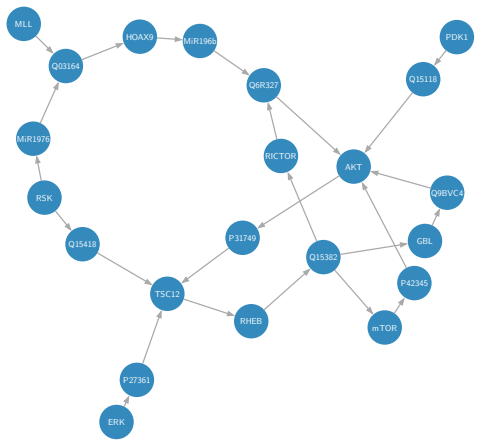
- The numerical experiments make the accuracy difference visible: among one-level partitions of the mTOR network, the worst partition is about two orders of magnitude less accurate than the best at fixed rank.
Reading between the lines
- An untested implication is that the uniform-counting assumption in Eq. (8) could be relaxed cheaply: using a short stochastic simulation or a steady-state estimate of the marginal distribution over the complementary partition would likely sharpen the entropy ranking for regimes where the distribution is far from uniform.
- The entropy score could be folded back into the graph weights before running Kernighan-Lin, as the authors note in their outlook; that would let the heuristic directly minimize information loss instead of only generating candidates that are then re-ranked.
- A practical extension would be to weight the per-rule entropies by rule probabilities for probabilistic Boolean networks, which is straightforward because the entropy is already defined per rule; the paper mentions this but does not test it.
- The rank-versus-entropy monotonicity observed in the experiments suggests a cheap model-selection tool: in parameter inference, where many network variants must be simulated, ranking partitions by $H$ may predict which models are simulable at low rank before any DLR run is attempted.
Editorial analysis
A structured set of objections, weighed in public.
Referee Report
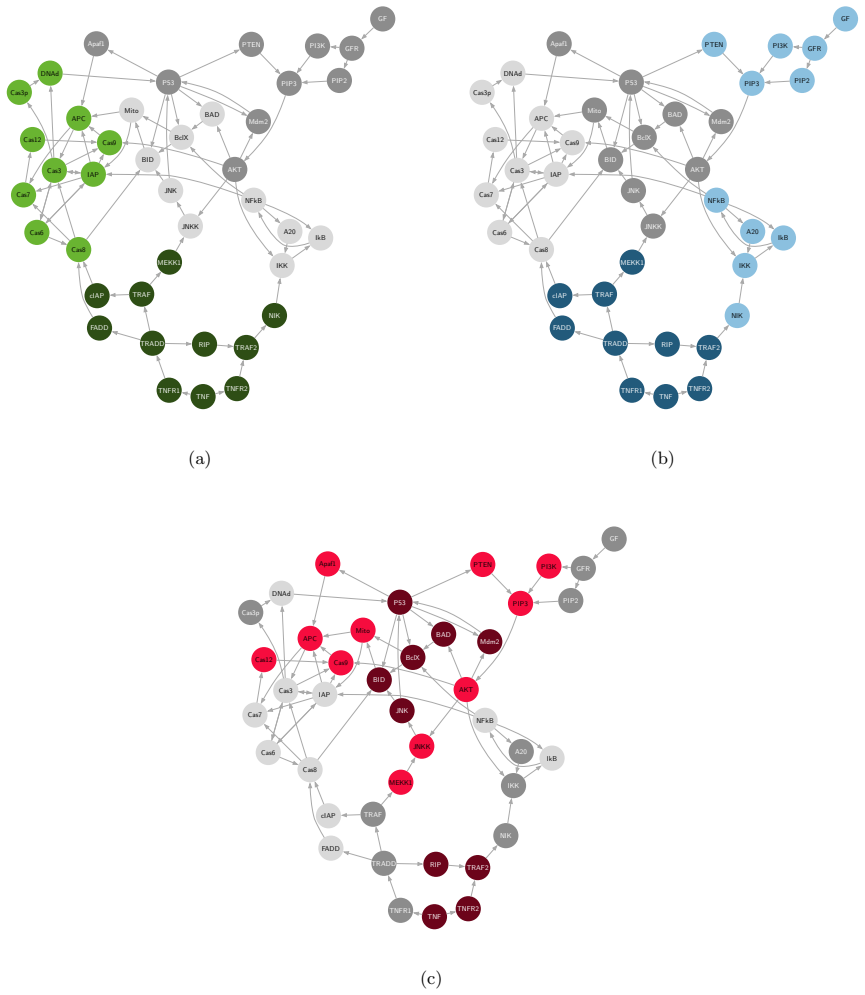
Summary. The authors propose a preprocessing heuristic for choosing the bipartition (and hierarchical tree partition) of a Boolean reaction network for dynamical low-rank (DLR) approximation of the master equation. Candidate partitions are generated by repeated Kernighan-Lin runs, and each candidate is scored by a rule-specific Shannon entropy H (Eqs. (6)-(9)) that measures information lost when a reaction pathway crosses the partition boundary; the lowest-H partition is selected. The scheme is tested on three biological models (mTOR with 22 species, pancreatic cancer with 34 species, and apoptosis with 41 species) for both one-level and hierarchical decompositions, and the authors report that the entropy-guided choice outperforms both manual literature partitions and pure cut-minimizing partitions.
Significance. If the entropy proxy is reliable, the method is a cheap and useful preprocessing step for an existing DLR simulation pipeline; the hierarchical extension appears new, and the reported preprocessing overhead is negligible (Table 3). The paper is clearly written, and the numerical experiments span a reasonable range of model sizes. However, the central proxy (uniform-distribution entropy) is not directly validated against the actual time-dependent distribution that governs the DLR rank, and the two largest benchmarks use DLR reference solutions rather than exact or independent stochastic references. The claim of superiority to human-expert partitions currently rests on a single direct comparison (one-level pancreatic cancer). While the paper does not ship code, the algorithm is straightforward enough to reproduce from the description.
major comments (4)
- [Section 4.2, Eqs. (6)-(8)] The rule-specific entropy h_i averages the binary entropy over a uniform distribution on the complementary partition states in Eq. (8). Because the DLR approximation error is governed by the actual master-equation distribution P(t,x), the uniform proxy may rank partitions incorrectly: a rule with large h_i may act only on states of negligible probability, and vice versa. The paper does not test whether the H-ordering matches the ordering induced by P(t,x). Figure 6 itself shows that the lowest-entropy partition (M11) is not the most accurate at any rank, and at r=8 two higher-entropy partitions (M4, PURPLE) beat it; the text acknowledges this in Section 5.1.1 ('a smaller entropy does not automatically yield better accuracy'). To support the central claim, please provide a direct comparison on a small exact model: for example, compute marginal probabilities from the exact solution (or from SSA samples) and show that the entropy ranking agrees with a distribution-aware importance ranking (e.g., the rank needed for a prescribed accuracy or a KL-divergence measure).
- [Sections 5.1.2 and 5.2.2, reference solutions] The reference solutions for the pancreatic cancer and apoptosis models are DLR approximations at rank 50 and 60, not solutions of the full master equation. The reported differences (3.34e-3 and 4.77e-3) between the r=50 and r=60 solutions only establish self-consistency of the DLR solver; a shared bias in the low-rank manifold could still affect the ranking of partitionings. Since the abstract claims superiority to manual and cut-minimal partitionings for these systems, at least one of the larger models should be validated against an independent reference (e.g., SSA estimates of the first moments, or the exact solution of a reduced model with similar topology).
- [Section 4.3, paragraph preceding Algorithm 1] The hierarchical entropy computation is underspecified. The sentence 'when a reaction pathway was approximated on the parent node, then it must not be considered for the computation of the entropies in the child nodes' needs a precise definition of how the Boolean rule's dependence is modified when computing Eq. (8) at child nodes (e.g., set to a constant, or excluded from the sum over species). The current Algorithm 1 does not show this step, yet the numerical values in Tables 6 and 7, and therefore the selection of 'best', depend on it.
- [Abstract and Section 6] The claim that the resulting accuracy is 'superior to both partitionings chosen by human experts and those found by simply minimizing the number of reaction pathways' is stronger than the evidence presented. The only direct comparison with a human-expert partition is the one-level pancreatic cancer case (Section 5.1.2, where 'best' beats 'literature'); in the mTOR example, manual partitions (BLUE, PURPLE, GREEN) are used to illustrate the entropy correlation, but the algorithm's single selected partition is not explicitly benchmarked against them, and Figure 6 shows cases where it would not be the most accurate. Please qualify the claim to what is demonstrated, or add the missing direct comparisons.
minor comments (5)
- [Section 6] The conclusion reads 'we proposed an heuristic algorithm'; 'an heuristic' should be 'a heuristic'.
- [Section 4.2, Eq. (8)] The notation Ω∁_i for the complementary partition is not defined in the text; please introduce it explicitly or use a simpler notation such as Ω_i^c.
- [Figure 6] The caption states 'A linear fit is shown for solutions with the same rank', but no fit parameters or R² values are reported; please include them or describe the fit as a qualitative guide only.
- [Figure 12 caption] The caption contains a duplicated word: 'for for three hierarchical partitionings' should be 'for three hierarchical partitionings'.
- [Section 5.1.1, Figure 5 discussion] The text notes that the best partition depends on the time horizon (around t=150 vs. steady state); please clarify which error measure (maximum over time, value at t=300, or steady state) is used for the entropy correlation in Figure 6, since the ranking is sensitive to this choice.
Circularity Check
No circularity: the entropy heuristic is computed from Boolean rules and partition candidates without fitted parameters, and the superiority claim is tested against exact and converged references.
full rationale
The paper's central claim is that the entropy H defined in Eqs. (6)-(9) ranks one-level and hierarchical partitions by expected information loss, and that choosing the minimal-H partition from a Kernighan-Lin pool improves DLR accuracy. This is not circular: H is a deterministic function of the Boolean rules and the partition, with no parameters fitted to DLR errors, and the ranking is not defined in terms of the error it predicts. The accuracy claim is validated empirically against independent references: an exact master-equation solution for the mTOR model, and converged rank-60 DLR references for the pancreatic cancer and apoptosis models. Baselines include cut-minimal partitions and hand-chosen partitions from the literature. Self-citations to the authors' earlier DLR integrators and to [54] for hand partitions are used as computational tools and comparison baselines, not as evidence for the entropy ranking; the heuristic itself is tested in this paper. The uniform averaging in Eq. (8) is a stated modeling assumption that could make the heuristic suboptimal if the true distribution is far from uniform, but that is a correctness risk, not a logical equivalence. The paper even reports that the lowest-entropy partition is not the most accurate for every rank (Fig. 6), which confirms the entropy is not tautologically aligned with the error. No equation identifies H with the DLR error, and no fitted quantity is renamed as a prediction. Therefore the derivation chain is self-contained and no circular step is present.
Assumptions & free parameters
assumptions (4)
- domain assumption Each species is governed by one Boolean rule and all transitions are equally likely (uniform transition probability A_i = 1 when the rule changes the state).
- domain assumption The dynamical low-rank approximation with a fixed tree structure and rank r is meaningful, and its accuracy is strongly controlled by the number and importance of cut reaction pathways.
- ad hoc to paper The information lost by cutting a pathway is quantified by the Shannon entropy of the Boolean rule output averaged over a uniform distribution of the states in the complementary partition, as in Eqs. (6)-(8).
- domain assumption The tree structure for hierarchical decompositions is fixed in advance by the user; the algorithm only assigns species to nodes of that tree.
Cite this review
Pith. "Pith review of Automatic partitioning for the low-rank integration of stochastic Boolean reaction networks." pith.science (2026). https://pith.science/paper/XALDDJ6X
@misc{pith2026250104157,
  author       = {Pith},
  title        = {Pith review of: Automatic partitioning for the low-rank integration of stochastic Boolean reaction networks},
  year         = {2026},
  howpublished = {\url{https://pith.science/paper/XALDDJ6X}},
  note         = {Machine review of arXiv:2501.04157}
}
read the original abstract
Boolean reaction networks are an important tool in biochemistry for studying mechanisms in the biological cell. However, the stochastic formulation of such networks requires the solution of a master equation which inherently suffers from the curse of dimensionality. In the past, the dynamical low-rank (DLR) approximation has been repeatedly used to solve high-dimensional reaction networks by separating the network into smaller partitions. However, the partitioning of these networks was so far only done by hand. In this paper, we present a heuristic, automatic partitioning scheme based on two ingredients: the Kernighan-Lin algorithm and information entropy. Our approach is computationally inexpensive and can be easily incorporated as a preprocessing step into the existing simulation workflow. We test our scheme by partitioning Boolean reaction networks on a single level and also in a hierarchical fashion with tree tensor networks. The resulting accuracy of the scheme is superior to both partitionings chosen by human experts and those found by simply minimizing the number of reaction pathways between partitions.
Figures


Figures from the paper (9 more)




Reference graph
Works this paper leans on
-
[1]
Scale-Free Networks: A Decade and Beyond
A.-L. Barab´ asi. “Scale-Free Networks: A Decade and Beyond”. In:Science 325.5939 (2009), pp. 412–
work page 2009
-
[2]
R. Barbuti et al. “A survey of gene regulatory networks modelling methods: from differential equations, to Boolean and qualitative bioinspired models”. In: J. Membr. Comput. 2 (2020), pp. 207–
work page 2020
-
[3]
An extended gene protein/products boolean network model including post- transcriptional regulation
A. Benso et al. “An extended gene protein/products boolean network model including post- transcriptional regulation”. In: Theor. Biol. Med. Model. 11.S5 (2014). doi: 10 . 1186 / 1742 - 4682-11-S1-S5
work page 2014
-
[4]
Mathematical Modelling of Cell-Fate Decision in Response to Death Receptor Engagement
L. Calzone et al. “Mathematical Modelling of Cell-Fate Decision in Response to Death Receptor Engagement”. In: PLOS Comput. Biol. 6.3 (2010). doi: 10.1371/journal.pcbi.1000702
-
[5]
Efficient 6D Vlasov simulation using the dynamical low-rank framework Ensign
F. Cassini and L. Einkemmer. “Efficient 6D Vlasov simulation using the dynamical low-rank framework Ensign”. In: Comput. Phys. Commun. 280 (2022). doi: 10.1016/j.cpc.2022.108489
arXiv 2022
-
[6]
Low-rank Tree Tensor Network Operators for Long-Range Pairwise Interactions
G. Ceruti, D. Kressner, and D. Sulz. “Low-rank Tree Tensor Network Operators for Long-Range Pairwise Interactions”. In: arXiv (2024). doi: 10.48550/arXiv.2405.09952
work page Pith review arXiv doi:10.48550/arxiv.2405.09952 2024
-
[7]
A parallel rank-adaptive integrator for dynamical low-rank approximation
G. Ceruti, J. Kusch, and C. Lubich. “A parallel rank-adaptive integrator for dynamical low-rank approximation”. In: SIAM J. Sci. Comput. 46.3 (2024), B205–B228. doi: 10.1137/23M1565103
-
[8]
A rank-adaptive robust integrator for dynamical low-rank approximation
G. Ceruti, J. Kusch, and C. Lubich. “A rank-adaptive robust integrator for dynamical low-rank approximation”. In: BIT Numer. Math. 62 (2022), pp. 1149–1174. doi: 10.1007/s10543- 021- 00907-7
doi:10.1007/s10543- 2022
Show all 65 references
-
[9]
An unconventional robust integrator for dynamical low-rank approxima- tion
G. Ceruti and C. Lubich. “An unconventional robust integrator for dynamical low-rank approxima- tion”. In: BIT Numer. Math. 62.1 (2022), pp. 23–44. doi: 10.1007/s10543-021-00873-0
2022 doi
-
[10]
Rank-adaptive time integration of tree tensor networks
G. Ceruti, C. Lubich, and D. Sulz. “Rank-adaptive time integration of tree tensor networks”. In: SIAM J. Numer. Anal. 61.1 (2023), pp. 194–222. doi: 10.1137/22M1473790
2023 doi
-
[11]
Time integration of tree tensor networks
G. Ceruti, C. Lubich, and H. Walach. “Time integration of tree tensor networks”. In: SIAM J. Numer. Anal. 59.1 (2021), pp. 289–313. doi: 10.1137/20M1321838
2021 doi
- [12]
-
[13]
A robust second-order low-rank BUG integrator based on the midpoint rule
G. Ceruti et al. “A robust second-order low-rank BUG integrator based on the midpoint rule”. In: BIT Numer. Math. 64.30 (2024). doi: 10.1007/s10543-024-01032-x
2024 doi
-
[14]
Efficient dynamical low-rank approximation for the Vlasov-Amp` ere-Fokker- Planck system
J. Coughlin and J. Hu. “Efficient dynamical low-rank approximation for the Vlasov-Amp` ere-Fokker- Planck system”. In: J. Comput. Phys. 470 (2022), p. 111590. doi: 10.1016/j.jcp.2022.111590
2022
-
[15]
Robust and conservative dynamical low-rank methods for the Vlasov equation via a novel macro-micro decomposition
J. Coughlin, J. Hu, and U. Shumlak. “Robust and conservative dynamical low-rank methods for the Vlasov equation via a novel macro-micro decomposition”. In: J. Comput. Phys. 509 (2024), p. 113055. doi: 10.1016/j.jcp.2024.113055. 21
2024
-
[16]
An adaptive solution to the chemical master equation using quantized tensor trains with sliding windows
T. Dinh and R. B. Sidje. “An adaptive solution to the chemical master equation using quantized tensor trains with sliding windows”. In: Phys. Biol. 17.065014 (2020). doi: 10.1088/1478-3975/aba1d2
2020 doi
-
[17]
Simultaneous state-time approximation of the chemical master equation using tensor product formats
S. Dolgov and B. Khoromskij. “Simultaneous state-time approximation of the chemical master equation using tensor product formats”. In: Numer. Linear Algebra Appl. 22 (2015), pp. 197–219. doi: 10.1002/nla.1942
2015 doi
-
[18]
Accelerating the simulation of kinetic shear Alfv´ en waves with a dynamical low-rank approximation
L. Einkemmer. “Accelerating the simulation of kinetic shear Alfv´ en waves with a dynamical low-rank approximation”. In: J. Comput. Phys. 501.112757 (2024). doi: 10.1016/j.jcp.2024.112757
2024
-
[19]
Asymptotic–preserving and energy stable dynamical low-rank approximation
L. Einkemmer, J. Hu, and J. Kusch. “Asymptotic–preserving and energy stable dynamical low-rank approximation”. In: SIAM J. Numer. Anal. 62.1 (2024), pp. 73–92. doi: 10.1137/23M1547603
2024 doi
-
[20]
An asymptotic-preserving dynamical low-rank method for the multi-scale multi-dimensional linear transport equation
L. Einkemmer, J. Hu, and Y. Wang. “An asymptotic-preserving dynamical low-rank method for the multi-scale multi-dimensional linear transport equation”. In: J. Comput. Phys. 439.110353 (2021), p. 110353. doi: 10.1016/j.jcp.2021.110353
2021
-
[21]
An Efficient Dynamical Low-Rank Algorithm for the Boltzmann- BGK Equation Close to the Compressible Viscous Flow Regime
L. Einkemmer, J. Hu, and L. Ying. “An Efficient Dynamical Low-Rank Algorithm for the Boltzmann- BGK Equation Close to the Compressible Viscous Flow Regime”. In: SIAM J. Sci. Comput. 43.5 (2021), B1057–B1080. doi: 10.1137/21m1392772
2021 doi
-
[22]
A mass, momentum, and energy conservative dynamical low-rank scheme for the Vlasov equation
L. Einkemmer and I. Joseph. “A mass, momentum, and energy conservative dynamical low-rank scheme for the Vlasov equation”. In: J. Comput. Phys. 443 (2021), p. 110495. doi: 10.1016/j.jcp. 2021.110495
2021
-
[23]
A Low-Rank Projector-Splitting Integrator for the Vlasov-Poisson Equation
L. Einkemmer and C. Lubich. “A Low-Rank Projector-Splitting Integrator for the Vlasov-Poisson Equation”. In: SIAM J. Sci. Comput. 40.5 (2018), B1330–B1360. doi: 10.1137/18M116383X
2018 doi
-
[24]
A hierarchical dynamical low-rank algorithm for the stochastic description of large reaction networks
L. Einkemmer, J. Mangott, and M. Prugger. “A hierarchical dynamical low-rank algorithm for the stochastic description of large reaction networks”. In: arXiv (2024). doi: 10.48550/arXiv.2407. 11792
2024 doi
-
[25]
A low-rank complexity reduction algorithm for the high-dimensional kinetic chemical master equation
L. Einkemmer, J. Mangott, and M. Prugger. “A low-rank complexity reduction algorithm for the high-dimensional kinetic chemical master equation”. In: J. Comput. Phys. 503.112827 (2024). doi: 10.1016/j.jcp.2024.112827
2024
-
[26]
A low-rank projector-splitting integrator for the Vlasov–Maxwell equations with divergence correction
L. Einkemmer, A. Ostermann, and C. Piazzola. “A low-rank projector-splitting integrator for the Vlasov–Maxwell equations with divergence correction”. In: J. Comput. Phys. 403 (2020), p. 109063
2020
-
[27]
A robust and conservative dynamical low-rank algorithm
L. Einkemmer, A. Ostermann, and C. Scalone. “A robust and conservative dynamical low-rank algorithm”. In: J. Comput. Phys. 484 (2023), p. 112060. doi: 10.1016/j.jcp.2023.112060
2023
-
[28]
Graphviz – Open Source Graph Drawing Tools
J. Ellson et al. “ Graphviz – Open Source Graph Drawing Tools”. In: Graph Drawing (GD 2001) . Ed. by P. Mutzel, M. J¨ unger, and S. Leipert. LNCS 2265. Springer, 2001, pp. 483–484
2001
-
[29]
Erban and S
R. Erban and S. J. Chapman. Stochastic Modelling of Reaction–Diffusion Processes . Cambridge University Press, 2020. doi: 10.1017/9781108628389
2020 doi
-
[30]
Gardiner
C. Gardiner. Handbook of Stochastic Methods . Springer Berlin, Heidelberg, 2004
2004
-
[31]
A general method for numerically simulating the stochastic time evolution of coupled chemical reactions
D. T. Gillespie. “A general method for numerically simulating the stochastic time evolution of coupled chemical reactions”. In: J. Comput. Phys. 22.4 (1976), pp. 403–434. doi: 10.1016/0021- 9991(76)90041-3
1976 doi
-
[32]
Exact stochastic simulation of coupled chemical reactions
D. T. Gillespie. “Exact stochastic simulation of coupled chemical reactions”. In: J. Chem. Phys. 81.25 (1977), pp. 2340–2361. doi: 10.1021/j100540a008
1977 doi
-
[33]
Symbolic Model Checking of Signaling Pathways in Pancreatic Cancer
H. Gong et al. “Symbolic Model Checking of Signaling Pathways in Pancreatic Cancer”. In: Pro- ceedings of the ISCA 3rd International Conference on Bioinformatics and Computational Biology 2011 (BICoB-2011) . Ed. by H. Al-Mubaid. ISCA, 2011, pp. 245–250
2011
-
[34]
Integrative Modelling of the Influence of MAPK Network on Cancer Cell Fate Decision
L. Grieco et al. “Integrative Modelling of the Influence of MAPK Network on Cancer Cell Fate Decision”. In: PLOS Comput. Biol. 9.10 (2013). doi: 10.1371/journal.pcbi.1003286
2013 doi
-
[35]
Exploring network structure, dynamics, and function using NetworkX
A. A. Hagberg, D. A. Schult, and P. J. Swart. “Exploring network structure, dynamics, and function using NetworkX”. In: Proceedings of the 7th Python in Science Conference (SciPy2008) . Ed. by G. Varoquaux, T. Vaught, and J. Millman. 2008, pp. 11–15. doi: 10.25080/TCWV9851
2008 doi
-
[36]
On the numerical solution of the chemical master equation with sums of rank one tensors
M. Hegland and J. Garcke. “On the numerical solution of the chemical master equation with sums of rank one tensors”. In: ANZIAM J. 52 (2011), pp. C628–C643. doi: 10.21914/anziamj.v52i0.3895
2011 doi
-
[37]
Tensor-train approximation of the chemical master equation and its application for parameter inference
I. G. Ion et al. “Tensor-train approximation of the chemical master equation and its application for parameter inference”. In: J. Chem. Phys. 155.034102 (2021). doi: 10.1063/5.0045521
2021 doi
-
[38]
A Dynamical Low-Rank Approach to the Chemical Master Equation
T. Jahnke and W. Huisinga. “A Dynamical Low-Rank Approach to the Chemical Master Equation”. In: Bull. Math. Biol. 70 (2008), pp. 2283–2302. doi: 10.1007/s11538-008-9346-x . 22
2008 doi
-
[39]
Metabolic Stability and Epigenesis in Randomly Constructed Genetic Nets
S. A. Kauffman. “Metabolic Stability and Epigenesis in Randomly Constructed Genetic Nets”. In: J. Theoret. Biol. 22 (1969), pp. 437–467. doi: 10.1016/0022-5193(69)90015-0
1969 doi
-
[40]
Tensor approximation of stationary distributions of chemical reaction networks
V. Kazeev and C. Schwab. “Tensor approximation of stationary distributions of chemical reaction networks”. In: SIAM J. Matrix Anal. Appl. 36.3 (2015), pp. 1221–1247. doi: 10.1137/130927218
2015 doi
-
[41]
Direct Solution of the Chemical Master Equation Using Quantized Tensor Trains
V. Kazeev et al. “Direct Solution of the Chemical Master Equation Using Quantized Tensor Trains”. In: PLOS Comput. Biol. 10.3 (2014). doi: 10.1371/journal.pcbi.1003359
2014 doi
-
[42]
An efficient heuristic procedure for partitioning graphs
B. W. Kernighan and S. Lin. “An efficient heuristic procedure for partitioning graphs”. In: Bell Labs Tech. J. 49.2 (1970), pp. 291–307. doi: 10.1002/j.1538-7305.1970.tb01770.x
1970
-
[43]
Dynamical Low-Rank Approximation
O. Koch and C. Lubich. “Dynamical Low-Rank Approximation”. In: SIAM J. Matrix Anal. Appl. 29.2 (2007), pp. 434–454. doi: 10.1137/050639703
2007 doi
- [44]
-
[45]
A robust collision source method for rank adaptive dynamical low-rank approximation in radiation therapy
J. Kusch and P. Stammer. “A robust collision source method for rank adaptive dynamical low-rank approximation in radiation therapy”. In: ESAIM: Math. Model. Numer. Anal. 57.2 (2023), pp. 865–
2023
-
[46]
A low-rank power iteration scheme for neutron transport critically problems
J. Kusch et al. “A low-rank power iteration scheme for neutron transport critically problems”. In: J. Comput. Phys. 470.111587 (2022). doi: 10.1016/j.jcp.2022.111587
2022
-
[47]
Quantitative and logic modelling of molecular and gene networks
N. Le Nov` ere. “Quantitative and logic modelling of molecular and gene networks”. In: Nat. Rev. Genet. 16 (2015), pp. 146–158. doi: 10.1038/nrg3885
2015 doi
-
[48]
A projector-splitting integrator for dynamical low-rank approxima- tion
C. Lubich and I. V. Oseledets. “A projector-splitting integrator for dynamical low-rank approxima- tion”. In: BIT Numer. Math. 54.1 (2014), pp. 171–188. doi: 10.1007/s10543-013-0454-0
2014 doi
-
[49]
Time Integration of Rank-Constrained Tucker Tensors
C. Lubich, B. Vandereycken, and H. Walach. “Time Integration of Rank-Constrained Tucker Tensors”. In: SIAM J. Numer. Anal. 56.3 (2018), pp. 1273–1290. doi: 10.1137/17M1146889
2018 doi
-
[50]
Boolean network-based analysis of the apoptosis network: Irreversible apoptosis and stable surviving
Z. Mai and H. Liu. “Boolean network-based analysis of the apoptosis network: Irreversible apoptosis and stable surviving”. In: J. Theor. Biol. 259 (2009), pp. 760–769. doi: 10.1016/j.jtbi.2009.04. 024
2009 doi
-
[51]
Quantifying Rare Events in Stochastic Reaction-Diffusion Dynamics Using Tensor Networks
S. B. Nicholson and T. R. Gingrich. “Quantifying Rare Events in Stochastic Reaction-Diffusion Dynamics Using Tensor Networks”. In: Phys. Rev. X 13.041006 (2023). doi: 10.1103/PhysRevX. 13.041006
2023 doi
-
[52]
A high-order/low-order (HOLO) algorithm for preserving conservation in time-dependent low-rank transport calculations
Z. Peng and R. McClarren. “A high-order/low-order (HOLO) algorithm for preserving conservation in time-dependent low-rank transport calculations”. In: J. Comput. Phys. 447.110672 (2021). doi: 10.1016/j.jcp.2021.110672
2021
-
[53]
A low-rank method for two-dimensional time-dependent radiation transport calculations
Z. Peng, R. McClarren, and M. Frank. “A low-rank method for two-dimensional time-dependent radiation transport calculations”. In: J. Comput. Phys. 421.109735 (2020). doi: 10.1016/j.jcp. 2020.109735
2020
-
[54]
A dynamical low-rank approach to solve the chemical master equation for biological reaction networks
M. Prugger, L. Einkemmer, and C. F. Lopez. “A dynamical low-rank approach to solve the chemical master equation for biological reaction networks”. In: J. Comput. Phys. 489 (2023). doi: 10.1016/j.jcp.2023.112250
2023
-
[55]
Unsupervised logic-based mechanism inference for network-driven biological processes
M. Prugger et al. “Unsupervised logic-based mechanism inference for network-driven biological processes”. In: PLOS Comput. Biol. 17.6 (2021). doi: 10.1371/journal.pcbi.1009035
2021 doi
-
[56]
A Mathematical Theory of Communication
C. E. Shannon. “A Mathematical Theory of Communication”. In: Bell Syst. Tech. J. 27.3 (1948), pp. 379–423. doi: 10.1002/j.1538-7305.1948.tb01338.x
1948
-
[57]
Probabilistic Boolean networks: a rule-based uncertainty model for gene regulatory networks
I. Shmulevich et al. “Probabilistic Boolean networks: a rule-based uncertainty model for gene regulatory networks”. In: Bioinformatics 18.2 (2002), pp. 261–274. doi: 10.1093/bioinformatics/ 18.2.261
2002 doi
-
[58]
Numerical simulation of long-range open quantum many-body dynamics with tree tensor networks
D. Sulz et al. “Numerical simulation of long-range open quantum many-body dynamics with tree tensor networks”. In: Phys. Rev. A 109.022420 (2024). doi: 10.1103/PhysRevA.109.022420
2024 doi
-
[59]
Boolean formalization of genetic control circuits
R. Thomas. “Boolean formalization of genetic control circuits”. In: J. Theor. Biol. 42.3 (1973), pp. 563–585. doi: 10.1016/0022-5193(73)90247-6
1973 doi
-
[60]
Regulatory Networks Seen as Asynchronous Automata: A Logical Description
R. Thomas. “Regulatory Networks Seen as Asynchronous Automata: A Logical Description”. In: J. Theor. Biol. 153.1 (1991), pp. 1–23. doi: 10.1016/S0022-5193(05)80350-9
1991 doi
-
[61]
N. G. Van Kampen. Stochastic Processes in Physics and Chemistry . North Holland, 2007. doi: 10.1016/B978-0-444-52965-7.X5000-4 . 23
2007 doi
-
[62]
Boolean modeling in systems biology: an overview of methodology and applications
R.-S. Wang, A. Saadatpour, and R. Albert. “Boolean modeling in systems biology: an overview of methodology and applications”. In: Phys. Biol. 9.055001 (2012). doi: 10.1088/1478-3975/9/5/ 055001. 24
2012 doi
-
[226]
doi: 10.1007/s41965-020-00046-y
-
[413]
doi: 10.1126/science.1173299
-
[891]
doi: 10.1051/m2an/2022090
Reviewed August 10, 2026 · model on record in the stance chip above.
Discussion (0). Continue with ORCID to comment.